OCR · GCSE · Further Mathematics
Error Intervals
Error Intervals is a critical topic in OCR GCSE Further Mathematics that examines how candidates apply inequality notation to continuous data with precision. This topic underpins high-level 'Bounds' questions and requires rigorous understanding of the distinction between rounding and truncation. Mastering error intervals is essential for earning reliable marks in both Foundation and Higher tier papers.
- 10 min read
- 5 worked examples
- 6 practice questions
- 9 key terms
Study Notes

Overview
Error Intervals represent one of the most mark-efficient topics in OCR GCSE Further Mathematics. When a measurement or calculation is rounded or truncated, the original value could have been any number within a specific range—this range is the error interval. Understanding error intervals is fundamental to working with bounds in algebraic contexts, calculating maximum and minimum values in compound measures such as speed and density, and demonstrating numerical precision in examinations. OCR examiners award marks for correctly identifying lower and upper bounds, applying the appropriate inequality notation (≤ for lower bounds, < for upper bounds), and distinguishing between rounding and truncation. Typical exam questions include finding error intervals for rounded or truncated values, determining bounds for calculations involving multiple measurements, and applying bounds to real-world contexts such as perimeter, area, and speed. This topic connects directly to significant figures, decimal places, standard form, and algebraic manipulation—all of which are assessed synoptically in Further Mathematics papers.
Key Concepts
Concept 1: Understanding Error Intervals and Bounds
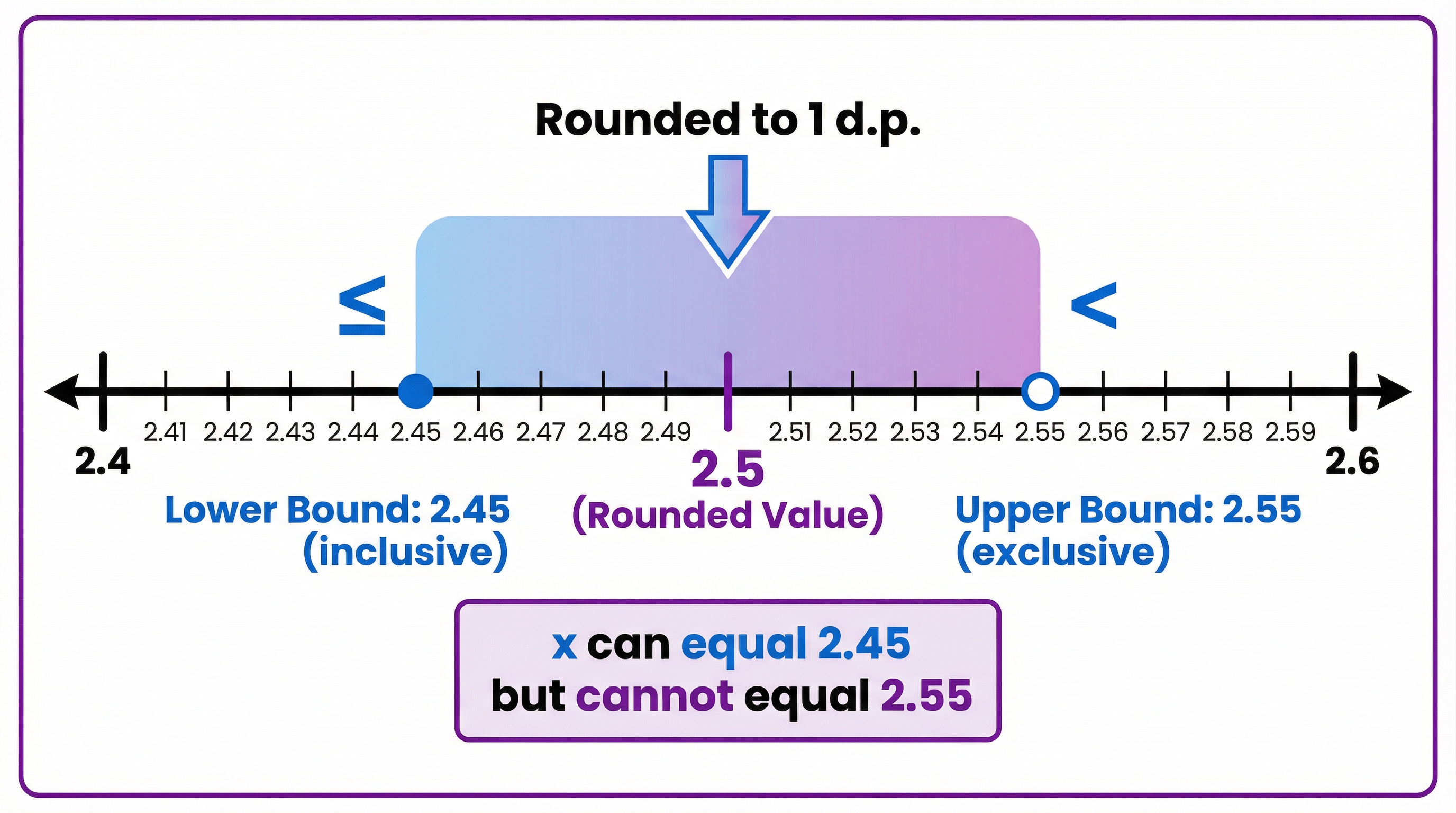
An error interval defines the range of possible values that a number could have been before it was rounded or truncated. When we record a measurement as 5.7 cm (to 1 decimal place), we acknowledge that the actual measurement could have been anywhere from 5.65 cm up to, but not including, 5.75 cm. The lower bound is the smallest value that would round to the given number, and the upper bound is the smallest value that would round to the next number up. Crucially, the lower bound is inclusive (the value can equal the lower bound), while the upper bound is exclusive (the value cannot equal the upper bound, as that would round to a different number). This distinction is represented using inequality notation: for 5.7 rounded to 1 d.p., we write 5.65 ≤ x < 5.75. The symbol ≤ means 'less than or equal to', while < means 'strictly less than'. Examiners award one mark for the correct lower bound, one mark for the correct upper bound, and one mark for the correct inequality notation—so precision in notation is as important as precision in calculation.
Example: A length is recorded as 12.4 m to 1 decimal place. The lower bound is 12.35 m (the smallest value that rounds up to 12.4), and the upper bound is 12.45 m (the smallest value that rounds up to 12.5). The error interval is 12.35 ≤ x < 12.45.

Concept 2: Rounding vs Truncation—A Critical Distinction
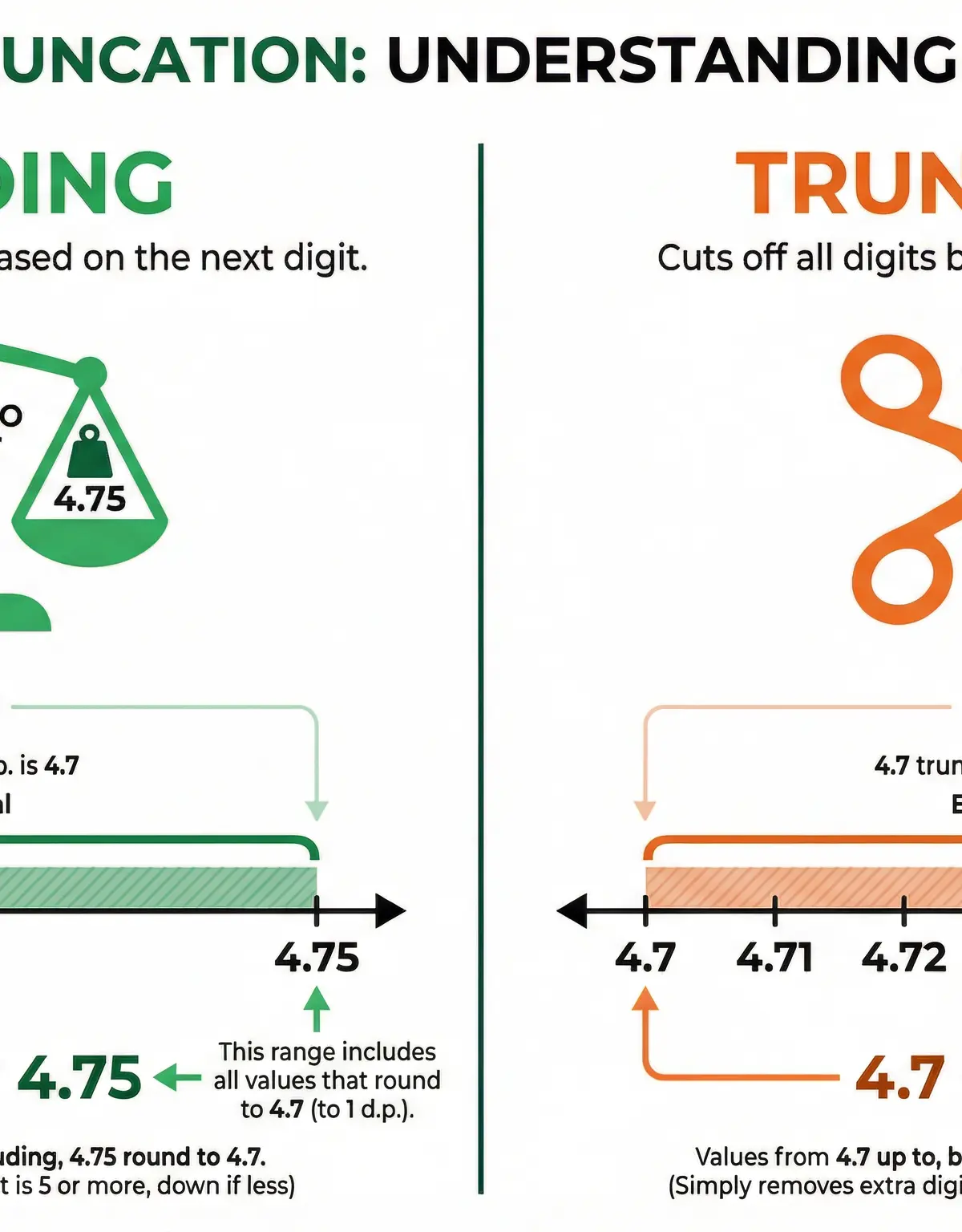
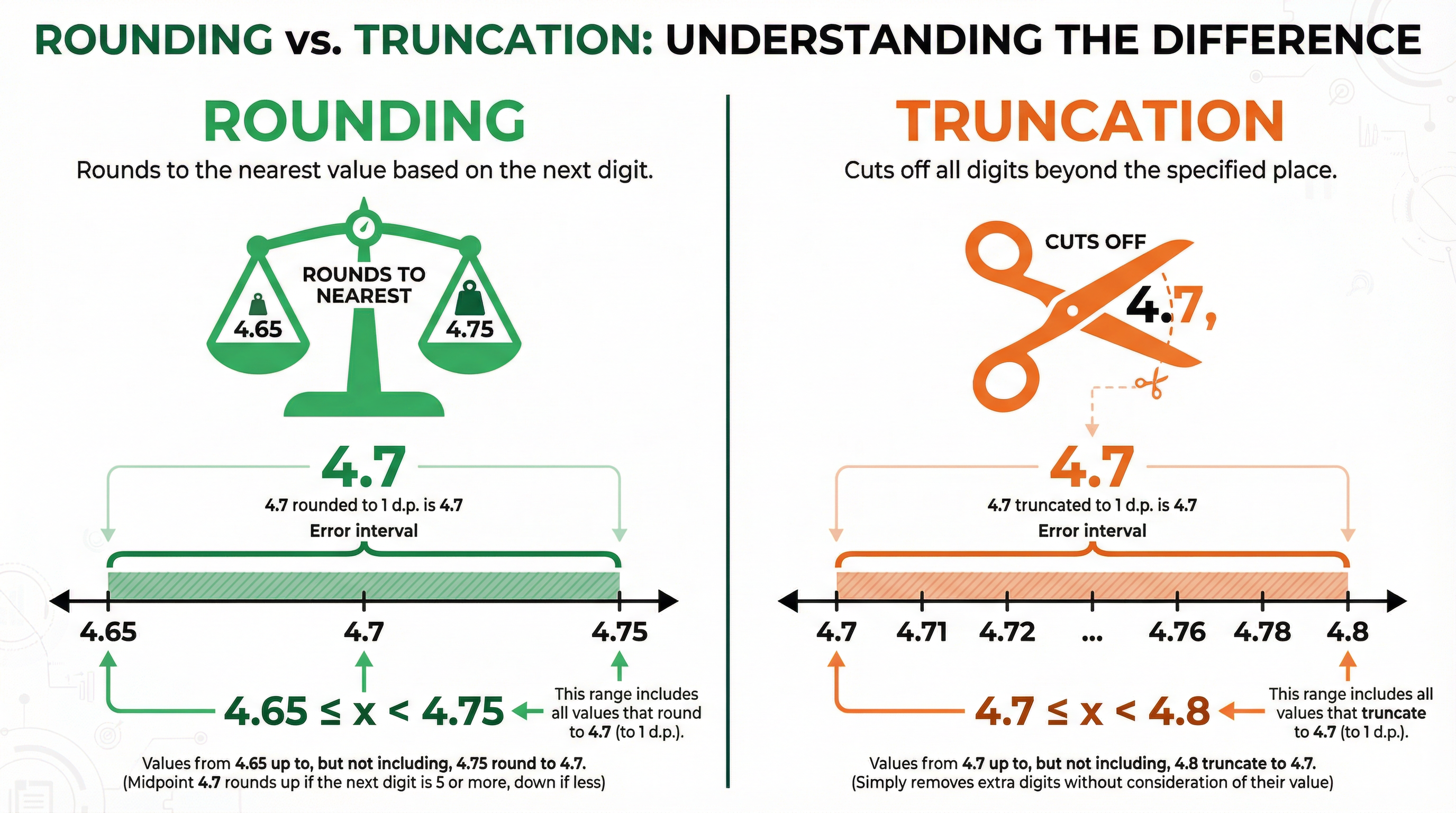
Candidates frequently lose marks by confusing rounding with truncation. These are fundamentally different processes that produce different error intervals. Rounding involves looking at the next digit and deciding whether to round up or down based on whether that digit is 5 or greater. Truncation, by contrast, simply removes all digits beyond a certain point without any consideration of their value—it 'cuts off' the number. For a value of 4.7 rounded to 1 d.p., the error interval is 4.65 ≤ x < 4.75, because any value from 4.65 upwards would round to 4.7, and any value from 4.75 upwards would round to 4.8. However, for 4.7 truncated to 1 d.p., the error interval is 4.7 ≤ x < 4.8, because truncation does not consider rounding—the original value must have been at least 4.7 (anything smaller would truncate to a smaller number), and less than 4.8 (which would truncate to 4.8, not 4.7). The key rule: for truncation, the lower bound is always the face value itself, not half a unit below.
Example: A calculator display shows 8.3, truncated to 1 decimal place. The error interval is 8.3 ≤ x < 8.4. If the same display showed 8.3 rounded to 1 d.p., the error interval would be 8.25 ≤ x < 8.35.
Concept 3: Error Intervals for Significant Figures
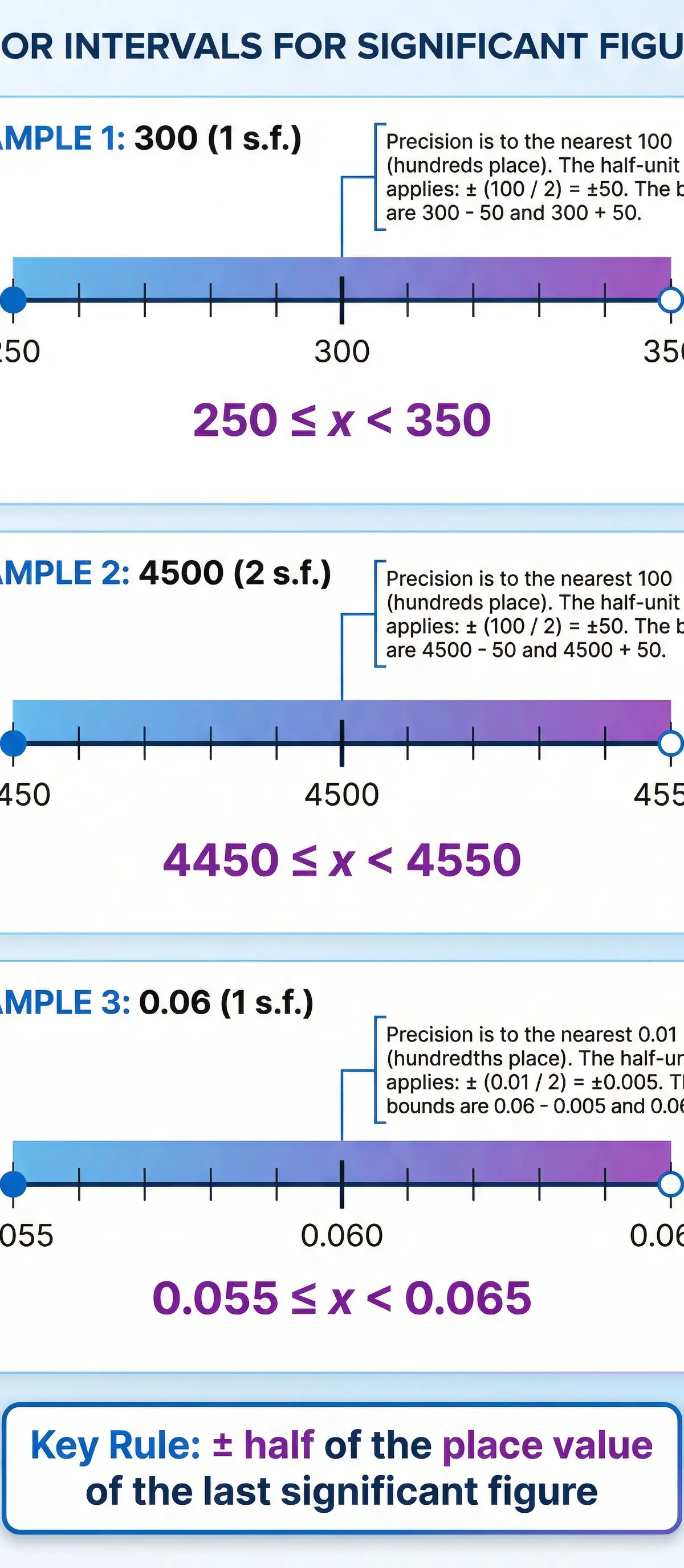
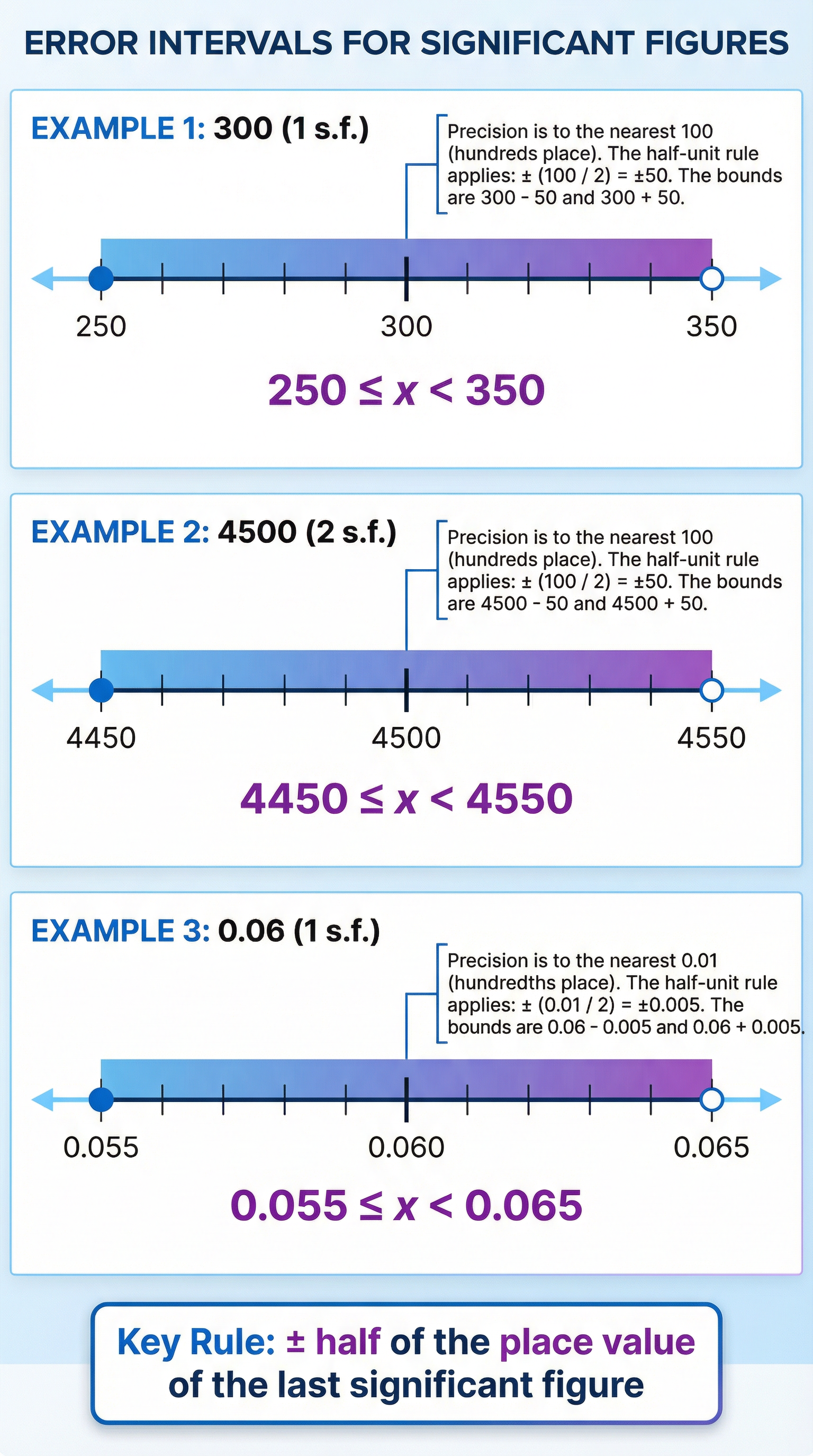
When a number is given to a certain number of significant figures, the error interval can be much wider than for decimal places, especially for large numbers. The principle remains the same: identify the place value of the last significant figure, then apply the half-unit rule—the error is ± half of that place value. For example, if a number is given as 300 to 1 significant figure, the last significant figure is in the hundreds place. Half of 100 is 50, so the bounds are 300 − 50 = 250 and 300 + 50 = 350. The error interval is 250 ≤ x < 350. Notice how wide this interval is—any value from 250 up to (but not including) 350 would round to 300 when rounded to 1 s.f. For 4500 to 2 significant figures, the last significant figure is in the hundreds place, so the half-unit is 50, giving bounds of 4450 ≤ x < 4550. Candidates often make the mistake of using ±5 or ±50 without considering the actual place value, leading to incorrect bounds such as 295–305 for 300 (1 s.f.), which would be the bounds for 300 to the nearest 10, not to 1 s.f.
Example: A population is given as 0.06 million to 1 significant figure. The last significant figure is in the hundredths place (0.01), so the half-unit is 0.005. The error interval is 0.055 ≤ x < 0.065 million.
Concept 4: Applying Bounds to Calculations
When performing calculations with rounded or truncated values, candidates must determine the maximum and minimum possible results. The rules depend on the operation. For addition, the maximum result comes from adding the upper bounds, and the minimum from adding the lower bounds. For subtraction, the maximum comes from subtracting the minimum from the maximum, and the minimum from subtracting the maximum from the minimum. For multiplication, maximum is upper bound × upper bound, minimum is lower bound × lower bound. For division, maximum is upper bound ÷ lower bound, minimum is lower bound ÷ upper bound. A common exam question involves calculating speed = distance ÷ time. If distance d = 50 m (to nearest 10 m) and time t = 8 s (to nearest second), then d has bounds 45 ≤ d < 55 and t has bounds 7.5 ≤ t < 8.5. Maximum speed = 55 ÷ 7.5 = 7.33... m/s, minimum speed = 45 ÷ 8.5 = 5.29... m/s. Examiners credit candidates who show clear working for each bound before substituting into the formula.
Example: A rectangle has length 12.4 cm and width 8.3 cm, both measured to 1 d.p. Find the maximum possible area. Length bounds: 12.35 ≤ L < 12.45. Width bounds: 8.25 ≤ W < 8.35. Maximum area = 12.45 × 8.35 = 103.9575 cm². (Note: use upper bounds for both dimensions to maximise the product.)
Mathematical Relationships
Error Interval Notation
For a value x rounded or truncated to a given precision:
Lower Bound ≤ x < Upper Bound
- Lower Bound (LB): The smallest value that would round/truncate to the given value
- Upper Bound (UB): The smallest value that would round/truncate to the next value up
- ≤: 'Less than or equal to' (inclusive)—used for the lower bound
- <: 'Strictly less than' (exclusive)—used for the upper bound
Finding Bounds for Decimal Places
If a number n is rounded to d decimal places:
- LB = n − 0.5 × 10^(−d)
- **UB = n + 0.5 × 10^(−d)**Example: For 7.3 rounded to 1 d.p., LB = 7.3 − 0.05 = 7.25, UB = 7.3 + 0.05 = 7.35.
Finding Bounds for Significant Figures
If a number n is rounded to s significant figures:
- Identify the place value of the last significant figure
- Calculate half of that place value
- LB = n − (half of place value), UB = n + (half of place value)
Example: For 300 (1 s.f.), place value = 100, half = 50. LB = 250, UB = 350.
Bounds for Calculations
| Operation | Maximum Result | Minimum Result |
|---|---|---|
| Addition (a + b) | UB(a) + UB(b) | LB(a) + LB(b) |
| Subtraction (a − b) | UB(a) − LB(b) | LB(a) − UB(b) |
| Multiplication (a × b) | UB(a) × UB(b) | LB(a) × LB(b) |
| Division (a ÷ b) | UB(a) ÷ LB(b) | LB(a) ÷ UB(b) |
Note: These rules assume positive values. For negative values or mixed signs, candidates must consider which combinations produce maximum and minimum results.
Truncation Bounds
If a number n is truncated to d decimal places:
- LB = n (the face value itself)
- UB = n + 10^(−d) (one unit of the last decimal place)
Example: For 3.4 truncated to 1 d.p., LB = 3.4, UB = 3.5.
Practical Applications
Error intervals are not merely abstract mathematical concepts—they have real-world significance in science, engineering, and everyday measurements. When a scientist records a temperature as 23.5°C (to 1 d.p.), they acknowledge that the true temperature lies within the interval 23.45 ≤ T < 23.55°C. This precision is critical in experiments where small variations can affect results. In construction, measurements are often given to the nearest centimetre or millimetre, and understanding bounds ensures that components fit together correctly—a door frame measured as 2.0 m (to nearest 10 cm) could actually be anywhere from 1.95 m to 2.05 m, which is a 10 cm range that could affect whether a door fits. In manufacturing, tolerances (acceptable ranges of variation) are essentially error intervals, ensuring that parts are produced within acceptable limits. Speed cameras measure speed to a certain precision, and understanding bounds is important in legal contexts—if a speed is recorded as 35 mph (to nearest mph), the true speed could be as low as 34.5 mph, which might be below a 35 mph limit. In data analysis, rounding large numbers to significant figures (e.g., reporting a population as 52,000 to 2 s.f.) introduces potential errors of ±500, which must be acknowledged when making comparisons or predictions.
Worked Examples
The following worked examples demonstrate the step-by-step approach that earns full marks in OCR examinations, with examiner commentary highlighting key mark-earning points.
Visual Resources
3 diagrams and illustrations
Interactive Diagrams
2 interactive diagrams to visualise key concepts
Conceptual Flow Outline
Decision flowchart for finding error intervals, showing the critical distinction between rounding and truncation and the correct inequality notation.
Conceptual Flow Outline
Process for calculating error intervals for both decimal places and significant figures, using the half-unit rule.
Worked Examples
5 worked examples — open one to explore the question and available guidance.
Practice Questions
Test your understanding — click to reveal model answers
A mass is given as 3.6 kg, correct to 1 decimal place. Write down the error interval for this mass.
Hint: Remember to use ≤ for the lower bound and < for the upper bound.
A number is truncated to 1 decimal place and the result is 7.2. Write down the error interval for the original number.
Hint: Truncation means the lower bound is the face value itself, not half a unit below.
A distance is given as 8400 m, correct to 2 significant figures. Calculate the lower and upper bounds of this distance.
Hint: Identify the place value of the last significant figure (the 4 is in the hundreds place), then apply the half-unit rule.
A rectangle has length 9.4 cm and width 6.2 cm, both measured to 1 decimal place. Calculate the maximum possible perimeter of the rectangle.
Hint: Perimeter = 2(length + width). To maximise the perimeter, use the upper bounds for both length and width.
A car travels 240 m (to the nearest 10 m) in 15 seconds (to the nearest second). Calculate the minimum possible speed of the car in m/s. Give your answer to 2 decimal places.
Hint: Speed = distance ÷ time. For minimum speed, use minimum distance and maximum time.
A length is measured as 0.057 m, correct to 2 significant figures. Determine whether the actual length could be 0.0563 m. You must show your working.
Hint: Calculate the error interval for 0.057 (to 2 s.f.), then check whether 0.0563 lies within that interval.
Test your understanding of Error Intervals
Active recall beats re-reading. Take an instant quiz now to test what you’ve learned and lock it into long-term memory.
7 days Premium · Then free forever · No card, no charge