OCR · GCSE · Further Mathematics
Iteration
Iteration is a powerful numerical method that allows you to find approximate solutions to equations that cannot be solved algebraically. By repeatedly applying an iterative formula of the form x_{n+1} = g(x_n), you systematically converge on roots to a specified degree of accuracy. This topic is essential for OCR GCSE Further Mathematics and typically appears as structured 4-6 mark questions testing both algebraic manipulation and precise calculator technique.
- 8 min read
- 3 worked examples
- 5 practice questions
- 8 key terms
Study Notes
Overview
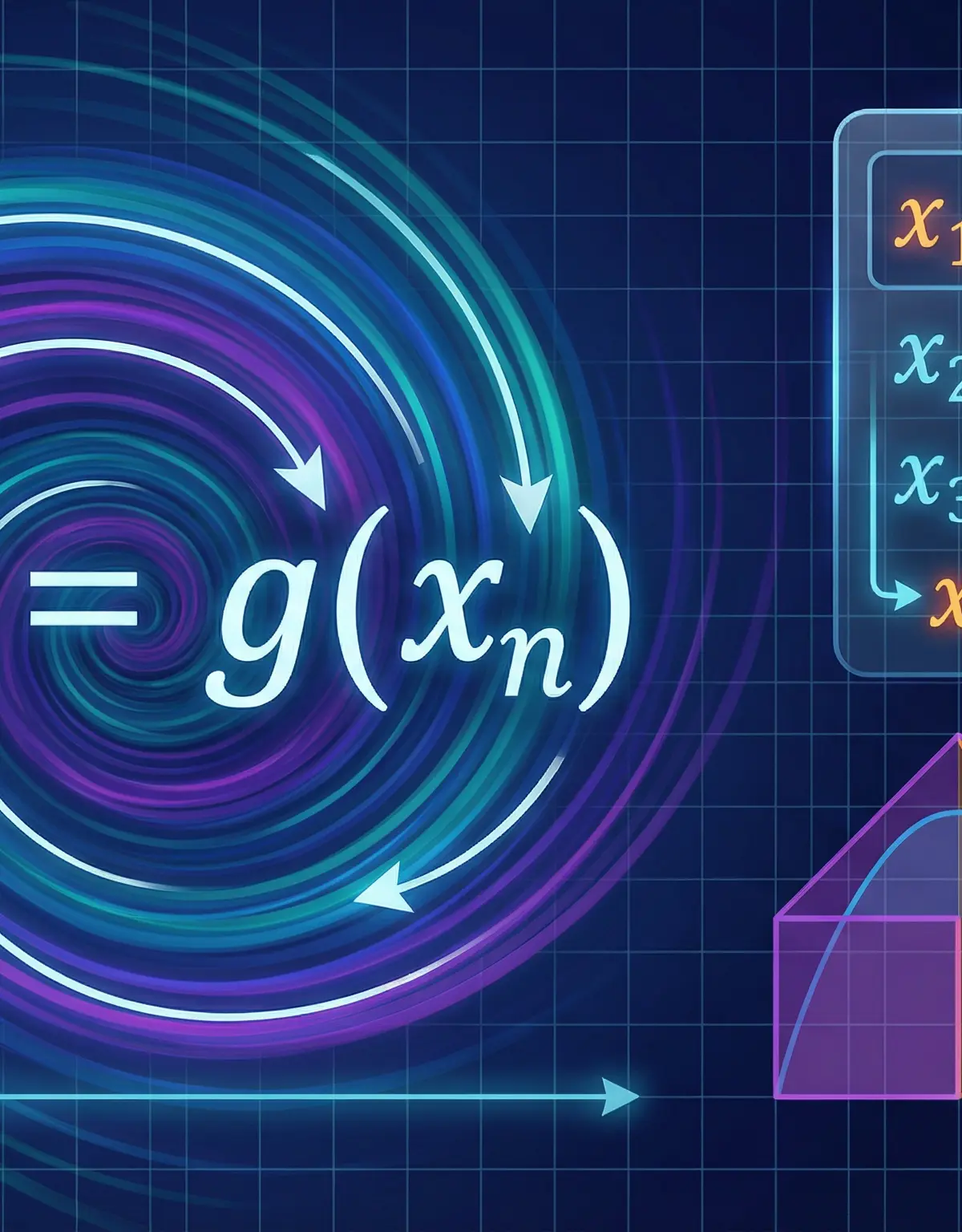
Iteration represents one of the most elegant and practical numerical methods in GCSE Further Mathematics. When faced with equations such as x³ - x - 1 = 0 that resist traditional algebraic techniques like factorisation or the quadratic formula, iteration provides a systematic pathway to approximate solutions with remarkable precision. The method transforms an equation f(x) = 0 into an iterative formula x_{n+1} = g(x_n), which when applied repeatedly from a starting value x₀, generates a sequence of values that converge toward the true root. OCR assesses this topic rigorously, expecting candidates to demonstrate both algebraic fluency in deriving iterative formulas and technical precision in executing calculations using the 'Ans' function on scientific calculators. Iteration questions typically appear as 4-6 mark structured problems, often bridging algebraic manipulation with graphical interpretation. The topic connects deeply with functions, graphs, and solving equations across the specification, making it a synoptic skill that rewards methodical working and attention to detail. Understanding iteration not only secures valuable exam marks but also provides insight into how computers and calculators solve complex equations behind the scenes.
Key Concepts
Concept 1: The Iterative Formula x_{n+1} = g(x_n)
The foundation of iteration lies in transforming an equation from the form f(x) = 0 into an iterative formula x_{n+1} = g(x_n). This transformation requires algebraic manipulation to isolate x on one side of the equation. The subscript notation is crucial: x_n represents the current value in the sequence, while x_{n+1} represents the next value. Think of this as a function machine where you input one value and receive the next approximation as output. The beauty of this approach is that it converts a static equation into a dynamic process. For example, if we start with x³ = x + 1, we can rearrange to x = ∛(x + 1), giving us the iterative formula x_{n+1} = ∛(x_n + 1). This formula becomes our recipe for generating successive approximations.
Example: Given x² - 3x - 5 = 0, rearrange to x² = 3x + 5, then x = √(3x + 5). The iterative formula is x_{n+1} = √(3x_n + 5).
Concept 2: Convergence and the Starting Value x₀
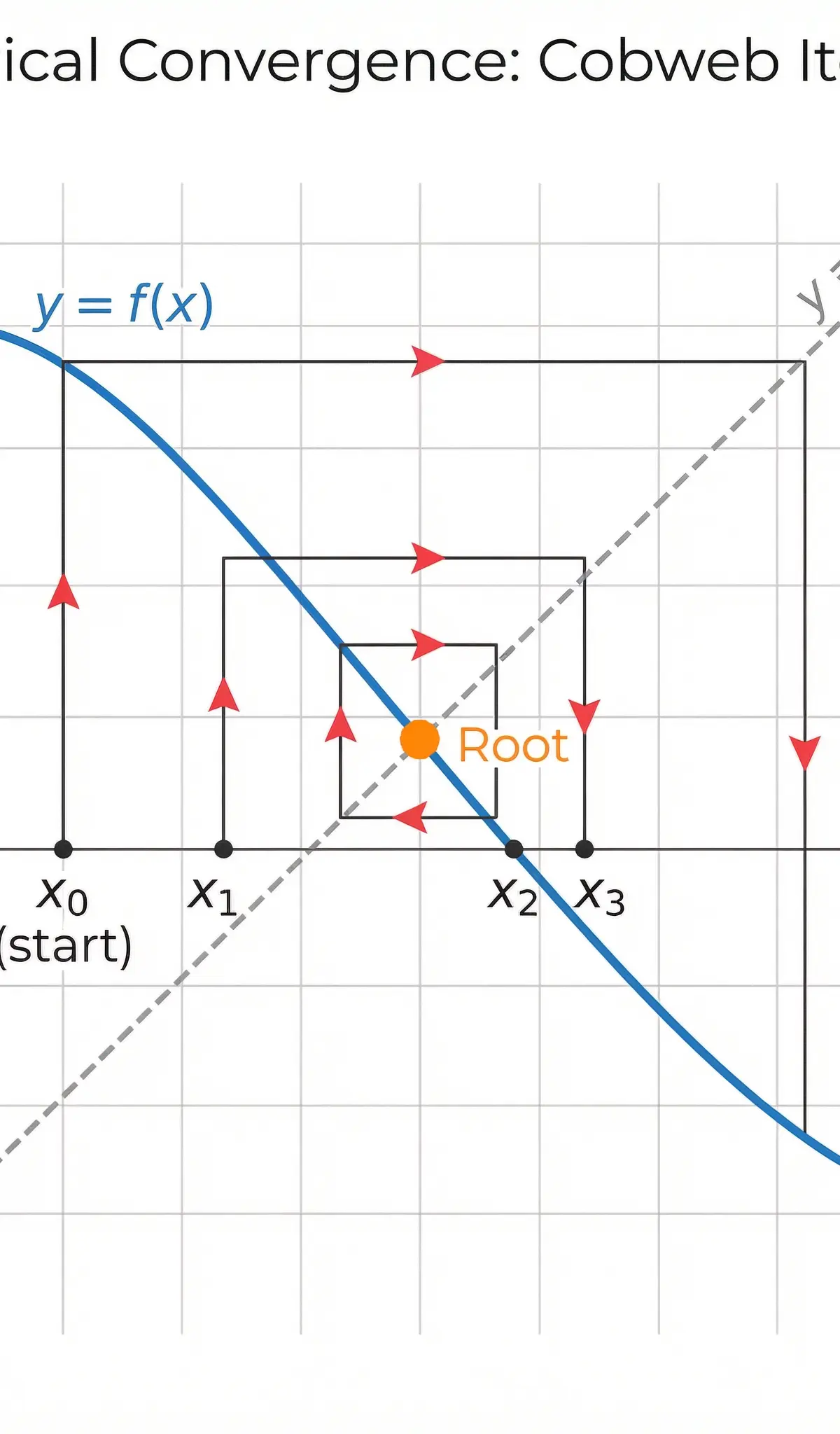
Convergence describes the behaviour of an iterative sequence as it approaches the true root. When a sequence converges, successive values get progressively closer together, eventually stabilising to the required degree of accuracy. The starting value x₀ plays a crucial role in this process. A good starting value, often estimated from a graph or chosen based on the context of the problem, helps the sequence converge more quickly. However, even a rough estimate will typically lead to convergence if the iterative formula is correctly constructed. Examiners often provide x₀ explicitly, such as "use x₀ = 2", removing the need for estimation. The convergence process is visual: imagine a spiral or staircase on a graph, with each iteration bringing you closer to the point where the curve intersects the solution.
Example: For x_{n+1} = ∛(x_n + 1) with x₀ = 1, the sequence begins: x₁ = ∛2 ≈ 1.26000, x₂ ≈ 1.31244, x₃ ≈ 1.32207, x₄ ≈ 1.32417. Notice the values stabilising around 1.324.
Concept 3: Precision and the 'Ans' Key Technique
Maintaining full precision throughout the iteration process is non-negotiable. Rounding intermediate values introduces cumulative errors that prevent convergence to the correct answer. The 'Ans' key on your calculator is your most powerful tool here. After calculating x₁, immediately input your formula using 'Ans' as the variable and press equals repeatedly. This technique ensures that the calculator uses the full stored precision (typically 10-12 digits) rather than the rounded display value. Candidates must write down intermediate values to at least five decimal places to demonstrate to examiners that the process is being followed correctly, even though the calculator is storing more digits internally. The final answer is then stated to the required accuracy, such as three significant figures or two decimal places.
Example: Using a calculator for x_{n+1} = ∛(Ans + 1) starting with 1: Press 1, =, then type ∛(Ans+1), =, =, =, =. Each press generates the next iteration with full precision.
Concept 4: Algebraic Rearrangement and 'Show That' Questions
OCR frequently asks candidates to "show that" an equation f(x) = 0 can be rearranged to a given iterative form. This requires explicit algebraic working showing every step of the manipulation. Candidates must start with the original equation, clearly indicate each operation (adding, subtracting, dividing, taking roots), and arrive at the target form. Working backwards from the answer or skipping steps will lose method marks even if the final form is correct. Common rearrangement techniques include isolating x², taking square roots, isolating x³ and taking cube roots, or rearranging linear terms. Be particularly careful with negative signs and division by variables, as these are frequent sources of error.
Example: Show that x³ - x - 1 = 0 can be rearranged to x = ∛(x + 1).
Solution:
- Start: x³ - x - 1 = 0
- Add x and 1 to both sides: x³ = x + 1
- Take cube root of both sides: x = ∛(x + 1) ✓
Concept 5: Determining Roots to a Specified Accuracy
The final stage of an iteration question requires stating the root to a specified degree of accuracy, such as "correct to 3 significant figures" or "to 2 decimal places". To achieve this, candidates must continue iterating until consecutive values agree to at least one more digit than required. For example, if the question asks for 3 significant figures, continue until the first four digits stabilise. This demonstrates that the sequence has genuinely converged rather than coincidentally produced similar values. The final answer should be clearly stated with appropriate rounding and labelling, such as "Therefore, the root is 1.32 to 3 s.f." Examiners award the final accuracy mark only if the working supports the stated answer.
Example: If x₄ = 1.324717 and x₅ = 1.324718, these agree to 5 decimal places, so the root is 1.32 to 3 s.f. or 1.3 to 2 s.f.
Mathematical Relationships
Core Formula
Iterative Formula: x_{n+1} = g(x_n)
Where:
- x_n is the current term in the sequence (the nth approximation)
- x_{n+1} is the next term in the sequence (the (n+1)th approximation)
- g(x_n) is a function of x_n derived from rearranging f(x) = 0
Must memorise - This formula structure is fundamental and must be understood, though specific rearrangements will be given or derived in context.
Common Rearrangement Patterns
| Original Equation | Rearranged Form | Iterative Formula |
|---|---|---|
| x² = a | x = √a | x_{n+1} = √a |
| x² = f(x) | x = √(f(x)) | x_{n+1} = √(f(x_n)) |
| x³ = f(x) | x = ∛(f(x)) | x_{n+1} = ∛(f(x_n)) |
| x = f(x) | x = f(x) | x_{n+1} = f(x_n) |
| ax = f(x) | x = f(x)/a | x_{n+1} = f(x_n)/a |
Convergence Criteria
A sequence converges to accuracy of k significant figures when |x_{n+1} - x_n| becomes sufficiently small that the first k digits remain unchanged across successive iterations.
Practical Applications
Iteration is not merely an abstract mathematical technique; it underpins computational methods across science, engineering, and technology. Every time you use a calculator to find a square root or solve an equation, iteration is working behind the scenes. The Newton-Raphson method, a more advanced iterative technique, is used in computer graphics to render curves and surfaces. Financial modelling uses iteration to calculate compound interest and loan repayments when exact algebraic solutions are impractical. Engineers apply iterative methods to optimise designs, such as determining the ideal dimensions of a bridge support or the trajectory of a spacecraft. In physics, iteration helps solve differential equations that model everything from planetary motion to electrical circuits. Even weather forecasting relies on iterative numerical methods to approximate solutions to complex atmospheric equations. Understanding iteration at GCSE level provides a foundation for these real-world applications and prepares students for further study in STEM fields where numerical methods are indispensable.
Podcast: Iteration Explained
Listen to this 10-minute educational podcast for a comprehensive audio guide to iteration, including core concepts, exam tips, common mistakes, and a quick-fire recall quiz. Perfect for revision on the go!
Visual Resources
2 diagrams and illustrations
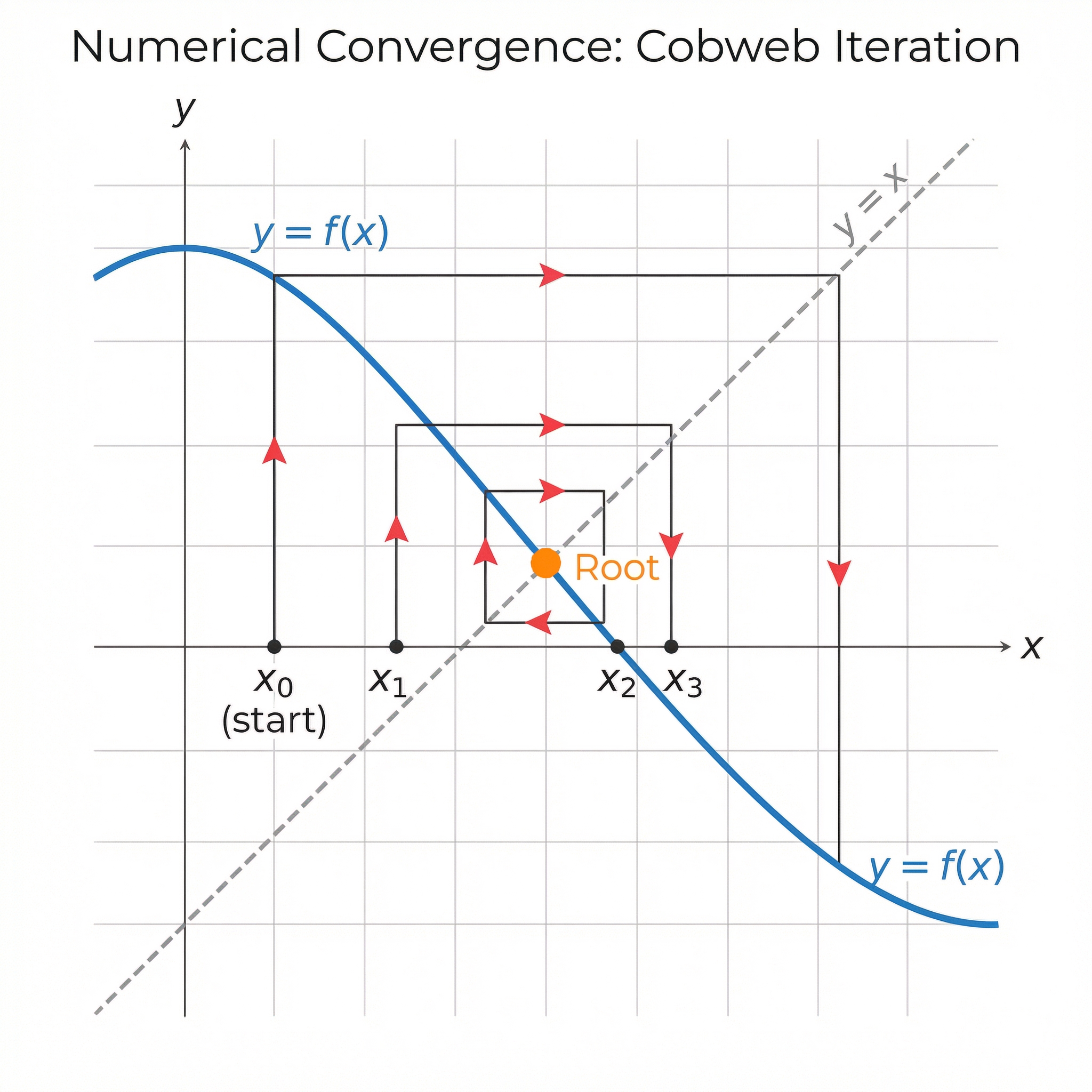
Interactive Diagrams
2 interactive diagrams to visualise key concepts
Conceptual Flow Outline
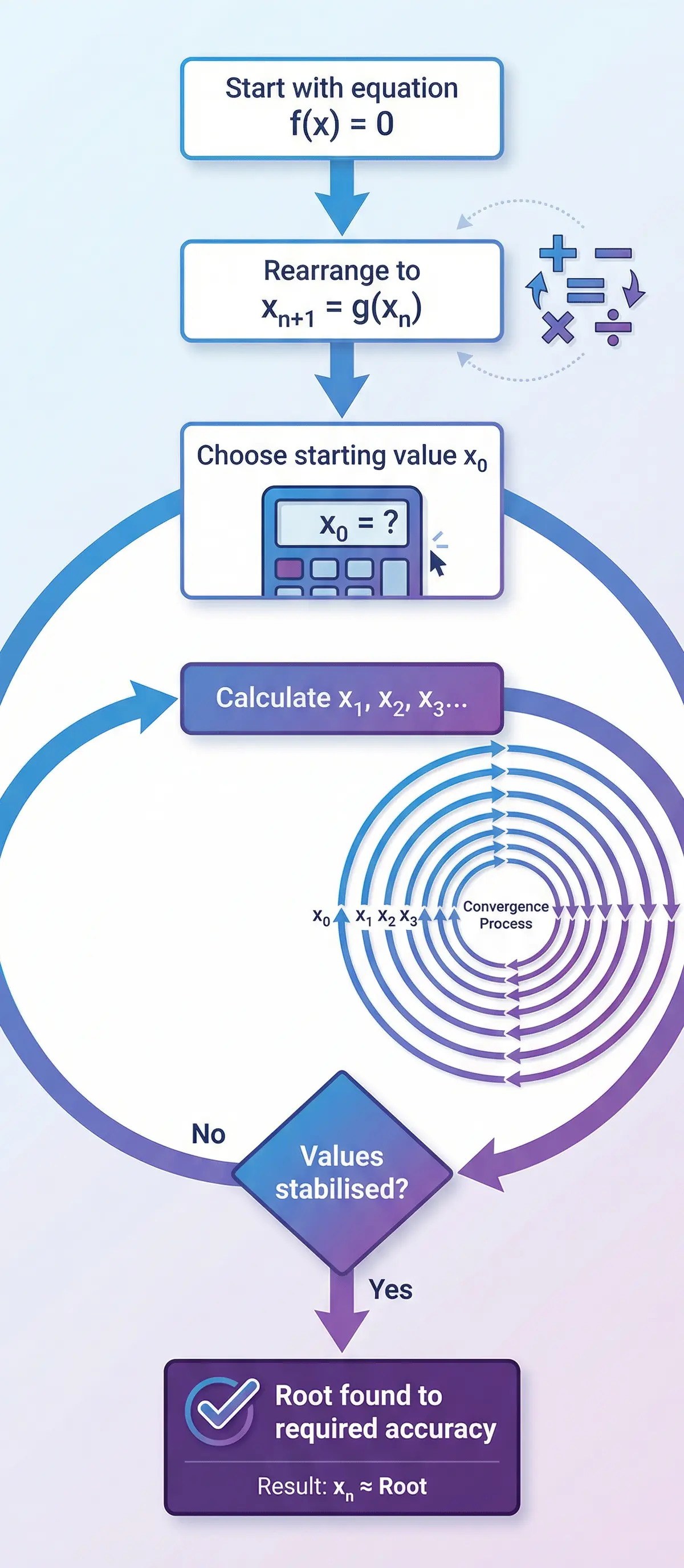
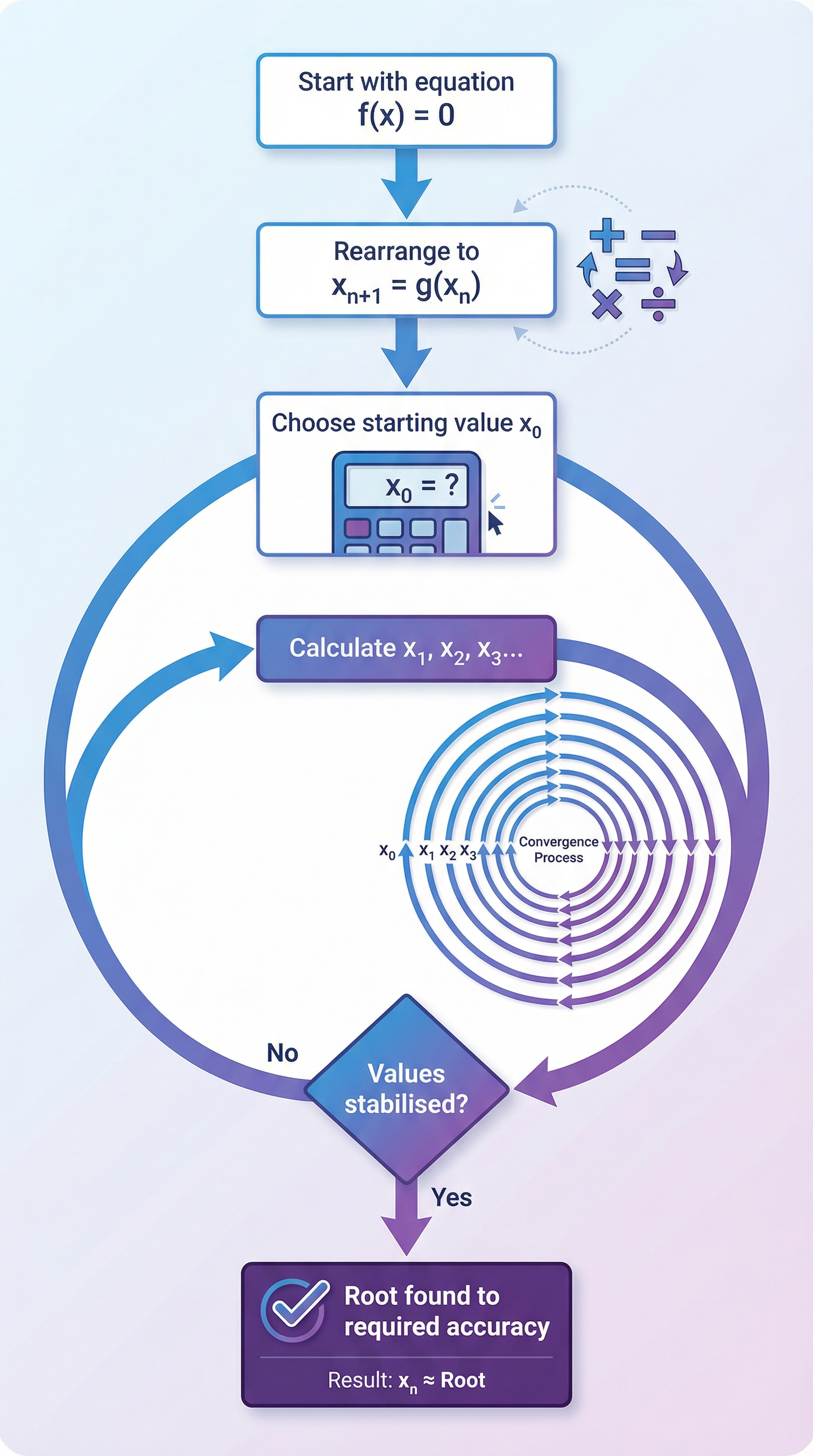
Complete iteration process flowchart showing the systematic steps from initial equation to converged root
Conceptual Flow Outline
Step-by-step algebraic rearrangement showing how to transform an equation into iterative form
Worked Examples
3 worked examples — open one to explore the question and available guidance.
Practice Questions
Test your understanding — click to reveal model answers
The equation x² + x - 7 = 0 has a root between 2 and 3. Show that this equation can be rearranged to x = √(7 - x).
Hint: Start by moving the x term to the right-hand side, then isolate x² before taking the square root.
Use the iterative formula x_{n+1} = √(7 - x_n) with x₀ = 2 to find a root of x² + x - 7 = 0 correct to 1 decimal place.
Hint: Calculate at least 4 iterations to 5 decimal places, then check that your answer to 1 d.p. is stable across consecutive terms.
The equation x³ - 2x - 5 = 0 has a root near x = 2. (a) Show that the equation can be rearranged to x = ∛(2x + 5). (b) Use the iterative formula x_{n+1} = ∛(2x_n + 5) with x₀ = 2 to find the root correct to 3 significant figures.
Hint: For part (a), show every algebraic step clearly. For part (b), use the Ans key and calculate at least 5 iterations to demonstrate convergence to 3 s.f.
A student uses the iterative formula x_{n+1} = (x_n³ + 3)/4 with x₀ = 1.5 to solve the equation 4x - x³ - 3 = 0. Explain why the student's sequence of values is likely to diverge rather than converge.
Hint: Consider what happens when you substitute values into the formula. Does x_{n+1} get closer to x_n or further away?
The iterative formula x_{n+1} = √(3x_n + 1) is used with x₀ = 2. (a) Calculate x₁, x₂, and x₃ to 4 decimal places. (b) By considering your answers, suggest to what value the sequence is converging. (c) Verify your answer by substituting it into the original equation x² - 3x - 1 = 0.
Hint: For part (c), if your suggested value is correct, substituting it into x² - 3x - 1 should give a result very close to zero.
Test your understanding of Iteration
Active recall beats re-reading. Take an instant quiz now to test what you’ve learned and lock it into long-term memory.
7 days Premium · Then free forever · No card, no charge