AQA · A-Level · Geography
Course version: 7037 · Version from Sept 2018
The nature of vulcanicity and its relation to plate tectonics: forms of…
Full specification wording
Volcanic hazards: The nature of vulcanicity and its relation to plate tectonics: forms of volcanic hazard: nuées ardentes, lava flows, mudflows, pyroclastic and ash fallout, gases/acid rain, tephra. Spatial distribution, magnitude, frequency, regularity and predictability of hazard events.
Vulcanicity involves magma reaching the surface, driven by plate tectonics.
Checked against the AQA 7037 specification (opens in a new tab) on .
- Point 1 of 2
- 4 key terms
Study notes
From the checked teaching notes for this specification point.
The idea
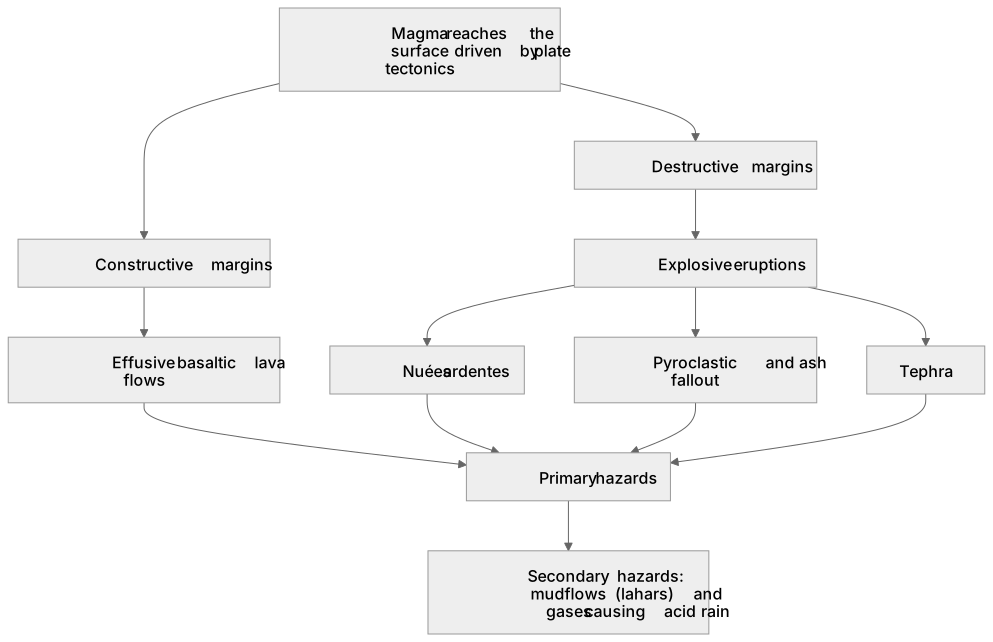
Vulcanicity involves magma reaching the surface, driven by plate tectonics. Constructive margins produce effusive basaltic lava flows, while destructive margins create explosive eruptions with nuées ardentes (glowing avalanches), pyroclastic and ash fallout, and tephra. Secondary hazards include mudflows (lahars) and toxic gases causing acid rain. Volcanic hazards are spatially distributed along plate boundaries like the Pacific Ring of Fire. Magnitude (measured by VEI) and frequency are inversely related. Regularity varies; some volcanoes erupt continuously, others remain dormant. Predictability relies on monitoring seismic activity and gas emissions, making volcanoes generally predictable.
What earns the marks
- Explain how magma viscosity and gas content, determined by plate margin type, dictate the explosive or effusive nature of vulcanicity.
- Identify primary hazards like nuées ardentes, lava flows, tephra, and pyroclastic fallout, linking them to specific eruption types.
- Describe secondary hazards such as mudflows (lahars) triggered by rainfall or melting ice, and acid rain caused by volcanic gases like sulphur dioxide.
- Analyse the spatial distribution of volcanoes, noting their concentration along destructive and constructive plate boundaries and at hotspots.
- Evaluate the relationship between magnitude (VEI), frequency, and regularity, noting that high-magnitude events are less frequent and harder to predict accurately.
Common mistakes and how to put them right
Confusing primary and secondary hazards.
Put it right: Classify lava flows and tephra as primary, and mudflows (lahars) or acid rain as secondary.
Using 'pyroclastic flow' and 'nuée ardente' as completely different phenomena.
Put it right: Recognise that a nuée ardente is a specific, highly destructive type of glowing pyroclastic flow.
Assuming all volcanoes are highly unpredictable.
Put it right: Explain that unlike earthquakes, volcanoes often show predictable warning signs like ground deformation and gas emissions.
Exam tips
- Use the Volcanic Explosivity Index (VEI) to compare the magnitude of different case study eruptions.
- Always link the specific forms of volcanic hazard (e.g., nuées ardentes) to the type of plate margin (e.g., destructive) in your answers.
- When discussing predictability, mention specific monitoring techniques such as tiltmeters or seismometers to support your evaluation.
Try the lesson
The start of the Volcanic hazards: The nature of vulcanicity and its relation to plate tectonics: forms of volcanic hazard: nuées ardentes, lava flows, mudflows, pyroclastic and ash fallout, gases/acid rain, tephra. Spatial distribution, magnitude, frequency, regularity and predictability of hazard events. lesson, made from checked teaching notes for this specification point.
Have a go first
Which of the following volcanic hazards is characterised by a rapidly moving, dense cloud of hot gas, ash, and rock fragments sweeping down the flanks of a volcano?
Listen
Vulcanicity involves magma reaching the surface, driven by plate tectonics. Constructive margins produce effusive basaltic lava flows, while destructive margins create explosive eruptions with nuées ardentes (glowing avalanches), pyroclastic and ash fallout, and tephra. Secondary hazards include mudflows (lahars) and toxic gases causing acid rain. Volcanic hazards are spatially distributed along plate boundaries like the Pacific Ring of Fire. Magnitude (measured by VEI) and frequency are inversely related. Regularity varies; some volcanoes erupt continuously, others remain dormant. Predictability relies on monitoring seismic activity and gas emissions, making volcanoes generally predictable. A strong answer earns marks for these points. Explain how magma viscosity and gas content, determined by plate margin type, dictate the explosive or effusive nature of vulcanicity. Identify primary hazards like nuées ardentes, lava flows, tephra, and pyroclastic fallout, linking them to specific eruption types. Describe secondary hazards such as mudflows (lahars) triggered by rainfall or melting ice, and acid rain caused by volcanic gases like sulphur dioxide. Analyse the spatial distribution of volcanoes, noting their concentration along destructive and constructive plate boundaries and at hotspots. A common slip: Confusing primary and secondary hazards. Instead, classify lava flows and tephra as primary, and mudflows (lahars) or acid rain as secondary. Exam tip: Use the Volcanic Explosivity Index (VEI) to compare the magnitude of different case study eruptions.
See it
Key words
Say what each word means before you turn the card.
Vulcanicity
Try answering aloud or in your head before turning the card.
Nuées ardentes
Try answering aloud or in your head before turning the card.
Tephra
Try answering aloud or in your head before turning the card.
Mudflows
Try answering aloud or in your head before turning the card.
See every definition
- Vulcanicity
- Magma reaching the surface, driven by plate tectonics, producing effusive or explosive eruptions depending on the plate margin.
- Nuées ardentes
- Glowing avalanches, a specific highly destructive type of pyroclastic flow associated with explosive eruptions at destructive margins.
- Tephra
- A primary volcanic hazard produced by explosive eruptions, alongside pyroclastic and ash fallout.
- Mudflows
- Secondary hazards, also called lahars, triggered by rainfall or melting ice.
Label the diagram
Some boxes have lost their names. Pick the right name for each number.
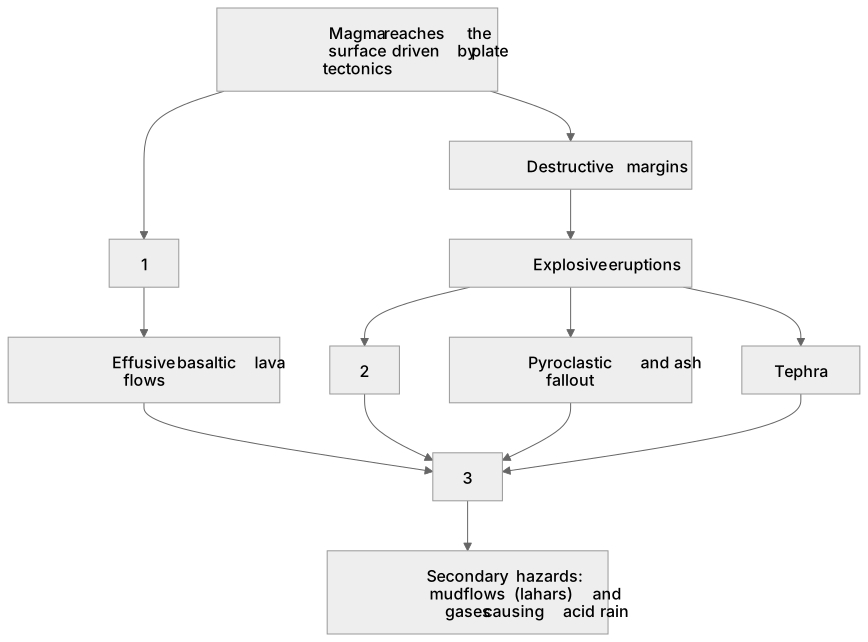
1Box 1
2Box 2
3Box 3
There is more to this lesson
The full lesson goes on to check your understanding and help you earn the marks. Create a free account to carry on, with your progress saved.
A week of Premium from your first lesson · Then the free plan continues · No card, no charge
Test your understanding of Volcanic hazards: The nature of vulcanicity and its relation to plate tectonics: forms of volcanic hazard: nuées ardentes, lava flows, mudflows, pyroclastic and ash fallout, gases/acid rain, tephra. Spatial distribution, magnitude, frequency, regularity and predictability of hazard events.
Active recall beats re-reading. Take an instant quiz now to test what you’ve learned and lock it into long-term memory.
A week of Premium from your first lesson · Then the free plan continues · No card, no charge