AQA · A-Level · Geography
Course version: 7037 · Version from Sept 2018
Systems in physical geography: systems concepts and their application to…
Full specification wording
Water and carbon cycles as natural systems: Systems in physical geography: systems concepts and their application to the water and carbon cycles inputs – outputs, energy, stores/components, flows/transfers, positive/negative feedback, dynamic equilibrium.
Physical systems comprise interrelated components working together.
Checked against the AQA 7037 specification (opens in a new tab) on .
- 4 key terms
Study notes
From the checked teaching notes for this specification point.
The idea
Physical systems comprise interrelated components working together. At the global scale, the water and carbon cycles are closed systems for matter: water and carbon circulate within the Earth system while energy crosses its boundary. At local scales, such as a drainage basin, they operate as open systems with inputs (precipitation) and outputs (runoff) crossing the boundary. Matter is held in stores or components (oceans, forests) and moves via flows or transfers (infiltration, photosynthesis). When inputs equal outputs, systems achieve dynamic equilibrium. Positive feedback amplifies change, whereas negative feedback dampens change and helps restore equilibrium.
What earns the marks
- Define a system as a set of interrelated components comprising stores, flows, inputs, and outputs.
- Explain that the global water and carbon cycles are closed systems where only energy crosses the boundary, but at a local scale they operate as open systems.
- Identify solar radiation as a primary energy source for both cycles, gravity as a driver mainly for water transfers, and geothermal energy driving the geological carbon cycle.
- Distinguish between positive feedback, which exacerbates changes to a system, and negative feedback, which neutralises changes to restore dynamic equilibrium.
Common mistakes and how to put them right
Confusing positive and negative feedback.
Put it right: Positive feedback amplifies a change away from equilibrium, while negative feedback reduces the effect of the change.
Describing the global water cycle as an open system.
Put it right: State that the global cycle is a closed system because only energy, not matter, crosses its boundary.
Using 'store' and 'flow' interchangeably.
Put it right: Clearly distinguish stores as places where matter is held (e.g. oceans) and flows as the movement between them (e.g. evaporation).
Exam tips
- Always link systems terminology directly to specific examples from either the water or carbon cycle to demonstrate applied understanding.
- When discussing dynamic equilibrium, emphasise that the system is not static but is constantly adjusting to maintain a balance between inputs and outputs.
- Use annotated flow diagrams in your exam answers to clearly illustrate feedback loops and system components.
Try the lesson
The start of the Water and carbon cycles as natural systems: Systems in physical geography: systems concepts and their application to the water and carbon cycles inputs – outputs, energy, stores/components, flows/transfers, positive/negative feedback, dynamic equilibrium. lesson, made from checked teaching notes for this specification point.
Have a go first
Which of the following best describes the concept of dynamic equilibrium in a physical geography system?
Listen
Physical systems comprise interrelated components working together. At the global scale, the water and carbon cycles are closed systems for matter: water and carbon circulate within the Earth system while energy crosses its boundary. At local scales, such as a drainage basin, they operate as open systems with inputs (precipitation) and outputs (runoff) crossing the boundary. Matter is held in stores or components (oceans, forests) and moves via flows or transfers (infiltration, photosynthesis). When inputs equal outputs, systems achieve dynamic equilibrium. Positive feedback amplifies change, whereas negative feedback dampens change and helps restore equilibrium. A strong answer earns marks for these points. Define a system as a set of interrelated components comprising stores, flows, inputs, and outputs. Explain that the global water and carbon cycles are closed systems where only energy crosses the boundary, but at a local scale they operate as open systems. Identify solar radiation as a primary energy source for both cycles, gravity as a driver mainly for water transfers, and geothermal energy driving the geological carbon cycle. Distinguish between positive feedback, which exacerbates changes to a system, and negative feedback, which neutralises changes to restore dynamic equilibrium. A common slip: Confusing positive and negative feedback. Instead, positive feedback amplifies a change away from equilibrium, while negative feedback reduces the effect of the change. Exam tip: Always link systems terminology directly to specific examples from either the water or carbon cycle to demonstrate applied understanding.
See it
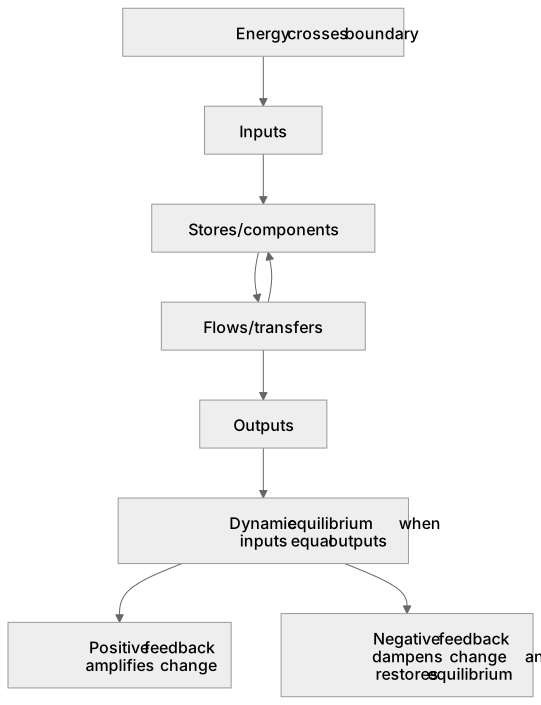
Key words
Say what each word means before you turn the card.
Systems theory
Try answering aloud or in your head before turning the card.
Feedback mechanisms
Try answering aloud or in your head before turning the card.
Dynamic equilibrium
Try answering aloud or in your head before turning the card.
Energy flows
Try answering aloud or in your head before turning the card.
See every definition
- Systems theory
- A set of interrelated components comprising stores, flows, inputs and outputs, applied to the water and carbon cycles.
- Feedback mechanisms
- Positive feedback amplifies change, whereas negative feedback dampens change and helps restore equilibrium.
- Dynamic equilibrium
- Achieved when inputs equal outputs, with the system constantly adjusting to maintain a balance rather than remaining static.
- Energy flows
- Energy crosses the boundary of the global cycles, with solar radiation a primary energy source and gravity a driver mainly for water transfers.
Label the diagram
Some boxes have lost their names. Pick the right name for each number.
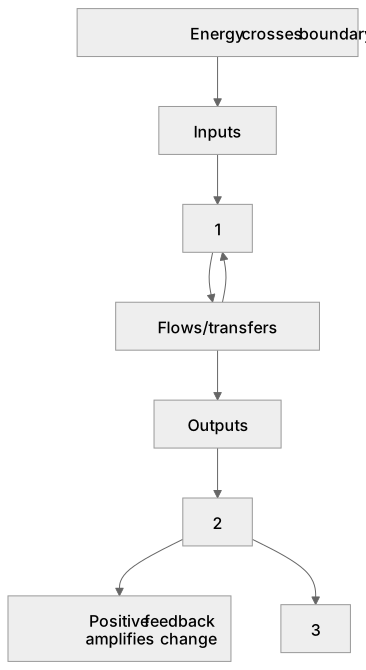
1Box 1
2Box 2
3Box 3
There is more to this lesson
The full lesson goes on to check your understanding and help you earn the marks. Create a free account to carry on, with your progress saved.
A week of Premium from your first lesson · Then the free plan continues · No card, no charge
Test your understanding of Water and carbon cycles as natural systems: Systems in physical geography: systems concepts and their application to the water and carbon cycles inputs – outputs, energy, stores/components, flows/transfers, positive/negative feedback, dynamic equilibrium.
Active recall beats re-reading. Take an instant quiz now to test what you’ve learned and lock it into long-term memory.
A week of Premium from your first lesson · Then the free plan continues · No card, no charge