AQA · A-Level · Geography
Course version: 7037 · Version from Sept 2018
Water conflicts at a variety of scales – local, national, international.
Full specification wording
Water security: Water conflicts at a variety of scales – local, national, international.
Water conflicts arise when demand exceeds supply, leading to disputes over access, allocation, and quality across different geographical scales.
Checked against the AQA 7037 specification (opens in a new tab) on .
- Point 6 of 6
- 3 key terms
Study notes
From the checked teaching notes for this specification point.
The idea
Water conflicts arise when demand exceeds supply, leading to disputes over access, allocation, and quality across different geographical scales. At a local scale, conflicts often occur between competing users, such as farmers requiring irrigation and nearby industries or municipalities needing water for domestic use. Nationally, disputes can emerge between regions or states sharing a river basin, such as the tensions over the Colorado River allocations. Internationally, transboundary water conflicts involve sovereign nations sharing rivers or aquifers, like the disputes between Egypt, Sudan, and Ethiopia over the Grand Ethiopian Renaissance Dam on the River Nile.
What earns the marks
- Identify the root causes of water conflicts, including physical scarcity, economic scarcity, and geopolitical tensions over shared resources.
- Analyse local-scale conflicts, such as disputes between agricultural, industrial, and domestic users over groundwater extraction rights.
- Examine national-scale conflicts involving the internal allocation of water resources between different states, provinces, or economic sectors.
- Evaluate international transboundary conflicts where upstream dam construction or water diversion threatens downstream water security and political stability.
Common mistakes and how to put them right
Focusing solely on international conflicts.
Put it right: Ensure you also prepare detailed case studies for local and national water disputes.
Describing the conflict without explaining the underlying geographical causes.
Put it right: Link the dispute back to physical water scarcity or economic mismanagement.
Assuming all transboundary water interactions lead to war.
Put it right: Many international river basins are managed peacefully through treaties and cooperative frameworks.
Exam tips
- Prepare a distinct, detailed case study for each scale of conflict (local, national, and international) to ensure you can answer specific scale-based questions.
- Use the concept of hydro-politics when discussing international conflicts, particularly regarding upstream versus downstream power dynamics.
- Consider how climate change acts as a threat multiplier, exacerbating existing water conflicts at all scales by altering precipitation patterns.
Try the lesson
The start of the Water security: Water conflicts at a variety of scales – local, national, international. lesson, made from checked teaching notes for this specification point.
Have a go first
Which of the following is an example of an international water conflict?
Listen
Water conflicts arise when demand exceeds supply, leading to disputes over access, allocation, and quality across different geographical scales. At a local scale, conflicts often occur between competing users, such as farmers requiring irrigation and nearby industries or municipalities needing water for domestic use. Nationally, disputes can emerge between regions or states sharing a river basin, such as the tensions over the Colorado River allocations. Internationally, transboundary water conflicts involve sovereign nations sharing rivers or aquifers, like the disputes between Egypt, Sudan, and Ethiopia over the Grand Ethiopian Renaissance Dam on the River Nile. A strong answer earns marks for these points. Identify the root causes of water conflicts, including physical scarcity, economic scarcity, and geopolitical tensions over shared resources. Analyse local-scale conflicts, such as disputes between agricultural, industrial, and domestic users over groundwater extraction rights. Examine national-scale conflicts involving the internal allocation of water resources between different states, provinces, or economic sectors. Evaluate international transboundary conflicts where upstream dam construction or water diversion threatens downstream water security and political stability. Exam tip: Prepare a distinct, detailed case study for each scale of conflict (local, national, and international) to ensure you can answer specific scale-based questions.
See it
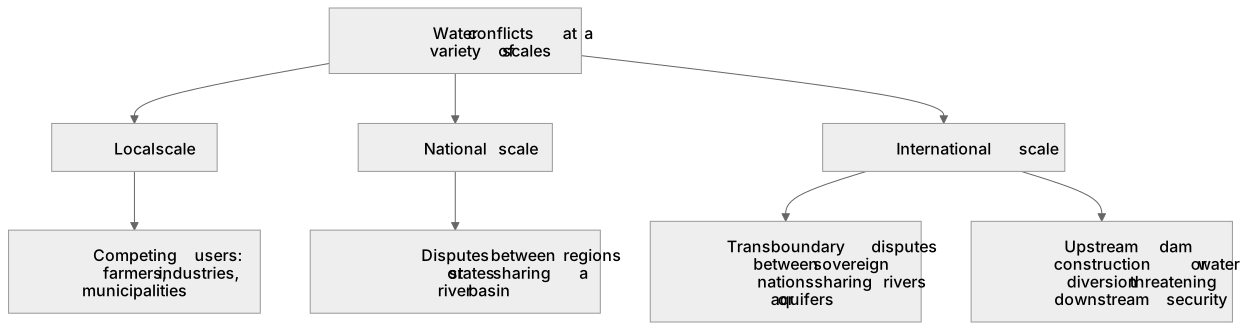
Key words
Say what each word means before you turn the card.
Hydro-politics
Try answering aloud or in your head before turning the card.
Water conflicts
Try answering aloud or in your head before turning the card.
Transboundary water conflicts
Try answering aloud or in your head before turning the card.
See every definition
- Hydro-politics
- The concept used when discussing international conflicts, particularly regarding upstream versus downstream power dynamics.
- Water conflicts
- Disputes over access, allocation, and quality that arise when demand exceeds supply across local, national, and international scales.
- Transboundary water conflicts
- International disputes involving sovereign nations sharing rivers or aquifers, where upstream dam construction or water diversion threatens downstream water security and political stability.
Label the diagram
Some boxes have lost their names. Pick the right name for each number.
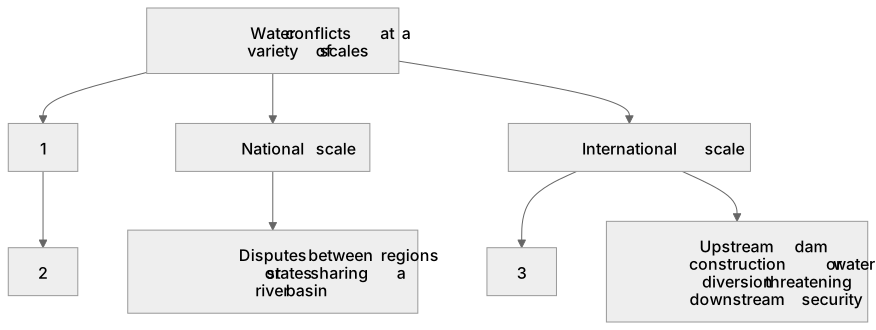
1Box 1
2Box 2
3Box 3
There is more to this lesson
The full lesson goes on to check your understanding and help you earn the marks. Create a free account to carry on, with your progress saved.
A week of Premium from your first lesson · Then the free plan continues · No card, no charge
Test your understanding of Water security: Water conflicts at a variety of scales – local, national, international.
Active recall beats re-reading. Take an instant quiz now to test what you’ve learned and lock it into long-term memory.
A week of Premium from your first lesson · Then the free plan continues · No card, no charge