Subject: Geography | Level: A-Level | Exam Board: Edexcel
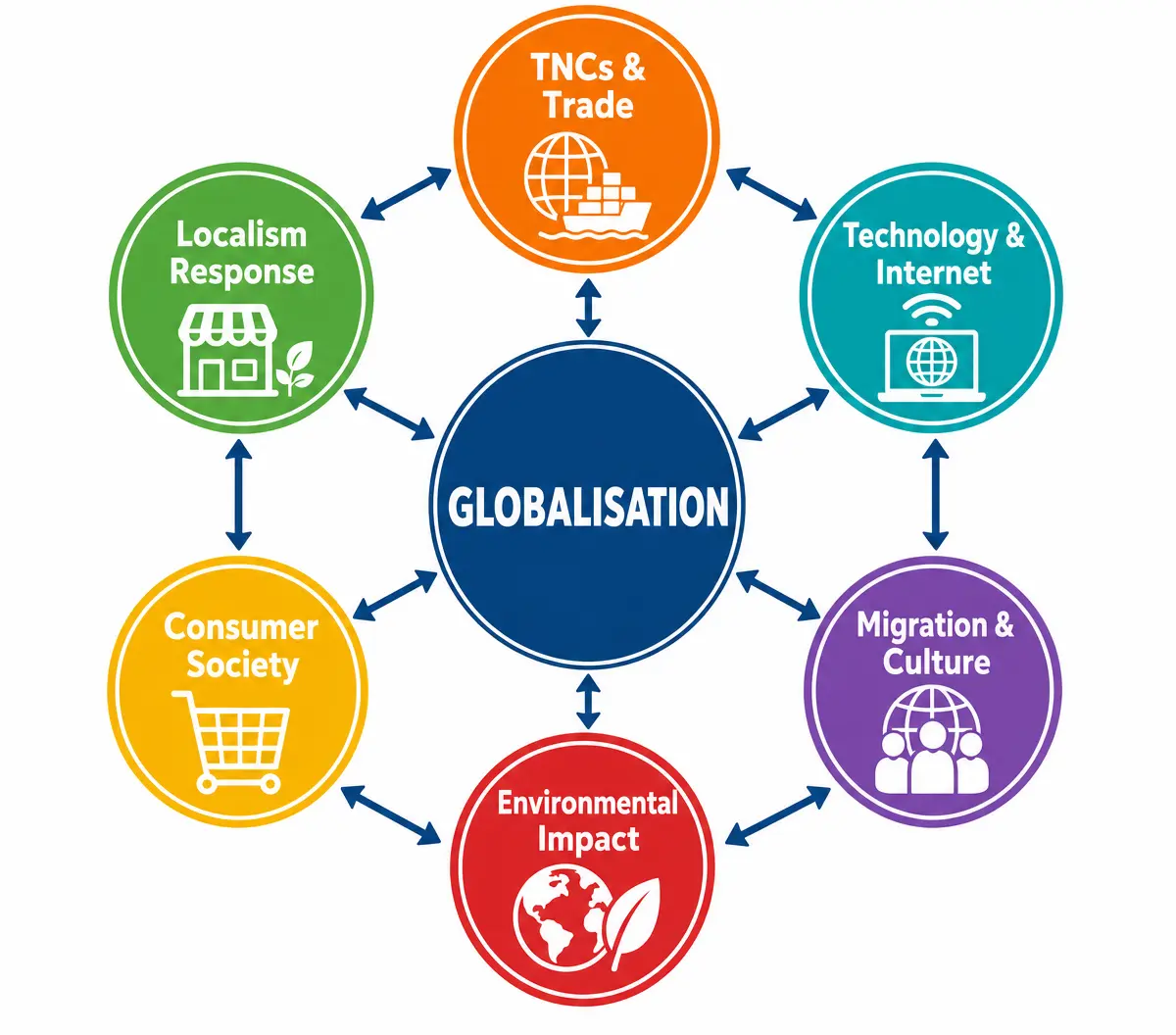
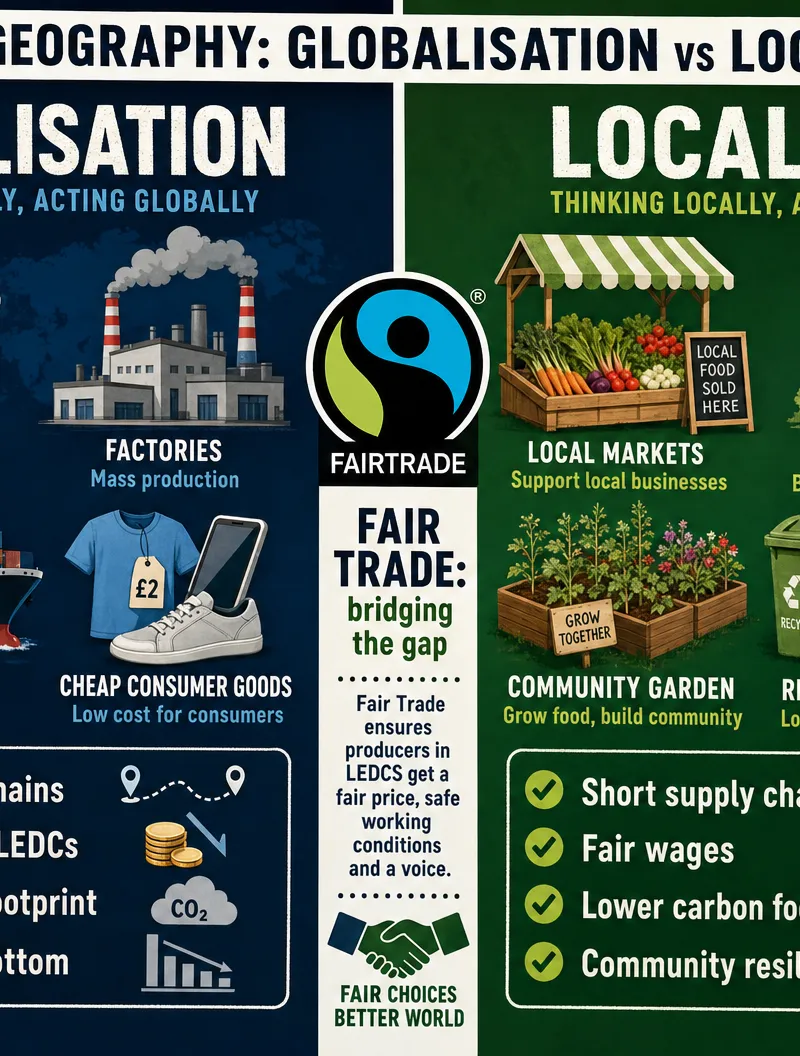
Globalisation has transformed the modern world, creating a highly interconnected consumer society with profound economic, social, and environmental impacts. This study guide explores how ethical concerns have driven a shift towards localism, fair trade, and sustainable resource management.
Revision Notes & Key Concepts
Revision Podcast Transcript
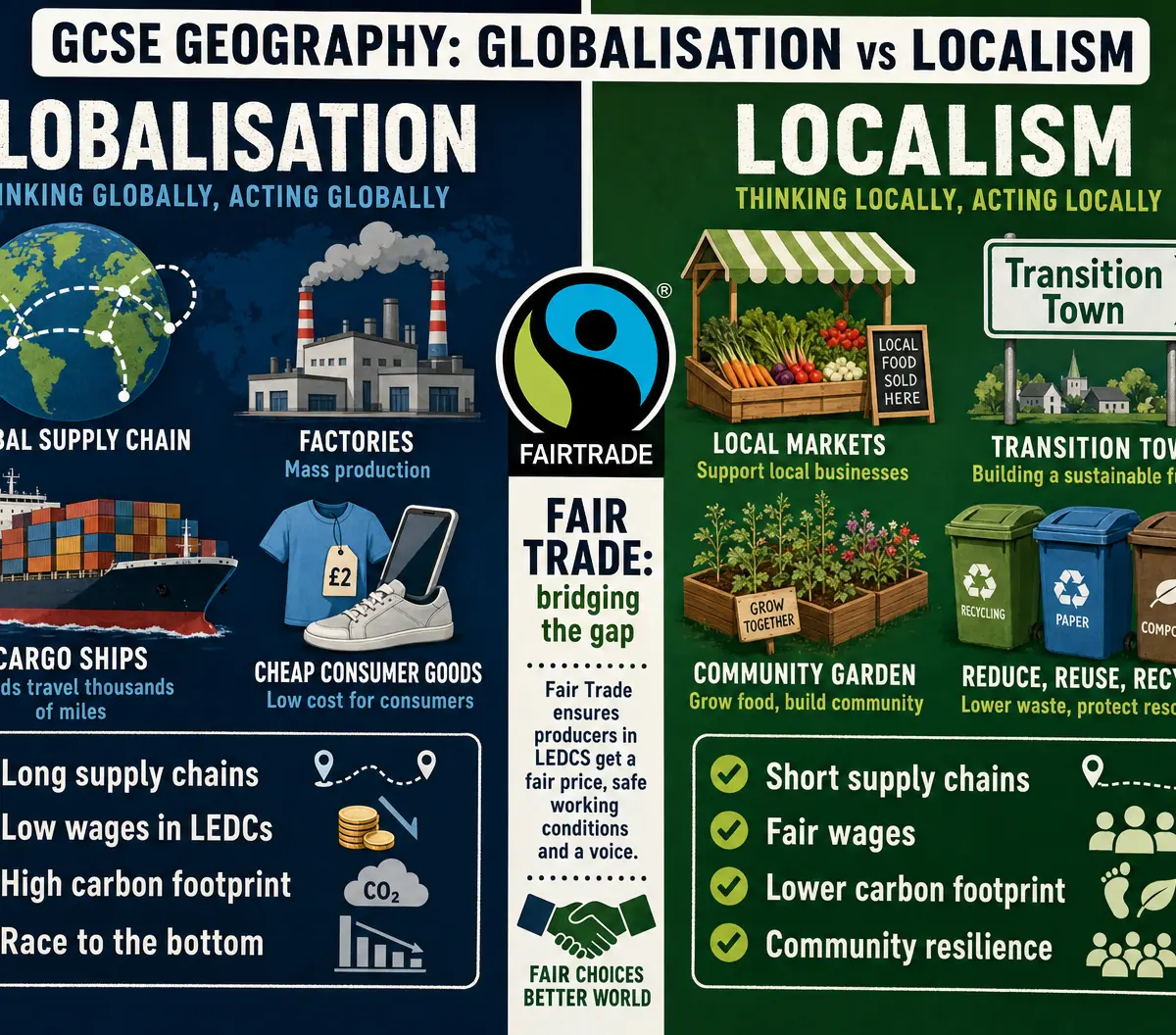
GCSE Geography Podcast: Globalisation, Localism, and Ethical Consumption Running time: approximately 10 minutes Voice: Female, warm, conversational, enthusiastic tutor [INTRO - 1 minute] Hello and welcome! I'm so glad you've tuned in, because today we're diving into one of the most relevant and fascinating topics in your GCSE Geography course: Globalisation, Localism, and Ethical Consumption. Whether you're revising for your mocks or your final exams, this episode is going to walk you through everything you need to know — from the big ideas that examiners love, to the specific examples that will earn you marks in the exam hall. Here's the thing about this topic: it's not just abstract geography. It's about the clothes you're wearing right now, the phone in your pocket, and the food on your plate. Globalisation has shaped the world you live in, and your exam is asking you to think critically about whether that's a good thing — and what we should do about it. So grab a pen, maybe jot down a few notes, and let's get started. By the end of this episode, you'll be able to define key terms confidently, use named examples like a pro, and tackle those tricky evaluate and assess questions that come up in the exam. [CORE CONCEPTS - 5 minutes] Let's start with the big picture. What actually is globalisation? Globalisation is the process by which the world's economies, cultures, and populations have become increasingly interconnected and interdependent. Think of it as the world shrinking — not literally, of course, but in terms of how quickly goods, money, people, and ideas can move around the planet. Now, what's driven this? Three big forces: Transnational Corporations, or TNCs, which are companies that operate in multiple countries — think Nike, Apple, and McDonald's. Second, improvements in transport and communications technology, particularly containerisation of shipping and the internet. And third, trade agreements and organisations like the World Trade Organisation, or WTO, which have reduced barriers to international trade. So what's the result? A global consumer society. We in the UK can buy a T-shirt made in Bangladesh, eat strawberries grown in Spain, and chat on a phone assembled in China. This has brought real benefits — lower prices for consumers, economic growth in some developing countries, and a huge variety of goods available to us. But here's where it gets complicated — and where the exam questions get interesting. This consumer society has serious ethical and environmental costs. Let's talk about the environmental costs first. Long supply chains mean enormous carbon footprints. When your trainers travel from a factory in Vietnam to a warehouse in Germany to a shop in Manchester, they've racked up thousands of product miles. The global shipping industry alone accounts for around two and a half percent of global greenhouse gas emissions. And fast fashion — cheap clothes designed to be worn a few times and thrown away — generates 92 million tonnes of textile waste every year globally. Then there are the social and ethical costs. Workers in factories in Less Economically Developed Countries often face low wages, poor working conditions, and long hours. The 2013 Rana Plaza factory collapse in Bangladesh, which killed over 1,100 garment workers, exposed just how dangerous and exploitative these supply chains can be. This is what geographers call the race to the bottom — TNCs moving production to wherever labour is cheapest and regulations are weakest. So what's the response to all of this? This is where localism comes in, and it's a really important concept for your exam. Localism is a movement that prioritises local production, local consumption, and local decision-making as a way of reducing dependence on global supply chains and their associated problems. Instead of buying a tomato grown in Spain and flown to the UK, you buy one grown by a local farmer. Instead of shopping at a global supermarket chain, you shop at a local market. One of the best examples you can use in your exam is the Transition Towns movement. Transition Towns began in Totnes, Devon, in 2006 — and this is a name and date worth remembering. The idea was to make communities more resilient and sustainable by reducing their dependence on fossil fuels and global supply chains. Totnes created its own local currency — the Totnes Pound — to keep money circulating within the local economy. The movement has now spread to over 50 countries, with thousands of communities involved. Examiners love this example because it's specific, it's named, and it directly links localism back to the problems of globalisation. Now let's talk about Fair Trade, because this is another key concept that comes up frequently. Fair Trade is a certification scheme that guarantees producers in developing countries receive a fair price for their goods, safe working conditions, and community investment funds. When you see the Fairtrade logo on a bar of chocolate or a bag of coffee, it means the farmers who grew those products were paid at least the Fairtrade minimum price, even if global market prices fall below that level. The Fairtrade Foundation, established in the UK in 1992, has certified thousands of producer organisations in over 70 countries. In 2022, Fairtrade sales in the UK were worth over 2.1 billion pounds. That's a significant figure worth knowing. But — and this is crucial for your evaluation questions — Fair Trade has limitations. Critics argue that it only reaches a small fraction of global trade and doesn't fundamentally change the unequal structures of global commerce. Some economists argue that the premium paid to Fairtrade farmers is often small and doesn't always reach the most vulnerable workers. And there are concerns about whether Fairtrade certification is always rigorously enforced. So when you're asked to evaluate Fair Trade, make sure you give both sides — the successes and the limitations. Finally, let's talk about recycling and resource management. Modern consumer society generates enormous amounts of waste, and managing this is a key part of reducing our ecological footprint. The ecological footprint is a measure of how much land and water area a human population requires to produce the resources it consumes and absorb the waste it generates. In the UK, recycling rates vary significantly by local authority. For example, South Oxfordshire District Council consistently achieves recycling rates above 60 percent, while some London boroughs recycle less than 20 percent of their waste. This variation reflects differences in infrastructure, policy, and public engagement. Organisations like Keep Britain Tidy campaign to improve waste management and recycling behaviour across the country. It's important to note that recycling is not just about individual behaviour — it's about managing resource consumption at a systemic level. The most sustainable approach follows the waste hierarchy: Reduce first, then Reuse, then Recycle. Recycling alone is not enough if we continue to consume at unsustainable rates. [EXAM TIPS AND COMMON MISTAKES - 2 minutes] Right, let's talk exam technique, because knowing the content is only half the battle. The most common mistake candidates make on this topic is failing to link localism back to globalisation. If a question asks you to explain localism as a response to globalisation, you must make that connection explicit. Don't just describe what Transition Towns do — explain why they exist as a reaction to the problems created by global supply chains and consumer society. Second common mistake: being too vague about recycling. If you write "recycling helps the environment," that's a Level 1 answer. A Level 3 answer says: "Recycling reduces the ecological footprint of consumer society by decreasing the demand for virgin raw materials and lowering the carbon emissions associated with extraction and production. In the UK, local authorities such as South Oxfordshire achieve recycling rates above 60 percent, demonstrating that effective management can significantly reduce resource consumption." See the difference? Specific, detailed, and linked to the bigger concept. Third: over-generalising Fair Trade. Examiners will reward you for evaluating — that means giving both the strengths and the weaknesses. A top-band answer might say: "While Fairtrade has improved the livelihoods of over 1.8 million farmers and workers globally, it remains limited in scope, reaching only a small fraction of global agricultural trade and failing to address the fundamental inequalities embedded in global trading systems." Key command words to watch for: Explain means give reasons and link them together. Assess or Evaluate means weigh up the positives and negatives and reach a judgement. Describe means state what you can observe — no need for reasons. And Define means give a precise, technical definition. For a 9-mark assess question, aim for three well-developed paragraphs plus a conclusion that makes a clear judgement. That's roughly one paragraph per three marks, spending about nine minutes on the question. [QUICK-FIRE RECALL QUIZ - 1 minute] Time for a quick-fire quiz! Pause after each question if you want to think it through. Question one: What is the name of the Transition Town that started the movement in 2006, and in which county is it located? Question two: What does the ecological footprint measure? Question three: Name one strength and one limitation of the Fairtrade scheme. Question four: What does the waste hierarchy prioritise above recycling? Question five: In which year did the Rana Plaza factory collapse, and in which country? How did you do? The answers are: Totnes, Devon. The ecological footprint measures the land and water area needed to support a population's resource consumption and waste. A strength of Fairtrade is guaranteed minimum prices for producers; a limitation is that it reaches only a small fraction of global trade. The waste hierarchy prioritises reduction and reuse above recycling. And Rana Plaza collapsed in 2013 in Bangladesh. [SUMMARY AND SIGN-OFF - 1 minute] Let's bring it all together. Globalisation has created a highly interconnected consumer society with real economic benefits — lower prices, greater variety, and economic growth in some developing countries. But it has also generated serious environmental costs, including high carbon footprints and resource depletion, and ethical concerns around exploitative labour practices. Localism — exemplified by Transition Towns like Totnes — and ethical consumption schemes like Fairtrade represent responses to these problems. Recycling and resource management, guided by the waste hierarchy, are further tools for reducing our ecological footprint. But none of these solutions is perfect, and examiners will reward you for evaluating their limitations as well as their successes. Remember the key names and figures: Totnes 2006, Rana Plaza 2013, Fairtrade Foundation 1992, UK Fairtrade sales over 2.1 billion pounds in 2022, South Oxfordshire recycling rates above 60 percent. You've got this. Keep revising, keep practising those exam questions, and I'll see you in the next episode. Good luck!
Key Terms & Definitions
- Globalisation
- The process by which the world is becoming increasingly interconnected as a result of massively increased trade and cultural exchange.
- Localism
- The reduction of globally sourced goods and services in favour of locally sourced alternatives to increase sustainability.
- Fairtrade
- A movement that aims to create a level playing field for global trade by guaranteeing producers a fair price and safe working conditions.
- Ecological Footprint
- A measure of the impact of human activities, expressed as the area of productive land and water required to produce the goods consumed and assimilate the wastes generated.
- Transnational Corporation (TNC)
- A company that operates in more than one country, often with headquarters in an MEDC and manufacturing in LEDCs.
- Waste Hierarchy
- A framework for managing waste sustainably, prioritizing reduction, then reuse, and finally recycling.
Worked Examples
Worked Example
Question: Explain how localism acts as a response to the environmental impacts of globalisation. (6 marks)
Solution: **Paragraph 1**: Globalisation has led to long, complex supply chains where goods travel thousands of miles, significantly increasing carbon emissions and contributing to climate change. **Paragraph 2**: Localism responds to this by promoting the consumption of locally sourced goods. For example, the Transition Towns movement, which started in Totnes, Devon, encourages residents to buy food grown locally rather than imported from overseas. **Paragraph 3**: By shortening the supply chain, localism reduces 'food miles' and the associated greenhouse gas emissions from transport, thereby mitigating one of the major environmental impacts of a globalised consumer society.
Worked Example
Question: Assess the effectiveness of Fairtrade in reducing global trade inequalities. (9 marks + 3 SPaG)
Solution: **Introduction**: Fairtrade is an ethical consumption scheme designed to provide better prices and working conditions for farmers in LEDCs. While it is effective on a local scale, its global impact is limited. **Paragraph 1 (Strengths)**: Fairtrade is highly effective for participating producers. It guarantees a minimum price, protecting farmers from volatile global market fluctuations. Additionally, the Fairtrade Premium provides funds for community projects, such as building schools or wells in coffee-producing regions like Colombia, directly improving local living standards. **Paragraph 2 (Limitations)**: However, the effectiveness of Fairtrade is limited on a global scale. It only accounts for a small fraction of total global agricultural trade. Furthermore, it does not address the fundamental structural inequalities of global trade, such as the fact that the vast majority of profits from processing and retail are still captured by TNCs in MEDCs, rather than the primary producers. **Conclusion**: In conclusion, while Fairtrade is highly effective in improving the livelihoods of specific farming communities and raising consumer awareness, it is only partially effective in reducing broader global trade inequalities, as it operates within the existing capitalist system rather than reforming it.
Worked Example
Question: Explain one way in which recycling practices vary across the UK. (2 marks)
Solution: Recycling rates vary significantly between different local authorities. For example, South Oxfordshire achieves recycling rates of over 60%, whereas some inner-city London boroughs recycle less than 20%, due to differences in council policies, funding, and the challenges of providing recycling infrastructure in densely populated areas.
Practice Questions
Question: Describe two features of a Transition Town. (4 marks)
Answer:
Question: Explain the environmental consequences of modern patterns of resource consumption. (6 marks)
Answer:
Question: To what extent is recycling the best way to manage resource consumption? (9 marks)
Answer:
Question: Outline the social costs associated with global supply chains. (4 marks)
Answer:
Question: Assess the success of ethical consumption schemes in reducing environmental degradation. (6 marks)
Answer: