Pearson Edexcel · A-Level · Geography
Course version: Pearson-A-Level-Geography · Version from Mar 2026
Tectonic Processes and Hazards
Master the dynamic forces that shape our planet and the devastating hazards they create. This comprehensive guide covers everything from deep mantle convection to surface-level earthquakes and volcanic eruptions, equipping you with the precise knowledge examiners demand.
- 5 min read
- 3 worked examples
- 5 practice questions
- 6 key terms
Check what you remember
Read the wording for your board, then hide it and explain Lithosphere in your own words. Rough notes are fine. This is a self-check, with no mark or grade.
Reference: Pearson Edexcel
The solid outer layer of the Earth, consisting of the crust and the rigid upper part of the mantle, broken into tectonic plates.
Study Notes
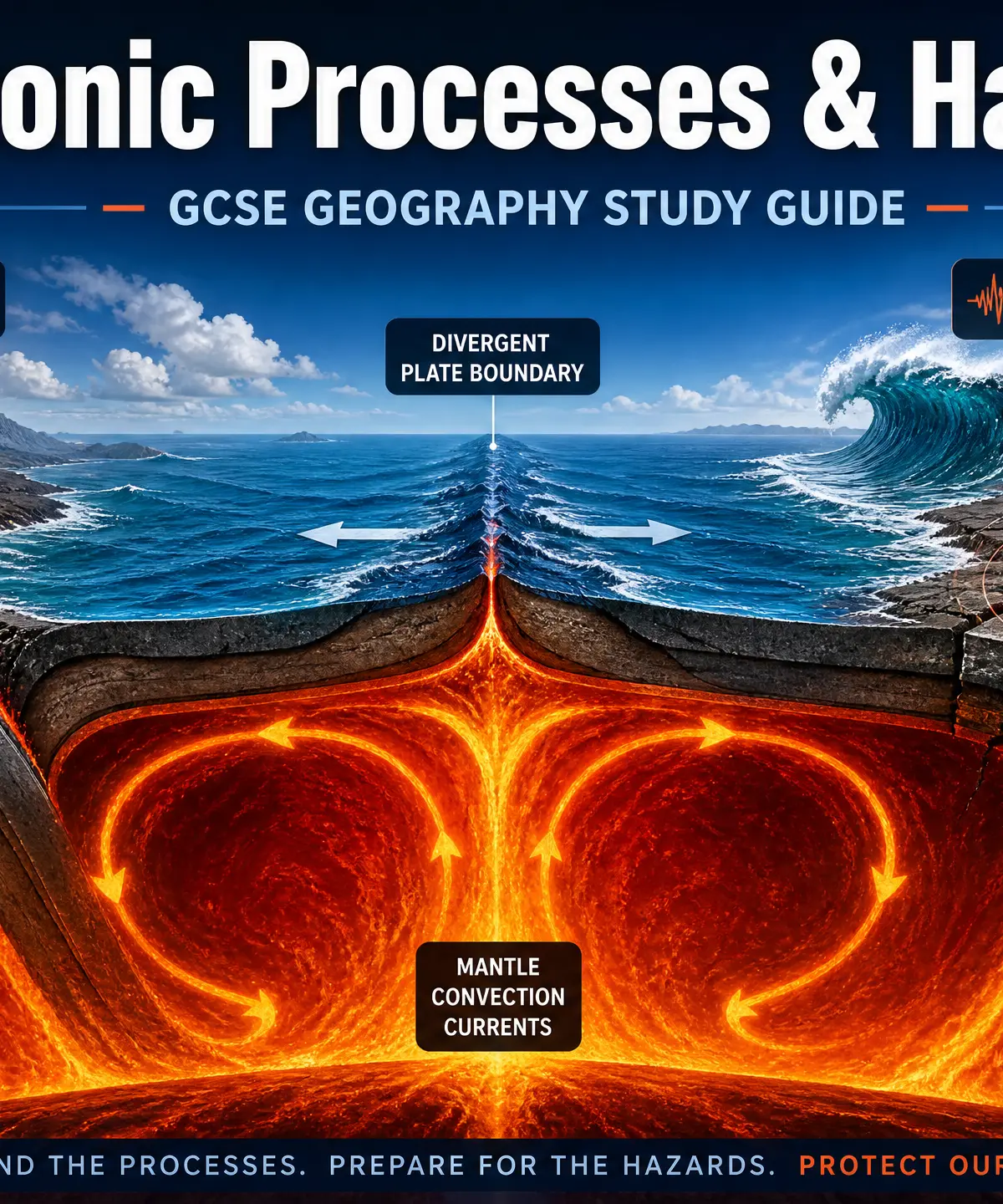
Overview
This study guide covers the fundamental processes that drive tectonic activity and the resulting hazards that impact human populations. You will explore the internal structure of the Earth, the mechanics of plate movement, and the specific features of different plate boundaries. Examiners expect candidates to clearly distinguish between processes like ridge push and slab pull, and to accurately link specific physical processes to the resulting hazard types. You must also understand the causes of intra-plate events, such as hot spot volcanoes, and be able to describe the characteristics of earthquake waves and secondary hazards like tsunamis, liquefaction, and landslides.
Listen to the Podcast
The Theory of Plate Tectonics
Earth's Internal Structure and Convection
The Earth consists of the inner core, outer core, mantle, and crust. The lithosphere (crust and uppermost solid mantle) is broken into tectonic plates. Heat from the core generates convection currents in the semi-molten mantle, which slowly drag the overlying plates.
Ridge Push and Slab Pull
Two other key forces drive plate movement:
- Ridge Push: At constructive boundaries, rising magma forms new, elevated oceanic crust. Gravity causes this newer, higher crust to push the older crust away from the ridge.
- Slab Pull: At destructive boundaries, dense oceanic crust sinks into the mantle under its own weight, pulling the rest of the plate behind it.
Plate Boundaries and Processes
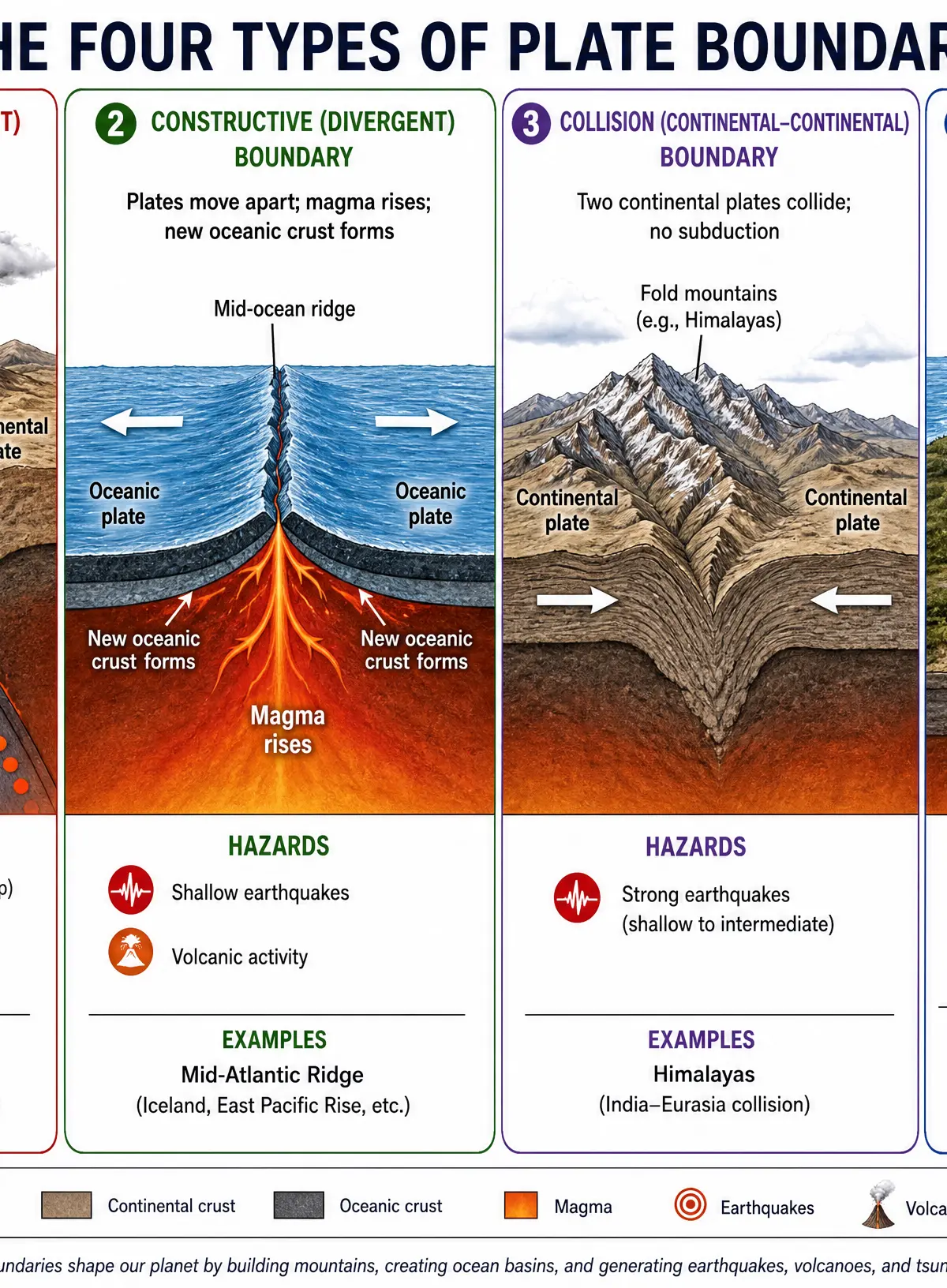
Destructive (Convergent) Boundaries
Process: Oceanic crust collides with continental crust and subducts (sinks) beneath it because it is denser.
Features: Ocean trenches, fold mountains, stratovolcanoes.
Hazards: Highly explosive volcanic eruptions (due to viscous, gas-rich magma) and powerful earthquakes. The Benioff zone is the area of earthquake activity along the subducting plate; focal depth increases with distance from the trench.
Constructive (Divergent) Boundaries
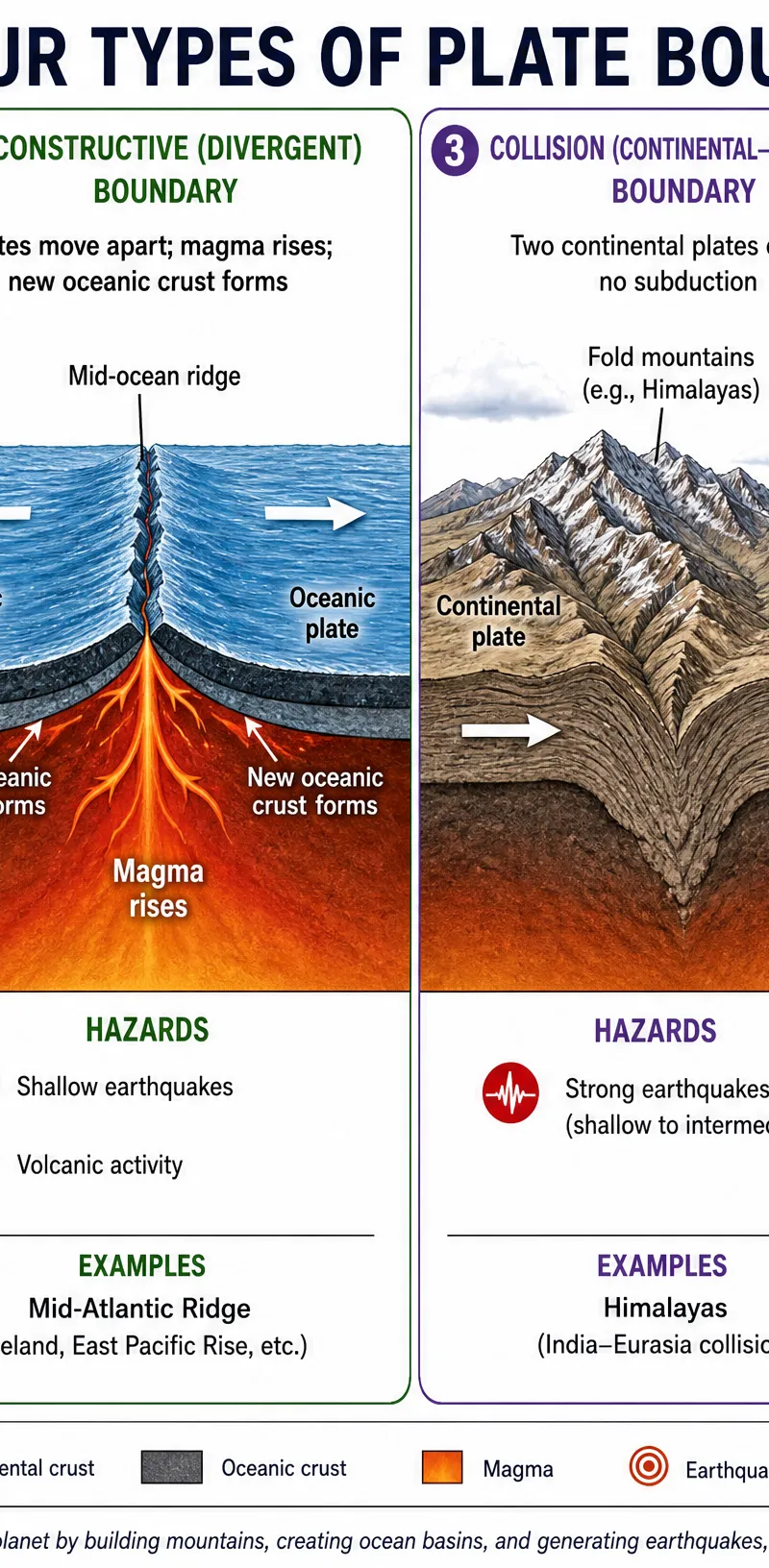
Process: Two plates move apart, and magma rises to fill the gap, creating new crust.
Features: Mid-ocean ridges (e.g., Mid-Atlantic Ridge) and rift valleys.
Hazards: Less explosive shield volcanoes with fluid basaltic lava, and relatively shallow, less severe earthquakes.
Collision Boundaries
Process: Two continental plates collide. Because both have low density, neither subducts. Instead, the crust crumples upwards.
Features: High fold mountains (e.g., the Himalayas).
Hazards: Major earthquakes, but no volcanoes as there is no subduction and melting.
Conservative (Transform) Boundaries
Process: Two plates slide past each other horizontally (e.g., San Andreas Fault).
Features: Major fault lines.
Hazards: Powerful, shallow-focus earthquakes caused by the sudden release of built-up friction. No volcanic activity.
Earthquakes and Seismic Waves
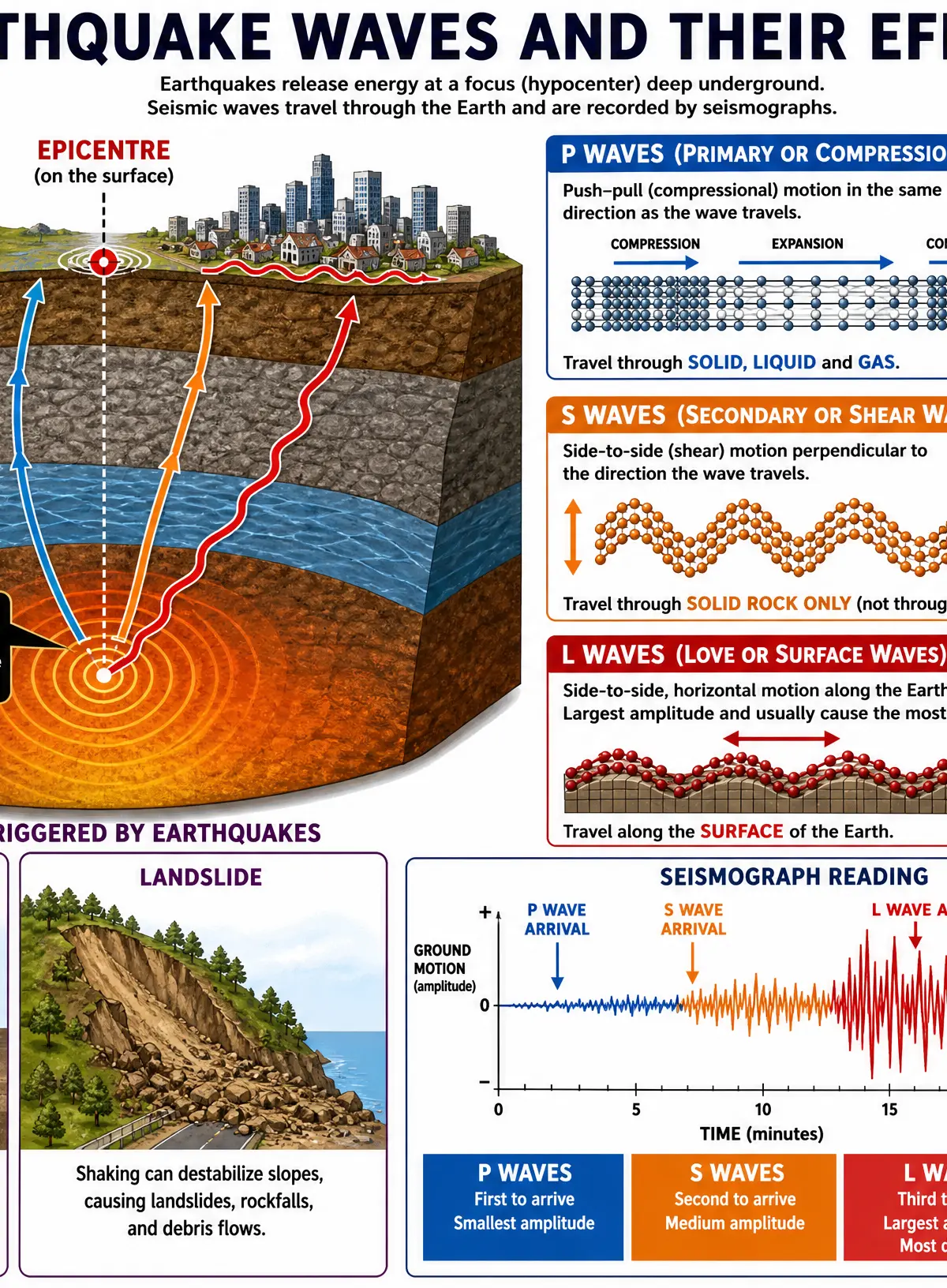
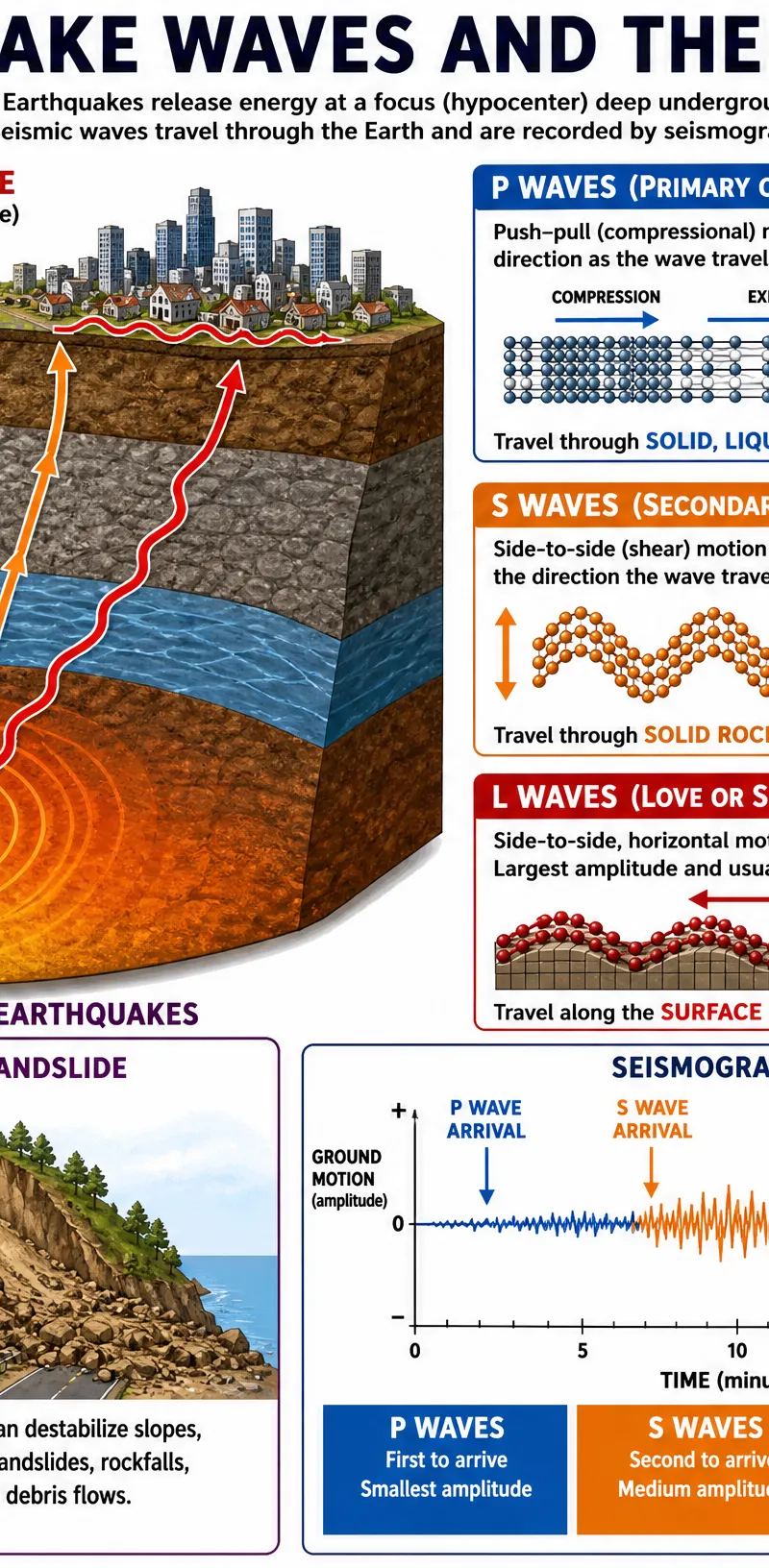
Earthquakes originate at the focus underground. The point directly above on the surface is the epicentre. Energy travels as seismic waves:
- P (Primary) Waves: Fastest, compressional waves travelling through solids and liquids.
- S (Secondary) Waves: Slower, shear waves travelling only through solids.
- L (Love/Surface) Waves: Slowest, but cause the most surface damage.
Secondary Hazards
- Liquefaction: Shaking causes saturated soil to lose strength and behave like a liquid, undermining foundations.
- Landslides: Shaking destabilizes slopes.
- Tsunamis: Massive ocean waves triggered by the displacement of the seabed during submarine earthquakes at subduction zones.
Volcanic Hazards
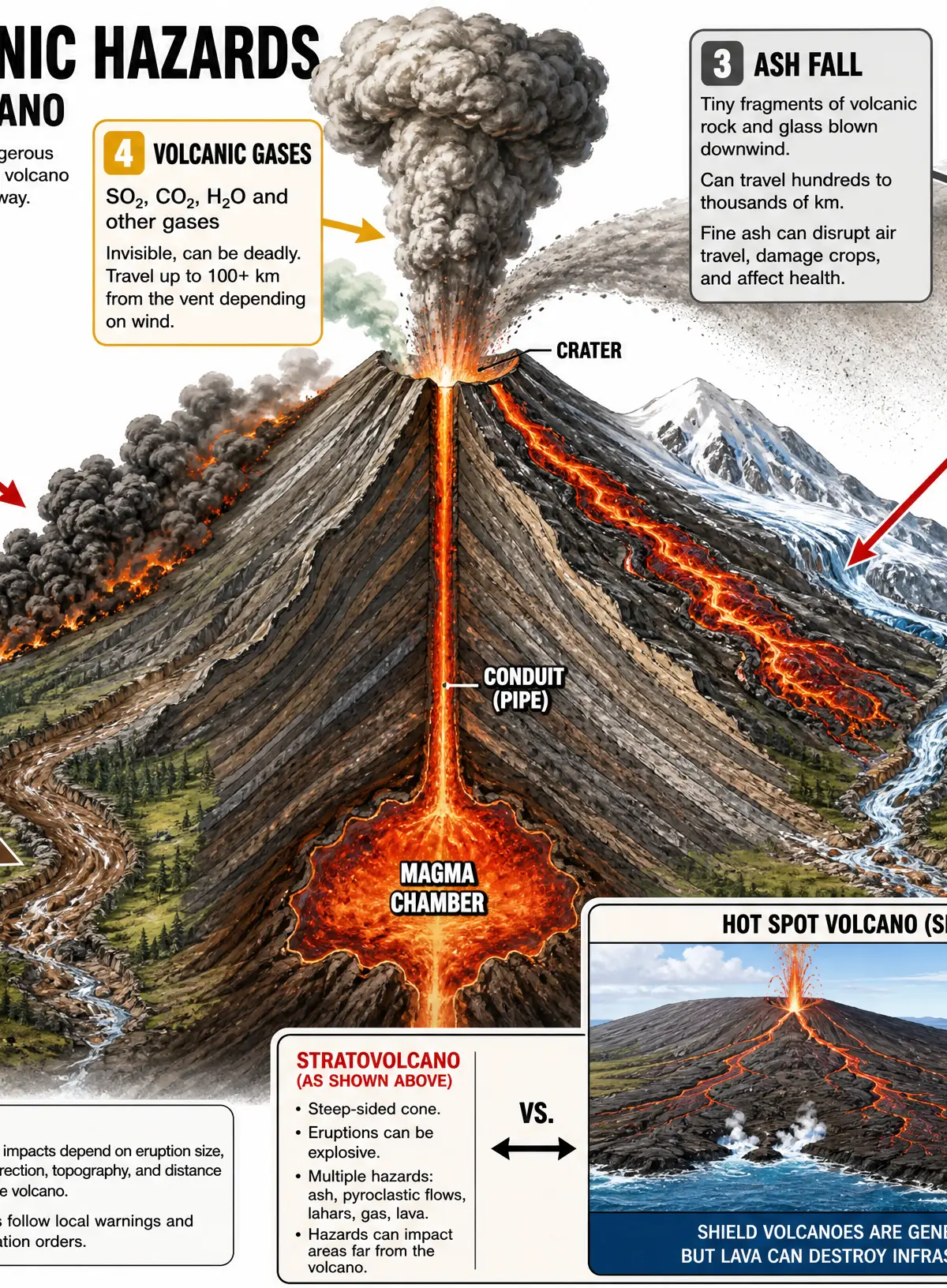
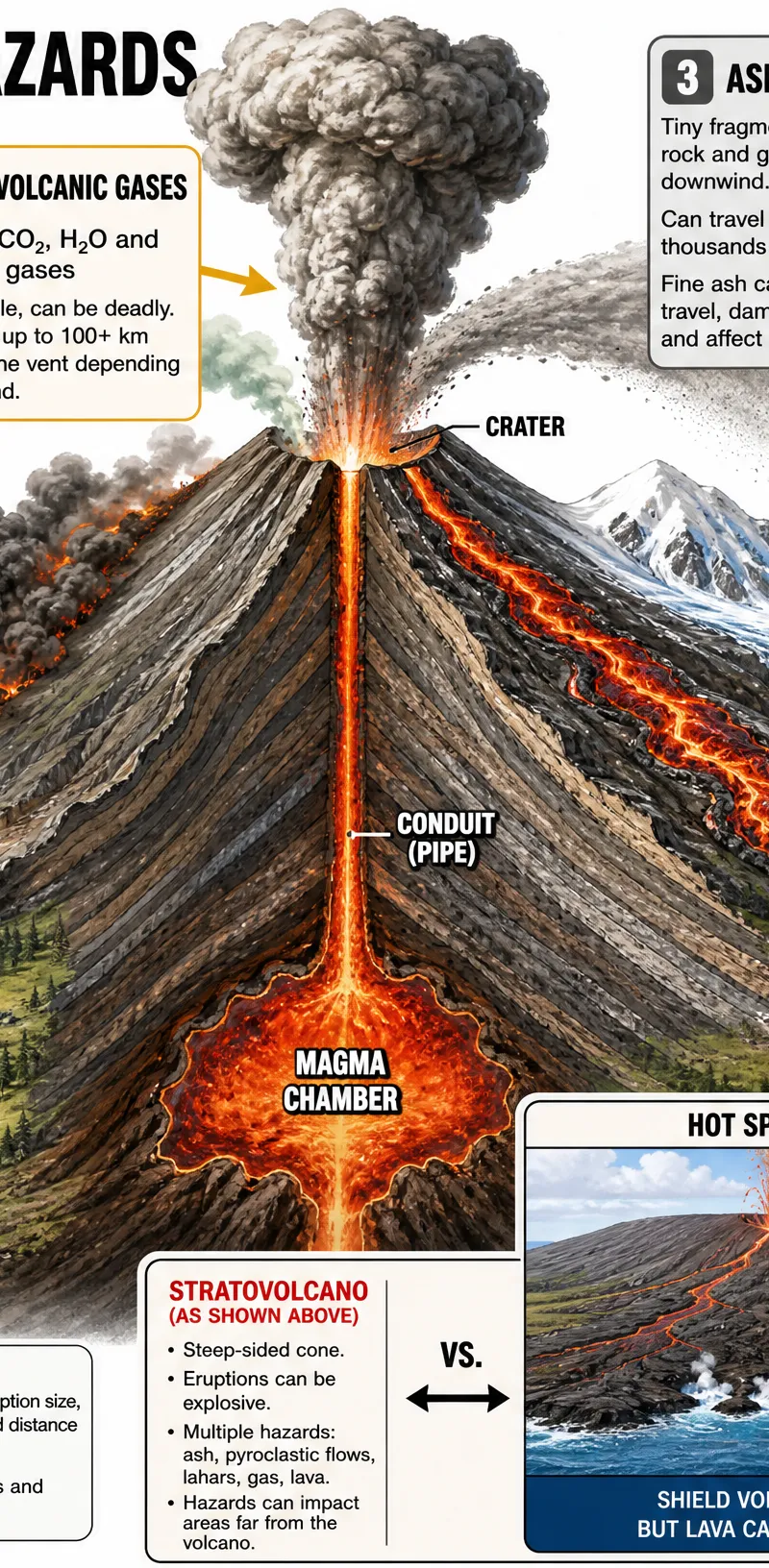
Volcanic eruptions produce multiple hazards:
- Lava Flows: Streams of molten rock. Basaltic lava (constructive margins/hot spots) is fast and fluid; andesitic/rhyolitic lava (destructive margins) is slow and viscous.
- Pyroclastic Flows: Deadly, fast-moving clouds of hot gas, ash, and rock fragments.
- Ash Falls: Tephra ejected into the atmosphere, causing respiratory issues and roof collapses.
- Volcanic Gases: Emissions like sulfur dioxide (SO_2) and carbon dioxide (CO_2).
- Lahars: Destructive volcanic mudflows formed when ash mixes with water (rain or melted snow).
- Jökulhlaups: Glacial outburst floods caused by volcanic heat melting ice beneath a glacier.
Intra-Plate Earthquakes and Hot Spots
Not all activity occurs at plate boundaries. Hot spots are areas where isolated mantle plumes (columns of hot magma) burn through the lithosphere, creating shield volcanoes (e.g., Hawaii) in the middle of a plate. Intra-plate earthquakes can occur along ancient, reactivated fault lines within plates.
Visual Resources
3 diagrams and illustrations
Interactive Diagrams
1 interactive diagram to visualise key concepts
Conceptual Flow Outline
Flowchart showing the relationship between mantle convection, plate boundaries, and resulting features.
Worked Examples
3 worked examples — open one to explore the question and available guidance.
Practice Questions
Try the question, then reveal an answer plan or example response
Explain the formation of a hot spot volcano. (4 marks)
Hint: Don't mention plate boundaries. Focus on the mantle and what the plate is doing above it.
Assess the extent to which the magnitude of an earthquake determines the severity of its impacts. (8 marks)
Hint: Magnitude is important, but what else matters? Think about depth, development level, time of day, and secondary hazards.
Describe the distribution of earthquakes globally. (3 marks)
Hint: Look for patterns. Where are the lines? Are there any exceptions?
Explain the difference between ridge push and slab pull. (4 marks)
Hint: Focus on which boundary each occurs at and the role of gravity/density.
Explain how secondary hazards can increase the impacts of a volcanic eruption. (6 marks)
Hint: Define secondary hazards, give examples (lahars, tsunamis, jökulhlaups), and explain how they extend the danger zone.
Exam technique
How to turn what you know into marks
How to approach the question
Underline the command word, identify the key geographical term, and note the mark allocation to determine the required depth.
How to structure your answer
- Assess questions
- Introduction stating your view → Paragraph 1 on the most significant factor → Paragraph 2 on a less significant factor → Conclusion weighing them up.
- Explain questions
- Make a point, then use connective phrases like 'this means that' or 'as a result' to develop the physical process.
- Data response questions
- Always manipulate the data (e.g., calculate the difference, state the maximum/minimum) rather than just copying it from the graph or map.
Timing
Approximately 1 minute per mark, plus planning time for 8+ mark questions.
Common pitfalls
- Confusing ridge push (constructive margins) with slab pull (destructive margins).
- Forgetting to mention mantle plumes when asked about the global distribution of volcanoes.
- Writing 'plates crash together' instead of using precise terminology like 'subduction' and 'convergent boundary'.
What the command words want
- Explain
- Give reasons why. Detail the step-by-step physical processes.
- Suggest
- Apply your geographical knowledge to a new situation or provide a possible reason for a pattern.
- Describe
- Say what you see. For a map, look for patterns (e.g., coastal, linear, clustered) and name specific regions.
- Assess/Evaluate
- Weigh up different sides of an argument and come to a justified conclusion.
Watch or listen (optional)
Test your understanding of Tectonic Processes and Hazards
Active recall beats re-reading. Take an instant quiz now to test what you’ve learned and lock it into long-term memory.
7 days Premium · Then the free plan continues · No card, no charge