Study Notes
Overview
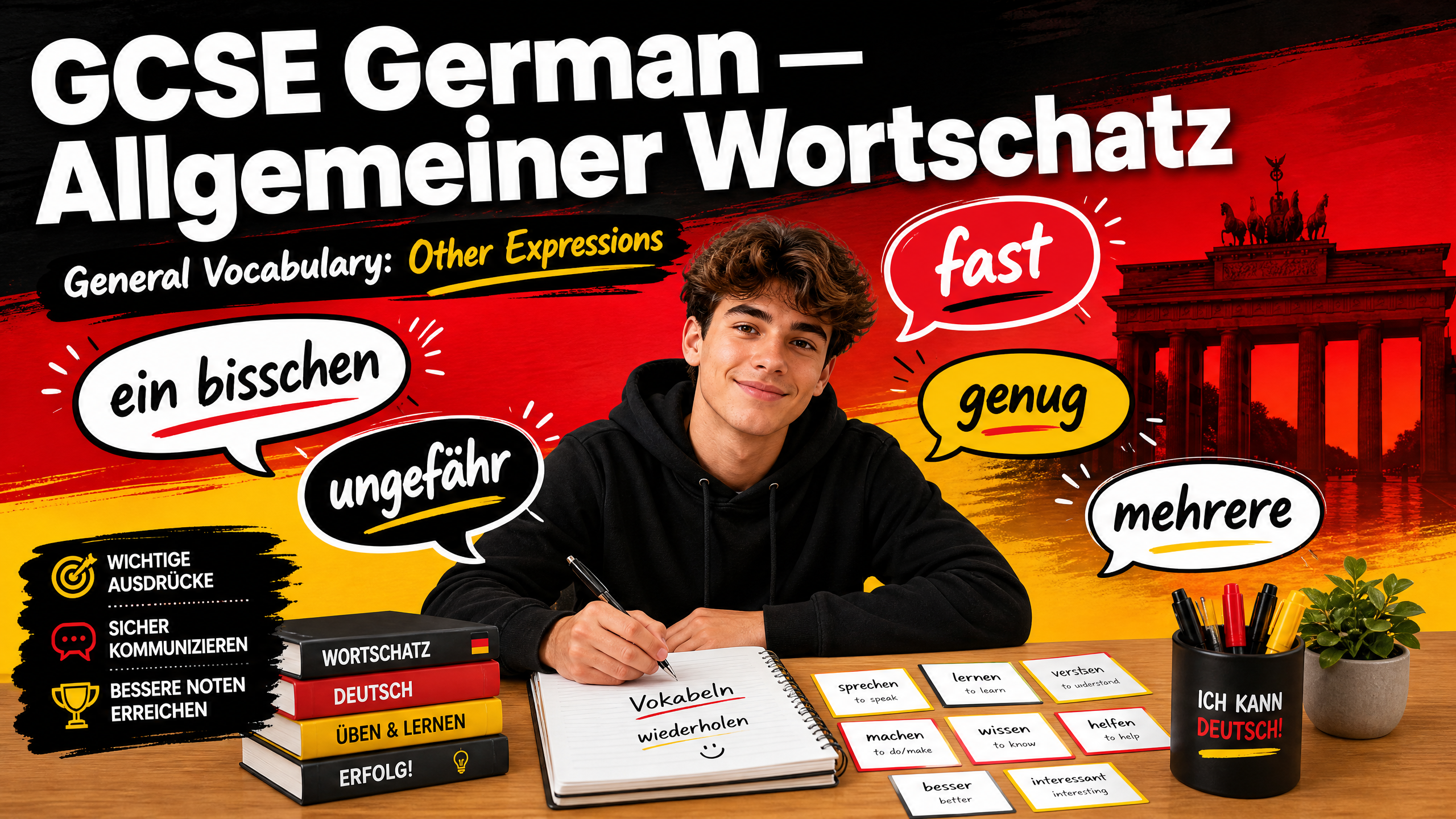
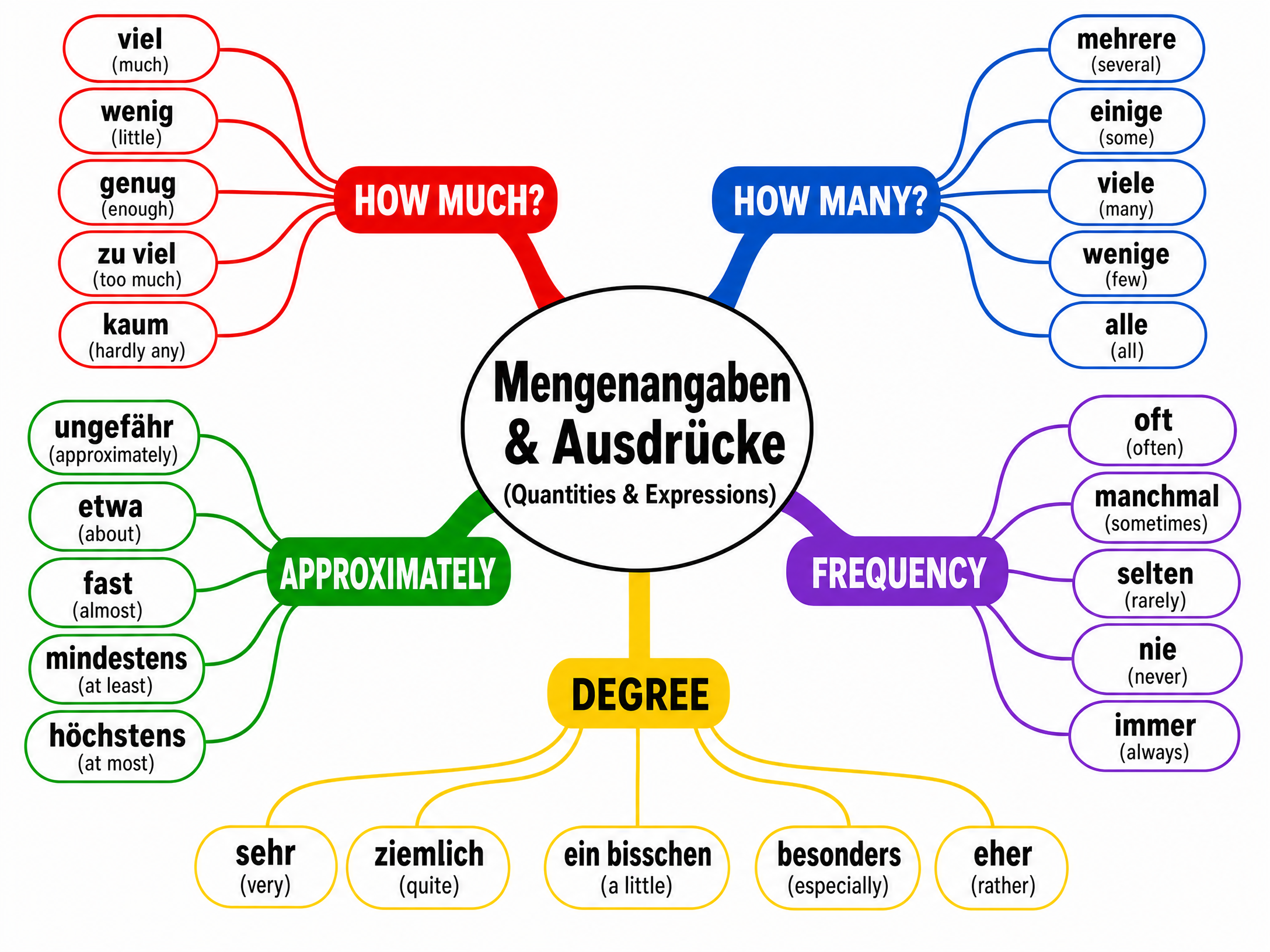
This topic covers the crucial "connective glue" of the German language — the general vocabulary and other expressions that aren't tied to a specific theme like "holidays" or "school," but are used everywhere. These include quantifiers (how much/many), approximation words (about/almost), degree modifiers (very/quite), and frequency adverbs (often/rarely). For the GCSE exam, mastering these words is essential. They appear constantly in Listening and Reading texts as key distractors or qualifiers. More importantly, using them in your Speaking and Writing exams is a guaranteed way to show the examiner you have a sophisticated range of vocabulary, helping you move from Foundation grades into the Higher tier boundaries.
🎧 Audio Revision: The GCSE German Podcast
Listen to this 10-minute deep dive into General Vocabulary. Our expert tutor explains how to use these words to upgrade your speaking and writing, and how to avoid the common traps in listening and reading exams.
📖 Essential Vocabulary
Tier 1 — Foundation Core
| German | English | Gender | Example Sentence |
|---|---|---|---|
| viel | much/a lot | n/a | Ich habe viel Zeit. (I have a lot of time.) |
| viele | many | n/a | Ich habe viele Freunde. (I have many friends.) |
| wenig | little/not much | n/a | Er hat wenig Geld. (He has little money.) |
| wenige | few | n/a | Es gibt wenige Probleme. (There are few problems.) |
| genug | enough | n/a | Wir haben genug Essen. (We have enough food.) |
| zu viel | too much | n/a | Das ist zu viel! (That is too much!) |
| sehr | very | n/a | Das Wetter ist sehr schön. (The weather is very nice.) |
| oft | often | n/a | Ich spiele oft Fußball. (I often play football.) |
| immer | always | n/a | Sie ist immer glücklich. (She is always happy.) |
| nie | never | n/a | Ich esse nie Fleisch. (I never eat meat.) |
| manchmal | sometimes | n/a | Manchmal gehe ich ins Kino. (Sometimes I go to the cinema.) |
| fast | almost | n/a | Ich bin fast fertig. (I am almost finished.) |
| auch | also/too | n/a | Ich komme auch. (I am coming too.) |
| etwas | something/some | n/a | Möchtest du etwas trinken? (Would you like something to drink?) |
| alles | everything/all | n/a | Alles ist gut. (Everything is fine.) |
Tier 2 — Higher Tier
| German | English | Gender | Example Sentence |
|---|---|---|---|
| mehrere | several | n/a | Ich habe mehrere Bücher gelesen. (I have read several books.) |
| ungefähr | approximately/about | n/a | Es kostet ungefähr zwanzig Euro. (It costs approximately twenty euros.) |
| kaum | hardly/barely | n/a | Ich kann kaum schlafen. (I can hardly sleep.) |
| mindestens | at least | n/a | Ich brauche mindestens acht Stunden Schlaf. (I need at least eight hours of sleep.) |
| höchstens | at most | n/a | Es dauert höchstens eine Stunde. (It takes at most an hour.) |
| ziemlich | quite/fairly | n/a | Der Film war ziemlich interessant. (The film was quite interesting.) |
| besonders | especially/particularly | n/a | Ich mag besonders Schokolade. (I especially like chocolate.) |
| eher | rather/more | n/a | Ich bin eher introvertiert. (I am rather introverted.) |
| ein bisschen | a little/a bit | n/a | Ich bin ein bisschen müde. (I am a little tired.) |
| etwa | about/approximately | n/a | Wir treffen uns um etwa drei Uhr. (We are meeting at about three o'clock.) |
High-Frequency Words & Phrases
| Phrase | English | Usage Context |
|---|---|---|
| zum Beispiel (z.B.) | for example | Giving examples to justify opinions |
| auf jeden Fall | definitely/in any case | Expressing strong agreement or certainty |
| auf keinen Fall | definitely not/no way | Expressing strong disagreement |
| im Allgemeinen | in general | Starting a broad statement or conclusion |
| ab und zu | from time to time | Describing frequency of an activity |
| hin und wieder | now and then | An alternative to "ab und zu" for variety |
| vor allem | above all/especially | Emphasizing the most important point |
| im Vergleich zu | in comparison to | Comparing two things (requires Dative case) |
| einerseits ... andererseits | on the one hand ... on the other hand | Balancing an argument in extended writing |
| glücklicherweise | fortunately/luckily | Adding emotion or attitude to a statement |
📝 Grammar Focus
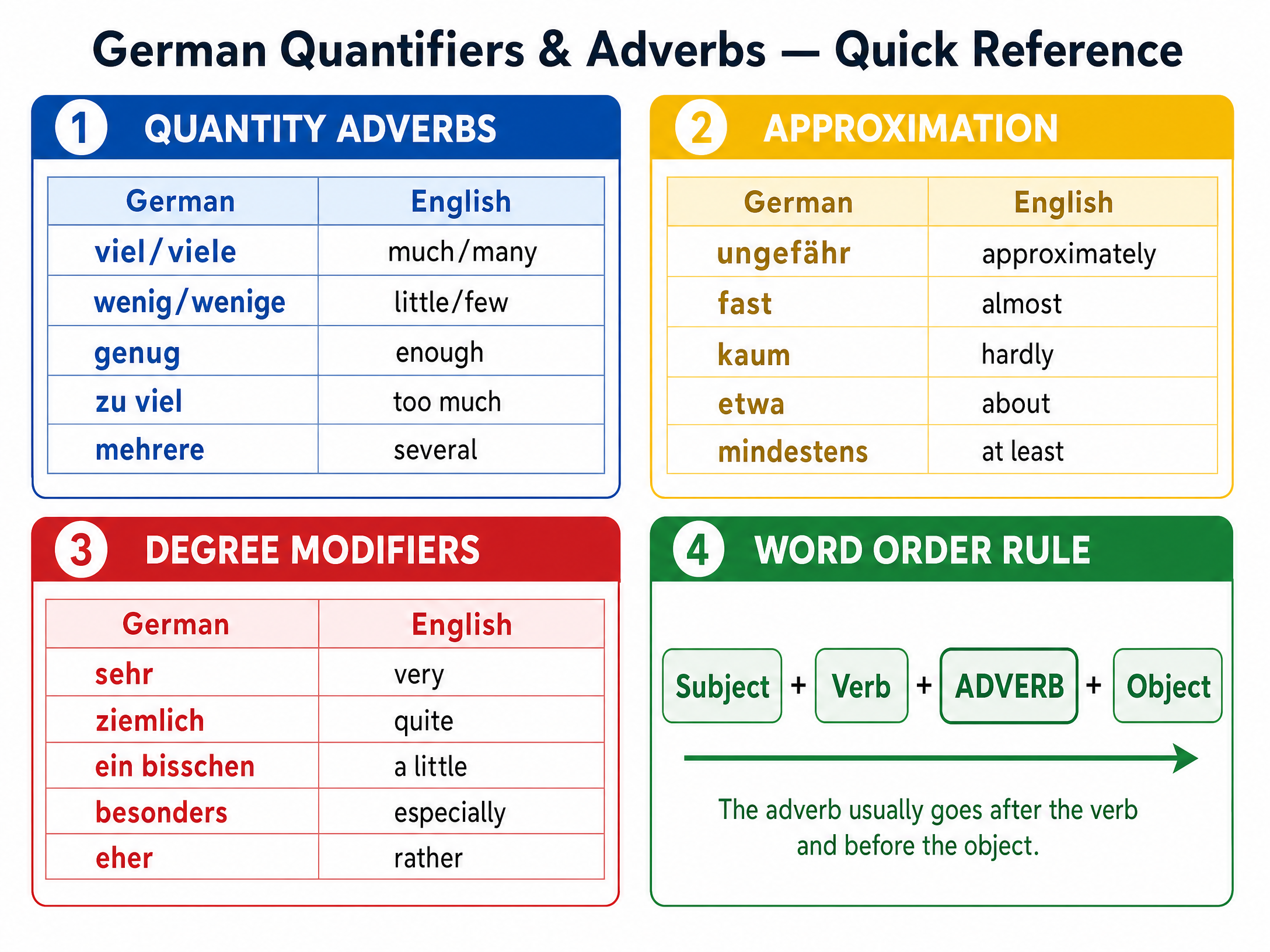
Key Structure 1: Adverb Placement (Word Order)
When to use it: When adding degree or frequency adverbs to your sentences.
The Rule: In a standard main clause, the adverb usually comes after the conjugated verb and before the object or adjective it modifies. The rule of thumb is Time, Manner, Place (TMP).
Example Table
| Subject | Verb | Adverb (Manner/Degree/Frequency) | Object/Adjective | English |
|---|---|---|---|---|
| Ich | spiele | oft | Tennis. | I often play tennis. |
| Das Buch | ist | ziemlich | interessant. | The book is quite interesting. |
| Wir | haben | genug | Zeit. | We have enough time. |
| Er | isst | kaum | Gemüse. | He hardly eats vegetables. |
Key Structure 2: Adjective Endings with Quantifiers
When to use it: When using quantifiers like "viele" (many), "wenige" (few), or "mehrere" (several) directly before an adjective and a plural noun.
The Rule: These quantifiers act like plural "der" words. The adjective that follows them will take an -en ending in the Nominative and Accusative cases.
Example Table
| Quantifier | Adjective (+en) | Plural Noun | English |
|---|---|---|---|
| viele | guten | Freunde | many good friends |
| wenige | neuen | Bücher | few new books |
| mehrere | interessanten | Filme | several interesting films |
Irregulars to learn: Note that "viel" and "wenig" (without the -e) are used with uncountable nouns (like money, time, water) and do NOT take endings: "viel kaltes Wasser" (much cold water).
Key Structure 3: "Ein bisschen" vs. "Ein wenig"
When to use it: When you want to say "a little" or "a bit".
The Rule: Both mean the same thing and are used interchangeably. Importantly, they do not decline (change endings) based on gender or case. They are fixed phrases.
Example Table
| Phrase | Usage | English |
|---|---|---|
| ein bisschen | Ich spreche ein bisschen Deutsch. | I speak a little German. |
| ein wenig | Ich bin ein wenig müde. | I am a little tired. |
| ein bisschen | Mit ein bisschen Glück... | With a little luck... |
🎧 Listening Skills
What to Expect
In listening exams, "other expressions" are frequently used to test your attention to detail. A speaker won't just say they liked a film; they will say it was ziemlich gut (quite good) or besonders gut (especially good). They are also used heavily in multiple-choice questions where the options rely on understanding quantities (e.g., did all the students go, or just several?).
Listening Strategies
- Watch for negatives and opinion qualifiers: Words like kaum (hardly) or fast nie (almost never) completely change the meaning of a sentence. Listen closely for them.
- Note numbers and approximations: If you hear a number, listen for ungefähr (approximately) or etwa (about) right before it.
- Listen for the "TMP" order: Time, Manner, Place. The frequency or degree adverb (Manner) will usually come right after the verb.
Common Listening Traps
- FAST: The German word fast means "almost", NOT quickly (which is schnell). If you hear "Er ist fast fertig", it means "He is almost finished", not "He is finished quickly."
- KAUM: Sounds a bit like "come", but means "hardly". "Ich habe kaum Zeit" means "I have hardly any time."
🗣️ Speaking Skills
Role Play Scenarios
Scenario 1: Buying tickets at a train station
- Examiner: Wie viele Fahrkarten möchten Sie? (How many tickets would you like?)
- Student: Ich möchte zwei Fahrkarten, bitte. Das ist ein bisschen teuer, gibt es einen Studentenrabatt? (I would like two tickets, please. That is a little expensive, is there a student discount?)
Scenario 2: Discussing free time
- Examiner: Was machst du in deiner Freizeit?
- Student: Ich spiele oft Fußball, aber ich lese selten Bücher, weil ich kaum Zeit habe. (I often play football, but I rarely read books because I have hardly any time.)
Photo Card Practice
Model Photo Card Response:
- Qu 1 (Description): Auf dem Foto gibt es viele Leute. Das Wetter ist ziemlich gut, weil die Sonne scheint. (In the photo there are many people. The weather is quite good because the sun is shining.)
- Qu 2 (Opinion): Ich finde das Foto besonders interessant, weil die Leute glücklich aussehen. (I find the photo especially interesting because the people look happy.)
- Qu 3 (Related topic): Ich gehe manchmal mit meinen Freunden in den Park. Wir haben immer viel Spaß. (I sometimes go to the park with my friends. We always have a lot of fun.)
- Qu 4 (Past/Future): Letztes Wochenende habe ich mehrere Hausaufgaben gemacht, das war zu viel! (Last weekend I did several homework assignments, that was too much!)
- Qu 5 (Unpredictable): Ich möchte mindestens dreimal pro Woche Sport treiben. (I would like to do sports at least three times a week.)
General Conversation Questions
| Question (German) | Model Answer | English Translation |
|---|---|---|
| Wie oft benutzt du dein Handy? | Ich benutze mein Handy sehr oft, ungefähr drei Stunden pro Tag. | I use my phone very often, approximately three hours a day. |
| Was hast du letztes Wochenende gemacht? | Ich habe einige Freunde getroffen und wir haben ziemlich viel Pizza gegessen. | I met some friends and we ate quite a lot of pizza. |
| Ist es wichtig, fit zu bleiben? | Ja, auf jeden Fall. Ich treibe fast jeden Tag Sport, weil es besonders wichtig für die Gesundheit ist. | Yes, definitely. I do sports almost every day because it is especially important for health. |
| Möchtest du auf die Universität gehen? | Ich bin mir nicht sicher. Ich möchte eher eine Lehre machen, weil ich mehr praktische Erfahrung sammeln will. | I am not sure. I would rather do an apprenticeship because I want to gain more practical experience. |
| Was wirst du nächstes Jahr machen? | Ich werde hoffentlich Abitur machen. Ich muss sehr viel lernen! | I will hopefully do A-levels. I have to study a lot! |
✍️ Writing Skills
Translation Practice
English → German:
| English | German | Key Grammar |
|---|---|---|
| I have a lot of time. | Ich habe viel Zeit. | Uncountable noun (viel, no ending) |
| We have read several books. | Wir haben mehrere Bücher gelesen. | Plural quantifier (mehrere) |
| The film was quite boring. | Der Film war ziemlich langweilig. | Degree modifier (ziemlich) |
| I almost never eat meat. | Ich esse fast nie Fleisch. | Combining approximation (fast) and frequency (nie) |
| I have hardly any money. | Ich habe kaum Geld. | High-level vocabulary (kaum) |
Extended Writing
**Model 90-word response (Foundation):**Ich wohne in einer kleinen Stadt. In meiner Stadt gibt es viele Geschäfte und ein Kino. Ich finde meine Stadt ziemlich gut, weil meine Freunde hier wohnen. Letztes Wochenende bin ich mit meinen Freunden ins Kino gegangen. Der Film war sehr interessant. Nächstes Wochenende werde ich wahrscheinlich zu Hause bleiben, weil ich viel Hausaufgaben habe. Ich spiele oft Fußball im Park, aber im Winter ist es ein bisschen zu kalt.
**Model 150-word response (Higher):**Ich wohne seit fünf Jahren in einer mittelgroßen Stadt. Im Allgemeinen mag ich meine Stadt, weil es hier mehrere gute Sportzentren gibt. Einerseits gibt es viel zu tun für Jugendliche, aber andererseits sind die öffentlichen Verkehrsmittel ziemlich teuer. Letztes Wochenende habe ich mich mit einigen Freunden getroffen und wir sind ins Kino gegangen. Der Film hat ungefähr zwei Stunden gedauert und war besonders spannend. Glücklicherweise hatten wir genug Geld für Popcorn! In der Zukunft möchte ich eher in einer Großstadt wie Berlin wohnen. Ich glaube, dass das Leben dort viel interessanter wäre, obwohl es wahrscheinlich kaum ruhige Orte gäbe. Ich werde mindestens einmal im Monat meine Familie besuchen.
Writing Checklist
- ✅ Have you used at least one degree modifier (sehr, ziemlich, besonders)?
- ✅ Have you used at least one frequency word (oft, manchmal, nie)?
- ✅ Have you checked your adjective endings after quantifiers (viele gute Freunde)?
- ✅ Have you included a "Higher tier" word like kaum, mehrere, or ungefähr?
📚 Reading Skills
Key Strategies
When reading comprehension passages, pay close attention to the modifiers. A text might say "Viele Jugendliche spielen am Computer" (Many young people play on the computer). If the question asks "Do all young people play on the computer?", the answer is False. The distinction between viele (many), einige (some), and alle (all) is crucial.
False Friends & Tricky Words
| Word | Looks Like | Actually Means |
|---|---|---|
| fast | fast/quick | almost |
| kaum | come | hardly/barely |
| also | also | so/therefore (Also is a false friend! 'Auch' means also) |
| aktuell | actual | current/up-to-date |
| eventuell | eventual | perhaps/possibly |
🌍 Cultural Knowledge
In German-speaking countries, precision is culturally valued, which is why there are so many specific words for quantities and degrees. However, in casual spoken German (Umgangssprache), you will often hear words slurred or shortened. For example, "ein bisschen" is frequently pronounced simply as "'n bisschen". Furthermore, regional variations exist: in Southern Germany, Austria, and Switzerland, you might hear "ein bisserl" or "ein bissel" instead of "ein bisschen". Knowing these variations can be helpful for the listening exam, as authentic recordings sometimes feature mild regional accents.
Visual Resources
2 diagrams and illustrations
Interactive Diagrams
1 interactive diagram to visualise key concepts
Conceptual Flow Outline
The TMP (Time, Manner, Place) rule for ordering adverbs.
Worked Examples
4 detailed examples with solutions and examiner commentary
Practice Questions
Test your understanding — click to reveal model answers
Writing: Translate the following sentence into German: 'I have read several books, but I have hardly any time.'
Hint: Remember the word for 'several' and the higher-tier word for 'hardly'. Watch the word order after 'aber'.
Reading: Read the sentence: 'Mein Bruder isst fast nie Gemüse, weil er es ziemlich eklig findet.' Does the brother eat vegetables?
Hint: Look at the combination of 'fast' and 'nie'.
Speaking: Answer the question: 'Wie findest du deine Schule?' Use at least two degree modifiers in your answer.
Hint: Think of words like sehr, ziemlich, ein bisschen, besonders.
Listening: You hear: 'Es dauert ungefähr zwei Stunden mit dem Zug.' How long does the journey take?
Hint: Listen for the word meaning 'approximately'.
Writing: Fill in the blank with the correct form of 'viel': 'Ich habe ______ gute Freunde.'
Hint: Is 'Freunde' plural or uncountable?
Writing: Fill in the blank with the correct word for 'enough': 'Wir haben ______ Zeit.'
Hint: This word doesn't change its ending.