Study Notes
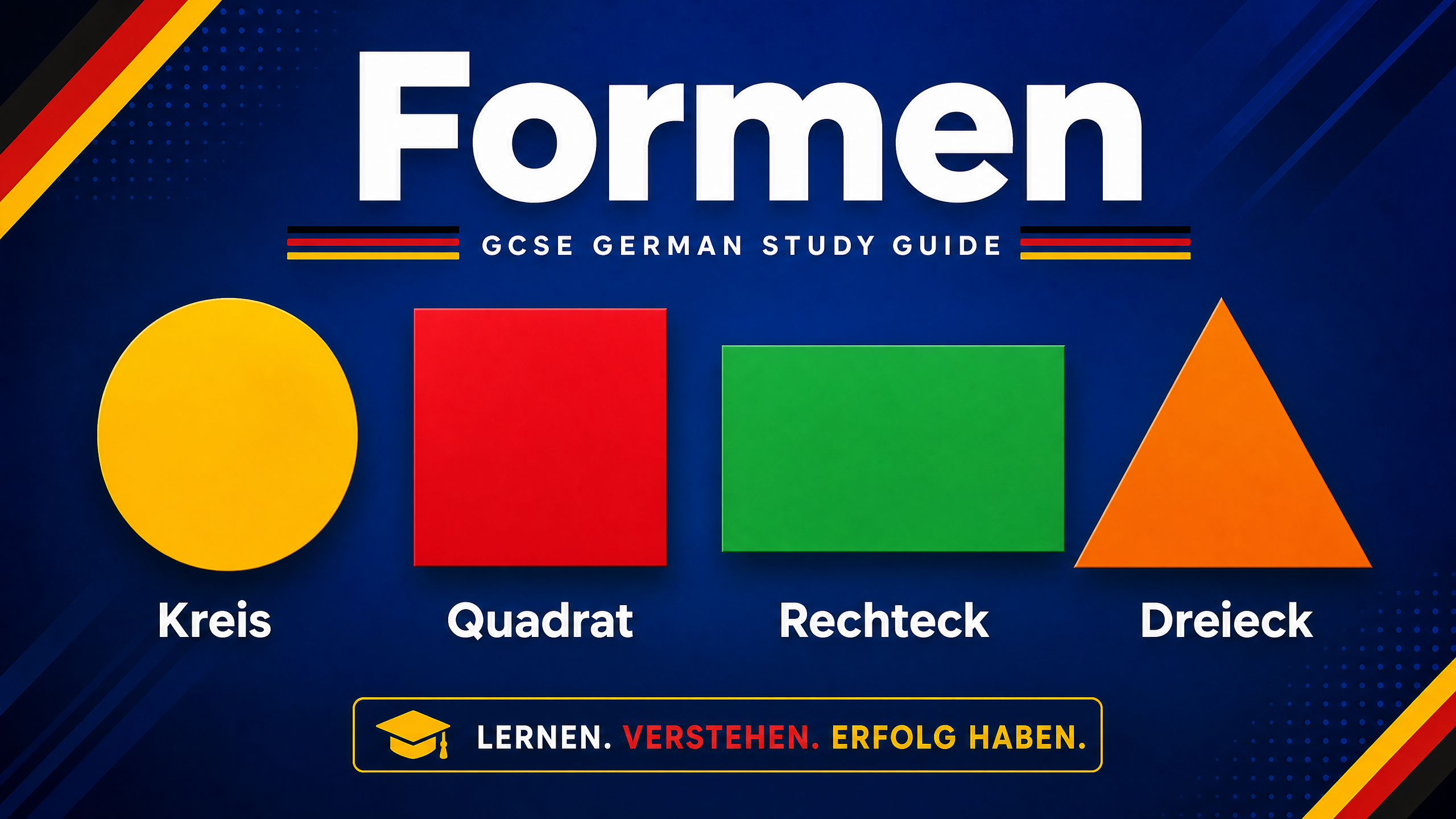
Overview
This topic covers the general vocabulary related to basic geometric shapes (Formen). While it might seem like a minor topic, it is highly versatile and frequently tested. You will need this vocabulary to describe objects in the Speaking exam (especially the Photo Card), to understand descriptions in the Listening and Reading papers, and to add detail to your Writing tasks. Examiners reward candidates who can accurately use shape adjectives with correct agreement, as it demonstrates a solid grasp of core grammar.
📖 Essential Vocabulary
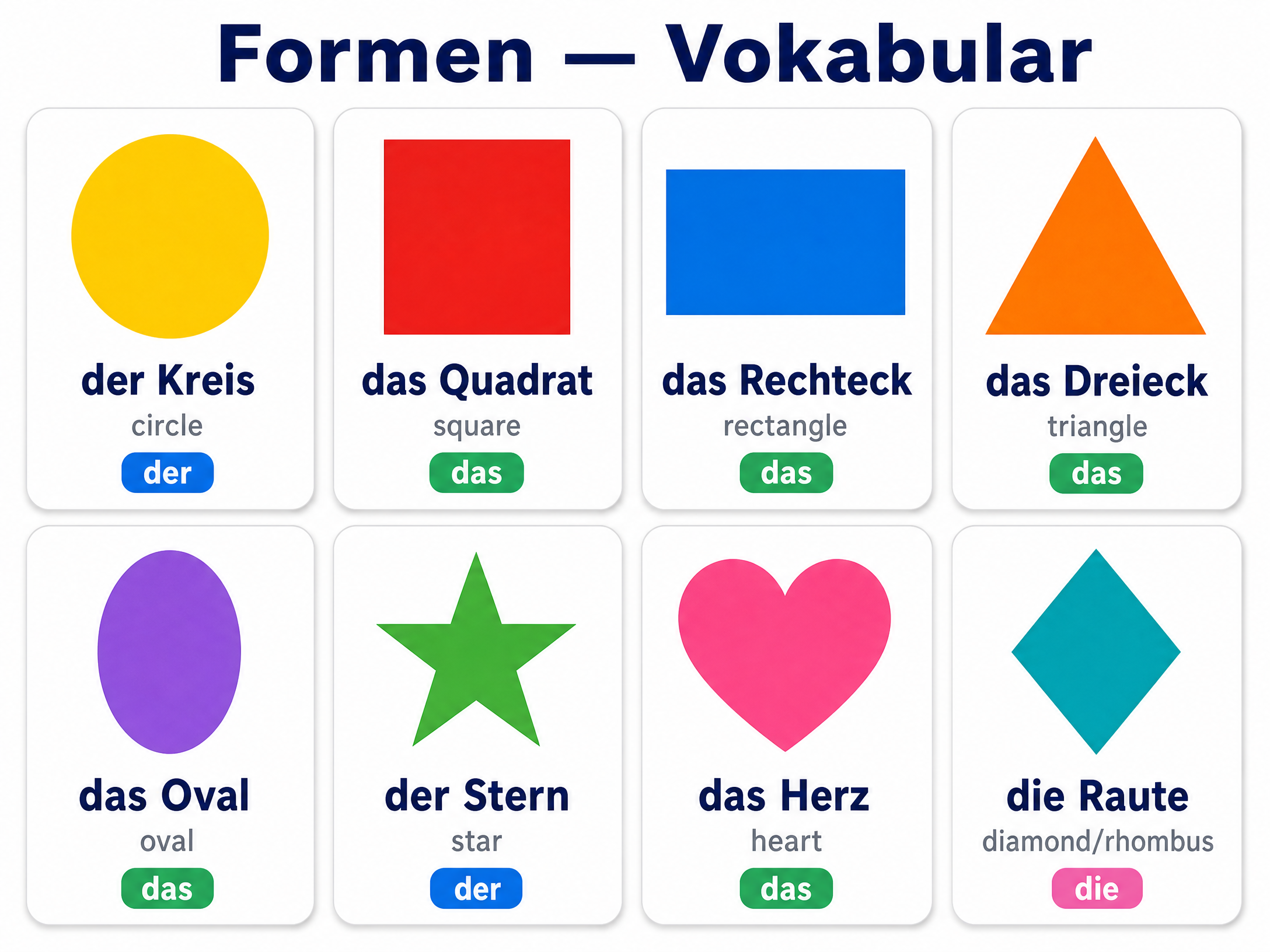
Tier 1 — Foundation Core
| German | English | Gender | Example Sentence |
|---|---|---|---|
| der Kreis | circle | m | Das Logo ist ein Kreis. |
| das Quadrat | square | n | Der Tisch ist ein Quadrat. |
| das Rechteck | rectangle | n | Das Fenster ist ein Rechteck. |
| das Dreieck | triangle | n | Das Schild ist ein Dreieck. |
| das Oval | oval | n | Der Spiegel ist ein Oval. |
| der Stern | star | m | Ich sehe einen Stern am Himmel. |
| das Herz | heart | n | Sie hat ein rotes Herz gezeichnet. |
| die Raute | diamond/rhombus | f | Das Muster hat eine Raute. |
| rund | round | - | Der Ball ist rund. |
| eckig | angular | - | Die Box ist eckig. |
| viereckig | square/rectangular | - | Das Zimmer ist viereckig. |
| dreieckig | triangular | - | Das Dach ist dreieckig. |
| oval | oval (adj) | - | Das Gesicht ist oval. |
| der Kasten | box/crate | m | Der Kasten ist schwer. |
| die Form | shape/form | f | Welche Form hat das Gebäude? |
Tier 2 — Higher Tier
| German | English | Gender | Example Sentence |
|---|---|---|---|
| der Karton | cardboard box | m | Wir brauchen einen Karton für den Umzug. |
| die Schachtel | small box/carton | f | Er kaufte eine Schachtel Pralinen. |
| die Geometrie | geometry | f | Geometrie ist mein Lieblingsfach. |
| symmetrisch | symmetrical | - | Das Design ist völlig symmetrisch. |
| asymmetrisch | asymmetrical | - | Das moderne Haus ist asymmetrisch. |
| parallel | parallel | - | Die Linien sind parallel. |
| der Umfang | perimeter/circumference | m | Der Umfang des Kreises ist groß. |
| die Fläche | area/surface | f | Die Fläche des Quadrats ist klein. |
| der Würfel | cube | m | Der Würfel hat sechs Seiten. |
| die Kugel | sphere | f | Die Erde ist eine Kugel. |
High-Frequency Words & Phrases
| Phrase | English | Usage Context |
|---|---|---|
| in Form von | in the shape of | Describing objects (e.g., in Form von einem Stern) |
| es sieht aus wie | it looks like | Describing appearances in speaking/writing |
| auf der linken Seite | on the left side | Photo card descriptions |
| auf der rechten Seite | on the right side | Photo card descriptions |
| im Vordergrund | in the foreground | Photo card descriptions |
| im Hintergrund | in the background | Photo card descriptions |
| es hat Ecken | it has corners | Describing objects |
| es hat keine Ecken | it has no corners | Describing round objects |
| rund um | around | Preposition for location |
| kreisförmig | circular | Alternative to 'rund' for formal writing |
📝 Grammar Focus
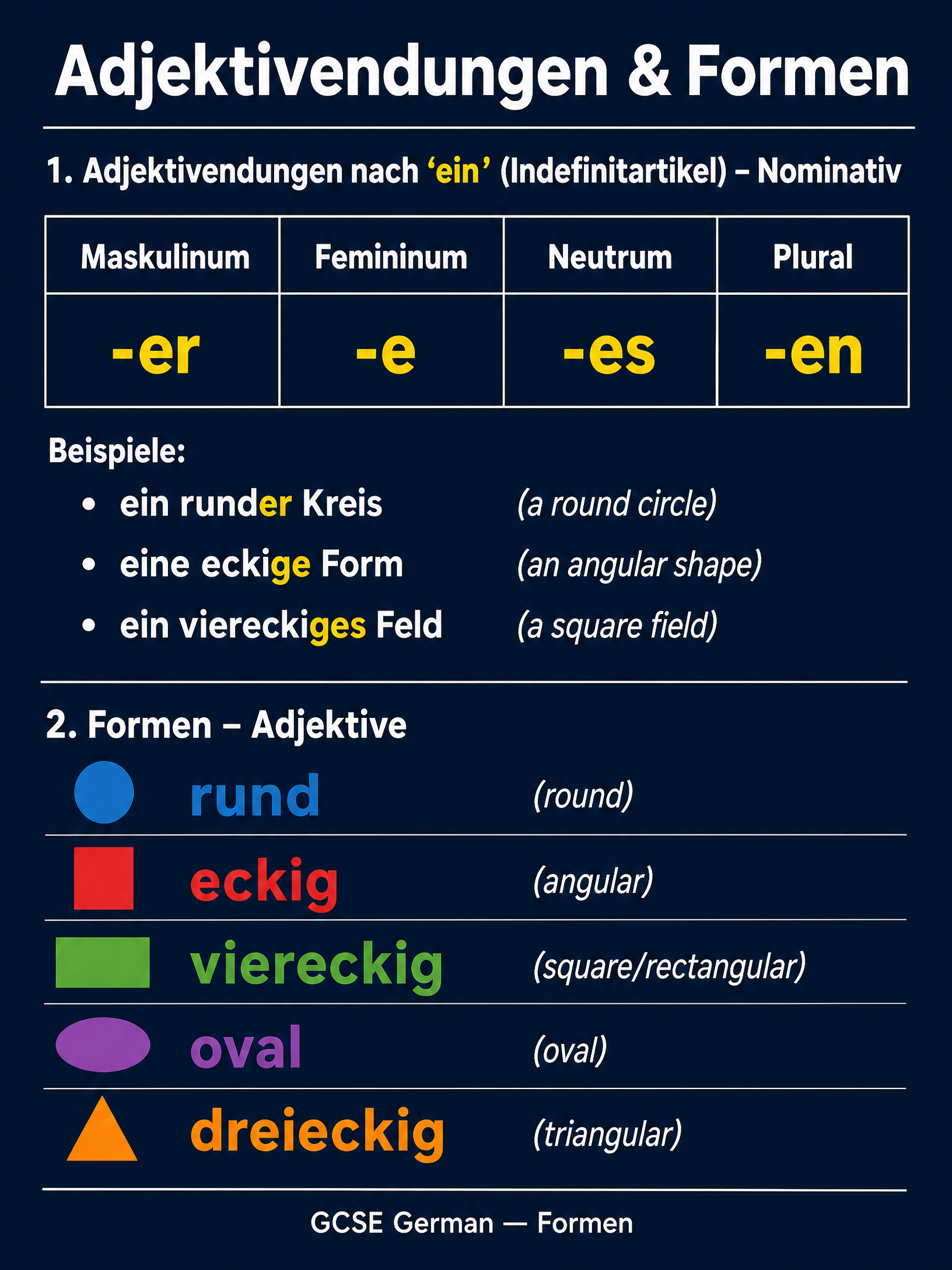
Key Structure 1: Adjective Endings after 'ein' (Nominative)
When to use it: When describing a shape using an indefinite article (a/an) as the subject of the sentence or after the verb 'sein' (to be).
Conjugation Table (Endings)
| Gender | Article | Adjective Ending | Example | English |
|---|---|---|---|---|
| Maskulinum | ein | -er | ein runder Kreis | a round circle |
| Femininum | eine | -e | eine eckige Form | an angular shape |
| Neutrum | ein | -es | ein viereckiges Feld | a square field |
| Plural | keine | -en | keine runden Kreise | no round circles |
Irregulars to learn: Adjectives ending in -el or -er often drop the 'e' before the ending (e.g., dunkel -> ein dunkles Zimmer), but shape adjectives are generally regular.
Key Structure 2: Adjective Endings after 'der/die/das' (Nominative)
When to use it: When describing a specific shape using a definite article (the).
Conjugation Table (Endings)
| Gender | Article | Adjective Ending | Example | English |
|---|---|---|---|---|
| Maskulinum | der | -e | der runde Kreis | the round circle |
| Femininum | die | -e | die eckige Form | the angular shape |
| Neutrum | das | -e | das viereckige Feld | the square field |
| Plural | die | -en | die runden Kreise | the round circles |
Key Structure 3: The Verb 'aussehen' (to look like)
When to use it: A separable verb crucial for describing shapes and appearances, especially in the Speaking exam.
Conjugation Table
| Subject | Verb Form | English |
|---|---|---|
| ich | sehe ... aus | I look (like) |
| du | siehst ... aus | you look (like) |
| er/sie/es | sieht ... aus | he/she/it looks (like) |
| wir | sehen ... aus | we look (like) |
| ihr | seht ... aus | you (pl) look (like) |
| sie/Sie | sehen ... aus | they/You look (like) |
Example: Das Gebäude sieht wie ein riesiger Würfel aus. (The building looks like a giant cube.)
🎧 Listening Skills
What to Expect
In the listening exam, shape vocabulary often appears in descriptions of lost property (e.g., a bag or suitcase), directions involving landmarks (e.g., a round square), or descriptions of buildings and rooms.
Listening Strategies
- Listen for cognates: Words like Oval, symmetrisch, and parallel sound very similar to English.
- Watch for adjectives vs nouns: Listen carefully to whether the speaker says rund (the adjective) or der Kreis (the noun).
- Note prefixes: Words like viereckig (four-cornered) and dreieckig (three-cornered) give you the shape directly through the number prefix.
Common Listening Traps
- Kreis vs Kreuz: Kreis means circle, Kreuz means cross. They sound similar but are very different shapes.
- Kasten vs Karton: Both are boxes, but Karton is specifically cardboard, while Kasten can be wood or plastic.
🗣️ Speaking Skills
Role Play Scenarios
Scenario 1: At the lost property office (Fundbüro)
- Official: Wie sieht Ihre Tasche aus? (What does your bag look like?)
- You: Sie ist groß und viereckig. Sie hat die Form eines Kastens. (It is big and rectangular. It has the shape of a box.)
Scenario 2: Buying a gift
- Assistant: Möchten Sie die runde oder die eckige Schachtel? (Would you like the round or the angular box?)
- You: Ich nehme die runde Schachtel, bitte. Sie sieht schöner aus. (I'll take the round box, please. It looks nicer.)
Photo Card Practice
Model Photo Card Response:
- Qu 1 (Description): Auf dem Foto sehe ich ein modernes Gebäude. Es ist sehr ungewöhnlich, weil es völlig rund ist. Es hat die Form eines Kreises.
- Qu 2 (Opinion): Ich finde das Gebäude fantastisch, weil ich moderne Architektur liebe. Symmetrische Formen sind sehr ästhetisch.
- Qu 3 (Related topic): In meiner Stadt gibt es meistens nur viereckige, langweilige Häuser. Wir haben keine interessanten Gebäude.
- Qu 4 (Past/Future): Letztes Jahr habe ich ein Museum in Berlin besucht, das wie ein riesiger Würfel aussah. Es war sehr beeindruckend.
- Qu 5 (Unpredictable): Wenn ich Architekt wäre, würde ich Häuser in Form von Sternen bauen!
General Conversation Questions
| Question (German) | Model Answer | English Translation |
|---|---|---|
| Beschreibe dein Traumhaus. | Mein Traumhaus wäre sehr modern. Es hätte große, viereckige Fenster und vielleicht ein rundes Wohnzimmer. | Describe your dream house. (My dream house would be very modern. It would have big, square windows and maybe a round living room.) |
| Was ist dein Lieblingsobjekt in deinem Zimmer? | Mein Lieblingsobjekt ist mein Spiegel. Er ist groß und oval, und der Rahmen ist aus Holz. | What is your favourite object in your room? (My favourite object is my mirror. It is big and oval, and the frame is made of wood.) |
| Beschreibe das Logo deiner Schule. | Das Logo meiner Schule ist ein blaues Dreieck mit einem gelben Stern in der Mitte. Ich finde es ein bisschen altmodisch. | Describe your school's logo. (My school's logo is a blue triangle with a yellow star in the middle. I find it a bit old-fashioned.) |
| Wie sah dein erstes Handy aus? | Es war sehr klein, dick und viereckig. Es sah wie ein kleiner Kasten aus! | What did your first mobile phone look like? (It was very small, thick and rectangular. It looked like a small box!) |
| Bevorzugst du moderne oder traditionelle Kunst? | Ich mag moderne Kunst, besonders Bilder mit geometrischen Formen wie Kreisen und Quadraten, weil sie sehr ordentlich aussehen. | Do you prefer modern or traditional art? (I like modern art, especially pictures with geometric shapes like circles and squares, because they look very neat.) |
✍️ Writing Skills
Translation Practice
English → German:
| English | German | Key Grammar |
|---|---|---|
| The table is round. | Der Tisch ist rund. | Basic adjective as predicate (no ending). |
| I have a square box. | Ich habe einen viereckigen Kasten. | Adjective ending after 'ein' (Accusative masculine). |
| The building looks like a triangle. | Das Gebäude sieht wie ein Dreieck aus. | Separable verb 'aussehen'. |
| Yesterday I bought a round mirror. | Gestern habe ich einen runden Spiegel gekauft. | Perfect tense + adjective ending. |
| The modern houses are completely asymmetrical. | Die modernen Häuser sind völlig asymmetrisch. | Plural adjective ending after 'die'. |
Extended Writing
**Model 90-word response (Foundation):**Mein Schlafzimmer ist ziemlich groß. Es ist ein viereckiger Raum mit weißen Wänden. In der Mitte gibt es einen runden Teppich. Er ist sehr weich. Mein Bett ist groß und rechteckig. Ich habe auch einen Spiegel. Der Spiegel ist oval. Ich finde mein Zimmer toll, weil es sehr gemütlich ist. Letztes Wochenende habe ich eine neue, sternförmige Lampe gekauft. Sie sieht fantastisch aus! Nächstes Jahr möchte ich mein Zimmer blau streichen.
**Model 150-word response (Higher):**Wenn ich an moderne Architektur denke, denke ich sofort an interessante geometrische Formen. In meiner Heimatstadt sind die meisten Gebäude sehr traditionell; sie sind einfach viereckige Kästen mit dreieckigen Dächern. Das finde ich ziemlich langweilig. Letzten Sommer bin ich jedoch nach München gefahren und habe dort fantastische Architektur gesehen. Ein Gebäude sah wie ein riesiger, silberner Würfel aus, und ein anderes hatte die Form eines perfekten Kreises. Es war unglaublich beeindruckend!
Meiner Meinung nach sollten Architekten kreativer sein und mehr asymmetrische oder runde Formen verwenden, weil das viel moderner und ästhetischer aussieht. In der Zukunft möchte ich in einem Haus wohnen, das völlig ungewöhnlich ist — vielleicht in Form eines Sterns! Obwohl solche Häuser wahrscheinlich sehr teuer sind, glaube ich, dass das Design genauso wichtig ist wie die Funktionalität.
Writing Checklist
- ✅ Have you used shape adjectives with the correct endings?
- ✅ Have you remembered that 'Kreis' is a noun and 'rund' is an adjective?
- ✅ Have you used at least three tenses (Past, Present, Future/Conditional)?
- ✅ Have you included justified opinions (weil/da)?
📚 Reading Skills
Key Strategies
When reading descriptions of objects, rooms, or buildings, highlight the shape words. They often hold the key to answering specific multiple-choice or matching questions. Pay attention to compound words — German loves to combine words, so you might see kreisförmig (circle-shaped) or sternförmig (star-shaped).
False Friends & Tricky Words
| Word | Looks Like | Actually Means |
|---|---|---|
| das Oval | oval | oval (True friend!) |
| der Kreis | cross | circle (Cross is 'das Kreuz') |
| die Form | form (document) | shape/form (Document is 'das Formular') |
| der Karton | cartoon | cardboard box (Cartoon is 'der Cartoon' or 'der Trickfilm') |
🌍 Cultural Knowledge
Germany is famous for the Bauhaus movement, an influential art and architecture school from the early 20th century. Bauhaus design heavily features basic geometric shapes — squares (Quadrate), circles (Kreise), and triangles (Dreiecke) — and primary colours. Mentioning Bauhaus architecture when describing buildings in a writing or speaking task shows excellent cultural awareness and will impress the examiner!
Visual Resources
2 diagrams and illustrations
Interactive Diagrams
1 interactive diagram to visualise key concepts
Conceptual Flow Outline
Decision tree for using shape vocabulary correctly
Worked Examples
4 detailed examples with solutions and examiner commentary
Practice Questions
Test your understanding — click to reveal model answers
Speaking: How would you describe a rectangular swimming pool in a photo card task?
Hint: Use the adjective for rectangular and remember the word for swimming pool (das Schwimmbad).
Writing: Translate 'The plates are round, but the table is square.'
Hint: Watch out for the plural verb for plates, and use the correct adjectives as predicates (no endings needed).
Listening: You hear 'Das Gebäude ist nicht rund, es hat viele Ecken.' What shape is the building?
Hint: Listen for the negative and the word for corners.
Reading: Read the text: 'Das neue Museum hat die Form eines großen, silbernen Würfels.' What does the museum look like?
Hint: Look for the word 'Würfel'.
Writing (Higher): Write a sentence explaining why you prefer symmetrical buildings, using a subordinate clause.
Hint: Use 'weil' or 'da' and remember to send the verb to the end.
Translation: Translate 'I bought a cardboard box in the shape of a heart.'
Hint: Use the phrase 'in Form von' or 'in der Form eines'. Watch out for the false friend!