Study Notes
Overview
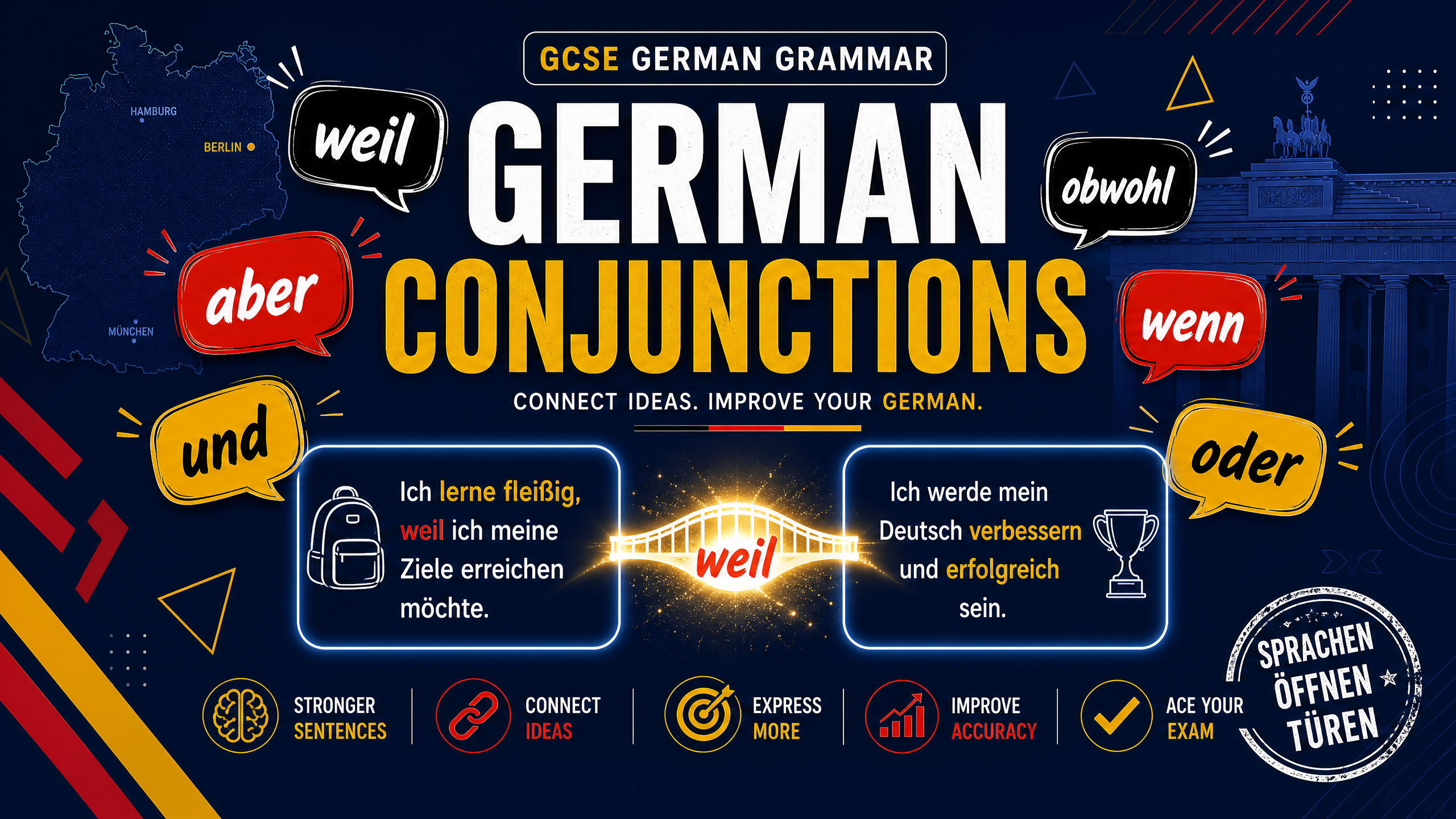
Conjunctions are the 'glue' that holds sentences together. In GCSE German, using a variety of conjunctions is one of the easiest ways to demonstrate range of language and secure higher marks. This topic appears in all four skills (Listening, Speaking, Reading, Writing). Examiners specifically look for subordinating conjunctions to award top marks for grammatical complexity.
🎧 The Revision Podcast
Listen to our 10-minute deep dive into German conjunctions, covering all the rules, memory tricks, and exam traps!
📖 Essential Vocabulary
Tier 1 — Foundation Core (Coordinating Conjunctions)
| German | English | Function | Example Sentence |
|---|---|---|---|
| und | and | Adds information | Ich spiele Fußball und ich schwimme gern. |
| aber | but | Shows contrast | Ich mag Mathe, aber es ist schwer. |
| oder | or | Offers an alternative | Gehen wir ins Kino oder bleiben wir hier? |
| denn | because | Gives a reason | Ich lerne Deutsch, denn es ist nützlich. |
| sondern | but rather | Corrects a negative | Ich trinke keinen Kaffee, sondern ich trinke Tee. |
Tier 2 — Higher Tier (Subordinating Conjunctions)
| German | English | Function | Example Sentence |
|---|---|---|---|
| weil | because | Gives a reason | Ich lerne Deutsch, weil es nützlich ist. |
| obwohl | although | Shows contrast | Ich gehe schwimmen, obwohl es kalt ist. |
| wenn | when / if | Condition / Habit | Ich spiele am Computer, wenn ich Zeit habe. |
| als | when (past) | Single past event | Als ich jünger war, spielte ich oft Tennis. |
| dass | that | Connects clauses | Ich denke, dass das eine gute Idee ist. |
| damit | so that | Expresses purpose | Ich lerne viel, damit ich gute Noten bekomme. |
| bevor | before | Time sequence | Ich mache Hausaufgaben, bevor ich fernsehe. |
| nachdem | after | Time sequence | Ich gehe ins Bett, nachdem ich ein Buch gelesen habe. |
| seitdem | since | Time reference | Ich spiele Gitarre, seitdem ich acht Jahre alt bin. |
| ob | whether / if | Indirect question | Ich weiß nicht, ob er heute kommt. |
High-Frequency Words & Phrases
| Phrase | English | Usage Context |
|---|---|---|
| entweder ... oder | either ... or | Giving two options |
| weder ... noch | neither ... nor | Excluding two options |
| nicht nur ... sondern auch | not only ... but also | Adding emphasis |
| einerseits ... andererseits | on the one hand ... on the other hand | Discussing pros and cons |
| sowohl ... als auch | both ... and | Linking two positive points |
📝 Grammar Focus
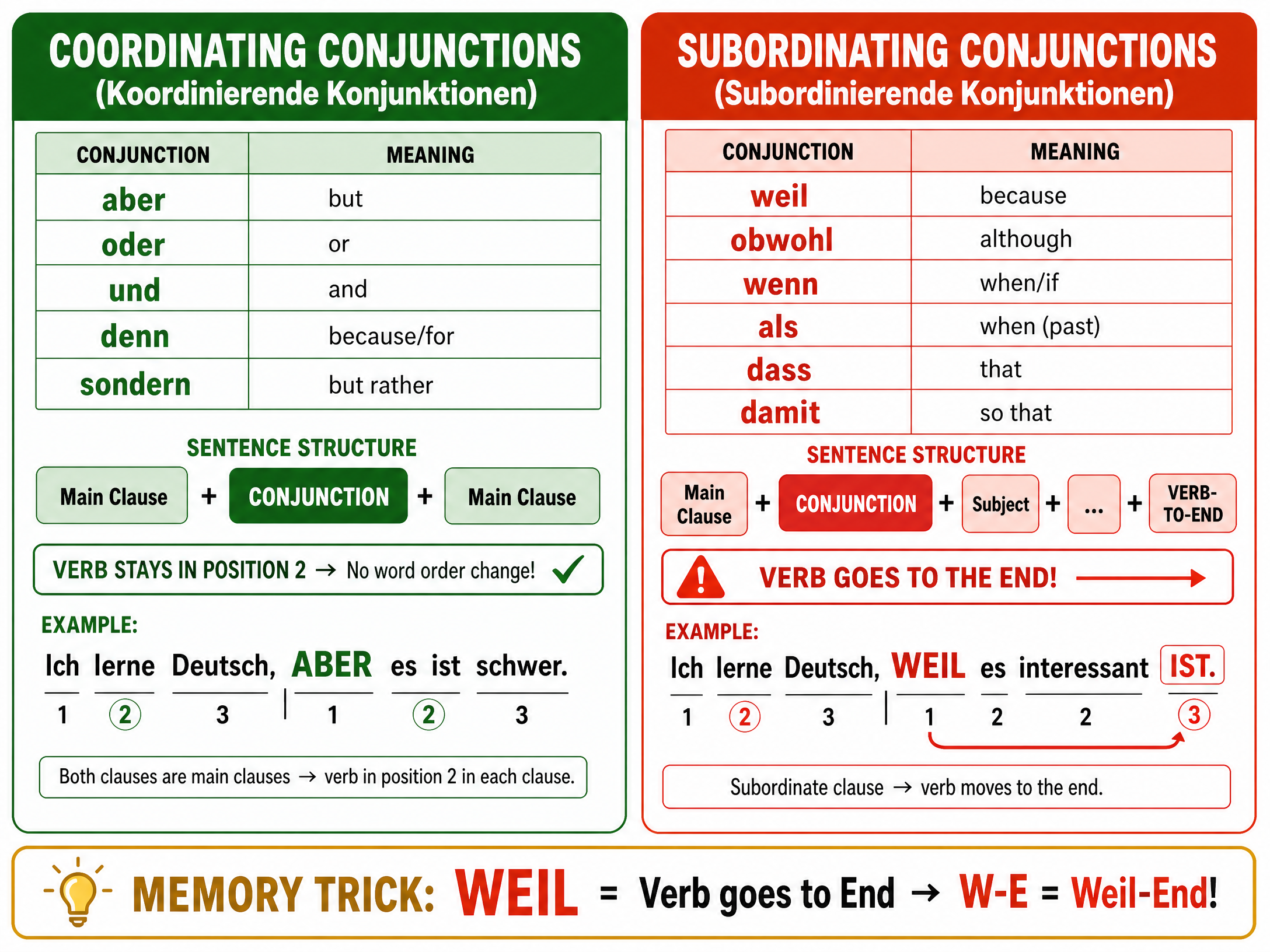
Key Structure 1: Coordinating Conjunctions (The V2 Rule)
When to use it: Use these to join two main clauses. The word order in the second clause does not change.
Rule: Clause 1 + Conjunction + Clause 2 (Subject + Verb + Rest)
The Big Five (ADUSO)
| Conjunction | English | Word Order Effect |
|---|---|---|
| Aber | but | None (V2) |
| Denn | because | None (V2) |
| Und | and | None (V2) |
| Sondern | but rather | None (V2) |
| Oder | or | None (V2) |
Key Structure 2: Subordinating Conjunctions (The Verb-End Rule)
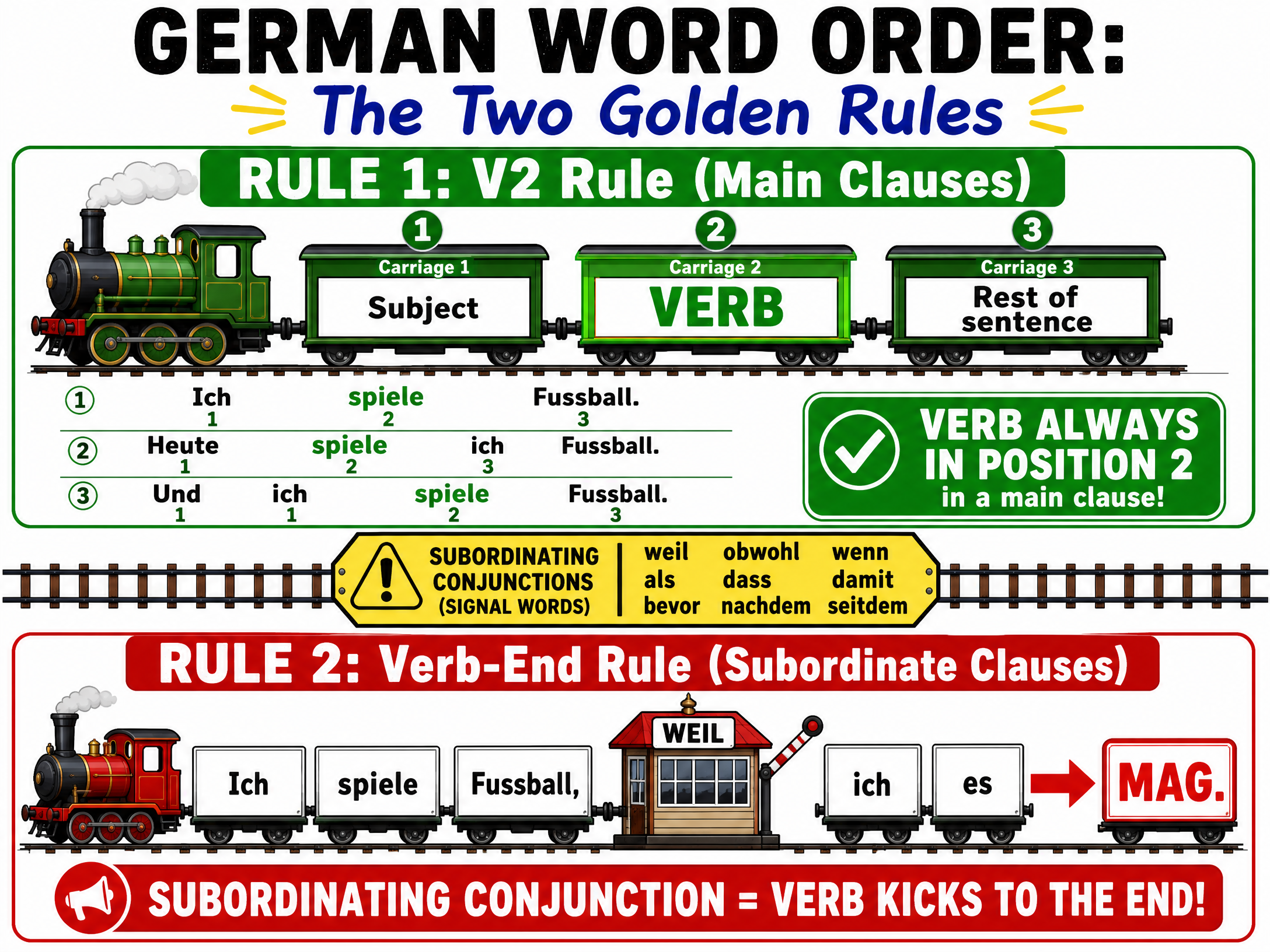
When to use it: Use these to introduce a subordinate clause. The conjugated verb is 'kicked' to the very end of the clause.
Rule: Main Clause + , + Conjunction + Subject + Rest + VERB.
Examples of Verb-End
| Main Clause | Conjunction | Subject | Rest | Verb (End) |
|---|---|---|---|---|
| Ich bleibe zu Hause | , weil | ich | krank | bin. |
| Er lernt viel | , damit | er | die Prüfung | besteht. |
| Wir spielen Fußball | , obwohl | es | stark | regnet. |
Key Structure 3: Starting with a Subordinate Clause
When to use it: To sound like a native speaker and score top marks for complex syntax, start your sentence with the subordinate clause.
Rule: Conjunction + Subject + Rest + VERB 1 + , + VERB 2 + Subject + Rest.
(Also known as the 'Comma-Verb-Verb' rule)
Examples:
- Weil ich krank bin, bleibe ich zu Hause.
- Wenn ich Zeit habe, gehe ich ins Kino.
- Obwohl es regnet, spielen wir Fußball.
🎧 Listening Skills
What to Expect
In the listening exam, conjunctions are often used as distractors. You might hear someone state an opinion, followed by 'aber' (but) or 'obwohl' (although), which completely changes the meaning of what they just said.
Listening Strategies
- Listen for the 'Turn': Words like aber, obwohl, and sondern indicate a change in direction. The speaker's true opinion usually comes after these words.
- Identify Reasons: Listen out for weil and denn. Examiners love to ask 'Why does the speaker like X?' The answer will follow these words.
- Watch for Past vs Present: Pay attention to wenn vs als. Als tells you they are talking about the past.
Common Listening Traps
- Hearing a negative statement, then missing the sondern (but rather) which gives the actual positive answer.
- Confusing denn (because) with dann (then).
🗣️ Speaking Skills
Role Play Scenarios
Scenario 1: In a restaurant
- Examiner: Was möchten Sie trinken?
- Candidate: Ich möchte einen Kaffee, aber ohne Milch, bitte.
Scenario 2: Buying a train ticket
- Examiner: Warum fahren Sie nach Berlin?
- Candidate: Ich fahre nach Berlin, weil ich meine Tante besuche.
Photo Card Practice
Model Photo Card Response (Theme: School):
- Qu 1 (Description): Auf dem Foto gibt es drei Schüler. Sie lernen in der Bibliothek, weil sie eine Prüfung haben.
- Qu 2 (Opinion): Ich finde die Bibliothek gut, obwohl sie manchmal zu laut ist.
- Qu 3 (Related topic): Nächstes Jahr werde ich auf die Uni gehen, damit ich Medizin studieren kann.
- Qu 4 (Past/Future): Als ich jünger war, hasste ich die Schule, aber jetzt mag ich sie.
- Qu 5 (Unpredictable): Hausaufgaben sind wichtig, denn man muss den Stoff üben.
General Conversation Questions
| Question (German) | Model Answer | English Translation |
|---|---|---|
| Was machst du in deiner Freizeit? | Ich spiele gern Fußball, weil ich gern draußen bin. | I like playing football because I like being outside. |
| Wie findest du deine Stadt? | Ich mag meine Stadt, obwohl es hier nicht viel zu tun gibt. | I like my town, although there isn't much to do here. |
| Was hast du letztes Wochenende gemacht? | Als das Wetter schön war, sind wir in den Park gegangen. | When the weather was nice, we went to the park. |
| Was wirst du in der Zukunft machen? | Ich werde an der Uni studieren, damit ich einen guten Job bekomme. | I will study at university so that I get a good job. |
| Ist es wichtig, Fremdsprachen zu lernen? | Ja, weil man andere Kulturen besser verstehen kann. | Yes, because you can understand other cultures better. |
✍️ Writing Skills
Translation Practice
English → German:
| English | German | Key Grammar |
|---|---|---|
| I play tennis and I swim. | Ich spiele Tennis und ich schwimme. | Coordinating (und) - V2 |
| I learn German because it is fun. | Ich lerne Deutsch, weil es Spaß macht. | Subordinating (weil) - Verb End |
| I stay at home when it rains. | Ich bleibe zu Hause, wenn es regnet. | Subordinating (wenn) - Verb End |
| Although I am tired, I do my homework. | Obwohl ich müde bin, mache ich meine Hausaufgaben. | Comma-Verb-Verb rule |
| When I was younger, I played the piano. | Als ich jünger war, spielte ich Klavier. | Als + Comma-Verb-Verb |
Extended Writing
**Model 90-word response (Foundation) - Topic: Free Time:**In meiner Freizeit spiele ich gern Fußball, weil es sehr gesund ist. Ich spiele jeden Samstag mit meinen Freunden im Park. Letztes Wochenende haben wir ein Spiel gewonnen und das war toll. Nächstes Wochenende werde ich ins Kino gehen, obwohl die Tickets sehr teuer sind. Ich mag Filme, denn sie sind spannend. Normalerweise sehe ich Komödien, aber manchmal sehe ich auch Actionfilme.
**Model 150-word response (Higher) - Topic: Holidays:**Letztes Jahr bin ich nach Spanien gefahren, weil das Wetter dort immer sonnig ist. Als wir angekommen sind, sind wir sofort an den Strand gegangen. Ich finde Strandurlaube wunderbar, obwohl sie manchmal ein bisschen langweilig sein können. Mein Bruder wollte nicht schwimmen, sondern er wollte in der Stadt einkaufen gehen. Nächstes Jahr werden wir vielleicht nach Österreich fahren, damit ich mein Deutsch üben kann. Wenn ich älter bin, möchte ich eine Weltreise machen. Ich denke, dass Reisen extrem wichtig ist, denn man lernt viel über andere Kulturen. Obwohl es teuer ist, lohnt es sich auf jeden Fall.
Writing Checklist
- ✅ Have I used at least one weil or obwohl?
- ✅ Have I sent the verb to the end after subordinating conjunctions?
- ✅ Have I remembered the comma before subordinating conjunctions?
- ✅ Have I used the Comma-Verb-Verb rule to start a sentence?
- ✅ Have I used als for the past and wenn for the present/future?
📚 Reading Skills
Key Strategies
- Look for the Comma: In German reading texts, a comma often signals a subordinate clause. Use this to break long, scary sentences down into manageable chunks.
- Find the Verb: If you see weil or obwohl, scan straight to the end of the clause to find the verb. This will tell you the main action of the sentence.
False Friends & Tricky Words
| Word | Looks Like | Actually Means |
|---|---|---|
| denn | then | because (dann = then) |
| als | also | when (in the past) (auch = also) |
| wenn | when | when/if (wann = question word 'when') |
| dass | das (the) | that (conjunction) |
🌍 Cultural Knowledge
In German-speaking countries, expressing ideas clearly and logically is highly valued. The structured nature of German grammar, particularly the strict rules surrounding conjunctions and word order, reflects a cultural preference for order and clarity. When writing formal letters or emails in Germany (e.g., applying for an internship or work experience), using complex sentences with subordinating conjunctions (like da, weil, obwohl) demonstrates high education and professionalism. Mastering these structures doesn't just get you exam marks; it makes you sound polite and educated to native speakers.
Visual Resources
2 diagrams and illustrations
Interactive Diagrams
1 interactive diagram to visualise key concepts
Conceptual Flow Outline
Decision tree for German word order with conjunctions
Worked Examples
4 detailed examples with solutions and examiner commentary
Practice Questions
Test your understanding — click to reveal model answers
Writing: Translate into German: 'I learn German because it is interesting, but it is difficult.'
Hint: You need one subordinating conjunction (because) and one coordinating conjunction (but). Watch your verb positions!
Writing: Rewrite these two sentences as one, starting with 'Obwohl': 'Es regnet. Wir spielen Fußball.'
Hint: Remember the Comma-Verb-Verb rule when starting a sentence with a subordinating conjunction.
Reading: Read the sentence and answer in English: 'Als ich zehn Jahre alt war, bin ich nach Berlin gefahren.' When did the person go to Berlin?
Hint: What does 'Als' mean in the context of the past?
Speaking: How would you extend this basic sentence using 'damit'? 'Ich lerne viel.' (To get good grades)
Hint: 'damit' means 'so that' and sends the verb to the end.
Writing: Fill in the blank with either 'wenn' or 'als': '_______ ich gestern in der Stadt war, habe ich ein T-Shirt gekauft.'
Hint: Is this a repeated action or a single event in the past?
Writing: Correct the mistake in this sentence: 'Ich gehe ins Bett, weil ich bin müde.'
Hint: Look at the conjunction 'weil'. What does it do to the verb?