Study Notes
Overview

Theme 3: Current and future study and employment is a highly rewarding topic in GCSE German. It covers your life at school, your plans for post-16 education, and your career ambitions. Examiners love this theme because it naturally invites the use of three tenses: talking about past work experience (Perfekt), current school life (Präsens), and future career plans (Futur I / Konjunktiv II). Mastering this topic will significantly boost your marks across all four skills: Listening, Speaking, Reading, and Writing.
Listen to the audio podcast below for a comprehensive walk-through of the key vocabulary, grammar, and exam tips for this theme:
📖 Essential Vocabulary
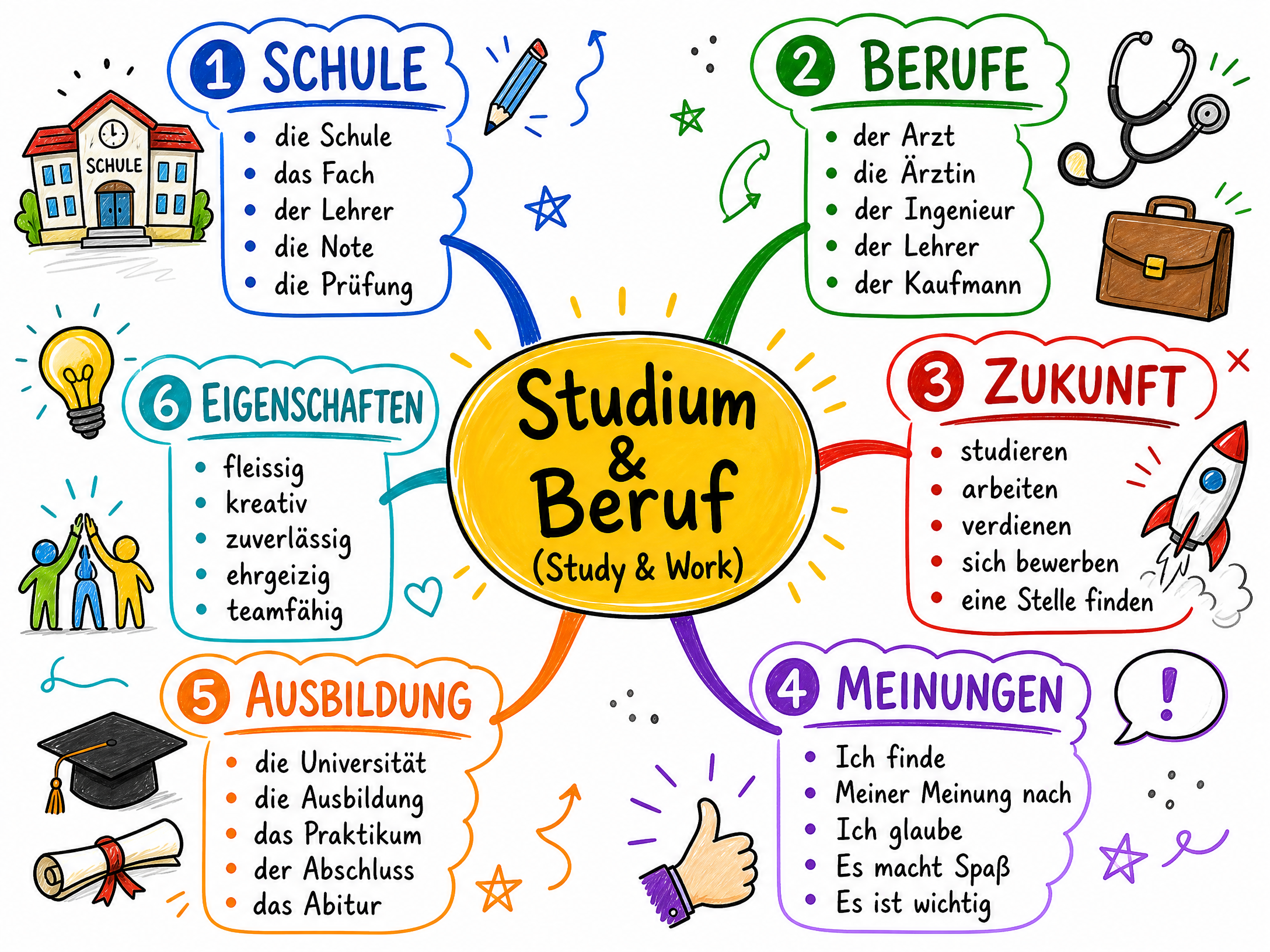
Tier 1 — Foundation Core
| German | English | Gender | Example Sentence |
|---|---|---|---|
| die Schule | school | f | Ich gehe gern in die Schule. (I like going to school.) |
| das Fach | subject | n | Mein Lieblingsfach ist Mathe. (My favourite subject is maths.) |
| der Lehrer | teacher (male) | m | Der Lehrer ist sehr streng. (The teacher is very strict.) |
| die Note | grade / mark | f | Ich habe gute Noten bekommen. (I got good grades.) |
| die Prüfung | exam / test | f | Nächste Woche habe ich eine Prüfung. (Next week I have an exam.) |
| der Beruf | job / profession | m | Welchen Beruf möchtest du haben? (Which job would you like to have?) |
| arbeiten | to work | - | Ich arbeite am Wochenende in einem Café. (I work in a café at the weekend.) |
| das Praktikum | work experience | n | Ich habe ein Praktikum im Krankenhaus gemacht. (I did work experience in a hospital.) |
| verdienen | to earn | - | Ich möchte viel Geld verdienen. (I would like to earn a lot of money.) |
| studieren | to study (at university) | - | Ich werde an der Universität studieren. (I will study at university.) |
| fleißig | hard-working | - | Man muss fleißig sein, um gute Noten zu bekommen. (One must be hard-working to get good grades.) |
| faul | lazy | - | Mein Bruder ist manchmal ziemlich faul. (My brother is sometimes quite lazy.) |
| interessant | interesting | - | Ich finde Geschichte sehr interessant. (I find history very interesting.) |
| langweilig | boring | - | Physik ist ein bisschen langweilig. (Physics is a bit boring.) |
| wichtig | important | - | Fremdsprachen sind wichtig für die Zukunft. (Foreign languages are important for the future.) |
Tier 2 — Higher Tier
| German | English | Gender | Example Sentence |
|---|---|---|---|
| die Ausbildung | apprenticeship / training | f | Nach der Schule mache ich eine Ausbildung. (After school I am doing an apprenticeship.) |
| sich bewerben um | to apply for | - | Ich werde mich um eine Stelle bewerben. (I will apply for a job.) |
| der Abschluss | qualification / degree | m | Ein guter Abschluss ist sehr nützlich. (A good qualification is very useful.) |
| die Erfahrung | experience | f | Arbeitserfahrung ist ein großer Vorteil. (Work experience is a big advantage.) |
| verantwortungsbewusst | responsible | - | In diesem Beruf muss man verantwortungsbewusst sein. (In this job one must be responsible.) |
| selbstständig | independent | - | Ich arbeite gern selbstständig. (I like working independently.) |
| der Arbeitgeber | employer | m | Mein Arbeitgeber ist sehr freundlich. (My employer is very friendly.) |
| der Lebenslauf | CV / resume | m | Ich muss meinen Lebenslauf schreiben. (I have to write my CV.) |
| das Vorstellungsgespräch | job interview | n | Morgen habe ich ein Vorstellungsgespräch. (Tomorrow I have a job interview.) |
| nützlich | useful | - | Computerkenntnisse sind heutzutage sehr nützlich. (Computer skills are very useful nowadays.) |
High-Frequency Words & Phrases
| Phrase | English | Usage Context |
|---|---|---|
| Meiner Meinung nach | In my opinion | Speaking/Writing: introducing a justified opinion. |
| Ich bin der Meinung, dass | I am of the opinion that | Speaking/Writing: strong opinion phrase (sends verb to end). |
| Einerseits ... andererseits | On the one hand ... on the other hand | Writing: balancing an argument (e.g., pros/cons of a job). |
| Um ... zu | In order to | Writing: showing purpose (e.g., in order to earn money). |
| Ich habe vor, ... zu | I intend to | Speaking/Writing: future plans with infinitive. |
| Es macht Spaß | It is fun | Speaking: giving reasons for liking a subject/job. |
| In der Zukunft | In the future | Speaking/Writing: introducing future tense. |
| Letztes Jahr | Last year | Speaking/Writing: introducing past tense (work experience). |
| Wenn ich älter bin | When I am older | Speaking/Writing: conditional/future plans. |
| Obwohl es anstrengend ist | Although it is tiring | Writing: complex sentence showing contrast. |
📝 Grammar Focus
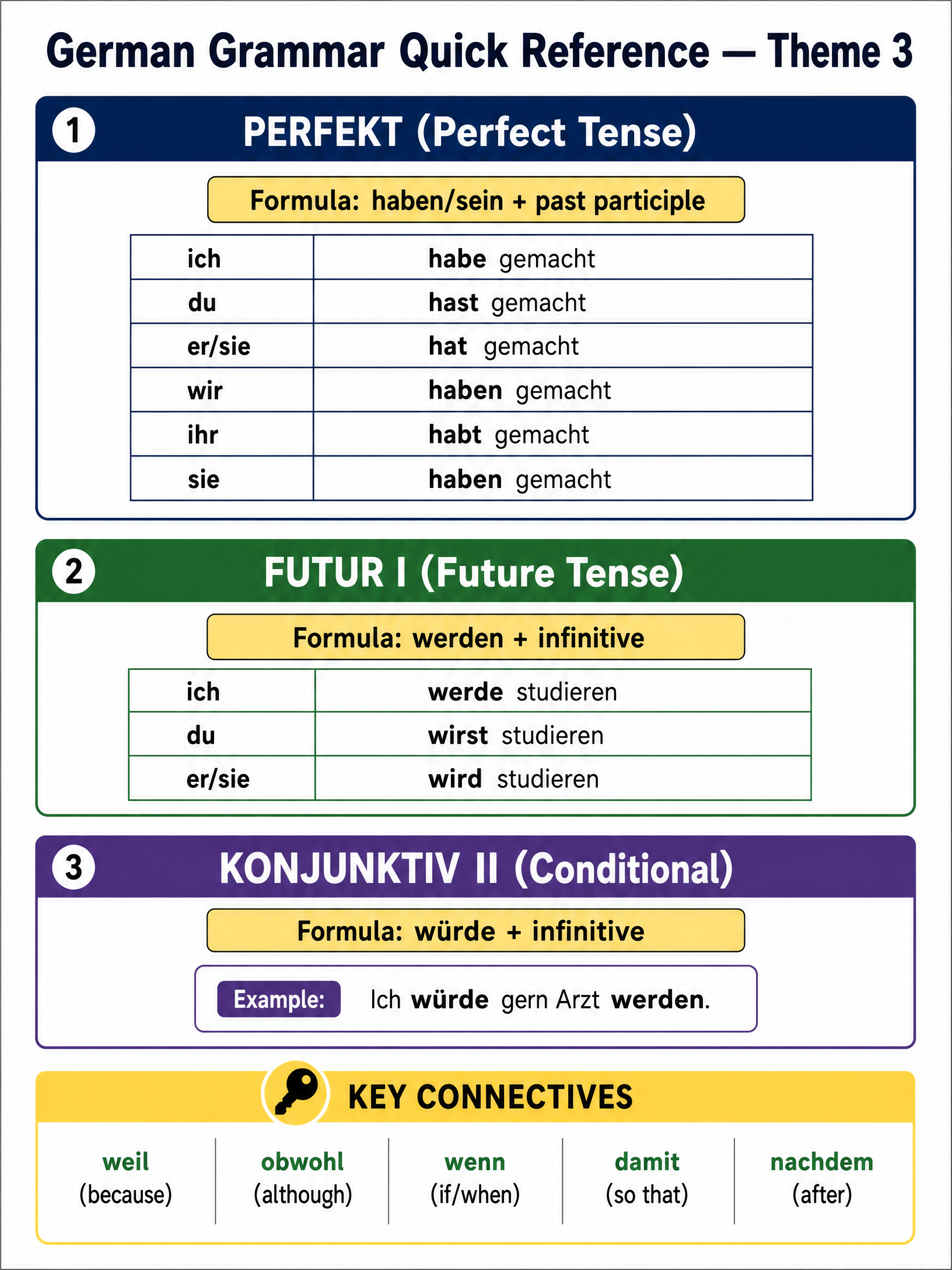
Key Structure 1: Das Perfekt (The Perfect Tense)
When to use it: To describe completed actions in the past. Essential for talking about your work experience (das Praktikum) or what you did at school last week. It requires an auxiliary verb (haben or sein) and a past participle at the end of the clause.
Conjugation Table (haben - to have)
| Subject | Verb Form | English |
|---|---|---|
| ich | habe | I have |
| du | hast | you (informal) have |
| er/sie/es | hat | he/she/it has |
| wir | haben | we have |
| ihr | habt | you (plural) have |
| sie/Sie | haben | they / you (formal) have |
Irregulars to learn: gemacht (done), geschrieben (written), gesprochen (spoken), gelesen (read), gesehen (seen). Remember that movement verbs use 'sein' (to be): gegangen (gone), gefahren (travelled), geblieben (stayed - exception to movement rule).
Key Structure 2: Futur I (The Future Tense)
When to use it: To state exactly what you will do in the future, such as your definitive career plans or university choices. Formed using the auxiliary verb 'werden' (to become/will) and the infinitive of the main verb at the end of the clause.
Conjugation Table (werden - will/to become)
| Subject | Verb Form | English |
|---|---|---|
| ich | werde | I will |
| du | wirst | you (informal) will |
| er/sie/es | wird | he/she/it will |
| wir | werden | we will |
| ihr | werdet | you (plural) will |
| sie/Sie | werden | they / you (formal) will |
Irregulars to learn: The infinitive at the end never changes! e.g., Ich werde Medizin studieren. (I will study medicine.)
Key Structure 3: Konjunktiv II (The Conditional)
When to use it: To express desires, wishes, or hypothetical situations. Perfect for discussing dream jobs or what you would do if you had the choice. Formed using 'würde' (would) and the infinitive at the end of the clause.
Conjugation Table (würden - would)
| Subject | Verb Form | English |
|---|---|---|
| ich | würde | I would |
| du | würdest | you (informal) would |
| er/sie/es | würde | he/she/it would |
| wir | würden | we would |
| ihr | würdet | you (plural) would |
| sie/Sie | würden | they / you (formal) would |
Irregulars to learn: Add 'gern' or 'lieber' to express preference: Ich würde gern Arzt werden. (I would like to become a doctor.)
🎧 Listening Skills
What to Expect
Listening tasks on this theme often feature young people discussing their school day, comparing subjects, or describing their work experience. Higher-tier questions may involve interviews with professionals discussing the pros and cons of their jobs, or students detailing their complex future career paths.
Listening Strategies
- Predict the Vocabulary: During the 5 minutes of reading time, identify the topic and brainstorm 5-10 related German words. If the question is about 'Jobs', think: arbeiten, verdienen, der Beruf, anstrengend.
- Listen for Negatives: Examiners love using 'nicht' (not), 'kein' (no/not any), and 'nie' (never) to flip the meaning. 'Ich möchte nicht an der Uni studieren' means the opposite of 'I want to study at university'.
- Note Tense Indicators: Listen out for time markers like 'gestern' (yesterday), 'früher' (in the past), 'morgen' (tomorrow), or 'in der Zukunft' (in the future) to determine if they are talking about a past work experience or a future plan.
Common Listening Traps
- False Friends: 'Das Gymnasium' means a grammar school, NOT a gymnasium/sports hall (die Turnhalle). 'Der Chef' means the boss, NOT a cook (der Koch).
- Qualifiers: Pay attention to words like 'ziemlich' (quite), 'sehr' (very), 'zu' (too), and 'ein bisschen' (a bit). They change the intensity of an opinion.
🗣️ Speaking Skills
Role Play Scenarios
Scenario: You are talking to a German exchange partner about your school.
- Teacher: Was ist dein Lieblingsfach?
- You: Mein Lieblingsfach ist Geschichte, weil der Lehrer sehr lustig ist und ich viel lerne.
- Teacher: Was hast du gestern in der Pause gemacht?
- You: Gestern habe ich in der Kantine einen Apfel gegessen und mit meinen Freunden gesprochen.
Photo Card Practice
Model Photo Card Response (A classroom scene):
- Qu 1 (Description): Auf dem Foto gibt es ein Klassenzimmer. Ich sehe einen Lehrer und viele Schüler. Der Lehrer steht an der Tafel und die Schüler schreiben in ihre Hefte.
- Qu 2 (Opinion): Ich finde das Foto interessant, weil die Schüler sehr fleißig aussehen. Meiner Meinung nach ist Bildung sehr wichtig.
- Qu 3 (Related topic): In meiner Schule tragen wir eine Schuluniform. Das finde ich gut, weil es praktisch ist.
- Qu 4 (Past/Future): Nächstes Jahr werde ich meine GCSE-Prüfungen machen. Ich hoffe, dass ich gute Noten bekomme.
- Qu 5 (Unpredictable): Ein guter Lehrer muss geduldig und freundlich sein. Er sollte den Schülern helfen.
General Conversation Questions
| Question (German) | Model Answer | English Translation |
|---|---|---|
| Beschreib deine Schule. | Meine Schule ist ein großes Gymnasium in London. Es gibt etwa tausend Schüler und viele moderne Klassenzimmer. | Describe your school. (My school is a large grammar school in London. There are about a thousand students and many modern classrooms.) |
| Was ist dein Lieblingsfach und warum? | Mein Lieblingsfach ist Informatik, weil ich mich für Technologie interessiere und der Unterricht immer spannend ist. | What is your favourite subject and why? (My favourite subject is computer science because I am interested in technology and the lessons are always exciting.) |
| Was hast du für dein Praktikum gemacht? | Letztes Jahr habe ich ein Praktikum in einem Büro gemacht. Ich habe am Computer gearbeitet und E-Mails geschrieben. Es war eine tolle Erfahrung. | What did you do for your work experience? (Last year I did work experience in an office. I worked on the computer and wrote emails. It was a great experience.) |
| Was möchtest du in der Zukunft machen? | In der Zukunft würde ich gern auf die Universität gehen, um Jura zu studieren, weil ich Anwalt werden möchte. | What would you like to do in the future? (In the future I would like to go to university to study law, because I want to become a lawyer.) |
| Ist es besser, auf die Uni zu gehen oder eine Ausbildung zu machen? | Einerseits ist die Uni gut für die Karriere, aber andererseits kann man bei einer Ausbildung sofort Geld verdienen. | Is it better to go to uni or do an apprenticeship? (On the one hand uni is good for the career, but on the other hand you can earn money immediately with an apprenticeship.) |
✍️ Writing Skills
Translation Practice
English → German:
| English | German | Key Grammar |
|---|---|---|
| I like going to school. | Ich gehe gern in die Schule. | 'gern' with verb for 'like doing' |
| Maths is my favourite subject because it is easy. | Mathe ist mein Lieblingsfach, weil es einfach ist. | 'weil' sends verb to the end |
| Last week I did my work experience. | Letzte Woche habe ich mein Praktikum gemacht. | Time phrase at start = verb second (inversion), perfect tense |
| Next year I will study at university. | Nächstes Jahr werde ich an der Universität studieren. | Inversion after time phrase, future tense with 'werden' |
| I would like to become a doctor in order to help people. | Ich würde gern Arzt werden, um Menschen zu helfen. | Conditional 'würde', 'um...zu' infinitive clause |
Extended Writing
**Model 90-word response (Foundation):**Ich gehe auf eine Gesamtschule in Manchester. Meine Schule ist ziemlich groß und modern. Mein Lieblingsfach ist Englisch, weil ich gern lese und die Lehrerin sehr nett ist. Mathe finde ich langweilig. Letztes Jahr habe ich ein Praktikum in einem Geschäft gemacht. Das war interessant, aber ein bisschen anstrengend. Ich habe am Computer gearbeitet. In der Zukunft werde ich auf die Universität gehen, weil ich studieren möchte. Ich möchte Lehrer werden, weil ich gern mit Kindern arbeite und das Gehalt gut ist.
**Model 150-word response (Higher):**Ich besuche ein großes Gymnasium in der Nähe von London. Obwohl das Gebäude ziemlich altmodisch ist, sind die Einrichtungen ausgezeichnet. Ich interessiere mich besonders für Fremdsprachen, deshalb ist Deutsch mein Lieblingsfach. Meiner Meinung nach ist es äußerst wichtig, Sprachen zu lernen, um bessere Berufschancen zu haben.
Letzten Sommer habe ich ein zweiwöchiges Praktikum in einem internationalen Unternehmen absolviert. Jeden Tag musste ich früh aufstehen, was sehr ermüdend war, aber ich habe viel über die Arbeitswelt gelernt. Ich habe E-Mails auf Deutsch beantwortet und an Besprechungen teilgenommen.
Was meine Zukunftspläne betrifft, habe ich vor, Abitur zu machen und danach an der Universität zu studieren. Ich würde wahnsinnig gern ein Jahr im Ausland verbringen, um meine Sprachkenntnisse zu verbessern. Danach hoffe ich, eine gut bezahlte Stelle als Übersetzer zu finden, weil ich reisen und verschiedene Kulturen kennenlernen möchte.
Writing Checklist
- ✅ Three Tenses: Have I clearly used the past, present, and future/conditional?
- ✅ Opinions & Reasons: Have I included phrases like 'Ich finde' or 'Meiner Meinung nach' with 'weil' or 'da'?
- ✅ Word Order: Is the verb the second idea in main clauses? Is it at the end after 'weil/obwohl/dass'?
- ✅ Adjective Agreements: Do my adjectives match the gender and case of the nouns?
- ✅ Bullet Points: Have I addressed every single bullet point in the prompt?
📚 Reading Skills
Key Strategies
- Skim for Gist: Read the text quickly first without worrying about unknown words. Understand the overall context (e.g., is this person happy or sad about their job?).
- Read the Questions First: Knowing what information you are looking for makes finding it much easier.
- Context Clues: If you don't know a word, look at the words around it. If a text says 'Der Beruf ist sehr anstrengend und ich bin abends immer müde', you can guess 'anstrengend' means exhausting because of 'müde' (tired).
False Friends & Tricky Words
| Word | Looks Like | Actually Means |
|---|---|---|
| das Gymnasium | gymnasium / sports hall | grammar school |
| der Chef | chef / cook | boss / manager |
| die Hochschule | high school | university / college |
| studieren | to study (general) | to study at university ONLY (use 'lernen' for school) |
| aktuell | actual | current / up-to-date |
🌍 Cultural Knowledge
Understanding the German education system enriches your speaking and writing. In Germany, students are often separated into different types of schools at age 10: the Gymnasium (academic, leads to university), the Realschule (intermediate), and the Hauptschule (vocational). The final exams at a Gymnasium are called the Abitur (or 'Abi'), which is equivalent to A-Levels and required for university entry.
Germany is also famous for its Duales System (dual education system), a highly respected apprenticeship model where young people spend part of their week at a vocational school (Berufsschule) and the rest working for a company. Mentioning the 'Abitur' or an 'Ausbildung' in your exams shows excellent cultural awareness and will impress the examiner.
Visual Resources
2 diagrams and illustrations
Interactive Diagrams
1 interactive diagram to visualise key concepts
Conceptual Flow Outline
MFL exam approach by skill
Worked Examples
4 detailed examples with solutions and examiner commentary
Practice Questions
Test your understanding — click to reveal model answers
Translate into German: 'I would like to work in an office because the salary is good.'
Hint: Use the conditional 'würde' and remember word order after 'weil'.
Writing (Foundation): Write approximately 90 words about your school. Include: what your school is like, your favourite subject, what you did at school yesterday, and your plans for next year.
Hint: Address all 4 bullet points. Use present, perfect, and future tenses.
Speaking (Conversation): Warum ist es wichtig, Fremdsprachen zu lernen?
Hint: Give an opinion, justify it, and link it to future careers.
Reading: 'Mein Traumjob ist Tierarzt, da ich mich gern um kranke Tiere kümmere. Leider muss man dafür sehr lange an der Uni studieren und die Prüfungen sind extrem schwer.' Question: Why might the author find it difficult to achieve their dream job? (Give two details)
Hint: Look for the word 'Leider' (unfortunately) to find the negative aspects.
Translate into English: 'Nachdem ich meine Prüfungen bestanden habe, werde ich eine Lehre als Mechaniker machen.'
Hint: Identify the tense in both clauses. 'Nachdem' means 'after'.
Listening: 'Einerseits möchte ich Pilot werden, weil man viel reisen kann. Andererseits bin ich oft müde und der Job ist sehr stressig.' Question: What is one advantage and one disadvantage of being a pilot according to the speaker?
Hint: Listen for the 'Einerseits... Andererseits' structure balancing pros and cons.