Study Notes

Overview
This topic is a cornerstone of the GCSE German specification, appearing frequently across all four skills: Listening, Speaking, Reading, and Writing. It covers everything from describing your current school life and subjects to expressing your future career ambitions. Examiners particularly look for your ability to use different time frames (past, present, and future) and to justify your opinions about studies and jobs.
📖 Essential Vocabulary
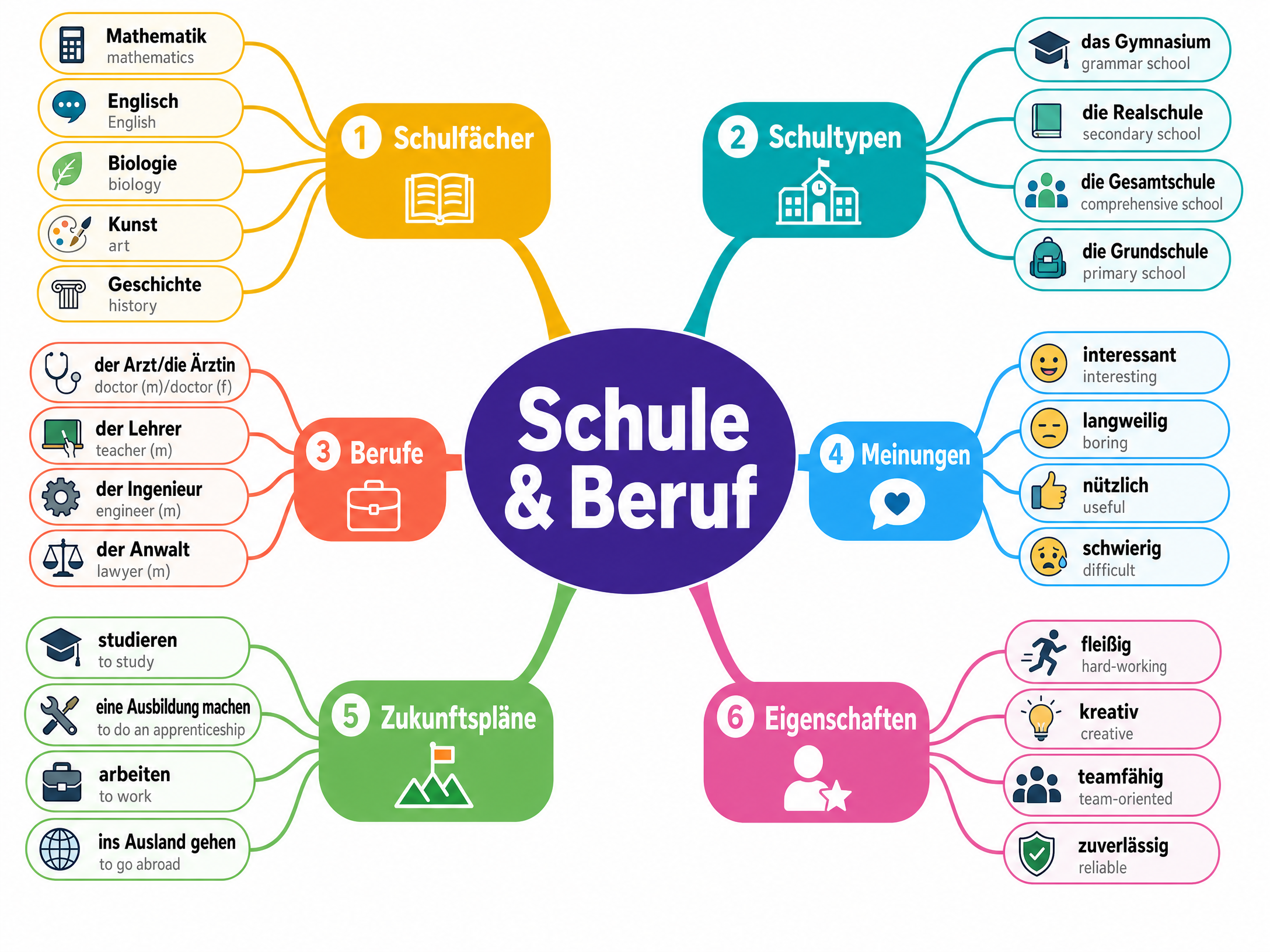
Tier 1 — Foundation Core
| German | English | Gender | Example Sentence |
|---|---|---|---|
| die Schule | school | f | Ich gehe gern in die Schule. |
| das Fach | subject | n | Mein Lieblingsfach ist Geschichte. |
| der Lehrer | teacher (m) | m | Der Lehrer ist sehr streng. |
| die Lehrerin | teacher (f) | f | Die Lehrerin ist freundlich. |
| der Beruf | job / profession | m | Welchen Beruf möchtest du haben? |
| die Arbeit | work | f | Die Arbeit ist sehr interessant. |
| das Abitur | A-Levels / exams | n | Ich möchte das Abitur machen. |
| die Note | grade / mark | f | Ich habe gute Noten in Mathe. |
| lernen | to learn / study | - | Ich lerne jeden Tag Deutsch. |
| arbeiten | to work | - | Mein Vater arbeitet im Büro. |
| interessant | interesting | - | Biologie ist sehr interessant. |
| langweilig | boring | - | Ich finde Physik langweilig. |
| einfach | easy | - | Sport ist einfach. |
| schwierig | difficult | - | Chemie ist ziemlich schwierig. |
| nützlich | useful | - | Informatik ist sehr nützlich. |
Tier 2 — Higher Tier
| German | English | Gender | Example Sentence |
|---|---|---|---|
| die Ausbildung | apprenticeship | f | Ich werde eine Ausbildung machen. |
| das Praktikum | work experience | n | Nächstes Jahr mache ich ein Praktikum. |
| der Arbeitgeber | employer | m | Mein zukünftiger Arbeitgeber muss fair sein. |
| die Universität | university | f | Ich möchte an der Universität studieren. |
| der Lebenslauf | CV / resume | m | Ich muss meinen Lebenslauf schreiben. |
| sich bewerben | to apply (for a job) | - | Ich bewerbe mich um diesen Job. |
| das Gehalt | salary | n | Das Gehalt ist nicht so wichtig wie der Spaß. |
| die Erfahrung | experience | f | Ich habe viel Erfahrung in diesem Bereich. |
| verantwortungsbewusst | responsible | - | Für diesen Beruf muss man verantwortungsbewusst sein. |
| abwechslungsreich | varied | - | Ich möchte einen abwechslungsreichen Beruf. |
High-Frequency Words & Phrases
| Phrase | English | Usage Context |
|---|---|---|
| in der Zukunft | in the future | When discussing career plans |
| nach der Schule | after school | When talking about next steps |
| meiner Meinung nach | in my opinion | Introducing an opinion in speaking/writing |
| auf der einen Seite... auf der anderen Seite | on the one hand... on the other hand | Weighing up pros and cons of a job |
| es macht Spaß | it is fun | Justifying why you like a subject/job |
| ich habe vor, ... zu ... | I intend to... | Expressing future intentions |
| um ... zu ... | in order to... | Explaining why you are doing something |
| ich interessiere mich für | I am interested in | Discussing subjects or career fields |
| wenn ich älter bin | when I am older | Starting a sentence about future plans |
| das Wichtigste ist | the most important thing is | Prioritising aspects of a career |
📝 Grammar Focus
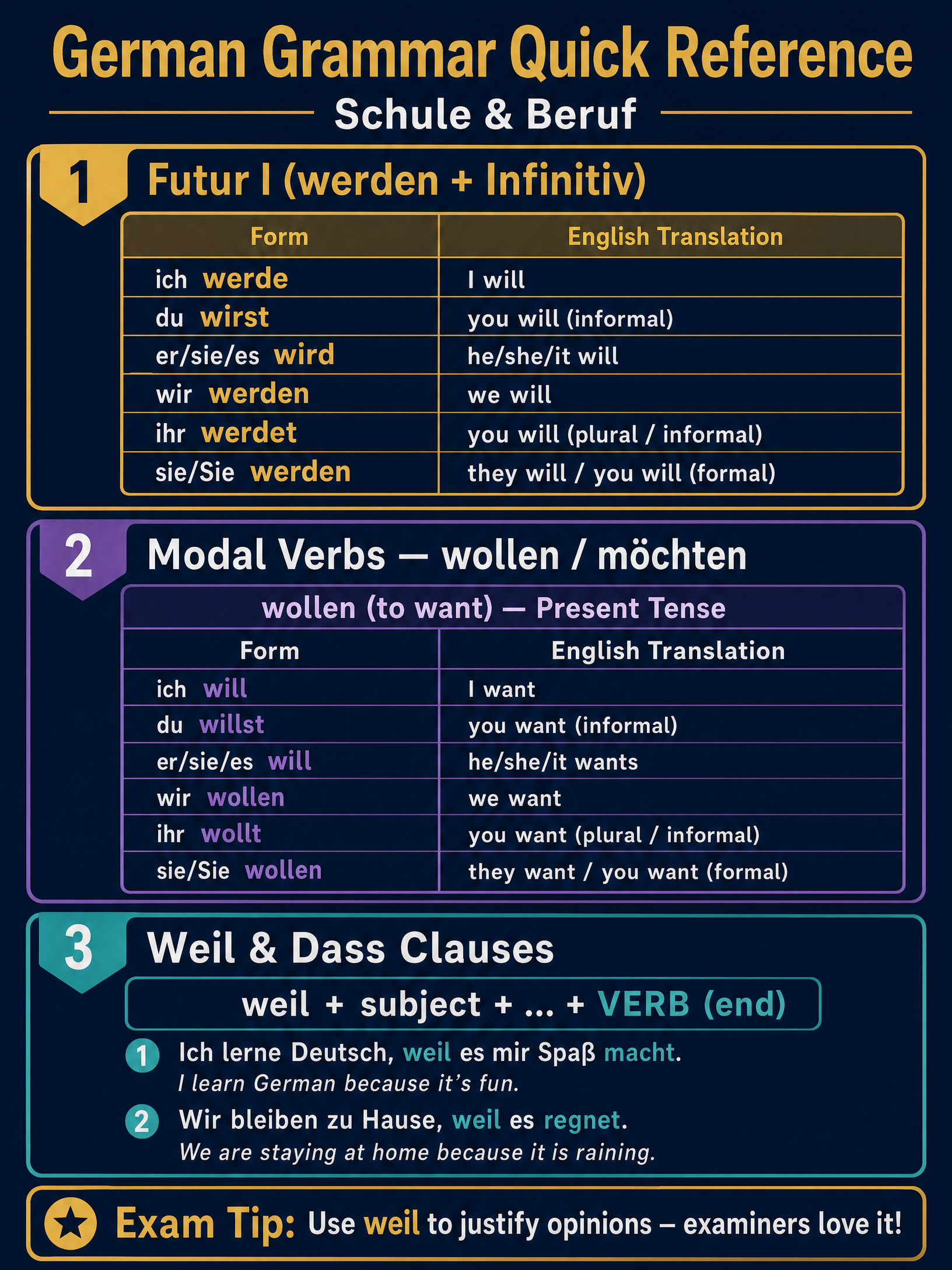
Key Structure 1: Futur I (werden + Infinitiv)
When to use it: To talk about your future career plans, what you will study, or what you will do after school.
Conjugation Table
| Subject | Verb Form | English |
|---|---|---|
| ich | werde | I will |
| du | wirst | you will (informal) |
| er/sie/es | wird | he/she/it will |
| wir | werden | we will |
| ihr | werdet | you will (plural) |
| sie/Sie | werden | they/you (formal) will |
Irregulars to learn: 'werden' is irregular in the 'du' and 'er/sie/es' forms. Remember that the infinitive verb ALWAYS goes to the end of the sentence (e.g., Ich werde Arzt werden).
Key Structure 2: Modal Verbs (wollen / möchten)
When to use it: To express what you want to do or would like to do in the future.
Conjugation Table (wollen - to want)
| Subject | Verb Form | English |
|---|---|---|
| ich | will | I want |
| du | willst | you want |
| er/sie/es | will | he/she/it wants |
| wir | wollen | we want |
| ihr | wollt | you want |
| sie/Sie | wollen | they/you want |
Irregulars to learn: 'wollen' is irregular in the singular forms (ich will, du willst, er will). Like 'werden', modal verbs send the main infinitive verb to the end of the clause.
Key Structure 3: Subordinating Conjunctions (weil / dass)
When to use it: To justify your opinions about school subjects or career choices. Examiners specifically look for 'weil' clauses to award higher marks.
Rule: Verb to the End
When you use 'weil' (because) or 'dass' (that), the conjugated verb gets kicked to the end of the clause.
Example: Ich lerne Deutsch, weil es nützlich ist.
Example: Ich denke, dass Mathe schwierig ist.
🎧 Listening Skills
What to Expect
In the listening exam, you will hear native speakers discussing their school experiences, their favourite or least favourite subjects, and their future career aspirations. You might hear interviews, school announcements, or conversations between friends.
Listening Strategies
- Listen for cognates: Words like 'Biologie', 'Chemie', and 'Musik' sound very similar to English. Use them to anchor your understanding.
- Watch for negatives: Listen carefully for words like 'nicht' (not), 'nie' (never), or 'kein' (no/none). "Ich lerne nicht gern Mathe" means they DON'T like maths.
- Note time markers: Pay attention to 'früher' (in the past), 'jetzt' (now), and 'in der Zukunft' (in the future) to understand which timeframe they are discussing.
Common Listening Traps
- Note vs Notiz: 'Note' means a school grade. 'Notiz' means a written note.
- Gymnasium vs Turnhalle: 'Gymnasium' is an academic grammar school, NOT a sports hall ('Turnhalle').
- Arbeiten vs Studieren: 'Arbeiten' means to work (a job). 'Studieren' specifically means to study at university, NOT to study for a test at school (which is 'lernen').
🗣️ Speaking Skills
Role Play Scenarios
Scenario 1: Work ExperienceTeacher: Wo hast du dein Praktikum gemacht?
You: Ich habe mein Praktikum in einem Büro gemacht. (I did my work experience in an office.)
Teacher: Wie war es?
You: Es war sehr interessant, aber ein bisschen anstrengend. (It was very interesting, but a bit tiring.)
Scenario 2: Future PlansTeacher: Was wirst du nächstes Jahr machen?
You: Ich werde Abitur machen, weil ich an der Uni studieren möchte. (I will do A-Levels because I want to study at university.)
Photo Card Practice
Model Photo Card Response (A photo of students in a classroom):
- Qu 1 (Description): Auf dem Foto gibt es drei Schüler und einen Lehrer. Sie sind im Klassenzimmer. (In the photo there are three students and a teacher. They are in the classroom.)
- Qu 2 (Opinion): Ich denke, dass sie fleißig sind, weil sie schreiben. (I think that they are hard-working because they are writing.)
- Qu 3 (Related topic): Mein Lieblingsfach ist Englisch, weil es nützlich ist. (My favourite subject is English because it is useful.)
- Qu 4 (Past): Gestern habe ich in der Schule Fußball gespielt. Es hat Spaß gemacht. (Yesterday I played football at school. It was fun.)
- Qu 5 (Future): In der Zukunft möchte ich als Lehrer arbeiten, weil ich gern mit Kindern arbeite. (In the future I would like to work as a teacher because I like working with children.)
General Conversation Questions
| Question (German) | Model Answer | English Translation |
|---|---|---|
| Was ist dein Lieblingsfach? | Mein Lieblingsfach ist Geschichte, weil es faszinierend ist und der Lehrer sehr lustig ist. | My favourite subject is history because it is fascinating and the teacher is very funny. |
| Wie findest du deine Schule? | Ich finde meine Schule ziemlich gut. Die Lehrer sind meistens hilfsbereit, aber wir bekommen zu viele Hausaufgaben. | I find my school quite good. The teachers are mostly helpful, but we get too much homework. |
| Was möchtest du in der Zukunft als Beruf machen? | In der Zukunft möchte ich Arzt werden, weil ich Menschen helfen will. Das Gehalt ist auch sehr gut. | In the future I would like to become a doctor because I want to help people. The salary is also very good. |
| Möchtest du an der Universität studieren? | Ja, ich habe vor, an der Uni zu studieren, um einen guten Job zu finden. | Yes, I intend to study at university in order to find a good job. |
| Was hast du gestern in der Pause gemacht? | Gestern in der Pause habe ich mit meinen Freunden geplaudert und einen Apfel gegessen. | Yesterday at break time I chatted with my friends and ate an apple. |
✍️ Writing Skills
Translation Practice
English → German:
| English | German | Key Grammar |
|---|---|---|
| I learn German. | Ich lerne Deutsch. | Present tense, regular verb |
| Maths is boring. | Mathe ist langweilig. | Adjective usage |
| Yesterday I did my homework. | Gestern habe ich meine Hausaufgaben gemacht. | Perfect tense (past) |
| I will study at university. | Ich werde an der Uni studieren. | Future tense (werden + infinitive) |
| I want to become a teacher because it is interesting. | Ich möchte Lehrer werden, weil es interessant ist. | Modal verb + weil clause (verb to end) |
Extended Writing
**Model 90-word response (Foundation):**Ich gehe auf eine Gesamtschule in London. Meine Schule ist ziemlich groß und modern. Mein Lieblingsfach ist Kunst, weil ich sehr kreativ bin. Mathe finde ich langweilig, weil es schwierig ist. Gestern habe ich in der Schule Fußball gespielt. Es war super! Nächstes Jahr werde ich Abitur machen. In der Zukunft möchte ich als Designer arbeiten, weil das interessant ist. Ich möchte auch viel Geld verdienen.
**Model 150-word response (Higher):**Ich besuche ein großes Gymnasium in der Nähe von London. Meiner Meinung nach ist meine Schule ausgezeichnet, obwohl wir zu viele Hausaufgaben bekommen. Mein Lieblingsfach ist zweifellos Biologie, weil ich mich sehr für Naturwissenschaften interessiere und der Lehrer uns immer unterstützt. Auf der anderen Seite hasse ich Physik, da ich es extrem kompliziert finde.
Gestern in der Mittagspause habe ich mit meinen Freunden in der Kantine gegessen und wir haben über unsere Zukunftspläne gesprochen. Nach meinen Prüfungen habe ich vor, auf die Oberstufe zu gehen, um Abitur zu machen.
In der Zukunft werde ich bestimmt an der Universität Medizin studieren, weil mein größter Traum ist, Arzt zu werden. Ich möchte Menschen helfen und Leben retten. Ein hohes Gehalt ist mir nicht so wichtig wie ein abwechslungsreicher und lohnender Beruf. Später möchte ich vielleicht auch ein Jahr im Ausland verbringen, um neue Kulturen kennenzulernen.
Writing Checklist
- ✅ Have I used at least three tenses (Past, Present, Future)?
- ✅ Have I included opinions and justified them using 'weil' or 'da'?
- ✅ Is the verb at the end in my 'weil' clauses?
- ✅ Have I checked my adjective endings and noun genders?
- ✅ Have I used connectives (und, aber, oder, deshalb) to link my sentences?
📚 Reading Skills
Key Strategies
- Skim read first: Read the whole text quickly to get the general idea before looking at the questions.
- Use context: If you don't know a word, look at the words around it to guess the meaning.
- Check the question language: Ensure you answer in the correct language (English for English questions, German for German questions).
False Friends & Tricky Words
| Word | Looks Like | Actually Means |
|---|---|---|
| das Gymnasium | a gym | grammar school |
| die Note | a note | a grade / mark |
| studieren | to study (general) | to study at university |
| der Chef | a chef (cook) | the boss / manager |
| die Rente | rent | pension |
🌍 Cultural Knowledge
Understanding the German education system is crucial for this topic. Unlike the UK, German students are often separated into different types of schools at around age 10 based on their academic ability: the Gymnasium (academic, leading to university), the Realschule (intermediate, leading to vocational training), and the Hauptschule (basic, leading to trades). However, many areas now also have Gesamtschulen (comprehensive schools).
Also, grading in Germany is the opposite of the UK! A grade '1' (sehr gut) is the best possible mark, while a '6' (ungenügend) is the worst. Mentioning these cultural details in a speaking or writing exam shows excellent wider knowledge.
Visual Resources
2 diagrams and illustrations
Interactive Diagrams
1 interactive diagram to visualise key concepts
Conceptual Flow Outline
MFL exam approach by skill
Worked Examples
4 detailed examples with solutions and examiner commentary
Practice Questions
Test your understanding — click to reveal model answers
Writing: Translate the following sentence into German: 'I want to be a doctor because I like helping people.'
Hint: Use the modal verb 'wollen' or 'möchten' and remember where the verb goes after 'weil'.
Speaking: Answer the following question: 'Was ist dein Lieblingsfach und warum?'
Hint: Name a subject, give an opinion, and use 'weil' to justify it.
Reading: True or False? 'Ich werde nicht auf die Uni gehen, da ich sofort Geld verdienen will.' -> The person wants to go to university.
Hint: Look for negative words.
Listening: You hear: 'Mein Traumjob ist Pilot, aber meine Eltern wollen, dass ich Anwalt werde.' What does the person want to be, and what do their parents want them to be?
Hint: Listen for the contrast word 'aber' (but).
Writing: Write a 90-word email to your German exchange partner about your school. Mention: what your school is like, your favourite subject, what you did at break time yesterday, and what you will do after your exams.
Hint: Ensure you cover all 4 bullet points and use past, present, and future tenses.
Speaking (Photo Card): Look at the photo of a teacher and students. Answer: 'Was machen die Schüler auf dem Foto?'
Hint: Describe the visible action using the present tense.