Study Notes

Overview
The 'Current and Future Study and Employment' topic (Studium und Beruf) is a cornerstone of the GCSE German Higher Tier specification. It appears across all four skills: Listening, Speaking, Reading, and Writing. Examiners use this topic to test your ability to use complex vocabulary (moving beyond simple jobs to discussing training and workplace issues), employ future and conditional tenses, and articulate justified opinions about your ambitions. Mastering this topic is essential for achieving grades 7-9.
📖 Essential Vocabulary
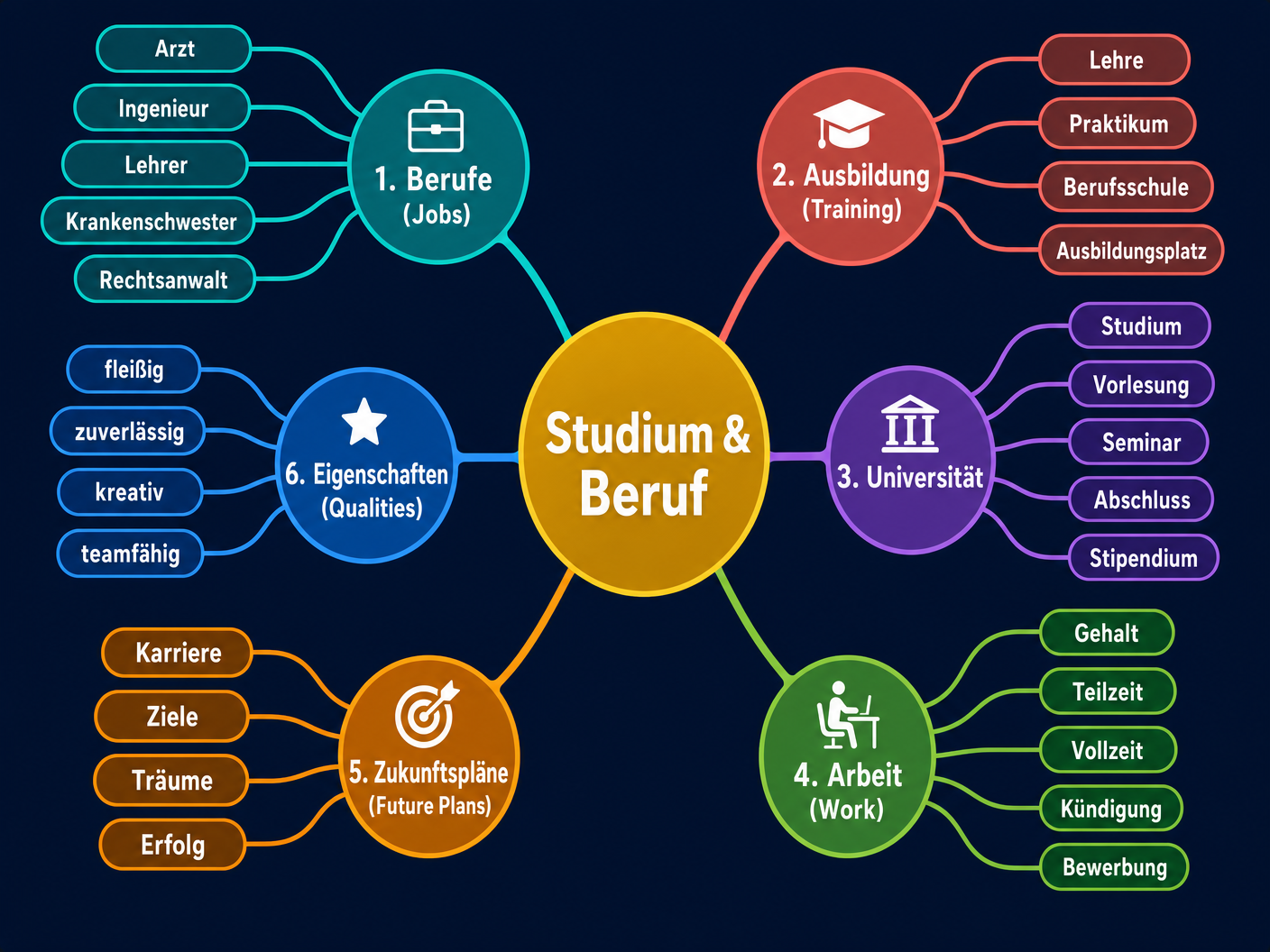
Tier 1 — Foundation Core
| German | English | Gender | Example Sentence |
|---|---|---|---|
| der Beruf | job / profession | m | Mein Traumberuf ist Arzt. |
| die Schule | school | f | Ich gehe jeden Tag in die Schule. |
| arbeiten | to work | - | Ich arbeite am Wochenende in einem Café. |
| das Geld | money | n | Ich möchte viel Geld verdienen. |
| der Lehrer / die Lehrerin | teacher | m/f | Mein Lehrer ist sehr streng, aber fair. |
| lernen | to learn / study | - | Ich lerne Deutsch und Mathe. |
| das Büro | office | n | Mein Vater arbeitet in einem großen Büro. |
| der Chef / die Chefin | boss | m/f | Meine Chefin ist sehr freundlich. |
| der Arzt / die Ärztin | doctor | m/f | Wenn ich krank bin, gehe ich zum Arzt. |
| die Prüfung | exam | f | Nächste Woche habe ich eine wichtige Prüfung. |
| der Kollege / die Kollegin | colleague | m/f | Meine Kollegen sind sehr hilfsbereit. |
| die Universität | university | f | Später möchte ich an der Universität studieren. |
| verdienen | to earn | - | In diesem Beruf kann man gut verdienen. |
| die Stunde | hour | f | Ich arbeite acht Stunden pro Tag. |
| interessant | interesting | - | Ich finde Naturwissenschaften sehr interessant. |
Tier 2 — Higher Tier
| German | English | Gender | Example Sentence |
|---|---|---|---|
| die Ausbildung | apprenticeship / training | f | Nach der Schule werde ich eine Ausbildung machen. |
| das Praktikum | work experience / internship | n | Letztes Jahr habe ich ein Praktikum im Krankenhaus gemacht. |
| die Bewerbung | job application | f | Ich habe meine Bewerbung per E-Mail geschickt. |
| der Lebenslauf | CV / resume | m | Ein guter Lebenslauf ist sehr wichtig für die Karriere. |
| das Vorstellungsgespräch | job interview | n | Ich war sehr nervös vor meinem Vorstellungsgespräch. |
| das Gehalt | salary | n | Das Einstiegsgehalt in diesem Beruf ist ziemlich niedrig. |
| die Erfahrung | experience | f | Man braucht viel Erfahrung für diese Stelle. |
| selbstständig | independent / self-employed | - | Eines Tages möchte ich selbstständig sein. |
| die Verantwortung | responsibility | f | In meinem neuen Job habe ich viel Verantwortung. |
| zuverlässig | reliable | - | Ein guter Arbeitnehmer muss immer zuverlässig sein. |
High-Frequency Words & Phrases
| Phrase | English | Usage Context |
|---|---|---|
| Ich habe vor, ... zu [Inf] | I intend to... | Expressing future plans without using 'werden' |
| Mein Traumberuf wäre... | My dream job would be... | Using the conditional to discuss ambitions |
| Einerseits... andererseits... | On the one hand... on the other hand... | Balancing arguments in speaking/writing |
| Um ... zu [Inf] | In order to... | Explaining purpose or reasons |
| Es kommt darauf an | It depends | Showing nuanced thinking in conversation |
| In der Zukunft | In the future | Setting the timeframe for your plans |
| Meiner Meinung nach | In my opinion | Introducing justified views (triggers verb-second) |
| Ich bin der Meinung, dass | I am of the opinion that | Expressing views (sends verb to the end) |
| Sowohl ... als auch ... | Both ... and ... | Connecting ideas sophisticatedly |
| Im Gegensatz zu | In contrast to | Comparing different jobs or study paths |
📝 Grammar Focus
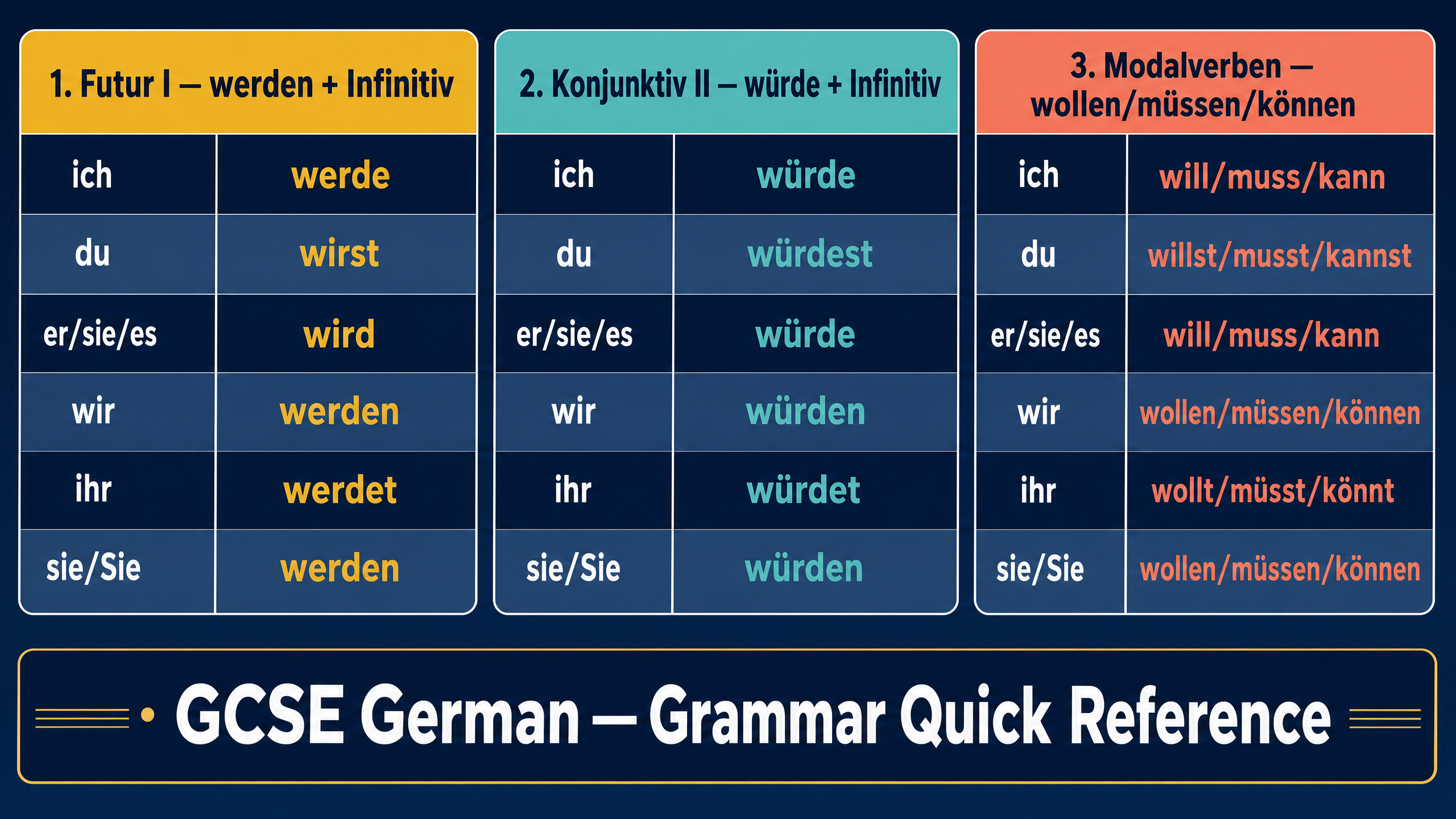
Key Structure 1: Futur I (Future Tense)
When to use it: To talk about your definitive plans for study and employment.
Conjugation Table (werden + Infinitive)
| Subject | Verb Form | English |
|---|---|---|
| ich | werde ... arbeiten | I will work |
| du | wirst ... arbeiten | you (sg, inf) will work |
| er/sie/es | wird ... arbeiten | he/she/it will work |
| wir | werden ... arbeiten | we will work |
| ihr | werdet ... arbeiten | you (pl, inf) will work |
| sie/Sie | werden ... arbeiten | they/you (form) will work |
Key Rule: The auxiliary verb 'werden' goes in position 2, and the infinitive goes to the very end of the clause.
Example: Ich werde nach den Prüfungen an der Universität studieren.
Key Structure 2: Konjunktiv II (Conditional with 'würde')
When to use it: To express hypothetical situations, dreams, or ambitions (e.g., 'I would like to...').
Conjugation Table (würde + Infinitive)
| Subject | Verb Form | English |
|---|---|---|
| ich | würde ... studieren | I would study |
| du | würdest ... studieren | you (sg, inf) would study |
| er/sie/es | würde ... studieren | he/she/it would study |
| wir | würden ... studieren | we would study |
| ihr | würdet ... studieren | you (pl, inf) would study |
| sie/Sie | würden ... studieren | they/you (form) would study |
Irregulars to learn: Some verbs don't use 'würde' but have their own conditional form: ich wäre (I would be), ich hätte (I would have), ich könnte (I could).
Key Structure 3: Modal Verbs with Infinitives
When to use it: To express obligation (müssen), desire (wollen/möchten), or ability (können) related to jobs and studies.
Conjugation Table (wollen - to want to)
| Subject | Verb Form | English |
|---|---|---|
| ich | will ... werden | I want to become |
| du | willst ... werden | you (sg, inf) want to become |
| er/sie/es | will ... werden | he/she/it wants to become |
| wir | wollen ... werden | we want to become |
| ihr | wollt ... werden | you (pl, inf) want to become |
| sie/Sie | wollen ... werden | they/you (form) want to become |
Key Rule: Like the future tense, the modal verb is in position 2 and the infinitive goes to the end.
🎧 Listening Skills
What to Expect
In the Listening exam, you will hear monologues or dialogues about people's work experience, their future plans, or complaints about their current jobs. At Higher Tier, expect complex sentences, distractors, and opinions that are implied rather than stated directly.
Listening Strategies
- Listen for time markers: Pay attention to words like früher (in the past), jetzt (now), and später (later). Examiners often test your ability to distinguish between past jobs and future plans.
- Note the negatives: Listen carefully for nicht, kein, nie (never), or weder... noch (neither... nor). These completely change the meaning.
- Watch for 'aber eigentlich': Speakers often state an initial plan, then say 'aber eigentlich' (but actually) and give their real intention. The second statement is usually the correct answer.
Common Listening Traps
- False Friends: Das Gymnasium means a grammar school, NOT a gym. Die Note means a grade, NOT a musical note. Der Chef means the boss, NOT a cook.
- Tense Confusion: Hearing ich habe gearbeitet (I worked) and confusing it with ich werde arbeiten (I will work).
🗣️ Speaking Skills
Role Play Scenarios
Scenario 1: A job interview
- Interviewer: Warum möchten Sie hier arbeiten? (Why do you want to work here?)
- You: Ich möchte hier arbeiten, weil die Firma einen guten Ruf hat und ich viel Erfahrung sammeln kann. (I want to work here because the company has a good reputation and I can gain a lot of experience.)
Scenario 2: Discussing work experience with a teacher
- Teacher: Was hast du in deinem Praktikum gemacht?
- You: Ich habe E-Mails geschrieben und Kaffee gekocht. Es war ein bisschen langweilig, aber nützlich.
Photo Card Practice
Model Photo Card Response (A photo of people working in a modern office):
- Qu 1 (Description): Auf dem Foto sehe ich drei Personen in einem modernen Büro. Sie sitzen an Schreibtischen und arbeiten an Computern. Es sieht sehr professionell aus.
- Qu 2 (Opinion): Ich finde die Atmosphäre gut, weil es hell und sauber ist. Meiner Meinung nach ist ein gutes Arbeitsumfeld sehr wichtig für die Motivation.
- Qu 3 (Related topic): Persönlich möchte ich nicht in einem Büro arbeiten, da ich lieber draußen in der Natur bin.
- Qu 4 (Past/Future): Letztes Jahr habe ich ein Praktikum in einem Büro gemacht. Nächstes Jahr werde ich jedoch etwas anderes ausprobieren.
- Qu 5 (Unpredictable): Ein Vorteil der Büroarbeit ist, dass die Arbeitszeiten oft sehr regelmäßig sind.
General Conversation Questions
| Question (German) | Model Answer | English Translation |
|---|---|---|
| Was möchtest du nach der Schule machen? | Nach den Prüfungen werde ich auf die Oberstufe gehen, um mein Abitur zu machen. Danach würde ich gern an der Uni studieren. | After the exams I will go to sixth form to do my A-Levels. After that I would like to study at university. |
| Was ist dein Traumberuf? | Mein Traumberuf wäre Arzt, weil ich Menschen helfen möchte. Außerdem interessiert mich die Medizin sehr. | My dream job would be a doctor because I want to help people. Furthermore, medicine interests me a lot. |
| Hast du schon Arbeitserfahrung? | Ja, letzten Sommer habe ich zwei Wochen in einem Geschäft gearbeitet. Es war anstrengend, aber ich habe viel gelernt. | Yes, last summer I worked in a shop for two weeks. It was tiring, but I learned a lot. |
| Ist ein hohes Gehalt wichtig für dich? | Einerseits ist Geld wichtig, um gut zu leben. Andererseits ist es mir wichtiger, dass die Arbeit Spaß macht. | On the one hand money is important to live well. On the other hand it is more important to me that the work is fun. |
| Möchtest du im Ausland arbeiten? | Ja, absolut! Wenn ich könnte, würde ich in Deutschland arbeiten, um meine Sprachkenntnisse zu verbessern. | Yes, absolutely! If I could, I would work in Germany in order to improve my language skills. |
✍️ Writing Skills
Translation Practice
English → German:
| English | German | Key Grammar |
|---|---|---|
| I want to become a teacher. | Ich will Lehrer werden. | Modal verb + infinitive at end. No article for jobs. |
| Last year I did work experience. | Letztes Jahr habe ich ein Praktikum gemacht. | Perfect tense; time phrase at start triggers inversion. |
| I will study at university. | Ich werde an der Universität studieren. | Futur I; 'werden' + infinitive at end. |
| Although the work is hard, the salary is good. | Obwohl die Arbeit schwer ist, ist das Gehalt gut. | 'Obwohl' sends verb to end; next clause starts with verb. |
| If I had good grades, I would study medicine. | Wenn ich gute Noten hätte, würde ich Medizin studieren. | Konjunktiv II (hätte / würde) + conditional structure. |
Extended Writing
**Model 90-word response (Foundation/Overlap):**Nach der Schule möchte ich eine Ausbildung machen, weil ich praktisch lernen will. Letztes Jahr habe ich ein Praktikum in einer Autowerkstatt gemacht. Das war fantastisch, denn ich liebe Autos. In der Zukunft werde ich als Mechaniker arbeiten. Meiner Meinung nach ist dieser Beruf sehr interessant, obwohl man manchmal schmutzig wird. Ein hohes Gehalt ist mir nicht so wichtig, aber ich möchte nette Kollegen haben.
(Approx. 65 words - concise, hits all bullet points, uses 3 tenses, gives opinions)
**Model 150-word response (Higher):**Wenn ich die Schule abschließe, habe ich vor, auf die Oberstufe zu gehen, um mein Abitur zu machen. Danach würde ich unglaublich gern an der Universität in Berlin studieren, da ich mich sehr für Fremdsprachen interessiere.
Um Erfahrung zu sammeln, habe ich letzten Sommer ein zweiwöchiges Praktikum in einem internationalen Büro gemacht. Einerseits war die Arbeit manchmal monoton, weil ich viele E-Mails schreiben musste, aber andererseits waren die Kollegen äußerst hilfsbereit. Ich habe dort gelernt, wie wichtig Teamarbeit ist.
In der Zukunft ist es mein absoluter Traum, als Übersetzer zu arbeiten. Obwohl das Gehalt vielleicht nicht so hoch ist wie bei einem Arzt, finde ich es faszinierend, verschiedene Kulturen kennenzulernen. Für mich ist die Arbeitszufriedenheit viel wichtiger als ein luxuriöses Leben, denn man verbringt einen großen Teil seines Lebens am Arbeitsplatz.
(Approx. 140 words - uses um...zu, conditional, perfect, present, complex opinions, subordinate clauses)
Writing Checklist
- ✅ Have I used at least three different tenses (Past, Present, Future/Conditional)?
- ✅ Are my verbs in the correct position (V2 normally, end for subordinate clauses/infinitives)?
- ✅ Have I justified my opinions using weil, da, or denn?
- ✅ Did I remember NOT to use ein/eine when stating a profession (e.g., Ich bin Arzt)?
- ✅ Have I checked my adjective endings and noun genders?
📚 Reading Skills
Key Strategies
- Read the questions first: Before tackling the German text, read the English questions. They guide you on what specific information to scan for.
- Look for synonyms: If the question asks about 'salary', the text might not use das Gehalt; it might use Geld verdienen (to earn money) or die Bezahlung (the pay).
- Identify the tense: Ensure you answer in the correct timeframe. If the text says Ich wollte Tierarzt werden (I wanted to become a vet), don't write that they want to be a vet now.
False Friends & Tricky Words
| Word | Looks Like | Actually Means |
|---|---|---|
| das Gymnasium | gymnasium (sports hall) | grammar school / academic high school |
| die Note | a musical note | a grade / mark in school |
| das Praktikum | practice | work experience / internship |
| der Chef | a chef (cook) | the boss / manager |
| die Rente | rent | pension / retirement |
🌍 Cultural Knowledge
Understanding the German education and training system is vital for this topic. In Germany, students are separated into different types of secondary schools (Hauptschule, Realschule, Gymnasium) around age 10, though comprehensive schools (Gesamtschulen) exist. The Abitur is the exam taken at the Gymnasium, required for university entry.
Crucially, Germany is famous for its duales Ausbildungssystem (dual vocational training system). This combines classroom learning at a Berufsschule (vocational school) with practical, on-the-job training at a company. It is highly respected and many young Germans choose this path over university for careers ranging from banking to mechanics. Knowing terms like Abitur, Berufsschule, and duales System will add authentic cultural context to your writing and speaking responses.
Visual Resources
2 diagrams and illustrations
Interactive Diagrams
1 interactive diagram to visualise key concepts
Conceptual Flow Outline
Grammar decision tree for expressing future career plans
Worked Examples
4 detailed examples with solutions and examiner commentary
Practice Questions
Test your understanding — click to reveal model answers
Writing: Translate the following sentence into German: 'I want to be a teacher because I am patient.'
Hint: Use a modal verb for 'want to' and remember the verb position after 'because'.
Speaking: Prepare a 3-sentence answer to the question: 'Was sind die Vor- und Nachteile von Büroarbeit?'
Hint: Use 'einerseits... andererseits' to balance the argument.
Reading: Translate this text to English: 'Nach meinem Abitur habe ich vor, ein Jahr im Ausland zu verbringen. Danach werde ich an der Universität studieren, um Ingenieur zu werden.'
Hint: Pay attention to the tense and the 'um...zu' structure.
Listening: You hear 'Ich wollte Friseurin werden, aber jetzt lerne ich Informatik, da es bessere Karrierechancen gibt.' What did she want to do, what is she doing now, and why?
Hint: Listen for the past modal 'wollte' and the reason introduced by 'da'.
Writing: Write 90 words about your work experience. Include: where you worked, what you did, your opinion of it, and your future plans.
Hint: Ensure you use the perfect tense for the work experience and the future tense for your plans.
Speaking (Photo Card): Describe a photo of a teacher in a classroom and answer: Möchtest du Lehrer/in werden? Warum (nicht)?
Hint: State what you see, then give a clear yes/no with a reason.