Study Notes
Overview
This comprehensive guide focuses on the Higher-tier theme of Local, national, international and global areas of interest. This topic is a cornerstone of the GCSE German specification, appearing across all four examination papers: Listening, Speaking, Reading, and Writing. Mastering this theme is essential for candidates aiming for top grades (7-9), as it requires moving beyond simple descriptions of one's immediate surroundings to discussing complex social issues, environmental challenges, and global events. Examiners specifically look for the ability to use advanced vocabulary, express justified opinions, and accurately apply a variety of grammatical structures across different time frames.
📖 Essential Vocabulary
Tier 1 — Foundation Core
| German | English | Gender | Example Sentence |
|---|---|---|---|
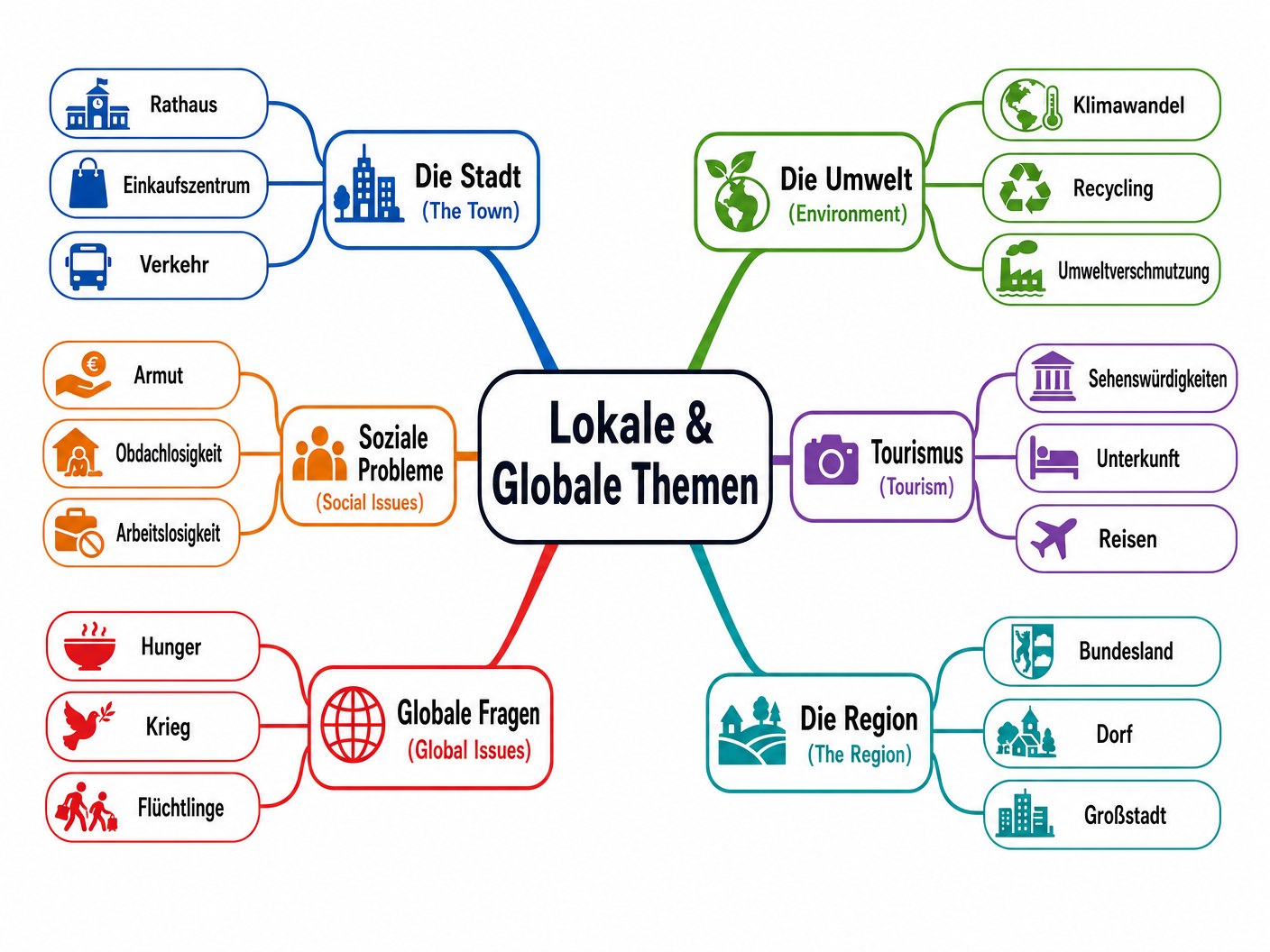
| das Rathaus | town hall | n | Das Rathaus ist im Stadtzentrum. |
| das Einkaufszentrum | shopping centre | n | Ich gehe gern ins Einkaufszentrum. |
| der Verkehr | traffic | m | Es gibt zu viel Verkehr. |
| der Park | park | m | Wir spielen Fußball im Park. |
| die Umwelt | environment | f | Die Umwelt ist sehr wichtig. |
| das Recycling | recycling | n | Das Recycling ist gut für die Natur. |
| der Müll | rubbish/trash | m | Wir müssen den Müll trennen. |
| die Armut | poverty | f | Armut ist ein großes Problem. |
| die Arbeitslosigkeit | unemployment | f | Die Arbeitslosigkeit steigt. |
| der Tourismus | tourism | m | Der Tourismus ist wichtig für die Stadt. |
| das Hotel | hotel | n | Das Hotel war sehr teuer. |
| die Reise | journey/trip | f | Die Reise war lang und anstrengend. |
| das Ausland | abroad | n | Ich fahre gern ins Ausland. |
| der Krieg | war | m | Krieg ist furchtbar. |
| der Hunger | hunger | m | Viele Menschen leiden an Hunger. |
Tier 2 — Higher Tier
| German | English | Gender | Example Sentence |
|---|---|---|---|
| die Fußgängerzone | pedestrian zone | f | In der Fußgängerzone gibt es keine Autos. |
| die Umweltverschmutzung | pollution | f | Die Umweltverschmutzung schadet der Gesundheit. |
| der Klimawandel | climate change | m | Der Klimawandel bedroht unseren Planeten. |
| die erneuerbare Energie | renewable energy | f | Wir sollten mehr erneuerbare Energie nutzen. |
| die Obdachlosigkeit | homelessness | f | Die Obdachlosigkeit in der Großstadt ist besorgniserregend. |
| die Sehenswürdigkeiten | sights/attractions | f (pl) | Wir haben alle Sehenswürdigkeiten besichtigt. |
| die Unterkunft | accommodation | f | Die Unterkunft war komfortabel, aber preiswert. |
| die Gesellschaft | society | f | Unsere Gesellschaft muss toleranter werden. |
| die Flüchtlinge | refugees | m (pl) | Es ist unsere Pflicht, den Flüchtlingen zu helfen. |
| die Spende | donation | f | Eine Spende kann Leben retten. |
High-Frequency Words & Phrases
| Phrase | English | Usage Context |
|---|---|---|
| Ich bin der Meinung, dass... | I am of the opinion that... | Introducing a justified opinion (sends verb to end) |
| Auf der einen Seite... auf der anderen Seite... | On the one hand... on the other hand... | Balancing an argument in Writing or Speaking |
| Einerseits... andererseits... | On the one hand... on the other hand... | A slightly more advanced alternative for balancing points |
| Es ist wichtig, dass... | It is important that... | Expressing necessity (sends verb to end) |
| Um die Umwelt zu schützen... | In order to protect the environment... | Using um...zu clauses for purpose |
| Im Großen und Ganzen... | By and large / On the whole... | Summarising a point |
| Heutzutage... | Nowadays... | Contrasting past and present situations |
| Laut des Textes... | According to the text... | Referencing reading passages (uses genitive) |
| Meiner Meinung nach... | In my opinion... | A concise way to state your view (verb must follow immediately) |
| Es lässt sich nicht leugnen, dass... | It cannot be denied that... | Strong statement for extended writing |
📝 Grammar Focus
Key Structure 1: Das Perfekt (The Perfect Tense)
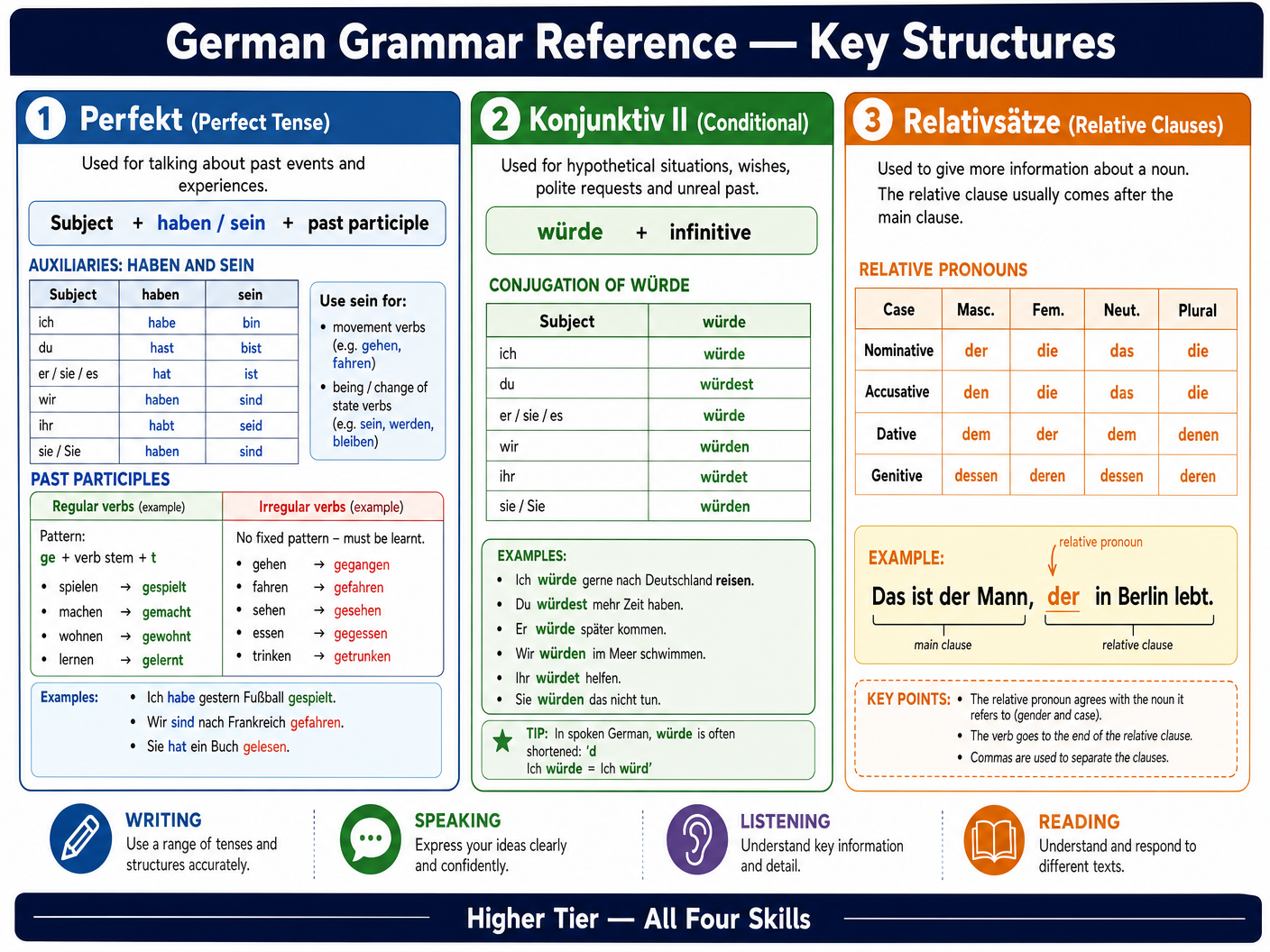
When to use it: To talk about completed actions in the past. This is the most common past tense used in spoken German and informal writing.
Conjugation Table (haben / sein)
| Subject | Auxiliary (haben) | Auxiliary (sein) | Example |
|---|---|---|---|
| ich | habe | bin | Ich habe recycelt. / Ich bin gefahren. |
| du | hast | bist | Du hast geholfen. / Du bist gereist. |
| er/sie/es | hat | ist | Er hat gespendet. / Sie ist geblieben. |
| wir | haben | sind | Wir haben gesehen. / Wir sind gegangen. |
| ihr | habt | seid | Ihr habt gemacht. / Ihr seid gekommen. |
| sie/Sie | haben | sind | Sie haben gewohnt. / Sie sind geflogen. |
Irregulars to learn:
- gehen → gegangen (sein)
- fahren → gefahren (sein)
- sehen → gesehen (haben)
- helfen → geholfen (haben)
- bleiben → geblieben (sein)
Key Structure 2: Das Futur (The Future Tense)
When to use it: To discuss future plans, intentions, or predictions. Essential for meeting the 'three tenses' requirement at Higher tier.
Conjugation Table (werden + infinitive)
| Subject | Verb Form (werden) | Example |
|---|---|---|
| ich | werde | Ich werde mehr recyceln. |
| du | wirst | Du wirst ins Ausland fahren. |
| er/sie/es | wird | Die Stadt wird sauberer sein. |
| wir | werden | Wir werden erneuerbare Energien nutzen. |
| ihr | werdet | Ihr werdet spenden. |
| sie/Sie | werden | Sie werden das Problem lösen. |
Key Structure 3: Relativsätze (Relative Clauses)
When to use it: To provide additional information about a noun without starting a new sentence. This demonstrates complex sentence structure to the examiner.
Conjugation Table (Relative Pronouns in Nominative and Accusative)
| Gender | Nominative | Accusative | Example |
|---|---|---|---|
| Masculine | der | den | Der Park, den ich besuche, ist groß. |
| Feminine | die | die | Die Stadt, die ich mag, ist alt. |
| Neuter | das | das | Das Problem, das wir haben, ist ernst. |
| Plural | die | die | Die Leute, die hier wohnen, sind nett. |
Key Rule: The relative pronoun must agree in gender and number with the noun it refers to, but its case depends on its role in the relative clause. The conjugated verb always goes to the end of the relative clause.
🎧 Listening Skills
What to Expect
In the Listening exam, you will hear native speakers discussing their towns, holidays, or opinions on social and global issues. The passages will increase in speed and complexity. Higher-tier questions will often feature distractors, complex opinions, and references to multiple time frames.
Listening Strategies
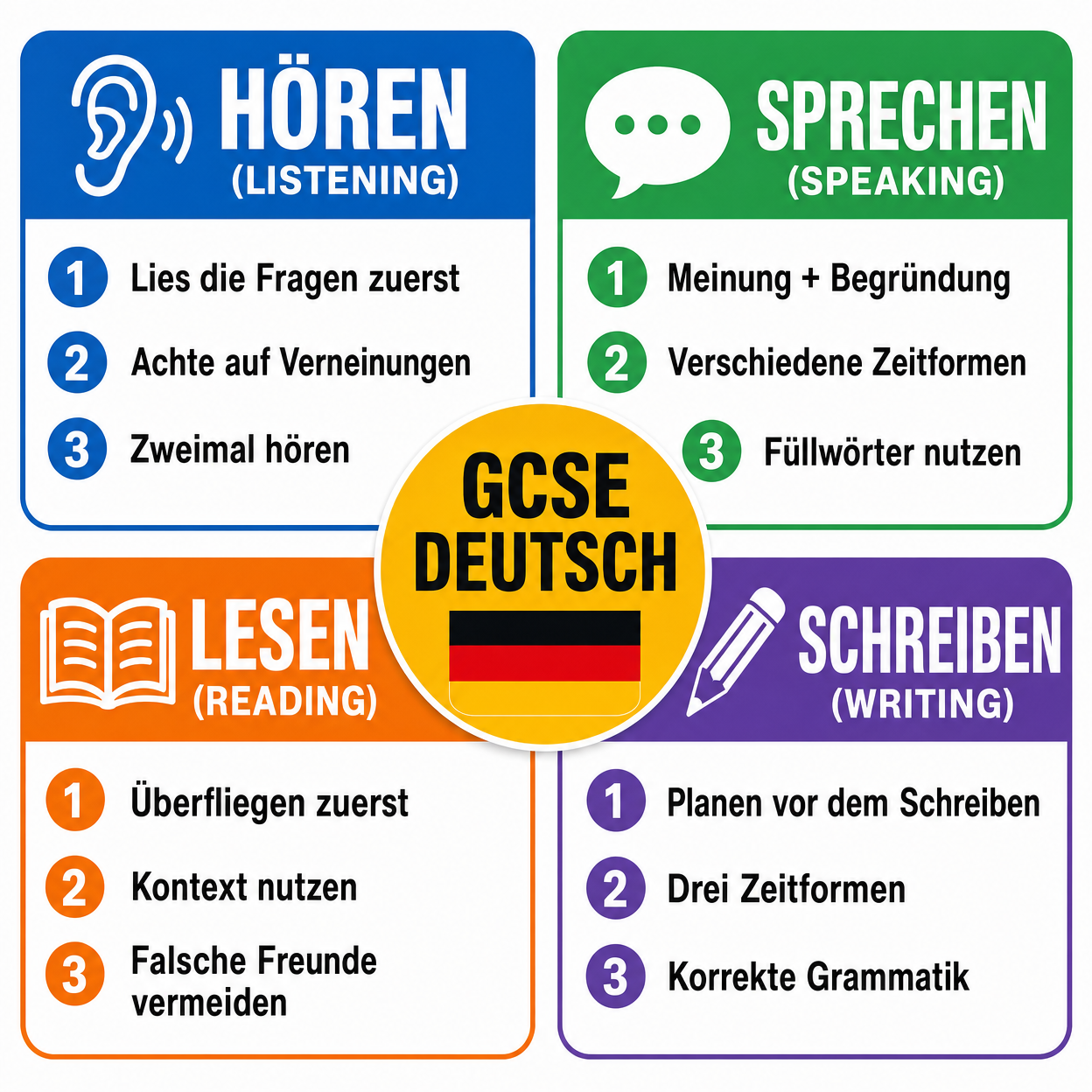
- Read the questions first: Use the reading time to predict vocabulary you might hear.
- Listen for qualifiers and negatives: Words like nicht, nie, kaum (hardly), or selten (rarely) completely change the meaning.
- Identify the tense: Listen carefully for auxiliary verbs (habe, bin, werde) or time phrases (gestern, nächstes Jahr) to determine if the speaker is talking about the past, present, or future.
Common Listening Traps
- False Friends: Hearing Gymnasium and thinking 'gym' (it means grammar school). Hearing sensibel and thinking 'sensible' (it means sensitive).
- Partial Matches: The speaker might mention a word from the question, but the actual answer is different. (e.g., Question: What is the main problem? Speaker: "Traffic is bad, but the main issue is pollution.")
🗣️ Speaking Skills
Role Play Scenarios
Scenario 1: At the Tourist Office
- Examiner: Wie kann ich Ihnen helfen?
- Candidate: Ich möchte Informationen über die Sehenswürdigkeiten in der Stadt.
- Examiner: Interessieren Sie sich für Museen oder Parks?
- Candidate: Ich interessiere mich für Museen, weil ich Geschichte liebe.
Scenario 2: Discussing a Charity
- Examiner: Für welche Organisation sammeln Sie Geld?
- Candidate: Ich sammle Geld für eine Umweltorganisation.
- Examiner: Warum ist das wichtig?
- Candidate: Es ist wichtig, weil wir den Klimawandel stoppen müssen.
Photo Card Practice
Model Photo Card Response (Topic: Environment):
- Qu 1 (Description): Auf dem Foto sehe ich viele Leute, die Müll am Strand sammeln. Das Wetter ist sonnig.
- Qu 2 (Opinion): Ich finde das sehr gut, weil es wichtig ist, die Umwelt zu schützen.
- Qu 3 (Related topic): In meiner Stadt gibt es auch viel Müll auf den Straßen. Das ist ein großes Problem.
- Qu 4 (Past/Future): Letztes Wochenende habe ich auch Altglas recycelt. Nächstes Jahr werde ich Mitglied in einer Umweltgruppe.
- Qu 5 (Unpredictable): Ja, meiner Meinung nach sollte die Regierung mehr tun, um erneuerbare Energien zu fördern.
General Conversation Questions
| Question (German) | Model Answer | English Translation |
|---|---|---|
| Wie ist deine Stadt? | Meine Stadt ist ziemlich lebhaft, obwohl es manchmal zu viel Verkehr gibt. Ich wohne gern hier. | What is your town like? - My town is quite lively, although there is sometimes too much traffic. I like living here. |
| Was hast du letztes Jahr im Urlaub gemacht? | Letztes Jahr bin ich nach Spanien gefahren. Ich habe am Strand entspannt und die Kultur genossen. | What did you do on holiday last year? - Last year I travelled to Spain. I relaxed on the beach and enjoyed the culture. |
| Was ist das größte Umweltproblem deiner Meinung nach? | Meiner Meinung nach ist der Klimawandel das größte Problem, weil er die ganze Welt betrifft. | What is the biggest environmental problem in your opinion? - In my opinion, climate change is the biggest problem because it affects the whole world. |
| Wie wirst du in der Zukunft helfen? | In der Zukunft werde ich öfter mit dem Rad fahren, um Abgase zu reduzieren. | How will you help in the future? - In the future I will cycle more often in order to reduce exhaust fumes. |
| Ist es wichtig, ins Ausland zu reisen? | Ja, es ist sehr wichtig, weil man andere Kulturen kennenlernen und den Horizont erweitern kann. | Is it important to travel abroad? - Yes, it is very important because one can get to know other cultures and broaden one's horizons. |
✍️ Writing Skills
Translation Practice
English → German:
| English | German | Key Grammar |
|---|---|---|
| I live in a big city. | Ich wohne in einer Großstadt. | Preposition in + dative (einer) |
| Last year we travelled to Germany. | Letztes Jahr sind wir nach Deutschland gefahren. | Perfekt tense with sein |
| Homelessness is a serious problem. | Die Obdachlosigkeit ist ein ernstes Problem. | Noun gender (-keit) and adjective ending |
| I think that we must protect the environment. | Ich denke, dass wir die Umwelt schützen müssen. | dass clause (verb to end) + modal verb |
| Next year I will work for a charity. | Nächstes Jahr werde ich für eine Hilfsorganisation arbeiten. | Futur tense + preposition für + accusative |
Extended Writing
**Model 90-word response (Foundation):**Ich wohne in einer kleinen Stadt. Meine Stadt ist sehr schön, aber es gibt nicht viel für Jugendliche. Letztes Wochenende bin ich mit meinen Freunden ins Kino gegangen. Das war toll. In meiner Stadt gibt es ein großes Problem mit Müll. Ich finde das schrecklich. Nächstes Jahr werde ich mehr recyceln, um die Umwelt zu helfen. Ich möchte auch im Ausland arbeiten, vielleicht in Spanien, weil das Wetter dort besser ist.
**Model 150-word response (Higher):**Ich wohne seit zehn Jahren in einer lebhaften Großstadt. Einerseits gibt es hier viele ausgezeichnete Sehenswürdigkeiten und gute Einkaufsmöglichkeiten. Andererseits lässt sich nicht leugnen, dass der Verkehr ein massives Problem ist. Die Luftverschmutzung ist schrecklich, was schlecht für die Gesundheit ist.
Meiner Meinung nach ist der Klimawandel die größte globale Herausforderung unserer Zeit. Wir müssen dringend handeln, bevor es zu spät ist. Letztes Jahr habe ich an einer Demonstration für den Umweltschutz teilgenommen, weil ich glaube, dass junge Leute eine Stimme haben sollten. Außerdem haben wir zu Hause angefangen, unseren Müll strenger zu trennen.
In der Zukunft werde ich versuchen, umweltfreundlicher zu leben. Ich werde öfter öffentliche Verkehrsmittel benutzen und weniger Fleisch essen. Wenn ich älter bin, möchte ich für eine internationale Hilfsorganisation im Ausland arbeiten, um Menschen in Not zu helfen und einen positiven Beitrag zur Gesellschaft zu leisten.
Writing Checklist
- ✅ Have I used at least three different tenses (Past, Present, Future)?
- ✅ Have I included opinions and justified them with weil or da?
- ✅ Have I used complex structures like relative clauses or um...zu?
- ✅ Are my adjective endings correct?
- ✅ Have I addressed all the bullet points in the prompt?
📚 Reading Skills
Key Strategies
- Skim for gist: Read the text quickly to understand the overall topic before looking at the questions.
- Use context clues: If you don't know a word, look at the words around it. Is it a noun, verb, or adjective? Is the tone positive or negative?
- Watch out for tense shifts: A text might start by describing a current problem, then discuss what caused it (past), and finish with proposed solutions (future).
False Friends & Tricky Words
| Word | Looks Like | Actually Means |
|---|---|---|
| das Gymnasium | gym | grammar school |
| sensibel | sensible | sensitive |
| aktuell | actual | current/up-to-date |
| der Chef | chef | boss/manager |
| die Fabrik | fabric | factory |
🌍 Cultural Knowledge
Understanding the cultural context of German-speaking countries can significantly enrich your Speaking and Writing responses. Germany is known as a world leader in environmental protection (Umweltschutz). The Green Party (Die Grünen) is a major political force, and recycling is taken very seriously—many supermarkets have Pfandautomaten where you return plastic bottles for a deposit (Pfand). When discussing tourism, mentioning specific regions like the Schwarzwald (Black Forest) or the Alpen (Alps), or cities like Berlin and Munich, shows the examiner you have authentic cultural awareness.
Visual Resources
3 diagrams and illustrations
Interactive Diagrams
1 interactive diagram to visualise key concepts
Conceptual Flow Outline
MFL exam approach by skill
Worked Examples
4 detailed examples with solutions and examiner commentary
Practice Questions
Test your understanding — click to reveal model answers
Writing: Translate the following sentence into German: 'I am of the opinion that unemployment is a big problem.'
Hint: Remember how 'dass' affects the word order in the second clause.
Speaking: Answer the conversation question: 'Was hast du letztes Jahr für die Umwelt gemacht?'
Hint: Use the Perfekt tense and give specific examples.
Reading: Translate to English: 'Die Luftverschmutzung in der Innenstadt hat sich in den letzten Jahren verschlechtert.'
Hint: Identify the tense and the core vocabulary words.
Listening: You hear: 'Nächstes Jahr werden wir unseren Urlaub nicht im Ausland verbringen, sondern in den Alpen wandern.' Where will they spend their holiday next year?
Hint: Listen for the negative 'nicht' and the contrast 'sondern'.
Writing: Write 90 words about your local area. Include: what it is like, what you did there recently, what the problems are, and what you will do there next weekend.
Hint: Ensure you cover all 4 bullet points and use past, present, and future tenses.
Writing: Write 150 words on global issues. Include: the biggest global problem, what your school does for the environment, a recent charity event you participated in, and how society should change in the future.
Hint: Use ambitious vocabulary, complex clauses (weil, dass, um...zu), and ensure high grammatical accuracy.