Study Notes
Overview
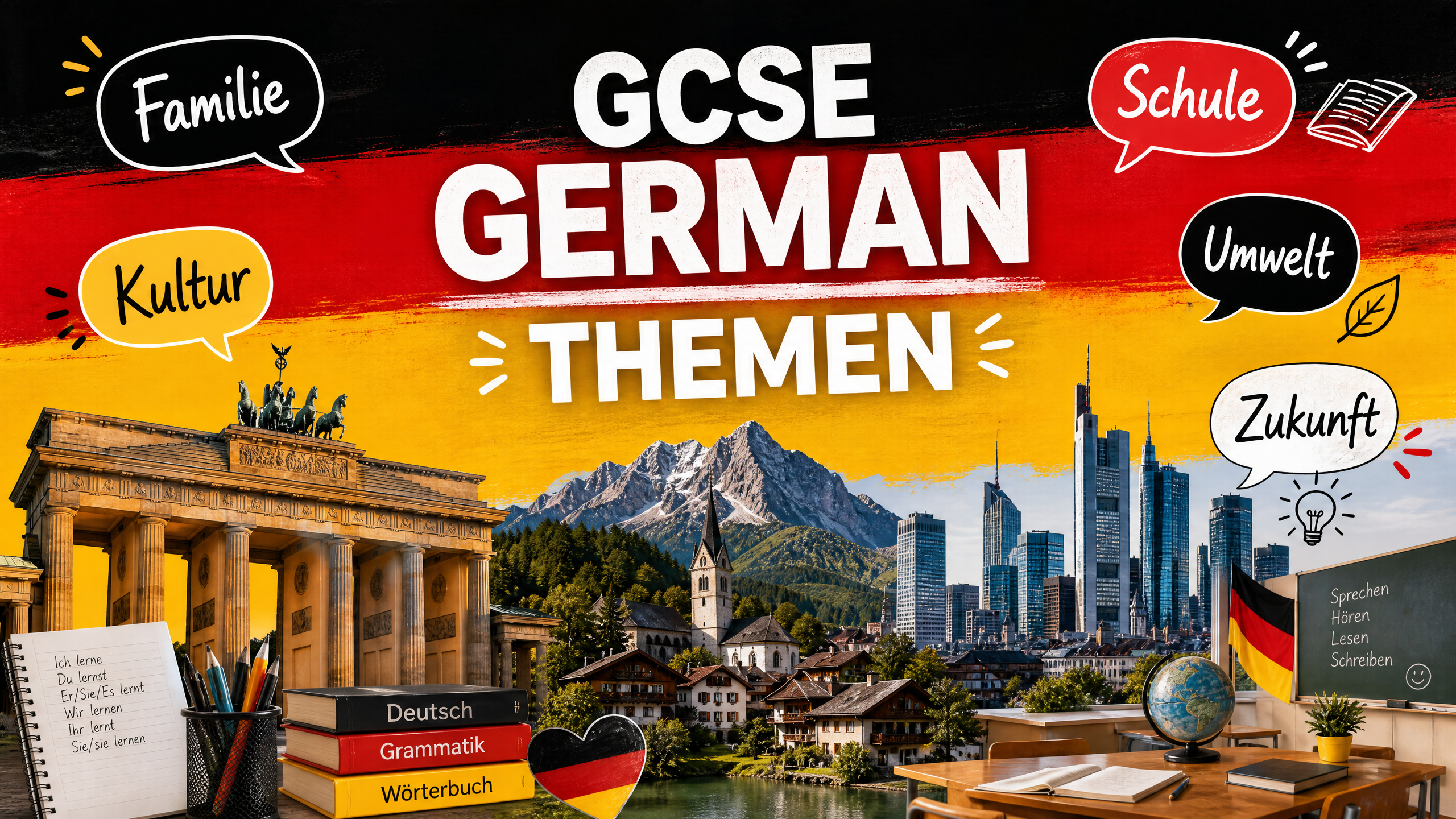
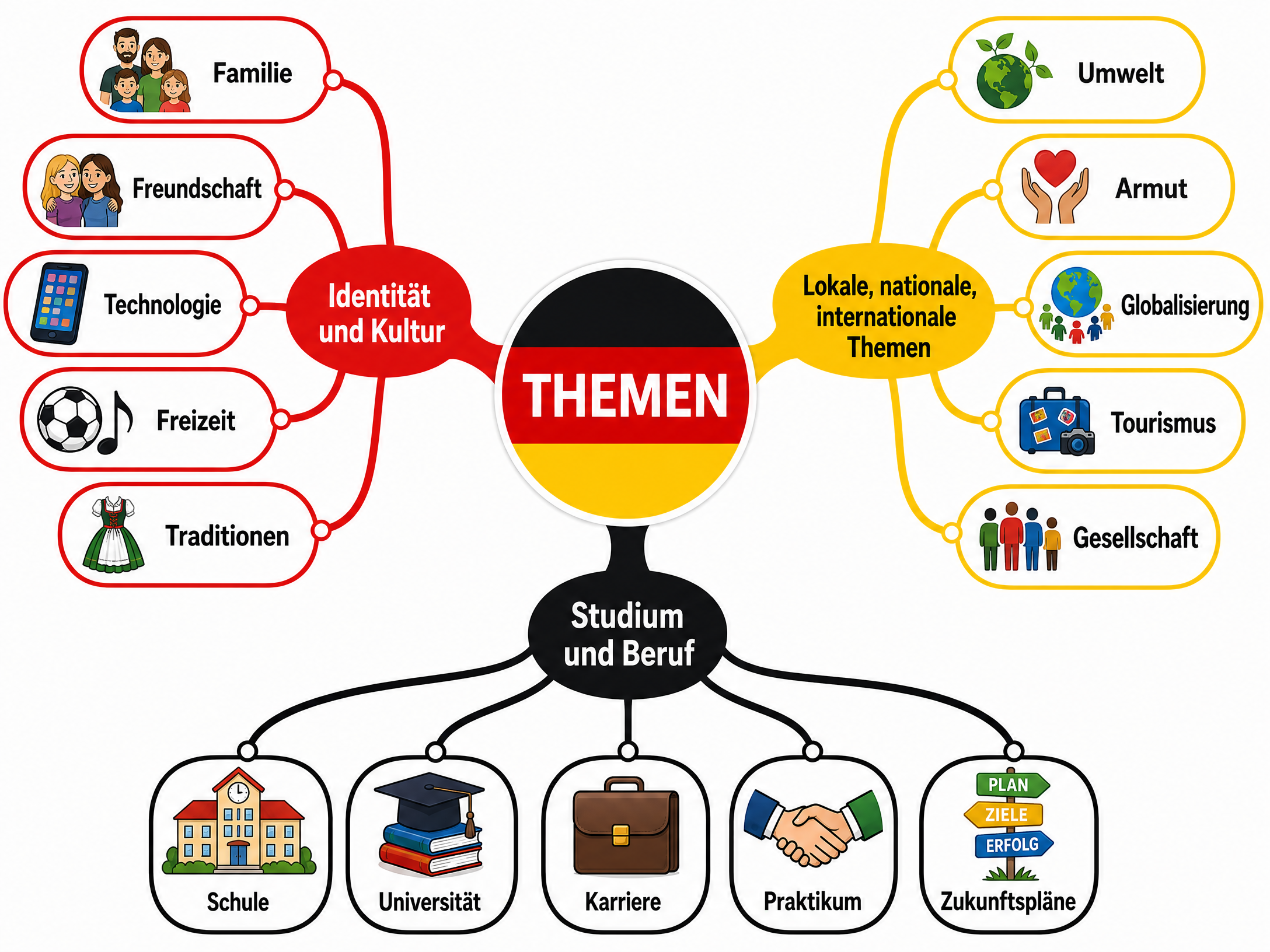
The GCSE German specification is built around three broad themes: Identität und Kultur (Identity and Culture), Lokale, nationale, internationale und globale Themen (Local, national, international and global areas of interest), and Aktuelle und zukünftige Studien und Beschäftigung (Current and future study and employment). These themes are the foundation of your entire course. You will encounter vocabulary from these areas across all four exam papers: Listening, Speaking, Reading, and Writing. Mastering this vocabulary and the associated grammar is essential for achieving top marks, as it allows you to express opinions, narrate events, and understand authentic German texts and audio.
🎧 Audio Lesson
Listen to our 10-minute podcast covering the core concepts, vocabulary, and exam tips for the GCSE German Themes:
📖 Essential Vocabulary
Tier 1 — Foundation Core
| German | English | Gender | Example Sentence |
|---|---|---|---|
| die Familie | family | f | Meine Familie ist sehr groß. |
| der Freund / die Freundin | friend | m/f | Mein Freund heißt Lukas. |
| die Schule | school | f | Ich gehe gern in die Schule. |
| das Fach | subject | n | Mein Lieblingsfach ist Mathe. |
| das Handy | mobile phone | n | Ich benutze mein Handy jeden Tag. |
| die Freizeit | free time | f | In meiner Freizeit spiele ich Fußball. |
| das Wochenende | weekend | n | Am Wochenende besuche ich meine Großeltern. |
| der Urlaub | holiday | m | Nächstes Jahr fahren wir in den Urlaub. |
| das Haus | house | n | Wir wohnen in einem kleinen Haus. |
| das Zimmer | room | n | Mein Zimmer ist sehr gemütlich. |
| das Essen | food | n | Das Essen in der Kantine ist lecker. |
| trinken | to drink | - | Ich trinke gern Apfelsaft. |
| arbeiten | to work | - | Mein Vater arbeitet in einem Büro. |
| das Geld | money | n | Ich bekomme Taschengeld von meinen Eltern. |
| das Wetter | weather | n | Das Wetter ist heute sehr schön. |
Tier 2 — Higher Tier
| German | English | Gender | Example Sentence |
|---|---|---|---|
| die Beziehung | relationship | f | Ich habe eine gute Beziehung zu meiner Schwester. |
| der Leistungsdruck | pressure to achieve | m | Es gibt viel Leistungsdruck in der Schule. |
| die Umweltverschmutzung | environmental pollution | f | Die Umweltverschmutzung ist ein großes Problem. |
| die Armut | poverty | f | Wir müssen gegen die Armut kämpfen. |
| die Gleichberechtigung | equality | f | Die Gleichberechtigung ist sehr wichtig in unserer Gesellschaft. |
| die Erfahrung | experience | f | Mein Praktikum war eine tolle Erfahrung. |
| die Ausbildung | apprenticeship/training | f | Nach der Schule möchte ich eine Ausbildung machen. |
| ehrenamtlich | voluntary | - | Ich arbeite ehrenamtlich im Tierheim. |
| obdachlos | homeless | - | In der Stadt gibt es viele obdachlose Menschen. |
| der Klimawandel | climate change | m | Der Klimawandel bedroht unsere Zukunft. |
High-Frequency Words & Phrases
| Phrase | English | Usage Context |
|---|---|---|
| meiner Meinung nach | in my opinion | Introducing an opinion |
| ich finde, dass | I find that | Expressing a view (sends verb to end) |
| auf der einen Seite | on the one hand | Structuring an argument |
| auf der anderen Seite | on the other hand | Structuring a counter-argument |
| zum Beispiel | for example | Giving examples |
| jedoch | however | Adding contrast |
| außerdem | furthermore | Adding information |
| im Großen und Ganzen | on the whole | Summarising a point |
| es gibt | there is / there are | Describing a scene or situation |
| es macht Spaß | it is fun | Justifying why you like something |
📝 Grammar Focus
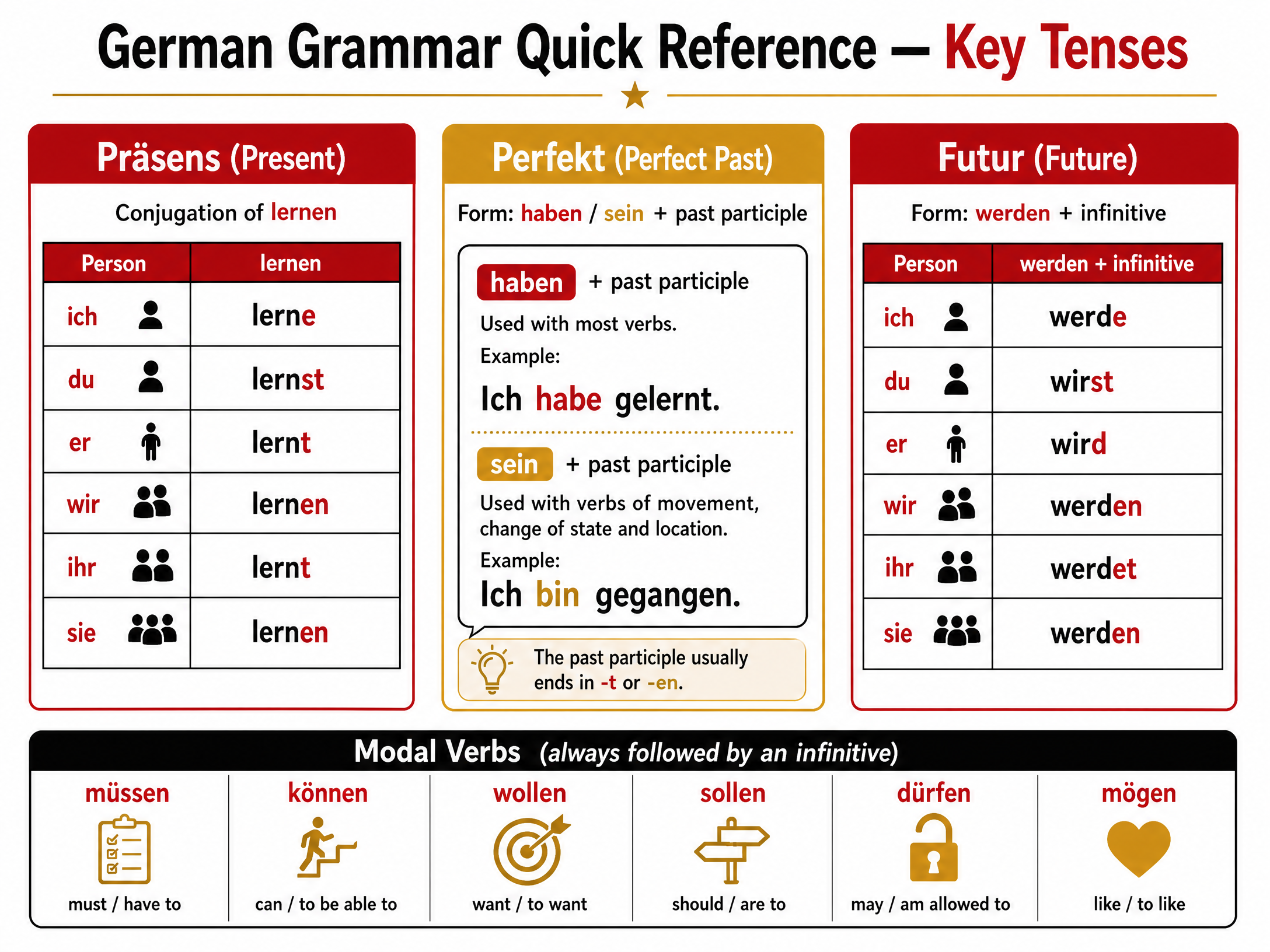
Key Structure 1: The Perfect Tense (Das Perfekt)
When to use it: To describe events that happened in the past. Examiners expect you to use past time frames, especially in Speaking and Writing tasks.
Conjugation Table (haben + past participle)
| Subject | Verb Form (haben) | Example | English |
|---|---|---|---|
| ich | habe | Ich habe gespielt. | I played / have played. |
| du | hast | Du hast gelernt. | You played / have played. |
| er/sie/es | hat | Er hat gearbeitet. | He worked / has worked. |
| wir | haben | Wir haben gegessen. | We ate / have eaten. |
| ihr | habt | Ihr habt getrunken. | You (pl) drank / have drunk. |
| sie/Sie | haben | Sie haben gelesen. | They/You (formal) read / have read. |
Irregulars to learn:
- sein (to be) -> ist gewesen
- haben (to have) -> hat gehabt
- sehen (to see) -> hat gesehen
- gehen (to go) -> ist gegangen (Note: uses sein as auxiliary because it's motion)
Key Structure 2: The Future Tense (Das Futur)
When to use it: To describe plans, intentions, or events that will happen later. Crucial for the 'future plans' bullet points in Writing.
Conjugation Table (werden + infinitive)
| Subject | Verb Form (werden) | Example | English |
|---|---|---|---|
| ich | werde | Ich werde spielen. | I will play. |
| du | wirst | Du wirst lernen. | You will learn. |
| er/sie/es | wird | Er wird arbeiten. | He will work. |
| wir | werden | Wir werden essen. | We will eat. |
| ihr | werdet | Ihr werdet trinken. | You (pl) will drink. |
| sie/Sie | werden | Sie werden lesen. | They/You (formal) will read. |
Irregulars to learn: The verb werden itself is irregular in the du and er/sie/es forms (wirst, wird). Remember that the infinitive always goes at the very end of the clause.
Key Structure 3: Subordinating Conjunctions (weil, dass, obwohl, wenn)
When to use it: To link sentences and add complexity. This is a key differentiator between Foundation and Higher tier writing.
The Rule: When you use a subordinating conjunction, the conjugated verb is 'kicked' to the very end of the clause.
- Ich lerne Deutsch. (I learn German.)
- Ich lerne Deutsch, weil es wichtig ist. (I learn German because it is important.)
- Ich denke, dass Mathe schwer ist. (I think that maths is hard.)
- Obwohl es regnet, spiele ich Fußball. (Although it is raining, I play football. Note: if the subordinate clause is first, the verb in the main clause immediately follows the comma.)
🎧 Listening Skills
What to Expect
The listening exam tests your comprehension of spoken German across all three themes. You will hear short announcements, conversations, interviews, and longer narratives. The recordings are played twice.
Listening Strategies
- Read ahead: Use the reading time before the audio starts to read the questions and anticipate the vocabulary you might hear.
- Listen for negatives: Pay close attention to words like nicht (not), kein (no/none), nie (never), and nichts (nothing), as they completely change the meaning.
- Note details: Jot down numbers, times, dates, and names in the margin as soon as you hear them.
Common Listening Traps
Examiners love to use distractors. For example, if the question asks what the person did last weekend, the audio might mention what they usually do on weekends, what they plan to do next weekend, AND what they did last weekend. Listen carefully for the time markers (e.g., letztes Wochenende, normalerweise, nächstes Wochenende).
🗣️ Speaking Skills
Role Play Scenarios
Scenario: At the tourist information office
- You: Guten Tag. Haben Sie einen Stadtplan?
- Examiner: Ja, hier bitte. Wie kann ich Ihnen helfen?
- You: Welche Sehenswürdigkeiten gibt es hier?
- Examiner: Es gibt ein tolles Museum und eine alte Kirche.
- You: Um wie viel Uhr öffnet das Museum?
Photo Card Practice
Model Photo Card Response (Theme: School):
- Qu 1 (Description): Auf dem Foto gibt es drei Schüler. Sie sitzen im Klassenzimmer und arbeiten an Computern. Sie tragen eine Schuluniform.
- Qu 2 (Opinion): Meiner Meinung nach ist Technologie in der Schule sehr nützlich, weil man schnell Informationen finden kann.
- Qu 3 (Related topic): Mein Lieblingsfach ist Informatik, weil ich gern programmiere.
- Qu 4 (Past/Future): Gestern habe ich in der Schule ein Projekt über den Klimawandel gemacht. Nächstes Jahr werde ich Informatik weiter studieren.
- Qu 5 (Unpredictable): Eine ideale Schule hätte keine Hausaufgaben und eine bessere Kantine!
General Conversation Questions
| Question (German) | Model Answer | English Translation |
|---|---|---|
| Beschreib deine Familie. | In meiner Familie gibt es vier Personen: meine Eltern, meine Schwester und mich. Ich verstehe mich gut mit meiner Schwester. | Describe your family. / In my family there are four people: my parents, my sister and me. I get on well with my sister. |
| Was hast du letztes Wochenende gemacht? | Letztes Wochenende bin ich mit meinen Freunden ins Kino gegangen. Danach haben wir Pizza gegessen. Es war toll. | What did you do last weekend? / Last weekend I went to the cinema with my friends. Afterwards we ate pizza. It was great. |
| Was sind deine Pläne für die Zukunft? | In der Zukunft werde ich an der Universität studieren. Ich möchte Arzt werden, weil ich Menschen helfen will. | What are your plans for the future? / In the future I will study at university. I would like to become a doctor because I want to help people. |
| Wie schützt du die Umwelt? | Ich fahre immer mit dem Rad zur Schule und ich recycele Papier und Glas. Das ist sehr wichtig. | How do you protect the environment? / I always cycle to school and I recycle paper and glass. That is very important. |
| Was ist dein Lieblingsfest? | Mein Lieblingsfest ist Weihnachten, weil ich Zeit mit meiner Familie verbringen kann und wir leckeres Essen essen. | What is your favourite festival? / My favourite festival is Christmas because I can spend time with my family and we eat delicious food. |
✍️ Writing Skills
Translation Practice
English → German:
| English | German | Key Grammar |
|---|---|---|
| I live in a small house. | Ich wohne in einem kleinen Haus. | Dative case after 'in' |
| Last year I went to Germany. | Letztes Jahr bin ich nach Deutschland gefahren. | Perfect tense with 'sein' + time phrase word order |
| I think that school is important. | Ich denke, dass die Schule wichtig ist. | Subordinating conjunction 'dass' (verb to end) |
| I would like to work abroad. | Ich möchte im Ausland arbeiten. | Modal verb 'möchten' + infinitive at end |
| Next weekend I will play football. | Nächstes Wochenende werde ich Fußball spielen. | Future tense (werden + infinitive) + time phrase word order |
Extended Writing
**Model 90-word response (Foundation - Theme: Free Time):**In meiner Freizeit spiele ich gern Fußball, weil es gesund ist. Ich spiele jeden Samstag mit meinen Freunden im Park. Letztes Wochenende sind wir ins Kino gegangen und wir haben einen Actionfilm gesehen. Der Film war sehr spannend. Nächstes Wochenende werde ich am Computer spielen und Musik hören. Ich finde Technologie toll. Normalerweise lese ich auch Bücher, aber ich mag keine Hausaufgaben, weil sie langweilig sind.
**Model 150-word response (Higher - Theme: Environment):**Meiner Meinung nach ist die Umwelt sehr wichtig, aber es gibt heutzutage viele Probleme, wie zum Beispiel den Klimawandel und die Umweltverschmutzung. Um die Umwelt zu schützen, fahre ich jeden Tag mit dem Rad zur Schule, anstatt mit dem Auto zu fahren. Außerdem recyceln wir zu Hause immer Papier und Plastik.
Letztes Jahr habe ich bei einem Umweltprojekt in meiner Stadt mitgemacht. Wir haben Müll im Park gesammelt. Es war anstrengend, aber eine sehr gute Erfahrung, weil wir der Natur geholfen haben.
In der Zukunft werde ich versuchen, umweltfreundlicher zu leben. Ich werde weniger Fleisch essen und vielleicht Mitglied in einer Umweltorganisation werden. Ich denke, dass die Regierung mehr machen muss, um erneuerbare Energien zu fördern, weil wir nur eine Erde haben.
Writing Checklist
- ✅ Have I used at least three different tenses (Present, Past, Future)?
- ✅ Have I included opinions and justified them (weil/da/denn)?
- ✅ Have I used linking words (und, aber, oder, deshalb, außerdem)?
- ✅ Are my verb endings correct for the subject (ich -e, du -st, er/sie/es -t)?
- ✅ Are my adjective endings correct (especially after ein/eine)?
- ✅ Is the verb in the correct position (second position in main clauses, at the end in subordinate clauses)?
📚 Reading Skills
Key Strategies
- Skim for gist: Read the text quickly to get the general idea before looking at the questions.
- Look for cognates: Use words that look like English words to help you understand the context.
- Use context clues: If you don't know a word, look at the words around it to guess the meaning.
False Friends & Tricky Words
| Word | Looks Like | Actually Means |
|---|---|---|
| das Gift | gift | poison |
| der Chef | chef | boss |
| das Gymnasium | gymnasium | grammar school |
| aktuell | actual | current/up-to-date |
| brav | brave | well-behaved/good |
| fast | fast | almost |
🌍 Cultural Knowledge
Understanding the culture of German-speaking countries can add depth to your writing and speaking responses. For example, knowing that many German students attend different types of schools (Gymnasium, Realschule, Hauptschule) shows cultural awareness. Being aware of the strong emphasis on environmental protection (Umweltschutz) and recycling (Mülltrennung) in Germany is excellent for Theme 2. You can also mention specific festivals like Oktoberfest in Munich, Karneval, or traditional Christmas markets (Weihnachtsmärkte) when discussing traditions and celebrations in Theme 1.
Visual Resources
2 diagrams and illustrations
Interactive Diagrams
1 interactive diagram to visualise key concepts
Conceptual Flow Outline
MFL exam approach by skill
Worked Examples
4 detailed examples with solutions and examiner commentary
Practice Questions
Test your understanding — click to reveal model answers
Translate into German: 'I think that protecting the environment is important.'
Hint: Remember the word order after 'dass'.
Writing: Write a short paragraph (approx 40 words) about your family. Mention who is in your family and who you get on well with.
Hint: Use the verb 'sich verstehen' for getting on well.
Speaking (Photo Card): Look at a photo of people recycling. Answer the question: 'Ist Recycling wichtig für dich? Warum?'
Hint: Give a clear opinion and use 'weil' to justify it.
Reading: 'Letztes Jahr habe ich ein Praktikum in einem Krankenhaus gemacht. Es war sehr interessant, aber ich musste früh aufstehen.' Did the writer enjoy the work experience?
Hint: Look for the adjective describing the experience.
Writing: Translate into English: 'Nächstes Jahr werde ich mit meinen Freunden nach Spanien fahren.'
Hint: Identify the tense from 'werde ... fahren'.
Listening: 'Ich lerne gern Mathe, weil der Lehrer sehr gut erklärt, aber Englisch finde ich ziemlich langweilig.' What is the student's opinion of English?
Hint: Listen for the adjective associated with 'Englisch'.