Pearson Edexcel · GCSE · German
Course version: Pearson-GCSE-German · Version from Mar 2026
Grammar: Adjectives
Master German adjective endings across all cases and articles, plus comparatives and superlatives. Essential for accessing higher marks in Speaking and Writing, and crucial for decoding meaning in Reading and Listening exams.
- 11 min read
- 4 worked examples
- 6 practice questions
- 8 key terms
Check what you remember
Read the wording for your board, then hide it and explain Attributive Adjective in your own words. Rough notes are fine. This is a self-check, with no mark or grade.
Reference: Pearson Edexcel
An adjective that comes directly before the noun it describes (e.g., der rote Apfel). These MUST have endings.
Study Notes
Overview
Adjective agreement is one of the key differentiators between Foundation and Higher tier performance in GCSE German. Examiners actively look for correct adjective endings as a sign of grammatical competence. This guide covers how adjectives change based on gender, case, and article type, as well as how to form comparatives and superlatives.
📖 Essential Vocabulary
Tier 1 — Foundation Core
| German | English | Gender | Example Sentence |
|---|---|---|---|
| alt | old | - | Mein Großvater ist alt. |
| jung | young | - | Das Mädchen ist jung. |
| groß | big/tall | - | Ich wohne in einem großen Haus. |
| klein | small | - | Er hat einen kleinen Hund. |
| gut | good | - | Das Essen ist sehr gut. |
| schlecht | bad | - | Das Wetter ist heute schlecht. |
| schön | beautiful/nice | - | Wir haben einen schönen Garten. |
| hässlich | ugly | - | Das Gebäude ist hässlich. |
| billig | cheap | - | Die Schuhe sind billig. |
| teuer | expensive | - | Der Computer ist zu teuer. |
| lang | long | - | Der Film war sehr lang. |
| kurz | short | - | Sie trägt einen kurzen Rock. |
| neu | new | - | Ich brauche ein neues Handy. |
| schnell | fast | - | Das Auto ist sehr schnell. |
| langsam | slow | - | Der Zug ist langsam. |
Tier 2 — Higher Tier
| German | English | Gender | Example Sentence |
|---|---|---|---|
| fleißig | hard-working | - | Mein Bruder ist ein fleißiger Schüler. |
| faul | lazy | - | Sei nicht so faul! |
| nützlich | useful | - | Das ist ein nützliches Buch. |
| nutzlos | useless | - | Dieser alte Computer ist völlig nutzlos. |
| spannend | exciting | - | Wir haben einen spannenden Film gesehen. |
| langweilig | boring | - | Der Unterricht war extrem langweilig. |
| gefährlich | dangerous | - | Es ist eine gefährliche Situation. |
| sicher | safe/sure | - | Hier bist du sicher. |
| erfolgreich | successful | - | Sie ist eine erfolgreiche Geschäftsfrau. |
| wichtig | important | - | Das ist ein wichtiges Thema für die Prüfung. |
High-Frequency Words & Phrases
| Phrase | English | Usage Context |
|---|---|---|
| meiner Meinung nach | in my opinion | Introducing an opinion (Speaking/Writing) |
| auf der einen Seite | on the one hand | Balancing an argument |
| auf der anderen Seite | on the other hand | Balancing an argument |
| im Vergleich zu | compared to | Using comparatives with nouns |
| es ist besser als | it is better than | Simple comparison |
| es ist genauso... wie | it is just as... as | Equal comparison |
| das Beste daran ist | the best thing about it is | Using superlatives as nouns |
| ein großer Vorteil ist | a big advantage is | Discussing pros and cons |
| ein großer Nachteil ist | a big disadvantage is | Discussing pros and cons |
| um ehrlich zu sein | to be honest | Sounding natural in Speaking |
📝 Grammar Focus
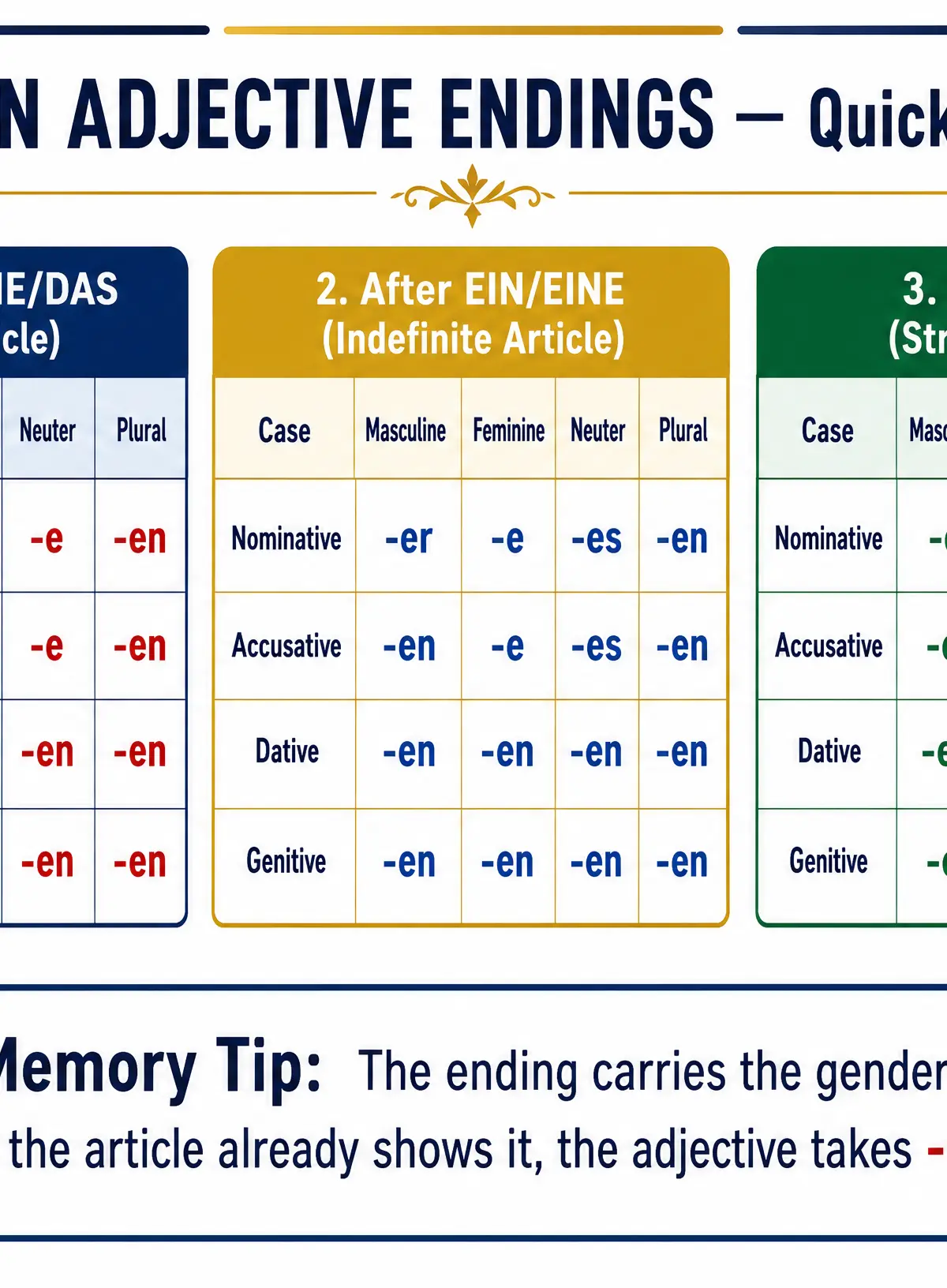
Key Structure 1: Adjective Endings after Definite Articles (der/die/das)
When to use it: When describing a specific noun (the big house, the red car).
Rule: The definite article already shows the gender and case, so the adjective takes a "weak" ending (-e or -en).
Declension Table
| Case | Masculine (der) | Feminine (die) | Neuter (das) | Plural (die) |
|---|---|---|---|---|
| Nominative | der alte Mann | die junge Frau | das kleine Kind | die netten Leute |
| Accusative | den alten Mann | die junge Frau | das kleine Kind | die netten Leute |
| Dative | dem alten Mann | der jungen Frau | dem kleinen Kind | den netten Leuten |
| Genitive | des alten Mannes | der jungen Frau | des kleinen Kindes | der netten Leute |
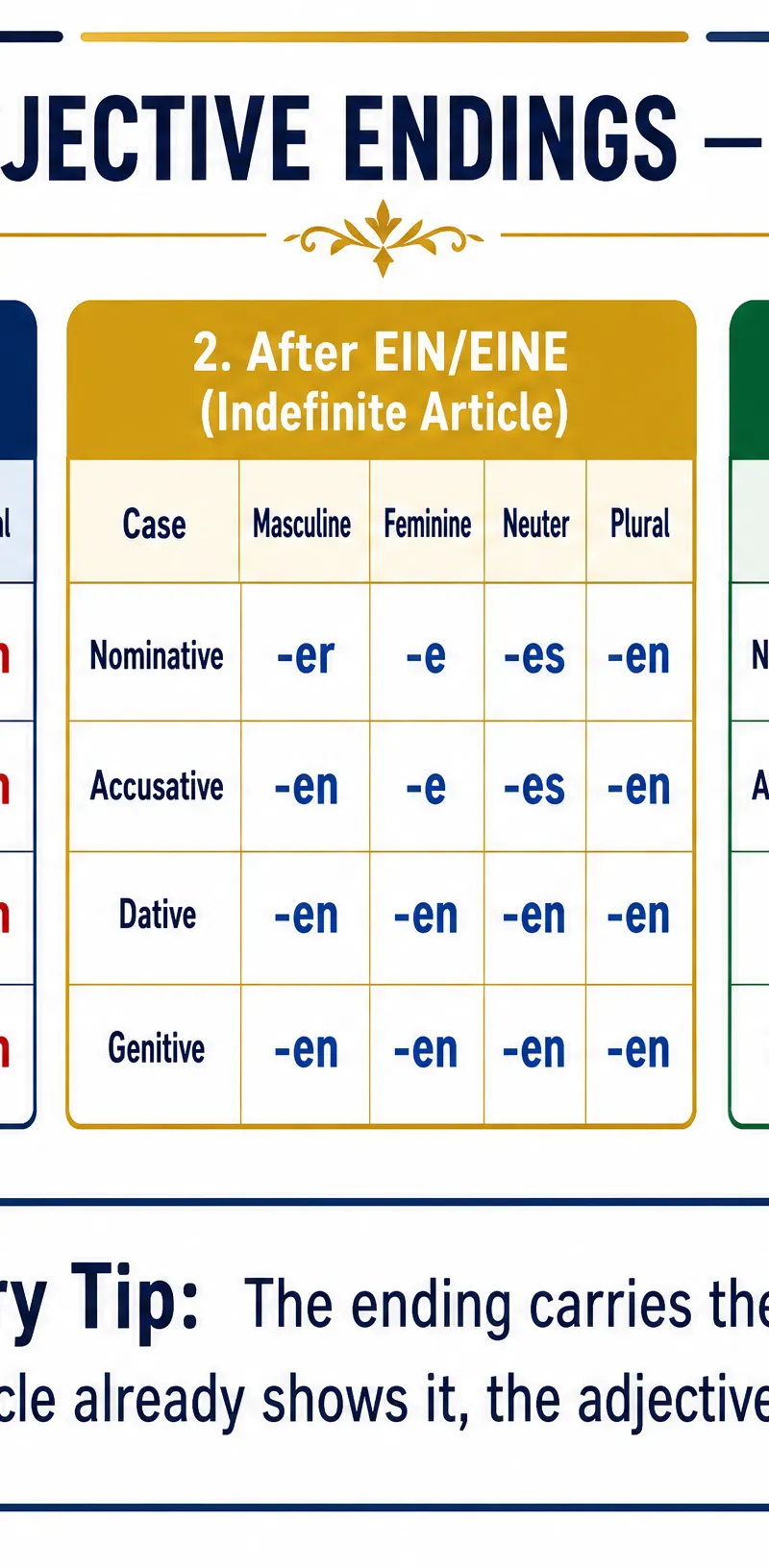
Key Structure 2: Adjective Endings after Indefinite Articles (ein/eine/ein)
When to use it: When describing a non-specific noun (a big house, a red car), or after possessives (mein, dein) and "kein".
Rule: If the article doesn't clearly show the gender (like "ein" for both masc/neut nom), the adjective must show it with a "strong" ending (-er, -es).
Declension Table
| Case | Masculine (ein) | Feminine (eine) | Neuter (ein) | Plural (keine/meine) |
|---|---|---|---|---|
| Nominative | ein alter Mann | eine junge Frau | ein kleines Kind | keine netten Leute |
| Accusative | einen alten Mann | eine junge Frau | ein kleines Kind | keine netten Leute |
| Dative | einem alten Mann | einer jungen Frau | einem kleinen Kind | keinen netten Leuten |
| Genitive | eines alten Mannes | einer jungen Frau | eines kleinen Kindes | keiner netten Leute |
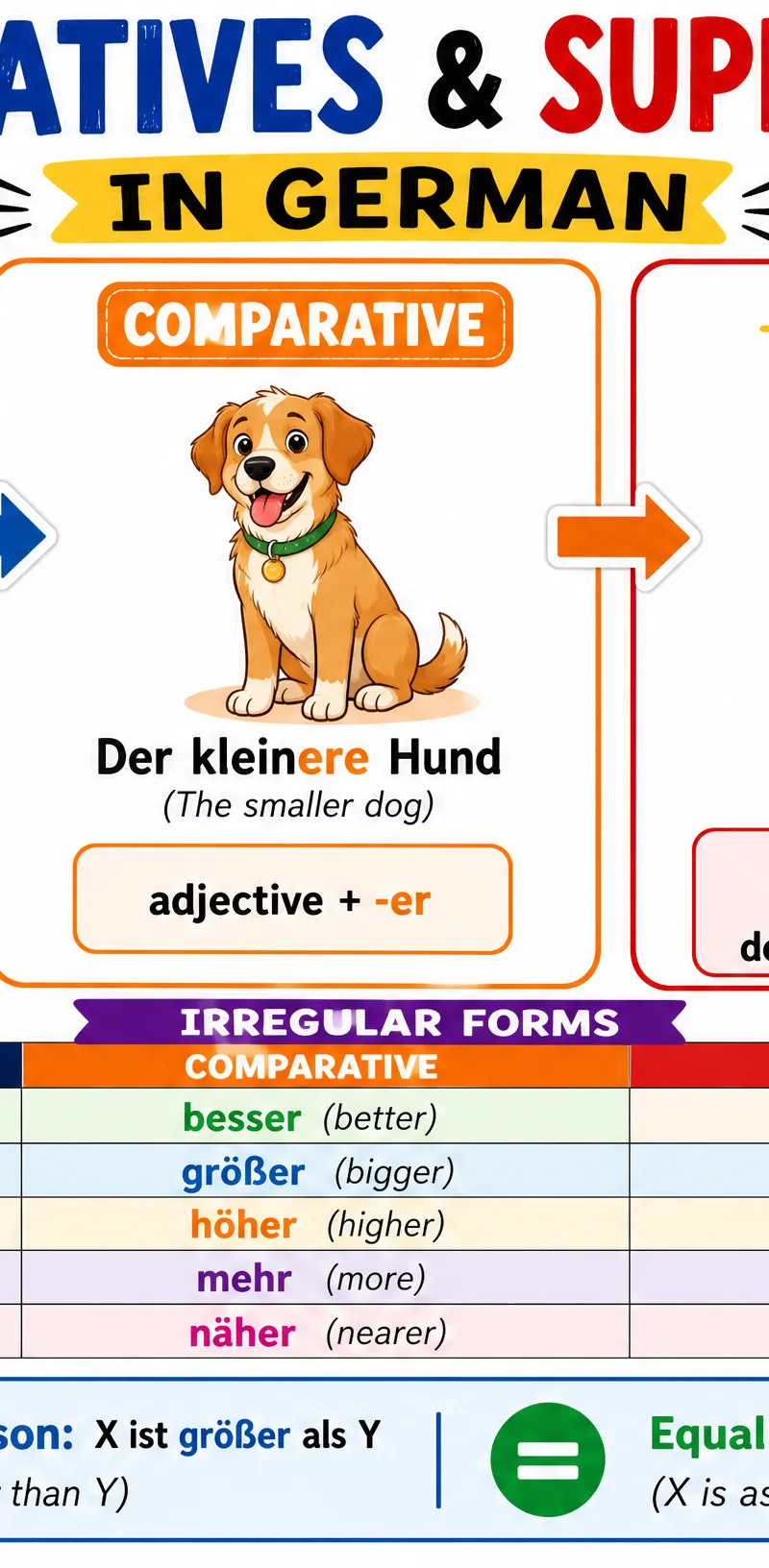
Key Structure 3: Comparatives and Superlatives
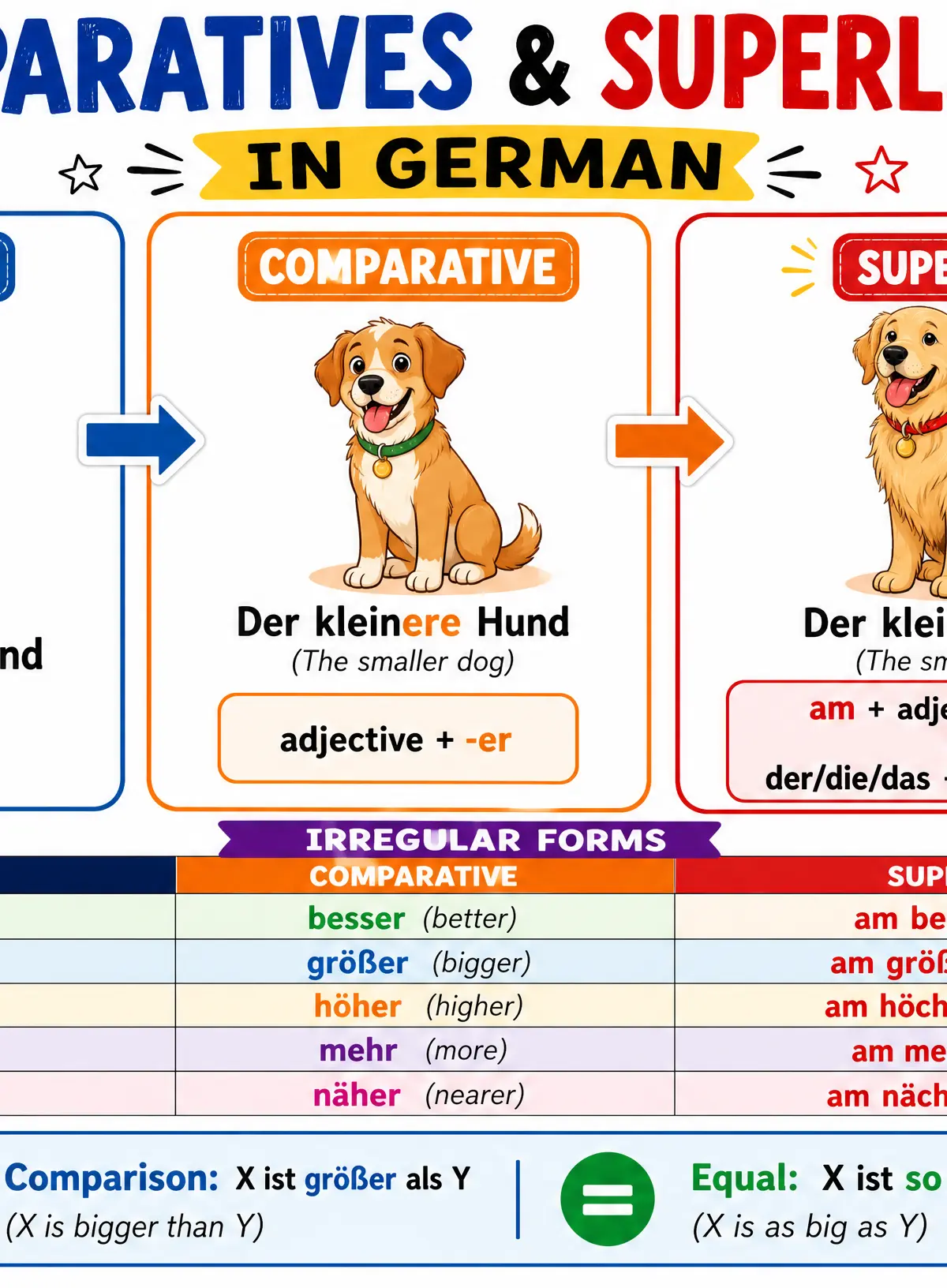
When to use it: To compare two things (bigger than) or state the extreme (the biggest).
Rule: Add -er for comparative and am ... -sten (or der/die/das ... -ste) for superlative. Short adjectives with a, o, u often take an umlaut.
Irregulars to learn:
- gut (good) → besser (better) → am besten (best)
- viel (much) → mehr (more) → am meisten (most)
- gern (gladly) → lieber (prefer) → am liebsten (prefer most)
- hoch (high) → höher (higher) → am höchsten (highest)
🎧 Listening Skills
What to Expect
In the listening exam, adjectives are crucial for identifying positive vs. negative opinions, which is a very common question type. You may hear someone describe a holiday, a film, or a job using a string of adjectives.
Listening Strategies
- Listen for qualifiers: Words like sehr (very), zu (too), ziemlich (quite), or gar nicht (not at all) often precede the key adjective.
- Watch for negatives: nicht gut is the opposite of gut. Don't just hear the adjective; listen for the negation.
- Listen for comparatives: If you hear als (than), the speaker is comparing two things. Make sure you identify which is better/worse.
Common Listening Traps
- False Friends: Aktuell means "current/up-to-date", not "actual". Sympathisch means "nice/likable", not "sympathetic".
- Comparisons: If someone says "Mathe ist interessanter als Deutsch", the question might ask "Which subject do they prefer?" — make sure you get the direction right!
🗣️ Speaking Skills
Role Play Scenarios
Scenario: Buying clothes in a shop.
- Assistant: Kann ich Ihnen helfen?
- You: Ja, ich suche einen warmen Pullover. (Yes, I'm looking for a warm jumper.)
- Assistant: Wie finden Sie diesen roten Pullover?
- You: Er ist schön, aber haben Sie einen billigeren Pullover? (It's nice, but do you have a cheaper jumper?)
Photo Card Practice
Model Photo Card Response (Describing a school photo):
- Qu 1 (Description): Auf dem Foto sehe ich viele junge Schüler in einem großen Klassenzimmer. (In the photo I see many young students in a large classroom.)
- Qu 2 (Opinion): Meiner Meinung nach sieht die Schule sehr modern und gut ausgestattet aus. (In my opinion the school looks very modern and well-equipped.)
- Qu 3 (Related topic): Mein Lieblingsfach ist Geschichte, weil es interessanter als Mathe ist. (My favourite subject is history because it is more interesting than maths.)
- Qu 4 (Past): Letztes Jahr war meine alte Schule ziemlich langweilig und klein. (Last year my old school was quite boring and small.)
General Conversation Questions
| Question (German) | Model Answer | English Translation |
|---|---|---|
| Wie ist dein bestes Fach? | Mein bestes Fach ist Kunst, weil es sehr kreativ und entspannend ist. | My best subject is art because it is very creative and relaxing. |
| Beschreib deine Stadt. | Ich wohne in einer malerischen, aber ruhigen Stadt. Es gibt einen großen Park. | I live in a picturesque but quiet town. There is a large park. |
| Was ist besser: Kino oder Theater? | Ich finde das Kino besser, weil die Spezialeffekte viel spannender sind. | I find the cinema better because the special effects are much more exciting. |
| Wie war dein letzter Urlaub? | Es war fantastisch! Wir hatten tolles Wetter und das Hotel war sehr luxuriös. | It was fantastic! We had great weather and the hotel was very luxurious. |
| Beschreib deinen idealen Partner. | Er muss freundlich und lustig sein. Aussehen ist nicht so wichtig. | He must be friendly and funny. Looks are not so important. |
✍️ Writing Skills
Translation Practice
English → German:
| English | German | Key Grammar |
|---|---|---|
| I have a small dog. | Ich habe einen kleinen Hund. | Accusative, masculine, after 'ein' (-en) |
| We live in an old house. | Wir wohnen in einem alten Haus. | Dative, neuter, after 'ein' (-em, -en) |
| The new teacher is very nice. | Der neue Lehrer ist sehr nett. | Nominative, masculine, after 'der' (-e) |
| My brother is taller than me. | Mein Bruder ist größer als ich. | Comparative with umlaut + als |
| That is the best film! | Das ist der beste Film! | Superlative attributive (-ste) |
Extended Writing
**Model 90-word response (Foundation - Topic: Holidays):**Letztes Jahr bin ich nach Spanien gefahren. Das Wetter war sehr heiß und sonnig. Wir haben in einem großen Hotel gewohnt. Das Essen war extrem lecker, aber ein bisschen teuer. Nächstes Jahr möchte ich nach Italien fahren, weil ich Strände liebe. Meiner Meinung nach sind Sommerurlaube am besten, weil man sich gut entspannen kann.
(Examiner comment: Good use of simple adjectives (heiß, sonnig, lecker, teuer) and one excellent superlative (am besten). Correct agreement in 'einem großen Hotel' (dative).)
**Model 150-word response (Higher - Topic: Technology):**Heutzutage spielt Technologie eine äußerst wichtige Rolle in unserem Leben. Ich benutze mein neues Smartphone jeden Tag, um mit meinen guten Freunden zu chatten und Musik zu hören. Einerseits ist das Internet unglaublich nützlich für meine Hausaufgaben, weil man schnell Informationen finden kann. Andererseits gibt es auch große Gefahren, wie zum Beispiel Cybermobbing. Letztes Wochenende habe ich einen spannenden Film auf meinem Laptop gesehen, was viel besser war, als ins teure Kino zu gehen. In der Zukunft werde ich versuchen, weniger Zeit vor dem Bildschirm zu verbringen, da es gesünder für die Augen ist. Zusammenfassend würde ich sagen, dass Technologie fantastisch ist, solange man sie vernünftig nutzt.
(Examiner comment: Excellent range of vocabulary (äußerst wichtig, unglaublich nützlich, große Gefahren). Perfect adjective agreements (mein neues Smartphone, meinen guten Freunden, einen spannenden Film). Strong comparative use (viel besser, weniger Zeit, gesünder).)
Writing Checklist
- ✅ Have I checked the gender and case for every adjective before a noun?
- ✅ Did I remember that ALL adjectives in the dative case (after mit, in, von etc.) end in -en?
- ✅ Have I used at least one comparative (with als)?
- ✅ Have I used at least one superlative (am ... -sten)?
- ✅ Have I used adverbs to boost my adjectives (sehr, ziemlich, total, extrem)?
📚 Reading Skills
Key Strategies
- Use endings as clues: If you see "mit einem großen Mann", the "-em" on einem tells you it's dative, meaning "with a big man". The endings help you parse the sentence structure.
- Look for capitalization: Remember that in German, nouns are capitalized but adjectives are not (unless they start a sentence). If you see "das Schöne", it's being used as a noun ("the beautiful thing").
False Friends & Tricky Words
| Word | Looks Like | Actually Means |
|---|---|---|
| aktuell | actual | current/up-to-date |
| brav | brave | well-behaved/good |
| sensibel | sensible | sensitive |
| sympathisch | sympathetic | nice/likable/pleasant |
| konsequent | consequent | consistent |
🌍 Cultural Knowledge
When describing people and places in German-speaking countries, knowing cultural nuances helps. For example, Germans often value Pünktlichkeit (punctuality) and Zuverlässigkeit (reliability), so these are great adjectives to use when describing an ideal employee or friend. When describing food, regional specialties are often described with pride — leckere bayerische Brezeln (tasty Bavarian pretzels) or berühmte Schweizer Schokolade (famous Swiss chocolate). Showing this cultural awareness in your Speaking and Writing tasks can impress examiners and demonstrate a deeper engagement with the language.
Visual Resources
2 diagrams and illustrations
Interactive Diagrams
1 interactive diagram to visualise key concepts
Conceptual Flow Outline
Decision tree for choosing the correct German adjective ending
Worked Examples
4 worked examples — open one to explore the question and available guidance.
Practice Questions
Try the question, then reveal an answer plan or example response
Translate into German: 'I am buying a new car.'
Hint: Car is neuter (das Auto). Buying takes the accusative case.
Translate into German: 'She lives in the big city.'
Hint: City is feminine (die Stadt). 'in' + static location takes the dative case.
Write a sentence comparing your town to a bigger city using 'als'.
Hint: Remember to use the comparative form of the adjective + als.
Translate into German: 'He is the smartest student in the class.'
Hint: Smart = intelligent or klug. Use the attributive superlative form.
Fill in the blank with the correct ending: Mit mein___ best___ Freunden gehe ich ins Kino.
Hint: 'Mit' takes the dative. 'Freunden' is plural.
Translate into German: 'I prefer drinking cold milk, but hot tea is the best.'
Hint: Use 'lieber' for prefer. Milk is feminine, tea is masculine. Use strong adjective endings for 'cold' and 'hot' as there are no articles.
Exam technique
How to turn what you know into marks
How to approach the question
In Writing: Draft your sentence first, then do an 'adjective sweep'. Go back through and specifically check the gender and case for every adjective before a noun.
How to structure your answer
When giving opinions, use the structure: Opinion phrase + noun + verb + comparative adjective + als + noun. (z.B. Meiner Meinung nach ist Deutsch nützlicher als Französisch).
Timing
Writing: Allow about 1 minute per mark. For a 16-mark 90-word task, spend 15 mins. For a 32-mark 150-word task, spend 30 mins. Always leave 5 mins to check adjective agreements.
Common pitfalls
- Forgetting adjective agreements entirely and leaving them in dictionary form
- Using the wrong ending after 'ein' in the masculine nominative (writing 'ein gute Mann' instead of 'ein guter Mann')
- Forgetting the umlaut in comparatives (grosser instead of größer)
- Using 'mehr' for comparatives like in English (writing 'mehr groß' instead of 'größer')
- Confusing 'als' (than) and 'wie' (as) in comparisons
- Not realising that plural adjectives after 'meine/keine/viele' take '-en'
What the command words want
- Describe the photo
- Use adjectives of colour, size, and emotion to describe the people and objects. (z.B. Ein großes, rotes Auto).
- Translate into German
- Do not translate word-for-word. Identify the case (Nom/Acc/Dat) required by the German verb/preposition before applying adjective endings.
- Write approximately 90 words
- Use at least 3-4 descriptive adjectives with correct endings to secure marks for 'range of language'.
- Write approximately 150 words
- You MUST include comparatives and superlatives to access the top band for complexity.
Watch or listen (optional)
Test your understanding of Grammar: Adjectives
Active recall beats re-reading. Take an instant quiz now to test what you’ve learned and lock it into long-term memory.
7 days Premium · Then the free plan continues · No card, no charge