Pearson Edexcel · GCSE · German
Course version: Pearson-GCSE-German · Version from Mar 2026
Grammar: Adverbs
Master the art of German adverbs to elevate your writing and speaking to the highest grade bands. This guide covers the essential Time, Manner, Place rule, comparative and superlative forms, and the sophisticated use of da-compounds across all four exam skills.
- 11 min read
- 4 worked examples
- 6 practice questions
- 8 key terms
Check what you remember
Read the wording for your board, then hide it and explain Adverb in your own words. Rough notes are fine. This is a self-check, with no mark or grade.
Reference: Pearson Edexcel
A word that modifies a verb, an adjective, or another adverb. In German, they never change their endings.
Study Notes

Overview
Adverbs are the secret weapon of high-scoring GCSE German candidates. While basic sentences get the job done, adding adverbs of time, manner, and place brings your German to life. Examiners specifically look for accurate adverb placement (the golden TMP rule) and the use of comparative structures (like lieber and am liebsten) to award marks in the top bands. This topic is essential for all four papers: Listening, Speaking, Reading, and Writing.
📖 Essential Vocabulary
Tier 1 — Foundation Core
| German | English | Gender | Example Sentence |
|---|---|---|---|
| heute | today | N/A | Ich spiele heute Fußball. |
| morgen | tomorrow | N/A | Wir gehen morgen ins Kino. |
| gestern | yesterday | N/A | Gestern war das Wetter schön. |
| immer | always | N/A | Er isst immer Pommes. |
| oft | often | N/A | Ich besuche oft meine Großeltern. |
| manchmal | sometimes | N/A | Manchmal spiele ich am Computer. |
| nie | never | N/A | Sie trinkt nie Kaffee. |
| schnell | quickly/fast | N/A | Das Auto fährt sehr schnell. |
| langsam | slowly | N/A | Bitte sprich langsam. |
| laut | loudly | N/A | Die Musik ist zu laut. |
| leise | quietly | N/A | Wir müssen leise sein. |
| gern / gerne | gladly / to like doing | N/A | Ich lese gern Bücher. |
| hier | here | N/A | Mein Bruder wohnt hier. |
| dort / da | there | N/A | Der Bahnhof ist dort drüben. |
| sehr | very | N/A | Der Film war sehr gut. |
Tier 2 — Higher Tier
| German | English | Gender | Example Sentence |
|---|---|---|---|
| neulich | recently | N/A | Ich habe neulich ein neues Handy gekauft. |
| heutzutage | nowadays | N/A | Heutzutage haben alle Jugendliche ein Smartphone. |
| glücklicherweise | fortunately | N/A | Glücklicherweise war niemand verletzt. |
| leider | unfortunately | N/A | Leider habe ich keine Zeit. |
| wahrscheinlich | probably | N/A | Wahrscheinlich werde ich an die Uni gehen. |
| vielleicht | perhaps/maybe | N/A | Vielleicht können wir am Wochenende einkaufen gehen. |
| draußen | outside | N/A | Im Sommer essen wir oft draußen. |
| drinnen | inside | N/A | Wenn es regnet, bleiben wir drinnen. |
| überall | everywhere | N/A | Es gab überall Müll auf den Straßen. |
| nirgendwo | nowhere | N/A | Ich konnte mein Heft nirgendwo finden. |
High-Frequency Words & Phrases
| Phrase | English | Usage Context |
|---|---|---|
| ab und zu | now and then | Great for describing hobbies or habits. |
| jeden Tag | every day | Essential for daily routine descriptions. |
| am liebsten | most of all / favourite | Perfect for expressing strong preferences in Speaking/Writing. |
| auf jeden Fall | definitely | Excellent filler phrase for Speaking exams to buy thinking time. |
| auf keinen Fall | definitely not | Strong opinion marker. |
| zum Glück | luckily | Good for adding emotion to past tense narratives. |
| normalerweise | normally | Useful for contrasting routine with a specific event. |
| besonders | especially | Used to intensify an adjective (e.g., besonders gut). |
| ziemlich | quite / fairly | Used to qualify an opinion (e.g., ziemlich langweilig). |
| wirklich | really | Adds emphasis to descriptions. |
📝 Grammar Focus
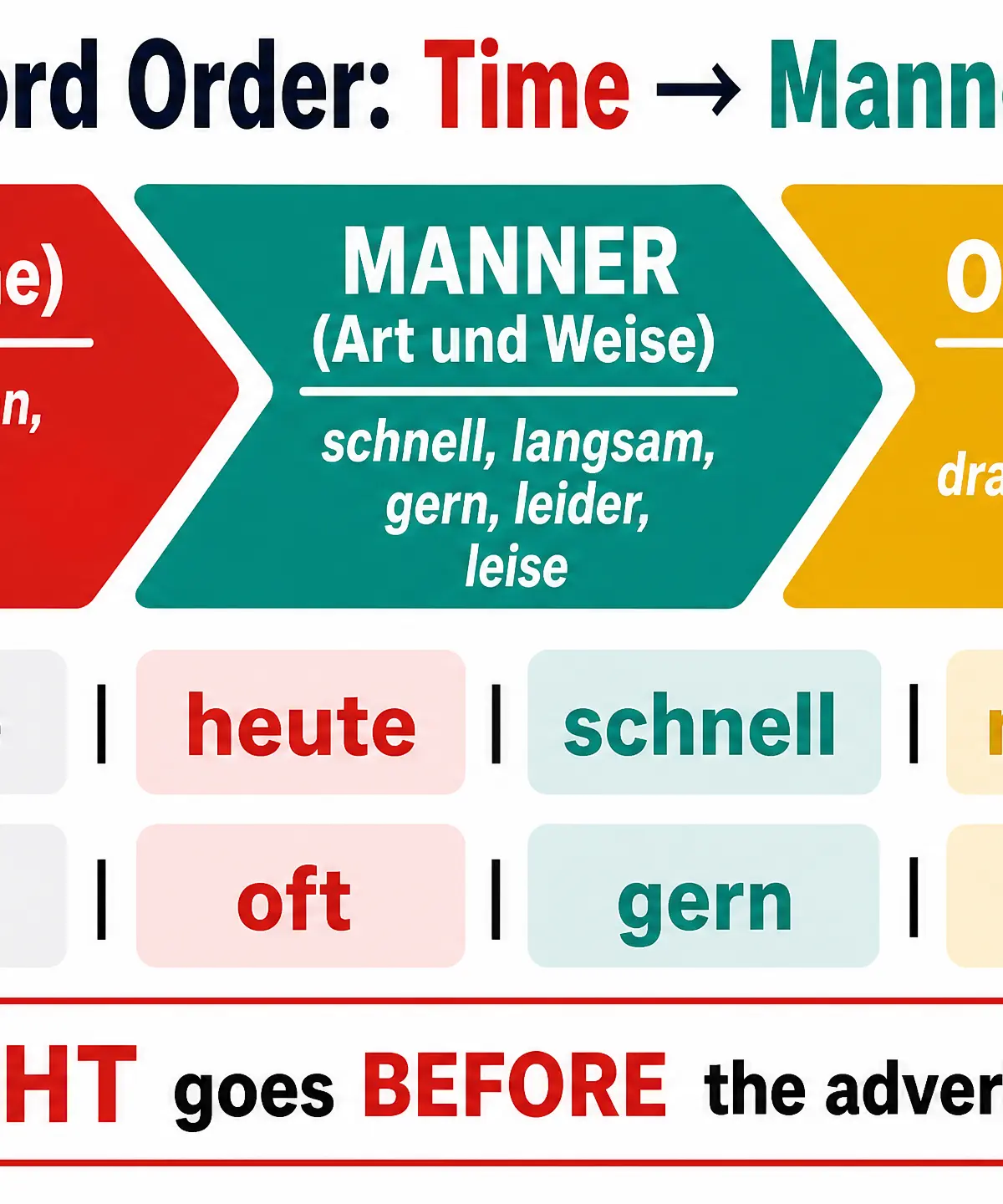
Key Structure 1: The Time, Manner, Place Rule (TMP)
When to use it: Every single time you have more than one adverb or adverbial phrase in a sentence. Examiners actively check for this.
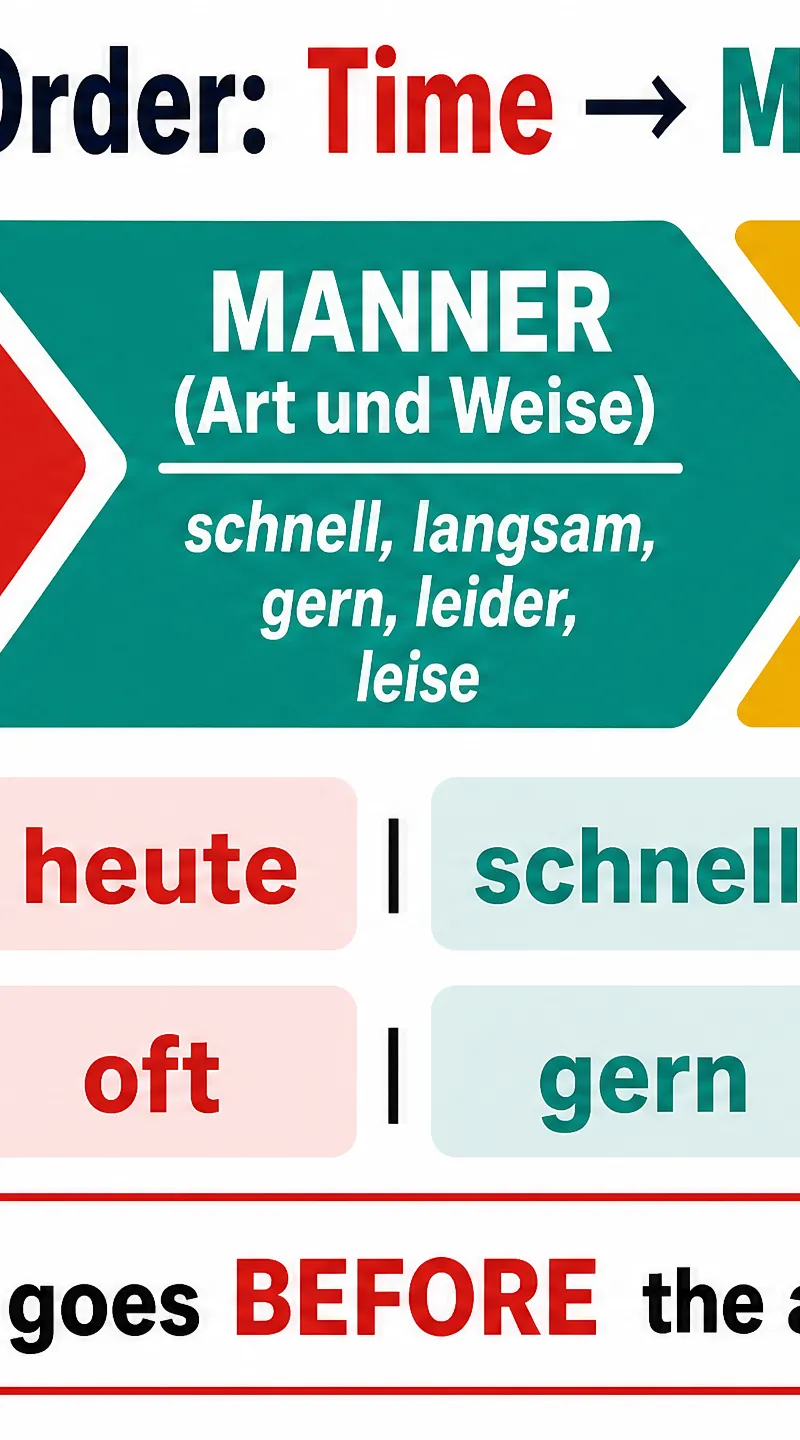
The Rule Structure
- Time (Wann?): heute, oft, am Wochenende
- Manner (Wie?): schnell, gern, mit dem Bus
- Place (Wo/Wohin?): hier, nach Berlin, im Park
Examples:
- Ich fahre heute (Time) schnell (Manner) nach Berlin (Place).
- Wir spielen am Samstag (Time) gern (Manner) im Park (Place).
Common Mistake: English speakers naturally say "I'm going to the cinema today" (Place then Time). In German, this is wrong. It MUST be: Ich gehe heute ins Kino.
Key Structure 2: Comparative and Superlative Adverbs
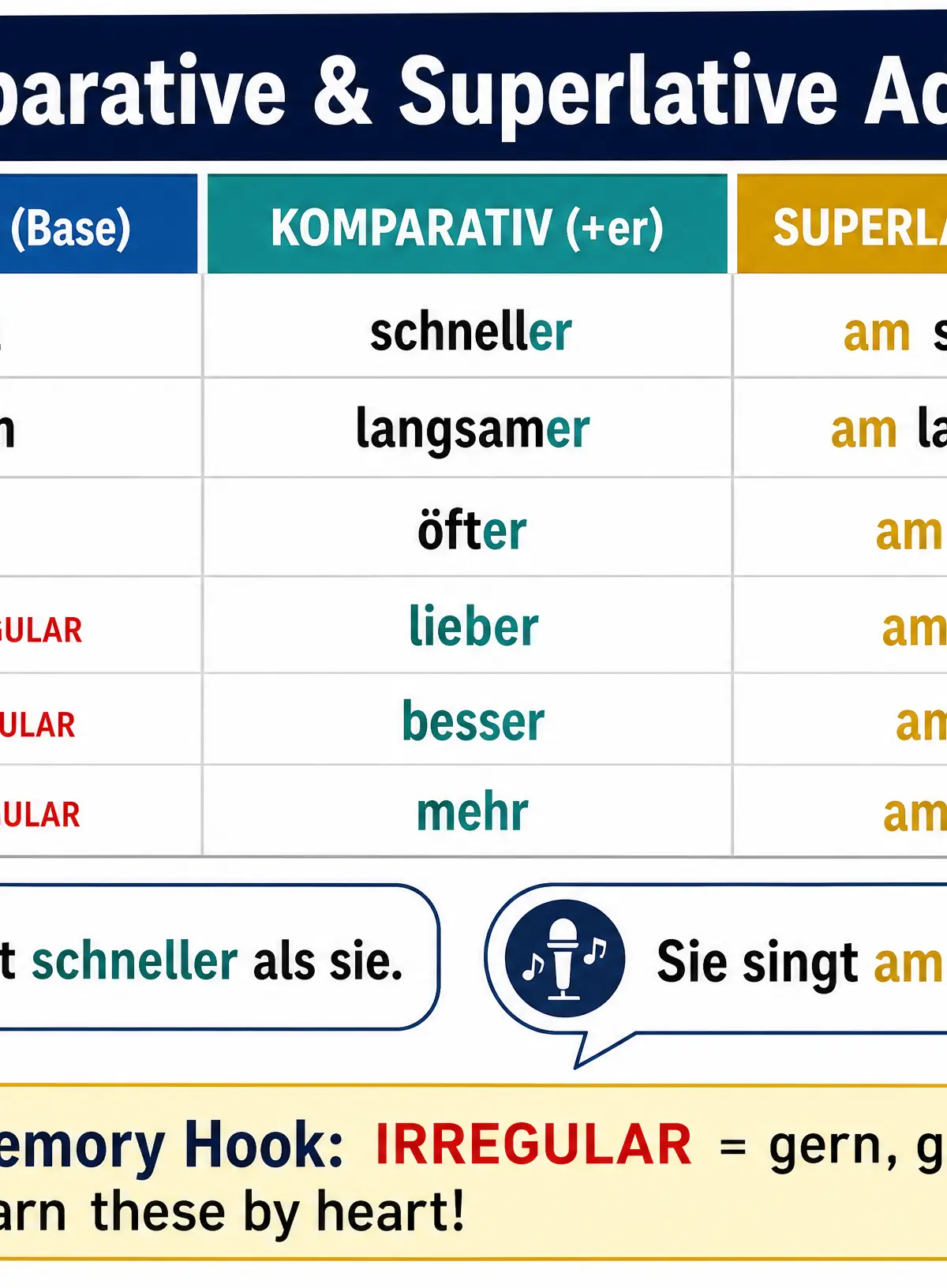
When to use it: When comparing how actions are performed, or expressing preferences. This is a key Higher Tier skill.
Formation Rules
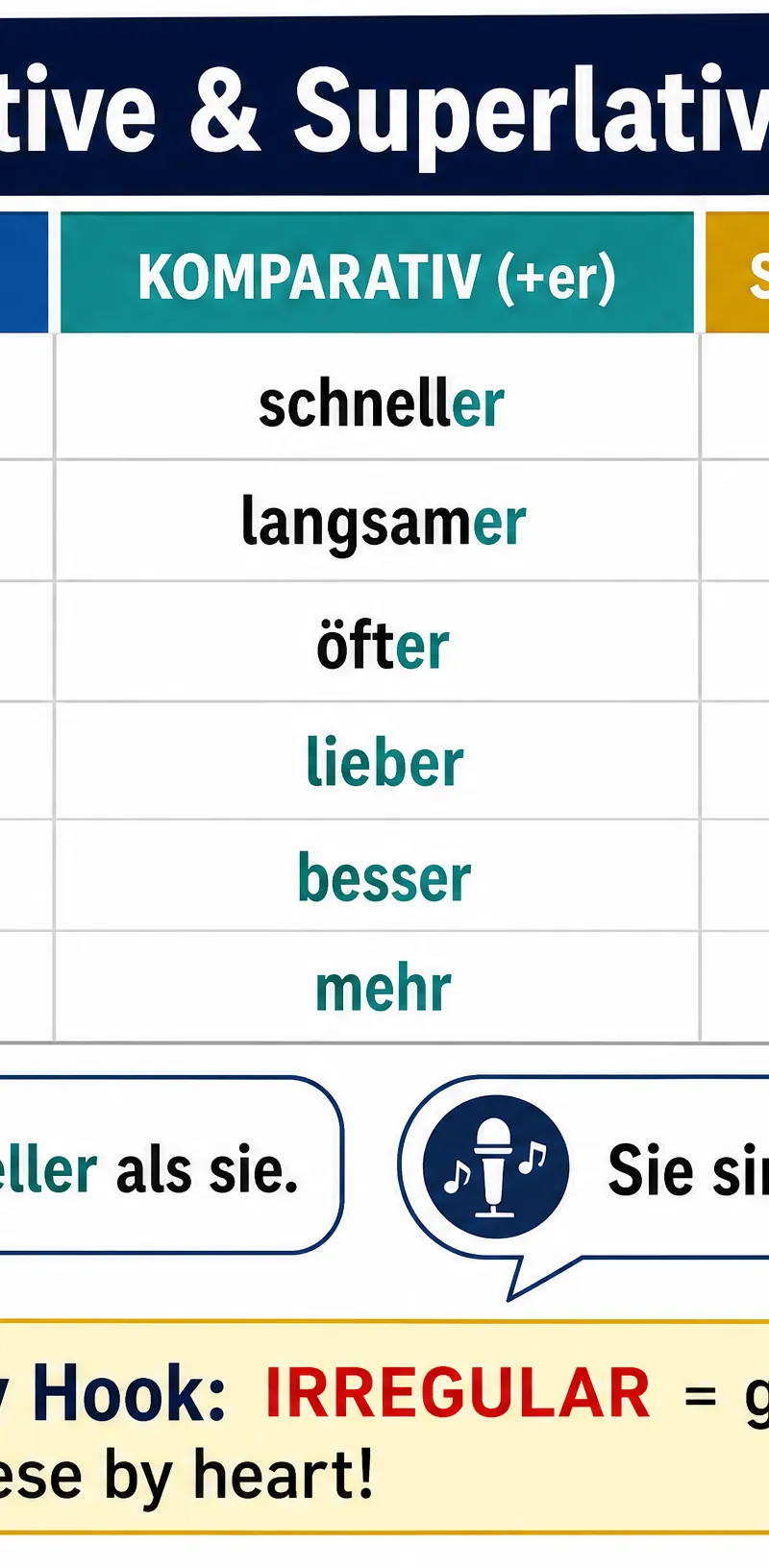
- Comparative: Add -er to the adverb (e.g., schnell → schneller).
- Superlative: Use am + adverb + -sten (e.g., schnell → am schnellsten).
The Big Three Irregulars
These three must be memorised as they do not follow the normal pattern and appear frequently in exams.
| Base Form (Grundform) | Comparative (+er) | Superlative (am...sten) | English Meaning |
|---|---|---|---|
| gut | besser | am besten | well / better / best |
| gern | lieber | am liebsten | gladly / prefer / most of all |
| viel | mehr | am meisten | a lot / more / most |
Key Structure 3: Da-Compounds
When to use it: To avoid repeating a prepositional phrase when referring to a thing or idea (not a person). This demonstrates complex sentence structure to the examiner.
Formation
Combine da + preposition. If the preposition starts with a vowel (like auf or über), add an -r- in the middle.
| Preposition | Da-Compound | English | Example |
|---|---|---|---|
| mit | damit | with it | Ich spiele Fußball. Ich bin damit zufrieden. |
| für | dafür | for it | Umweltschutz ist wichtig. Ich interessiere mich dafür. |
| auf | darauf | on/forward to it | Die Ferien kommen. Ich freue mich darauf. |
| über | darüber | about it | Der Film war toll. Wir haben darüber gesprochen. |
🎧 Listening Skills
What to Expect
Listening tracks frequently test your ability to pick out specific details like when (time adverbs), how often (frequency adverbs), or where (place adverbs) an event occurs. The difference between manchmal (sometimes) and meistens (mostly) is often the difference between the right and wrong multiple-choice answer.
Listening Strategies
- Listen for qualifiers: Pay close attention to adverbs that change the intensity of a statement, such as kaum (hardly), fast (almost), or ziemlich (quite).
- Watch for negatives: The position of nicht or the use of nie (never) completely changes the meaning. A speaker might say Ich spiele nicht gern Tennis — if you miss the nicht, you get the answer wrong.
- Note frequencies: Examiners love testing frequency adverbs. Write down T, M, P in the margin and tick off oft, immer, nie as you hear them.
Common Listening Traps
- Fast/Fast: The German word fast means "almost", not "quick" (which is schnell).
- Gern vs. Gar nicht: These can sound similar in fast, spoken German but have opposite meanings (gladly vs. not at all).
🗣️ Speaking Skills
Role Play Scenarios
Scenario 1: At the Tourist Office
- Examiner: Wie fahren Sie nach München?
- Candidate: Ich fahre morgen (Time) sehr gern (Manner) mit dem Zug (Manner) dorthin (Place).
Scenario 2: Discussing Hobbies
- Examiner: Was machst du in deiner Freizeit?
- Candidate: Ich lese ab und zu (Time) Bücher, aber ich spiele viel lieber (Comparative Adverb) Videospiele.
Photo Card Practice
Model Photo Card Response (Topic: Free Time):
- Qu 1 (Description): Auf dem Foto sehe ich zwei Personen. Sie spielen draußen (Place) Tennis.
- Qu 2 (Opinion): Ich finde Tennis ziemlich (Manner) anstrengend, deshalb spiele ich es nicht gern (Adverb of preference).
- Qu 3 (Related topic): Normalerweise (Time) spiele ich am Wochenende Fußball.
- Qu 4 (Past): Letztes Wochenende (Time) habe ich leider (Manner) Hausaufgaben gemacht.
- Qu 5 (Future): Nächstes Jahr (Time) werde ich hoffentlich (Manner) öfter (Comparative Adverb) Sport treiben.
General Conversation Questions
| Question (German) | Model Answer | English Translation |
|---|---|---|
| Was isst du gern? | Ich esse gern Pizza, aber ich esse lieber Pasta. Am liebsten esse ich jedoch Schnitzel. | I like eating pizza, but I prefer eating pasta. However, most of all I like eating schnitzel. |
| Wie oft gehst du ins Kino? | Ich gehe ziemlich oft ins Kino, vielleicht zweimal im Monat. | I go to the cinema quite often, maybe twice a month. |
| Wo verbringst du deine Ferien? | Normalerweise bleibe ich hier in England, aber nächstes Jahr fahre ich nach Spanien. | Normally I stay here in England, but next year I am travelling to Spain. |
| Was hast du gestern gemacht? | Ich habe gestern lange am Computer gespielt, was wirklich Spaß gemacht hat. | Yesterday I played on the computer for a long time, which was really fun. |
| Interessierst du dich für Musik? | Ja, ich höre jeden Tag Musik. Ich interessiere mich sehr dafür. | Yes, I listen to music every day. I am very interested in it. |
✍️ Writing Skills
Translation Practice
English → German:
| English | German | Key Grammar |
|---|---|---|
| I often play football. | Ich spiele oft Fußball. | Basic adverb placement. |
| She never goes to the cinema. | Sie geht nie ins Kino. | Adverb of frequency before the place. |
| I am travelling quickly to London today. | Ich fahre heute schnell nach London. | TMP Rule (Time, Manner, Place). |
| I like reading, but I prefer swimming. | Ich lese gern, aber ich schwimme lieber. | Irregular comparative adverbs. |
| The weather is bad. I am annoyed about it. | Das Wetter ist schlecht. Ich ärgere mich darüber. | Da-compound replacing prepositional phrase. |
Extended Writing
**Model 90-word response (Foundation) - Topic: Holidays:**Ich fahre jedes Jahr (Time) mit meiner Familie nach Frankreich. Wir fliegen immer (Time) gern (Manner) dorthin (Place), weil das Wetter sehr (Manner) schön ist. Draußen (Place) ist es heiß. Gestern (Time) haben wir Pizza gegessen. Das war wirklich (Manner) lecker! Nächstes Jahr (Time) möchte ich nach Italien (Place) fahren, weil ich lieber (Manner) neue Orte sehe.
**Model 150-word response (Higher) - Topic: Environment:**Umweltschutz ist heutzutage (Time) besonders (Manner) wichtig, und ich interessiere mich sehr dafür (Da-compound). Normalerweise (Time) fahre ich umweltfreundlich (Manner) mit dem Rad (Manner) zur Schule (Place), anstatt mit dem Auto zu fahren. Letzte Woche (Time) haben wir draußen (Place) Müll gesammelt. Das war ziemlich (Manner) anstrengend, aber glücklicherweise (Manner) hat es nicht geregnet. Meiner Meinung nach sollten wir alle (Manner) öfter (Comparative Adverb) recyceln. Ich trenne immer (Time) den Müll, aber mein Bruder macht das leider (Manner) nie (Time). In der Zukunft (Time) werde ich wahrscheinlich (Manner) Mitglied einer Umweltgruppe werden, weil ich am liebsten (Superlative Adverb) aktiv helfe.
Writing Checklist
- ✅ Did I check the Time, Manner, Place (TMP) word order?
- ✅ Have I used gern, lieber, and am liebsten to show preferences?
- ✅ Did I include at least three different time adverbs (e.g., heute, gestern, manchmal)?
- ✅ Did I use a da-compound (darauf, dafür) instead of repeating a noun?
- ✅ Is nicht placed correctly (directly before the adverb it negates)?
📚 Reading Skills
Key Strategies
- Highlight time markers: Adverbs like früher (formerly) or bald (soon) are massive clues about which tense the text is referring to, even if you don't recognise the verb.
- Spot the attitude: Adverbs of manner like leider (unfortunately) or glücklicherweise (fortunately) immediately tell you the writer's opinion without needing to understand the whole sentence.
False Friends & Tricky Words
| Word | Looks Like | Actually Means |
|---|---|---|
| fast | fast/quick | almost |
| aktuell | actual | current / up-to-date |
| eventuell | eventually | perhaps / possibly |
| brav | brave | well-behaved |
🌍 Cultural Knowledge
In German-speaking countries, punctuality is highly valued, which is reflected in the language's precision with time adverbs. The strict adherence to the Time, Manner, Place rule in grammar mirrors a cultural appreciation for structure and order. Furthermore, Germans frequently use adverbs like doch, ja, and halt as "modal particles" (Abtönungspartikeln) in spoken language to express emotion, emphasis, or surprise. While you don't need to master modal particles for GCSE, recognizing that words like doch add flavor to a sentence will make authentic reading and listening texts much easier to understand.
Visual Resources
2 diagrams and illustrations
Interactive Diagrams
1 interactive diagram to visualise key concepts
Conceptual Flow Outline
The TMP Word Order Rule
Worked Examples
4 worked examples — open one to explore the question and available guidance.
Practice Questions
Try the question, then reveal an answer plan or example response
Writing: Translate this sentence into German. 'I am playing tennis outside today.'
Hint: Remember the TMP rule: Time, Manner, Place. 'Today' is time, 'outside' is place.
Writing: Translate this sentence into German. 'She likes dancing, but she prefers singing.'
Hint: Use the adverb 'gern' for liking something, and its comparative form for preferring something.
Speaking: Answer the following question in German. 'Was machst du normalerweise am Wochenende?'
Hint: Use an adverb of time (normalerweise) and give an opinion using 'gern' or 'am liebsten'.
Reading: Read the sentence and answer true or false. 'Mein Bruder isst fast nie Gemüse.' -> The brother eats vegetables very quickly.
Hint: Watch out for the false friend 'fast'.
Writing: Rewrite this sentence replacing the prepositional phrase with a da-compound. 'Ich freue mich auf die Sommerferien.'
Hint: The preposition is 'auf'. Because it starts with a vowel, you need to add an 'r' between 'da' and 'auf'.
Writing: Place 'nicht' correctly in this sentence to negate the adverb 'schnell'. 'Der Zug fährt ___ schnell ___.'
Hint: Nicht always goes directly before the specific word it is negating.
Exam technique
How to turn what you know into marks
How to approach the question
Skill-by-skill strategy: Listening — note down frequency adverbs (oft, nie) as they often hold the answer. Speaking — buy thinking time with filler adverbs like 'eigentlich' or 'vielleicht'. Reading — highlight time adverbs to understand the tense of the paragraph. Writing — write 'TMP' at the top of your page and check every sentence against it.
How to structure your answer
Writing: Introduction → Main points with opinions → Justified reasons → Different tenses → Conclusion. Speaking: Give opinion → Justify → Extend → Use different tense. Always use 'gern/lieber/am liebsten' when giving opinions.
Timing
Listening: 25-35 mins (heard twice). Speaking: 7-12 mins total (role play + photo card + conversation). Reading: 45-60 mins. Writing: 60-75 mins (translation + structured + extended).
Common pitfalls
- Putting Place before Time or Manner in sentences (ignoring the TMP rule).
- Confusing the adjective 'schnell' (needs endings) with the adverb 'schnell' (no endings).
- Forgetting the irregular comparative forms of gern (lieber) and gut (besser).
- Translating the English false friend 'fast' as 'quick' instead of 'almost'.
- Placing 'nicht' in the wrong part of the sentence when negating an adverb.
What the command words want
- Describe the photo
- Use adverbs of place (draußen, drinnen, im Hintergrund) to structure your description.
- Translate into German
- Strictly apply the TMP rule for any sentence with multiple details.
- Translate into English
- Focus on the meaning of the adverbs. 'Er schwimmt gern' means 'He likes swimming', not 'He swims gladly'.
- Write approximately 90 words
- Include at least three different adverbs of time to show you can sequence events.
- Write approximately 150 words
- Use comparative and superlative adverbs (lieber, am besten) and da-compounds (darüber, dafür) to hit the top complexity bands.
Watch or listen (optional)
Test your understanding of Grammar: Adverbs
Active recall beats re-reading. Take an instant quiz now to test what you’ve learned and lock it into long-term memory.
7 days Premium · Then the free plan continues · No card, no charge