Pearson Edexcel · GCSE · German
Course version: Pearson-GCSE-German · Version from Mar 2026
Grammar: Derivational morphology
Master the powerful word-building rules of German derivational morphology! This guide covers essential prefixes (Lieblings-, Haupt-, un-) and suffixes (-ung, -heit, -los) to help you decode unfamiliar vocabulary, boosting your marks primarily in the Reading and Listening papers.
- 13 min read
- 4 worked examples
- 6 practice questions
- 8 key terms
Check what you remember
Read the wording for your board, then hide it and explain Derivational Morphology in your own words. Rough notes are fine. This is a self-check, with no mark or grade.
Reference: Pearson Edexcel
The process of forming a new word from an existing base word by adding a prefix or suffix, changing its meaning or word class.
Study Notes
Overview
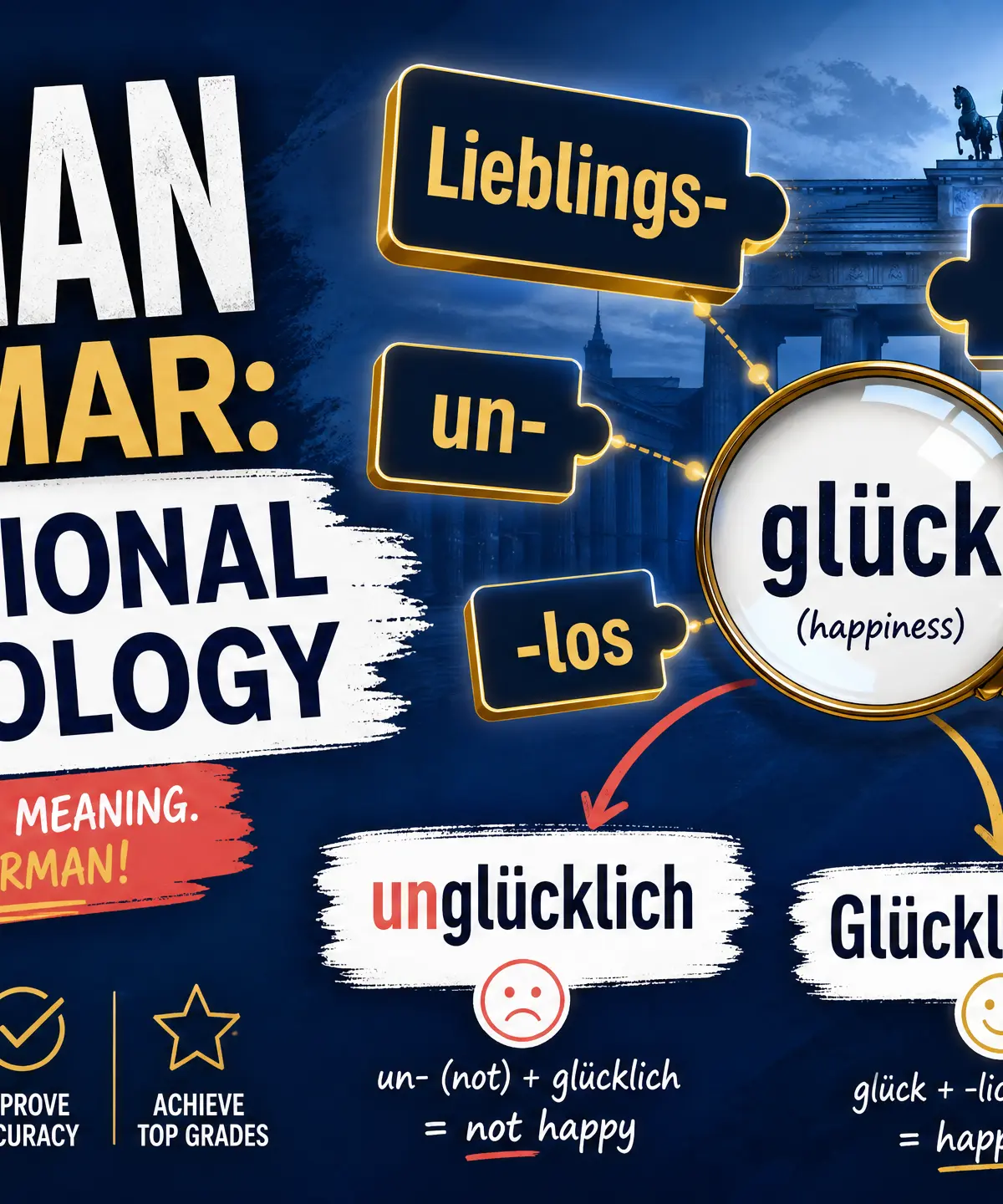
Derivational morphology sounds complex, but it is simply the system of building new words by adding prefixes (at the start) and suffixes (at the end) to base words. For your GCSE, you only need to recognise a specific set of these word-building blocks.
Why does this matter? Because examiners love to test this in the Reading and Listening papers. They will include derived words that aren't strictly on your vocabulary list, expecting you to use your knowledge of affixes to work out the meaning. If you know that Haupt- means 'main' and Bahnhof means 'station', you can instantly decode Hauptbahnhof. This topic is your secret weapon for accessing higher-tier marks.
Listen to our 10-minute revision podcast to cement your understanding:
📖 Essential Vocabulary
Tier 1 — Foundation Core
| German | English | Gender | Example Sentence |
|---|---|---|---|
| Lieblingsfilm | favourite film | m | Mein Lieblingsfilm ist sehr lustig. (My favourite film is very funny.) |
| Lieblingsessen | favourite food | n | Pizza ist mein Lieblingsessen. (Pizza is my favourite food.) |
| Lieblingsfach | favourite subject | n | Mein Lieblingsfach ist Deutsch. (My favourite subject is German.) |
| Hauptstadt | capital city | f | Berlin ist die Hauptstadt von Deutschland. (Berlin is the capital of Germany.) |
| Hauptbahnhof | main train station | m | Wir treffen uns am Hauptbahnhof. (We are meeting at the main station.) |
| unglücklich | unhappy | - | Er war gestern sehr unglücklich. (He was very unhappy yesterday.) |
| unfreundlich | unfriendly | - | Der Kellner war ziemlich unfreundlich. (The waiter was quite unfriendly.) |
| Wohnung | flat / apartment | f | Meine Wohnung ist ziemlich klein. (My flat is quite small.) |
| Lösung | solution | f | Das ist keine gute Lösung. (That is not a good solution.) |
| Krankheit | illness / sickness | f | Diese Krankheit ist gefährlich. (This illness is dangerous.) |
| Mädchen | girl | n | Das Mädchen spielt Fußball. (The girl is playing football.) |
| Lehrer | teacher (male) | m | Mein Lehrer ist sehr streng. (My teacher is very strict.) |
| arbeitslos | unemployed | - | Mein Onkel ist leider arbeitslos. (My uncle is unfortunately unemployed.) |
| zweite | second | - | Ich habe den zweiten Platz. (I got second place.) |
| morgens | in the mornings | - | Ich trinke morgens immer Kaffee. (I always drink coffee in the mornings.) |
Tier 2 — Higher Tier
| German | English | Gender | Example Sentence |
|---|---|---|---|
| Hauptspeise | main course | f | Als Hauptspeise nehme ich das Hähnchen. (For the main course, I'll take the chicken.) |
| unglaublich | unbelievable | - | Das Konzert war einfach unglaublich! (The concert was simply unbelievable!) |
| unmöglich | impossible | - | Es ist unmöglich, alles zu lernen. (It is impossible to learn everything.) |
| Erfahrung | experience | f | Das war eine tolle Erfahrung für mich. (That was a great experience for me.) |
| Freiheit | freedom | f | Freiheit ist sehr wichtig für Jugendliche. (Freedom is very important for young people.) |
| Möglichkeit | possibility / opportunity | f | Es gibt viele Möglichkeiten in der Stadt. (There are many opportunities in the city.) |
| Teilnehmer | participant | m | Es gab fünfzig Teilnehmer beim Rennen. (There were fifty participants in the race.) |
| hoffnungslos | hopeless | - | Die Situation schien völlig hoffnungslos. (The situation seemed completely hopeless.) |
| zwanzigste | twentieth | - | Heute ist der zwanzigste Mai. (Today is the twentieth of May.) |
| abends | in the evenings | - | Abends mache ich normalerweise meine Hausaufgaben. (In the evenings I normally do my homework.) |
High-Frequency Words & Phrases
| Phrase | English | Usage Context |
|---|---|---|
| Meiner Meinung nach... | In my opinion... | Speaking/Writing: Justifying an opinion |
| Auf der einen Seite... | On the one hand... | Writing: Structuring an argument |
| Auf der anderen Seite... | On the other hand... | Writing: Giving the opposing view |
| Ich würde sagen, dass... | I would say that... | Speaking: Giving a thoughtful response |
| Es kommt darauf an. | It depends. | Speaking: Buying time / showing nuance |
| Das Wichtigste ist... | The most important thing is... | Speaking/Writing: Emphasising a point |
| Ich freue mich darauf. | I'm looking forward to it. | Writing: Concluding a letter/email |
| Um ehrlich zu sein... | To be honest... | Speaking: Introducing a negative opinion |
| Wenn ich mehr Zeit hätte... | If I had more time... | Writing: Higher tier subjunctive phrase |
| Es hat Spaß gemacht. | It was fun. | Speaking/Writing: Simple past tense opinion |
📝 Grammar Focus
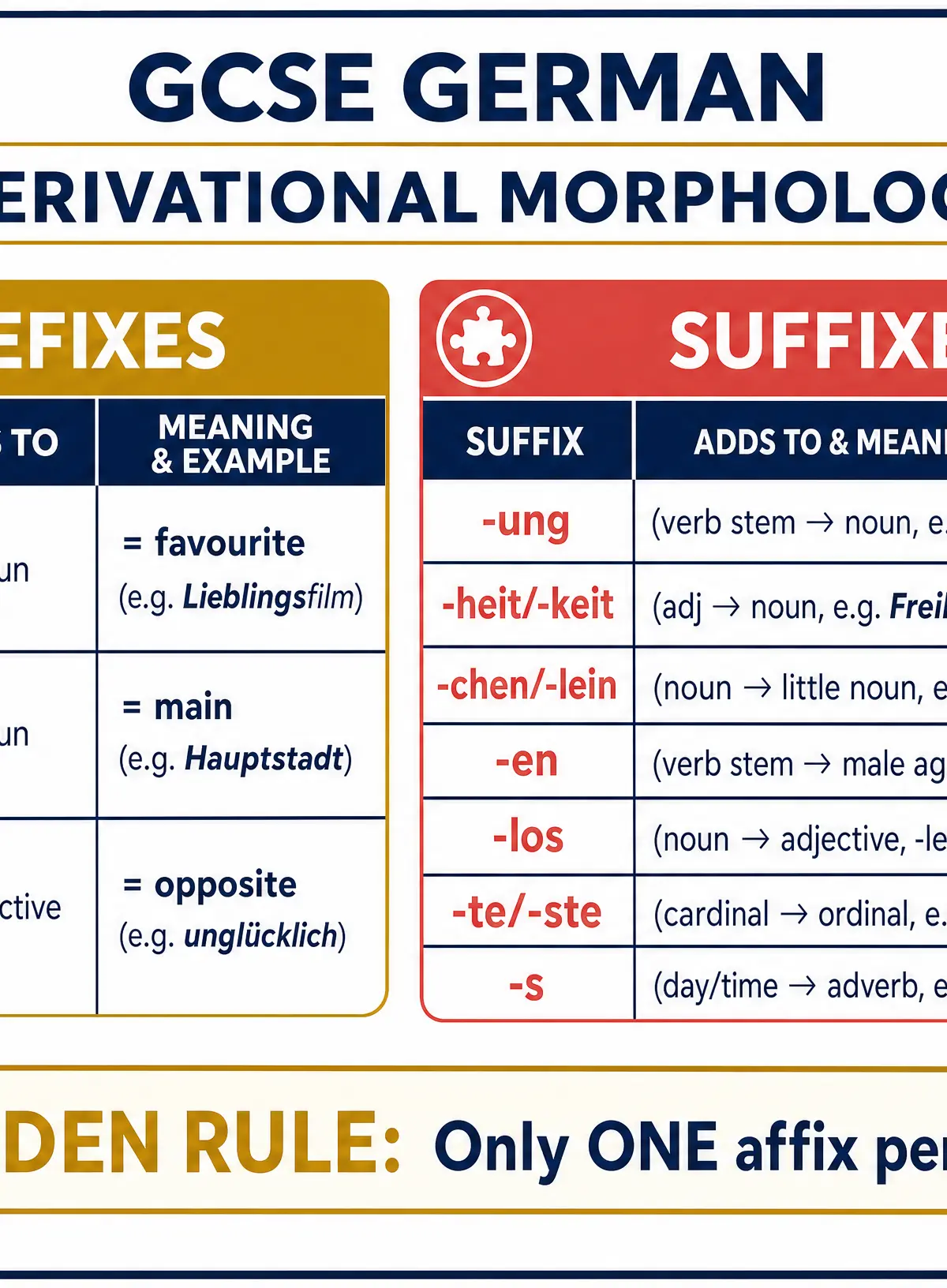
Key Structure 1: Noun-forming Suffixes (-ung, -heit, -keit)
When to use it: To change verbs or adjectives into abstract nouns. This is crucial for Reading comprehension. All nouns ending in these suffixes are feminine (die).
Rules:
- Verb stem + -ung = Noun (e.g., wohnen → Wohnung)
- Adjective + -heit or -keit = Noun (e.g., frei → Freiheit, möglich → Möglichkeit)
Example Derivations Table
| Base Word | Meaning | Derived Noun | English | Gender |
|---|---|---|---|---|
| wohnen (verb) | to live | die Wohnung | the flat/apartment | f |
| bedeuten (verb) | to mean | die Bedeutung | the meaning | f |
| frei (adj) | free | die Freiheit | the freedom | f |
| krank (adj) | sick | die Krankheit | the sickness/illness | f |
| möglich (adj) | possible | die Möglichkeit | the possibility | f |
Key Structure 2: The Diminutive (-chen / -lein)
When to use it: To describe something small or cute.
Rules:
- Noun + -chen or -lein = Little noun
- CRITICAL EXAM TRICK: All words ending in -chen or -lein are neuter (das), regardless of the original gender of the word.
- Sometimes the base vowel takes an umlaut (a → ä, o → ö, u → ü).
Example Derivations Table
| Base Noun | Meaning | Derived Noun | English | Gender |
|---|---|---|---|---|
| der Hund | dog | das Hündchen | little dog / puppy | n |
| die Katze | cat | das Kätzchen | little cat / kitten | n |
| die Magd (archaic) | maid | das Mädchen | girl | n |
| das Buch | book | das Büchlein | little book | n |
Key Structure 3: Creating Opposites (un- and -los)
When to use it: To express a negative state or the absence of something.
Rules:
- un- + Adjective = Opposite adjective (like English un-)
- Noun + -los = Adjective meaning '-less' or 'without' (often requires an 's' connecting letter).
Example Derivations Table
| Base Word | Meaning | Derived Word | English |
|---|---|---|---|
| glücklich (adj) | happy | unglücklich | unhappy |
| freundlich (adj) | friendly | unfreundlich | unfriendly |
| die Arbeit (noun) | work | arbeitslos | unemployed / workless |
| die Hoffnung (noun) | hope | hoffnungslos | hopeless |
🎧 Listening Skills
What to Expect
In the Listening paper, derivational morphology is used to test your precise understanding. A speaker might say they are arbeitslos (unemployed), and the question will ask why they don't have money. You need to recognise that Arbeit + los = without work.
Listening Strategies
- Listen for the base word: If you hear Lieblings-, focus hard on the noun that follows it. That's the key information.
- Watch for the 'un-' trap: A speaker might say Das Wetter war nicht schlecht, aber ziemlich ungemütlich. (The weather wasn't bad, but quite uncomfortable). The un- flips the meaning of gemütlich (cosy).
- Note time adverbs: If you hear morgens or abends, note it down immediately. The mark scheme will specifically require 'in the mornings' rather than just 'morning'.
Common Listening Traps
- False negatives: Hearing un- and assuming the whole sentence is negative. Listen to the whole clause.
- Plural confusion: Hearing Wohnungen and thinking the -en means it's a person (agent noun). Context will tell you it means 'flats'.
🗣️ Speaking Skills
Role Play Scenarios
Scenario 1: At the Tourist Office
- Examiner: Wie kann ich Ihnen helfen? (How can I help you?)
- Candidate: Ich suche den Hauptbahnhof. (I am looking for the main train station.)
Scenario 2: Discussing School
- Examiner: Was lernst du gern in der Schule?
- Candidate: Mein Lieblingsfach ist Geschichte, weil es sehr interessant ist. (My favourite subject is history because it is very interesting.)
Photo Card Practice
Model Photo Card Response (Topic: Free Time):
- Qu 1 (Description): Auf dem Foto sehe ich drei Mädchen, die im Park sitzen. (In the photo I see three girls sitting in the park.)
- Qu 2 (Opinion): Meiner Meinung nach sind sie sehr glücklich, weil sie lachen. (In my opinion they are very happy because they are laughing.)
- Qu 3 (Related topic): In meiner Freizeit ist mein Lieblingshobby Lesen. (In my free time, my favourite hobby is reading.)
- Qu 4 (Past/Future): Letztes Wochenende war das Wetter leider unmöglich, also bin ich zu Hause geblieben. (Last weekend the weather was unfortunately impossible, so I stayed at home.)
- Qu 5 (Unpredictable): Ein Leben ohne Hobbys wäre völlig hoffnungslos! (A life without hobbies would be completely hopeless!)
General Conversation Questions
| Question (German) | Model Answer | English Translation |
|---|---|---|
| Was ist dein Lieblingsessen? | Mein Lieblingsessen ist Pasta, weil es köstlich ist, aber es ist ziemlich ungesund. | My favourite food is pasta because it is delicious, but it is quite unhealthy. |
| Was machst du morgens? | Morgens stehe ich um sieben Uhr auf und ich trinke einen Kaffee. | In the mornings I get up at 7 o'clock and I drink a coffee. |
| Was möchtest du in der Zukunft machen? | Ich möchte als Lehrer arbeiten, weil ich gern Kindern helfe. | I would like to work as a teacher because I like helping children. |
| Wie war dein letzter Urlaub? | Es war eine tolle Erfahrung, aber die Anreise war unerträglich lang. | It was a great experience, but the journey was unbearably long. |
| Was ist das größte Problem für Jugendliche? | Ich denke, dass Jugendarbeitslosigkeit ein großes Problem ist. | I think that youth unemployment is a big problem. |
✍️ Writing Skills
Translation Practice
English → German:
| English | German | Key Grammar |
|---|---|---|
| My favourite film is very funny. | Mein Lieblingsfilm ist sehr lustig. | Prefix: Lieblings- |
| The weather was unfortunately unfriendly. | Das Wetter war leider unfreundlich. | Prefix: un- (adjective opposite) |
| I play football on Mondays. | Ich spiele montags Fußball. | Suffix: -s (time adverb) |
| The teacher (male) is unemployed. | Der Lehrer ist arbeitslos. | Suffixes: -er (agent) and -los (without) |
| Health is the most important thing. | Gesundheit ist das Wichtigste. | Suffix: -heit (abstract noun) |
Extended Writing
**Model 90-word response (Foundation) - Topic: Holidays:**Letztes Jahr bin ich nach Spanien gefahren. Das war eine tolle Erfahrung. Wir sind in die Hauptstadt geflogen. Mein Lieblingsessen im Urlaub war Paella, weil es sehr lecker war. Das Hotel war schön, aber das Wetter war leider unmöglich. Es hat jeden Tag geregnet! Nächstes Jahr möchte ich nach Italien fahren, weil es dort wärmer ist. Ich hoffe, dass ich dort nicht unglücklich sein werde.
**Model 150-word response (Higher) - Topic: Work and Future Plans:**In der Zukunft möchte ich als Lehrer arbeiten, weil es mein Traumjob ist. Meiner Meinung nach ist Bildung extrem wichtig für die Gesellschaft. Letztes Jahr habe ich ein Praktikum in einer Grundschule gemacht. Das war eine unglaubliche Erfahrung, obwohl die Kinder manchmal ziemlich unruhig waren! Ein großer Vorteil an diesem Beruf ist, dass man nie arbeitslos ist, weil man immer Lehrer braucht. Auf der anderen Seite ist die Arbeit oft stressig und man hat wenig Freizeit. Mein Lieblingsfach in der Schule war immer Mathe, also möchte ich das unterrichten. Wenn ich bessere Noten hätte, würde ich vielleicht Arzt werden, aber ich denke, dass die Verantwortung zu groß wäre. Zusammenfassend glaube ich, dass die Möglichkeit, jungen Menschen zu helfen, wunderbar ist.
Writing Checklist
- ✅ Check 1: Have I used Lieblings- to express a favourite thing?
- ✅ Check 2: Have I used an un- adjective to express a negative opinion?
- ✅ Check 3: Are my morgens/abends/montags adverbs lowercase?
- ✅ Check 4: Did I remember that words ending in -ung, -heit, -keit are feminine (die)?
📚 Reading Skills
Key Strategies
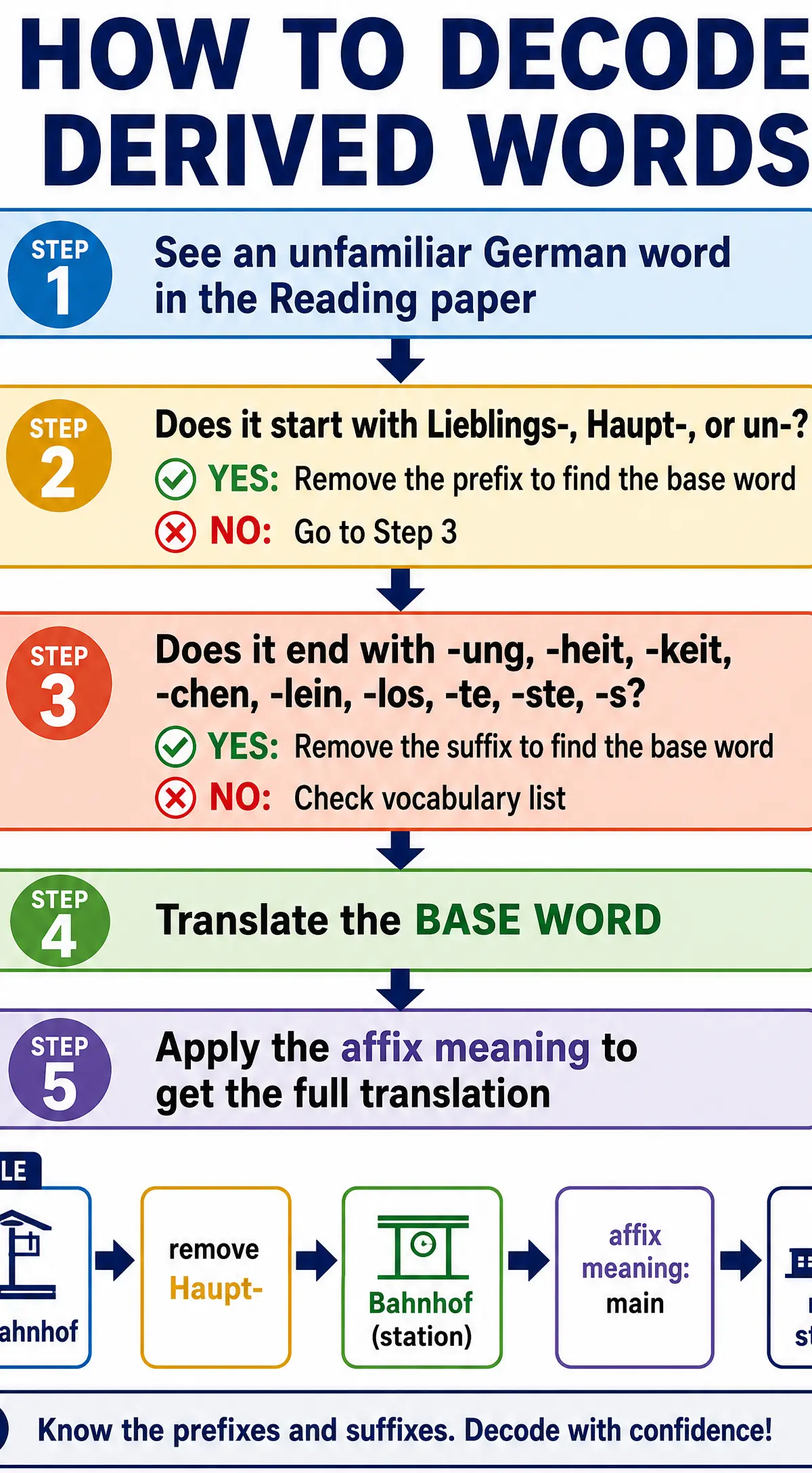
When you see a long, scary German word in the Reading paper, don't panic. Use the flowchart strategy:
- Look at the start: Is there a Haupt-, Lieblings-, or un-?
- Look at the end: Is there an -ung, -los, or -heit?
- Strip the affixes away to reveal the base word.
- Translate the base word.
- Re-apply the meaning of the affixes.
Example in exam: You read "Die Arbeitslosigkeit steigt."
- Base word: Arbeit (work)
- Suffix 1: -los (without) = unemployed
- Suffix 2: -igkeit (noun maker) = unemployment
- Meaning: Unemployment is rising.
False Friends & Tricky Words
| Word | Looks Like | Actually Means |
|---|---|---|
| das Gymnasium | a gym | a grammar school (academic secondary school) |
| der Chef | a chef (cook) | the boss / manager |
| aktuell | actual | current / up-to-date |
| das Gift | a gift | poison |
🌍 Cultural Knowledge
Understanding German compound nouns and derivational morphology gives you insight into the German mindset. The language is famously logical and descriptive. Rather than inventing entirely new words, German builds them from existing concepts. For example, a hospital is a Krankenhaus (sick-house). A slug is a Nacktschnecke (naked-snail).
When you use words like Hauptbahnhof (main train station), you're engaging with a culture that values efficiency and clear communication. Germany has a vast rail network, and every major city has a Hauptbahnhof — knowing this word is essential for navigating the country. Similarly, the concept of Feierabend (the time after work ends) is culturally huge in Germany, reflecting a strong respect for work-life balance.
Visual Resources
2 diagrams and illustrations
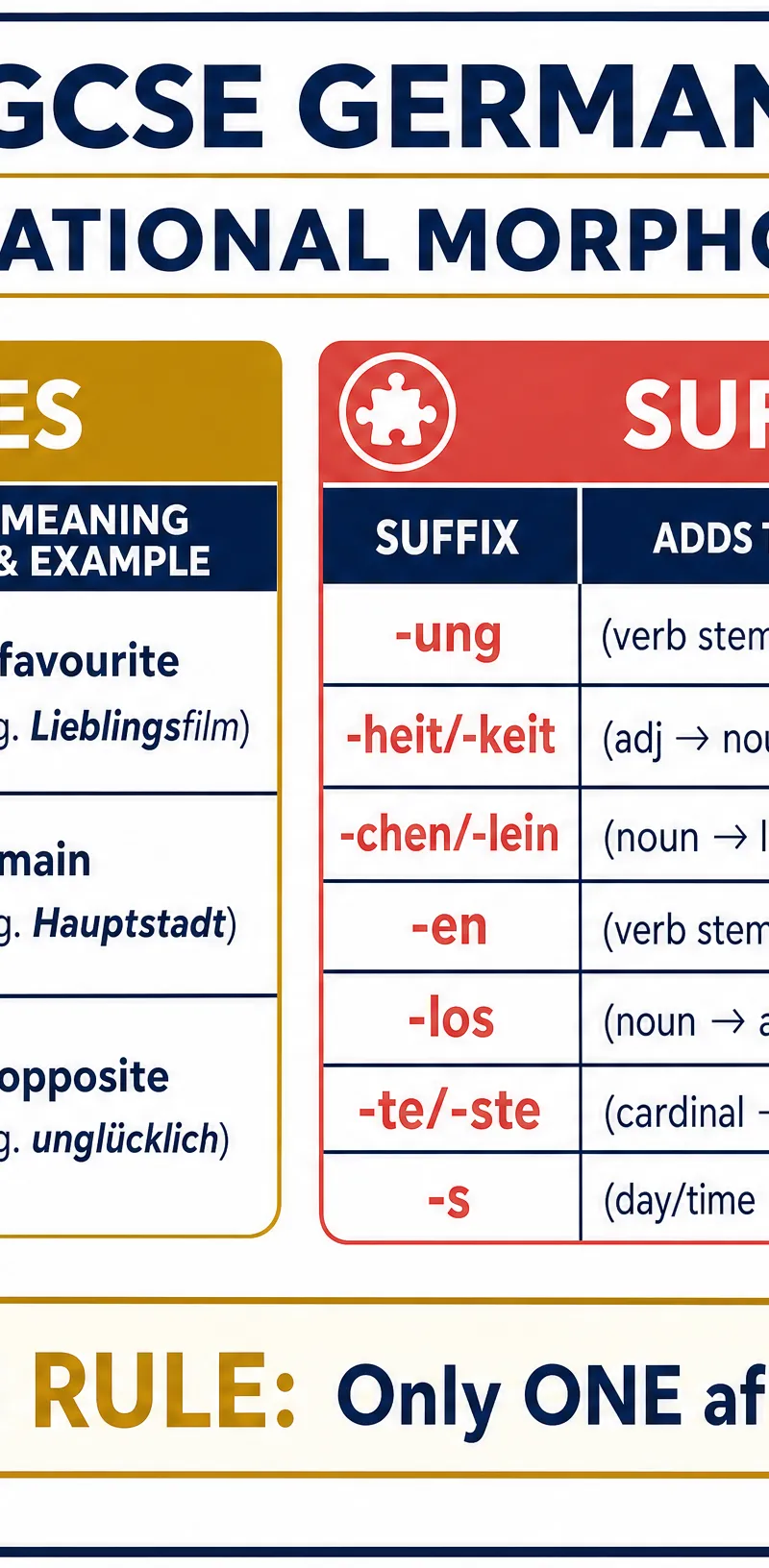
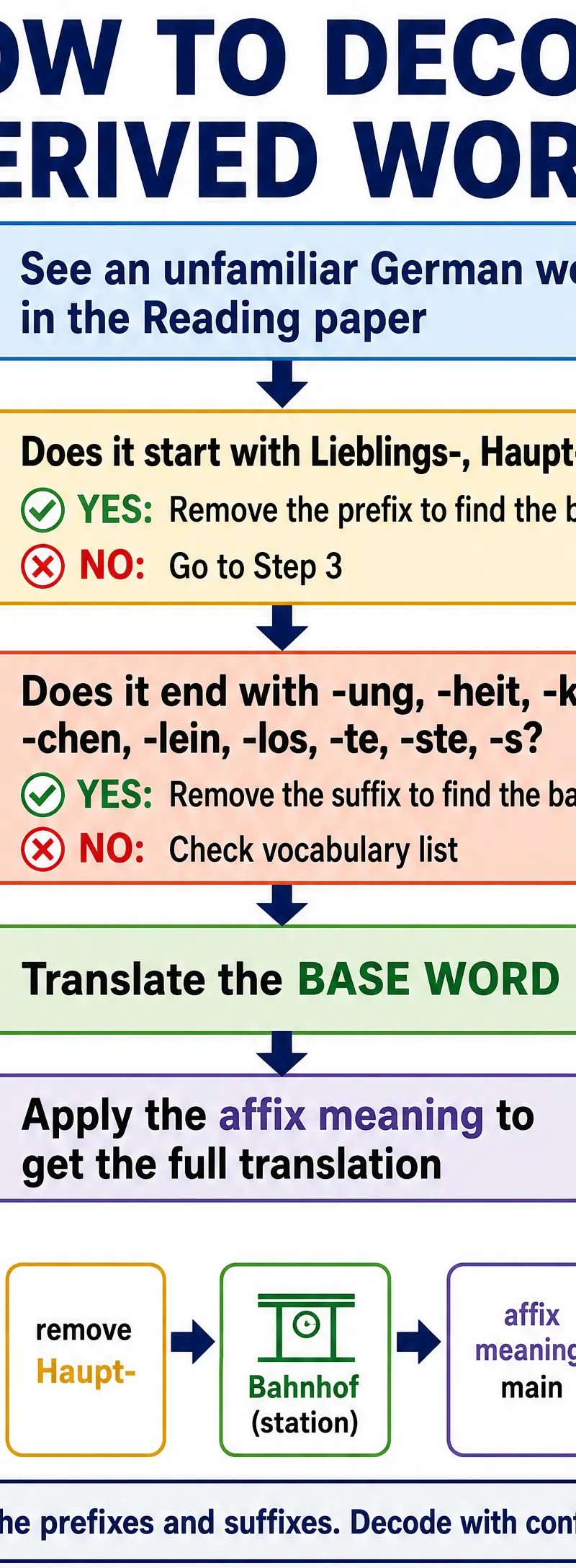
Interactive Diagrams
1 interactive diagram to visualise key concepts
Conceptual Flow Outline
The Decoding Strategy for Reading Exams
Worked Examples
4 worked examples — open one to explore the question and available guidance.
Practice Questions
Try the question, then reveal an answer plan or example response
Translate into English: 'Die Wohnung ist sehr schön, aber die Miete ist unmöglich.'
Hint: Look for the -ung suffix and the un- prefix.
Form the correct German word: The opposite of friendly (freundlich).
Hint: Use the prefix that works just like English.
What is the gender of 'das Mädchen' and why?
Hint: Look at the suffix.
Translate into German: 'I play tennis on Sundays.'
Hint: How do you turn 'Sonntag' into an adverb?
Read the text: 'Mein Onkel ist seit einem Jahr arbeitslos. Das ist eine schwierige Situation.' Why is the situation difficult?
Hint: Decode 'arbeitslos'.
Higher Writing: Write a sentence about your future career plans using an agent noun (ending in -er).
Hint: Think of a verb like 'lehren' or 'programmieren'.
Exam technique
How to turn what you know into marks
How to approach the question
Reading: Skim the text first. When you hit a word you don't know, don't panic. Look for prefixes and suffixes to decode it. Writing: Actively try to include at least one 'Lieblings-' word and one 'un-' adjective to show off your vocabulary range.
How to structure your answer
Writing: Introduction → Main points with opinions → Justified reasons → Different tenses → Conclusion.
Timing
Listening: 25 mins (heard twice). Speaking: 7-12 mins total. Reading: 45-60 mins. Writing: 60-75 mins.
Common pitfalls
- Stacking affixes: Only apply one prefix or suffix to a base word in your writing.
- Confusing -en (agent noun) with -en (plural/infinitive ending).
- Forgetting that all -chen words are neuter (das).
- Translating 'arbeitslos' as 'lazy' instead of 'unemployed'.
- Capitalising time adverbs (e.g., writing 'Montags' instead of 'montags' mid-sentence).
What the command words want
- Translate into German
- If you forget the exact word for 'capital', remember 'Hauptstadt' (main city).
- Translate into English
- Decode the affixes carefully. 'Unglücklich' must be 'unhappy', not just 'sad'.
- Write approximately 90 words
- Use 'Lieblings-' to easily give opinions about your favourite things.
- Write approximately 150 words
- Use abstract nouns ending in -heit or -keit to discuss complex ideas (e.g., Freiheit).
Watch or listen (optional)
Test your understanding of Grammar: Derivational morphology
Active recall beats re-reading. Take an instant quiz now to test what you’ve learned and lock it into long-term memory.
7 days Premium · Then the free plan continues · No card, no charge