Pearson Edexcel · GCSE · German
Course version: Pearson-GCSE-German · Version from Mar 2026
Grammar: Nouns, pronouns and determiners
This topic covers the fundamental grammatical building blocks of German: nouns, pronouns, and determiners. Mastering these elements is crucial for accuracy across all four skills (Listening, Speaking, Reading, Writing), allowing you to form correct sentences, express opinions clearly, and access higher mark bands.
- 12 min read
- 4 worked examples
- 6 practice questions
- 8 key terms
Check what you remember
Read the wording for your board, then hide it and explain Noun in your own words. Rough notes are fine. This is a self-check, with no mark or grade.
Reference: Pearson Edexcel
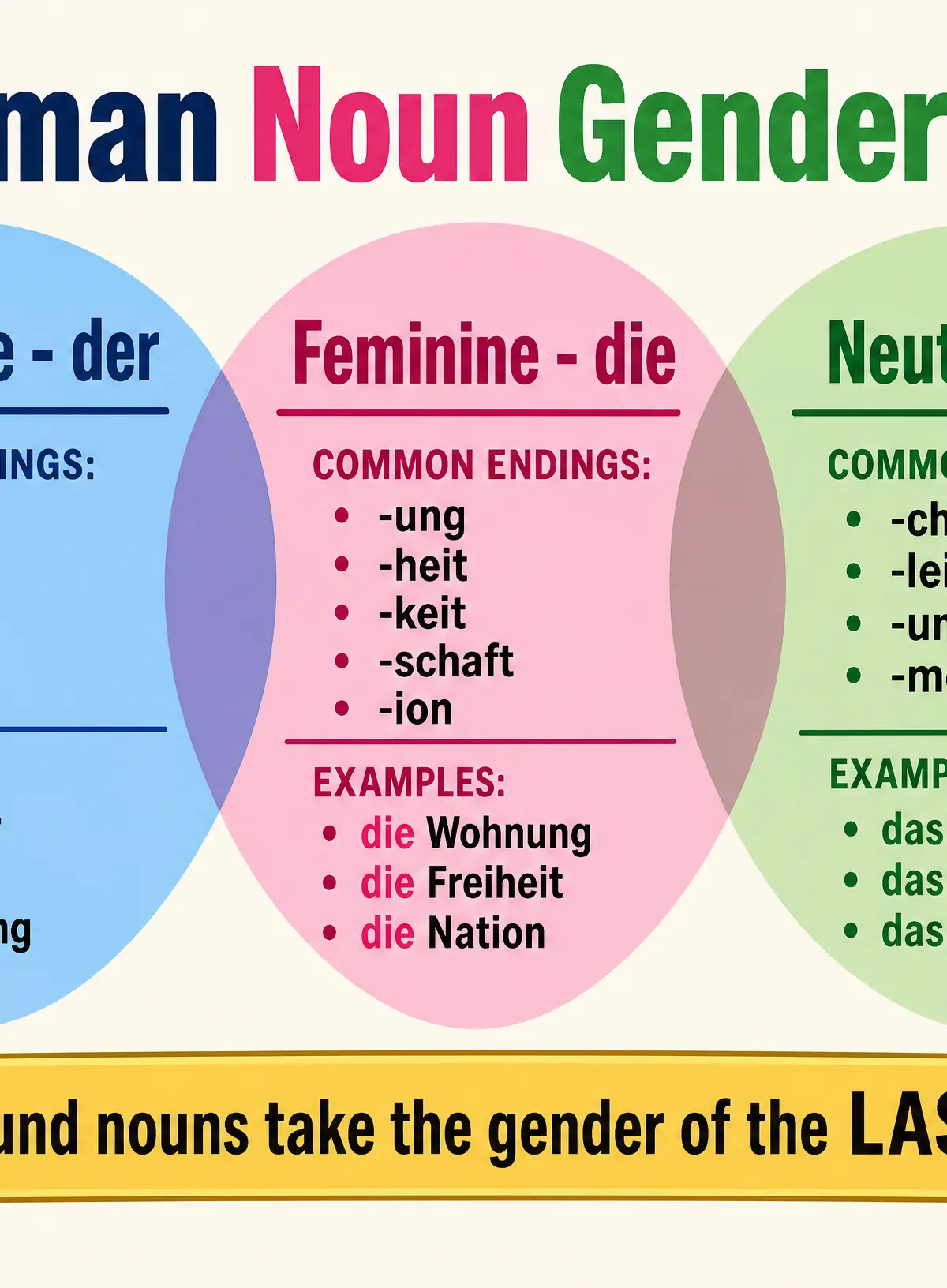
A naming word for a person, place, thing, or idea. In German, ALL nouns must be capitalized.
Study Notes
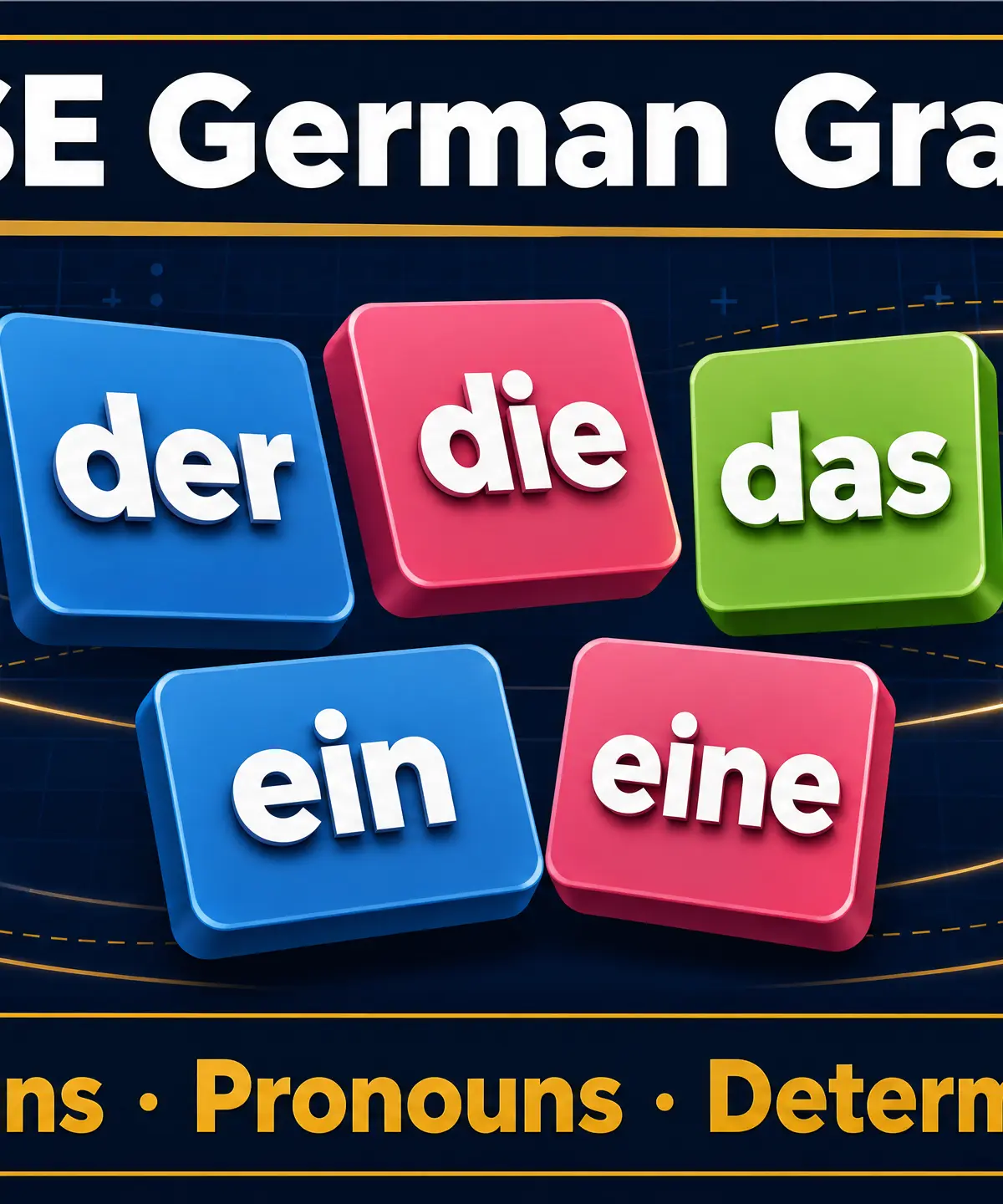
Overview
This study guide focuses on the absolute essentials of German grammar: nouns, pronouns, and determiners. Understanding how these work together is the key to unlocking the German language. It is particularly critical for the Writing and Speaking exams, where examiners actively look for correct gender usage, case endings, and pronoun agreements to award marks for accuracy. Even in Listening and Reading, recognizing these patterns helps you deduce meaning and identify the subject and object of sentences.
🎧 Audio Revision: German Grammar Unlocked Podcast
Listen to our comprehensive 10-minute podcast episode covering the core concepts of nouns, pronouns, and determiners, complete with exam tips and a quick-fire recall quiz.
📖 Essential Vocabulary
To master grammar, you need a strong vocabulary foundation. Here are key words to practice your genders and cases with.
Tier 1 — Foundation Core
| German | English | Gender | Example Sentence |
|---|---|---|---|
| der Bruder | brother | m | Mein Bruder ist sehr lustig. |
| die Schwester | sister | f | Ich habe eine kleine Schwester. |
| das Haus | house | n | Das Haus ist groß und modern. |
| der Hund | dog | m | Der Hund spielt im Garten. |
| die Katze | cat | f | Die Katze schläft auf dem Sofa. |
| das Buch | book | n | Ich lese ein interessantes Buch. |
| der Tisch | table | m | Das Buch liegt auf dem Tisch. |
| die Schule | school | f | Meine Schule ist in der Nähe. |
| das Auto | car | n | Mein Vater kauft ein neues Auto. |
| der Apfel | apple | m | Ich esse jeden Tag einen Apfel. |
| die Stadt | city/town | f | Wir wohnen in einer großen Stadt. |
| das Zimmer | room | n | Mein Zimmer ist immer unordentlich. |
| der Freund | friend (male) | m | Er ist mein bester Freund. |
| die Freundin | friend (female) | f | Sie ist meine beste Freundin. |
| das Kind | child | n | Das Kind spielt mit dem Ball. |
Tier 2 — Higher Tier
| German | English | Gender | Example Sentence |
|---|---|---|---|
| der Jugendliche | youth/teenager | m | Viele Jugendliche nutzen soziale Medien. |
| die Gesellschaft | society | f | Die Gesellschaft verändert sich schnell. |
| das Umweltschutzprojekt | environmental project | n | Unsere Schule organisiert ein Umweltschutzprojekt. |
| der Vorteil | advantage | m | Ein großer Vorteil ist die Flexibilität. |
| die Erfahrung | experience | f | Ich habe gute Erfahrungen gemacht. |
| das Vorurteil | prejudice | n | Wir müssen gegen Vorurteile kämpfen. |
| der Einfluss | influence | m | Das Internet hat einen großen Einfluss. |
| die Herausforderung | challenge | f | Das ist eine große Herausforderung für uns. |
| das Verhältnis | relationship | n | Ich habe ein gutes Verhältnis zu meinen Eltern. |
| der Fortschritt | progress | m | Der technologische Fortschritt ist wichtig. |
High-Frequency Words & Phrases
| Phrase | English | Usage Context |
|---|---|---|
| Meiner Meinung nach... | In my opinion... | Starting a sentence to give a justified opinion. |
| Auf der einen Seite... | On the one hand... | Introducing a balanced argument. |
| Auf der anderen Seite... | On the other hand... | Contrasting a previous point. |
| Ich interessiere mich für... | I am interested in... | Expressing hobbies or interests (uses accusative). |
| Ich freue mich auf... | I am looking forward to... | Talking about future plans (uses accusative). |
| Es gibt... | There is/are... | Describing a scene or situation (always followed by accusative). |
| Zum Beispiel... | For example... | Providing evidence for a point. |
| Ich bin der Ansicht, dass... | I am of the view that... | A sophisticated way to express an opinion (Higher Tier). |
| Im Großen und Ganzen... | By and large / Overall... | Summarising a point in a conclusion. |
| Einerseits... andererseits... | On the one hand... on the other hand... | Linking contrasting ideas smoothly. |
📝 Grammar Focus
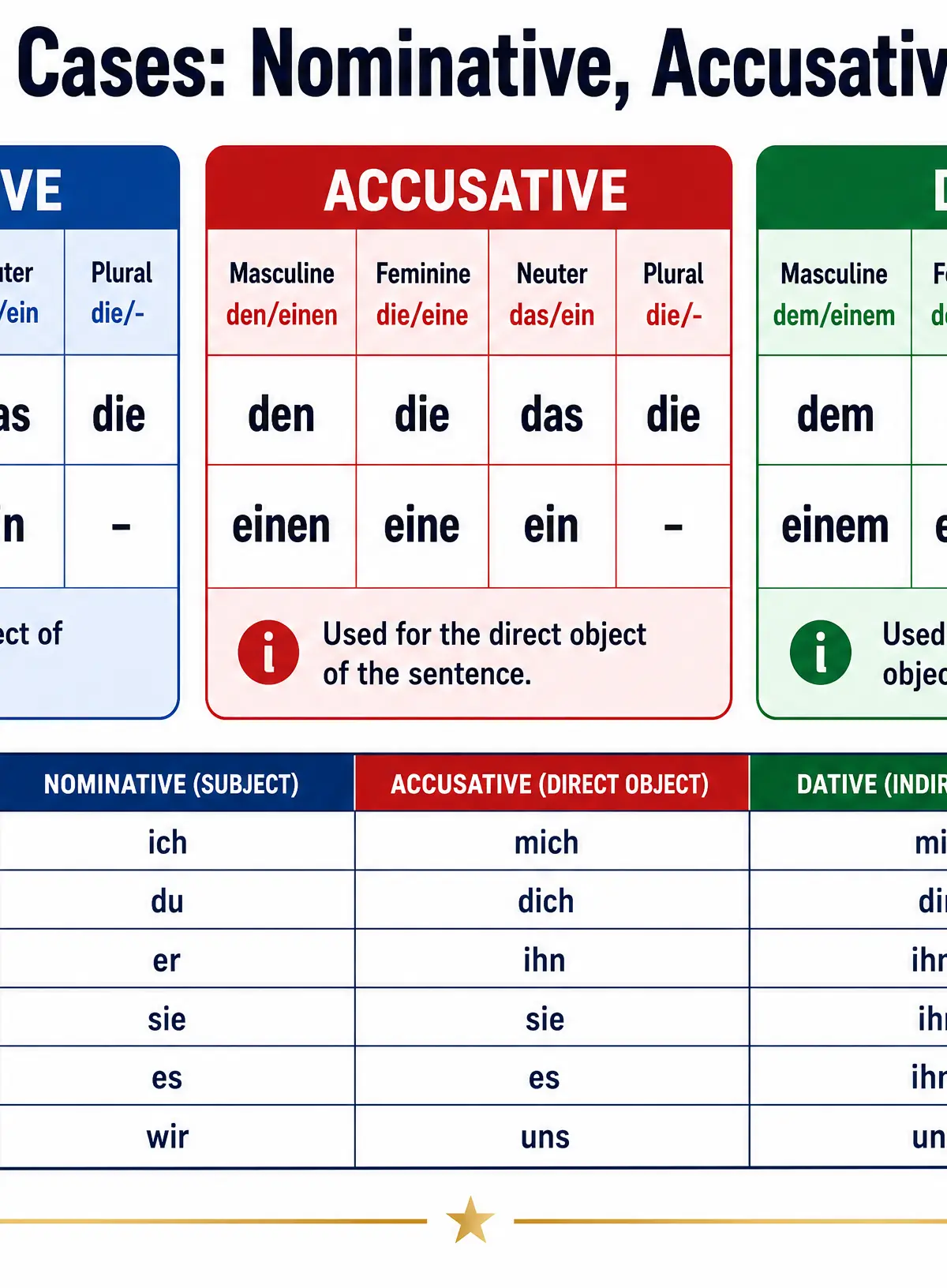
Key Structure 1: The Nominative Case (Der Nominativ)
When to use it: The nominative case is used for the subject of the sentence. The subject is the person or thing doing the action. It is also used after the verbs sein (to be) and werden (to become).
Definite and Indefinite Articles (Nominative)
| Gender | Definite Article (the) | Indefinite Article (a/an) | Negative Article (not a/no) |
|---|---|---|---|
| Masculine | der | ein | kein |
| Feminine | die | eine | keine |
| Neuter | das | ein | kein |
| Plural | die | - | keine |
Example: Der Hund ist laut. (The dog is loud - subject).
Key Structure 2: The Accusative Case (Der Akkusativ)
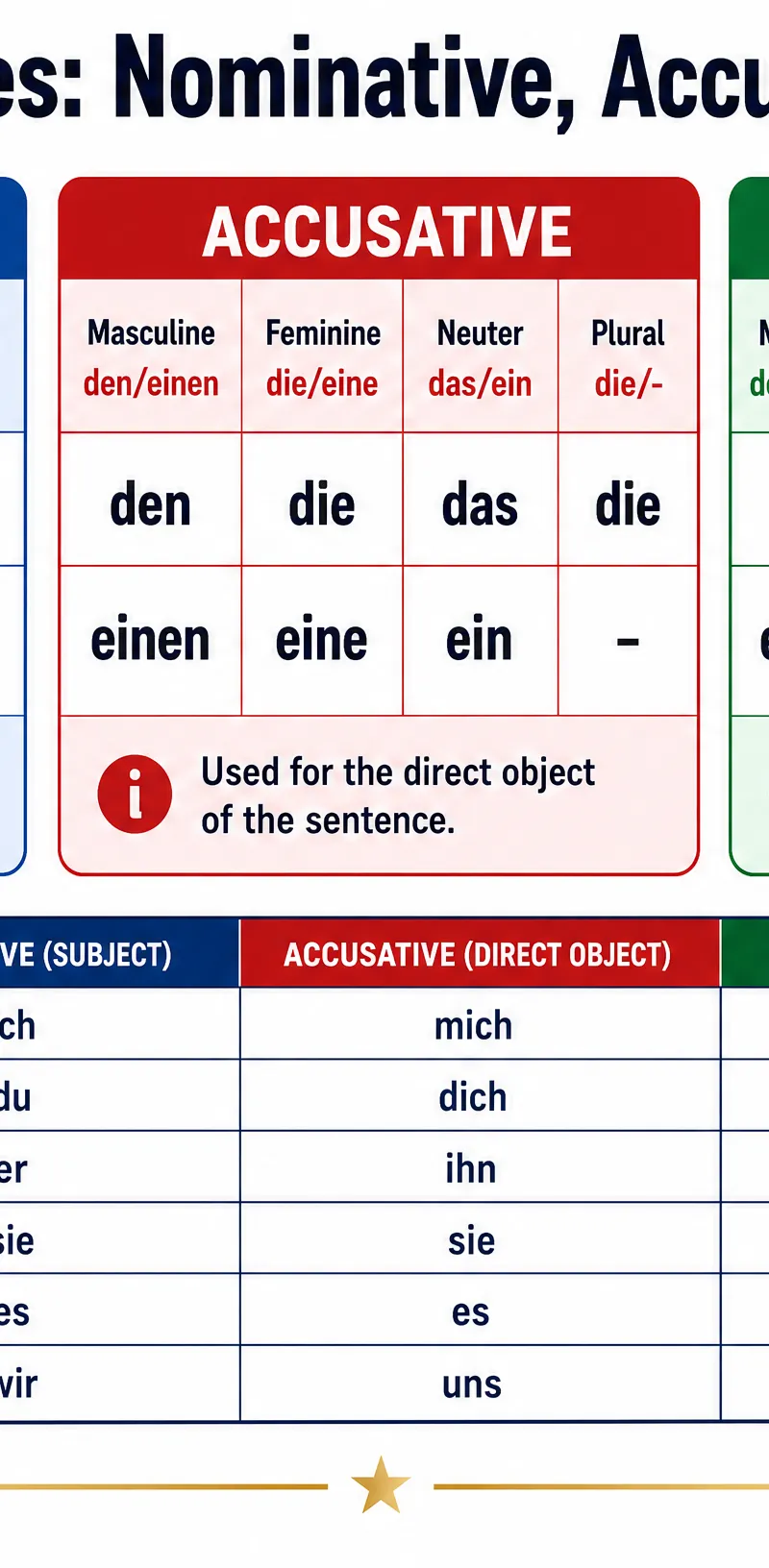
When to use it: The accusative case is used for the direct object of the sentence. The direct object is the person or thing receiving the action directly. It is also used after certain prepositions (e.g., für, um, durch, gegen, ohne).
Definite and Indefinite Articles (Accusative)
| Gender | Definite Article (the) | Indefinite Article (a/an) | Negative Article (not a/no) |
|---|---|---|---|
| Masculine | den | einen | keinen |
| Feminine | die | eine | keine |
| Neuter | das | ein | kein |
| Plural | die | - | keine |
Crucial Rule: Only the masculine articles change in the accusative case!
Example: Ich habe einen Hund. (I have a dog - direct object).
Key Structure 3: The Dative Case (Der Dativ)
When to use it: The dative case is used for the indirect object of the sentence (usually the person receiving something). It is also used after specific dative prepositions (e.g., aus, bei, mit, nach, seit, von, zu).
Definite and Indefinite Articles (Dative)
| Gender | Definite Article (the) | Indefinite Article (a/an) | Negative Article (not a/no) |
|---|---|---|---|
| Masculine | dem | einem | keinem |
| Feminine | der | einer | keiner |
| Neuter | dem | einem | keinem |
| Plural | den (+n) | - | keinen (+n) |
Crucial Rule: All genders change in the dative case. Plural nouns add an '-n' to the end of the noun itself (unless it already ends in -n or -s).
Example: Ich gebe dem Hund das Futter. (I give the dog the food - indirect object).
Key Structure 4: Personal Pronouns
When to use it: Pronouns replace nouns. They must agree with the case of the noun they are replacing.
Pronoun Declension Table
| Subject | Nominative (Subject) | Accusative (Direct Object) | Dative (Indirect Object) |
|---|---|---|---|
| I | ich | mich | mir |
| you (singular informal) | du | dich | dir |
| he | er | ihn | ihm |
| she | sie | sie | ihr |
| it | es | es | ihm |
| we | wir | uns | uns |
| you (plural informal) | ihr | euch | euch |
| they | sie | sie | ihnen |
| You (formal) | Sie | Sie | Ihnen |
Example: Er liebt sie (He loves her - accusative). Sie hilft ihm (She helps him - dative, because helfen always takes the dative).
🎧 Listening Skills
What to Expect
In the listening exam, you will hear native speakers discussing various topics. Pronouns and determiners are crucial here because they indicate who is doing what to whom.
Listening Strategies
- Listen for article changes: Hearing "den" or "einen" immediately tells you the following noun is the object, not the subject.
- Watch out for 'sie': The word "sie" can mean "she", "they", or "you (formal)". Listen to the verb ending to deduce the meaning. (e.g., sie spielt = she plays; sie spielen = they play).
- Identify dative prepositions: If you hear "mit", expect a dative article or pronoun to follow (e.g., mit mir, mit dem Bus).
Common Listening Traps
- Er vs. Ihr: "Er" (he) and "ihr" (her/you plural) can sound similar when spoken quickly. Pay close attention to context.
- Mir vs. Mich: Native speakers might blend these. Remember that verbs like helfen, danken, and gefallen always take the dative (mir).
🗣️ Speaking Skills
Role Play Scenarios
Scenario 1: In a shop
- Assistant: Wie kann ich Ihnen helfen? (How can I help you? - formal dative)
- You: Ich suche einen Pullover. (I am looking for a jumper. - masculine accusative)
- Assistant: Wie gefällt Ihnen dieser hier? (How do you like this one? - formal dative)
- You: Er gefällt mir sehr gut. Ich nehme ihn. (I like it very much. I'll take it. - dative 'mir', accusative 'ihn')
Photo Card Practice
Model Photo Card Response (Topic: Holidays):
- Qu 1 (Description): Auf dem Foto sehe ich eine Familie. Sie sind am Strand. Der Vater spielt mit den Kindern. (Accusative 'eine', nominative 'der', dative plural 'den')
- Qu 2 (Opinion): Meiner Meinung nach ist der Strandurlaub toll, weil er sehr entspannend ist. (Nominative pronoun 'er' replacing 'der Strandurlaub')
- Qu 3 (Related topic): Nächstes Jahr fahren wir nach Spanien. Ich freue mich darauf. (Nominative pronoun 'wir')
- Qu 4 (Past/Future): Letztes Jahr sind wir in die Berge gefahren. Es hat mir gut gefallen. (Accusative 'die', dative pronoun 'mir')
- Qu 5 (Unpredictable): Ein Vorteil von Urlaub im Ausland ist, dass man neue Kulturen kennenlernt. (Accusative plural adjective ending)
General Conversation Questions
| Question (German) | Model Answer | English Translation |
|---|---|---|
| Was machst du gern in deiner Freizeit? | Ich spiele gern Fußball mit meinen Freunden. Es macht mir Spaß. | I like playing football with my friends. It is fun for me. |
| Beschreib deine Familie. | Ich habe einen Bruder und eine Schwester. Mein Bruder ist sehr sportlich. | I have a brother and a sister. My brother is very sporty. |
| Was hast du letztes Wochenende gemacht? | Ich habe einen tollen Film gesehen. Er war sehr spannend. | I watched a great film. It was very exciting. |
| Was wirst du nächstes Jahr machen? | Ich werde die Oberstufe besuchen, weil ich Abitur machen will. | I will attend sixth form because I want to do my A-Levels. |
| Wie findest du deine Schule? | Ich finde sie gut, aber die Hausaufgaben sind manchmal stressig. | I find it good, but the homework is sometimes stressful. |
✍️ Writing Skills
Translation Practice
English → German:
| English | German | Key Grammar |
|---|---|---|
| I have a brother. | Ich habe einen Bruder. | Accusative masculine (einen) |
| He gives me the book. | Er gibt mir das Buch. | Dative pronoun (mir), Accusative neuter (das) |
| We are travelling with our friends. | Wir fahren mit unseren Freunden. | Dative plural after 'mit' (unseren + n on noun) |
| She sees him in the park. | Sie sieht ihn im Park. | Accusative pronoun (ihn) |
| I like the house because it is big. | Das Haus gefällt mir, weil es groß ist. | Dative pronoun with 'gefallen' (mir), Nominative pronoun (es) |
Extended Writing
**Model 90-word response (Foundation - Topic: Free Time):**In meiner Freizeit spiele ich gern Tennis mit meinen Freunden. Ich finde es sehr lustig. Letztes Wochenende habe ich einen neuen Film im Kino gesehen. Der Film war fantastisch, weil er viel Action hatte. Nächstes Wochenende werde ich meine Großeltern besuchen. Ich freue mich darauf, weil ich sie liebe. Mein Lieblingshobby ist Lesen, denn ich lese jeden Tag ein Buch.
**Model 150-word response (Higher - Topic: Environment):**Meiner Meinung nach ist der Umweltschutz extrem wichtig für unsere Gesellschaft. In meiner Stadt gibt es leider viel Müll, was mich sehr ärgert. Um die Umwelt zu schützen, trenne ich jeden Tag den Müll und ich fahre immer mit dem Fahrrad zur Schule. Letzte Woche haben wir an einem Umweltschutzprojekt teilgenommen, und wir haben den Park sauber gemacht. Es hat mir gut gefallen, weil es nützlich war. In der Zukunft werde ich versuchen, weniger Plastik zu kaufen, da Plastik unserer Natur schadet. Wenn jeder einen kleinen Beitrag leistet, können wir die Welt retten.
Writing Checklist
- ✅ Have I used at least three different tenses?
- ✅ Are my masculine accusative articles correct (den/einen/keinen)?
- ✅ Have I checked the gender of all my nouns?
- ✅ Are my pronouns in the correct case (mich vs. mir, ihn vs. ihm)?
- ✅ Have I justified my opinions using 'weil' or 'da' (verb to the end)?
📚 Reading Skills
Key Strategies
- Look at the article to find the subject: If a sentence starts with "Den Mann...", you know immediately that the man is the object, not the subject. E.g., "Den Mann beißt der Hund" means "The dog bites the man", NOT "The man bites the dog".
- Trace pronouns back: When you see "er", "sie", or "es", look back at the previous sentence to see which noun it replaces. This is essential for comprehension.
False Friends & Tricky Words
| Word | Looks Like | Actually Means |
|---|---|---|
| das Gymnasium | gymnasium | grammar school (academic secondary school) |
| der Chef | chef | boss / manager |
| die Rente | rent | pension |
| aktuell | actual | current / up-to-date |
| spenden | spend | to donate |
🌍 Cultural Knowledge
Understanding cultural nuances can enrich your language use. In German-speaking countries, the distinction between formal and informal pronouns is crucial. Using "du" (informal singular) or "ihr" (informal plural) is reserved for friends, family, and children. When speaking to adults you don't know, teachers, or in professional settings, you MUST use the formal "Sie" (capitalized). This cultural norm reflects respect and social distance. In your speaking and writing exams, ensure you use the appropriate register depending on the context of the task (e.g., writing a letter to a friend vs. a formal email to a company).
Visual Resources
2 diagrams and illustrations
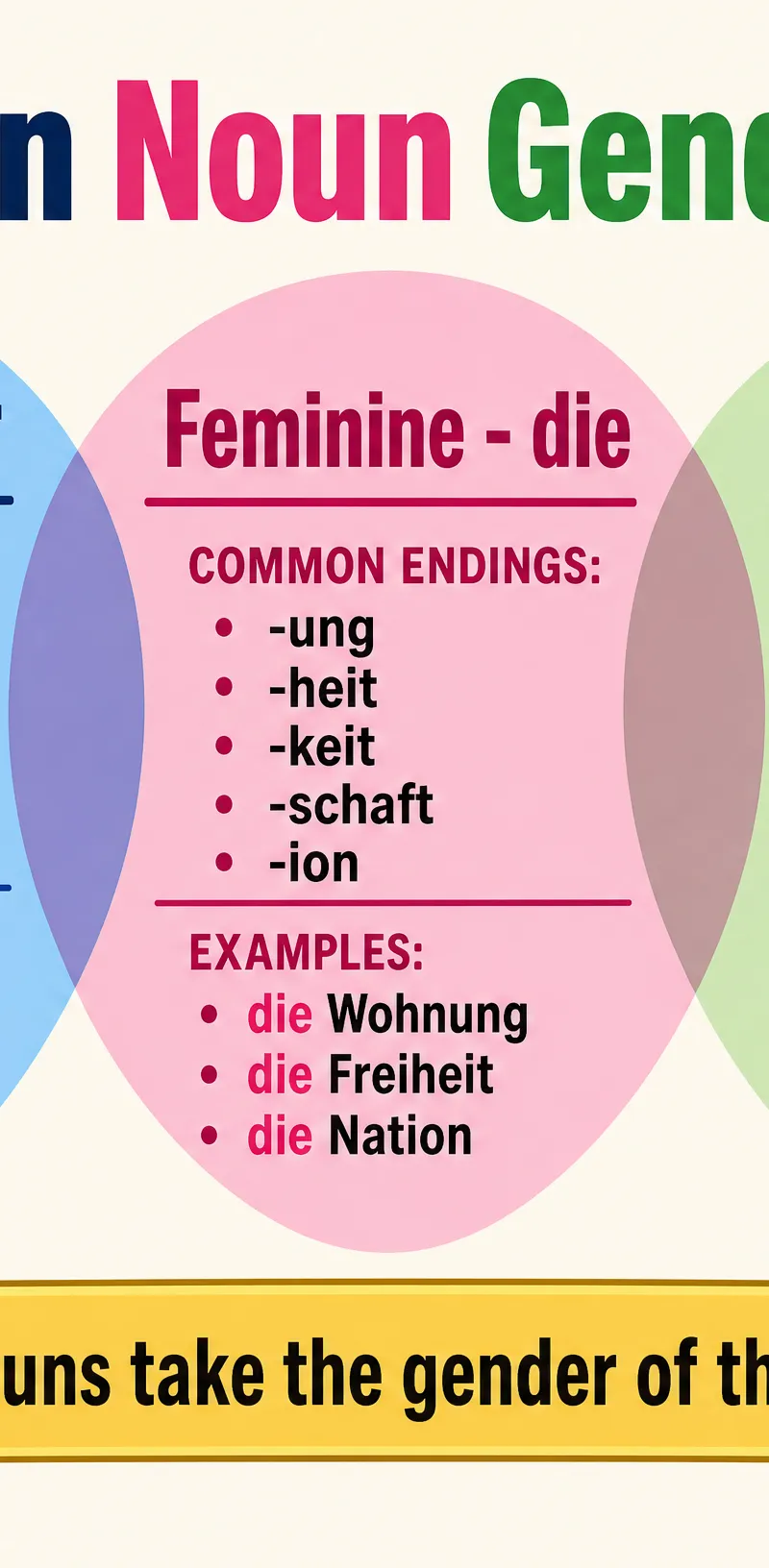
Interactive Diagrams
1 interactive diagram to visualise key concepts
Conceptual Flow Outline
MFL exam approach by skill
Worked Examples
4 worked examples — open one to explore the question and available guidance.
Practice Questions
Try the question, then reveal an answer plan or example response
Translate into German: 'I am playing football with my brother.'
Hint: Think about the preposition 'mit' - what case does it trigger?
Fill in the blank with the correct pronoun: 'Wo ist der Hund? Ich sehe _____ nicht.'
Hint: What gender is 'der Hund'? What case is needed for the direct object?
Write 90 words about your free time. Include: what you do normally, what you did last week, what you will do next week, and an opinion.
Hint: Ensure you use three different tenses and justify your opinion.
Read the text and answer in English: 'Das Mädchen spielt mit dem Hund. Sie liebt ihn sehr.' Question: Who does the girl love?
Hint: Look at the pronoun 'ihn'. What noun does it refer back to?
Translate into English: 'Der Lehrer hilft den Schülern.'
Hint: Look closely at the article 'den' and the 'n' on 'Schülern'.
Speaking (Conversation): Beschreib deinen besten Freund / deine beste Freundin.
Hint: Use adjectives and remember pronoun agreement (er/sie).
Exam technique
How to turn what you know into marks
How to approach the question
Skill-by-skill strategy: Listening — read questions first, note keywords. Speaking — prepare opinions in advance, have fillers ready. Reading — skim first, then detail. Writing — plan before writing, check accuracy after.
How to structure your answer
Writing: Introduction → Main points with opinions → Justified reasons → Different tenses → Conclusion. Speaking: Give opinion → Justify → Extend → Use different tense.
Timing
Listening: 25 mins (heard twice). Speaking: 7-12 mins total (role play + photo card + conversation). Reading: 45-60 mins. Writing: 60-75 mins (translation + structured + extended).
Common pitfalls
- Forgetting adjective agreements (gender & number)
- Using only the present tense — examiners want at least 3 tenses at Higher
- Giving one-word Speaking answers instead of developing responses
- Not checking verb endings in Writing
- Confusing false friends in Listening/Reading
- Not justifying opinions with 'weil' or 'da'
What the command words want
- Describe the photo
- Say what you can see, give an opinion, relate to your experience
- Translate into German
- Write full sentences with correct grammar — partial marks for partially correct
- Translate into English
- Meaning over word-for-word — capture the sense, don't guess cognates
- Write approximately 90 words
- Foundation task — cover all 4 bullet points, use present + one other tense
- Write approximately 150 words
- Higher task — 3 tenses, opinions, complex structures, ambitious vocabulary
Watch or listen (optional)
Test your understanding of Grammar: Nouns, pronouns and determiners
Active recall beats re-reading. Take an instant quiz now to test what you’ve learned and lock it into long-term memory.
7 days Premium · Then the free plan continues · No card, no charge