Pearson Edexcel · GCSE · German
Course version: Pearson-GCSE-German · Version from Mar 2026
Grammar: Prepositions
Master German prepositions and unlock top marks across all four skills. This guide covers essential vocabulary, the crucial difference between accusative, dative, and dual-case prepositions, and advanced structures like 'um...zu' to impress the examiner.
- 13 min read
- 4 worked examples
- 6 practice questions
- 8 key terms
Check what you remember
Read the wording for your board, then hide it and explain Preposition in your own words. Rough notes are fine. This is a self-check, with no mark or grade.
Reference: Pearson Edexcel
A word that shows the relationship between a noun/pronoun and other words in a sentence (e.g., in, on, with).
Study Notes
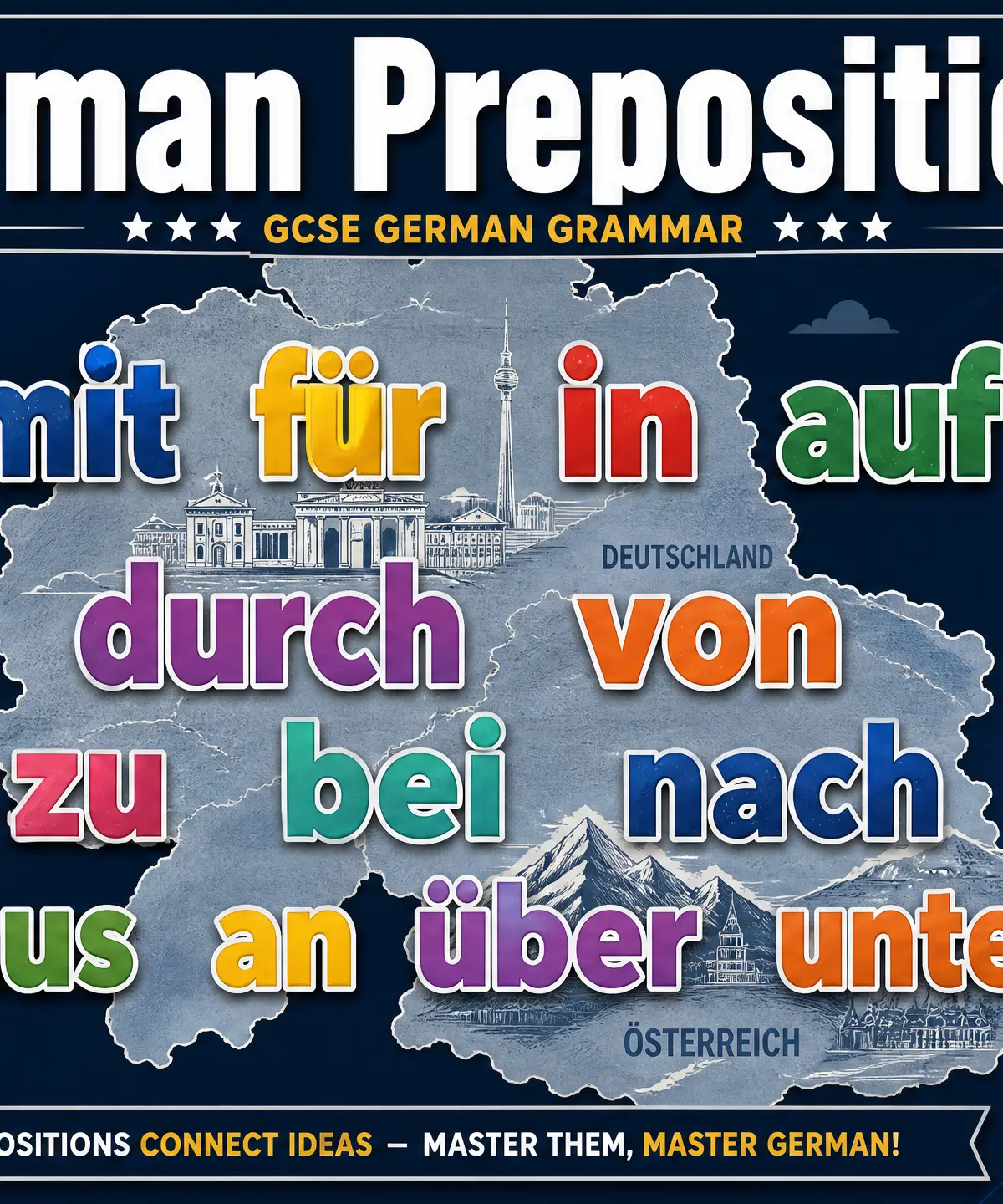
Overview
German prepositions are small words that pack a huge grammatical punch. Unlike in English, every German preposition forces the noun phrase that follows it into a specific case (Accusative, Dative, or Genitive). Mastering these rules is essential for the GCSE exam, as examiners specifically look for correct case usage in your Writing and Speaking tasks, and they test your understanding of them in Reading and Listening.
This guide will take you through the three main groups of prepositions you need for GCSE:
- Accusative-only prepositions (always take the accusative)
- Dative-only prepositions (always take the dative)
- Dual-case prepositions (Wechselpräpositionen - take either accusative or dative depending on movement vs. location)
We will also cover contracted forms (Verschmelzungsformen) and high-level infinitive constructions (um...zu, ohne...zu, statt...zu).
📖 Essential Vocabulary
Tier 1 — Foundation Core
| German | English | Gender | Example Sentence |
|---|---|---|---|
| das Geschenk | present / gift | n | Ich kaufe ein Geschenk für meinen Bruder. |
| die Schule | school | f | Ich gehe jeden Tag in die Schule. |
| der Bahnhof | train station | m | Wir treffen uns am Bahnhof. |
| das Wochenende | weekend | n | Was machst du am Wochenende? |
| der Tisch | table | m | Das Buch liegt auf dem Tisch. |
| die Stadt | city / town | f | Wir fahren in die Stadt. |
| der Freund / die Freundin | friend | m/f | Ich gehe mit meiner Freundin ins Kino. |
| das Haus | house | n | Ich bin zu Hause. |
| das Kino | cinema | n | Gehen wir am Freitag ins Kino? |
| der Park | park | m | Wir spielen Fußball im Park. |
| das Zimmer | room | n | Der Schreibtisch steht im Zimmer. |
| die Ferien (pl) | holidays | pl | In den Ferien fahre ich nach Spanien. |
| der Bus | bus | m | Ich fahre mit dem Bus zur Schule. |
| die Arbeit | work | f | Nach der Arbeit gehe ich einkaufen. |
| das Bett | bed | n | Der Hund schläft unter dem Bett. |
Tier 2 — Higher Tier
| German | English | Gender | Example Sentence |
|---|---|---|---|
| die Umgebung | surrounding area | f | In der Umgebung gibt es viele Bäume. |
| die Ausstellung | exhibition | f | Wir interessieren uns für die Ausstellung. |
| die Gesellschaft | society | f | In unserer Gesellschaft ist das wichtig. |
| die Erfahrung | experience | f | Aus meiner Erfahrung kann ich sagen, dass... |
| der Vorteil / der Nachteil | advantage / disadvantage | m | Ein Vorteil von dem System ist... |
| die Umwelt | environment | f | Wir müssen mehr für die Umwelt tun. |
| die Zukunft | future | f | In der Zukunft möchte ich im Ausland arbeiten. |
| die Gesundheit | health | f | Rauchen ist schlecht für die Gesundheit. |
| die Beziehung | relationship | f | Meine Beziehung zu meinen Eltern ist gut. |
| die Ausbildung | education / training | f | Nach der Schule mache ich eine Ausbildung. |
High-Frequency Words & Phrases
| Phrase | English | Usage Context |
|---|---|---|
| in der Nähe von | near to | Describing where you live or where something is. |
| auf dem Land | in the countryside | Discussing town vs. country living. |
| an der Küste | on the coast | Talking about holidays or location. |
| im Stadtzentrum | in the town centre | Describing your town. |
| um ... zu + infinitive | in order to ... | Explaining reasons (e.g. Ich lerne, um gute Noten zu bekommen). |
| ohne ... zu + infinitive | without ...ing | Describing actions (e.g. Er ging, ohne auf Wiedersehen zu sagen). |
| statt ... zu + infinitive | instead of ...ing | Contrasting actions (e.g. Statt Hausaufgaben zu machen, spiele ich am Computer). |
| meiner Meinung nach | in my opinion | Introducing a justified opinion. |
| zum Beispiel (z.B.) | for example | Giving examples to expand an answer. |
| auf der einen Seite ... auf der anderen Seite | on the one hand ... on the other hand | Weighing up pros and cons. |
📝 Grammar Focus
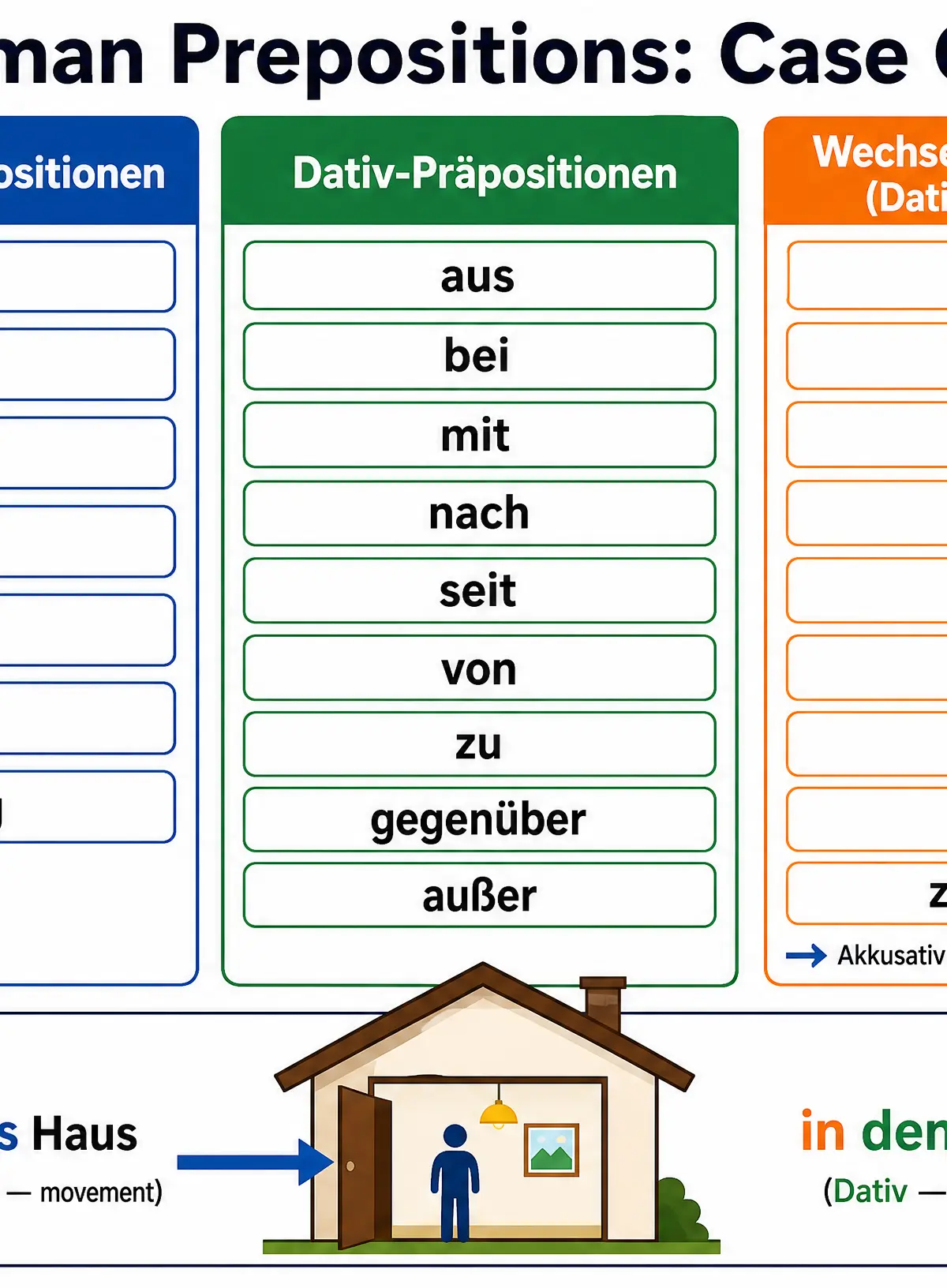
Key Structure 1: Accusative-only Prepositions
When to use it: These prepositions always force the following noun phrase into the accusative case. No exceptions.
The key prepositions are: bis (until/to), durch (through), für (for), gegen (against), ohne (without), um (around/at).
Definite Article Changes (Accusative)
| Subject | Nominative | Accusative | English (Accusative) |
|---|---|---|---|
| Masculine | der | den | the (e.g. für den Vater) |
| Feminine | die | die | the (e.g. für die Mutter) |
| Neuter | das | das | the (e.g. für das Kind) |
| Plural | die | die | the (e.g. für die Eltern) |
Note: Only the masculine changes (der → den). Everything else stays the same as nominative!
Irregulars to learn: Remember that possessive adjectives (mein, dein, sein) and indefinite articles (ein, kein) follow the same pattern: für einen Freund, ohne meinen Bruder.
Key Structure 2: Dative-only Prepositions
When to use it: These prepositions always force the following noun phrase into the dative case.
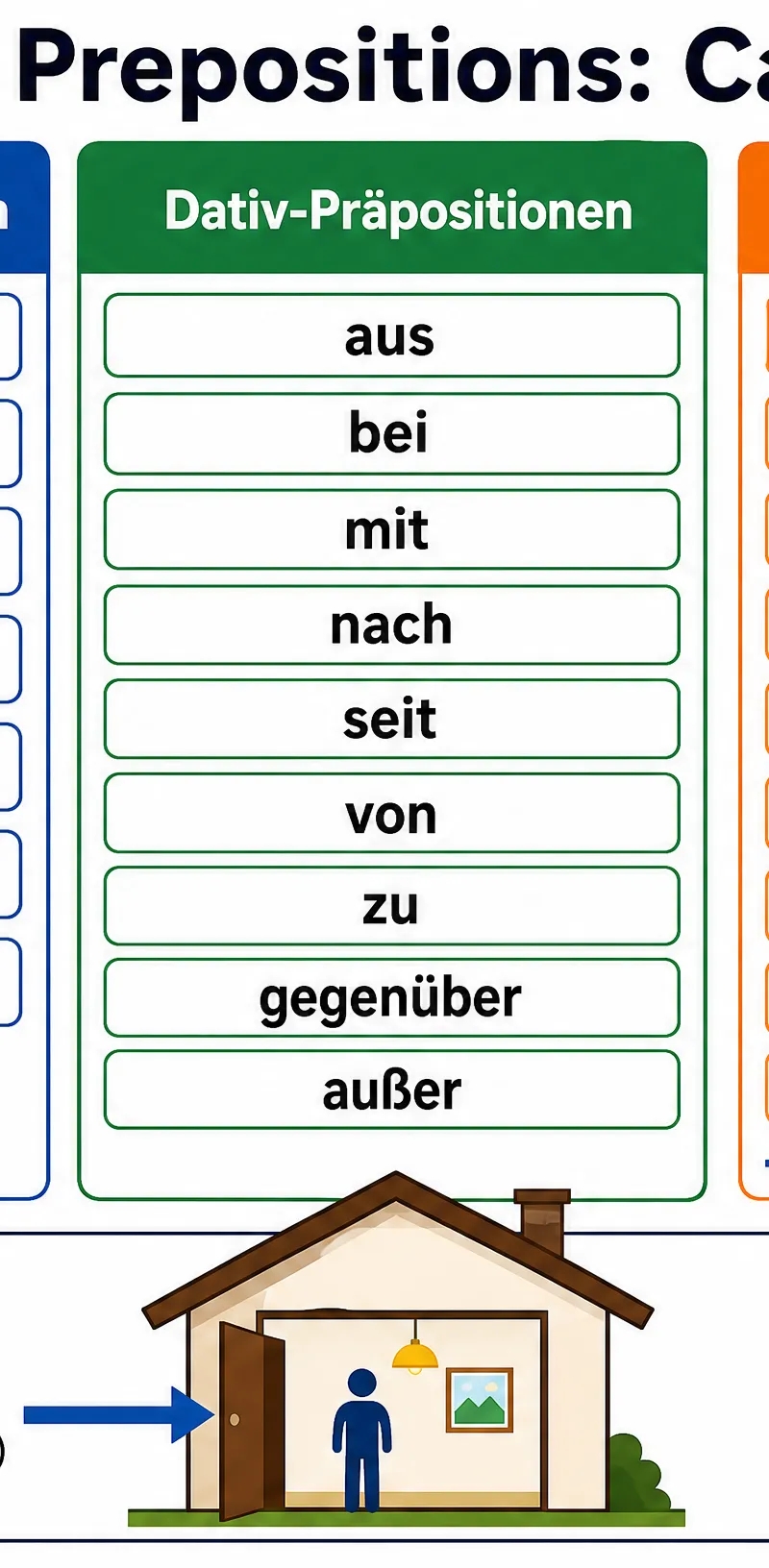
The key prepositions are: aus (out of/from), bei (at/with), mit (with), nach (after/to), seit (since/for), von (from/of), zu (to).
Definite Article Changes (Dative)
| Subject | Nominative | Dative | English (Dative) |
|---|---|---|---|
| Masculine | der | dem | the (e.g. mit dem Vater) |
| Feminine | die | der | the (e.g. mit der Mutter) |
| Neuter | das | dem | the (e.g. mit dem Kind) |
| Plural | die | den (+n) | the (e.g. mit den Eltern) |
Note: In the dative plural, you must also add an '-n' to the end of the noun if it doesn't already end in -n or -s.
Key Structure 3: Dual-case Prepositions (Wechselpräpositionen)
When to use it: These nine prepositions can take either the accusative OR the dative case.
They are: an (on/at), auf (on top of), hinter (behind), in (in/into), neben (next to), über (over/above), unter (under), vor (in front of/before), zwischen (between).
The Golden Rule:
- If there is movement towards a destination (Wohin? / Where to?), use the Accusative.
- If there is no movement / fixed location (Wo? / Where?), use the Dative.
Example:
- Ich gehe in den Park. (I am going into the park. → Movement = Accusative)
- Ich bin im (in dem) Park. (I am in the park. → Location = Dative)
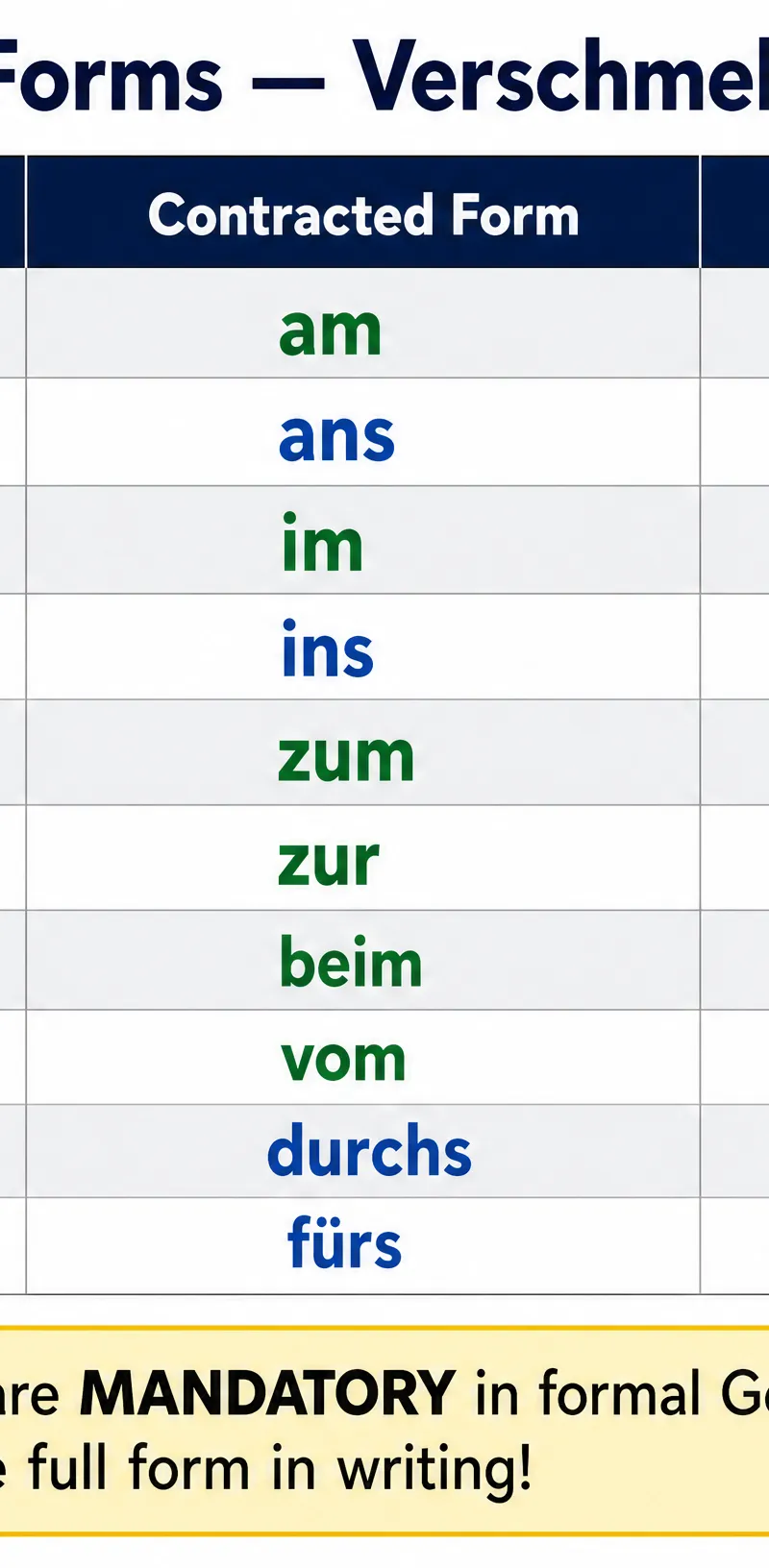
Key Structure 4: Contracted Forms (Verschmelzungsformen)
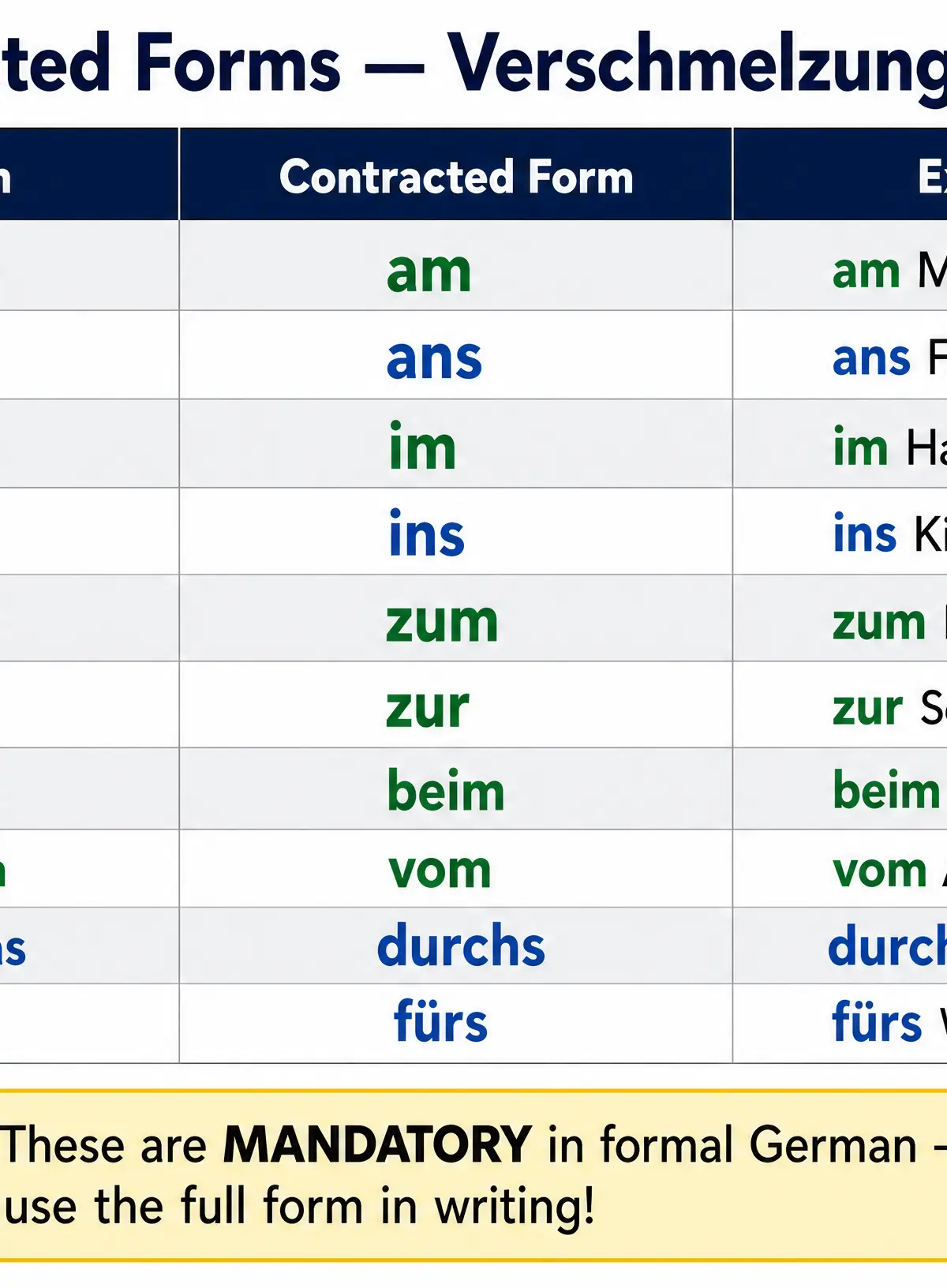
When to use it: When certain prepositions are followed by certain definite articles, they merge into one word. You must use these in German; writing the full form sounds unnatural.
Essential Contractions:
- an + dem = am (am Montag)
- an + das = ans (ans Meer)
- in + dem = im (im Kino)
- in + das = ins (ins Wasser)
- zu + dem = zum (zum Bahnhof)
- zu + der = zur (zur Schule)
- bei + dem = beim (beim Arzt)
- von + dem = vom (vom Supermarkt)
🎧 Listening Skills
What to Expect
In the listening exam, prepositions are crucial for understanding the exact meaning of a sentence. A single preposition can change the entire context (e.g. working for someone vs. working with someone). You will often hear contracted forms spoken quickly.
Listening Strategies
- Listen for contractions: Train your ear to catch am, im, zum, zur. They are spoken quickly and are often unstressed.
- Identify movement vs location: If you hear an accusative ending after in or auf, you know the person is travelling there. If you hear a dative ending, they are already there.
- Note time phrases: Prepositions like um (at a specific time), am (on days/parts of days), and im (in months/seasons) are key to answering 'when' questions.
Common Listening Traps
- Seit: Seit means 'since' or 'for' (an ongoing period of time). If you hear "seit drei Jahren", it means "for three years" (and they are still doing it). Don't translate it as "three years ago".
- Nach vs. Zu: Nach is used for geographical destinations with no article (nach Berlin, nach Deutschland). Zu is used for people and places with articles (zum Bahnhof, zur Schule).
- Vor: Vor can mean "in front of" (location) or "ago" (time). "Vor dem Haus" = in front of the house. "Vor zwei Jahren" = two years ago.
🗣️ Speaking Skills
Role Play Scenarios
Scenario 1: At the train station
- Examiner: Wohin möchten Sie fahren? (Where do you want to travel to?)
- Candidate: Ich möchte nach Berlin fahren. (I would like to travel to Berlin.)
- Examiner: Wann fährt der nächste Zug? (When does the next train leave?)
- Candidate: Der Zug fährt um zehn Uhr ab. (The train leaves at ten o'clock.)
Scenario 2: Making plans
- Examiner: Was machst du am Wochenende? (What are you doing at the weekend?)
- Candidate: Ich gehe mit meinen Freunden ins Kino. (I am going to the cinema with my friends.)
Photo Card Practice
Model Photo Card Response:
- Qu 1 (Description): Auf dem Foto sehe ich drei Personen. Sie sitzen an einem Tisch im Restaurant. (On the photo I see three people. They are sitting at a table in the restaurant.)
- Qu 2 (Opinion): Ich denke, das Essen ist lecker, weil sie glücklich aussehen. (I think the food is tasty because they look happy.)
- Qu 3 (Related topic): Letztes Wochenende bin ich mit meiner Familie ins Restaurant gegangen. (Last weekend I went to the restaurant with my family.)
- Qu 4 (Past/Future): Nächstes Jahr werde ich nach Spanien fliegen, um Paella zu essen. (Next year I will fly to Spain in order to eat paella.)
- Qu 5 (Unpredictable): Kochst du gern? Ja, ich koche gern für meine Freunde. (Do you like cooking? Yes, I like cooking for my friends.)
General Conversation Questions
| Question (German) | Model Answer | English Translation |
|---|---|---|
| Wo wohnst du? | Ich wohne in einem kleinen Haus auf dem Land. | I live in a small house in the countryside. |
| Was machst du gern in deiner Freizeit? | Ich spiele gern Fußball mit meinen Freunden im Park. | I like playing football with my friends in the park. |
| Wohin fährst du normalerweise in den Urlaub? | Normalerweise fahre ich mit meiner Familie nach Frankreich. | Normally I travel to France with my family. |
| Was hast du letztes Wochenende gemacht? | Ich bin in die Stadt gefahren, um Kleidung zu kaufen. | I travelled into town in order to buy clothes. |
| Wie kommst du zur Schule? | Ich fahre normalerweise mit dem Bus zur Schule. | I normally travel to school by bus. |
✍️ Writing Skills
Translation Practice
English → German:
| English | German | Key Grammar |
|---|---|---|
| I am going to the cinema. | Ich gehe ins Kino. | in + das (movement = accusative) |
| I live with my mother. | Ich wohne bei meiner Mutter. | bei + dative |
| He plays football for his school. | Er spielt Fußball für seine Schule. | für + accusative |
| We travel to Germany by train. | Wir fahren mit dem Zug nach Deutschland. | mit + dative / nach + country |
| I learn German in order to work in Berlin. | Ich lerne Deutsch, um in Berlin zu arbeiten. | um...zu construction |
Extended Writing
**Model 90-word response (Foundation):**Ich wohne in einem kleinen Dorf in der Nähe von London. In meiner Stadt gibt es einen großen Park und ein Kino. Letztes Wochenende bin ich mit meinen Freunden ins Kino gegangen. Der Film war sehr gut! Nächstes Wochenende fahre ich mit dem Zug nach Manchester, um meine Tante zu besuchen. Ich freue mich darauf.
**Model 150-word response (Higher):**Ich wohne seit fünf Jahren in einer mittelgroßen Stadt in der Nähe von London. Meiner Meinung nach ist das Leben hier ziemlich interessant, weil es viel zu tun gibt. Letztes Wochenende bin ich mit meinen Freunden in die Stadtmitte gefahren, um einkaufen zu gehen. Danach haben wir in einem neuen Restaurant gegessen. Das Essen war köstlich!
Ein Nachteil von meiner Stadt ist jedoch, dass es zu viel Verkehr gibt. Die öffentlichen Verkehrsmittel sind teuer, also fahre ich jeden Tag mit dem Fahrrad zur Schule, statt mit dem Bus zu fahren.
In der Zukunft möchte ich nach Deutschland ziehen, um an der Universität zu studieren. Ich denke, das wäre eine tolle Erfahrung, obwohl ich meine Familie vermissen würde.
Writing Checklist
- ✅ Used contracted forms correctly (am, im, zum, zur)?
- ✅ Checked cases after prepositions (accusative vs dative)?
- ✅ Used "mit" + dative for transport (mit dem Auto)?
- ✅ Included an "um...zu" clause to show high-level structure?
- ✅ Checked verb position (verb 2nd in main clauses, verb to the end in subordinate/infinitive clauses)?
📚 Reading Skills
Key Strategies
- Look at the endings: The endings on articles and adjectives after a preposition give you clues about gender and number. "Mit den kleinen Kindern" - the 'n's tell you it's plural.
- Context is key: Remember that prepositions can have multiple meanings. "Um" usually means "around" or "at" (time), but in an "um...zu" clause, it means "in order to".
False Friends & Tricky Words
| Word | Looks Like | Actually Means |
|---|---|---|
| nach | nothing specific | to (a country/city) OR after (time) |
| vor | for | in front of OR ago |
| für | for | for (accusative only) |
| seit | since | since OR for (an ongoing period of time) |
| bei | by | at / with / near / at the house of |
🌍 Cultural Knowledge
When talking about location in German-speaking countries, prepositions are essential. For example, knowing the difference between "Ich fahre in die Schweiz" (I am travelling to Switzerland - needs the article 'die' because Switzerland is feminine) versus "Ich fahre nach Deutschland" (I am travelling to Germany - no article needed).
Also, understanding regional variations in prepositions can be impressive. For example, in Austria and Bavaria, people often say "Ich bin in der Schule" (I am at school), but they might also say "Ich gehe in die Schule" for both movement and location. However, stick to standard High German (Hochdeutsch) rules for your GCSE exam!
Visual Resources
2 diagrams and illustrations
Interactive Diagrams
1 interactive diagram to visualise key concepts
Conceptual Flow Outline
Decision tree for choosing the correct case after a preposition.
Worked Examples
4 worked examples — open one to explore the question and available guidance.
Practice Questions
Try the question, then reveal an answer plan or example response
Translate into German: 'I am travelling to Germany with my family.'
Hint: Think about the preposition for 'to' a country, and the case required after 'with'.
Fill in the blanks with the correct contracted form: 'Am Wochenende gehe ich ___ (in das) Schwimmbad und dann ___ (zu dem) Park.'
Hint: Combine the preposition and the article into one short word.
Write a sentence using the 'um...zu' construction to explain why you are learning German.
Hint: Start with 'Ich lerne Deutsch, um...' and put 'zu' + infinitive at the end.
Choose the correct article: 'Das Buch liegt auf ___ (der/den/dem) Tisch.'
Hint: Is the book moving onto the table, or is it already located there? 'Tisch' is masculine (der).
Translate into English: 'Er geht aus dem Haus ohne seine Jacke.'
Hint: Identify the prepositions 'aus' and 'ohne'.
Writing (Higher): Write 3 sentences describing your town. You must use: one dative preposition, one accusative preposition, and one dual-case preposition showing location.
Hint: Plan your nouns and their genders first. E.g., Park (m), Stadt (f), Kino (n).
Exam technique
How to turn what you know into marks
How to approach the question
Writing — plan before writing, specifically noting which prepositions you will use and checking the gender/case of the following noun. Check accuracy after writing.
How to structure your answer
Writing: Introduction → Main points with opinions → Justified reasons → Different tenses → Conclusion. Use 'um...zu' to link ideas and extend sentences.
Timing
Writing: 60-75 mins total. Allocate 5-10 mins for planning prepositional phrases and checking cases.
Common pitfalls
- Using nominative after a preposition (e.g., für mein Vater instead of für meinen Vater).
- Using 'nach' for local destinations instead of 'zu' (e.g., nach dem Kino instead of zum Kino).
- Forgetting the plural 'n' in the dative case (e.g., mit meine Freunden instead of mit meinen Freunden).
- Translating 'for' as 'für' when talking about time. (Use 'seit' for ongoing time: seit drei Jahren).
- Putting the verb in the wrong place in an 'um...zu' clause. The 'zu + infinitive' MUST go at the very end.
What the command words want
- Translate into German
- Pay close attention to 'by', 'to', and 'for' - identify the correct German preposition and apply the case rule strictly.
- Write approximately 150 words
- Include at least one 'um...zu' clause, one dual-case preposition showing movement, and one showing location to demonstrate grammatical range.
Watch or listen (optional)
Test your understanding of Grammar: Prepositions
Active recall beats re-reading. Take an instant quiz now to test what you’ve learned and lock it into long-term memory.
7 days Premium · Then the free plan continues · No card, no charge