Pearson Edexcel · GCSE · German
Course version: Pearson-GCSE-German · Version from Mar 2026
Grammar: Sound-symbol correspondences (SSCs)
Master the rules of German pronunciation and spelling! This topic covers the essential Sound-Symbol Correspondences (SSCs) needed to achieve clear pronunciation in speaking exams and accurate spelling in listening dictation tasks.
- 13 min read
- 4 worked examples
- 6 practice questions
- 8 key terms
Check what you remember
Read the wording for your board, then hide it and explain Sound-Symbol Correspondence (SSC) in your own words. Rough notes are fine. This is a self-check, with no mark or grade.
Reference: Pearson Edexcel
The predictable relationship between a written letter (or group of letters) and its spoken sound.
Study Notes
Overview
Welcome to the Sound-Symbol Correspondences (SSCs) study guide! This topic focuses on the principles by which spelling represents sounds in standard German. Understanding these rules is your secret weapon for the GCSE exam. It directly impacts your marks in two crucial areas: achieving clear and comprehensible pronunciation in the Speaking (Read Aloud) task, and accurately transcribing spoken German in the Listening dictation tasks. Because German is highly phonetically regular, mastering these SSCs means you can confidently pronounce almost any new word you encounter.
📖 Essential Vocabulary
Note: Since SSCs apply to all words, this vocabulary list focuses on high-frequency examples that perfectly demonstrate key phonetic rules.
Tier 1 — Foundation Core
| German | English | Gender | Example Sentence | Phonetic Focus |
|---|---|---|---|---|
| spielen | to play | n/a | Ich spiele gern Fußball am Wochenende. | sp = shp |
| die Stadt | the city | f | Die Stadt ist sehr groß und laut. | st = sht |
| die Schule | the school | f | Meine Schule beginnt um acht Uhr. | sch = sh |
| Deutsch | German | n/a | Wir lernen Deutsch in der Schule. | tsch = ch |
| das Mädchen | the girl | n | Das Mädchen liest ein interessantes Buch. | ä = eh, ch = soft ich-Laut |
| schön | beautiful | n/a | Das Wetter ist heute sehr schön. | ö = round lips + eh |
| über | over / about | n/a | Der Film ist über einen Hund. | ü = round lips + ee |
| mein | my | n/a | Mein Vater arbeitet in einem Büro. | ei = eye |
| das Haus | the house | n | Wir wohnen in einem kleinen Haus. | au = ow |
| heute | today | n/a | Heute habe ich viel Hausaufgaben. | eu = oy |
| der Vater | the father | m | Mein Vater ist vierzig Jahre alt. | v = f |
| das Wasser | the water | n | Ich trinke gern Mineralwasser. | w = v |
| die Zeit | the time | f | Ich habe keine Zeit für Hobbys. | z = ts |
| groß | big / tall | n/a | Mein Bruder ist sehr groß. | ß = ss |
| das Buch | the book | n | Ich lese jeden Abend ein Buch. | ch = hard ach-Laut |
Tier 2 — Higher Tier
| German | English | Gender | Example Sentence | Phonetic Focus |
|---|---|---|---|---|
| das Gebäude | the building | n | Das Gebäude in der Stadtmitte ist neu. | äu = oy |
| die Qualität | the quality | f | Die Qualität des Essens war ausgezeichnet. | qu = kv |
| vielleicht | perhaps | n/a | Vielleicht gehe ich später ins Kino. | v = f, ie = ee, soft ch |
| die Aussprache | the pronunciation | f | Seine deutsche Aussprache ist fantastisch. | au = ow, sp = shp |
| der Dieb | the thief | m | Der Dieb hat das teure Auto gestohlen. | ie = ee, final b = p |
| der Tag | the day | m | Nächsten Tag fahren wir nach Berlin. | final g = k |
| das Fahrrad | the bicycle | n | Ich fahre jeden Tag mit dem Fahrrad zur Schule. | v = f, final d = t |
| wichtig | important | n/a | Es ist wichtig, Vokabeln zu lernen. | w = v, soft ch |
| die Enttäuschung | the disappointment | f | Das schlechte Wetter war eine große Enttäuschung. | äu = oy, sch = sh |
| spazieren gehen | to go for a walk | n/a | Wir gehen oft im Park spazieren. | sp = shp, z = ts, ie = ee |
High-Frequency Words & Phrases
| Phrase | English | Usage Context | Phonetic Focus |
|---|---|---|---|
| Ich bin der Meinung, dass... | I am of the opinion that... | Giving opinions | ei = eye, ss = ss |
| auf der einen Seite... | on the one hand... | Balancing arguments | ei = eye |
| auf der anderen Seite... | on the other hand... | Balancing arguments | ei = eye |
| Meiner Meinung nach... | In my opinion... | Giving opinions | ei = eye, hard ch |
| Ich spreche ziemlich gut Deutsch. | I speak German quite well. | Talking about skills | sp = shp, ie = ee, tsch = ch |
| Es macht viel Spaß. | It is a lot of fun. | Giving reasons | soft ch, sp = shp, ß = ss |
| Ich interessiere mich für... | I am interested in... | Talking about hobbies | soft ch |
| Ich habe vor, ... zu ... | I intend to... | Future plans | v = f |
| in der Zukunft | in the future | Future plans | z = ts |
| Es ist schrecklich! | It is terrible! | Giving negative opinions | sch = sh, soft ch |
📝 Grammar Focus
Note: While SSCs are primarily about pronunciation and spelling, applying them correctly requires understanding the grammar structures they appear in. Here we focus on verbs where pronunciation rules are critical.
Key Structure 1: Present Tense (Regular Verbs)
When to use it: To describe actions happening now or general facts. Pay attention to the st and t endings, ensuring clear pronunciation.
Conjugation Table: spielen (to play)
Pronunciation focus: Remember that the 'sp' is pronounced 'shp'.
| Subject | Verb Form | English |
|---|---|---|
| ich | spiele | I play |
| du | spielst | you (informal) play |
| er/sie/es | spielt | he/she/it plays |
| wir | spielen | we play |
| ihr | spielt | you (plural) play |
| sie/Sie | spielen | they/You (formal) play |
Key Structure 2: Modal Verbs (müssen, können, wollen)
When to use it: To express obligation, ability, or desire. These are crucial for demonstrating umlaut pronunciation (ü, ö).
Conjugation Table: müssen (must / to have to)
Pronunciation focus: The 'ü' requires rounded lips (like 'oo') while saying 'ee'.
| Subject | Verb Form | English |
|---|---|---|
| ich | muss | I must |
| du | musst | you must |
| er/sie/es | muss | he/she/it must |
| wir | müssen | we must |
| ihr | müsst | you must |
| sie/Sie | müssen | they/You must |
Key Structure 3: The Perfect Tense (Past)
When to use it: To talk about completed actions in the past. Examiners listen for the correct pronunciation of the 'ge-' prefix (unstressed) and past participle endings.
Conjugation Table: haben + gespielt (played)
Pronunciation focus: The stress is on 'SPIEL', not 'ge'. ge-SPIELT.
| Subject | Verb Form | English |
|---|---|---|
| ich | habe gespielt | I have played |
| du | hast gespielt | you have played |
| er/sie/es | hat gespielt | he/she/it has played |
| wir | haben gespielt | we have played |
| ihr | habt gespielt | you have played |
| sie/Sie | haben gespielt | they/You have played |
🎧 Listening Skills
What to Expect
In the Listening exam, SSCs are directly tested in the dictation task. You will hear a short passage of spoken German and must write it down accurately. Your knowledge of how sounds map to letters is the key to getting these marks.
Listening Strategies
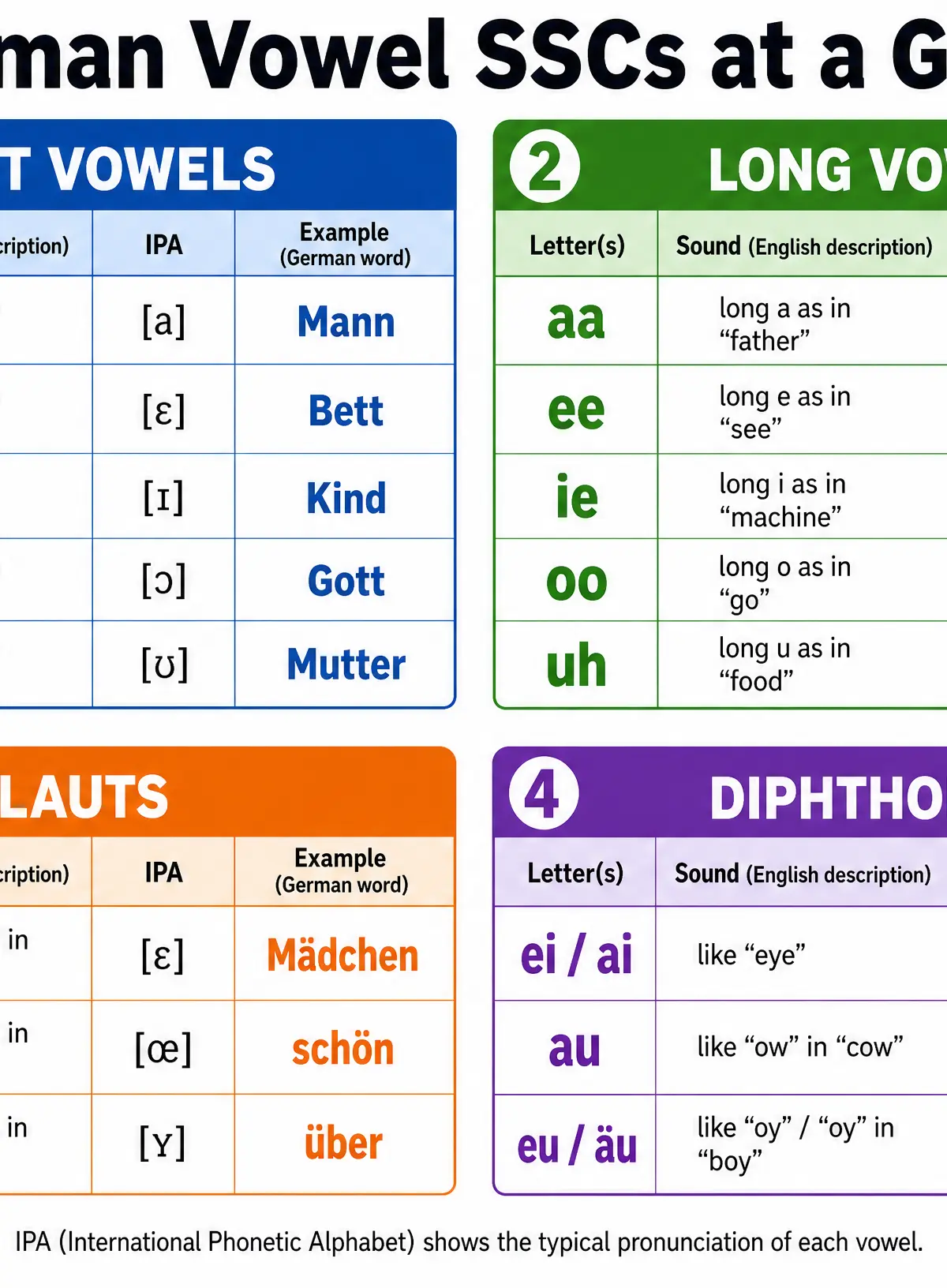
- Listen for vowel length: A long 'ee' sound means you should write 'ie'. A short 'e' sound means just 'e'.
- Decode the 'oy' sound: If you hear 'oy', it is almost always spelled 'eu' or 'äu' (e.g., heute, Häuser).
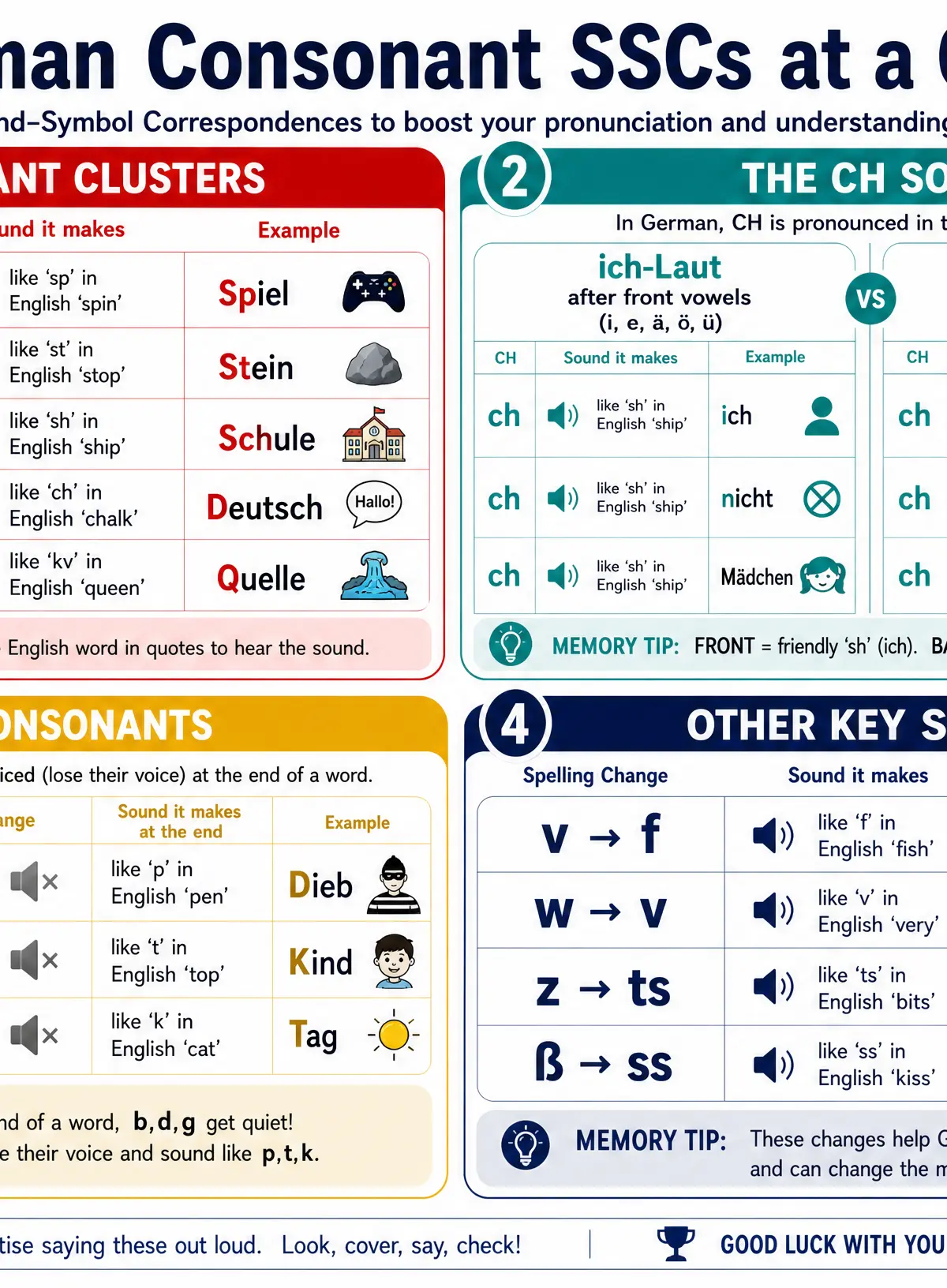
- Catch the initial 'shp' and 'sht': If a word starts with 'shp' or 'sht', write 'sp' or 'st' (never 'schp' or 'scht').
- Identify the 'ts' sound: If you hear a sharp 'ts', it's usually the letter 'z' or '-tz' (e.g., Zeit, Katze).
Common Listening Traps
- Confusing 'ei' and 'ie': Remember, 'ei' sounds like 'eye' (mein), and 'ie' sounds like 'ee' (Liebe). Write what you hear!
- Missing umlauts: If you hear the distinct 'eh' (ä), or the rounded 'ö' and 'ü' sounds, don't forget to add the two dots.
- V vs. W: If you hear a 'v' sound, write 'w' (Wasser). If you hear an 'f' sound, it could be 'v' (Vater) or 'f' (Fisch).
🗣️ Speaking Skills
Role Play Scenarios
Scenario 1: At the train station
Examiner (Ticket agent): Guten Tag. Wohin möchten Sie fahren?
Candidate: Ich möchte eine Fahrkarte nach Berlin, bitte. (Pronunciation focus: soft 'ich-Laut' in möchte/ich; long 'a' in Fahrkarte; short 'i' in bitte)
Scenario 2: In a restaurant
Examiner (Waiter): Was möchten Sie trinken?
Candidate: Ich nehme ein Glas Wasser und ein Stück Schokoladenkuchen, bitte. (Pronunciation focus: 'w' = v in Wasser; 'st' = sht in Stück; 'sch' = sh in Schokoladenkuchen)
Photo Card Practice
Model Photo Card Response (Topic: School):
- Qu 1 (Description): Auf dem Foto sehe ich drei Schüler. Sie spielen Fußball auf dem Schulhof. (Pronunciation focus: 'sch' in Schüler/Schulhof; 'sp' = shp in spielen; 'ß' = ss in Fußball)
- Qu 2 (Opinion): Ich finde Sport in der Schule sehr wichtig, weil es gesund ist. (Pronunciation focus: 'w' = v and soft 'ch' in wichtig; 'v' = f in von/weil)
- Qu 3 (Related topic): Mein Lieblingsfach ist Deutsch, denn die Lehrerin ist sehr sympathisch. (Pronunciation focus: 'tsch' = ch in Deutsch; 'ie' = ee in Lieblingsfach/die/Lehrerin)
- Qu 4 (Past/Future): Nächstes Jahr werde ich auf das Gymnasium gehen. (Pronunciation focus: 'ä' = eh in Nächstes; 'j' = y in Jahr; 'v' = f in von)
- Qu 5 (Unpredictable): Hausaufgaben sind manchmal langweilig, aber nützlich. (Pronunciation focus: 'au' = ow in Hausaufgaben; soft 'ch' in manchmal/nützlich)
General Conversation Questions
| Question (German) | Model Answer | English Translation | Phonetic Focus |
|---|---|---|---|
| Was machst du gern in deiner Freizeit? | Ich spiele gern Tennis und ich lese viele Bücher. | What do you like doing in your free time? I like playing tennis and reading lots of books. | sp = shp, hard ch in Bücher |
| Wie ist deine Stadt? | Meine Stadt ist ziemlich groß und sehr schön, aber manchmal zu laut. | What is your city like? My city is quite big and very beautiful, but sometimes too loud. | st = sht, ß = ss, ö = round lips+eh |
| Was hast du letztes Wochenende gemacht? | Letztes Wochenende bin ich mit meinem Vater ins Kino gegangen. | What did you do last weekend? Last weekend I went to the cinema with my father. | v = f in Vater, ie = ee in Kino |
| Was wirst du nächstes Jahr machen? | Nächstes Jahr werde ich vielleicht nach Spanien fahren. | What will you do next year? Next year I will perhaps travel to Spain. | v = f, ie = ee, soft ch in vielleicht; sp = shp in Spanien |
| Was ist dein Lieblingsessen? | Mein Lieblingsessen ist Wiener Schnitzel mit Pommes frites. | What is your favourite food? My favourite food is Wiener Schnitzel with chips. | ie = ee, sch = sh, z = ts in Schnitzel |
✍️ Writing Skills
Translation Practice
English → German:
| English | German | Key Grammar & SSC Focus |
|---|---|---|
| I play football. | Ich spiele Fußball. | sp = shp, ß = ss |
| My father is reading a book. | Mein Vater liest ein Buch. | ei = eye, v = f, ie = ee, hard ch |
| The weather today is beautiful. | Das Wetter ist heute schön. | w = v, eu = oy, ö = round lips+eh |
| We went to the city. | Wir sind in die Stadt gegangen. | w = v, ie = ee, st = sht |
| I am of the opinion that it is important. | Ich bin der Meinung, dass es wichtig ist. | ei = eye, ss = ss, w = v, soft ch |
Extended Writing
**Model 90-word response (Foundation) - Topic: Free Time:**In meiner Freizeit spiele ich gern Fußball mit meinen Freunden. Wir spielen oft im Park, weil das Wetter schön ist. Mein Lieblingshobby ist Lesen, denn Bücher sind sehr interessant. Letztes Wochenende bin ich mit meiner Familie ins Kino gegangen. Der Film war toll! Nächstes Wochenende werde ich vielleicht Musik hören oder fernsehen. Ich finde Musik fantastisch, weil sie entspannend ist.
**Model 150-word response (Higher) - Topic: School & Future Plans:**Ich besuche ein großes Gymnasium in der Stadtmitte. Meine Schule gefällt mir ziemlich gut, obwohl der Schultag manchmal zu lang ist. Mein Lieblingsfach ist definitiv Deutsch, weil ich Fremdsprachen faszinierend finde und die Lehrerin sehr hilfsbereit ist. Auf der anderen Seite lerne ich gar nicht gern Mathe, da ich die Hausaufgaben extrem schwierig finde!
Letztes Jahr haben wir eine tolle Klassenfahrt nach Berlin gemacht. Wir haben viele Sehenswürdigkeiten besichtigt und das war eine unvergessliche Erfahrung. Das Essen in Deutschland war auch unglaublich lecker, besonders das Wiener Schnitzel.
In der Zukunft habe ich vor, auf die Universität zu gehen, um Sprachen zu studieren. Ich bin der Meinung, dass es sehr wichtig ist, andere Kulturen zu verstehen. Später möchte ich vielleicht im Ausland arbeiten, weil ich gern reise und neue Leute kennenlerne.
Writing Checklist
- ✅ Have I checked my 'ie' and 'ei' spellings carefully?
- ✅ Have I used umlauts (ä, ö, ü) where required?
- ✅ Have I remembered that 'ß' is used after long vowels and diphthongs?
- ✅ Are my capital letters correct for ALL nouns?
📚 Reading Skills
Key Strategies
When reading German, sound the words out in your head using your SSC rules. Because German is phonetic, 'hearing' the word in your mind can often help you recognize it, especially if it's a cognate (a word that sounds similar to English, like 'Haus' or 'Wasser').
False Friends & Tricky Words
| Word | Looks Like | Actually Means | Phonetic Focus |
|---|---|---|---|
| das Gymnasium | gymnasium (sports hall) | grammar school | y = ü sound |
| aktuell | actual | current / up-to-date | qu = kv |
| bekommen | to become | to get / receive | stress on KOM-men |
| der Chef | chef (cook) | boss / manager | ch = sh (French loanword) |
🌍 Cultural Knowledge
Understanding SSCs also helps with reading German names and places correctly. For example, knowing that 'w' sounds like 'v' helps you pronounce the car brand 'VW' (Fau-Vay) or the sausage 'Bratwurst'. Knowing the 'st' rule helps you pronounce the city 'Stuttgart' (Shtoot-gart). Recognizing the 'ie' rule helps with the city 'Kiel' or the greeting 'Auf Wiedersehen'. Embracing these phonetic rules shows examiners you have a genuine appreciation for the language and culture.
Visual Resources
2 diagrams and illustrations
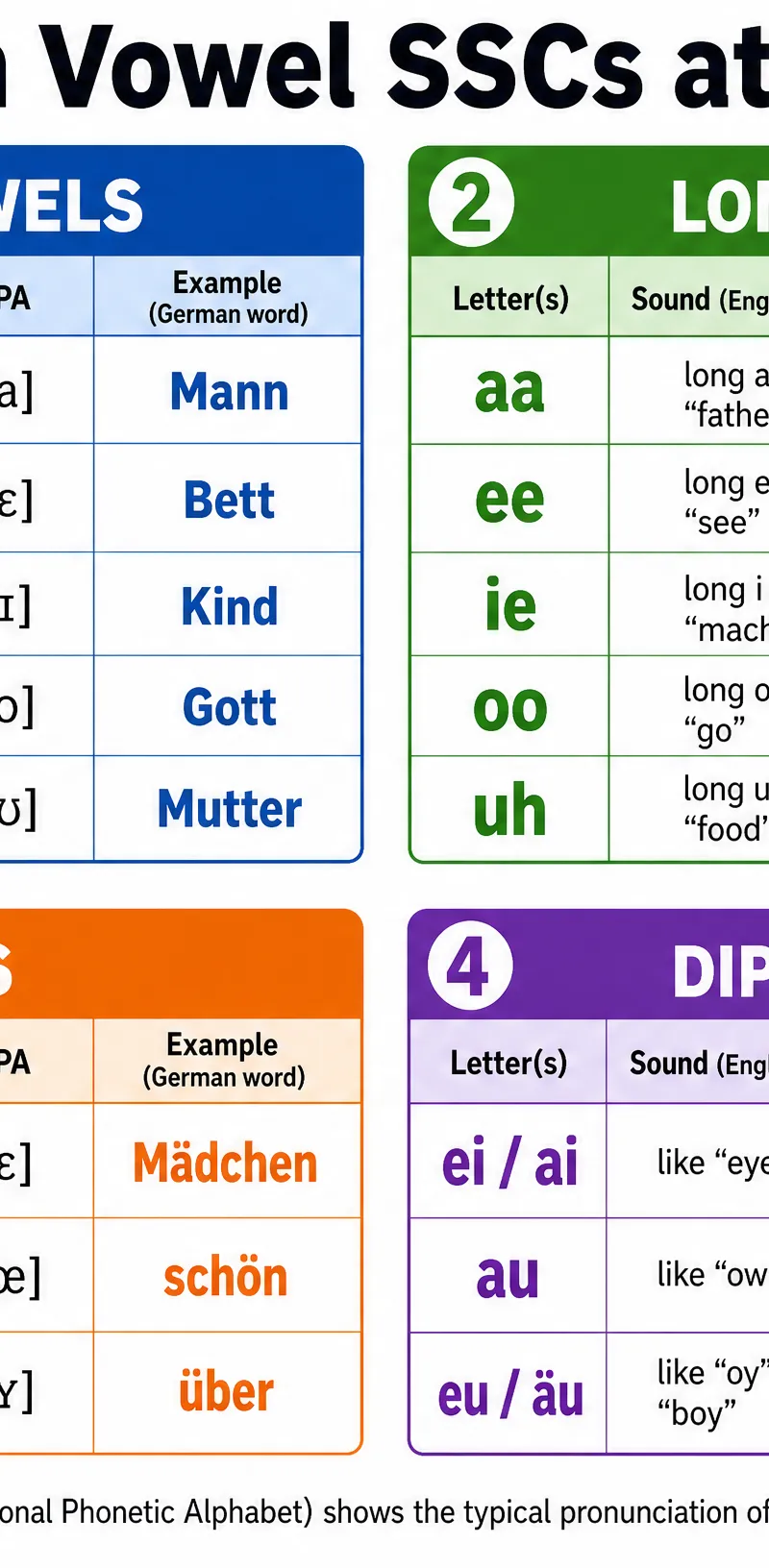
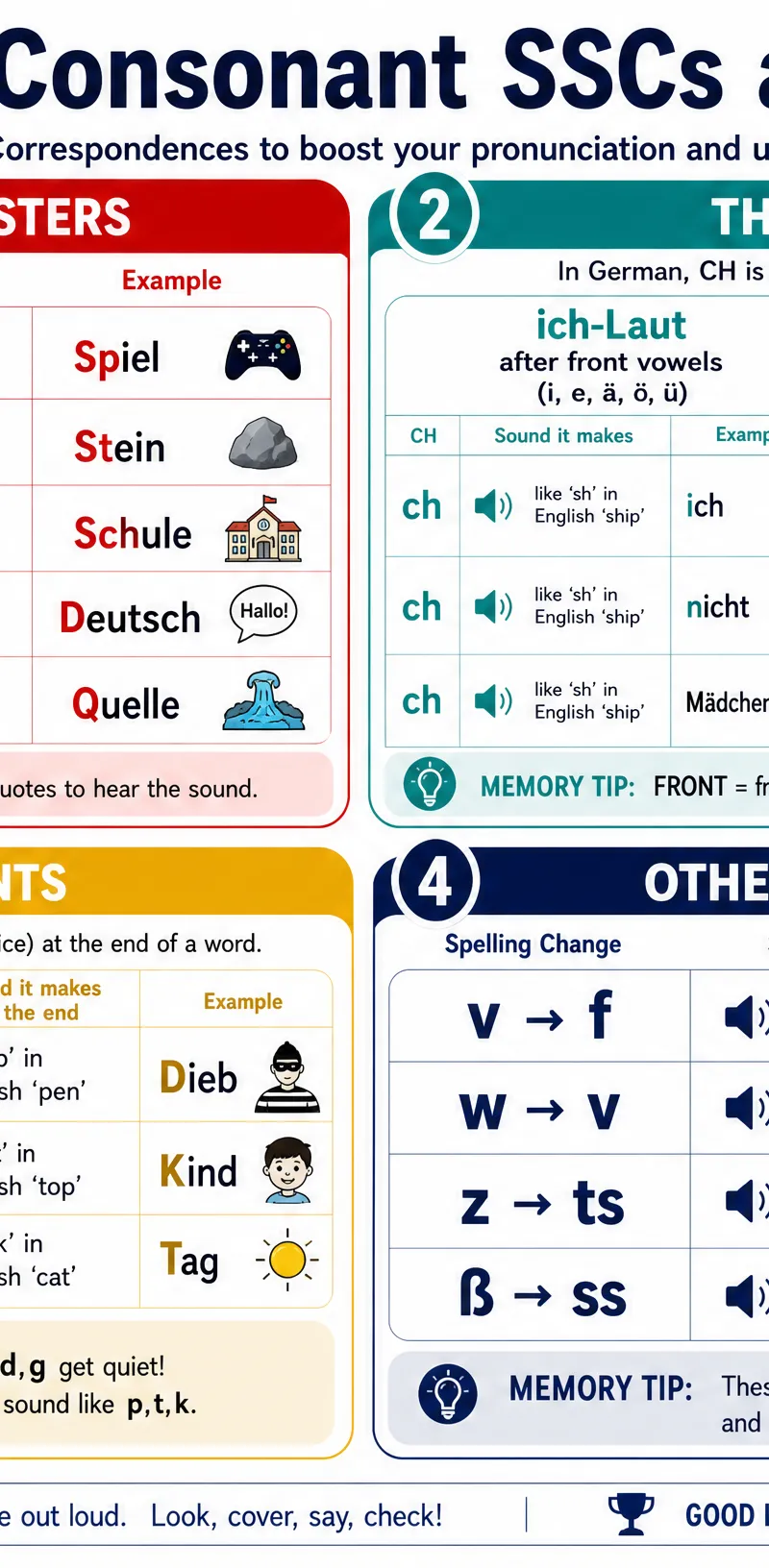
Interactive Diagrams
1 interactive diagram to visualise key concepts
Conceptual Flow Outline
How to choose the correct 'CH' pronunciation
Worked Examples
4 worked examples — open one to explore the question and available guidance.
Practice Questions
Try the question, then reveal an answer plan or example response
Speaking: Read the following sentence aloud, paying attention to the 'sp', 'st', and 'v' sounds: 'Mein Vater spielt Tennis in der Stadt.'
Hint: Remember the 'Start with a SHhh' rule for sp/st, and the 'V is Fake' rule.
Listening: Write down the German word you hear: [Audio: 'Hausaufgaben']
Hint: Think about how the 'ow' sound is spelled in German.
Writing: Translate into German: 'I love my dog.'
Hint: Pay attention to the 'ie' and 'ei' spellings.
Speaking: Read aloud: 'Vielleicht besuche ich am Wochenende meine Großeltern.'
Hint: Watch out for 'v', 'ie', soft 'ch', and 'w'.
Listening: Write down the German word you hear: [Audio: 'Deutsch']
Hint: How do you spell the 'oy' sound and the 'ch' sound at the end?
Reading: Which German word sounds like the English word 'friend' but means 'friend' in German? (Hint: look at the 'eu' rule)
Hint: Think about the 'oy' sound.
Exam technique
How to turn what you know into marks
How to approach the question
For the Read Aloud task: Use your prep time to actively mark up the text. Underline 'ie', circle 'sp/st', box 'ch'. For Dictation: Write exactly what you hear using SSC rules, don't guess English spellings.
How to structure your answer
Speaking: Speak clearly, at a moderate pace. Do not rush. Pronunciation and intonation are more important than speed.
Timing
Speaking Read Aloud: You have 12 minutes total preparation time for the speaking exam. Spend 1-2 minutes specifically annotating the read aloud text for SSCs.
Common pitfalls
- Pronouncing 'sp' and 'st' the English way (Speel instead of Shpeel)
- Confusing 'ie' (ee) and 'ei' (eye)
- Pronouncing 'v' as an English V instead of an F
- Pronouncing 'w' as an English W instead of a V
- Ignoring umlauts completely (saying 'schon' instead of 'schön')
- Failing to devoice final consonants (saying 'Tag' with a hard G instead of a K)
What the command words want
- Read aloud
- Focus on accuracy of SSCs, appropriate stress, and intonation. Pauses at commas and full stops.
- Transcribe / Dictation
- Apply SSC rules backwards (sound to spelling). 'oy' = eu/äu, 'shp' = sp.
Watch or listen (optional)
Test your understanding of Grammar: Sound-symbol correspondences (SSCs)
Active recall beats re-reading. Take an instant quiz now to test what you’ve learned and lock it into long-term memory.
7 days Premium · Then the free plan continues · No card, no charge