Pearson Edexcel · GCSE · German
Course version: Pearson-GCSE-German · Version from Mar 2026
Grammar: Verbs and tenses
This comprehensive GCSE German Grammar guide focuses on Verbs and Tenses, covering present, past, and future timeframes. It provides essential vocabulary, structured grammar rules with conjugation tables, and specific exam strategies to help candidates secure top marks across Listening, Speaking, Reading, and Writing papers.
- 13 min read
- 4 worked examples
- 6 practice questions
- 8 key terms
Check what you remember
Read the wording for your board, then hide it and explain Infinitive in your own words. Rough notes are fine. This is a self-check, with no mark or grade.
Reference: Pearson Edexcel
The 'dictionary form' of a verb, usually ending in -en (e.g., spielen, machen).
Study Notes
Overview
This topic covers the foundational grammar required for GCSE German: verbs and tenses. Mastery of this area is non-negotiable, as verbs dictate sentence structure and meaning. Examiners heavily reward candidates who can confidently deploy at least three tenses (present, past, and future) and correctly apply word order rules. This knowledge is assessed directly in the Writing and Speaking papers, and underpins comprehension in Listening and Reading.
📖 Essential Vocabulary
Tier 1 — Foundation Core
| German | English | Gender | Example Sentence |
|---|---|---|---|
| spielen | to play | - | Ich spiele am Wochenende Fußball. |
| machen | to do / to make | - | Wir machen unsere Hausaufgaben. |
| gehen | to go | - | Er geht jeden Tag in die Schule. |
| haben | to have | - | Sie haben einen großen Hund. |
| sein | to be | - | Ich bin sehr glücklich heute. |
| kaufen | to buy | - | Wir kaufen Brot im Supermarkt. |
| hören | to listen / hear | - | Ich höre gern Popmusik. |
| lernen | to learn | - | Du lernst Deutsch in der Schule. |
| wohnen | to live (reside) | - | Wir wohnen in einer kleinen Stadt. |
| trinken | to drink | - | Ich trinke lieber Wasser als Cola. |
| essen | to eat | - | Er isst einen Apfel in der Pause. |
| sehen | to see | - | Wir sehen unsere Freunde am Samstag. |
| fahren | to travel / drive | - | Meine Familie fährt nach Spanien. |
| lesen | to read | - | Ich lese abends ein Buch. |
| schreiben | to write | - | Sie schreibt eine E-Mail an ihren Freund. |
Tier 2 — Higher Tier
| German | English | Gender | Example Sentence |
|---|---|---|---|
| verbringen | to spend (time) | - | Ich habe meine Ferien in Italien verbracht. |
| stattfinden | to take place | - | Das Konzert findet am Freitag statt. |
| teilnehmen an | to take part in | - | Wir nehmen an einem Austausch teil. |
| sich interessieren für | to be interested in | - | Er interessiert sich sehr für Geschichte. |
| sich freuen auf | to look forward to | - | Ich freue mich auf die Sommerferien. |
| empfehlen | to recommend | - | Ich kann dieses Restaurant empfehlen. |
| verbessern | to improve | - | Ich möchte mein Deutsch verbessern. |
| sich entspannen | to relax | - | Am Wochenende entspanne ich mich gern. |
| verbieten | to forbid | - | Meine Eltern verbieten mir, so spät auszugehen. |
| überzeugen | to convince | - | Der Film hat mich wirklich überzeugt. |
High-Frequency Words & Phrases
| Phrase | English | Usage Context |
|---|---|---|
| Meiner Meinung nach... | In my opinion... | Speaking/Writing: introducing an opinion |
| Ich denke, dass... | I think that... | Speaking/Writing: introducing an opinion with a subordinate clause |
| Einerseits... andererseits... | On the one hand... on the other hand... | Writing: presenting a balanced argument |
| In der Zukunft werde ich... | In the future I will... | Speaking/Writing: signaling the future tense |
| Letztes Jahr bin ich... gefahren | Last year I travelled... | Speaking/Writing: signaling the perfect tense (movement) |
| Es hat viel Spaß gemacht | It was a lot of fun | Speaking/Writing: giving an opinion in the past tense |
| Ich habe vor, ... zu [infinitive] | I intend to... | Higher tier writing: using an infinitive construction |
| Um ... zu [infinitive] | In order to... | Higher tier writing: expressing purpose |
| Wenn ich mehr Zeit hätte, würde ich... | If I had more time, I would... | Higher tier writing: conditional clause |
| Das Wichtigste ist, dass... | The most important thing is that... | Speaking/Writing: emphasizing a point |
📝 Grammar Focus
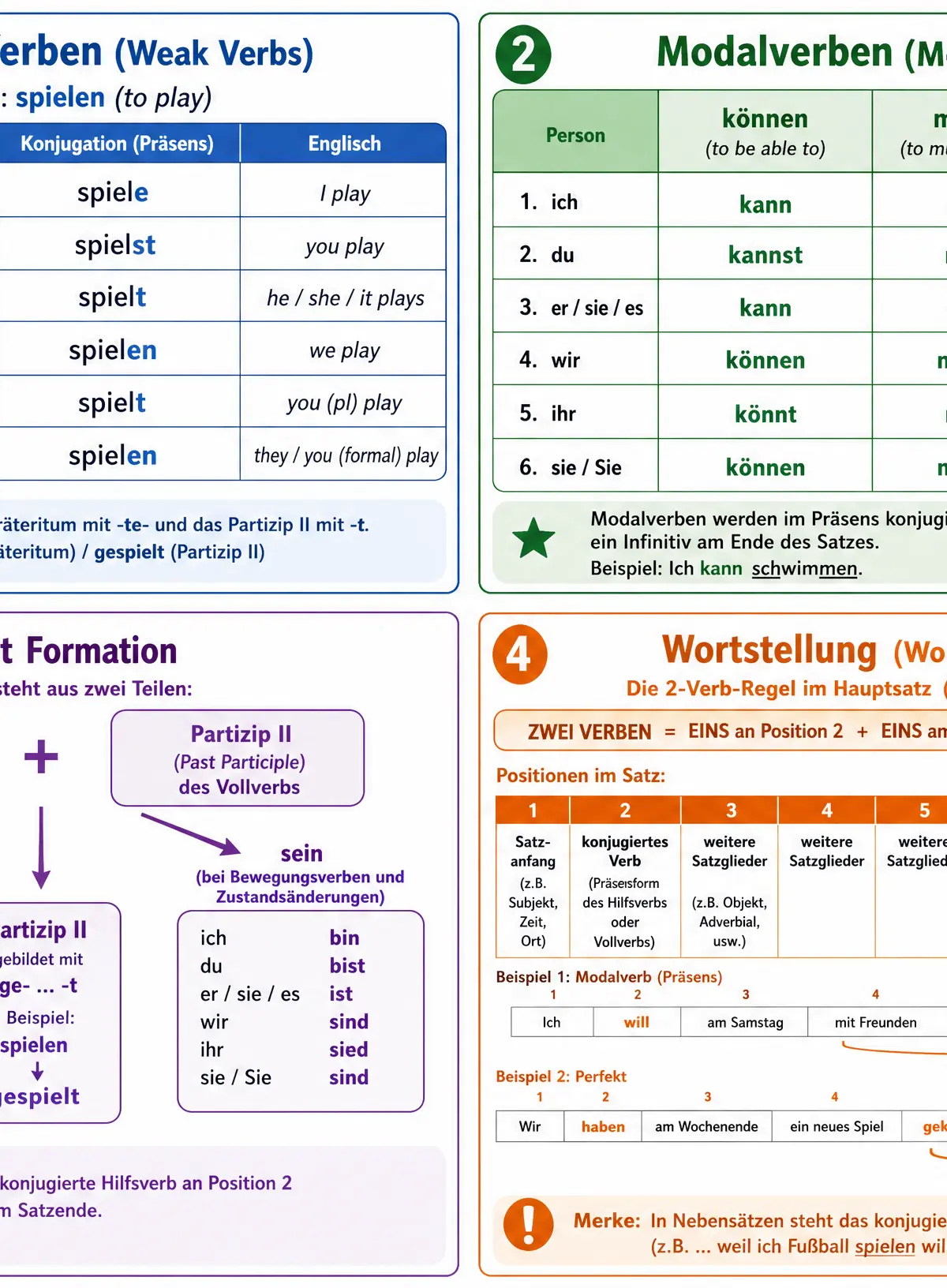
Key Structure 1: Das Präsens (The Present Tense)
When to use it: To describe actions happening now, routines, or facts. It can also be used with a future time phrase to indicate the future (e.g., Morgen spiele ich Tennis).
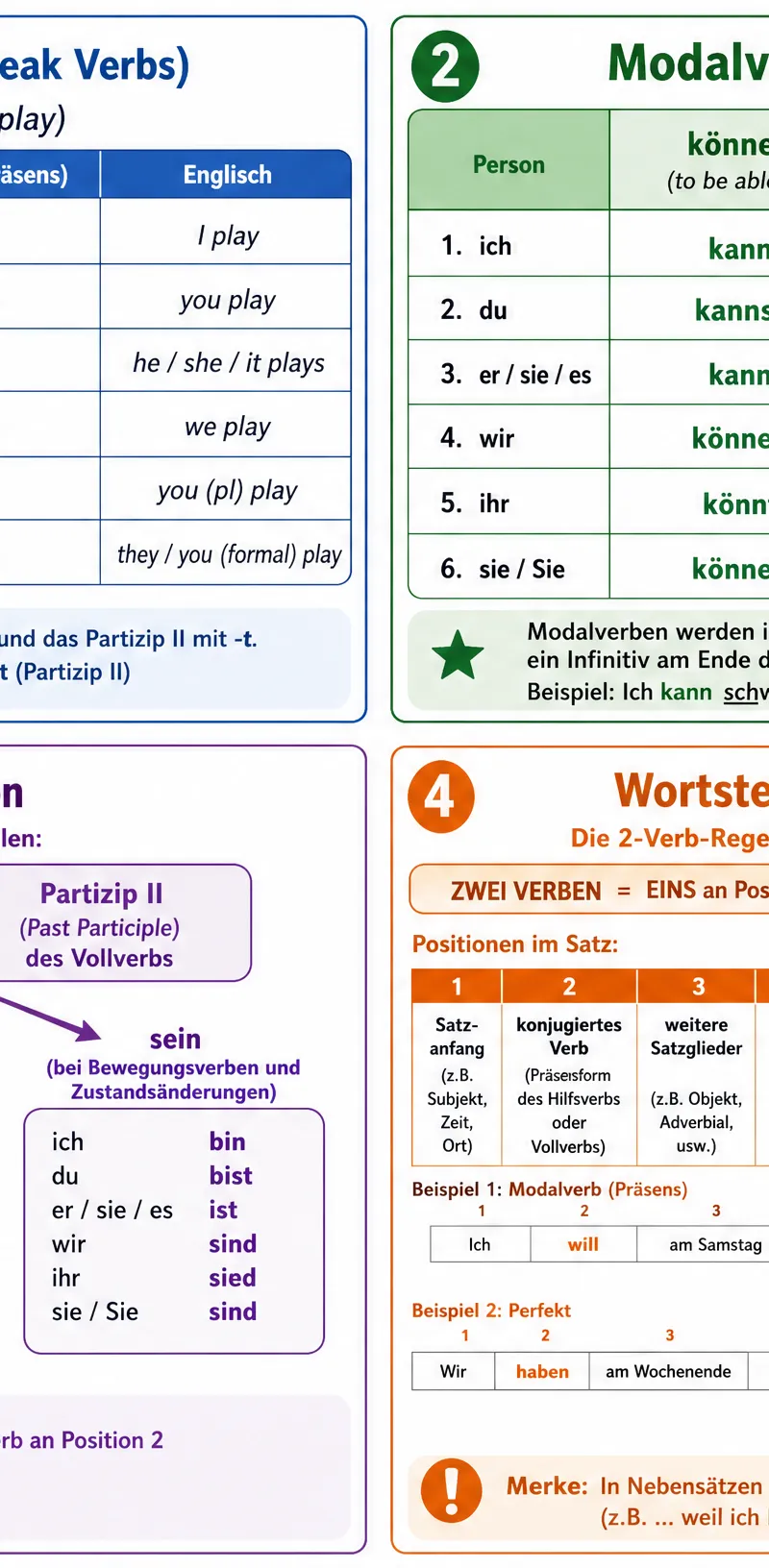
Conjugation Table (Weak Verb: spielen)
| Subject | Verb Form | English |
|---|---|---|
| ich | spiele | I play |
| du | spielst | you play (informal singular) |
| er/sie/es | spielt | he/she/it plays |
| wir | spielen | we play |
| ihr | spielt | you play (informal plural) |
| sie/Sie | spielen | they / you (formal) play |
Irregulars to learn: Strong verbs change their stem vowel in the du and er/sie/es forms.
- fahren (to travel): du fährst, er fährt
- lesen (to read): du liest, er liest
- sehen (to see): du siehst, er sieht
- sprechen (to speak): du sprichst, er spricht
Key Structure 2: Das Perfekt (The Perfect Tense)
When to use it: To describe completed actions in the past. This is the primary past tense used in spoken German and informal writing (like emails or letters).
Formation Rule
Auxiliary verb (haben or sein) at Position 2 + Past Participle (Partizip II) at the end of the clause.
The 'sein' rule: Use sein for verbs indicating a change of location (e.g., gehen, fahren, fliegen, kommen) or a change of state (e.g., sterben, aufwachen), plus sein itself and bleiben (to stay).
Conjugation Table (with haben: machen)
| Subject | Verb Form | English |
|---|---|---|
| ich | habe ... gemacht | I did / have done |
| du | hast ... gemacht | you did |
| er/sie/es | hat ... gemacht | he/she/it did |
| wir | haben ... gemacht | we did |
| ihr | habt ... gemacht | you did |
| sie/Sie | haben ... gemacht | they did |
Conjugation Table (with sein: gehen)
| Subject | Verb Form | English |
|---|---|---|
| ich | bin ... gegangen | I went / have gone |
| du | bist ... gegangen | you went |
| er/sie/es | ist ... gegangen | he/she/it went |
| wir | sind ... gegangen | we went |
| ihr | seid ... gegangen | you went |
| sie/Sie | sind ... gegangen | they went |
Key Structure 3: Modalverben (Modal Verbs)
When to use it: To express ability, permission, obligation, or desire. They are crucial for adding nuance to your sentences.
Formation Rule
Conjugated modal verb at Position 2 + Infinitive of the main verb at the end of the clause.
Conjugation Table (können - to be able to / can)
| Subject | Verb Form | English |
|---|---|---|
| ich | kann | I can |
| du | kannst | you can |
| er/sie/es | kann | he/she/it can |
| wir | können | we can |
| ihr | könnt | you can |
| sie/Sie | können | they can |
Other Modals: müssen (must/have to), dürfen (may/allowed to), wollen (want to), sollen (should/supposed to), mögen (to like).
🎧 Listening Skills
What to Expect
You will hear recordings of native speakers (conversations, announcements, interviews) and answer questions in English or German. Tenses are often tested indirectly by asking when an event happened.
Listening Strategies
- Listen for time markers: Words like gestern (yesterday), heute (today), morgen (tomorrow), letztes Jahr (last year) often signal the tense before you even hear the verb.
- Listen to the end of the sentence: In German, crucial information (like the past participle or infinitive) is pushed to the end of the clause. Don't stop listening halfway through!
- Note the auxiliary: Hearing ich habe vs ich bin vs ich werde immediately tells you if the action is past or future.
Common Listening Traps
- Negatives: Listen carefully for nicht, kein, or nie. They completely reverse the meaning of the verb.
- Modal verb nuances: Distinguishing between er muss (he has to) and er soll (he is supposed to) can be the difference between a correct and incorrect answer.
- False friends: E.g., bekommen means 'to receive', not 'to become' (which is werden).
🗣️ Speaking Skills
Role Play Scenarios
Scenario 1: Buying a train ticket
- Examiner: Guten Tag. Wie kann ich Ihnen helfen?
- Candidate: Ich möchte eine Fahrkarte nach Berlin kaufen, bitte. (I would like to buy a ticket to Berlin, please. - Using modal 'möchten')
- Examiner: Einfach oder hin und zurück?
- Candidate: Hin und zurück. Ich werde am Freitag zurückfahren. (Return. I will travel back on Friday. - Using future tense)
Scenario 2: Discussing a recent holiday
- Examiner: Wo hast du deinen letzten Urlaub verbracht?
- Candidate: Letztes Jahr bin ich mit meiner Familie nach Spanien gefahren. (Last year I travelled to Spain with my family. - Using perfect tense with sein)
- Examiner: Wie war das Wetter?
- Candidate: Das Wetter war fantastisch. Es hat jeden Tag die Sonne geschienen. (The weather was fantastic. The sun shone every day. - Using imperfect 'war' and perfect 'hat geschienen')
Photo Card Practice
Model Photo Card Response (Topic: School):
- Qu 1 (Description): Auf dem Foto sehe ich drei Schüler. Sie sitzen in einem Klassenzimmer und schreiben in ihre Hefte. (On the photo I see three students. They are sitting in a classroom and writing in their exercise books. - Present tense)
- Qu 2 (Opinion): Ich denke, dass sie fleißig sind, weil sie konzentriert aussehen. (I think that they are hardworking because they look focused. - Opinion + subordinate clause verb order)
- Qu 3 (Related topic): Mein Lieblingsfach ist Geschichte, weil der Lehrer sehr lustig ist. (My favourite subject is history because the teacher is very funny.)
- Qu 4 (Past/Future): Gestern habe ich eine Matheprüfung gemacht. Es war sehr schwierig! (Yesterday I did a maths exam. It was very difficult! - Perfect tense + imperfect 'war')
- Qu 5 (Unpredictable): Nächstes Jahr werde ich das Abitur machen, um auf die Universität zu gehen. (Next year I will do my A-Levels in order to go to university. - Future tense + infinitive construction)
General Conversation Questions
| Question (German) | Model Answer | English Translation |
|---|---|---|
| Was machst du gern in deiner Freizeit? | In meiner Freizeit spiele ich gern Fußball, weil es gesund ist. | What do you like doing in your free time? / In my free time I like playing football because it is healthy. |
| Was hast du letztes Wochenende gemacht? | Letztes Wochenende bin ich mit Freunden ins Kino gegangen. Der Film war toll. | What did you do last weekend? / Last weekend I went to the cinema with friends. The film was great. |
| Was wirst du nächstes Jahr machen? | Nächstes Jahr werde ich in die Oberstufe gehen, weil ich studieren möchte. | What will you do next year? / Next year I will go to sixth form because I want to study at university. |
| Wie findest du deine Stadt? | Ich finde meine Stadt ziemlich langweilig, obwohl es ein gutes Sportzentrum gibt. | How do you find your town? / I find my town quite boring, although there is a good sports centre. |
| Wo möchtest du in der Zukunft wohnen? | In der Zukunft möchte ich in Berlin wohnen, um mein Deutsch zu verbessern. | Where would you like to live in the future? / In the future I would like to live in Berlin in order to improve my German. |
✍️ Writing Skills
Translation Practice
English → German:
| English | German | Key Grammar |
|---|---|---|
| I play tennis every weekend. | Ich spiele jedes Wochenende Tennis. | Present tense regular verb |
| My brother reads a lot of books. | Mein Bruder liest viele Bücher. | Present tense strong verb (e -> ie) |
| Yesterday we went to the cinema. | Gestern sind wir ins Kino gegangen. | Perfect tense with 'sein' (movement) |
| I think that the film was good. | Ich denke, dass der Film gut war. | Subordinate clause (verb to end) + imperfect 'war' |
| Next year I will travel to Germany. | Nächstes Jahr werde ich nach Deutschland fahren. | Future tense (werden + infinitive at end) |
Extended Writing
**Model 90-word response (Foundation - Topic: Free Time):**In meiner Freizeit spiele ich gern Fußball mit meinen Freunden, weil es sehr gesund ist. Ich spiele jeden Samstag im Park. Letztes Wochenende bin ich ins Kino gegangen. Der Film war sehr lustig und ich habe Popcorn gegessen. Nächstes Wochenende werde ich Musik hören und ich werde meine Hausaufgaben machen. Mein Lieblingshobby ist Lesen, obwohl es manchmal ein bisschen langweilig ist. Ich finde Sport besser als Fernsehen.
**Model 150-word response (Higher - Topic: Holidays):**Normalerweise fahre ich mit meiner Familie nach Spanien, weil das Wetter dort immer sonnig und heiß ist. Wir übernachten in einem großen Hotel an der Küste, was ich sehr entspannend finde.
Letztes Jahr sind wir jedoch nach Österreich gefahren, um die Berge zu sehen. Die Reise war ziemlich anstrengend, da wir mit dem Auto gefahren sind. Einerseits war die Landschaft wunderschön, aber andererseits hat es oft geregnet. Eines Tages haben wir eine lange Wanderung gemacht, was mir sehr gut gefallen hat, obwohl ich danach total müde war.
In der Zukunft möchte ich mit meinen Freunden nach Berlin fahren. Wir werden die Sehenswürdigkeiten besichtigen und wir wollen die Kultur erleben. Ich freue mich schon darauf, weil ich mich sehr für Geschichte interessiere. Wenn ich mehr Geld hätte, würde ich auch nach Amerika fliegen!
Writing Checklist
- ✅ Have I used at least three different tenses (Past, Present, Future)?
- ✅ Is the conjugated verb in Position 2 in main clauses?
- ✅ Is the verb at the END in subordinate clauses (after weil, dass, obwohl, wenn)?
- ✅ Have I used 'sein' for verbs of movement in the perfect tense?
- ✅ Have I included justified opinions (e.g., weil es ... ist)?
📚 Reading Skills
Key Strategies
- Skim for gist: Read the text quickly first to understand the overall topic and timeframes before looking at the questions.
- Identify the subjects: Pay close attention to pronouns (er vs sie vs Sie) and verb endings to know exactly who is doing the action.
- Tense hunting: Scan the text for auxiliary verbs (hat/ist/wird) to quickly establish if the text refers to the past, present, or future.
False Friends & Tricky Words
| Word | Looks Like | Actually Means |
|---|---|---|
| bekommen | become | to receive / to get |
| also | also | therefore / so |
| das Gift | gift | poison |
| aktuell | actual | current / up-to-date |
| der Chef | chef | boss / manager |
🌍 Cultural Knowledge
Understanding cultural context can elevate your writing and speaking responses. In German-speaking countries, punctuality (Pünktlichkeit) is highly valued, which reflects in how precise language often is regarding time. When discussing holidays, it's useful to know that Germans are among the world's most frequent travelers (Reiseweltmeister), making travel a highly authentic topic. When talking about school, mentioning the Abitur (A-Levels) or the grading system (where 1 is the best and 6 is the worst) adds impressive cultural authenticity to your answers.
🎧 Podcast Lesson
Listen to our comprehensive 12-minute audio guide covering all these concepts with pronunciation practice and a quick-fire quiz:
Podcast Script available in the download package.
Visual Resources
2 diagrams and illustrations
Interactive Diagrams
1 interactive diagram to visualise key concepts
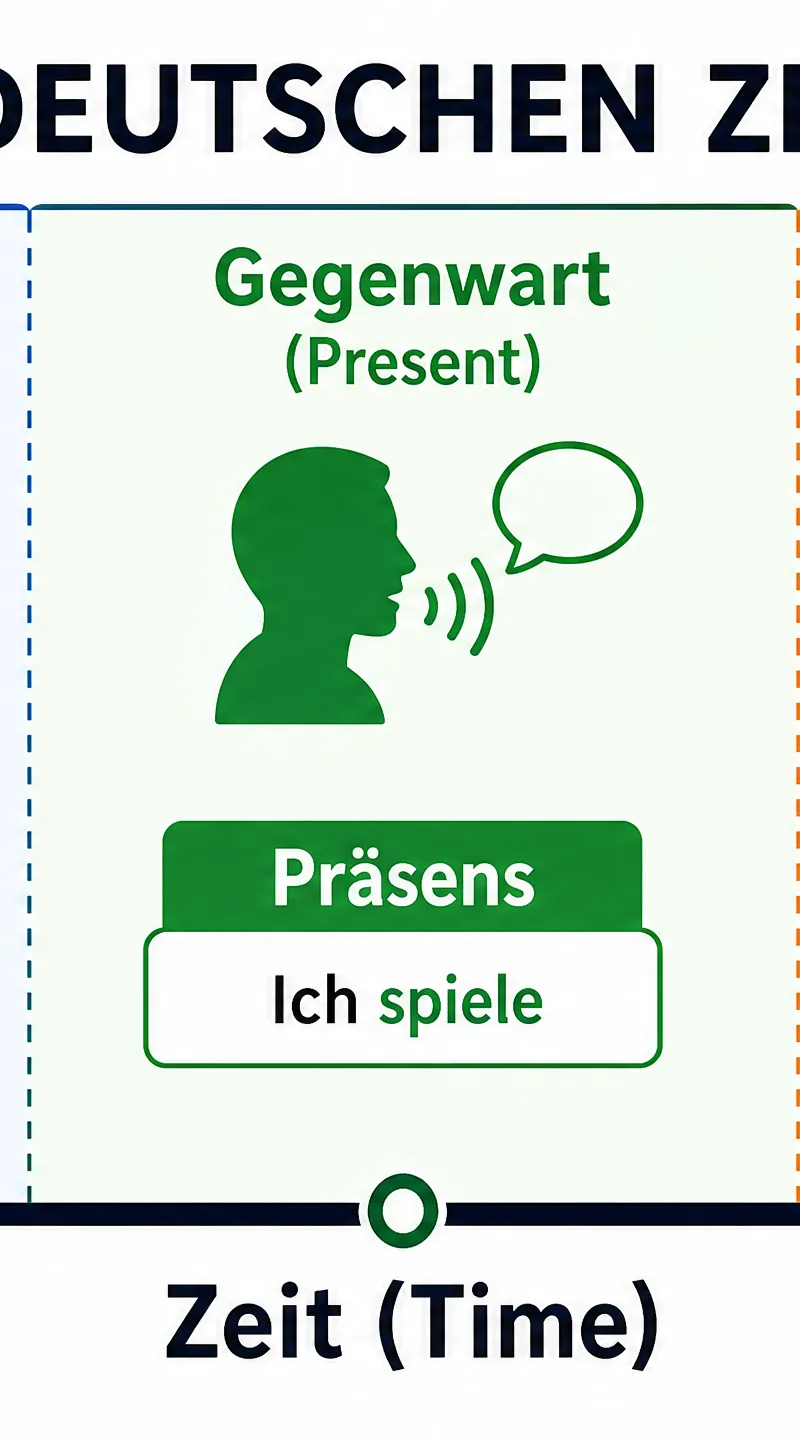
Conceptual Flow Outline
German Main Clause Verb Position Decision Tree
Worked Examples
4 worked examples — open one to explore the question and available guidance.
Practice Questions
Try the question, then reveal an answer plan or example response
Writing: Translate the following sentence into German: 'I must do my homework because it is important.'
Hint: Remember the 2-verb rule for the first clause, and the subordinate clause rule for the second clause.
Writing: Translate into German: 'Last year we travelled to Germany.'
Hint: Think about whether 'travelled' involves movement from A to B. Which auxiliary verb do you need?
Speaking: Answer the following conversation question: 'Was wirst du am Wochenende machen?'
Hint: The question asks about the future. Use 'werden' + infinitive.
Reading: Identify the tense of this sentence: 'Mein Bruder hat ein neues Handy gekauft.'
Hint: Look at the auxiliary verb at position 2 and the word at the end.
Writing: Translate into German: 'If I had more money, I would buy a car.'
Hint: This requires the conditional tense and complex word order (verb comma verb).
Listening: You hear: 'Ich wollte Pizza essen, aber meine Mutter hat Fisch gekocht.' What did the person eat?
Hint: Distinguish between what they *wanted* to do and what actually *happened*.
Exam technique
How to turn what you know into marks
How to approach the question
Writing: Plan your tenses first (P, Pa, F). Speaking: Use your 15 minutes preparation time to annotate cards with key verbs and tenses. Reading/Listening: Hunt for time markers and auxiliary verbs to determine the tense before translating the vocabulary.
How to structure your answer
For extended writing: Paragraph 1 (Present tense + description), Paragraph 2 (Past tense + recount an event), Paragraph 3 (Future tense + plans/intentions). Include a justified opinion in every paragraph.
Timing
Writing: Allow roughly 1 minute per mark. For a 16-mark question, spend 3-4 minutes planning, 10 minutes writing, and 2-3 minutes proofreading.
Common pitfalls
- Using 'haben' instead of 'sein' for movement verbs in the perfect tense.
- Leaving the conjugated verb in position 2 after 'weil' or 'dass'.
- Forgetting to put the infinitive at the end when using a modal verb.
- Translating 'I am playing' literally as 'Ich bin spielen' (it should just be 'Ich spiele').
- Using the present tense exclusively in higher tier writing tasks.
What the command words want
- Describe the photo
- State what is visible using the present tense. Use positional language (Im Hintergrund, Auf der linken Seite). Give an opinion on what is happening.
- Translate into German
- Focus on grammatical accuracy over literal word-for-word translation. Ensure verbs are in the correct position.
- Write approximately 90 words
- Address all 4 bullet points clearly. Use the present tense and at least one other tense. Keep sentences relatively simple but accurate.
- Write approximately 150 words
- Address all bullet points. You MUST use three tenses. Include complex structures like subordinate clauses, infinitive constructions (um... zu), and a variety of vocabulary.
Watch or listen (optional)
Test your understanding of Grammar: Verbs and tenses
Active recall beats re-reading. Take an instant quiz now to test what you’ve learned and lock it into long-term memory.
7 days Premium · Then the free plan continues · No card, no charge