Pearson Edexcel · GCSE · German
Course version: Pearson-GCSE-German · Version from Mar 2026
Thematic Context: Lifestyle and wellbeing
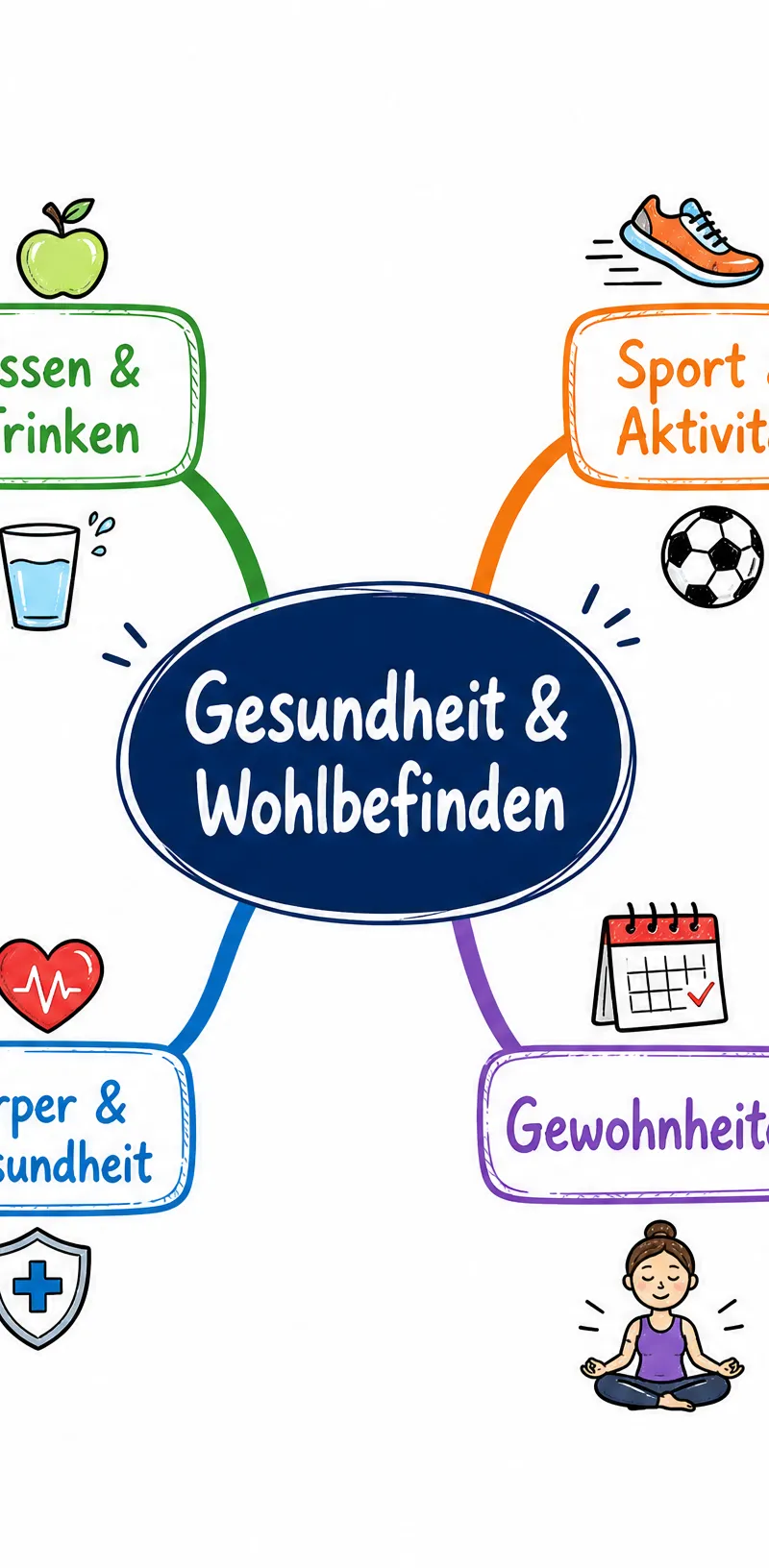
This topic covers essential vocabulary for food, sport, and daily habits, requiring the use of reflexive verbs and multiple tenses. It is a highly synoptic theme that appears across Listening, Speaking, Reading, and Writing exams, offering excellent opportunities to demonstrate higher-level grammar and justified opinions.
- 12 min read
- 4 worked examples
- 6 practice questions
- 8 key terms
Check what you remember
Read the wording for your board, then hide it and explain Reflexive Verb in your own words. Rough notes are fine. This is a self-check, with no mark or grade.
Reference: Pearson Edexcel
A verb where the action reflects back on the subject (e.g., I wash myself). In German, requires a reflexive pronoun (mich, dich, sich, uns, euch, sich).
Study Notes
Overview
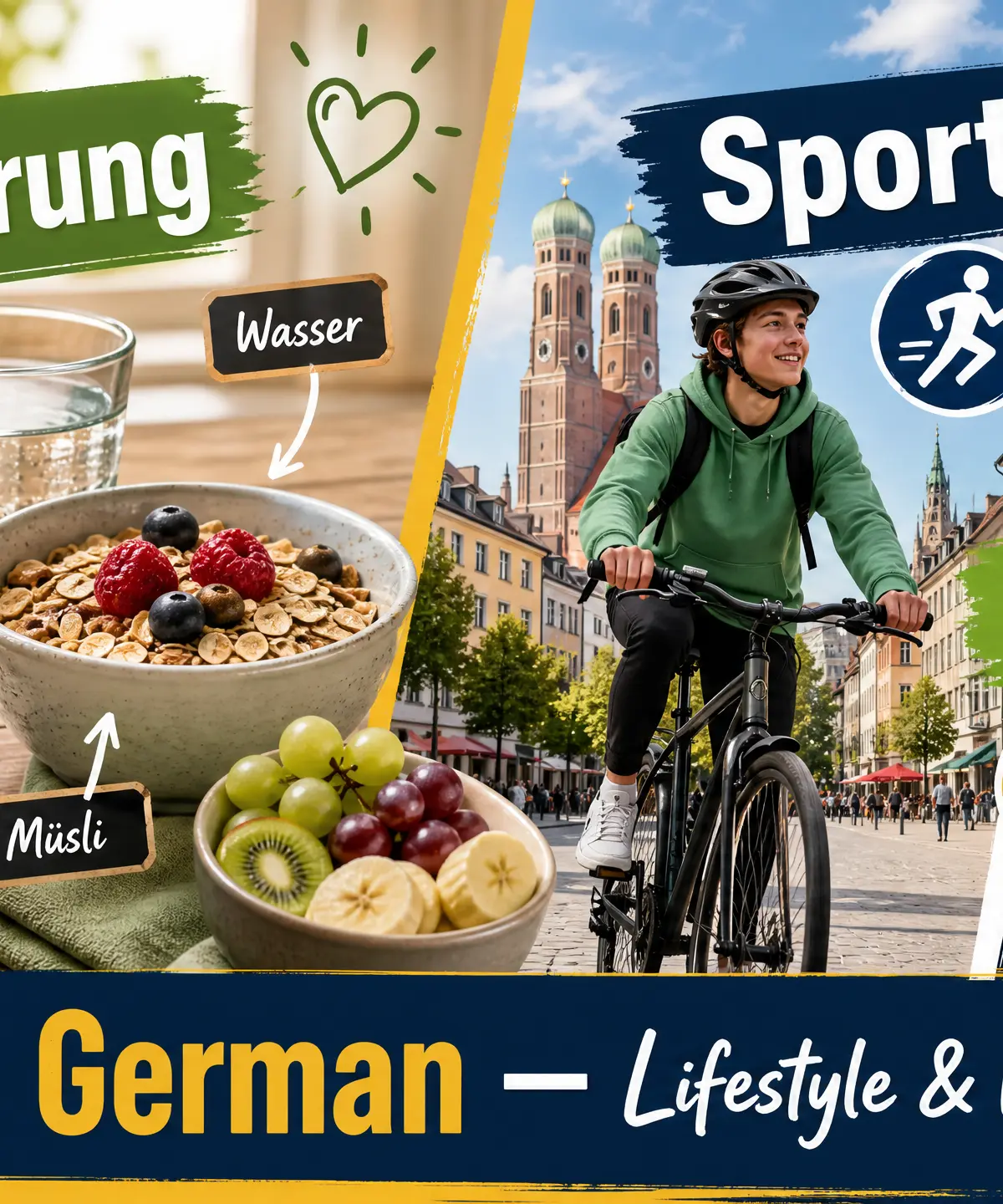
The Lifestyle and Wellbeing thematic context focuses on personal health, physical and mental wellbeing, food and drink, and sports. This topic is fundamental as it appears in every single paper (Listening, Speaking, Reading, and Writing) and provides excellent opportunities to showcase a range of tenses, reflexive verbs, and justified opinions. Examiners particularly reward candidates who can confidently narrate past habits and future health plans.
📖 Essential Vocabulary
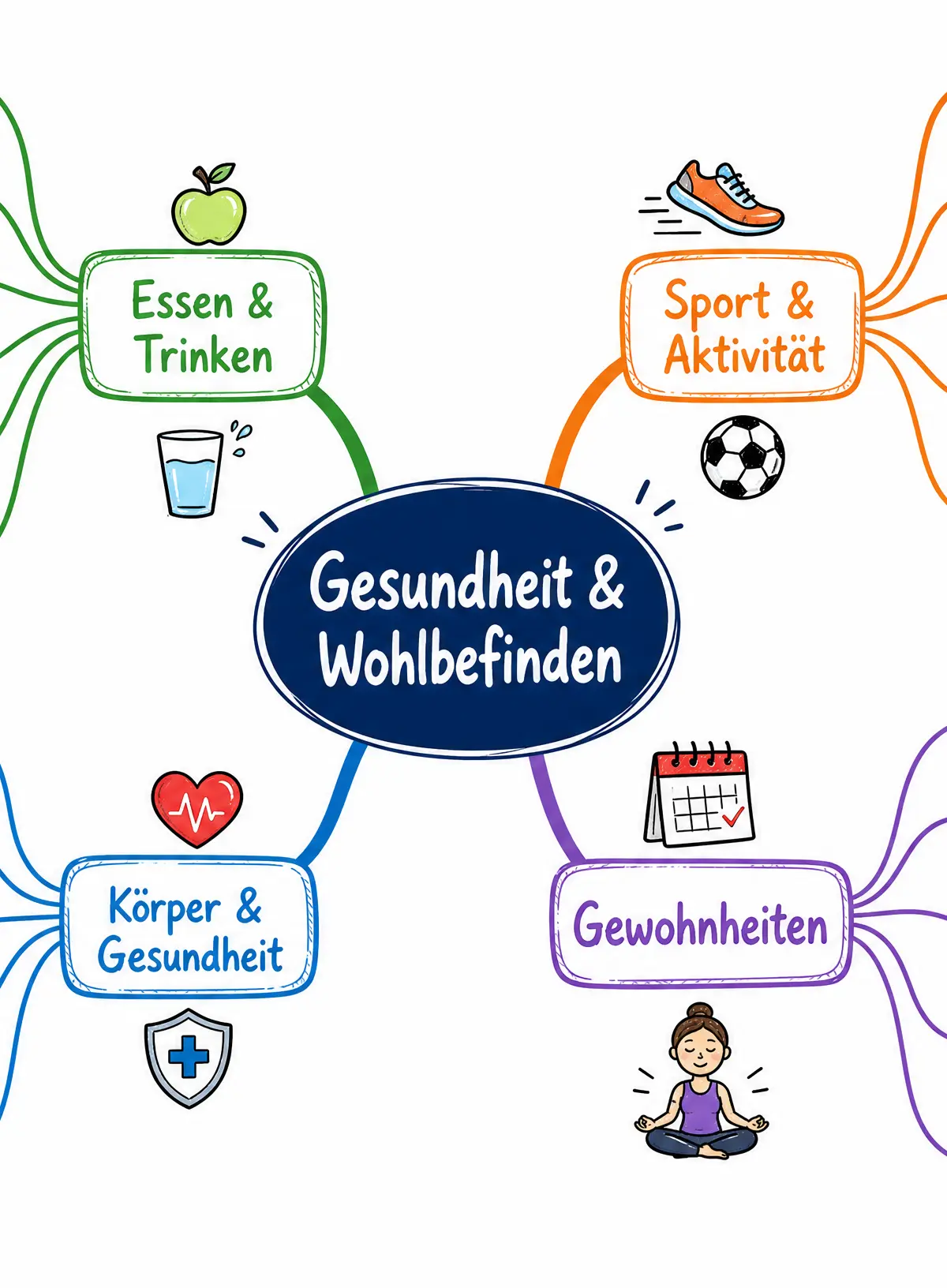
Tier 1 — Foundation Core
| German | English | Gender | Example Sentence |
|---|---|---|---|
| das Gemüse | vegetables | n | Ich esse jeden Tag Gemüse. |
| das Obst | fruit | n | Obst ist sehr gesund. |
| das Fleisch | meat | n | Mein Bruder isst kein Fleisch. |
| das Wasser | water | n | Ich trinke zwei Liter Wasser. |
| die Mahlzeit | meal | f | Das Frühstück ist meine Lieblingsmahlzeit. |
| kochen | to cook | - | Meine Mutter kocht oft gesund. |
| schwimmen | to swim | - | Im Sommer gehe ich schwimmen. |
| laufen | to run | - | Ich laufe gern im Park. |
| Rad fahren | to cycle | - | Er fährt mit dem Rad zur Schule. |
| gesund | healthy | - | Eine gesunde Ernährung ist wichtig. |
| krank | ill / sick | - | Heute bin ich leider krank. |
| der Arzt / die Ärztin | doctor (m/f) | m/f | Ich muss zum Arzt gehen. |
| schlafen | to sleep | - | Ich schlafe acht Stunden pro Nacht. |
| oft | often | - | Wir spielen oft Fußball. |
| nie | never | - | Ich rauche nie. |
Tier 2 — Higher Tier
| German | English | Gender | Example Sentence |
|---|---|---|---|
| die Ernährung | diet / nutrition | f | Eine ausgewogene Ernährung ist unentbehrlich. |
| das Wohlbefinden | wellbeing | n | Yoga ist gut für mein Wohlbefinden. |
| sich entspannen | to relax | - | Am Wochenende entspanne ich mich. |
| sich fit halten | to keep fit | - | Um mich fit zu halten, jogge ich. |
| vermeiden | to avoid | - | Man sollte zu viel Zucker vermeiden. |
| schädlich | harmful | - | Rauchen ist extrem schädlich. |
| der Bewegungsmangel | lack of exercise | m | Bewegungsmangel führt zu Problemen. |
| abnehmen | to lose weight | - | Mein Vater möchte abnehmen. |
| zunehmen | to put on weight | - | Wenn man zu viel isst, nimmt man zu. |
| süchtig nach | addicted to | - | Viele Jugendliche sind süchtig nach Handys. |
High-Frequency Words & Phrases
| Phrase | English | Usage Context |
|---|---|---|
| Meiner Meinung nach | In my opinion | Speaking/Writing: introducing an opinion |
| Ich bin der Ansicht, dass | I am of the view that | Speaking/Writing: higher-level opinion (forces verb to end) |
| Einerseits ... andererseits | On the one hand ... on the other hand | Speaking/Writing: balancing an argument |
| Um gesund zu bleiben | In order to stay healthy | Speaking/Writing: expressing purpose (um... zu + infinitive) |
| Man sollte | One should | Giving advice or recommendations |
| Es ist wichtig | It is important | Expressing necessity |
| Ich habe vor | I intend to | Future plans (takes 'zu' + infinitive) |
| Im Großen und Ganzen | By and large / On the whole | Summarising an opinion |
| Es hilft mir | It helps me | Justifying why you do an activity |
| Ich fühle mich | I feel | Describing physical or mental state |
📝 Grammar Focus
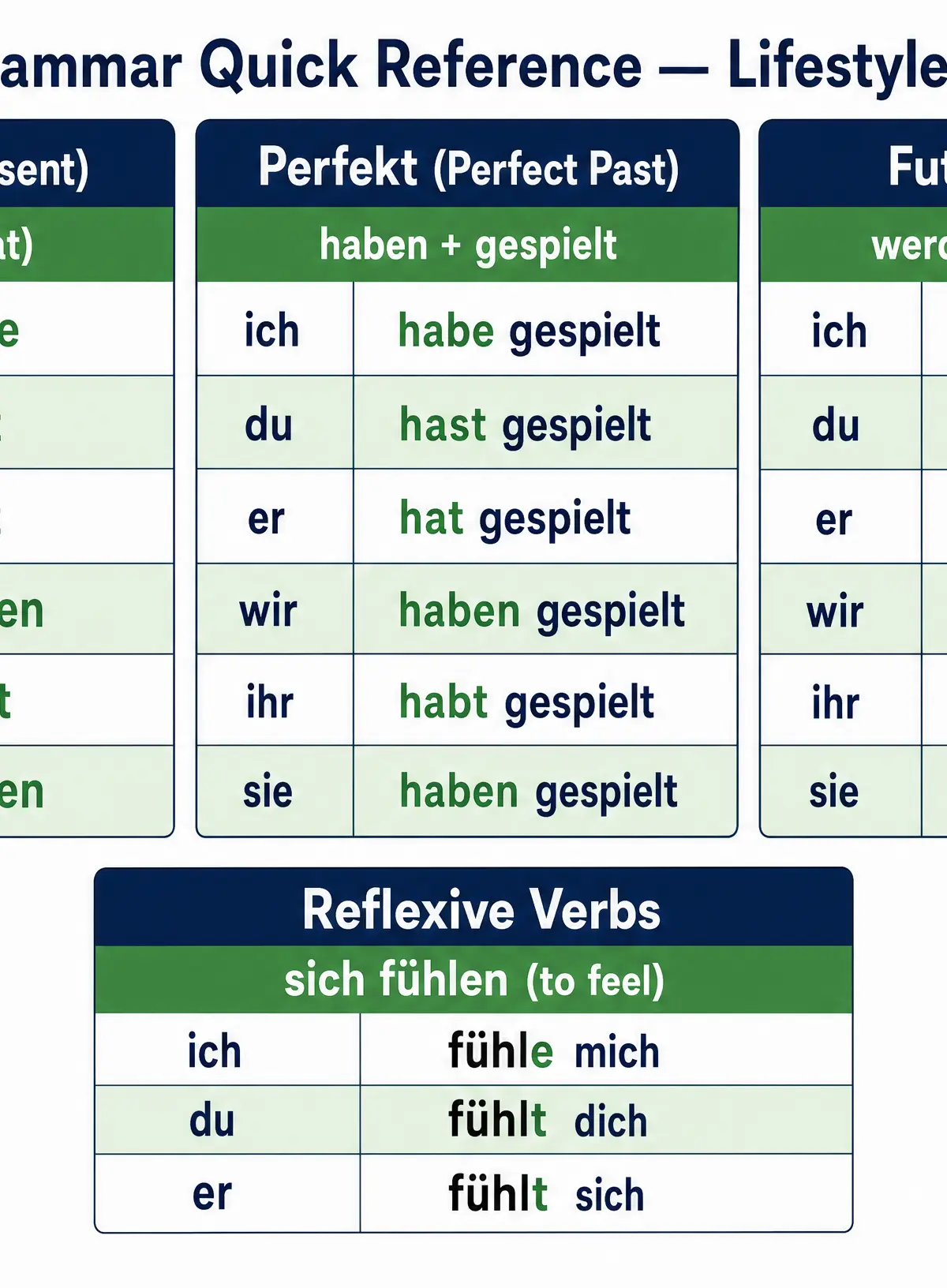
Key Structure 1: Das Perfekt (The Perfect Tense)
When to use it: To describe actions completed in the past, such as what you ate yesterday or sports you played last weekend. It is formed with an auxiliary verb (haben or sein) and a past participle.
Conjugation Table (haben + spielen)
| Subject | Verb Form | English |
|---|---|---|
| ich | habe gespielt | I played / have played |
| du | hast gespielt | you played (informal singular) |
| er/sie/es | hat gespielt | he/she/it played |
| wir | haben gespielt | we played |
| ihr | habt gespielt | you played (informal plural) |
| sie/Sie | haben gespielt | they played / you played (formal) |
Irregulars to learn: essen -> gegessen, trinken -> getrunken, laufen -> ist gelaufen, schwimmen -> ist geschwommen (Note: verbs of motion take 'sein' instead of 'haben').
Key Structure 2: Reflexive Verbs
When to use it: When the subject and object of the verb are the same person. Crucial for this topic when discussing keeping fit (sich fit halten), relaxing (sich entspannen), or feeling well/unwell (sich fühlen).
Conjugation Table (sich fühlen - to feel)
| Subject | Verb Form | English |
|---|---|---|
| ich | fühle mich | I feel |
| du | fühlst dich | you feel |
| er/sie/es | fühlt sich | he/she/it feels |
| wir | fühlen uns | we feel |
| ihr | fühlt euch | you feel |
| sie/Sie | fühlen sich | they feel / you feel |
Irregulars to learn: sich fit halten (ich halte mich fit, du hältst dich fit, er hält sich fit).
Key Structure 3: Modal Verbs (sollen - should)
When to use it: To express obligation, permission, or ability. 'Sollen' is especially useful in this topic for giving health advice (e.g., 'Man sollte mehr Wasser trinken' - One should drink more water). The modal verb takes the second position, and the infinitive goes to the end of the clause.
Conjugation Table (sollen)
| Subject | Verb Form | English |
|---|---|---|
| ich | soll | I should |
| du | sollst | you should |
| er/sie/es | soll | he/she/it should |
| wir | sollen | we should |
| ihr | sollt | you should |
| sie/Sie | sollen | they should / you should |
🎧 Listening Skills
What to Expect
You will hear dialogues, announcements, or interviews about people's eating habits, sporting activities, or health problems. Tasks may include multiple-choice, matching, or answering short questions in English or German.
Listening Strategies
- Listen for negatives: Words like 'nicht', 'kein', or 'nie' can completely reverse the meaning of a sentence.
- Listen for qualifiers: Words like 'leider' (unfortunately), 'ziemlich' (quite), or 'zu' (too, as in 'too much') often indicate an opinion or problem.
- Note time phrases: Pay attention to 'gestern' (yesterday), 'heute' (today), or 'morgen' (tomorrow) to understand the tense being used.
Common Listening Traps
- False friends: 'Gymnasium' means grammar school, not gym (that's 'Fitnessstudio'). 'Also' means so/therefore, not also (that's 'auch').
- Contradictions: A speaker might say they used to eat fast food, but now they eat healthily. Wait for words like 'aber' (but) or 'jetzt' (now) before deciding on your answer.
🗣️ Speaking Skills
Role Play Scenarios
Scenario 1: At the doctor's clinic
- Doctor: Was fehlt Ihnen? (What's wrong with you?)
- You: Ich habe Kopfschmerzen und mir ist übel. (I have a headache and I feel sick.)
- Doctor: Seit wann haben Sie diese Schmerzen? (Since when have you had these pains?)
- You: Seit drei Tagen. (For three days.)
Scenario 2: Discussing sports with a German exchange partner
- Partner: Treibst du gern Sport? (Do you like doing sport?)
- You: Ja, ich spiele gern Tennis, weil es Spaß macht. (Yes, I like playing tennis because it's fun.)
- Partner: Was hast du letztes Wochenende gemacht?
- You: Letztes Wochenende bin ich geschwommen. (Last weekend I went swimming.)
Photo Card Practice
Model Photo Card Response (A photo of people eating a healthy meal):
- Qu 1 (Description): Auf dem Foto sehe ich eine Familie, die zusammen isst. Es gibt viel gesundes Essen, zum Beispiel einen großen Salat und etwas Obst. (In the photo I see a family eating together. There is a lot of healthy food, for example a large salad and some fruit.)
- Qu 2 (Opinion): Ich finde es wichtig, mit der Familie zu essen, weil man sich dabei gut unterhalten kann. (I find it important to eat with the family because you can have a good chat.)
- Qu 3 (Related topic): Normalerweise esse ich sehr gesund, aber am Wochenende esse ich manchmal Fastfood. (Normally I eat very healthily, but at the weekend I sometimes eat fast food.)
- Qu 4 (Past/Future): Gestern habe ich einen Apfel gegessen und Wasser getrunken. Morgen werde ich im Park joggen. (Yesterday I ate an apple and drank water. Tomorrow I will jog in the park.)
- Qu 5 (Unpredictable): In der Zukunft möchte ich öfter kochen, um mich besser zu ernähren. (In the future I would like to cook more often in order to eat better.)
General Conversation Questions
| Question (German) | Model Answer | English Translation |
|---|---|---|
| Was isst du normalerweise zum Frühstück? | Normalerweise esse ich Müsli mit Milch, weil es gesund ist und mir Energie gibt. | Normally I eat muesli with milk because it is healthy and gives me energy. |
| Was hast du gestern Abend gegessen? | Gestern Abend habe ich Hähnchen mit Gemüse gegessen. Es war sehr lecker. | Yesterday evening I ate chicken with vegetables. It was very tasty. |
| Was machst du, um dich fit zu halten? | Um mich fit zu halten, spiele ich zweimal pro Woche Fußball und ich fahre oft Rad. | In order to keep fit, I play football twice a week and I often cycle. |
| Ist Stress ein Problem für Jugendliche? | Ja, meiner Meinung nach haben viele Jugendliche Stress wegen der Schule und der Prüfungen. | Yes, in my opinion many young people have stress because of school and exams. |
| Was wirst du in der Zukunft machen, um gesünder zu leben? | In der Zukunft werde ich versuchen, mehr zu schlafen und weniger Schokolade zu essen. | In the future I will try to sleep more and eat less chocolate. |
✍️ Writing Skills
Translation Practice
English → German:
| English | German | Key Grammar |
|---|---|---|
| I eat fruit every day. | Ich esse jeden Tag Obst. / Jeden Tag esse ich Obst. | Present tense, inversion if starting with time. |
| Last week I played tennis. | Letzte Woche habe ich Tennis gespielt. | Perfect tense (haben), past participle at the end. |
| He went swimming yesterday. | Er ist gestern geschwommen. | Perfect tense with 'sein' for motion. |
| In my opinion, smoking is harmful. | Meiner Meinung nach ist Rauchen schädlich. | Inversion after 'Meiner Meinung nach'. |
| Tomorrow I will eat healthier food. | Morgen werde ich gesünderes Essen essen. | Future tense (werden + infinitive at end). |
Extended Writing
**Model 90-word response (Foundation):**Ich lebe ziemlich gesund. Zum Frühstück esse ich immer Müsli und ich trinke Wasser. Das ist gut für die Gesundheit. In meiner Freizeit spiele ich gern Fußball mit meinen Freunden, weil es Spaß macht. Letztes Wochenende habe ich Tennis gespielt und es war toll. In der Zukunft werde ich mehr Obst essen, um fit zu bleiben. Ich finde Sport sehr wichtig.
**Model 150-word response (Higher):**Meiner Meinung nach ist ein gesunder Lebensstil extrem wichtig für das körperliche und geistige Wohlbefinden. Im Großen und Ganzen ernähre ich mich gut. Ich versuche, jeden Tag fünf Portionen Obst und Gemüse zu essen, und ich trinke viel Wasser. Einerseits esse ich gern gesund, aber andererseits liebe ich Schokolade, was ab und zu in Ordnung ist.
Um mich fit zu halten, treibe ich dreimal pro Woche Sport. Letztes Wochenende bin ich mit meinem Bruder im Park gelaufen, obwohl das Wetter furchtbar war. Danach haben wir uns zu Hause entspannt.
Leider haben viele Jugendliche heutzutage zu viel Stress wegen der Schule. Um Stress zu vermeiden, sollte man regelmäßig Pausen machen und genug schlafen. In der Zukunft habe ich vor, öfter Yoga zu machen, weil ich glaube, dass es sehr entspannend ist. Außerdem werde ich versuchen, weniger Zeit vor dem Bildschirm zu verbringen.
Writing Checklist
- ✅ Have I used at least three tenses (Present, Perfect, Future)?
- ✅ Have I included justified opinions (weil, da, denn)?
- ✅ Are my verb positions correct (verb second in main clauses, verb at the end after 'weil/dass')?
- ✅ Have I checked adjective agreements and genders?
- ✅ Have I used higher-level vocabulary (e.g., Reflexive verbs, 'um... zu')?
📚 Reading Skills
Key Strategies
- Skim for gist: Read the text quickly first to get the general idea before looking at the questions.
- Use context: Don't panic if you don't know a word. Read the whole sentence and guess the meaning from context.
- Look for synonyms: The question will often use a synonym rather than the exact word in the text (e.g., text says 'nicht teuer', question asks about 'billig').
False Friends & Tricky Words
| Word | Looks Like | Actually Means |
|---|---|---|
| das Rezept | receipt | recipe |
| die Rente | rent | pension |
| aktuell | actually | current / up-to-date |
| das Gift | gift | poison (important in health contexts!) |
🌍 Cultural Knowledge
Understanding cultural context can enrich your writing and speaking responses. In Germany, there is a strong culture of wellness and preventative health. Many Germans value outdoor activities, and 'Wandern' (hiking) is a hugely popular national pastime. Germany is also famous for its bread culture ('Brotkultur') with hundreds of varieties of 'Vollkornbrot' (wholemeal bread) which is considered much healthier than white bread. Additionally, the concept of 'Kur' (a preventative health retreat) is well-established, where doctors can prescribe a stay at a spa town (often places starting with 'Bad', like Baden-Baden) for rest and recovery.
Visual Resources
2 diagrams and illustrations
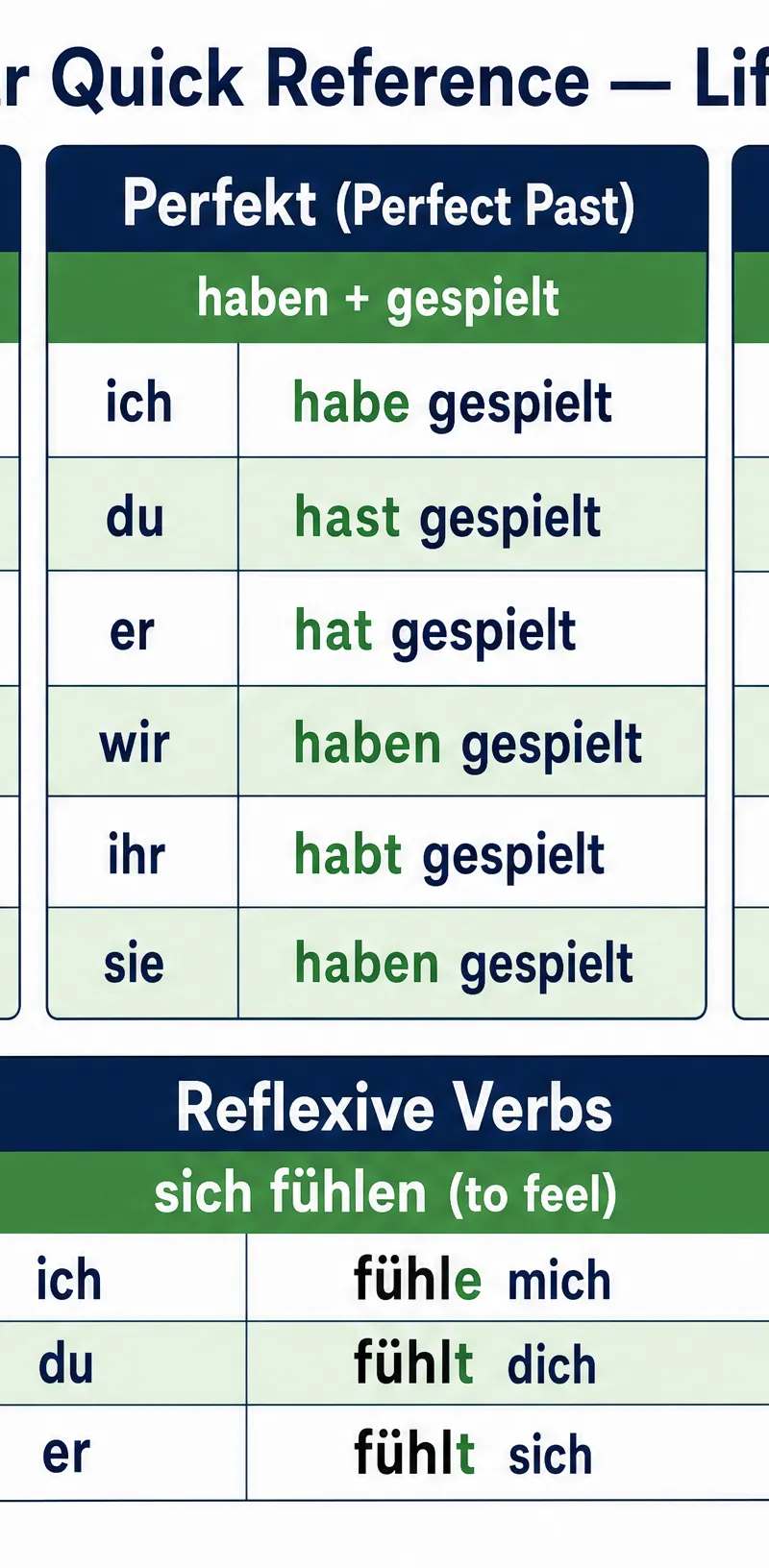
Interactive Diagrams
1 interactive diagram to visualise key concepts
Conceptual Flow Outline
MFL exam approach by skill
Worked Examples
4 worked examples — open one to explore the question and available guidance.
Practice Questions
Try the question, then reveal an answer plan or example response
Translate into German: 'I play football because it is healthy.'
Hint: Remember the word order rule after 'weil'.
Writing: Write 90 words about your health habits. Include: what you eat, sports you play, a recent illness, and future plans.
Hint: Cover all 4 bullet points and use at least two tenses.
Speaking: Answer the question 'Was machst du, um dich zu entspannen?'
Hint: Use a reflexive verb and justify your answer.
Translate into English: 'Man sollte jeden Tag frische Luft schnappen.'
Hint: Think about what 'sollte' means and the idiom 'Luft schnappen'.
Writing (Higher): Translate into German: 'Although I ate vegetables yesterday, I will eat pizza tomorrow.'
Hint: Watch the word order. 'Obwohl' sends the verb to the end, which forces an inversion in the next clause.
Reading: Read the sentence and answer in English: 'Der Arzt hat mir geraten, mich mehr zu bewegen.' What did the doctor advise?
Hint: Look at the reflexive verb at the end.
Exam technique
How to turn what you know into marks
How to approach the question
Skill-by-skill strategy: Listening — read questions first, note keywords. Speaking — prepare opinions in advance, have fillers ready (z.B. 'also', 'na ja'). Reading — skim first, then detail. Writing — plan tenses and complex structures before writing, check accuracy after.
How to structure your answer
Writing: Introduction → Main points with opinions → Justified reasons → Different tenses → Conclusion. Speaking: Give opinion → Justify → Extend → Use different tense.
Timing
Listening: 25-35 mins (heard twice). Speaking: 7-12 mins total (role play + photo card + conversation). Reading: 45-60 mins. Writing: 60-75 mins (translation + structured + extended).
Common pitfalls
- Forgetting adjective agreements (gender & number)
- Using only the present tense — examiners want at least 3 tenses at Higher
- Giving one-word Speaking answers instead of developing responses
- Not checking verb endings in Writing
- Confusing false friends in Listening/Reading (e.g., Gymnasium, aktuell)
- Not justifying opinions with 'weil', 'da', or 'denn'
What the command words want
- Describe the photo
- Say what you can see (Auf dem Foto gibt es...), give an opinion, relate to your own experience.
- Translate into German
- Write full sentences with correct grammar — partial marks for partially correct structures.
- Translate into English
- Meaning over word-for-word — capture the sense, ensure it reads as natural English.
- Write approximately 90 words
- Foundation task — cover all 4 bullet points equally, use present + one other tense.
- Write approximately 150 words
- Higher task — 3 tenses, opinions, complex structures (um...zu, reflexive verbs), ambitious vocabulary.
Watch or listen (optional)
Test your understanding of Thematic Context: Lifestyle and wellbeing
Active recall beats re-reading. Take an instant quiz now to test what you’ve learned and lock it into long-term memory.
7 days Premium · Then the free plan continues · No card, no charge