Pearson Edexcel · GCSE · German
Course version: Pearson-GCSE-German · Version from Mar 2026
Thematic Context: Media and technology
This topic covers essential vocabulary for digital communication, devices, and online safety. You'll need to master the Perfekt tense, modal verbs, and subordinate clauses (weil/dass) to express and justify opinions on the pros and cons of technology across all four exam skills.
- 13 min read
- 4 worked examples
- 6 practice questions
- 8 key terms
Check what you remember
Read the wording for your board, then hide it and explain Perfekt (Perfect Tense) in your own words. Rough notes are fine. This is a self-check, with no mark or grade.
Reference: Pearson Edexcel
The conversational past tense formed with an auxiliary verb (haben/sein) and a past participle.
Study Notes

Overview
The Medien und Technologie (Media and Technology) thematic context focuses on how we interact with the digital world. It's a high-frequency topic that appears regularly across Listening, Speaking, Reading, and Writing exams. Examiners use this topic to test your ability to express opinions, justify arguments, and narrate experiences in different timeframes. Whether you're discussing the benefits of a new app or the dangers of cyberbullying, this guide gives you the vocabulary and grammar to secure top marks.
📖 Essential Vocabulary
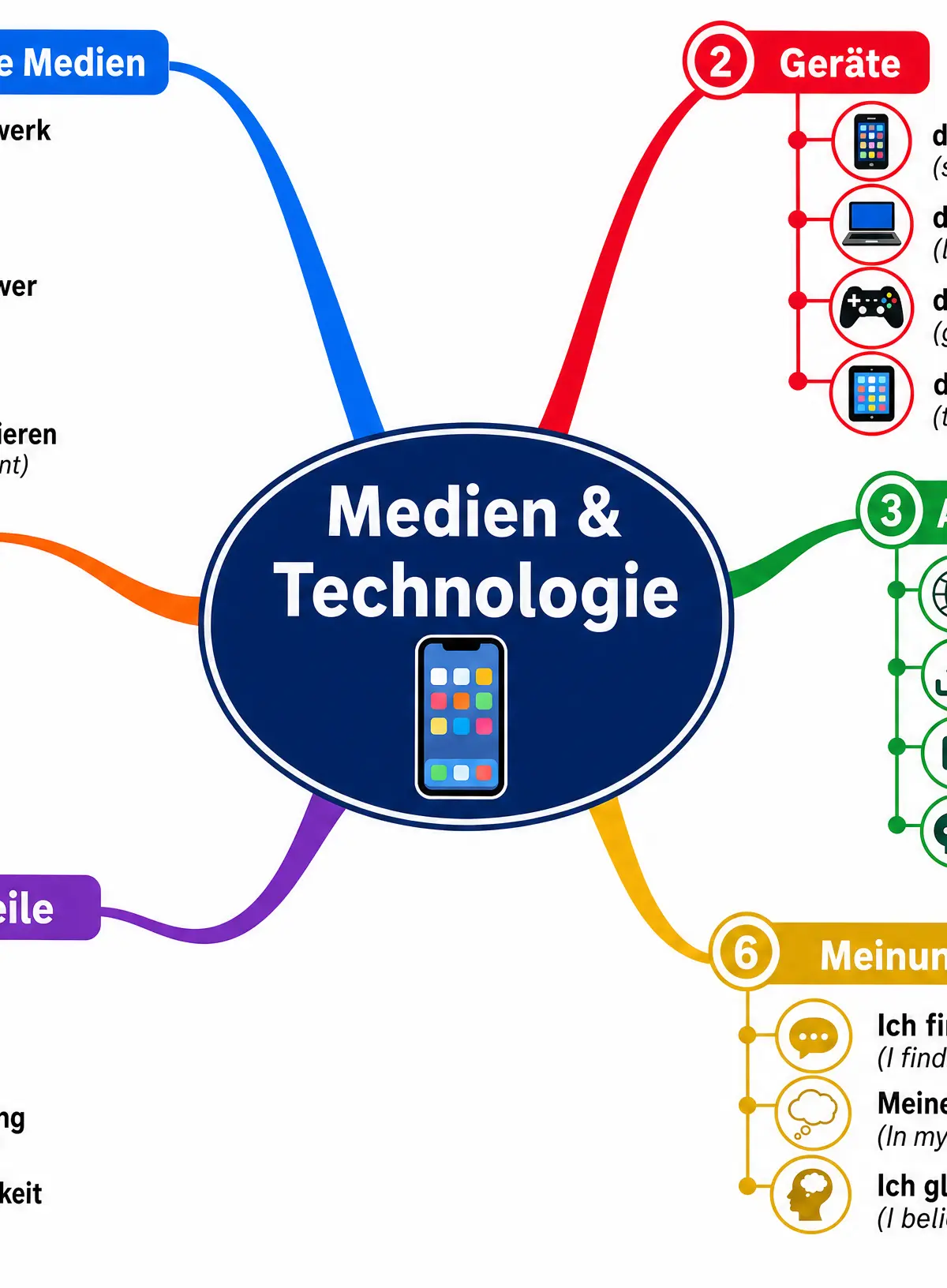
Tier 1 — Foundation Core
| German | English | Gender | Example Sentence |
|---|---|---|---|
| das Internet | the internet | n | Ich surfe jeden Tag im Internet. |
| das Smartphone | the smartphone | n | Mein Smartphone ist sehr wichtig für mich. |
| die App | the app | f | Diese App ist wirklich nützlich. |
| das Netzwerk | the network | n | Ich benutze oft soziale Netzwerke. |
| der Computer | the computer | m | Ich spiele Spiele auf meinem Computer. |
| der Bildschirm | the screen | m | Der Bildschirm ist zu klein. |
| die Nachricht | the message | f | Ich schreibe eine Nachricht an meinen Freund. |
| das Passwort | the password | n | Mein Passwort ist geheim. |
| herunterladen | to download | - | Ich lade Musik herunter. |
| hochladen | to upload | - | Er lädt ein Foto hoch. |
| streamen | to stream | - | Wir streamen oft Filme am Wochenende. |
| chatten | to chat (online) | - | Ich chatte gern mit meinen Freunden. |
| posten | to post | - | Sie postet viele Fotos auf Instagram. |
| teilen | to share | - | Ich teile dieses Video mit dir. |
| nützlich | useful | - | Das Internet ist sehr nützlich für meine Hausaufgaben. |
Tier 2 — Higher Tier
| German | English | Gender | Example Sentence |
|---|---|---|---|
| die Cyberkriminalität | cybercrime | f | Cyberkriminalität ist ein großes Problem heutzutage. |
| das Cybermobbing | cyberbullying | n | Wir müssen Cybermobbing stoppen. |
| der Datenschutz | data protection | m | Datenschutz ist mir sehr wichtig. |
| die Abhängigkeit | addiction / dependence | f | Die Abhängigkeit von Handys steigt. |
| der Missbrauch | the abuse / misuse | m | Der Missbrauch von Daten ist illegal. |
| süchtig | addicted / addictive | - | Viele Jugendliche sind süchtig nach ihren Handys. |
| gefährlich | dangerous | - | Das Internet kann manchmal gefährlich sein. |
| verbreiten | to spread | - | Falsche Informationen verbreiten sich schnell online. |
| sich informieren | to inform oneself | - | Ich nutze das Internet, um mich zu informieren. |
| sich anmelden | to log in / register | - | Du musst dich zuerst anmelden. |
High-Frequency Words & Phrases
| Phrase | English | Usage Context |
|---|---|---|
| Meiner Meinung nach... | In my opinion... | Starting a speaking or writing response |
| Ich bin der Meinung, dass... | I am of the opinion that... | Giving a formal opinion (sends verb to end) |
| Einerseits... andererseits... | On the one hand... on the other hand... | Providing a balanced argument |
| Im Großen und Ganzen | By and large / on the whole | Concluding an extended writing piece |
| Es gibt sowohl Vorteile als auch Nachteile | There are advantages as well as disadvantages | Introducing a balanced discussion |
| Ich verbringe viel Zeit online | I spend a lot of time online | Discussing daily habits |
| Um in Kontakt zu bleiben | In order to stay in contact | Giving a reason for using technology |
| Das Schlimmste daran ist... | The worst thing about it is... | Highlighting a negative aspect |
| Ohne mein Handy könnte ich nicht leben | I couldn't live without my mobile phone | Showing strong opinion (uses conditional) |
| In der Zukunft werde ich... | In the future I will... | Introducing the future tense |
📝 Grammar Focus
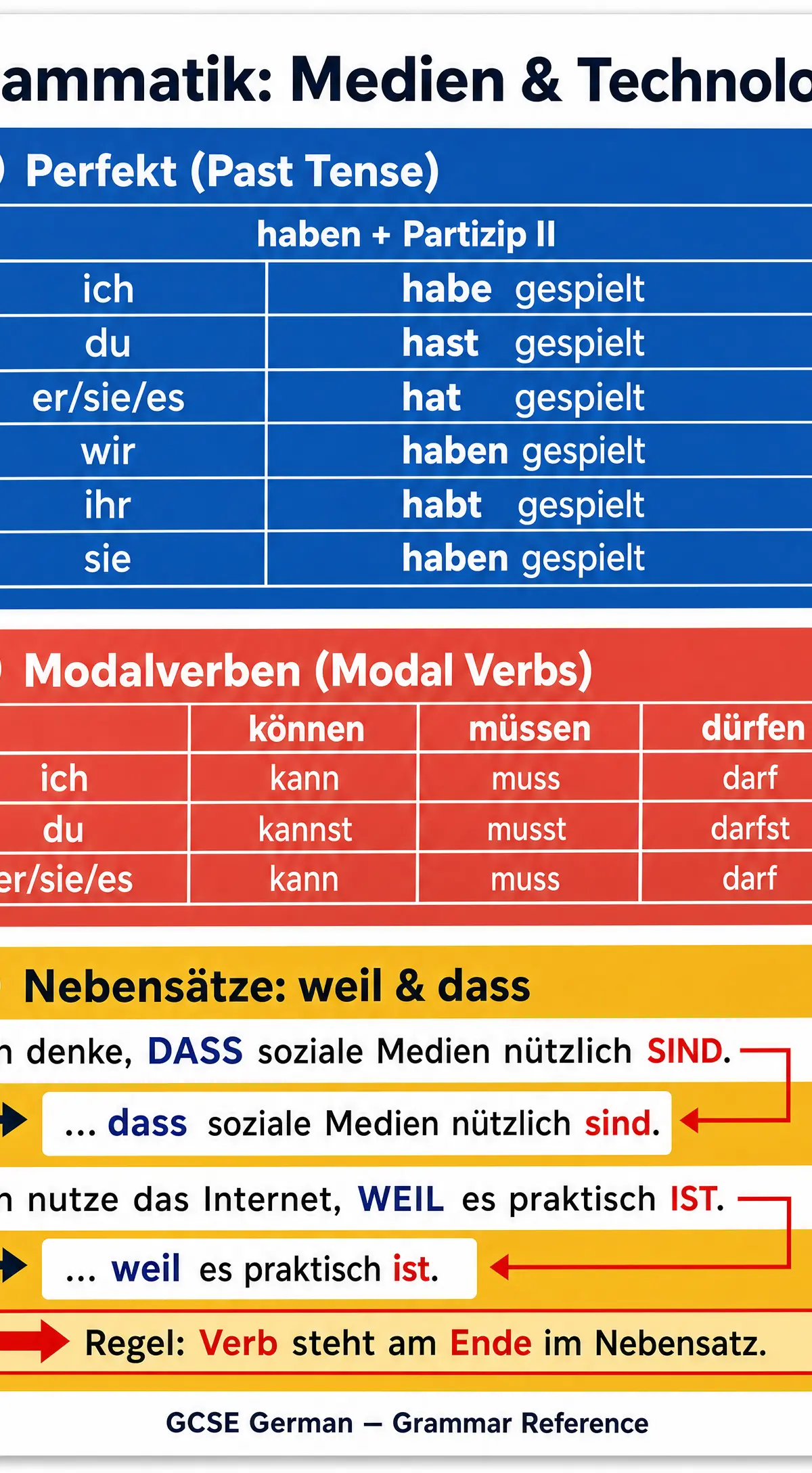
Key Structure 1: Das Perfekt (The Perfect Tense)
When to use it: To describe past experiences, such as what you did online yesterday or a device you bought.
Conjugation Table (haben + Partizip II)
| Subject | Verb Form | English |
|---|---|---|
| ich | habe ... gespielt | I have played / I played |
| du | hast ... gespielt | you have played / you played |
| er/sie/es | hat ... gespielt | he/she/it has played / played |
| wir | haben ... gespielt | we have played / we played |
| ihr | habt ... gespielt | you (pl) have played / you played |
| sie/Sie | haben ... gespielt | they/You have played / played |
Irregulars to learn:
- sehen (to see) → habe gesehen
- schreiben (to write) → habe geschrieben
- lesen (to read) → habe gelesen
Key Structure 2: Modalverben (Modal Verbs)
When to use it: To talk about rules (what you must or are allowed to do online) or abilities.
Conjugation Table
| Subject | können (can/be able) | müssen (must/have to) | dürfen (may/be allowed) |
|---|---|---|---|
| ich | kann | muss | darf |
| du | kannst | musst | darfst |
| er/sie/es | kann | muss | darf |
| wir | können | müssen | dürfen |
| ihr | könnt | müsst | dürft |
| sie/Sie | können | müssen | dürfen |
Rule: The modal verb is in position 2, and the main verb (infinitive) goes to the END of the sentence.
Example: Ich kann stundenlang im Internet surfen.
Key Structure 3: Nebensätze mit 'weil' und 'dass' (Subordinate Clauses)
When to use it: To justify opinions (weil) or express thoughts (dass). This is crucial for higher marks.
Conjugation Table / Structure
When you use weil (because) or dass (that), the conjugated verb is pushed to the very end of the clause.
| Main Clause | Conjunction | Subordinate Clause (Verb at end) | English |
|---|---|---|---|
| Ich mag mein Handy, | weil | es sehr praktisch ist. | I like my phone because it is very practical. |
| Ich denke, | dass | das Internet gefährlich sein kann. | I think that the internet can be dangerous. |
| Er surft nicht, | weil | er keine Zeit hat. | He isn't surfing because he has no time. |
🎧 Listening Skills
What to Expect
You will hear teenagers discussing their screen time, parents complaining about gaming, or news reports about cyberbullying. The recordings are played twice.
Listening Strategies
- Read the questions first: Use the reading time to predict vocabulary. If the question is about 'risks', expect words like gefährlich, Mobbing, or Vorsicht.
- Listen for negatives: A speaker might say "Ich lade nie Musik herunter" (I never download music). If you miss the nie, you get the opposite meaning.
- Watch for tense changes: If the question asks what they did yesterday, listen for gestern or letztes Wochenende and perfect tense verbs (habe... gemacht).
Common Listening Traps
- False Friends: Das Handy = mobile phone (not handy). Der Chef = boss (not chef). Die Rente = pension (not rent).
- Qualifiers: Words like fast immer (almost always), selten (rarely), or ab und zu (now and then) completely change the frequency.
🗣️ Speaking Skills
Role Play Scenarios
Scenario 1: Buying a new phone in a shop
- Shop assistant: Guten Tag, wie kann ich Ihnen helfen?
- You: Guten Tag. Ich suche ein neues Smartphone. Mein altes Handy ist kaputt.
- Shop assistant: Welche Marke bevorzugen Sie?
- You: Ich möchte ein iPhone, weil es einfach zu bedienen ist.
Photo Card Practice
Model Photo Card Response:
- Qu 1 (Description): Auf dem Foto gibt es drei Jugendliche. Sie sitzen auf einem Sofa und schauen auf ihre Handys. Sie lächeln, also denke ich, dass sie ein lustiges Video sehen.
- Qu 2 (Opinion): Meiner Meinung nach ist das ein bisschen traurig. Sie verbringen Zeit zusammen, aber sie sprechen nicht miteinander.
- Qu 3 (Related topic): Persönlich nutze ich mein Handy etwa drei Stunden pro Tag, meistens für soziale Medien.
- Qu 4 (Past): Gestern habe ich mein Handy benutzt, um meine Hausaufgaben zu machen und mit meiner Oma zu skypen.
- Qu 5 (Future): Nächstes Wochenende werde ich versuchen, mein Handy weniger zu benutzen, weil ich mehr Sport treiben will.
General Conversation Questions
| Question (German) | Model Answer | English Translation |
|---|---|---|
| Wofür benutzt du dein Handy? | Ich benutze mein Handy hauptsächlich, um Musik zu hören und mit Freunden in Kontakt zu bleiben, weil das sehr praktisch ist. | What do you use your phone for? / I use my phone mainly to listen to music and stay in contact with friends, because that is very practical. |
| Was sind die Gefahren des Internets? | Einerseits ist das Internet nützlich, aber andererseits gibt es Gefahren wie Cybermobbing und Viren. Man muss vorsichtig sein. | What are the dangers of the internet? / On the one hand the internet is useful, but on the other hand there are dangers like cyberbullying and viruses. One must be careful. |
| Wie hast du gestern Technologie genutzt? | Gestern Abend habe ich einen Film auf meinem Laptop gestreamt und danach habe ich eine E-Mail an meinen Lehrer geschrieben. | How did you use technology yesterday? / Yesterday evening I streamed a film on my laptop and after that I wrote an email to my teacher. |
| Könntest du ohne das Internet leben? | Nein, auf keinen Fall! Ohne das Internet könnte ich meine Hausaufgaben nicht machen und ich wäre sehr isoliert. | Could you live without the internet? / No, absolutely not! Without the internet I couldn't do my homework and I would be very isolated. |
| Was wirst du heute Abend im Internet machen? | Heute Abend werde ich Fotos auf Instagram posten und vielleicht ein bisschen online einkaufen. | What will you do on the internet tonight? / Tonight I will post photos on Instagram and maybe do a little bit of online shopping. |
✍️ Writing Skills
Translation Practice
English → German:
| English | German | Key Grammar |
|---|---|---|
| I use my phone every day. | Ich benutze mein Handy jeden Tag. | Present tense, word order (time before manner/place) |
| I think that social media is dangerous. | Ich denke, dass soziale Medien gefährlich sind. | 'dass' clause pushing verb to the end |
| Yesterday I played computer games. | Gestern habe ich Computerspiele gespielt. | Time phrase at start = verb as 2nd idea (inversion), Perfect tense |
| We must protect our data. | Wir müssen unsere Daten schützen. | Modal verb (müssen) + infinitive at end |
| In the future I will buy a new laptop. | In der Zukunft werde ich einen neuen Laptop kaufen. | Future tense (werden + infinitive), inversion |
Extended Writing
**Model 90-word response (Foundation):**Ich liebe Technologie. Jeden Tag benutze ich mein Smartphone, um mit meinen Freunden zu chatten und Musik zu hören. Das ist sehr praktisch und macht Spaß. Mein Lieblingsgerät ist mein Laptop, weil der Bildschirm groß ist. Gestern habe ich zwei Stunden lang am Computer gespielt. Das war toll, aber meine Mutter war wütend! In der Zukunft möchte ich ein neues Tablet kaufen, weil mein altes Tablet kaputt ist. Meiner Meinung nach ist das Internet fantastisch, aber man muss vorsichtig sein.
**Model 150-word response (Higher):**Heutzutage spielt Technologie eine wesentliche Rolle in unserem Leben. Persönlich könnte ich ohne mein Smartphone nicht leben. Ich nutze es nicht nur, um mit Freunden in Kontakt zu bleiben, sondern auch, um mich über aktuelle Nachrichten zu informieren. Einerseits sind soziale Netzwerke extrem nützlich, weil sie Menschen verbinden. Andererseits bin ich der Meinung, dass es viele Gefahren gibt. Zum Beispiel ist Cybermobbing ein wachsendes Problem für Jugendliche, und viele Leute werden süchtig nach ihren Bildschirmen.
Gestern Abend habe ich drei Stunden online verbracht. Zuerst habe ich Hausaufgaben gemacht, und danach habe ich einen Film gestreamt. Obwohl das entspannend war, hatte ich danach Kopfschmerzen. Deshalb habe ich beschlossen, meine Gewohnheiten zu ändern. Nächstes Wochenende werde ich mein Handy ausschalten und mehr Zeit draußen verbringen. Wir müssen lernen, Technologie verantwortungsvoll zu nutzen, damit sie unser Leben verbessert und nicht kontrolliert.
Writing Checklist
- ✅ Tenses: Have I used at least three tenses? (Present, Past/Perfect, Future/Conditional)
- ✅ Opinions: Have I given opinions and justified them with weil or da?
- ✅ Word Order: Are my verbs in the correct position? (V2 normally, V-end after weil/dass, inversion after time phrases)
- ✅ Vocabulary: Have I used higher-tier vocabulary instead of repeating gut or schlecht?
- ✅ Accuracy: Do my adjectives agree? Are my verb endings correct for the subject?
📚 Reading Skills
Key Strategies
- Skim for Gist: Read the whole text quickly first to understand the general mood (positive, negative, balanced).
- Identify the Subject: Look at verb endings to see WHO is doing the action. Ich lade herunter (I download) vs Er lädt herunter (He downloads).
- Context is King: If you don't know a word, guess its meaning from the rest of the sentence before panicking.
False Friends & Tricky Words
| Word | Looks Like | Actually Means |
|---|---|---|
| das Handy | handy | mobile phone |
| aktuell | actual | current / up-to-date |
| kontrollieren | to control | to check / monitor (e.g. check tickets) |
| das Gift | gift | poison (very important for online safety texts!) |
| also | also | therefore / so |
🌍 Cultural Knowledge
In Germany, data privacy (Datenschutz) is taken extremely seriously due to historical reasons. Germans are generally more cautious about sharing personal information online compared to people in the UK or US. Cash is still widely preferred over digital payments in many places, though this is changing. Knowing this adds excellent cultural context to a speaking or writing response about the risks of the internet!
Additionally, the German equivalent of a high school diploma is the Abitur (or Abi). Mentioning that you use technology to study for your Abitur sounds much more authentic than trying to translate 'GCSE'.
Visual Resources
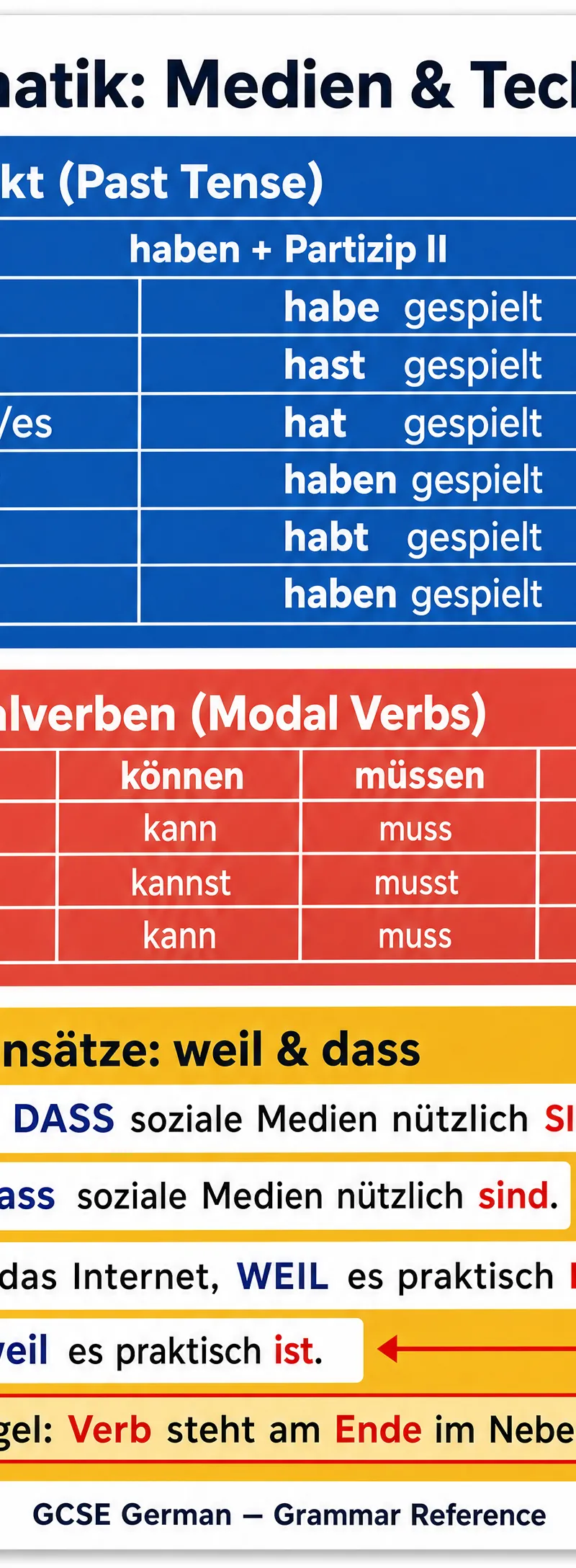
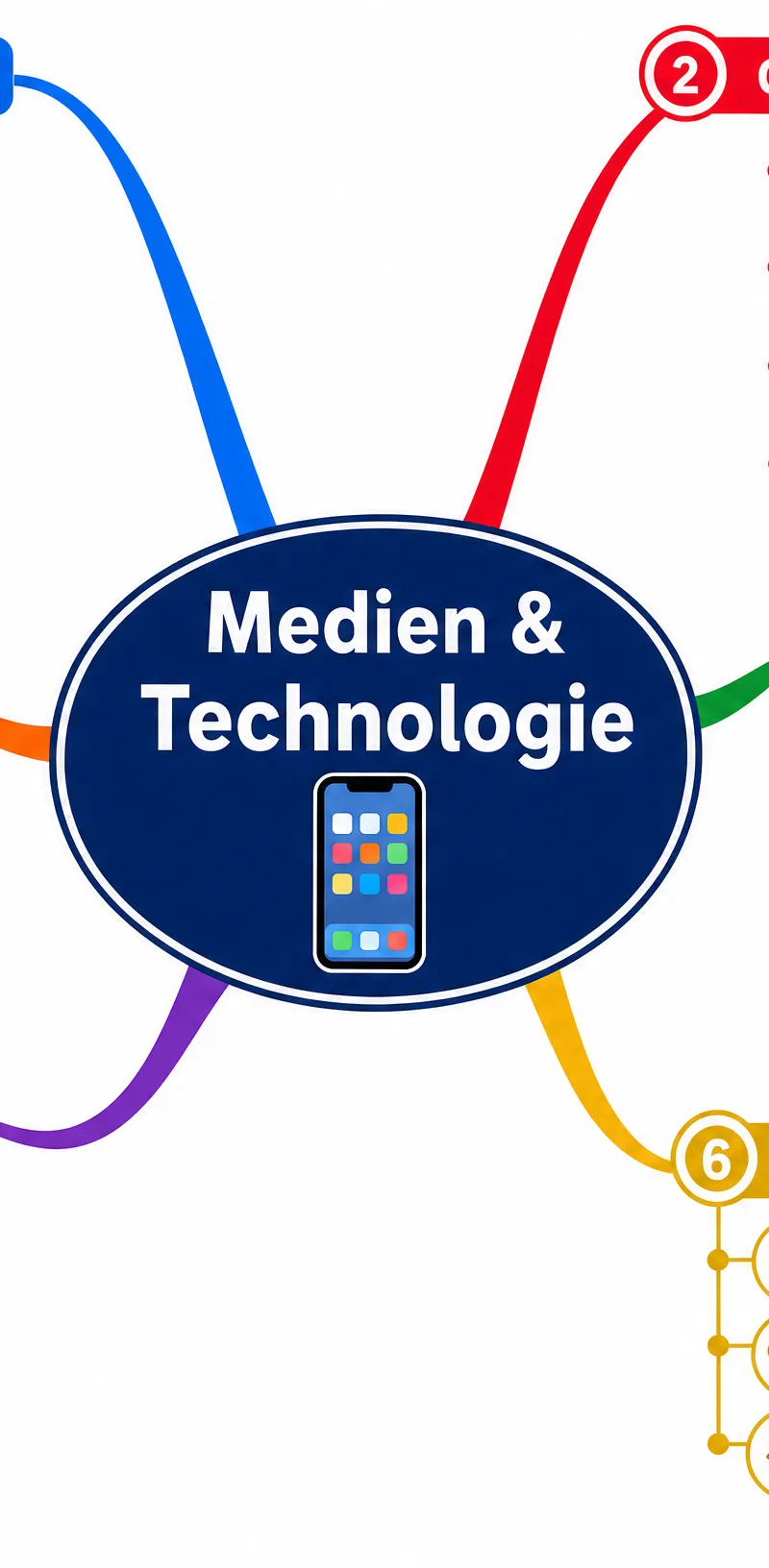
2 diagrams and illustrations
Interactive Diagrams
1 interactive diagram to visualise key concepts
Conceptual Flow Outline
MFL exam approach by skill
Worked Examples
4 worked examples — open one to explore the question and available guidance.
Practice Questions
Try the question, then reveal an answer plan or example response
Writing (Higher): Write an article for your school magazine about the impact of technology on young people. Include: the benefits of the internet, the dangers of social media, how you used technology recently, and your predictions for technology in the future. (Approx 150 words)
Hint: Ensure you use at least three tenses, include justified opinions, and use complex structures like 'weil', 'dass', or 'um... zu'.
Speaking (Photo Card): Describe a photo showing a family sitting at a dinner table, but everyone is looking at their smartphones instead of talking.
Hint: Use PALM (People, Action, Location, Mood) to describe the photo before giving your opinion.
Translation (Foundation): Translate into German: 1. I like playing computer games. 2. The internet is useful. 3. Yesterday I chatted online.
Hint: Watch out for the past tense in sentence 3.
Reading (Higher): Read the text: 'Obwohl mein Bruder stundenlang am Computer sitzt, hat er gute Noten. Ich dagegen muss mein Handy abends abgeben, damit ich besser schlafen kann.' Who has to hand in their phone, and why?
Hint: Look for the subject 'Ich' and the conjunction 'damit'.
Listening (Foundation): You hear: 'Ich finde mein neues Tablet toll, aber es war extrem teuer.' What does the person think of their tablet, and what is the negative point?
Hint: Listen for the word after 'aber'.
Translation (Higher): Translate into German: 'Although social media is fun, it can be addictive. Therefore I will spend less time online.'
Hint: Remember the word order rule for 'Obwohl' (Although) and 'Deshalb' (Therefore).
Exam technique
How to turn what you know into marks
How to approach the question
Skill-by-skill strategy: Listening — read questions first, note keywords. Speaking — prepare opinions in advance, have fillers ready. Reading — skim first, then detail. Writing — plan before writing, check accuracy after.
How to structure your answer
Writing: Introduction → Main points with opinions → Justified reasons → Different tenses → Conclusion. Speaking: Give opinion → Justify → Extend → Use different tense.
Timing
Listening: 25-35 mins (heard twice). Speaking: 7-12 mins total (role play + photo card + conversation). Reading: 45-60 mins. Writing: 60-75 mins (translation + structured + extended).
Common pitfalls
- Forgetting adjective agreements (gender & number)
- Using only the present tense — examiners want at least 3 tenses at Higher
- Giving one-word Speaking answers instead of developing responses
- Not pushing the verb to the end after 'weil' or 'dass'
- Confusing false friends in Listening/Reading
- Forgetting the reflexive pronoun with verbs like 'sich informieren'
What the command words want
- Describe the photo
- Say what you can see, give an opinion, relate to your experience
- Translate into German
- Write full sentences with correct grammar — partial marks for partially correct
- Translate into English
- Meaning over word-for-word — capture the sense, don't guess cognates
- Write approximately 90 words
- Foundation task — cover all 4 bullet points, use present + one other tense
- Write approximately 150 words
- Higher task — 3 tenses, opinions, complex structures, ambitious vocabulary
Watch or listen (optional)
Test your understanding of Thematic Context: Media and technology
Active recall beats re-reading. Take an instant quiz now to test what you’ve learned and lock it into long-term memory.
7 days Premium · Then the free plan continues · No card, no charge