Pearson Edexcel · GCSE · German
Course version: Pearson-GCSE-German · Version from Mar 2026
Thematic Context: My neighbourhood
Master the 'My Neighbourhood' thematic context with this comprehensive guide covering essential vocabulary, the crucial two-way prepositions, and key structures like 'es gibt'. This topic appears across all four skills (Listening, Speaking, Reading, Writing) and provides a strong foundation for describing your local area, transport, and environment.
- 14 min read
- 4 worked examples
- 3 practice questions
- 8 key terms
Check what you remember
Read the wording for your board, then hide it and explain Two-Way Prepositions (Wechselpräpositionen) in your own words. Rough notes are fine. This is a self-check, with no mark or grade.
Reference: Pearson Edexcel
Prepositions (in, an, auf, etc.) that take the Dative case for location (where?) and the Accusative case for movement (where to?).
Study Notes
Overview
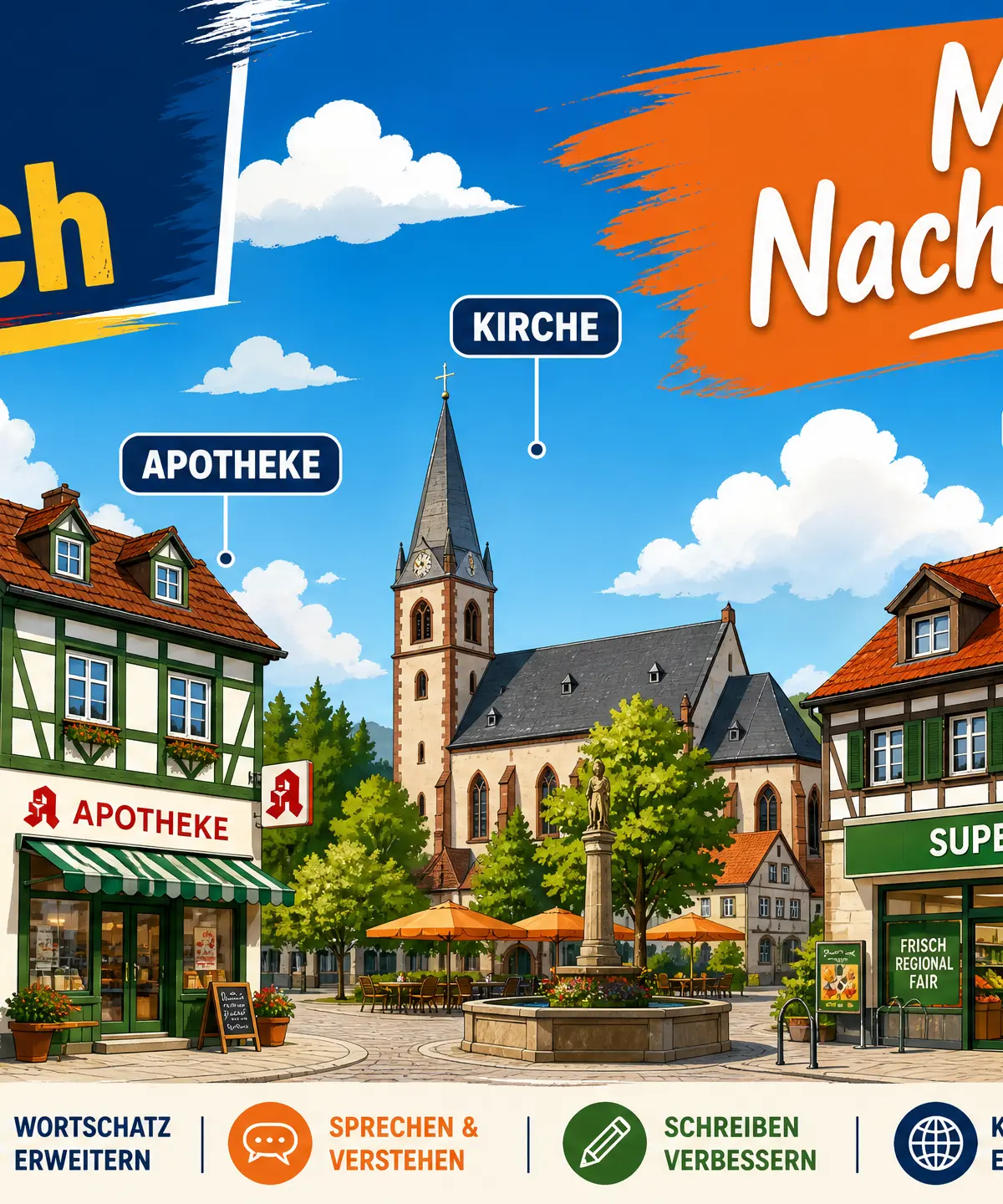
The 'Meine Nachbarschaft' (My Neighbourhood) theme is a core component of the GCSE German specification. It requires candidates to describe their local area, discuss transport links, evaluate shopping facilities, and express opinions about where they live. This topic is heavily assessed across all four papers: Listening (understanding directions and descriptions), Speaking (photo cards and general conversation), Reading (extracting details from texts about towns), and Writing (producing structured descriptions using multiple tenses).
Examiners particularly look for accurate use of two-way prepositions (dative vs. accusative), correct application of the phrase 'es gibt', and the ability to justify opinions using subordinate clauses.
🎧 Audio Revision: My Neighbourhood Podcast
Listen to this 10-minute revision podcast covering essential vocabulary, key grammar rules, and top exam tips. Perfect for reviewing on the go!
📖 Essential Vocabulary
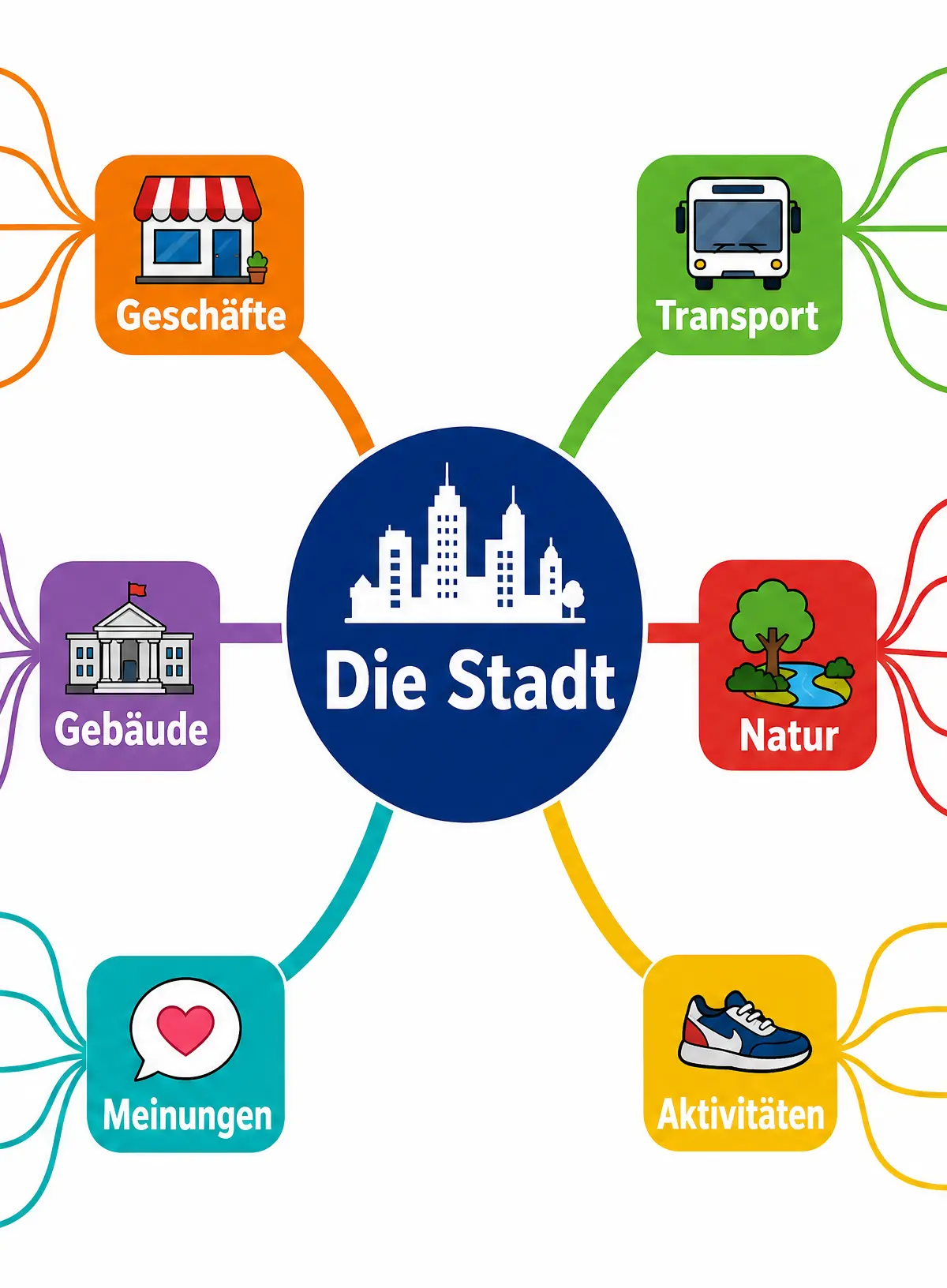
Tier 1 — Foundation Core
| German | English | Gender | Example Sentence |
|---|---|---|---|
| die Stadt | the town/city | f | Meine Stadt ist ziemlich groß. |
| das Dorf | the village | n | Ich wohne in einem kleinen Dorf. |
| die Bäckerei | the bakery | f | Ich kaufe Brot in der Bäckerei. |
| der Supermarkt | the supermarket | m | Der Supermarkt ist neben der Post. |
| die Schule | the school | f | Meine Schule ist sehr modern. |
| der Bahnhof | the train station | m | Der Bahnhof ist im Stadtzentrum. |
| das Kino | the cinema | n | Am Wochenende gehe ich ins Kino. |
| der Park | the park | m | Es gibt einen schönen Park hier. |
| die Kirche | the church | f | Die alte Kirche ist sehr interessant. |
| das Krankenhaus | the hospital | n | Das Krankenhaus ist nicht weit von hier. |
| der Bus | the bus | m | Ich fahre mit dem Bus zur Schule. |
| das Auto | the car | n | Wir fahren oft mit dem Auto. |
| einkaufen | to shop | verb | Ich gehe gern in der Stadt einkaufen. |
| langweilig | boring | adj | Mein Dorf ist manchmal ein bisschen langweilig. |
| schön | beautiful/nice | adj | Die Umgebung ist wirklich schön. |
Tier 2 — Higher Tier
| German | English | Gender | Example Sentence |
|---|---|---|---|
| die Fußgängerzone | pedestrian zone | f | In der Fußgängerzone gibt es viele Geschäfte. |
| die Verkehrsanbindung | transport links | f | Die Verkehrsanbindung ist ausgezeichnet. |
| das Einkaufszentrum | shopping centre | n | Das neue Einkaufszentrum ist sehr beliebt. |
| die Sehenswürdigkeit | tourist attraction | f | Die Burg ist eine bekannte Sehenswürdigkeit. |
| die Umgebung | surroundings/area | f | Die Umgebung ist malerisch und ruhig. |
| das Freizeitzentrum | leisure centre | n | Im Freizeitzentrum kann man Sport treiben. |
| die Einwohner | inhabitants | pl | Die Stadt hat ungefähr 50.000 Einwohner. |
| umweltfreundlich | environmentally friendly | adj | Die öffentlichen Verkehrsmittel sind umweltfreundlich. |
| lebendig | lively | adj | Das Stadtzentrum ist abends sehr lebendig. |
| historisch | historical | adj | Der Marktplatz hat viele historische Gebäude. |
High-Frequency Words & Phrases
| Phrase | English | Usage Context |
|---|---|---|
| Es gibt... | There is / there are... | Describing what facilities are available (always takes accusative). |
| Meiner Meinung nach... | In my opinion... | Introducing an evaluation of your area. |
| Ich wohne gern hier, weil... | I like living here because... | Justifying a positive opinion. |
| Auf der einen Seite... auf der anderen Seite... | On the one hand... on the other hand... | Providing a balanced evaluation (Higher tier). |
| In der Nähe von... | Near... / In the vicinity of... | Describing location relative to something else. |
| Ich bin der Ansicht, dass... | I am of the view that... | Advanced opinion phrase (verb goes to end). |
| Obwohl es klein ist... | Although it is small... | Concession clause (verb to end, next clause starts with verb). |
| Wenn ich die Wahl hätte... | If I had the choice... | Conditional structure for future/ideal plans. |
| Ein großer Vorteil ist... | A big advantage is... | Structuring an argument about your town. |
| Ein Nachteil ist... | A disadvantage is... | Discussing negative aspects. |
📝 Grammar Focus
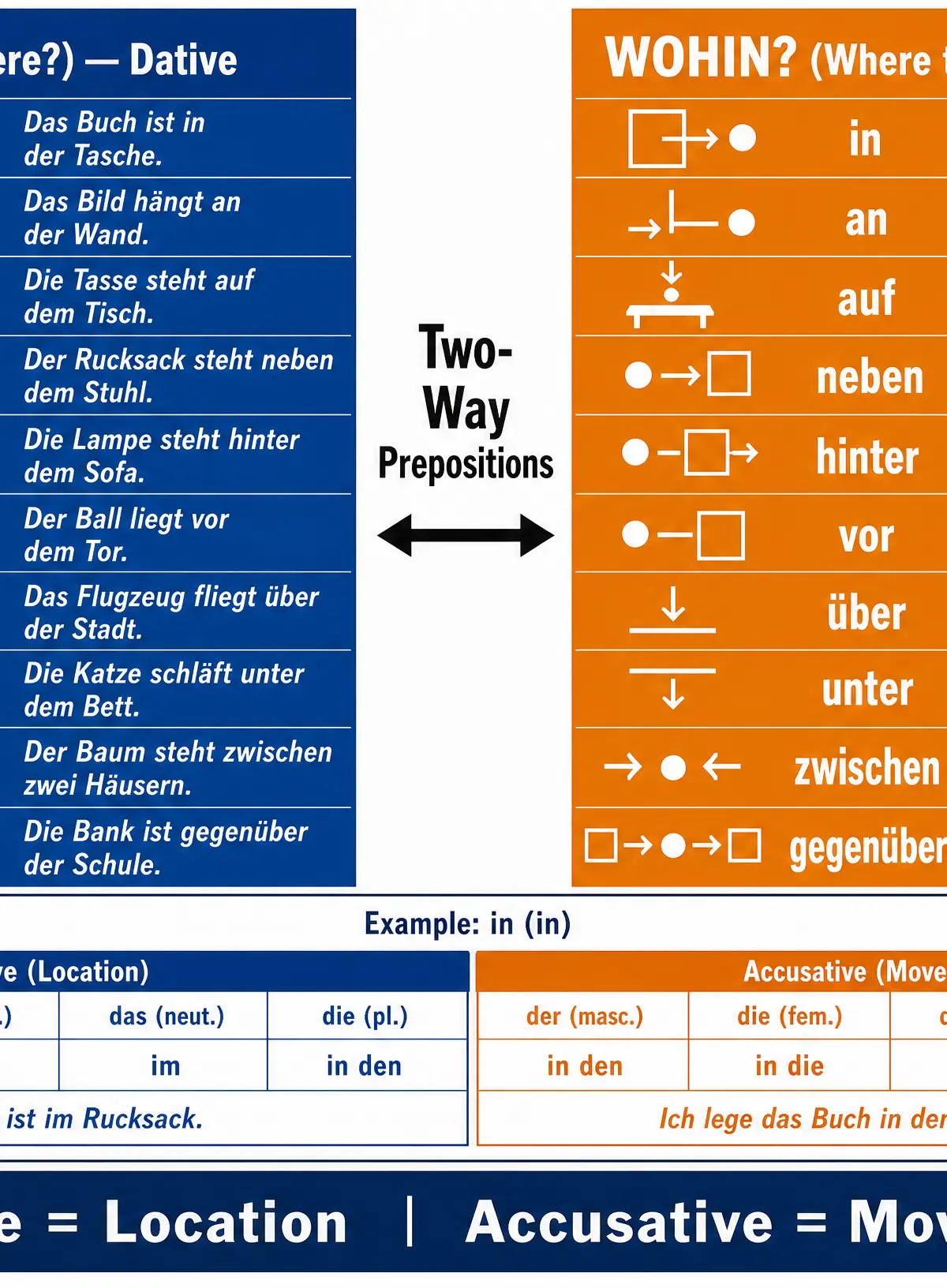
Key Structure 1: Two-Way Prepositions (Wechselpräpositionen)
When to use it: When describing exactly where places are (location) or where you are travelling to (movement). Examiners actively test your ability to choose the correct case.
The Rule:
- Question WO? (Where is it?) → Use DATIVE case.
- Question WOHIN? (Where to?) → Use ACCUSATIVE case.
Conjugation Table: Definite Articles after Prepositions
| Gender | Dative (Location - Wo?) | Accusative (Movement - Wohin?) |
|---|---|---|
| Masculine (der) | dem (e.g., in dem = im) | den (e.g., in den) |
| Feminine (die) | der (e.g., in der) | die (e.g., in die) |
| Neuter (das) | dem (e.g., in dem = im) | das (e.g., in das = ins) |
| Plural (die) | den + n on noun | die |
Examples:
- Location: Die Bäckerei ist in der Stadtmitte. (The bakery is in the town centre.)
- Movement: Ich gehe in die Stadtmitte. (I am going into the town centre.)
Key Structure 2: 'Es gibt' (There is / There are)
When to use it: Essential for describing the facilities in your neighbourhood.
The Rule: 'Es gibt' ALWAYS takes the ACCUSATIVE case. This is a very common area for dropped marks, especially with masculine nouns.
Conjugation Table: Indefinite Articles after 'es gibt'
| Gender | Accusative Article | Example |
|---|---|---|
| Masculine (der) | einen | Es gibt einen großen Park. |
| Feminine (die) | eine | Es gibt eine alte Kirche. |
| Neuter (das) | ein | Es gibt ein modernes Kino. |
| Plural (die) | viele / keine | Es gibt viele Geschäfte. |
Key Structure 3: Word Order in Subordinate Clauses
When to use it: When justifying opinions (weil, da) or adding complex details (obwohl, dass, wenn).
The Rule: After a subordinating conjunction, the conjugated verb gets kicked to the END of the clause.
Examples:
- Ich finde meine Stadt toll, weil sie sehr lebendig ist.
- Ich fahre mit dem Bus, obwohl er oft spät ankommt.
- Ich denke, dass die Verkehrsanbindung gut ist.
🎧 Listening Skills
What to Expect
In the listening exam, you will hear native speakers describing their local area, giving directions, discussing the pros and cons of their town, or talking about recent changes to the neighbourhood. Tasks may involve multiple-choice, matching, or writing short answers in English (or German for Higher tier).
Listening Strategies
- Listen for qualifiers and negatives: A speaker might say 'Es gibt ein Kino, aber es ist nicht sehr modern' or 'Es gibt kein Schwimmbad'. Don't just tick 'cinema' and 'swimming pool' as soon as you hear the words.
- Watch for tense changes: Speakers often contrast what the town used to be like with what it is like now. Listen for 'früher' (formerly) vs. 'jetzt/heute' (now/today).
- Identify opinion markers: Listen for adjectives (toll, furchtbar) and verbs of preference (ich mag, ich hasse) to understand the speaker's attitude.
Common Listening Traps
- Distractors: The speaker might mention a place they wanted to go, but then say they went somewhere else. The final destination is usually the answer.
- False Friends: Hearing 'Gymnasium' and thinking 'gym' (it means grammar school). Hearing 'Fabrik' and thinking 'fabric' (it means factory).
🗣️ Speaking Skills
Role Play Scenarios
Scenario 1: At the Tourist Information Office
- Tourist (You): Entschuldigung, wo ist der Bahnhof, bitte? (Excuse me, where is the train station, please?)
- Officer: Gehen Sie geradeaus und dann die erste Straße links.
- Tourist (You): Gibt es hier in der Nähe ein gutes Restaurant? (Is there a good restaurant nearby?)
- Officer: Ja, gegenüber der Kirche gibt es eine tolle Pizzeria.
Photo Card Practice
Model Photo Card Response (A photo showing a busy town square):
- Qu 1 (Description): Auf dem Foto gibt es einen großen Marktplatz. Im Hintergrund sehe ich eine alte Kirche und viele historische Gebäude. Es gibt auch viele Leute, die einkaufen oder spazieren gehen. Das Wetter ist sonnig.
- Qu 2 (Opinion): Ich finde diesen Marktplatz sehr schön, weil er lebendig und malerisch ist. Ich mag historische Städte.
- Qu 3 (Your area): In meiner Gegend gibt es auch einen kleinen Marktplatz, aber wir haben keine alte Kirche. Wir haben ein modernes Einkaufszentrum.
- Qu 4 (Past/Future): Letztes Wochenende bin ich mit meinen Freunden in die Stadtmitte gefahren. Wir haben im Café Eis gegessen und danach haben wir einen Film im Kino gesehen.
- Qu 5 (Unpredictable - z.B. Transport): Normalerweise fahre ich mit dem Bus in die Stadt, weil es billig und umweltfreundlich ist. Manchmal fahre ich auch mit dem Fahrrad.
General Conversation Questions
| Question (German) | Model Answer | English Translation |
|---|---|---|
| Beschreib deine Stadt oder dein Dorf. | Ich wohne in einer mittelgroßen Stadt in Südengland. Es gibt ein modernes Einkaufszentrum, viele Parks und ein großes Krankenhaus. | Describe your town or village. (I live in a medium-sized town in the south of England. There is a modern shopping centre, many parks and a large hospital.) |
| Was gibt es für Jugendliche in deiner Gegend? | Für Jugendliche gibt es ziemlich viel zu tun. Man kann ins Kino gehen oder im Freizeitzentrum Sport treiben. Leider gibt es keine Eisbahn. | What is there for young people in your area? (For young people there is quite a lot to do. You can go to the cinema or do sport in the leisure centre. Unfortunately there is no ice rink.) |
| Was sind die Vor- und Nachteile deiner Stadt? | Ein Vorteil ist, dass die Verkehrsanbindung sehr gut ist. Ein Nachteil ist jedoch, dass es manchmal zu laut ist und es gibt zu viel Verkehr. | What are the advantages and disadvantages of your town? (An advantage is that the transport links are very good. A disadvantage however is that it is sometimes too loud and there is too much traffic.) |
| Was hast du letztes Wochenende in deiner Gegend gemacht? | Letztes Wochenende bin ich mit dem Bus in die Stadt gefahren. Ich habe mit meinen Freunden eingekauft und wir haben Pizza gegessen. Es war toll. | What did you do last weekend in your area? (Last weekend I travelled into town by bus. I shopped with my friends and we ate pizza. It was great.) |
| Wo möchtest du in der Zukunft wohnen? Warum? | In der Zukunft möchte ich in einer Großstadt wie Berlin oder London wohnen, weil es dort mehr Arbeitsplätze und eine bessere Kultur gibt. | Where would you like to live in the future? Why? (In the future I would like to live in a big city like Berlin or London, because there are more jobs and better culture there.) |
✍️ Writing Skills
Translation Practice
English → German:
| English | German | Key Grammar |
|---|---|---|
| 1. I live in a small village. | Ich wohne in einem kleinen Dorf. | Dative case after 'in' (location). |
| 2. There is a new supermarket. | Es gibt einen neuen Supermarkt. | Accusative masculine after 'es gibt'. |
| 3. I like my town because it is beautiful. | Ich mag meine Stadt, weil sie schön ist. | Verb to the end after 'weil'. |
| 4. Yesterday I went to the cinema. | Gestern bin ich ins Kino gegangen. | Perfect tense with 'sein' (movement). |
| 5. Next year I will live in the city. | Nächstes Jahr werde ich in der Stadt wohnen. | Future tense (werden + infinitive at end). |
Extended Writing
**Model 90-word response (Foundation):**Ich wohne in einer kleinen Stadt in der Nähe von London. Meine Stadt gefällt mir sehr gut, weil sie ruhig und sauber ist. In meiner Gegend gibt es einen großen Park, einen Bahnhof und viele Geschäfte. Leider gibt es kein Kino. Das finde ich ein bisschen langweilig. Letztes Wochenende bin ich mit meinen Freunden in die Stadtmitte gefahren. Wir haben Hamburger gegessen und wir haben Fußball im Park gespielt. Das war sehr lustig. In der Zukunft möchte ich in einer Großstadt wohnen, weil das interessanter ist.
**Model 150-word response (Higher):**Ich wohne seit zehn Jahren in einer mittelgroßen Stadt im Süden von England. Meiner Meinung nach ist meine Gegend ziemlich attraktiv, obwohl es manchmal zu viel Verkehr gibt. Auf der einen Seite gibt es ausgezeichnete Einrichtungen für Jugendliche; zum Beispiel haben wir ein modernes Freizeitzentrum und ein großes Kino. Auf der anderen Seite ist die Verkehrsanbindung nicht besonders gut, was ein großer Nachteil ist.
Letztes Wochenende bin ich mit dem Zug in die nächste Großstadt gefahren, um einzukaufen. Ich habe ein neues T-Shirt gekauft und danach haben wir in einem italienischen Restaurant gegessen. Das Essen war unglaublich lecker!
Wenn ich älter bin, werde ich bestimmt in einer europäischen Hauptstadt wie Berlin oder Wien wohnen. Ich bin der Ansicht, dass das Leben in der Stadt viel spannender ist, da man verschiedene Kulturen erleben kann und es mehr Berufsmöglichkeiten gibt. Trotzdem werde ich meine Heimatstadt immer mögen.
Writing Checklist
- ✅ Have I used at least three tenses accurately? (Present, Perfect, Future/Conditional)
- ✅ Are my 'es gibt' phrases followed by the accusative case? (e.g., einen Park)
- ✅ Have I put the verb at the end of the clause after 'weil', 'dass', or 'obwohl'?
- ✅ Have I included justified opinions? (Ich finde das toll, weil...)
- ✅ Have I checked my adjective agreements?
📚 Reading Skills
Key Strategies
- Skim for gist: Read the whole text quickly first to understand the overall tone. Is the writer happy or unhappy with their town?
- Identify the time frame: Look for time phrases (gestern, heute, nächstes Jahr) to ensure you don't answer a question about the past with information about the future.
- Use logical deduction: If you don't know a word, look at the words around it. If a text says 'Ich kaufe Brot in der...', it must be a bakery (Bäckerei).
False Friends & Tricky Words
| Word | Looks Like | Actually Means |
|---|---|---|
| das Gymnasium | gym | grammar school (academic high school) |
| die Fabrik | fabric | factory |
| aktuell | actual | current / up-to-date |
| der Chef | chef | boss / manager |
| raten | to rate | to advise / to guess |
🌍 Cultural Knowledge
Understanding the cultural context of German towns can enrich your speaking and writing responses, showing the examiner a deeper appreciation of the language.
- Die Fußgängerzone: Most German towns and cities have extensive, well-planned pedestrian zones in the centre, making them very walkable and focused on local commerce rather than cars.
- Der Marktplatz: The market square is traditionally the heart of a German town, often featuring a historic Rathaus (town hall) and a church. Many towns still hold weekly fresh produce markets (Wochenmarkt) here.
- Öffentliche Verkehrsmittel: Public transport in Germany, Austria, and Switzerland is generally highly developed. Trams (Straßenbahnen) are very common even in medium-sized cities, and the U-Bahn (underground) and S-Bahn (suburban train) networks in major cities are extensive.
- Umweltfreundlichkeit: Environmental awareness is high. Recycling facilities are ubiquitous, and cycling infrastructure (Radwege) is excellent in many towns, notably in places like Münster or Freiburg.
Visual Resources
2 diagrams and illustrations
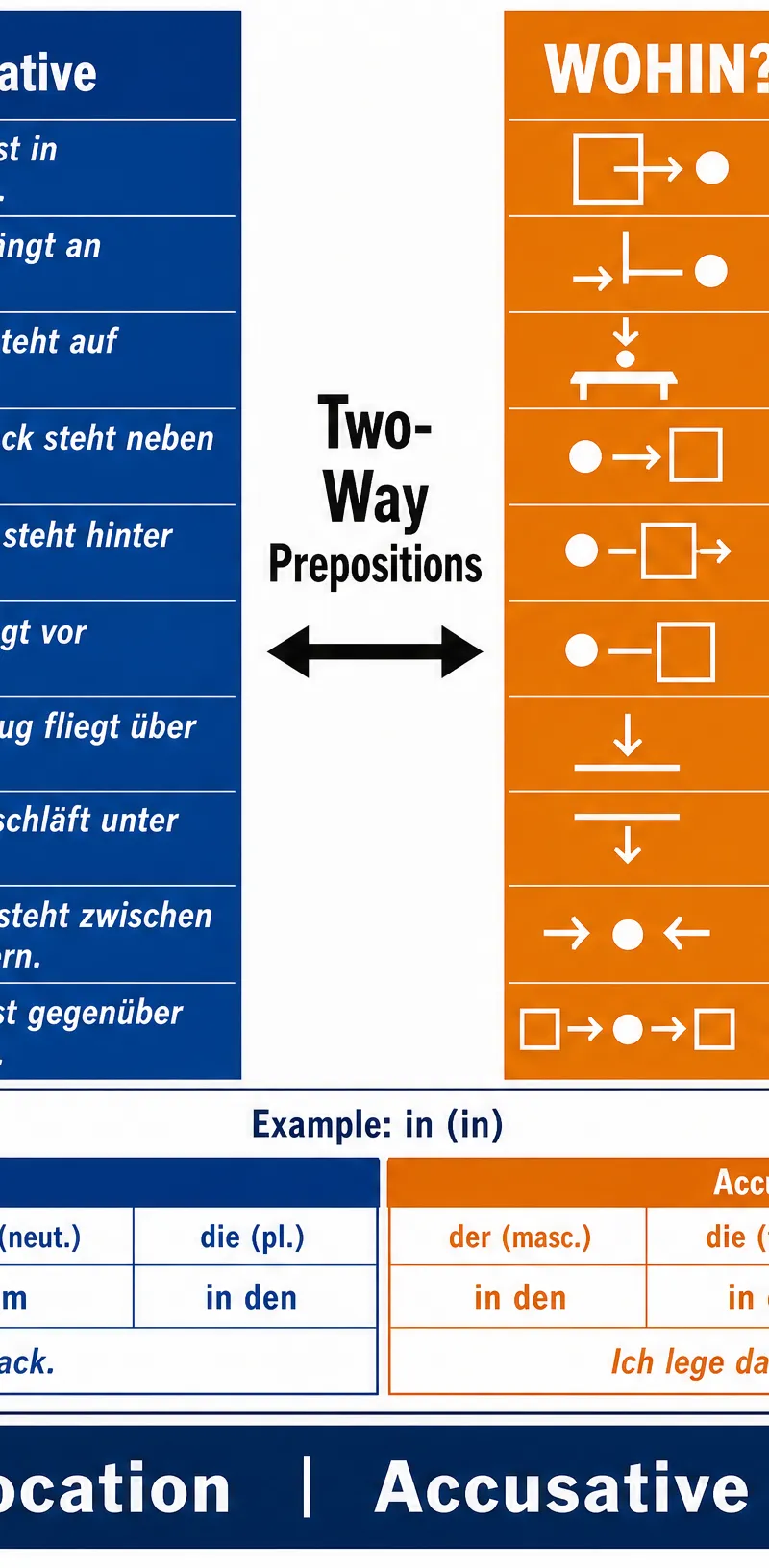
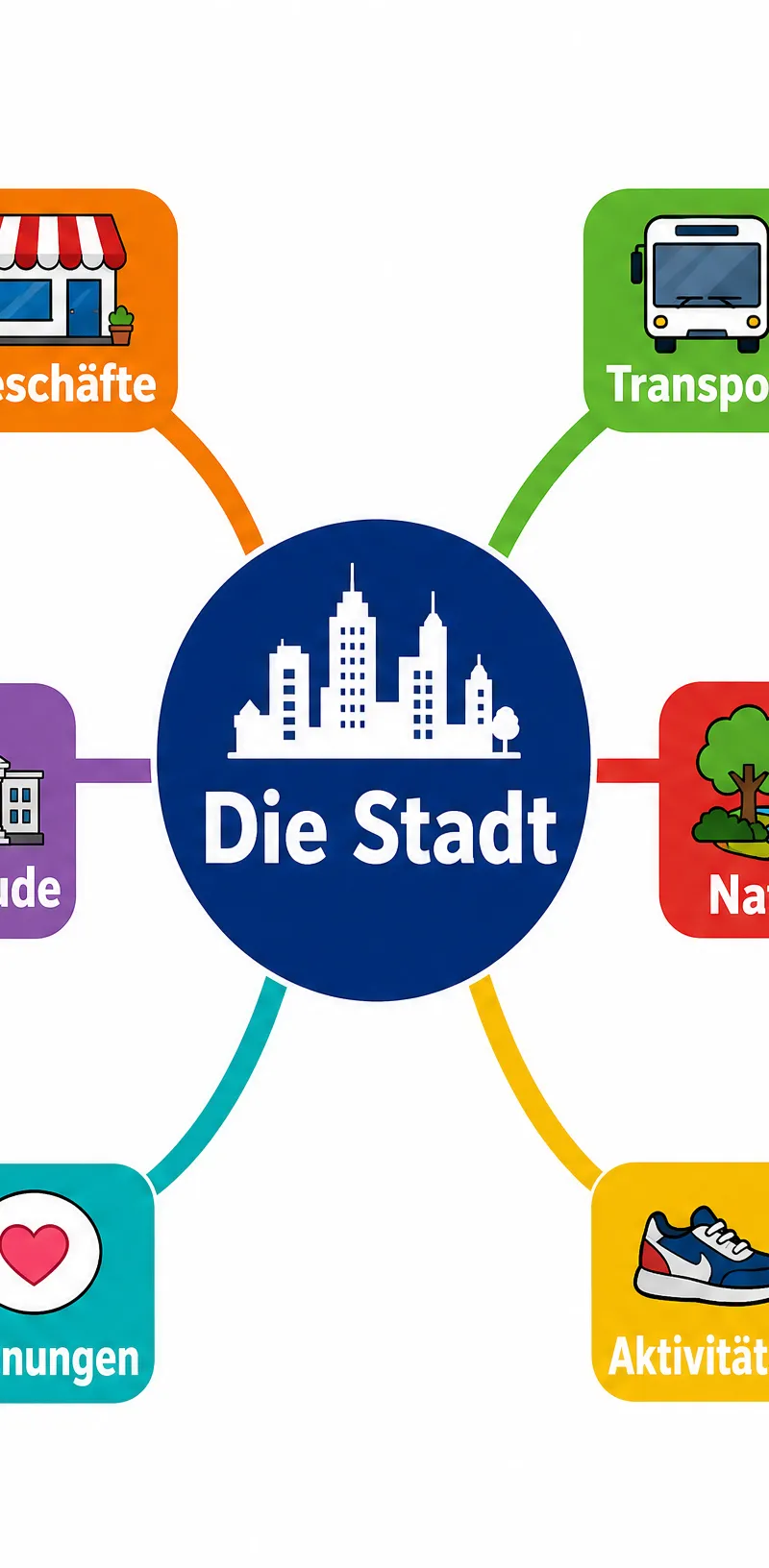
Interactive Diagrams
1 interactive diagram to visualise key concepts
Conceptual Flow Outline
Decision tree for Two-Way Prepositions
Worked Examples
4 worked examples — open one to explore the question and available guidance.
Practice Questions
Try the question, then reveal an answer plan or example response
Translate into German: 1. There is a large park in my town. 2. I went to the cinema yesterday.
Hint: Check the case after 'es gibt'. For sentence 2, remember to use the correct auxiliary verb for movement.
Writing (Foundation): Write about your town (approx. 90 words). Include: what there is in your town, what you think of it, what you did there last weekend, and where you want to live in the future.
Hint: Cover all four bullet points. Keep sentences simple but accurate. Use 'weil' for your opinion and remember verb-to-end.
Speaking (Photo Card): Describe a photo of a busy pedestrian zone. (Say what you see, give an opinion on shopping in town, say what you bought recently).
Hint: Use 'Auf dem Foto gibt es...'. Use the perfect tense for what you bought.
Exam technique
How to turn what you know into marks
How to approach the question
Skill-by-skill strategy: Listening — read questions first, note keywords and negatives. Speaking — prepare opinions in advance, have filler phrases ready ('also', 'naja'). Reading — skim first, then detail, watch for false friends. Writing — plan your tenses before writing, check noun genders and verb endings after.
How to structure your answer
Writing: Introduction → Main points with opinions → Justified reasons (weil/da) → Different tenses (past/future) → Conclusion. Speaking: Give opinion → Justify → Extend with a detail → Use a different tense.
Timing
Listening: 25-35 mins (heard twice). Speaking: 7-12 mins total (role play + photo card + conversation). Reading: 45-60 mins. Writing: 60-75 mins (translation + structured + extended).
Common pitfalls
- Forgetting to change 'ein' to 'einen' after 'es gibt' for masculine nouns.
- Using 'in der' for movement instead of 'in die' or 'in den'.
- Forgetting to send the verb to the end of the clause after 'weil' or 'dass'.
- Using only the present tense in Higher tier writing/speaking tasks.
- Directly translating 'I went' as 'Ich ging' when you mean 'Ich bin gefahren' (travelled by transport).
What the command words want
- Describe the photo
- Say what you can see literally, give an opinion on it, and relate it to your own experience or area.
- Translate into German
- Accuracy is key. Check verb position, noun genders, and case endings. Partial marks are given for partially correct sections.
- Translate into English
- Meaning over word-for-word — capture the sense, ensure it reads as natural English.
- Write approximately 90 words
- Foundation task — ensure ALL four bullet points are covered. Use present tense and attempt at least one past or future reference.
- Write approximately 150 words
- Higher task — must include three time frames (past, present, future), justified opinions, and complex structures (subordinate clauses).
Watch or listen (optional)
Test your understanding of Thematic Context: My neighbourhood
Active recall beats re-reading. Take an instant quiz now to test what you’ve learned and lock it into long-term memory.
7 days Premium · Then the free plan continues · No card, no charge