Pearson Edexcel · GCSE · German
Course version: Pearson-GCSE-German · Version from Mar 2026
Thematic Context: My personal world
Master the essential vocabulary and grammar for the 'Meine persönliche Welt' topic. Learn to describe family and friends, express justified opinions, and use three tenses across Listening, Speaking, Reading, and Writing exams.
- 12 min read
- 4 worked examples
- 6 practice questions
- 8 key terms
Check what you remember
Read the wording for your board, then hide it and explain Infinitive in your own words. Rough notes are fine. This is a self-check, with no mark or grade.
Reference: Pearson Edexcel
The dictionary form of a verb, usually ending in -en (e.g., spielen, machen).
Study Notes

Overview
The 'Meine persönliche Welt' (My Personal World) topic is fundamental to your GCSE German success. It covers family, friends, relationships, and personal identity. Because it's so relatable, examiners expect you to use a wide range of vocabulary and express detailed, justified opinions. This topic frequently appears in the Speaking exam (Role Plays and Photo Cards) and is a common theme for the Extended Writing tasks. Mastering this topic gives you the building blocks to talk about yourself confidently in German.
📖 Essential Vocabulary
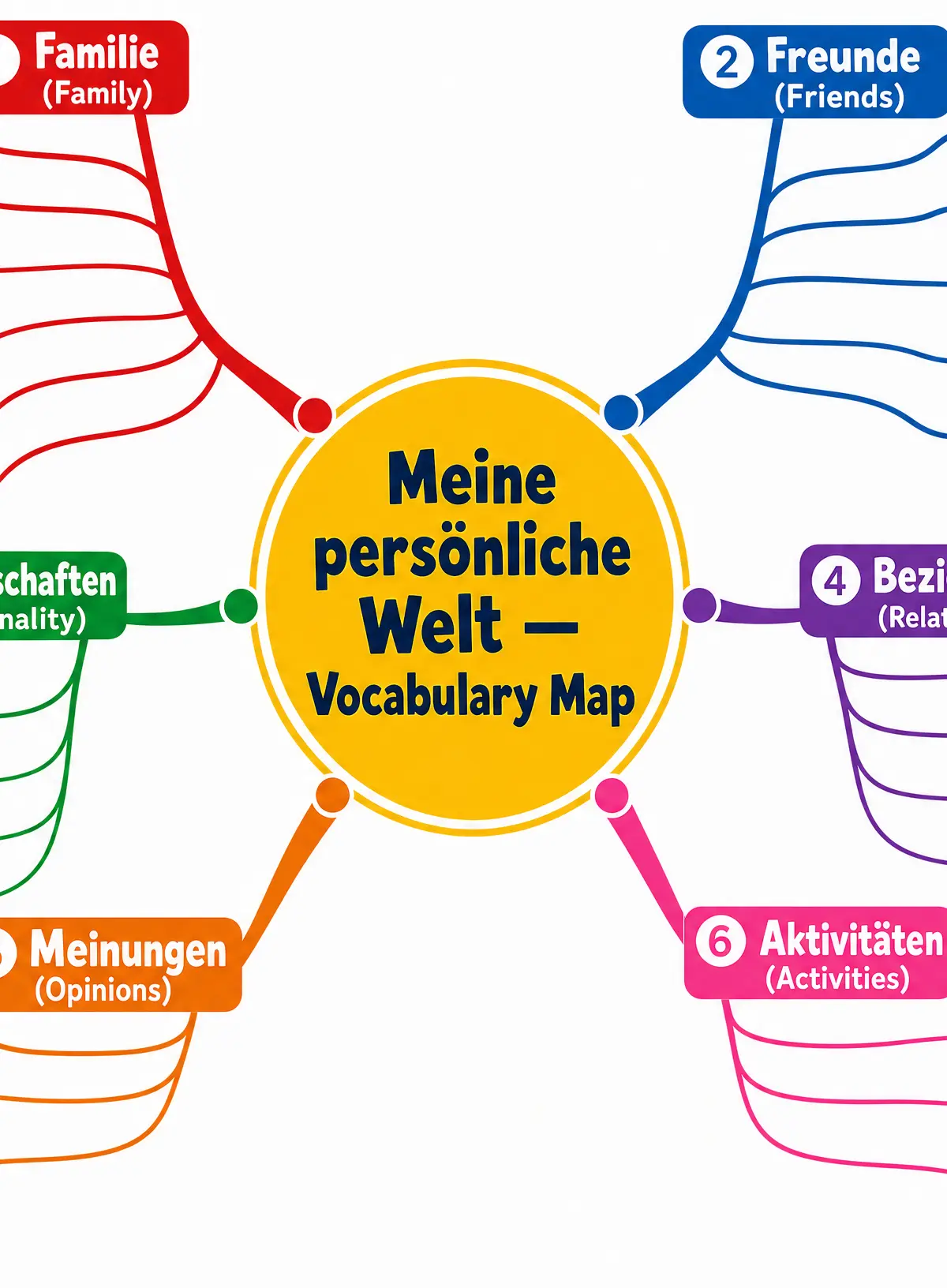
Tier 1 — Foundation Core
| German | English | Gender | Example Sentence |
|---|---|---|---|
| die Familie | family | f | Meine Familie ist sehr groß. |
| die Mutter | mother | f | Meine Mutter heißt Anna. |
| der Vater | father | m | Mein Vater ist streng. |
| die Schwester | sister | f | Ich habe eine Schwester. |
| der Bruder | brother | m | Mein Bruder ist nervig. |
| die Eltern | parents | pl | Meine Eltern sind freundlich. |
| der Freund | friend (male) / boyfriend | m | Mein Freund ist lustig. |
| die Freundin | friend (female) / girlfriend | f | Meine Freundin wohnt hier. |
| nett | nice | - | Er ist sehr nett. |
| lustig | funny | - | Sie ist immer lustig. |
| streng | strict | - | Mein Lehrer ist streng. |
| faul | lazy | - | Mein Bruder ist oft faul. |
| fleißig | hardworking | - | Ich bin ziemlich fleißig. |
| alt | old | - | Mein Großvater ist alt. |
| jung | young | - | Meine Schwester ist jung. |
Tier 2 — Higher Tier
| German | English | Gender | Example Sentence |
|---|---|---|---|
| das Einzelkind | only child | n | Ich bin ein Einzelkind. |
| die Beziehung | relationship | f | Ich habe eine gute Beziehung zu ihr. |
| das Vorbild | role model | n | Meine Mutter ist mein Vorbild. |
| sich verstehen (mit) | to get on (with) | - | Ich verstehe mich gut mit ihm. |
| sich streiten | to argue | - | Wir streiten uns oft. |
| unterstützen | to support | - | Meine Freunde unterstützen mich. |
| vertrauen | to trust | - | Ich kann ihm alles vertrauen. |
| zuverlässig | reliable | - | Ein guter Freund muss zuverlässig sein. |
| ehrgeizig | ambitious | - | Mein Bruder ist sehr ehrgeizig. |
| rücksichtsvoll | considerate | - | Sie ist immer rücksichtsvoll. |
High-Frequency Words & Phrases
| Phrase | English | Usage Context |
|---|---|---|
| Ich komme gut mit... aus | I get on well with... | Describing relationships in Speaking/Writing |
| Meiner Meinung nach | In my opinion | Introducing a justified opinion |
| Auf der einen Seite... auf der anderen Seite... | On the one hand... on the other hand... | Balancing an argument at Higher tier |
| Es geht mir auf die Nerven | It gets on my nerves | Expressing a negative opinion strongly |
| Wir haben viel gemeinsam | We have a lot in common | Describing friendships |
| Im Großen und Ganzen | By and large / On the whole | Summarising a point |
| Das Wichtigste ist, dass... | The most important thing is that... | Concluding an opinion |
| Ich verbringe gern Zeit mit... | I like spending time with... | Describing activities with family/friends |
| Wir streiten uns um... | We argue about... | Explaining family conflicts |
| Ich kann mich immer auf ihn/sie verlassen | I can always rely on him/her | Describing a good friend |
📝 Grammar Focus
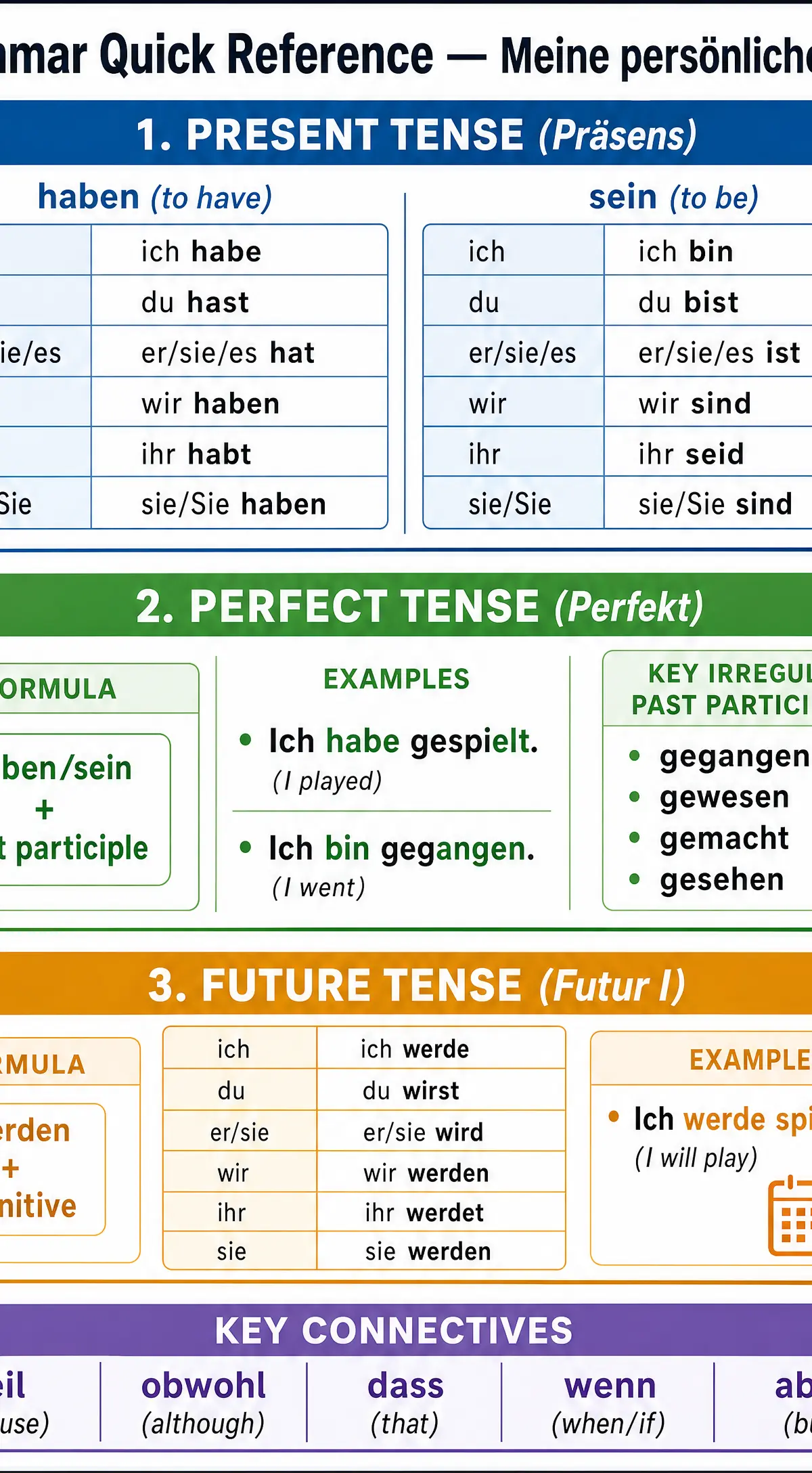
Key Structure 1: The Present Tense (Präsens)
When to use it: To describe facts, current situations, and routines (e.g., describing your family members or what you normally do with friends).
Conjugation Table (Regular verbs e.g., spielen - to play)
| Subject | Verb Form | English |
|---|---|---|
| ich | spiele | I play |
| du | spielst | you play (informal singular) |
| er/sie/es | spielt | he/she/it plays |
| wir | spielen | we play |
| ihr | spielt | you play (informal plural) |
| sie/Sie | spielen | they play / you play (formal) |
Irregulars to learn: sein (ich bin, du bist, er ist...), haben (ich habe, du hast, er hat...), werden (ich werde, du wirst, er wird...)
Key Structure 2: The Perfect Tense (Perfekt)
When to use it: To talk about events in the past in spoken German and informal writing. Essential for answering "What did you do last weekend?" questions.
Conjugation Table (haben/sein + Past Participle)
| Subject | Auxiliary (haben) | Auxiliary (sein) | Past Participle |
|---|---|---|---|
| ich | habe | bin | gespielt / gegangen |
| du | hast | bist | gespielt / gegangen |
| er/sie/es | hat | ist | gespielt / gegangen |
| wir | haben | sind | gespielt / gegangen |
| ihr | habt | seid | gespielt / gegangen |
| sie/Sie | haben | sind | gespielt / gegangen |
Irregulars to learn: gegangen (gone), gewesen (been), gesehen (seen), gemacht (done/made), gegessen (eaten)
Key Structure 3: Subordinating Conjunctions (weil, dass, obwohl, wenn)
When to use it: To extend sentences and justify opinions. This is a crucial skill for reaching higher grades.
Rule: The verb goes to the END of the clause.
| Main Clause | Conjunction | Subject | Details | Verb at the end |
|---|---|---|---|---|
| Ich liebe meine Familie, | weil | sie | immer nett | ist. |
| Ich denke, | dass | ein guter Freund | zuverlässig sein | muss. |
| Wir streiten uns oft, | obwohl | wir uns | eigentlich gut | verstehen. |
🎧 Listening Skills
Listen to our 10-minute podcast episode covering vocabulary, grammar, and exam tips for this topic!
What to Expect
You will hear short monologues, conversations, or interviews about family life, friendship qualities, and relationship problems. Questions may be multiple-choice, matching, or short written answers in English or German.
Listening Strategies
- Listen for qualifiers: Words like ziemlich (quite), sehr (very), or zu (too) can change the meaning of an adjective.
- Watch out for negatives: nicht (not), kein (no/none), and nie (never) completely flip the meaning of a sentence.
- Identify the tense: Listen for habe/bin + ge- (past) or werde (future) to know when the action is happening.
Common Listening Traps
- Distractors: You might hear someone mention that their brother is faul (lazy), but the question asks about their father. Don't just write down the first adjective you hear.
- False Friends: sympathisch means nice/likeable, NOT sympathetic. sensibel means sensitive, NOT sensible.
🗣️ Speaking Skills
Role Play Scenarios
Scenario 1: Talking to a German exchange partner about family
- Teacher: Wie viele Personen gibt es in deiner Familie?
- You: In meiner Familie gibt es vier Personen: meine Eltern, meinen Bruder und mich.
- Teacher: Wie verstehst du dich mit deinem Bruder?
- You: Ich verstehe mich gut mit ihm, obwohl er manchmal nervig ist.
Photo Card Practice
Model Photo Card Response:
- Qu 1 (Description - Was gibt es auf dem Foto?): Auf dem Foto sehe ich eine Familie. Es gibt eine Mutter, einen Vater und zwei Kinder. Sie sitzen im Wohnzimmer und sie lachen. Ich glaube, sie sind glücklich.
- Qu 2 (Opinion - Wie findest du deine Familie?): Ich finde meine Familie toll, weil meine Eltern sehr verständnisvoll sind. Wir verbringen viel Zeit zusammen.
- Qu 3 (Related topic - Was machst du gern mit deinen Freunden?): Am Wochenende gehe ich gern mit meinen Freunden ins Kino, weil wir die gleichen Filme mögen.
- Qu 4 (Past - Was hast du letztes Wochenende mit deiner Familie gemacht?): Letztes Wochenende sind wir in den Park gegangen und wir haben ein Picknick gemacht. Es war sehr schön.
- Qu 5 (Future - Möchtest du später heiraten?): Ja, in der Zukunft möchte ich heiraten, weil eine eigene Familie für mich sehr wichtig ist.
General Conversation Questions
| Question (German) | Model Answer | English Translation |
|---|---|---|
| Beschreib mir deinen besten Freund / deine beste Freundin. | Mein bester Freund heißt Lukas. Er ist groß und sportlich. Er ist auch sehr lustig und wir lachen viel zusammen. | Describe your best friend. (My best friend is called Lukas. He is tall and sporty. He is also very funny and we laugh a lot together.) |
| Wie verstehst du dich mit deiner Familie? | Meistens verstehe ich mich gut mit meinen Eltern, aber manchmal streite ich mich mit meinem jüngeren Bruder, weil er meine Sachen nimmt. | How do you get on with your family? (Mostly I get on well with my parents, but sometimes I argue with my younger brother because he takes my things.) |
| Was hast du letztes Wochenende mit deinen Freunden gemacht? | Letztes Wochenende sind wir in die Stadt gefahren. Wir haben Pizza gegessen und dann haben wir einen Film gesehen. Es war fantastisch! | What did you do last weekend with your friends? (Last weekend we travelled into town. We ate pizza and then we watched a film. It was fantastic!) |
| Was wirst du nächstes Wochenende mit deiner Familie machen? | Nächstes Wochenende werden wir meine Großeltern besuchen. Wir werden zusammen im Restaurant essen, um den Geburtstag meiner Oma zu feiern. | What will you do next weekend with your family? (Next weekend we will visit my grandparents. We will eat together in a restaurant to celebrate my grandma's birthday.) |
| Was ist wichtiger: Familie oder Freunde? | Meiner Meinung nach sind beide wichtig. Freunde sind toll für Spaß, aber die Familie unterstützt dich immer, wenn du Probleme hast. | What is more important: family or friends? (In my opinion both are important. Friends are great for fun, but family always supports you when you have problems.) |
✍️ Writing Skills
Translation Practice
English → German:
| English | German | Key Grammar |
|---|---|---|
| I have a small family. | Ich habe eine kleine Familie. | Adjective agreement (accusative feminine) |
| My sister is very annoying. | Meine Schwester ist sehr nervig. | Basic present tense and adjective |
| I get on well with my father. | Ich verstehe mich gut mit meinem Vater. | Reflexive verb + dative preposition |
| Last weekend I played football with my friends. | Letztes Wochenende habe ich mit meinen Freunden Fußball gespielt. | Perfect tense (haben) + time phrase word order |
| Next year I will visit my grandparents. | Nächstes Jahr werde ich meine Großeltern besuchen. | Future tense (werden) + time phrase word order |
Extended Writing
Model 90-word response (Foundation):
Topic: Your family and friends
Ich habe eine mittelgroße Familie. Es gibt meine Eltern, meine Schwester und mich. Meine Schwester heißt Lisa und sie ist fünfzehn Jahre alt. Sie ist ziemlich freundlich, aber manchmal ist sie faul. Ich verstehe mich gut mit meinen Eltern, weil sie nett sind.
In meiner Freizeit verbringe ich gern Zeit mit meinen Freunden. Letztes Wochenende sind wir ins Kino gegangen. Es war sehr lustig! Nächstes Wochenende werde ich mit meiner Familie Fußball spielen. Ich liebe meine Familie und meine Freunde.
Model 150-word response (Higher):
Topic: Relationships and future plans
In meiner Familie gibt es vier Personen. Im Großen und Ganzen verstehe ich mich sehr gut mit meinen Eltern, weil sie ziemlich verständnisvoll und geduldig sind. Jedoch streite ich mich ab und zu mit meinem älteren Bruder, da er oft rücksichtslos ist und meine Musik hasst!
Meiner Meinung nach sind Freunde genauso wichtig wie die Familie. Ein guter Freund muss zuverlässig und ehrlich sein, damit man ihm alles vertrauen kann. Letztes Wochenende habe ich meinen Geburtstag mit meiner Clique gefeiert. Wir sind in ein italienisches Restaurant gegangen und danach haben wir bei mir übernachtet. Es war ein unvergessliches Erlebnis!
In der Zukunft möchte ich auf jeden Fall heiraten und Kinder haben, obwohl das sehr teuer sein kann. Zuerst werde ich aber an der Uni studieren und mit meinen Freunden die Welt bereisen.
Writing Checklist
- ✅ Have I used at least three tenses (Present, Past, Future)?
- ✅ Have I given opinions and justified them using weil or da (verb to the end)?
- ✅ Have I checked my adjective agreements (e.g., mein guter Freund, meine kleine Schwester)?
- ✅ Have I used connectives (und, aber, obwohl, jedoch) to link sentences?
- ✅ Is my word order correct? (Verb as the 2nd idea in a main clause, verb at the end after weil).
📚 Reading Skills
Key Strategies
- Skim read first: Get the gist of the text before looking at the questions. Is it a positive or negative description?
- Look for pronouns: Pay attention to er (he), sie (she/they), sein (his), and ihr (her/their) to understand exactly who is doing what.
- Use context clues: If you don't know a word, look at the rest of the sentence. If someone is arguing (streiten), the unknown adjective is probably negative.
False Friends & Tricky Words
| Word | Looks Like | Actually Means |
|---|---|---|
| sympathisch | sympathetic | nice / likeable |
| sensibel | sensible | sensitive |
| vernünftig | - | sensible / reasonable |
| die Eltern | elders | parents |
| der Freund | friend | can mean friend OR boyfriend |
🌍 Cultural Knowledge
In Germany, the concept of friendship (Freundschaft) is taken very seriously. Germans often distinguish between Bekannte (acquaintances) and Freunde (close friends). It can take longer to become true Freunde in Germany than in the UK, but once established, these friendships are deep and long-lasting.
Also, when talking to friends and family, Germans always use the informal du (singular) or ihr (plural). The formal Sie is strictly reserved for teachers, strangers, and professional situations. Mentioning this cultural nuance in your speaking or writing can impress examiners!
Visual Resources
2 diagrams and illustrations
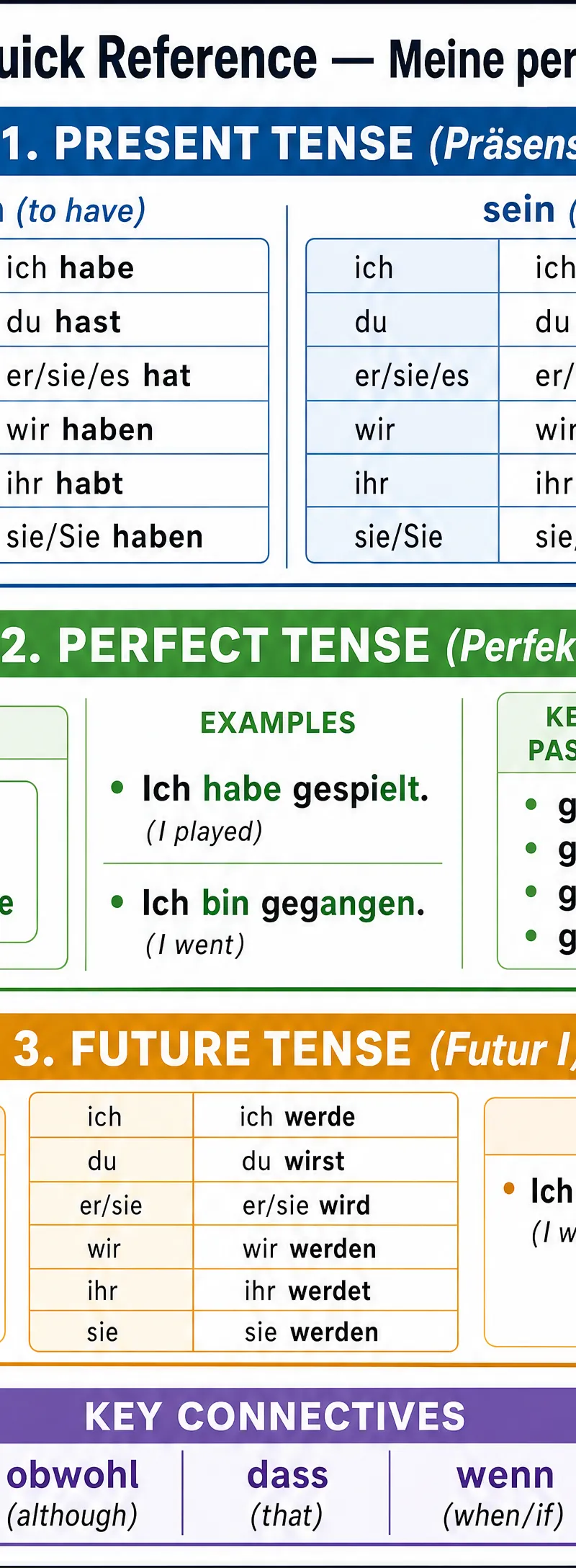
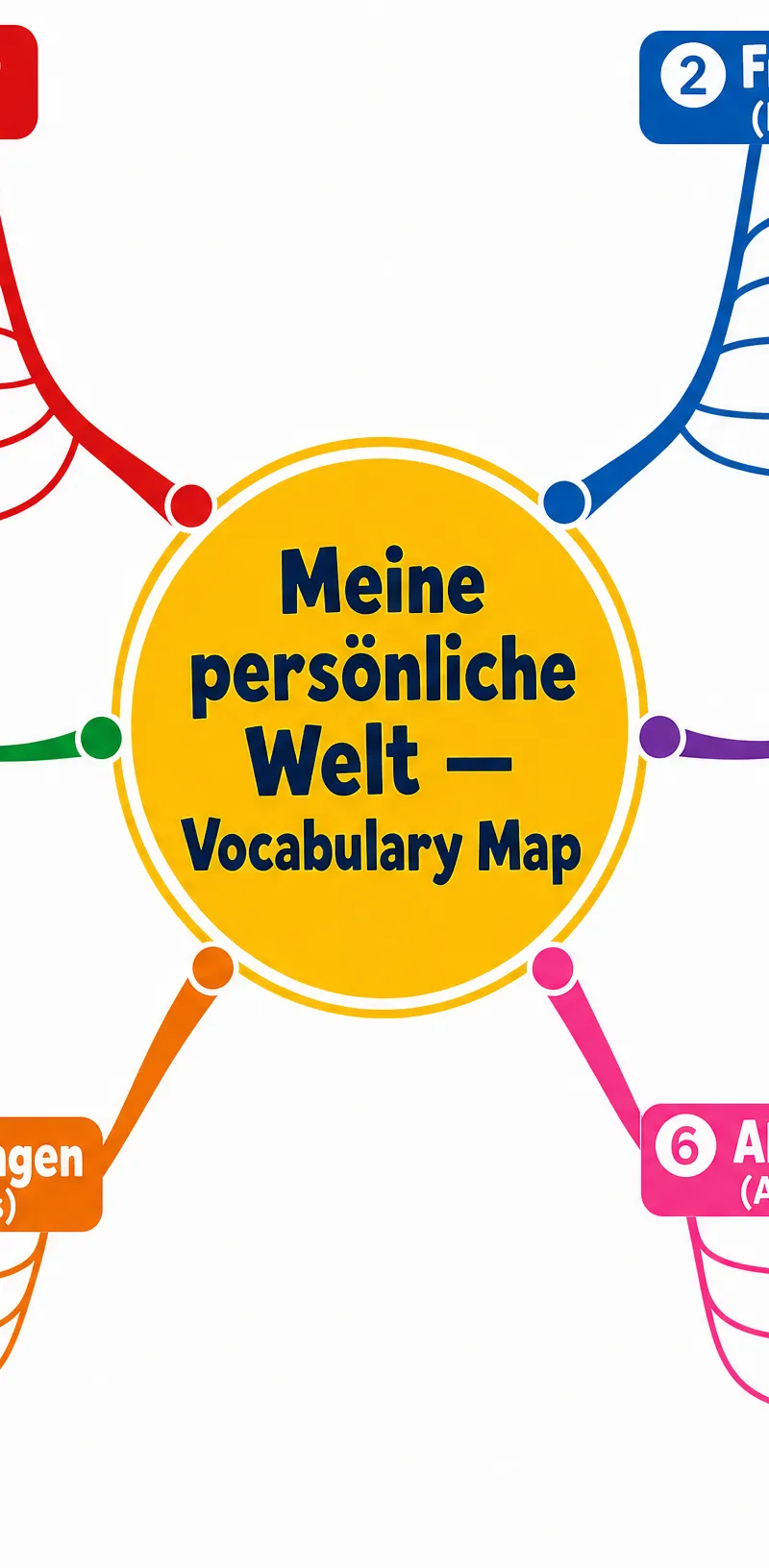
Interactive Diagrams
1 interactive diagram to visualise key concepts
Conceptual Flow Outline
Structure for a high-scoring response
Worked Examples
4 worked examples — open one to explore the question and available guidance.
Practice Questions
Try the question, then reveal an answer plan or example response
Writing (Foundation): Write approx 90 words about your family. Include: a description of a family member, what you do together, an opinion on your family, and a future plan.
Hint: Use present tense for descriptions, 'werden' for the future plan, and 'weil' for your opinion.
Translation (Higher): Translate into German: 'I get on well with my sister because she is very funny. Next weekend we will go to the cinema.'
Hint: Remember the reflexive pronoun for 'get on well'. Watch the verb position after 'weil'.
Speaking (Conversation): Was sind die Eigenschaften eines guten Freundes? (What are the qualities of a good friend?)
Hint: Use 'Ein guter Freund muss... sein' (A good friend must be...) and list 2-3 adjectives.
Reading (Standard): Read the text: 'Früher war mein Bruder sehr nervig, aber jetzt verstehen wir uns besser.' True or False: The siblings get on better now than in the past.
Hint: Look at the time words 'früher' (formerly/in the past) and 'jetzt' (now).
Listening (Higher): You hear: 'Ich bin ein Einzelkind. Manchmal ist das langweilig, aber ich habe viele Cousins.' Question: What is the speaker's family situation and how do they feel about it?
Hint: Listen for the word 'Einzelkind'.
Writing (Higher): Write approx 150 words about a recent argument with a friend and how you resolved it.
Hint: Focus heavily on the perfect tense for the narrative, use emotion adjectives.
Exam technique
How to turn what you know into marks
How to approach the question
Skill-by-skill strategy: Listening — read questions first, note keywords. Speaking — prepare opinions in advance, have fillers ready. Reading — skim first, then detail. Writing — plan before writing, check accuracy after.
How to structure your answer
Writing: Introduction → Main points with opinions → Justified reasons → Different tenses → Conclusion. Speaking: Give opinion → Justify → Extend → Use different tense.
Timing
Listening: 25 mins (heard twice). Speaking: 7-12 mins total (role play + photo card + conversation). Reading: 45-60 mins. Writing: 60-75 mins (translation + structured + extended).
Common pitfalls
- Forgetting adjective agreements (gender & number)
- Using only the present tense — examiners want at least 3 tenses at Higher
- Giving one-word Speaking answers instead of developing responses
- Not checking verb endings in Writing
- Confusing false friends like sympathisch and sensibel in Listening/Reading
- Not justifying opinions with 'weil' or 'da'
What the command words want
- Describe the photo
- Say what you can see (Auf dem Foto gibt es...), give an opinion, relate to your own experience
- Translate into German
- Write full sentences with correct grammar — partial marks are awarded for partially correct phrases
- Translate into English
- Meaning over word-for-word — capture the sense, don't guess false friends
- Write approximately 90 words
- Foundation task — cover all 4 bullet points, use present + one other tense (past or future)
- Write approximately 150 words
- Higher task — 3 tenses essential, opinions with justification, complex structures (subordinate clauses), ambitious vocabulary
Watch or listen (optional)
Test your understanding of Thematic Context: My personal world
Active recall beats re-reading. Take an instant quiz now to test what you’ve learned and lock it into long-term memory.
7 days Premium · Then the free plan continues · No card, no charge