Pearson Edexcel · GCSE · German
Course version: Pearson-GCSE-German · Version from Mar 2026
Thematic Context: Studying and my future
This study guide covers the essential vocabulary, grammar, and exam techniques for the GCSE German topic 'Studying and my future'. It includes key terms for school subjects and careers, structures for expressing opinions, and the three crucial tenses needed for top marks.
- 11 min read
- 4 worked examples
- 6 practice questions
- 8 key terms
Check what you remember
Read the wording for your board, then hide it and explain Infinitive in your own words. Rough notes are fine. This is a self-check, with no mark or grade.
Reference: Pearson Edexcel
The 'dictionary form' of a verb, usually ending in -en (e.g., machen, spielen).
Study Notes

Overview
This thematic context focuses on your life at school, your opinions on subjects, and your future career aspirations. It is a critical topic that frequently appears across all four exam papers (Listening, Speaking, Reading, and Writing). Examiners particularly look for your ability to use three timeframes (past, present, future) and to justify your opinions when discussing school and jobs.
📖 Essential Vocabulary
Tier 1 — Foundation Core
| German | English | Gender | Example Sentence |
|---|---|---|---|
| die Schule | school | f | Ich gehe gern in die Schule. |
| das Fach | subject | n | Mein Lieblingsfach ist Deutsch. |
| die Hausaufgaben | homework | f (pl) | Ich mache meine Hausaufgaben. |
| der Lehrer / die Lehrerin | teacher | m/f | Der Lehrer ist sehr streng. |
| die Pause | break | f | In der Pause esse ich einen Apfel. |
| die Prüfung | exam/test | f | Ich habe morgen eine Prüfung. |
| das Zeugnis | school report | n | Mein Zeugnis ist sehr gut. |
| der Beruf | job/profession | m | Welchen Beruf möchtest du? |
| die Arbeit | work | f | Die Arbeit ist interessant. |
| das Büro | office | n | Mein Vater arbeitet im Büro. |
| verdienen | to earn | - | Ich möchte viel Geld verdienen. |
| lernen | to learn/study | - | Ich lerne jeden Tag. |
| schwer | difficult | - | Mathe ist sehr schwer. |
| einfach | easy | - | Englisch ist ziemlich einfach. |
| wichtig | important | - | Bildung ist sehr wichtig. |
Tier 2 — Higher Tier
| German | English | Gender | Example Sentence |
|---|---|---|---|
| die Ausbildung | apprenticeship | f | Ich werde eine Ausbildung machen. |
| das Abitur | A-Levels (equivalent) | n | Ich möchte das Abitur bestehen. |
| die Erfahrung | experience | f | Arbeitserfahrung ist nützlich. |
| das Gehalt | salary | n | Ein gutes Gehalt ist mir wichtig. |
| der Traumberuf | dream job | m | Mein Traumberuf ist Arzt. |
| die Verantwortung | responsibility | f | Ich möchte viel Verantwortung haben. |
| selbstständig | independent | - | Ich möchte selbstständig arbeiten. |
| sich bewerben um | to apply for | - | Ich werde mich um den Job bewerben. |
| erfolgreich | successful | - | Ich hoffe, erfolgreich zu sein. |
| die Zukunft | the future | f | In der Zukunft werde ich reisen. |
High-Frequency Words & Phrases
| Phrase | English | Usage Context |
|---|---|---|
| Meiner Meinung nach | In my opinion | Starting an opinion sentence |
| Ich finde, dass | I find that | Giving a complex opinion (verb to end) |
| auf der einen Seite | on the one hand | Structuring a balanced argument |
| auf der anderen Seite | on the other hand | Structuring a balanced argument |
| um ... zu | in order to | Explaining purpose (e.g., um Geld zu verdienen) |
| Ich freue mich auf | I am looking forward to | Discussing future plans |
| Ich interessiere mich für | I am interested in | Discussing subjects or careers |
| im Vergleich zu | in comparison to | Comparing subjects or jobs |
| Es macht Spaß | It is fun | Giving a simple reason |
| Das Wichtigste ist | The most important thing is | Prioritising ideas |
📝 Grammar Focus
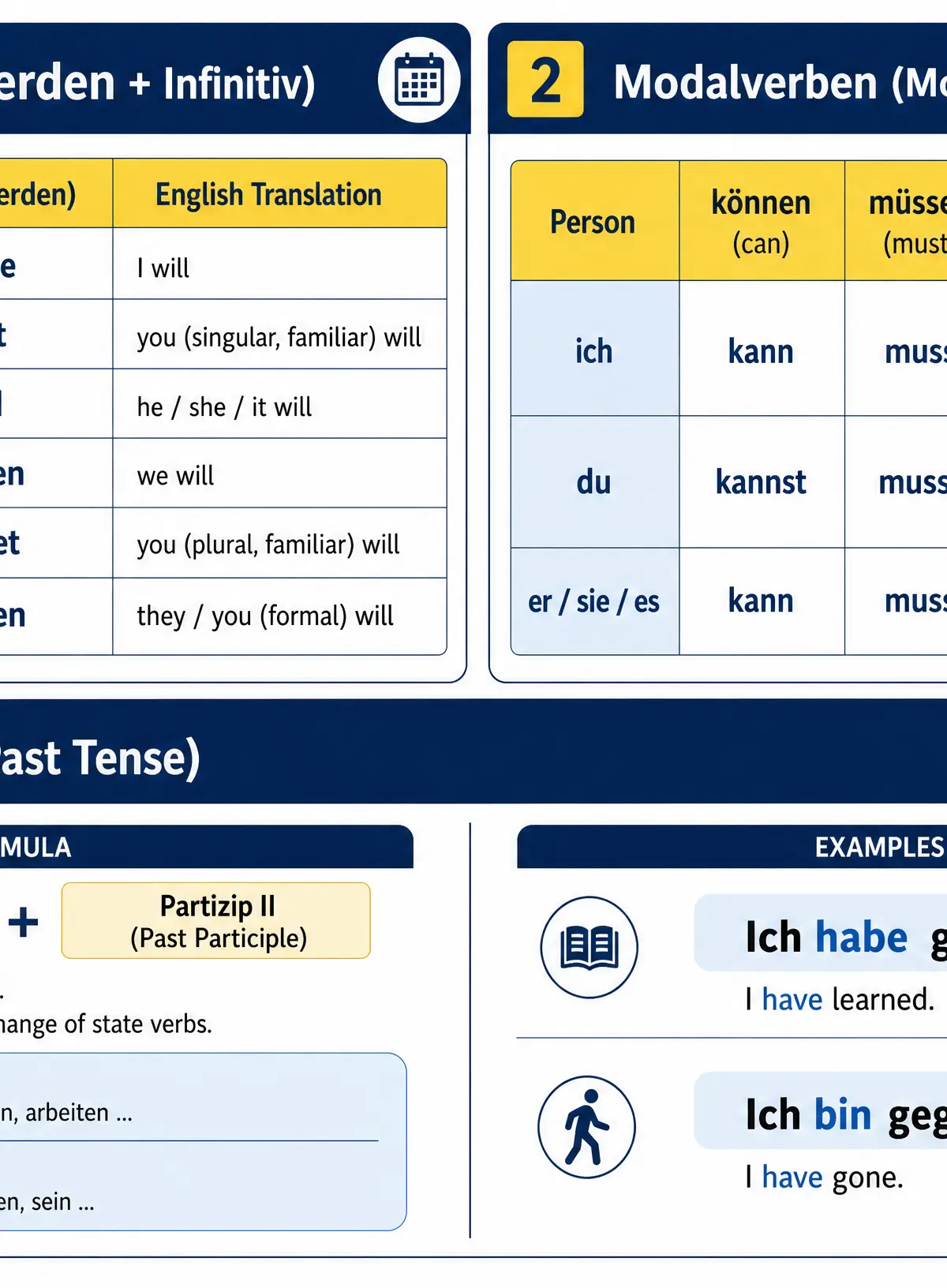
Key Structure 1: Perfekt (The Perfect Tense)
When to use it: To talk about what you did in the past (e.g., past work experience, primary school).
Formula: Subject + Auxiliary Verb (haben/sein) + ... + Past Participle
Conjugation Table (haben vs sein)
| Subject | Auxiliary (haben) | Auxiliary (sein) | Example |
|---|---|---|---|
| ich | habe | bin | Ich habe gelernt / Ich bin gegangen |
| du | hast | bist | Du hast gespielt / Du bist gefahren |
| er/sie/es | hat | ist | Er hat gearbeitet / Sie ist geflogen |
| wir | haben | sind | Wir haben gegessen / Wir sind gekommen |
| ihr | habt | seid | Ihr habt gemacht / Ihr seid geblieben |
| sie/Sie | haben | sind | Sie haben gelesen / Sie sind gelaufen |
Irregulars to learn: gearbeitet (worked), gelesen (read), geschrieben (written), gesehen (seen).
Key Structure 2: Futur I (The Future Tense)
When to use it: Essential for discussing future career plans and university intentions.
Formula: Subject + werden + ... + Infinitive
Conjugation Table (werden)
| Subject | Verb Form | English |
|---|---|---|
| ich | werde | I will |
| du | wirst | you will |
| er/sie/es | wird | he/she/it will |
| wir | werden | we will |
| ihr | werdet | you (pl) will |
| sie/Sie | werden | they/you (formal) will |
Key Structure 3: Modal Verbs (Modalverben)
When to use it: To express obligation (müssen), ability (können), permission (dürfen), or desire (wollen/möchten). Crucial for school rules and job requirements.
Formula: Subject + Modal Verb + ... + Infinitive
Conjugation Table
| Subject | müssen (must) | können (can) | wollen (want) | dürfen (may) |
|---|---|---|---|---|
| ich | muss | kann | will | darf |
| du | musst | kannst | willst | darfst |
| er/sie/es | muss | kann | will | darf |
| wir | müssen | können | wollen | dürfen |
| ihr | müsst | könnt | wollt | dürft |
| sie/Sie | müssen | können | wollen | dürfen |
🎧 Listening Skills
What to Expect
Audio clips of German teenagers discussing their school day, their opinions on teachers, or their plans for apprenticeships and university.
Listening Strategies
- Read ahead: Use the reading time to predict vocabulary. If the question is about 'rules', listen for 'müssen' or 'nicht dürfen'.
- Listen for qualifiers: Words like sehr (very), zu (too), ziemlich (quite), and gar nicht (not at all) often change the answer.
- Watch for tenses: A speaker might say they wanted to be a vet, but now they want to be a teacher. Listen for früher (previously) vs jetzt (now).
Common Listening Traps
- Negatives: Missing a small nicht or kein will completely reverse the meaning.
- False Friends: Hearing Gymnasium and thinking 'gym' (it means grammar school).
🗣️ Speaking Skills
Role Play Scenarios
Scenario 1: Discussing work experience with a German friend.
- Friend: Wo hast du dein Arbeitspraktikum gemacht?
- You: Ich habe in einem Büro gearbeitet. Es war sehr interessant, aber ein bisschen langweilig.
Scenario 2: Talking to a teacher about future plans.
- Teacher: Was wirst du nächstes Jahr machen?
- You: Nächstes Jahr werde ich auf die Universität gehen, um Medizin zu studieren.
Photo Card Practice
Model Photo Card Response:
- Qu 1 (Description): Auf dem Foto gibt es drei Schüler. Sie sitzen an einem Schreibtisch und sie machen ihre Hausaufgaben. Sie sehen konzentriert aus.
- Qu 2 (Opinion): Meiner Meinung nach sind Hausaufgaben wichtig, weil man viel lernt. Aber manchmal haben wir zu viele Hausaufgaben.
- Qu 3 (Related topic): Mein Lieblingsfach ist Geschichte, weil der Lehrer sehr lustig ist.
- Qu 4 (Past): Gestern habe ich drei Stunden für meine Matheprüfung gelernt. Es war sehr anstrengend.
- Qu 5 (Future): In der Zukunft möchte ich als Journalist arbeiten, weil ich gern schreibe und reise.
General Conversation Questions
| Question (German) | Model Answer | English Translation |
|---|---|---|
| Beschreib deine Schule. | Meine Schule ist ziemlich groß und modern. Es gibt etwa tausend Schüler. | Describe your school. / My school is quite big and modern. There are about a thousand students. |
| Was ist dein Lieblingsfach? | Mein Lieblingsfach ist Kunst, weil ich kreativ bin und der Lehrer sehr nett ist. | What is your favourite subject? / My favourite subject is art because I am creative and the teacher is very nice. |
| Was hast du gestern in der Pause gemacht? | Gestern in der Pause habe ich mit meinen Freunden geplaudert und ein Sandwich gegessen. | What did you do yesterday at break? / Yesterday at break I chatted with my friends and ate a sandwich. |
| Möchtest du auf die Universität gehen? | Ja, ich werde auf die Uni gehen, um Informatik zu studieren, weil ich Computer liebe. | Would you like to go to university? / Yes, I will go to uni to study computer science because I love computers. |
| Was ist dein Traumberuf? | Mein Traumberuf ist Pilot, weil ich gern reisen möchte und das Gehalt sehr gut ist. | What is your dream job? / My dream job is a pilot because I would like to travel and the salary is very good. |
✍️ Writing Skills
Translation Practice
English → German:
| English | German | Key Grammar |
|---|---|---|
| I learn German. | Ich lerne Deutsch. | Present tense |
| Maths is very difficult. | Mathe ist sehr schwer. | Adjectives |
| Yesterday I did my homework. | Gestern habe ich meine Hausaufgaben gemacht. | Perfect tense (haben) |
| I must study every day. | Ich muss jeden Tag lernen. | Modal verbs (müssen) |
| Next year I will go to university. | Nächstes Jahr werde ich auf die Universität gehen. | Future tense (werden) |
Extended Writing
**Model 90-word response (Foundation):**Meine Schule ist ziemlich groß. Mein Lieblingsfach ist Englisch, weil es interessant ist. Ich mag Mathe nicht, weil es zu schwer ist. Gestern in der Pause habe ich einen Apfel gegessen und Fußball gespielt. Nächstes Jahr werde ich eine Ausbildung machen. Ich möchte Mechaniker werden, weil ich Autos liebe.
**Model 150-word response (Higher):**Ich besuche eine große Gesamtschule in London. Einerseits mag ich meine Schule, weil meine Freunde dort sind, aber andererseits haben wir zu viele Regeln. Zum Beispiel dürfen wir keine Handys benutzen. Mein Lieblingsfach ist Biologie, da ich mich für Naturwissenschaften interessiere und die Lehrerin sehr hilfsbereit ist.
Gestern war ein anstrengender Tag. Ich habe drei Stunden in der Bibliothek gelernt, weil ich nächste Woche Prüfungen habe. Danach bin ich mit dem Bus nach Hause gefahren.
In der Zukunft habe ich vor, auf die Universität zu gehen, um Medizin zu studieren. Mein Traumberuf ist Arzt. Obwohl das Studium sehr lang und schwer ist, möchte ich Menschen helfen. Außerdem ist das Gehalt ziemlich gut!
Writing Checklist
- ✅ Three timeframes used (Past, Present, Future)
- ✅ Opinions given AND justified (weil/da/denn)
- ✅ Complex structures (um... zu, infinitive clauses)
- ✅ Verb positioning correct (V2 in main clauses, end of clause after weil/dass)
- ✅ Adjective endings and noun genders checked
📚 Reading Skills
Key Strategies
- Read the questions first: Know what information you are hunting for.
- Use logic: If the text is about a part-time job, expect vocabulary about money, hours, and bosses.
- Look for time markers: Letztes Jahr (last year), heute (today), in zehn Jahren (in ten years).
False Friends & Tricky Words
| Word | Looks Like | Actually Means |
|---|---|---|
| das Gymnasium | a gym | a grammar school |
| der Chef | a chef (cook) | the boss/manager |
| die Rente | rent | pension |
| aktuell | actual | current/up-to-date |
🌍 Cultural Knowledge
In Germany, the school system is tracked early. After primary school (Grundschule), students usually go to one of three types of secondary schools: the Hauptschule (vocational track), the Realschule (intermediate track), or the Gymnasium (academic track leading to the Abitur and university).
Apprenticeships (die Ausbildung) are highly respected in Germany through the "Dual System" (Duales System), where students split their time between a vocational school and practical work at a company. Mentioning the Abitur or an Ausbildung in your speaking or writing shows excellent cultural awareness!
Visual Resources
2 diagrams and illustrations
Interactive Diagrams
1 interactive diagram to visualise key concepts
Conceptual Flow Outline
MFL exam approach by skill
Worked Examples
4 worked examples — open one to explore the question and available guidance.
Practice Questions
Try the question, then reveal an answer plan or example response
Writing: Write 90 words about your school life. Mention: what your school is like, your favourite subject, what you did at break yesterday, and what you will do next year.
Hint: Ensure you cover all 4 bullet points equally. Use the present, perfect, and future tenses.
Speaking (Conversation): Was möchtest du in der Zukunft als Beruf machen?
Hint: Name a job, give a reason why, and mention something about the salary or conditions.
Translation: Translate into German: 'I must do my homework because exams are important.'
Hint: Use the modal verb 'müssen' and remember what 'because' does to the verb order.
Reading: Read the text: 'Nach dem Abitur habe ich vor, ein Jahr Pause zu machen. Ich will durch Europa reisen, bevor ich an der Uni studiere.' Was plant die Person direkt nach der Schule?
Hint: Look for the action happening *before* university.
Listening: You hear 'Ich finde Chemie furchtbar, aber Physik ist mein Lieblingsfach.' Which subject does the speaker dislike?
Hint: Listen for the negative adjective 'furchtbar'.
Writing: Write 150 words about work experience and future plans. Include opinions on your work experience, what you did there, and your long-term career goals.
Hint: Use complex sentences, at least three tenses, and ambitious vocabulary.
Exam technique
How to turn what you know into marks
How to approach the question
Skill-by-skill strategy: Listening — read questions first, note keywords. Speaking — prepare opinions in advance, have fillers ready. Reading — skim first, then detail. Writing — plan before writing, check accuracy after.
How to structure your answer
Writing: Introduction → Main points with opinions → Justified reasons → Different tenses → Conclusion. Speaking: Give opinion → Justify → Extend → Use different tense.
Timing
Listening: 25-35 mins. Speaking: 7-12 mins total. Reading: 45-60 mins. Writing: 60-75 mins.
Common pitfalls
- Forgetting adjective agreements (gender & number)
- Using only the present tense — examiners want at least 3 tenses at Higher
- Giving one-word Speaking answers instead of developing responses
- Not sending the verb to the end after 'weil' or 'dass'
- Confusing false friends like Gymnasium and Chef
- Using 'haben' instead of 'sein' for movement verbs in the past tense
What the command words want
- Describe the photo
- Say what you can see (Es gibt...), give an opinion, relate to your experience
- Translate into German
- Write full sentences with correct grammar — partial marks are given for partially correct grammar
- Translate into English
- Meaning over word-for-word — capture the sense, don't guess cognates blindly
- Write approximately 90 words
- Foundation task — cover all 4 bullet points equally, use present + one other tense
- Write approximately 150 words
- Higher task — 3 tenses essential, complex structures, ambitious vocabulary required
Watch or listen (optional)
Test your understanding of Thematic Context: Studying and my future
Active recall beats re-reading. Take an instant quiz now to test what you’ve learned and lock it into long-term memory.
7 days Premium · Then the free plan continues · No card, no charge