Pearson Edexcel · GCSE · German
Course version: Pearson-GCSE-German · Version from Mar 2026
Thematic Context: Travel and tourism
This comprehensive guide covers the essential vocabulary and grammar for the Travel and Tourism thematic context. It focuses on transport, accommodation, and expressing justified opinions across three tenses, preparing candidates for Listening, Speaking, Reading, and Writing exams.
- 12 min read
- 4 worked examples
- 6 practice questions
- 8 key terms
Check what you remember
Read the wording for your board, then hide it and explain Das Perfekt (Perfect Tense) in your own words. Rough notes are fine. This is a self-check, with no mark or grade.
Reference: Pearson Edexcel
The spoken past tense, formed with an auxiliary verb (haben or sein) and a past participle.
Study Notes
Overview
The Travel and Tourism (Reisen und Tourismus) thematic context is a core component of the GCSE German specification across all major exam boards. It requires candidates to understand and communicate about holidays, transport, accommodation, and tourist attractions. This topic appears in all four skills (Listening, Speaking, Reading, and Writing) and is an excellent opportunity to showcase complex grammar, such as using three timeframes and subordinating conjunctions to justify opinions.
📖 Essential Vocabulary
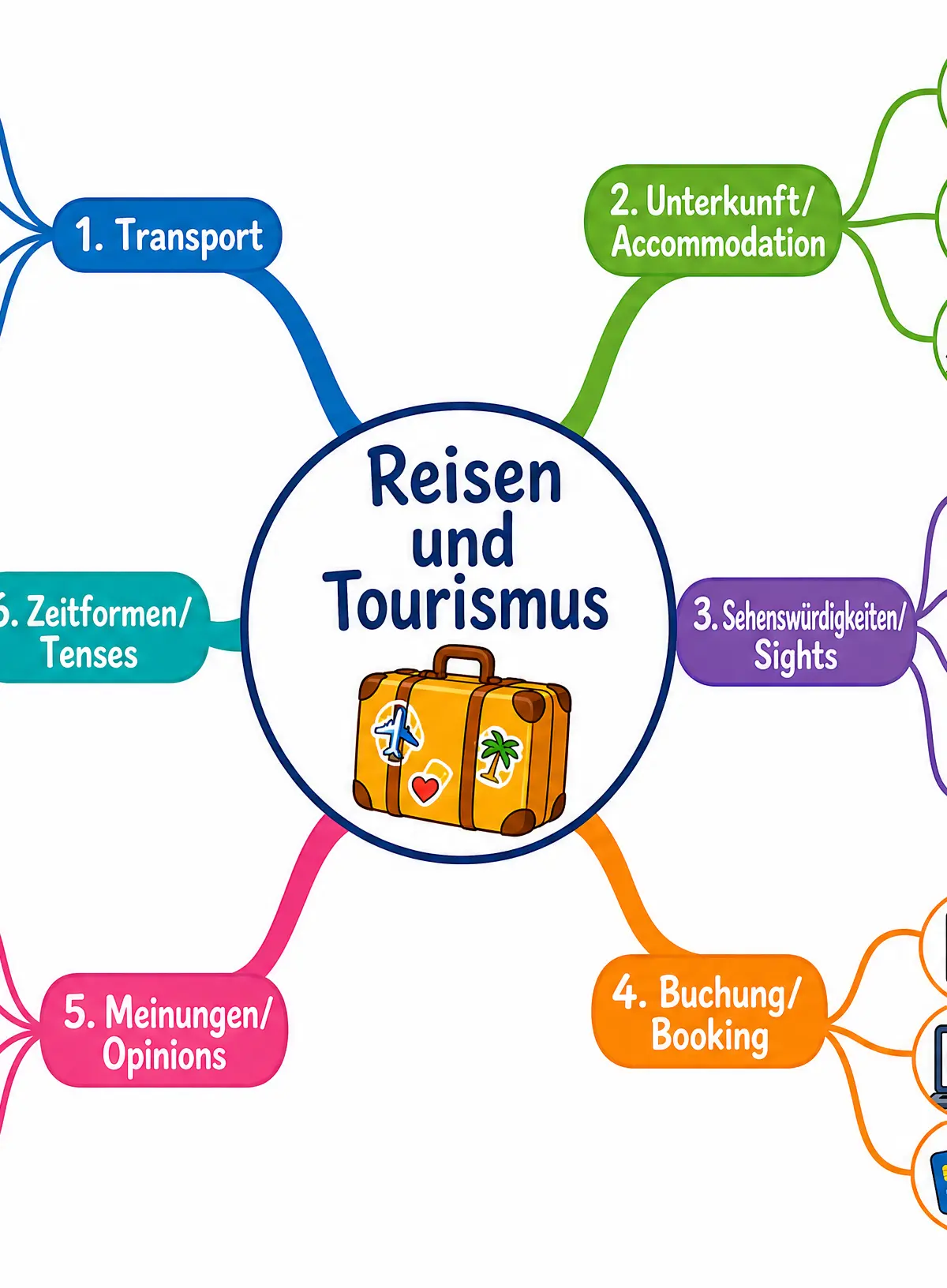
Tier 1 — Foundation Core
| German | English | Gender | Example Sentence |
|---|---|---|---|
| der Urlaub | the holiday | m | Mein Urlaub in Spanien war fantastisch. |
| die Reise | the journey/trip | f | Die Reise war sehr lang. |
| das Hotel | the hotel | n | Das Hotel hat ein Schwimmbad. |
| der Zug | the train | m | Ich fahre mit dem Zug nach Berlin. |
| das Flugzeug | the aeroplane | n | Das Flugzeug ist sehr schnell. |
| der Bus | the bus | m | Der Bus fährt um zehn Uhr ab. |
| das Auto | the car | n | Wir fahren mit dem Auto nach Frankreich. |
| der Strand | the beach | m | Ich liege gern am Strand. |
| die Stadt | the town/city | f | Die Stadt ist sehr schön. |
| das Zimmer | the room | n | Das Zimmer ist klein, aber sauber. |
| buchen | to book | - | Ich möchte ein Hotelzimmer buchen. |
| teuer | expensive | - | Die Fahrkarte ist zu teuer. |
| billig | cheap | - | Das Restaurant war sehr billig. |
| das Wetter | the weather | n | Das Wetter war sonnig und warm. |
| toll | great | - | Die Ferien waren toll. |
Tier 2 — Higher Tier
| German | English | Gender | Example Sentence |
|---|---|---|---|
| die Sehenswürdigkeit | the tourist attraction | f | Wir haben viele Sehenswürdigkeiten besichtigt. |
| die Jugendherberge | the youth hostel | f | Die Jugendherberge ist preiswert. |
| der Campingplatz | the campsite | m | Wir übernachten auf einem Campingplatz. |
| die Ferienwohnung | the holiday apartment | f | Die Ferienwohnung hat eine große Küche. |
| das Gebirge | the mountains | n | Im Winter fahre ich ins Gebirge. |
| der Ausflug | the excursion | m | Morgen machen wir einen Ausflug. |
| reservieren | to reserve | - | Ich habe einen Tisch im Restaurant reserviert. |
| die Fahrkarte | the ticket (transport) | f | Ich brauche eine Fahrkarte nach München. |
| abfahren | to depart | - | Der Zug fährt in fünf Minuten ab. |
| ankommen | to arrive | - | Wir kommen um acht Uhr an. |
High-Frequency Words & Phrases
| Phrase | English | Usage Context |
|---|---|---|
| Meiner Meinung nach | In my opinion | Used to introduce a justified opinion. |
| Ich finde es toll, weil... | I find it great, because... | Used to give a positive opinion with a reason. |
| Obwohl es teuer ist... | Although it is expensive... | Used to show complex sentence structure. |
| Im Großen und Ganzen | On the whole / Overall | Used to summarize an opinion. |
| Auf der einen Seite... auf der anderen Seite... | On the one hand... on the other hand... | Used to weigh pros and cons. |
| Es hat Spaß gemacht | It was fun | Used to describe a past experience. |
| Ich habe vor, ... zu ... | I intend to... | Used to discuss future plans. |
| Wenn das Wetter schön ist... | If the weather is nice... | Used to introduce a conditional clause. |
| Ich hätte gern... | I would like... | Used for polite requests (e.g., in a hotel). |
| Wie viel kostet das? | How much does that cost? | Used for transactions. |
📝 Grammar Focus
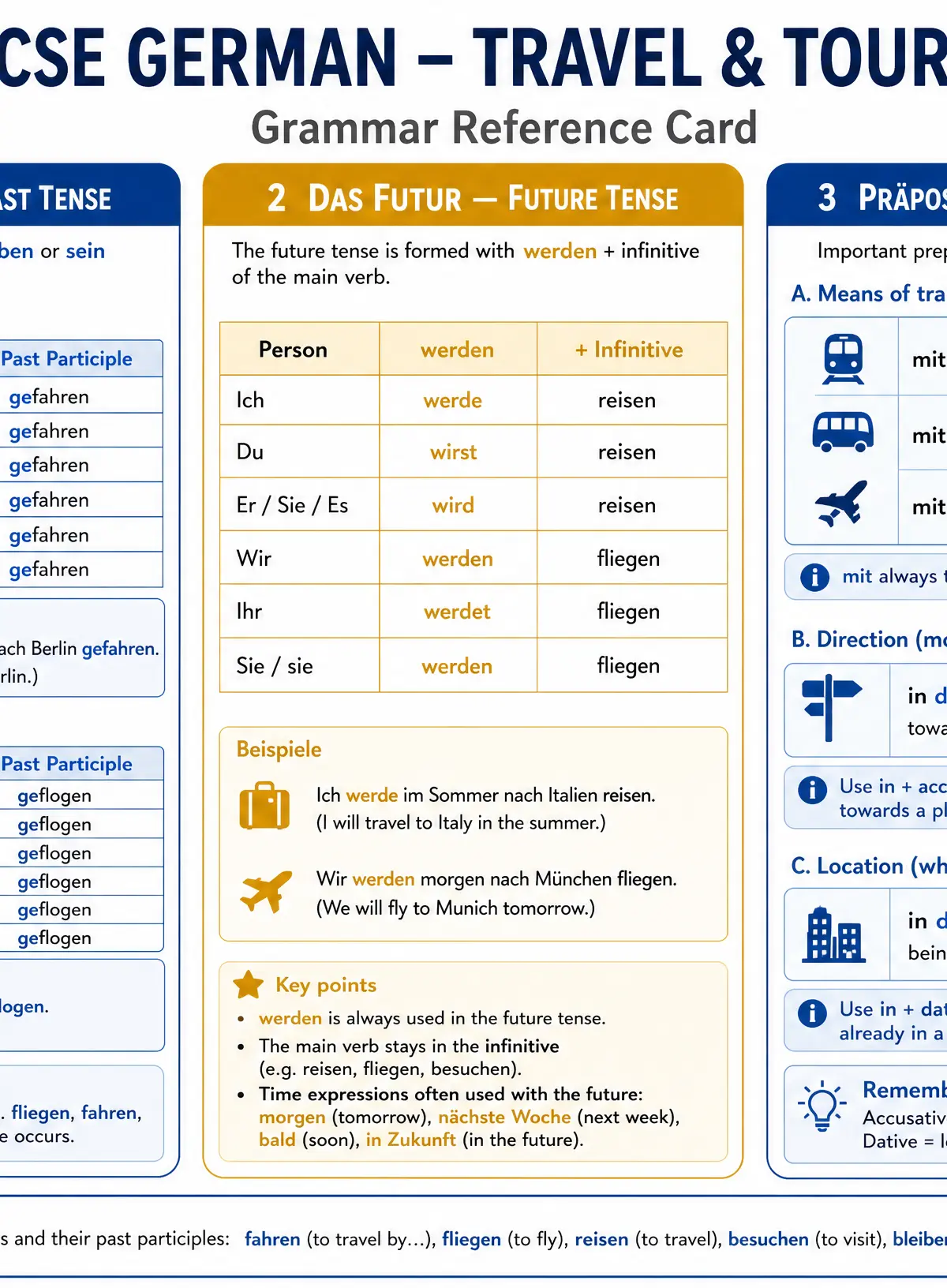
Key Structure 1: Das Perfekt (The Perfect Tense)
When to use it: To describe past holidays, journeys, and experiences.
Conjugation Table
| Subject | Verb Form (haben) | Verb Form (sein) | English |
|---|---|---|---|
| ich | habe ... gespielt | bin ... geflogen | I played / I flew |
| du | hast ... gespielt | bist ... geflogen | you played / you flew |
| er/sie/es | hat ... gespielt | ist ... geflogen | he/she/it played / flew |
| wir | haben ... gespielt | sind ... geflogen | we played / we flew |
| ihr | habt ... gespielt | seid ... geflogen | you (pl) played / flew |
| sie/Sie | haben ... gespielt | sind ... geflogen | they/You played / flew |
Irregulars to learn: gefahren (travelled/drove), geflogen (flew), gegangen (went), geblieben (stayed - takes sein), gesehen (saw), gegessen (ate).
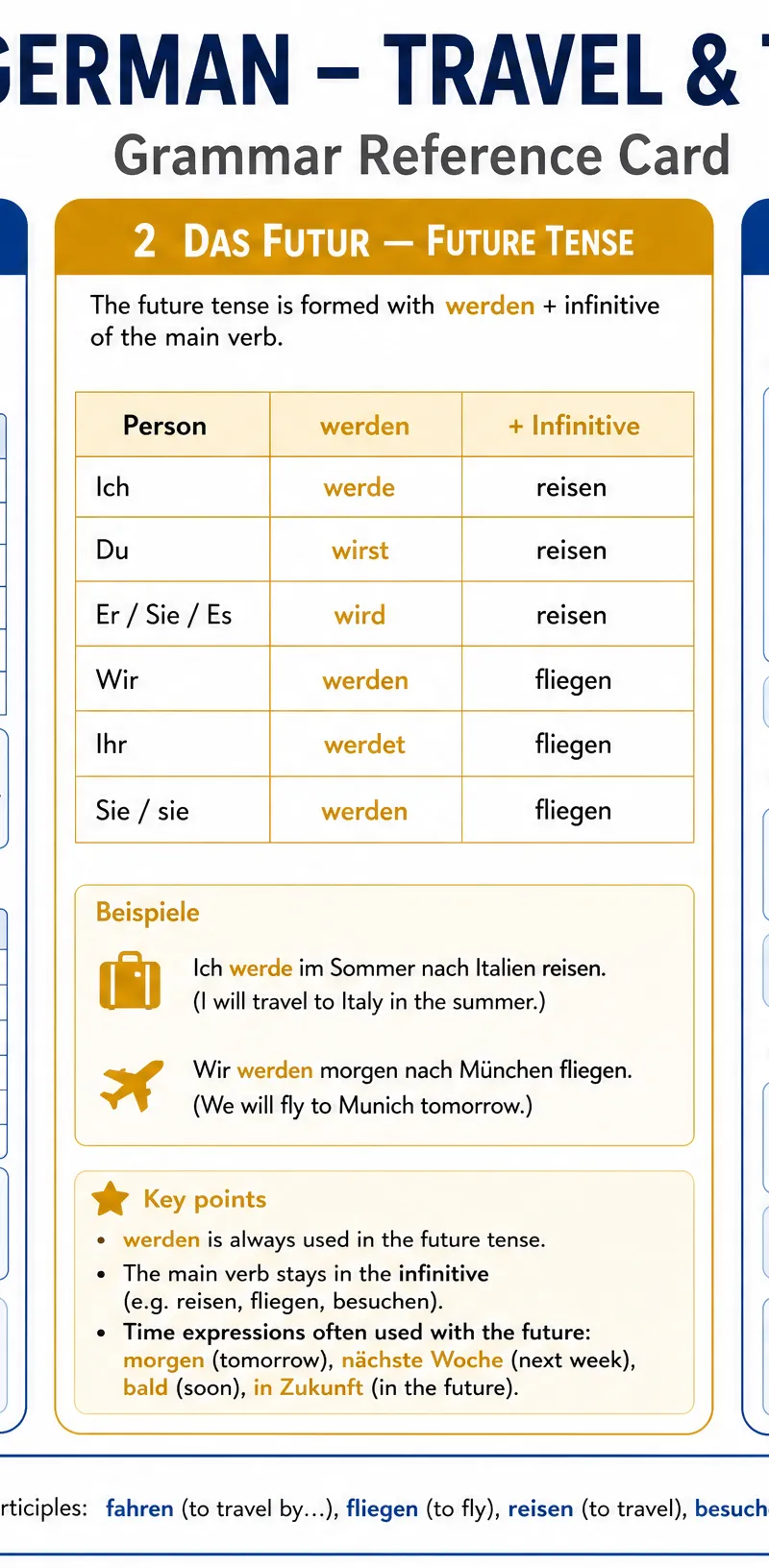
Key Structure 2: Das Futur (The Future Tense)
When to use it: To describe future travel plans and holiday intentions.
Conjugation Table
| Subject | Verb Form | English |
|---|---|---|
| ich | werde ... reisen | I will travel |
| du | wirst ... reisen | you will travel |
| er/sie/es | wird ... reisen | he/she/it will travel |
| wir | werden ... reisen | we will travel |
| ihr | werdet ... reisen | you (pl) will travel |
| sie/Sie | werden ... reisen | they/You will travel |
Irregulars to learn: werden is irregular in the du and er/sie/es forms. The main verb stays in the infinitive at the end of the sentence.
Key Structure 3: Prepositions with Transport (mit + Dative)
When to use it: To explain how you travelled somewhere.
Conjugation Table
| Preposition + Article | Noun | English |
|---|---|---|
| mit dem | Zug (m) | by train |
| mit dem | Bus (m) | by bus |
| mit dem | Auto (n) | by car |
| mit dem | Flugzeug (n) | by plane |
| mit der | U-Bahn (f) | by underground |
Irregulars to learn: 'zu Fuß' (on foot) is the exception to the 'mit' rule.
🎧 Listening Skills
What to Expect
Listening tasks on travel and tourism often involve public announcements (e.g., at a train station or airport), hotel bookings, or people discussing their holiday experiences and opinions.
Listening Strategies
- Listen for time indicators: Words like gestern (yesterday), heute (today), and morgen (tomorrow) are crucial for determining the timeframe.
- Watch for opinion qualifiers: Listen for aber (but), obwohl (although), and leider (unfortunately), which often signal a change in opinion.
- Note numbers and times: Train departure times, platform numbers (Gleis), and prices are frequently tested.
Common Listening Traps
- Distractors: The speaker might mention travelling by bus, but then say aber der Bus war zu spät, also bin ich mit dem Zug gefahren (but the bus was too late, so I travelled by train).
- False Friends: Sensibel means sensitive, not sensible. Das Gymnasium is a grammar school, not a gym.
🗣️ Speaking Skills
Role Play Scenarios
Scenario 1: At the Hotel
You: Ich habe ein Zimmer reserviert. Mein Name ist Smith. (I have reserved a room. My name is Smith.)
Receptionist: Ah ja. Ein Doppelzimmer für drei Nächte?
You: Nein, ein Einzelzimmer, bitte. Ist das Frühstück inklusive? (No, a single room, please. Is breakfast included?)
Scenario 2: At the Train Station
You: Ich hätte gern eine Fahrkarte nach Berlin, bitte. (I would like a ticket to Berlin, please.)
Clerk: Einfach oder hin und zurück?
You: Hin und zurück, bitte. Wann fährt der nächste Zug ab? (Return, please. When does the next train depart?)
Photo Card Practice
Model Photo Card Response (A photo of a family at the beach):
- Qu 1 (Description): Auf dem Foto gibt es eine Familie am Strand. Das Wetter ist sehr sonnig. (In the photo there is a family at the beach. The weather is very sunny.)
- Qu 2 (Opinion): Ich finde Strandurlaube toll, weil man sich entspannen kann. (I find beach holidays great because you can relax.)
- Qu 3 (Related topic): Letztes Jahr bin ich mit meiner Familie nach Italien gefahren. (Last year I travelled to Italy with my family.)
- Qu 4 (Past/Future): Nächsten Sommer werde ich mit Freunden nach Spanien fliegen. (Next summer I will fly to Spain with friends.)
- Qu 5 (Unpredictable): Ich reise lieber mit dem Flugzeug, weil es schneller ist. (I prefer travelling by plane because it is faster.)
General Conversation Questions
| Question (German) | Model Answer | English Translation |
|---|---|---|
| Wohin fährst du normalerweise in Urlaub? | Normalerweise fahre ich nach Frankreich, weil das Wetter dort schön ist. | Where do you normally go on holiday? / Normally I travel to France because the weather there is nice. |
| Was machst du gern im Urlaub? | Ich schwimme gern im Meer und ich besichtige gern Sehenswürdigkeiten. | What do you like doing on holiday? / I like swimming in the sea and I like visiting sights. |
| Wohin bist du letztes Jahr gefahren? | Letztes Jahr bin ich nach Berlin geflogen. Es war sehr interessant. | Where did you travel to last year? / Last year I flew to Berlin. It was very interesting. |
| Wohin wirst du nächstes Jahr fahren? | Nächstes Jahr werde ich nach Italien fahren, um Pizza zu essen. | Where will you travel to next year? / Next year I will travel to Italy in order to eat pizza. |
| Was ist besser: Urlaub am Strand oder in der Stadt? | Meiner Meinung nach ist ein Strandurlaub besser, weil er entspannender ist. | What is better: a holiday on the beach or in the city? / In my opinion a beach holiday is better because it is more relaxing. |
✍️ Writing Skills
Translation Practice
English → German:
| English | German | Key Grammar |
|---|---|---|
| I travel by train. | Ich fahre mit dem Zug. | mit + dative |
| Last year I went to Germany. | Letztes Jahr bin ich nach Deutschland gefahren. | Perfekt tense with 'sein' |
| Next summer I will fly to Spain. | Nächsten Sommer werde ich nach Spanien fliegen. | Futur tense with 'werden' |
| I like the hotel because it is big. | Ich mag das Hotel, weil es groß ist. | Subordinating conjunction (weil) |
| Although it rained, the holiday was great. | Obwohl es geregnet hat, war der Urlaub toll. | Subordinating conjunction (obwohl) + V2 |
Extended Writing
**Model 90-word response (Foundation):**Letztes Jahr bin ich mit meiner Familie nach Spanien geflogen. Das Wetter war sehr heiß und sonnig. Wir haben in einem großen Hotel gewohnt. Das Hotel war toll, weil es ein Schwimmbad hatte. Jeden Tag bin ich im Meer geschwommen und ich habe Eis gegessen. Nächstes Jahr werde ich nach Deutschland fahren. Ich möchte Berlin besuchen, weil es sehr interessant ist. Ich reise gern, weil ich neue Kulturen liebe.
**Model 150-word response (Higher):**Normalerweise fahre ich jeden Sommer mit meiner Familie nach Frankreich, weil wir dort eine kleine Ferienwohnung haben. Ich finde das toll, weil das Wetter meistens wunderbar ist und man sich gut entspannen kann. Jedoch bin ich letztes Jahr mit meiner Schule nach Berlin geflogen. Die Reise war ziemlich lang, aber sehr lustig. Wir haben in einer Jugendherberge im Stadtzentrum übernachtet. Obwohl das Essen nicht besonders lecker war, haben wir viele historische Sehenswürdigkeiten besichtigt, wie zum Beispiel das Brandenburger Tor. Es hat viel Spaß gemacht! In der Zukunft werde ich bestimmt wieder nach Deutschland reisen. Nächsten Sommer habe ich vor, mit meinen Freunden nach München zu fahren. Wir werden mit dem Zug reisen, weil das umweltfreundlicher als das Flugzeug ist. Meiner Meinung nach ist Reisen extrem wichtig, um neue Kulturen kennenzulernen und Fremdsprachen zu üben.
Writing Checklist
- ✅ Three tenses used (Past, Present, Future)
- ✅ Opinions included with justifications (weil, da)
- ✅ Complex structures used (obwohl, um... zu, infinitive clauses)
- ✅ Accurate adjective agreements and verb endings
- ✅ 'mit dem' used correctly for transport
📚 Reading Skills
Key Strategies
- Skim for gist: Read the text quickly first to understand the general topic (e.g., a hotel review, a travel blog).
- Identify timeframes: Look for tense markers to understand if the text is about a past trip or a future plan.
- Read the questions carefully: Pay attention to the exact wording of the question. If it asks 'Why...', look for 'weil' or 'denn' in the text.
False Friends & Tricky Words
| Word | Looks Like | Actually Means |
|---|---|---|
| das Gymnasium | gym | grammar school |
| die Fabrik | fabric | factory |
| sensibel | sensible | sensitive |
| brav | brave | well-behaved / good |
| aktuell | actual | current / up-to-date |
🌍 Cultural Knowledge
Understanding the cultural context of travel in German-speaking countries enriches your responses. Germany has an excellent public transport system, particularly the train network operated by Deutsche Bahn (DB). Germans are known for their love of travel (Reiselust) and frequently visit countries like Spain, Italy, and Austria. The concept of 'Urlaub' (holiday) is highly valued, with workers receiving generous annual leave. Germany itself is a major tourist destination, famous for its historic cities, the Bavarian Alps, the Black Forest, and the romantic Rhine valley.
Visual Resources
2 diagrams and illustrations
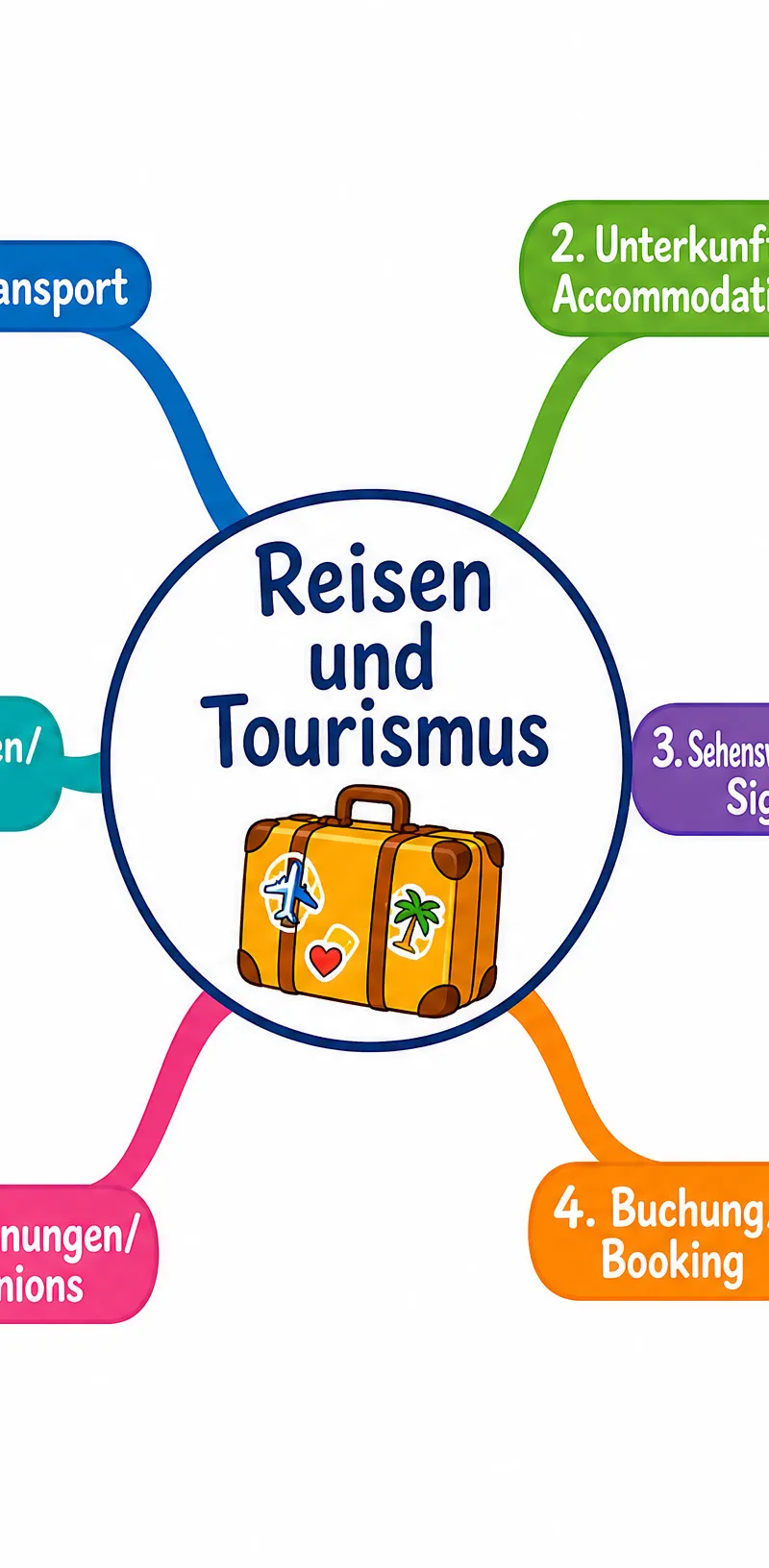
Interactive Diagrams
1 interactive diagram to visualise key concepts
Conceptual Flow Outline
Choosing the correct tense for travel topics
Worked Examples
4 worked examples — open one to explore the question and available guidance.
Practice Questions
Try the question, then reveal an answer plan or example response
Writing: Translate the following sentence into German: 'Last year I travelled to Germany by train.'
Hint: Remember the perfect tense auxiliary for movement verbs, and the dative case for transport.
Speaking: Answer the question: 'Was ist besser: Urlaub am Strand oder in der Stadt?'
Hint: Give an opinion, justify it with 'weil', and use a comparative adjective (besser, entspannender).
Writing: Write a 90-word email to your German friend about your holidays. Mention: where you usually go, where you went last year, and where you will go next year.
Hint: Ensure you cover all three timeframes clearly.
Reading: Read the sentence and answer in English: 'Obwohl das Hotel sehr teuer war, war das Zimmer ziemlich klein und schmutzig.' What was wrong with the hotel?
Hint: Look for the adjectives describing the room.
Listening: You hear: 'Ich fahre lieber mit dem Zug, weil das Flugzeug zu teuer ist.' Why does the person prefer the train?
Hint: Listen for the reason following 'weil'.
Writing: Translate into English: 'Nächsten Sommer werde ich mit meinen Freunden nach Spanien fliegen.'
Hint: Identify the tense indicated by 'werde... fliegen'.
Exam technique
How to turn what you know into marks
How to approach the question
Listening: Read questions during the pause, note keywords. Speaking: Use prep time to annotate photo card. Reading: Skim text, then read questions. Writing: Plan tenses and vocabulary before writing.
How to structure your answer
Writing: Introduction (Past) → Main points (Present) with justified opinions → Conclusion (Future). Speaking: Opinion → Justification → Extension.
Timing
Listening: 25-35 mins. Speaking: 7-12 mins. Reading: 45-60 mins. Writing: 60-75 mins.
Common pitfalls
- Using 'mit der Zug' instead of 'mit dem Zug'.
- Forgetting to send the verb to the end after 'weil' or 'obwohl'.
- Using 'haben' instead of 'sein' for movement verbs in the past tense.
- Not addressing all bullet points in the writing task.
- Using only the present tense.
What the command words want
- Describe the photo
- Use 'Auf dem Foto gibt es...' (In the photo there is...) and give an opinion.
- Translate into German
- Ensure grammatical accuracy (verb endings, word order, cases).
- Translate into English
- Focus on conveying the accurate meaning, not just word-for-word literal translation.
- Write approximately 90 words
- Cover all bullet points, use at least two tenses, include opinions.
- Write approximately 150 words
- Use three tenses, complex structures (subordinating conjunctions), and ambitious vocabulary.
Watch or listen (optional)
Test your understanding of Thematic Context: Travel and tourism
Active recall beats re-reading. Take an instant quiz now to test what you’ve learned and lock it into long-term memory.
7 days Premium · Then the free plan continues · No card, no charge