Pearson Edexcel · GCSE · German
Course version: Pearson-GCSE-German · Version from Mar 2026
Vocabulary: Adjectives
Mastering German adjectives is crucial for unlocking higher grades across all four skills. This guide covers essential vocabulary, the rules of adjective agreement (endings), and the formation of comparatives and superlatives, equipping you to add descriptive flair and grammatical accuracy to your exam responses.
- 11 min read
- 4 worked examples
- 6 practice questions
- 8 key terms
Check what you remember
Read the wording for your board, then hide it and explain Adjective in your own words. Rough notes are fine. This is a self-check, with no mark or grade.
Reference: Pearson Edexcel
A word that describes a noun (e.g., big, red, interesting).
Study Notes
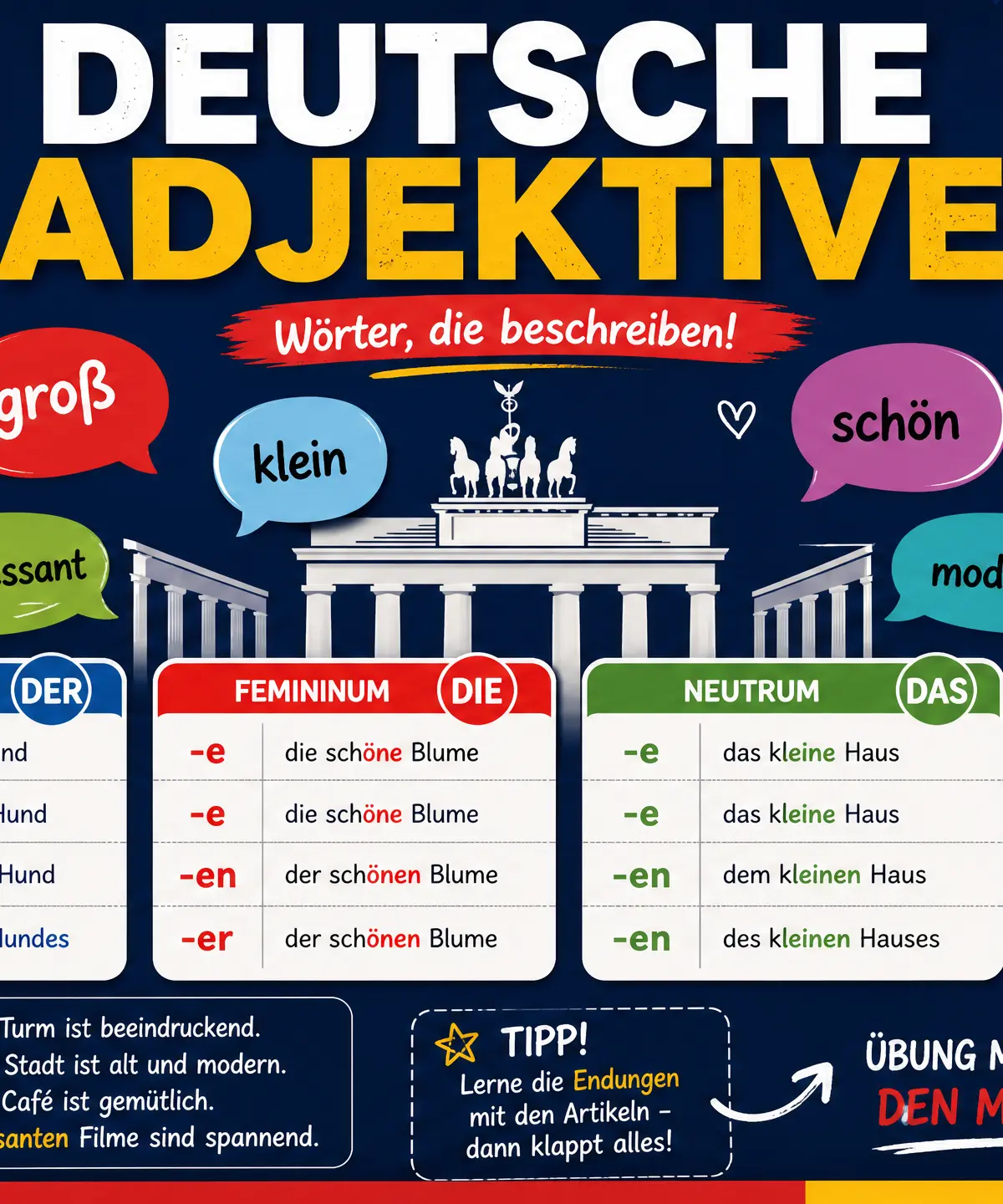
Overview
Adjectives are the descriptive words that bring your German to life. In the GCSE exam, using adjectives correctly is one of the most reliable ways to boost your marks. Whether you're describing a photo in the speaking exam, understanding a complex text in reading, or showing off your grammatical accuracy in writing, adjectives are essential. This guide covers the three main types of adjective endings, comparative and superlative forms, and how to deploy them effectively across all four skills.
🎧 Audio Revision
Listen to our comprehensive 10-minute podcast episode on German Adjectives, covering all the essential rules, common pitfalls, and a quick-fire recall quiz.
📖 Essential Vocabulary
Tier 1 — Foundation Core
| German | English | Gender | Example Sentence |
|---|---|---|---|
| groß | big / tall | N/A | Mein Bruder ist sehr groß. |
| klein | small / short | N/A | Das ist ein kleines Haus. |
| alt | old | N/A | Der alte Mann liest ein Buch. |
| neu | new | N/A | Ich habe ein neues Handy. |
| gut | good | N/A | Das Essen hier ist sehr gut. |
| schlecht | bad | N/A | Das Wetter war gestern schlecht. |
| schön | beautiful / nice | N/A | Wir hatten einen schönen Urlaub. |
| hässlich | ugly | N/A | Das ist ein hässliches Gebäude. |
| teuer | expensive | N/A | Dieses Auto ist zu teuer. |
| billig | cheap | N/A | Ich suche ein billiges Hotel. |
| lang | long | N/A | Die Reise war sehr lang. |
| kurz | short | N/A | Der Film war ziemlich kurz. |
| schnell | fast | N/A | Er fährt ein schnelles Auto. |
| langsam | slow | N/A | Der Zug war sehr langsam. |
| interessant | interesting | N/A | Das ist ein interessantes Buch. |
Tier 2 — Higher Tier
| German | English | Gender | Example Sentence |
|---|---|---|---|
| beeindruckend | impressive | N/A | Die Aussicht vom Berg war beeindruckend. |
| abwechslungsreich | varied | N/A | Die Arbeit ist sehr abwechslungsreich. |
| umweltfreundlich | eco-friendly | N/A | Wir sollten umweltfreundliche Produkte kaufen. |
| unvergesslich | unforgettable | N/A | Es war ein unvergessliches Erlebnis. |
| außergewöhnlich | extraordinary | N/A | Sie hat ein außergewöhnliches Talent. |
| vielfältig | diverse | N/A | Die Kultur in Berlin ist sehr vielfältig. |
| nachhaltig | sustainable | N/A | Nachhaltige Energie ist wichtig für die Zukunft. |
| lebhaft | lively | N/A | Die Innenstadt ist abends sehr lebhaft. |
| anstrengend | exhausting | N/A | Die Prüfung war unglaublich anstrengend. |
| nützlich | useful | N/A | Ein Wörterbuch ist sehr nützlich. |
High-Frequency Words & Phrases
| Phrase | English | Usage Context |
|---|---|---|
| meiner Meinung nach | in my opinion | Use to introduce a justified opinion. |
| auf der einen Seite | on the one hand | Use for balanced arguments (Writing/Speaking). |
| auf der anderen Seite | on the other hand | The pair to 'auf der einen Seite'. |
| im Großen und Ganzen | on the whole | Good for conclusions. |
| es ist wichtig, dass | it is important that | Use with a subordinate clause (verb to the end). |
| ein großer Vorteil ist | a big advantage is | Use when evaluating pros and cons. |
| ein großer Nachteil ist | a big disadvantage is | The opposite of 'ein großer Vorteil ist'. |
| am wichtigsten ist | the most important thing is | Uses a superlative adjective. |
| es wäre besser, wenn | it would be better if | Uses a comparative adjective + conditional. |
| im Vergleich zu | compared to | Use when comparing two things (takes dative). |
📝 Grammar Focus
Key Structure 1: Adjective Endings (Definite Articles)
When to use it: When an adjective comes between a definite article (der, die, das, die [pl]) and a noun.
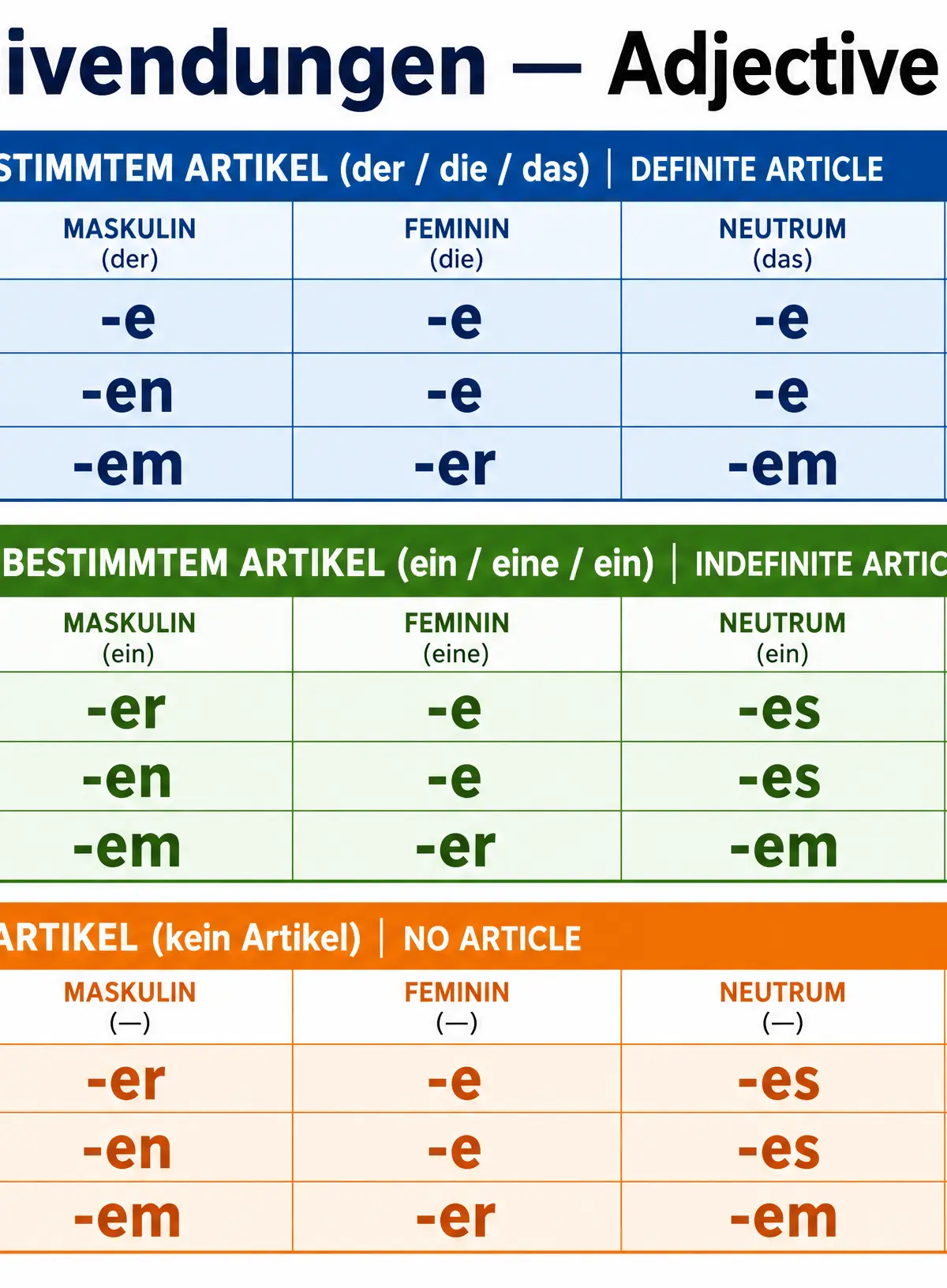
Endings Table
| Case | Masculine (der) | Feminine (die) | Neuter (das) | Plural (die) |
|---|---|---|---|---|
| Nominative | -e | -e | -e | -en |
| Accusative | -en | -e | -e | -en |
| Dative | -en | -en | -en | -en |
Memory Trick: Think of the 'frying pan' shape. The Nominative M/F/N and Accusative F/N are all '-e'. Everything else is '-en'.
Key Structure 2: Adjective Endings (Indefinite Articles)
When to use it: When an adjective comes between an indefinite article (ein, eine, ein / kein, mein, dein) and a noun.
Endings Table
| Case | Masculine (ein) | Feminine (eine) | Neuter (ein) | Plural (keine) |
|---|---|---|---|---|
| Nominative | -er | -e | -es | -en |
| Accusative | -en | -e | -es | -en |
| Dative | -en | -en | -en | -en |
Memory Trick: In the Nominative, 'ein' doesn't show gender for masculine or neuter, so the adjective has to do the heavy lifting (-er for masculine, -es for neuter).
Key Structure 3: Comparatives and Superlatives
When to use it: When comparing two things (comparative) or stating that something is the most/least (superlative).
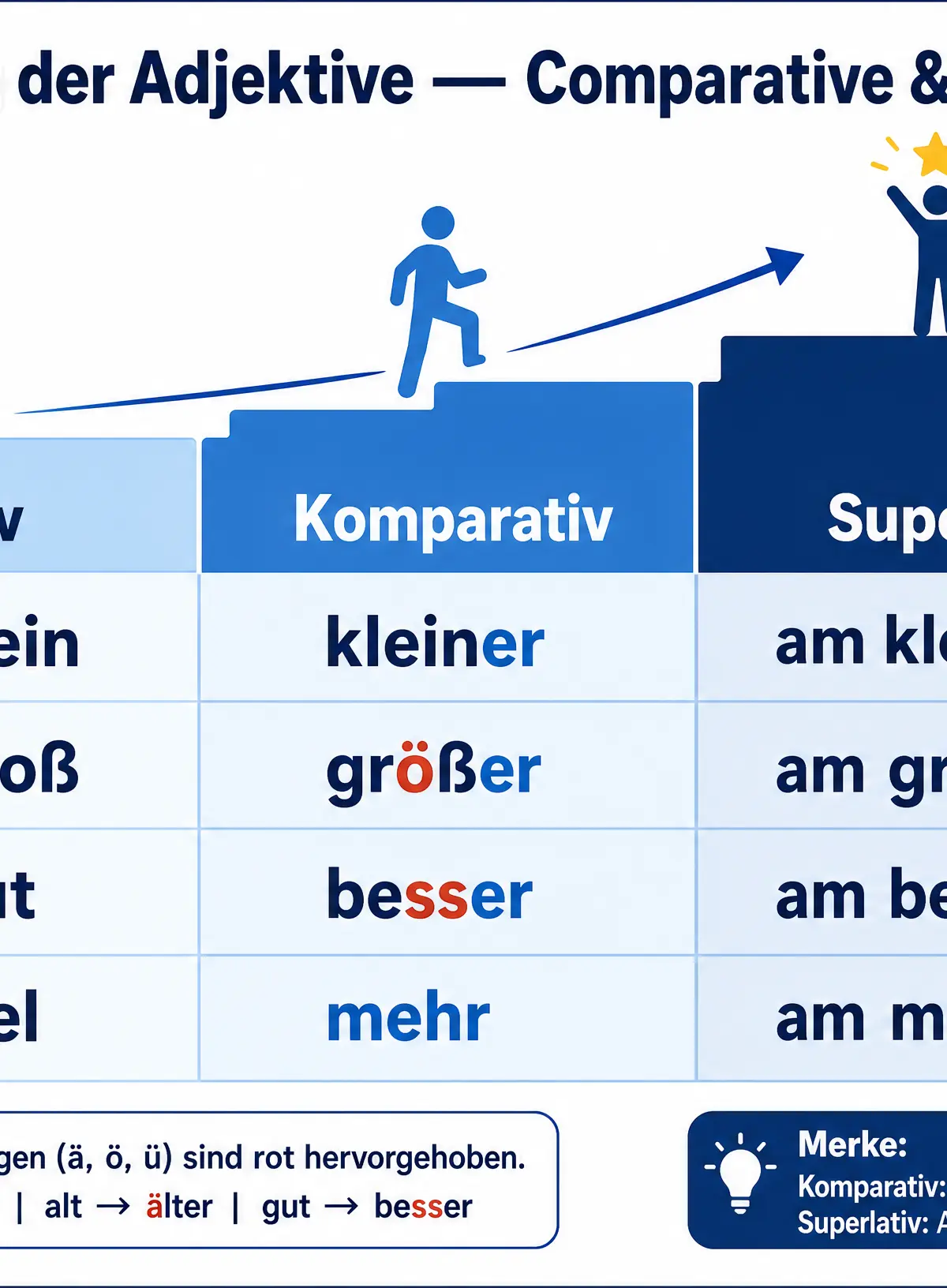
Formation Rules
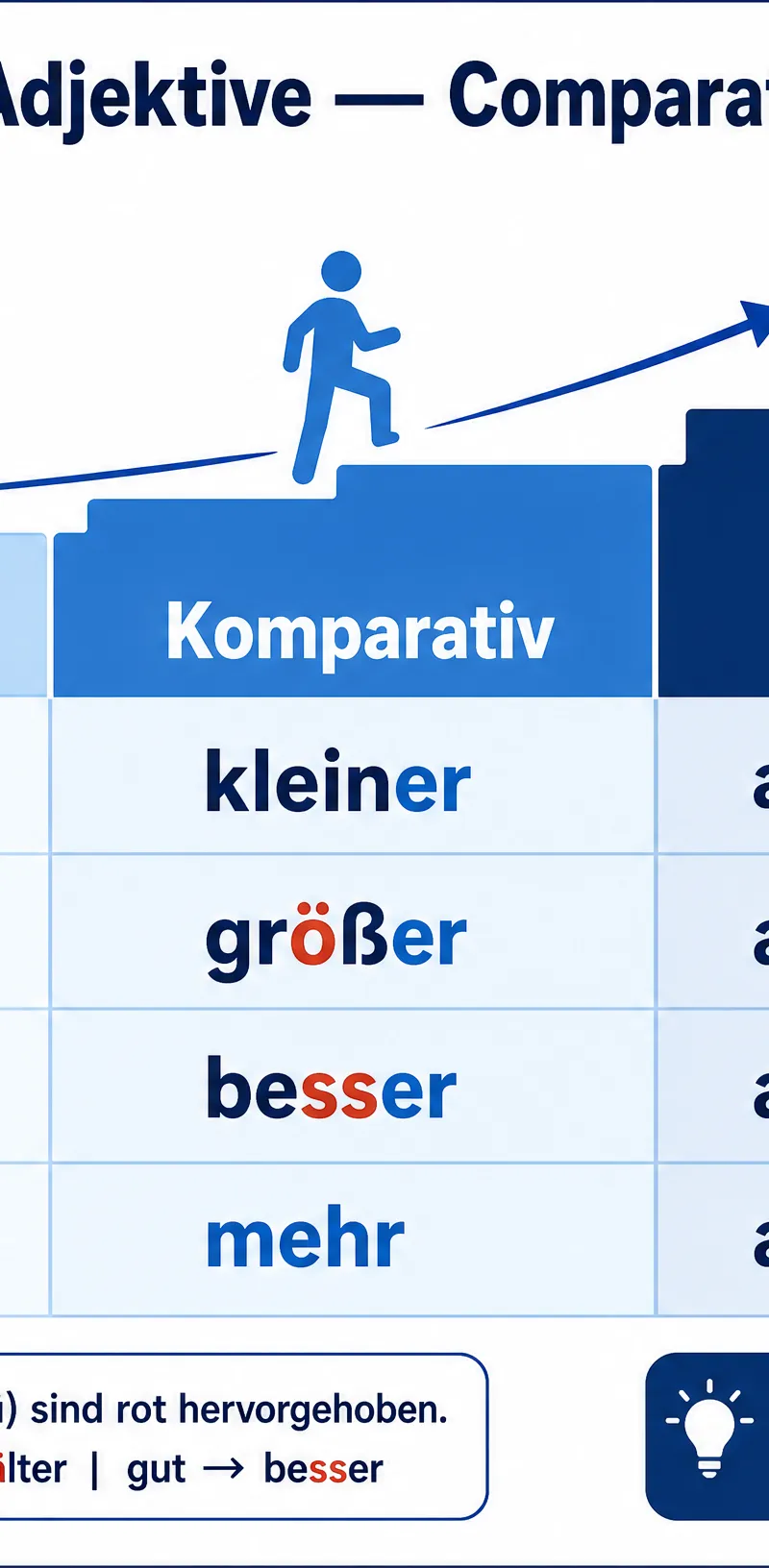
- Comparative: Add '-er' to the adjective (e.g., schnell -> schneller). Often adds an umlaut (e.g., groß -> größer).
- Superlative: Use 'am' + adjective + '-sten' (e.g., am schnellsten). Often adds an umlaut (e.g., am größten).
Irregulars to learn:
| Positive | Comparative | Superlative | English |
|---|---|---|---|
| gut | besser | am besten | good, better, best |
| viel | mehr | am meisten | much, more, most |
| hoch | höher | am höchsten | high, higher, highest |
| nah | näher | am nächsten | near, nearer, nearest |
🎧 Listening Skills
What to Expect
You will hear adjectives used extensively to describe people, places, holidays, and opinions. Endings might be spoken quickly, so you need to listen for the root word.
Listening Strategies
- Listen for comparatives: Words ending in '-er' or starting with 'am' indicate a comparison, which is often the key to the answer.
- Watch for qualifiers: Words like 'sehr' (very), 'zu' (too), or 'ziemlich' (quite) change the intensity of the adjective.
- Note the tone: The speaker's tone often matches the adjective (e.g., sounding happy when saying 'wunderbar').
Common Listening Traps
- False friends: 'Sympathisch' means 'nice/likeable', NOT 'sympathetic'. 'Aktuell' means 'current/up-to-date', NOT 'actual'.
- Negatives: 'Nicht gut' is the opposite of 'gut'. Always listen for the 'nicht' or 'kein' before the adjective.
🗣️ Speaking Skills
Role Play Scenarios
Scenario: You are in a tourist office in Berlin asking about local attractions.
- You: Haben Sie Informationen über interessante Museen? (Do you have information about interesting museums?)
- Official: Ja, das Technikmuseum ist sehr modern und beliebt. (Yes, the technology museum is very modern and popular.)
Photo Card Practice
Model Photo Card Response:
- Qu 1 (Description): Auf dem Foto sehe ich eine große Familie. Sie sitzen in einem schönen Park. Das Wetter ist sehr sonnig und warm.
- Qu 2 (Opinion): Meiner Meinung nach sieht die Familie sehr glücklich aus, weil sie alle lächeln. Ein Picknick ist eine tolle Idee.
- Qu 3 (Related topic): Letztes Wochenende habe ich auch ein tolles Picknick mit meinen besten Freunden gemacht.
- Qu 4 (Past/Future): Nächstes Jahr möchte ich einen langen Urlaub am Strand machen, weil das entspannender ist.
- Qu 5 (Unpredictable): Ich finde es wichtig, Zeit mit der Familie zu verbringen, weil es gut für die geistige Gesundheit ist.
General Conversation Questions
| Question (German) | Model Answer | English Translation |
|---|---|---|
| Wie ist dein Haus? | Ich wohne in einem modernen Haus. Es ist ziemlich groß, aber mein Zimmer ist ein bisschen klein. | What is your house like? / I live in a modern house. It is quite big, but my room is a bit small. |
| Wie war dein letzter Urlaub? | Mein letzter Urlaub war fantastisch. Das Hotel war sehr luxuriös und das Essen war unglaublich lecker. | How was your last holiday? / My last holiday was fantastic. The hotel was very luxurious and the food was incredibly tasty. |
| Was ist besser: Stadt oder Land? | Meiner Meinung nach ist die Stadt besser, weil sie lebhafter ist. Das Land ist ruhiger, aber manchmal zu langweilig. | What is better: city or countryside? / In my opinion the city is better because it is livelier. The countryside is quieter, but sometimes too boring. |
| Beschreibe deinen besten Freund. | Mein bester Freund ist sehr lustig und immer hilfsbereit. Er ist auch größer als ich. | Describe your best friend. / My best friend is very funny and always helpful. He is also taller than me. |
| Wie findest du deine Schule? | Meine Schule ist ziemlich alt, aber wir haben neue Computer. Die Lehrer sind meistens freundlich. | How do you find your school? / My school is quite old, but we have new computers. The teachers are mostly friendly. |
✍️ Writing Skills
Translation Practice
English → German:
| English | German | Key Grammar |
|---|---|---|
| The big dog is barking. | Der große Hund bellt. | Nominative, definite article (-e) |
| I have a small brother. | Ich habe einen kleinen Bruder. | Accusative, indefinite article (-en) |
| We live in an old house. | Wir wohnen in einem alten Haus. | Dative, indefinite article (-en) |
| My car is faster than your car. | Mein Auto ist schneller als dein Auto. | Comparative adjective |
| That is the most interesting book. | Das ist das interessanteste Buch. | Superlative adjective |
Extended Writing
**Model 90-word response (Foundation):**Letztes Wochenende bin ich in eine große Stadt gefahren. Das Wetter war sehr schön und warm. Ich habe ein interessantes Museum besucht. Das Museum war fantastisch, aber die Tickets waren ziemlich teuer. Danach habe ich leckeres Essen in einem kleinen Restaurant gegessen. Nächstes Wochenende werde ich mit meinen guten Freunden ins Kino gehen. Ich denke, das wird sehr lustig sein, weil wir einen neuen Film sehen wollen.
**Model 150-word response (Higher):**Meiner Meinung nach ist es sehr wichtig, in einer schönen Umgebung zu leben. Ich wohne in einem kleinen, aber modernen Haus am Stadtrand. Das Beste an meinem Haus ist der große Garten, wo ich mich im Sommer entspannen kann. Letztes Jahr haben wir eine lange Reise nach Spanien gemacht. Das Wetter dort war viel wärmer als in England und die historischen Gebäude waren absolut beeindruckend. Obwohl die Reise fantastisch war, war das Hotel leider das schlechteste, in dem ich je übernachtet habe. In der Zukunft möchte ich in einer größeren Stadt wie Berlin wohnen, weil das Leben dort abwechslungsreicher und interessanter ist. Es gibt mehr kulturelle Möglichkeiten und bessere öffentliche Verkehrsmittel.
Writing Checklist
- ✅ Adjective endings check: Does the ending match the gender, case, and article?
- ✅ Comparatives check: Did I use at least one '-er' word (with 'als')?
- ✅ Superlatives check: Did I use at least one 'am ...-sten' word?
- ✅ Umlaut check: Did I remember the umlauts on words like größer, älter, jünger?
📚 Reading Skills
Key Strategies
- Identify the noun: When you see an adjective, find the noun it's describing to understand the full context.
- Use adjectives for tone: Adjectives carry the emotion of the text. Words like 'leider' (unfortunately) or 'glücklicherweise' (fortunately) often accompany adjectives to show the writer's opinion.
- Break down compounds: German loves compound words. 'Umweltfreundlich' = Umwelt (environment) + freundlich (friendly).
False Friends & Tricky Words
| Word | Looks Like | Actually Means |
|---|---|---|
| sympathisch | sympathetic | nice / likeable |
| aktuell | actual | current / up-to-date |
| brav | brave | well-behaved / good (for children/pets) |
| sensibel | sensible | sensitive |
| das Gift | gift | poison |
🌍 Cultural Knowledge
When describing things in German, it's useful to know cultural context. For example, describing a city as 'grün' (green) or 'umweltfreundlich' (eco-friendly) is very relevant, as environmentalism is a significant part of modern German culture. Cities like Freiburg are famous for this. Similarly, describing food as 'lecker' (tasty) or 'deftig' (hearty) fits well with traditional German cuisine like Bratwurst or Schnitzel. Using these adjectives in culturally appropriate contexts shows a deeper understanding of the language.
Visual Resources
2 diagrams and illustrations
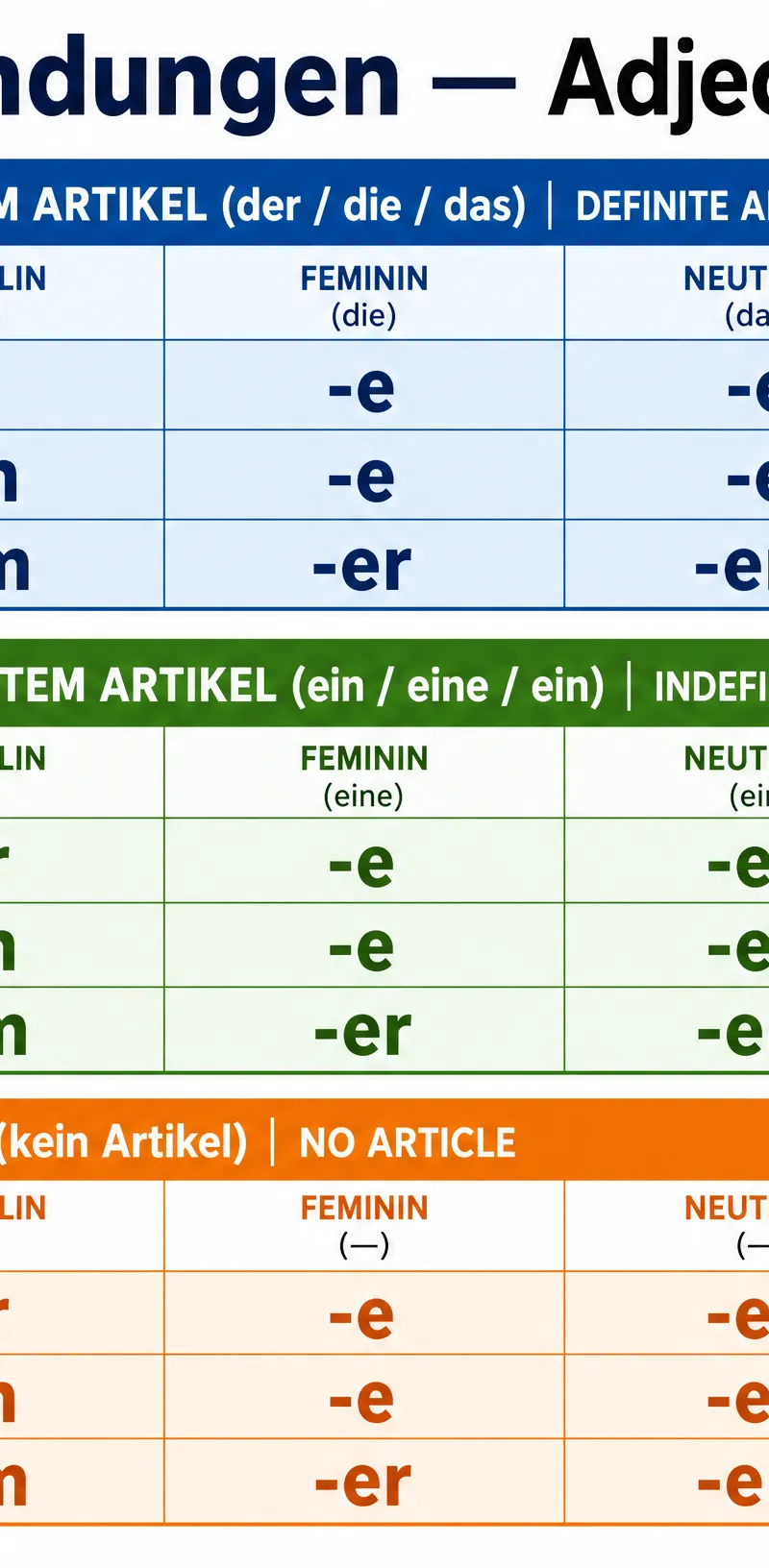
Interactive Diagrams
1 interactive diagram to visualise key concepts
Conceptual Flow Outline
Decision tree for choosing German adjective endings
Worked Examples
4 worked examples — open one to explore the question and available guidance.
Practice Questions
Try the question, then reveal an answer plan or example response
Writing: Translate the following sentence into German: 'I am buying a red car.'
Hint: Car (Auto) is neuter. 'Buying' takes the accusative case.
Writing: Translate into German: 'The old man is my grandfather.'
Hint: Man (Mann) is masculine. This is the subject of the sentence (nominative).
Speaking (Photo Card): Describe the weather and the people in the photo using at least three adjectives.
Hint: Use predicate adjectives (no endings) for simple descriptions.
Writing: Write one sentence comparing your town to another town, using a comparative adjective.
Hint: Remember to use 'als' for 'than', and check if your adjective needs an umlaut.
Reading: Translate the phrase 'mit meinen besten Freunden' into English and explain the grammar.
Hint: Think about what case the preposition 'mit' takes.
Listening: You hear 'Es war der schlechteste Urlaub meines Lebens'. What is the speaker's opinion of the holiday?
Hint: Listen for the superlative ending '-ste'.
Exam technique
How to turn what you know into marks
How to approach the question
Skill-by-skill strategy: Listening — read questions first, note keywords. Speaking — prepare opinions in advance, have fillers ready. Reading — skim first, then detail. Writing — plan before writing, check accuracy after.
How to structure your answer
Writing: Introduction → Main points with opinions → Justified reasons → Different tenses → Conclusion. Speaking: Give opinion → Justify → Extend → Use different tense.
Timing
Listening: 25 mins (heard twice). Speaking: 7-12 mins total (role play + photo card + conversation). Reading: 45-60 mins. Writing: 60-75 mins (translation + structured + extended).
Common pitfalls
- Forgetting adjective agreements (gender & number) entirely in Writing.
- Using the wrong ending after 'ein' (e.g., 'ein gute Film' instead of 'ein guter Film').
- Forgetting the umlaut on comparatives like 'größer' and 'älter'.
- Adding endings to predicate adjectives ('Das Haus ist großes' - incorrect).
- Confusing 'besser' (better) and 'am besten' (best).
What the command words want
- Describe the photo
- Use adjectives heavily here. Colors, sizes, emotions (e.g., glücklich, traurig).
- Translate into German
- Pay strict attention to gender and case for every adjective ending. Partial marks are given for accuracy.
- Translate into English
- Meaning over word-for-word — capture the sense, especially with comparatives and superlatives.
- Write approximately 90 words
- Foundation task — use a range of basic adjectives accurately.
- Write approximately 150 words
- Higher task — MUST include comparatives, superlatives, and complex adjective phrases.
Watch or listen (optional)
Test your understanding of Vocabulary: Adjectives
Active recall beats re-reading. Take an instant quiz now to test what you’ve learned and lock it into long-term memory.
7 days Premium · Then the free plan continues · No card, no charge