Pearson Edexcel · GCSE · German
Course version: Pearson-GCSE-German · Version from Mar 2026
Vocabulary: Adverbs
This topic covers the essential vocabulary and grammar of German adverbs. You will learn the Time-Manner-Place word order rule, comparative and superlative forms, and how to use adverbs to add detail and complexity across all four exam skills.
- 10 min read
- 4 worked examples
- 6 practice questions
- 8 key terms
Check what you remember
Read the wording for your board, then hide it and explain Adverb in your own words. Rough notes are fine. This is a self-check, with no mark or grade.
Reference: Pearson Edexcel
A word that describes a verb, an adjective, or another adverb (e.g., quickly, very). They do not change endings in German.
Study Notes
Overview
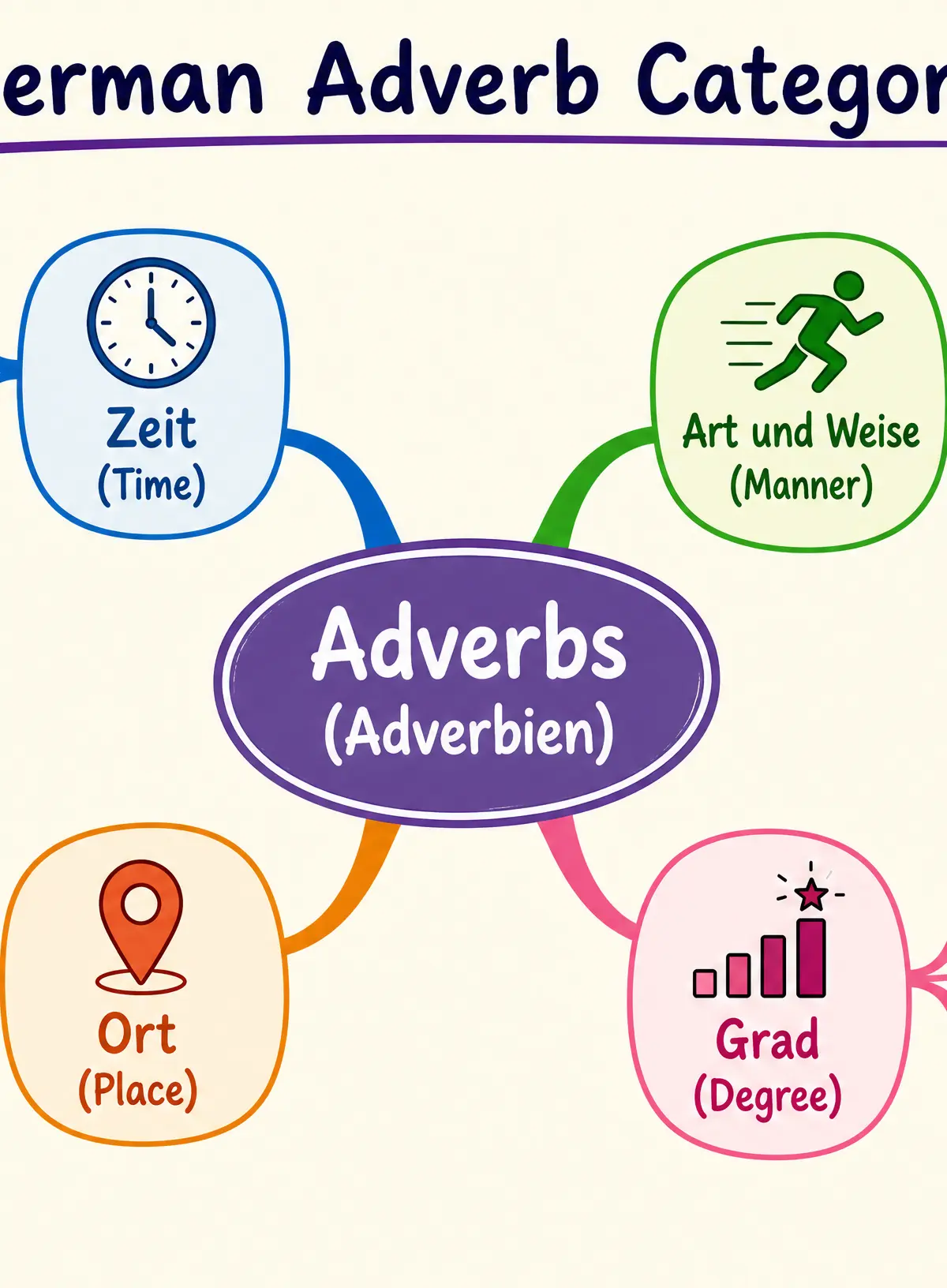
Adverbs are words that describe how, when, where, or to what degree an action happens. In the GCSE German exam, mastering adverbs is a quick way to elevate your language from basic to complex. Examiners actively look for adverbs because they add nuance to your writing and speaking. Whether you are describing a past holiday, discussing future plans, or giving an opinion on school, adverbs are essential. They appear in every paper: Listening, Speaking, Reading, and Writing.
📖 Essential Vocabulary
Tier 1 — Foundation Core
| German | English | Gender | Example Sentence |
|---|---|---|---|
| heute | today | n/a | Ich spiele heute Fußball. |
| morgen | tomorrow | n/a | Wir fahren morgen nach Berlin. |
| gestern | yesterday | n/a | Gestern war das Wetter schön. |
| immer | always | n/a | Ich esse immer Müsli zum Frühstück. |
| oft | often | n/a | Er geht oft ins Kino. |
| manchmal | sometimes | n/a | Manchmal lese ich ein Buch. |
| nie | never | n/a | Sie trinkt nie Kaffee. |
| hier | here | n/a | Mein Bruder wohnt hier. |
| dort | there | n/a | Das Museum ist dort drüben. |
| schnell | quickly/fast | n/a | Der Zug fährt sehr schnell. |
| langsam | slowly | n/a | Bitte sprich langsam. |
| gut | well/good | n/a | Du sprichst sehr gut Deutsch. |
| sehr | very | n/a | Der Film war sehr interessant. |
| viel | a lot/much | n/a | Ich habe viel gelernt. |
| gern | gladly (like to) | n/a | Ich höre gern Musik. |
Tier 2 — Higher Tier
| German | English | Gender | Example Sentence |
|---|---|---|---|
| glücklicherweise | fortunately | n/a | Glücklicherweise hat es nicht geregnet. |
| leider | unfortunately | n/a | Leider habe ich keine Zeit. |
| überraschenderweise | surprisingly | n/a | Überraschenderweise war der Test einfach. |
| besonders | especially | n/a | Mathe finde ich besonders schwer. |
| ziemlich | quite/fairly | n/a | Das neue Restaurant ist ziemlich teuer. |
| kaum | hardly/barely | n/a | Ich habe heute kaum geschlafen. |
| plötzlich | suddenly | n/a | Plötzlich fing es an zu regnen. |
| überall | everywhere | n/a | Es gab überall Leute auf der Straße. |
| draußen | outside | n/a | Im Sommer essen wir oft draußen. |
| drinnen | inside | n/a | Wenn es kalt ist, bleiben wir drinnen. |
High-Frequency Words & Phrases
| Phrase | English | Usage Context |
|---|---|---|
| ab und zu | now and then | To express frequency in routines |
| jeden Tag | every day | For daily habits |
| am liebsten | most of all | When expressing a top preference |
| gar nicht | not at all | Strong negation |
| noch nicht | not yet | When something hasn't happened but might |
| schon wieder | once again | Expressing mild frustration or repetition |
| auf jeden Fall | definitely | Strong agreement or intention |
| auf keinen Fall | definitely not | Strong disagreement or refusal |
| zum Glück | luckily | Reacting to a positive outcome |
| meiner Meinung nach | in my opinion | Introducing a justified viewpoint |
📝 Grammar Focus
Key Structure 1: Time, Manner, Place (TMP Rule)
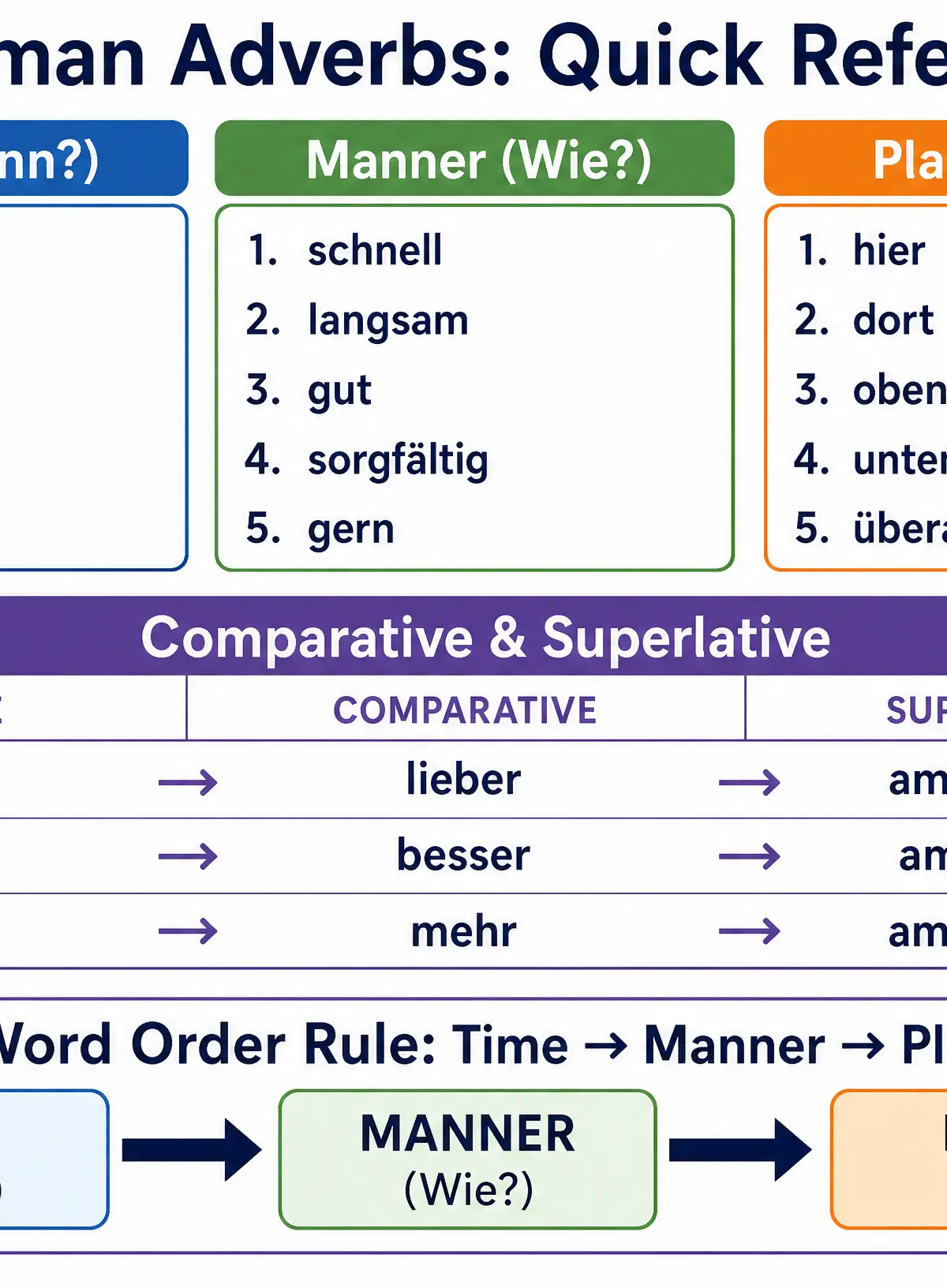
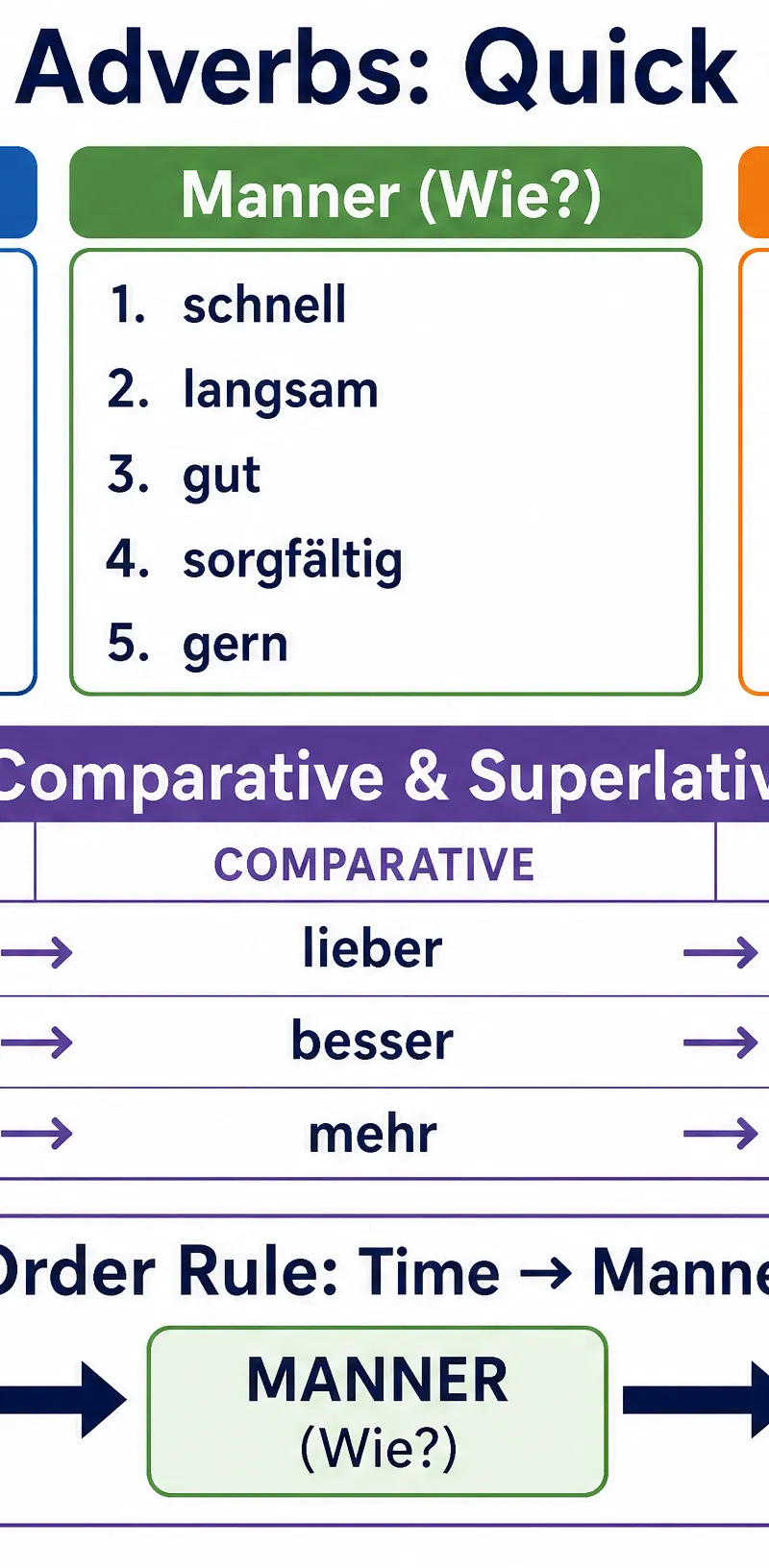
When to use it: Whenever you have multiple adverbial phrases in a single German sentence, they must follow the order: Time (Wann?), Manner (Wie?), Place (Wo?).
Conjugation Table (Example Verb: fahren - to travel/drive)
| Subject | Verb Form | English |
|---|---|---|
| ich | fahre | I drive/travel |
| du | fährst | you drive/travel |
| er/sie/es | fährt | he/she/it drives/travels |
| wir | fahren | we drive/travel |
| ihr | fahrt | you (pl) drive/travel |
| sie/Sie | fahren | they/You drive/travel |
Irregulars to learn: fahren is a stem-changing verb (a -> ä for du/er/sie/es).
Example of TMP Rule:
Ich fahre morgen (Time) schnell (Manner) nach Berlin (Place).
Key Structure 2: Comparative and Superlative Adverbs
When to use it: When comparing how actions are performed, or stating preferences.
Irregular Adverb Table
| Positive | Comparative | Superlative | English |
|---|---|---|---|
| gern | lieber | am liebsten | gladly -> prefer -> like most of all |
| gut | besser | am besten | well -> better -> best |
| viel | mehr | am meisten | much/a lot -> more -> most |
Example: Ich spiele gern Tennis, aber ich spiele lieber Basketball, und am liebsten schwimme ich.
Key Structure 3: Adverbs in Subordinate Clauses
When to use it: When using conjunctions like weil (because), dass (that), or obwohl (although), the conjugated verb is pushed to the end of the clause. The adverbs stay in their TMP order before the verb.
Example: Ich lerne Deutsch, weil ich nächstes Jahr (Time) wirklich gern (Manner) nach Deutschland (Place) fahre (Verb at end).
🎧 Listening Skills
What to Expect
You will hear short monologues or dialogues where speakers describe events, routines, or opinions. Adverbs are often the key to distinguishing between multiple choice options (e.g., did it happen yesterday or today?).
Listening Strategies
- Listen for frequency: Words like immer, oft, nie completely change the meaning. Note them down immediately.
- Watch for 'noch' vs 'schon': schon (already) means the action is complete; noch nicht (not yet) means it isn't. Examiners love testing this distinction.
- Note Time markers: Time adverbs usually appear early in the sentence. Listen closely right after the verb.
Common Listening Traps
- Hearing gern but missing the lieber later in the sentence. The question might ask what the person prefers, not just what they like.
- Confusing fast (almost) with the English word fast. In German, fast means nearly, not quickly (which is schnell).
🗣️ Speaking Skills
Role Play Scenarios
Scenario 1: Booking a train ticket
- You: Ich möchte morgen (Time) nach München fahren.
- Ticket agent: Möchten Sie schnell (Manner) reisen? Der ICE ist teurer.
- You: Ja, lieber schnell, bitte.
Scenario 2: Discussing school
- Friend: Wie findest du Mathe?
- You: Ich finde Mathe ziemlich (Degree) schwer, aber ich lerne immer (Time) fleißig (Manner).
Photo Card Practice
Model Photo Card Response:
- Qu 1 (Description): Auf dem Foto sehe ich Leute, die draußen im Park sitzen.
- Qu 2 (Opinion): Ich finde das Bild sehr schön, weil das Wetter besonders gut ist.
- Qu 3 (Related topic): In meiner Freizeit spiele ich oft Fußball im Park.
- Qu 4 (Past/Future): Gestern habe ich leider zu Hause geblieben, weil es geregnet hat.
- Qu 5 (Unpredictable): Nächstes Jahr möchte ich unbedingt nach Deutschland reisen.
General Conversation Questions
| Question (German) | Model Answer | English Translation |
|---|---|---|
| Was machst du gern in deiner Freizeit? | Ich spiele gern Videospiele, aber ich lese lieber ein Buch. | What do you like doing in your free time? I like playing video games, but I prefer reading a book. |
| Wie fährst du zur Schule? | Ich fahre normalerweise mit dem Bus, weil es sehr schnell ist. | How do you travel to school? I usually travel by bus because it is very fast. |
| Was hast du letztes Wochenende gemacht? | Gestern bin ich glücklicherweise ins Kino gegangen. | What did you do last weekend? Yesterday I fortunately went to the cinema. |
| Wohnst du gern hier? | Ja, ich wohne sehr gern hier, weil es überall Parks gibt. | Do you like living here? Yes, I like living here very much because there are parks everywhere. |
| Was wirst du morgen machen? | Ich werde morgen wahrscheinlich Hausaufgaben machen. | What will you do tomorrow? I will probably do homework tomorrow. |
✍️ Writing Skills
Translation Practice
English → German:
| English | German | Key Grammar |
|---|---|---|
| I always play football here. | Ich spiele immer hier Fußball. | Time before Place |
| She is driving to Berlin tomorrow. | Sie fährt morgen nach Berlin. | Time adverb placement |
| I prefer eating pizza. | Ich esse lieber Pizza. | Irregular comparative (gern -> lieber) |
| Unfortunately, the weather is very bad. | Leider ist das Wetter sehr schlecht. | Adverb starting sentence (verb inversion) + Degree adverb |
| I travel quickly to school today. | Ich fahre heute schnell zur Schule. | Time-Manner-Place rule |
Extended Writing
**Model 90-word response (Foundation):**Hallo! Ich wohne in London. Ich spiele oft Fußball, weil es sehr lustig ist. Gestern bin ich ins Kino gegangen. Der Film war ziemlich gut. Morgen werde ich meine Hausaufgaben machen. Ich lerne nicht gern, aber ich muss. Tschüss!
**Model 150-word response (Higher):**Hallo! Ich wohne schon lange in London. In meiner Freizeit spiele ich oft Fußball im Park, weil es besonders gesund ist. Normalerweise spiele ich mit meinen Freunden, aber ich gehe lieber schwimmen, und am liebsten fahre ich Rad. Letztes Wochenende bin ich leider zu Hause geblieben, weil das Wetter wirklich furchtbar war. Es hat überall geregnet! Glücklicherweise habe ich einen guten Film gesehen. Nächstes Jahr möchte ich unbedingt nach Spanien fahren, weil ich die Kultur sehr interessant finde. Ich hoffe, dass wir schnell dorthin fliegen können!
Writing Checklist
- ✅ Have I used Time-Manner-Place order?
- ✅ Have I included at least 3 adverbs of degree (sehr, ziemlich, besonders)?
- ✅ Have I used gern / lieber / am liebsten correctly?
- ✅ If I started a sentence with an adverb (e.g., Gestern...), is the verb in the second position (e.g., Gestern bin ich...)?
📚 Reading Skills
Key Strategies
- Scan for adverbs first: They often hold the key to the writer's true opinion. A sentence with leider (unfortunately) immediately tells you the sentiment is negative.
- Look for time shifts: Words like früher (previously/in the past) and bald (soon) indicate a change in tense, which examiners use to test your comprehension of timeframes.
False Friends & Tricky Words
| Word | Looks Like | Actually Means |
|---|---|---|
| fast | fast/quick | almost/nearly |
| bald | bald (no hair) | soon |
| also | also/too | therefore/so |
| aktuell | actual/real | current/up-to-date |
🌍 Cultural Knowledge
In German-speaking countries, punctuality is highly valued, making adverbs of time culturally significant. When a German says pünktlich (on time) or sofort (immediately), they mean exactly that. Furthermore, regional dialects often use unique adverbs. For example, in Bavaria and Austria, you might hear fei as a filler word for emphasis, or halt to mean 'just' or 'simply'. While you should stick to standard High German (Hochdeutsch) in your exams, understanding these nuances shows a deep appreciation of the culture.
Visual Resources
2 diagrams and illustrations
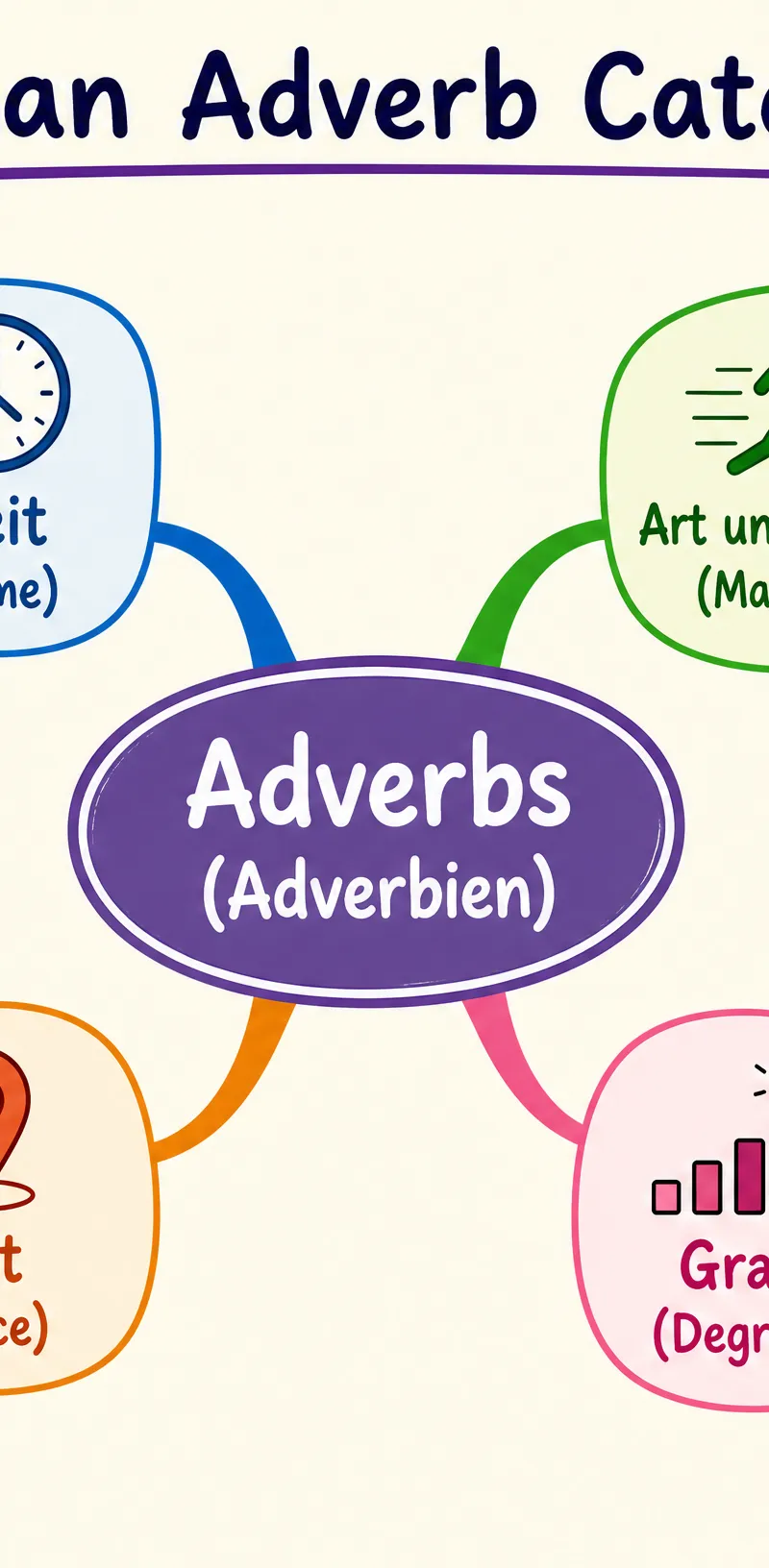
Interactive Diagrams
1 interactive diagram to visualise key concepts
Conceptual Flow Outline
MFL exam approach for Adverbs by skill
Worked Examples
4 worked examples — open one to explore the question and available guidance.
Practice Questions
Try the question, then reveal an answer plan or example response
Translate into German: I am travelling to Germany tomorrow quickly.
Hint: Remember the TMP rule: Time, Manner, Place.
Translate into English: Glücklicherweise habe ich gestern viel Pizza gegessen.
Hint: Identify the adverb at the start and the past participle at the end.
Writing: Write one sentence explaining what you prefer to do in your free time.
Hint: Use the comparative form of 'gern'.
Speaking: Answer the question 'Wann machst du deine Hausaufgaben?'
Hint: Provide a time adverb.
Reading: 'Er ist sehr schnell gelaufen, aber er ist fast zu spät gekommen.' Did he arrive late?
Hint: What does 'fast' mean in German?
Writing: Start a sentence with 'Morgen' to say you are going to the cinema.
Hint: Remember inversion: the verb must be the second idea.
Exam technique
How to turn what you know into marks
How to approach the question
Skill-by-skill strategy: Listening — read questions first, note keywords. Speaking — prepare opinions in advance, have fillers ready. Reading — skim first, then detail. Writing — plan before writing, check accuracy after.
How to structure your answer
Writing: Introduction → Main points with opinions → Justified reasons → Different tenses → Conclusion. Speaking: Give opinion → Justify → Extend → Use different tense.
Timing
Listening: 25 mins (heard twice). Speaking: 7-12 mins total (role play + photo card + conversation). Reading: 45-60 mins. Writing: 60-75 mins (translation + structured + extended).
Common pitfalls
- Forgetting the TMP rule and putting Place before Time
- Confusing adjectives with adverbs and trying to add endings to adverbs
- Starting a sentence with an adverb but forgetting to invert the subject and verb (e.g., writing 'Gestern ich bin' instead of 'Gestern bin ich')
- Using 'fast' to mean quickly instead of 'schnell'
- Mixing up 'schon' (already) and 'noch' (still/yet)
- Forgetting the irregular comparative forms (lieber, besser, mehr)
What the command words want
- Describe the photo
- Say what you can see, give an opinion, relate to your experience
- Translate into German
- Write full sentences with correct grammar — partial marks for partially correct
- Translate into English
- Meaning over word-for-word — capture the sense, don't guess cognates
- Write approximately 90 words
- Foundation task — cover all 4 bullet points, use present + one other tense
- Write approximately 150 words
- Higher task — 3 tenses, opinions, complex structures, ambitious vocabulary
Watch or listen (optional)
Test your understanding of Vocabulary: Adverbs
Active recall beats re-reading. Take an instant quiz now to test what you’ve learned and lock it into long-term memory.
7 days Premium · Then the free plan continues · No card, no charge