Pearson Edexcel · GCSE · German
Course version: Pearson-GCSE-German · Version from Mar 2026
Vocabulary: Articles and pronouns
Master the building blocks of German! This topic covers definite/indefinite articles, personal/reflexive pronouns, and the crucial case system (Nominative, Accusative, Dative) needed for accuracy in all four exam skills.
- 12 min read
- 4 worked examples
- 6 practice questions
- 8 key terms
Check what you remember
Read the wording for your board, then hide it and explain Nominative Case (Nominativ) in your own words. Rough notes are fine. This is a self-check, with no mark or grade.
Reference: Pearson Edexcel
The subject of the sentence; the person or thing doing the action.
Study Notes
Overview
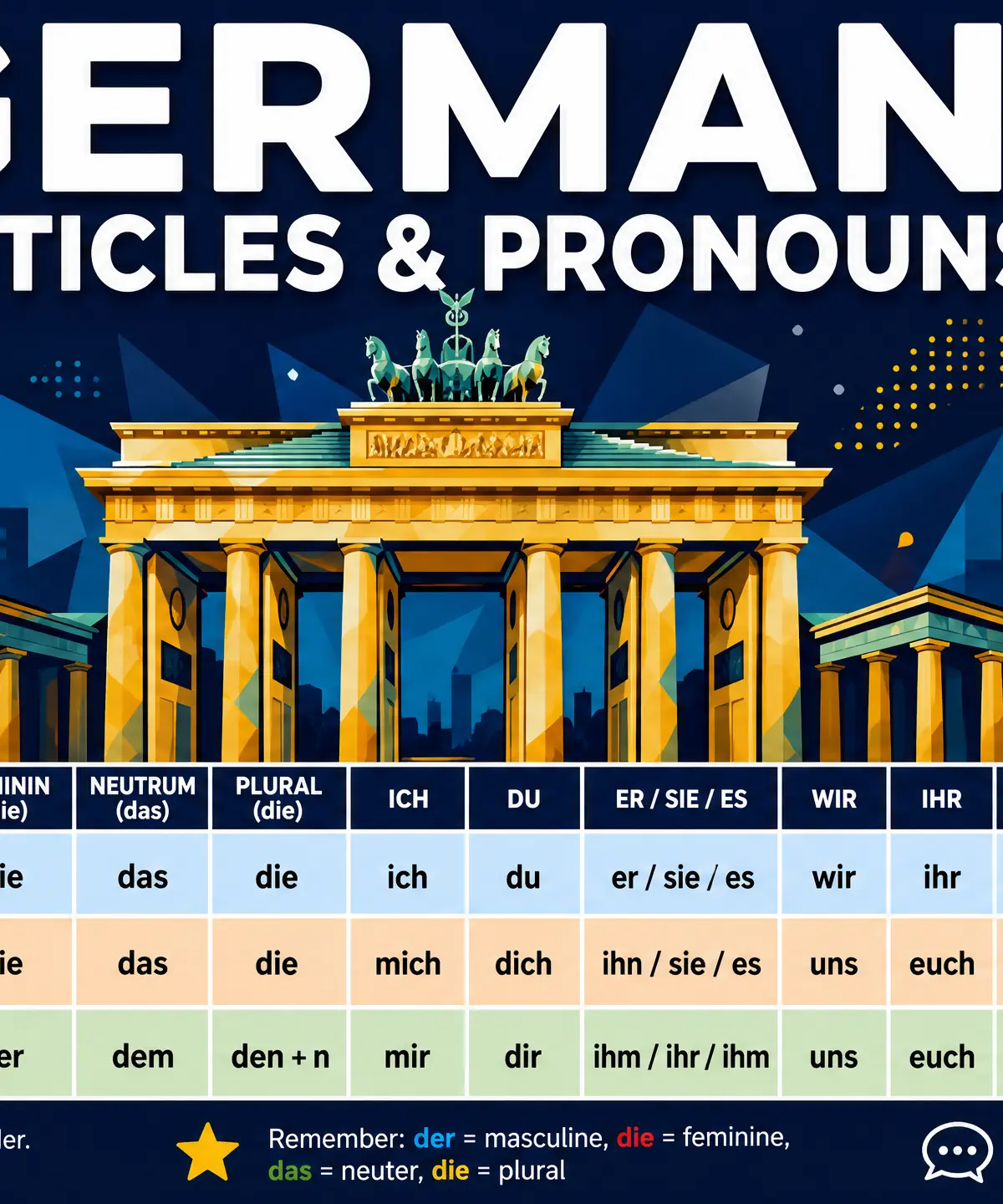
Articles and pronouns are the absolute foundation of German grammar. While vocabulary gives you the bricks, articles and pronouns are the mortar that holds your sentences together. In the GCSE exam, examiners actively look for correct article agreements and pronoun usage, especially in the Writing and Speaking papers. Mastering cases (Nominativ, Akkusativ, Dativ) is essential for accessing the higher mark bands, as it demonstrates grammatical control and accuracy.
Listen to our comprehensive revision podcast to solidify your understanding:
📖 Essential Vocabulary
Tier 1 — Foundation Core
| German | English | Gender | Example Sentence |
|---|---|---|---|
| der Mann | the man | m | Der Mann ist sehr freundlich. |
| die Frau | the woman | f | Ich sehe die Frau im Park. |
| das Kind | the child | n | Das Kind spielt mit dem Ball. |
| der Junge | the boy | m | Der Junge liest ein Buch. |
| das Mädchen | the girl | n | Das Mädchen lernt Deutsch. |
| der Hund | the dog | m | Ich habe einen Hund. |
| die Katze | the cat | f | Die Katze schläft auf dem Sofa. |
| das Haus | the house | n | Wir wohnen in einem Haus. |
| der Vater | the father | m | Mein Vater arbeitet in Berlin. |
| die Mutter | the mother | f | Meine Mutter ist Lehrerin. |
| das Auto | the car | n | Er kauft ein neues Auto. |
| der Bruder | the brother | m | Mein Bruder ist fünfzehn Jahre alt. |
| die Schwester | the sister | f | Hast du eine Schwester? |
| das Buch | the book | n | Ich lese das Buch. |
| der Tisch | the table | m | Das Buch liegt auf dem Tisch. |
Tier 2 — Higher Tier
| German | English | Gender | Example Sentence |
|---|---|---|---|
| der Jugendliche | the youth/teenager | m | Der Jugendliche interessiert sich für Musik. |
| die Gesellschaft | society | f | Die Gesellschaft verändert sich schnell. |
| das Mitglied | the member | n | Er ist ein Mitglied des Vereins. |
| der Erwachsene | the adult | m | Die Erwachsenen müssen arbeiten. |
| die Beziehung | the relationship | f | Wir haben eine gute Beziehung. |
| das Vorbild | the role model | n | Mein Vater ist mein Vorbild. |
| der Bekannte | the acquaintance | m | Ein Bekannter hat mir geholfen. |
| die Verwandtschaft | the relatives | f | Meine ganze Verwandtschaft wohnt hier. |
| das Verhältnis | the relationship/ratio | n | Das Verhältnis zwischen uns ist gut. |
| der Mitmensch | the fellow human being | m | Wir müssen an unsere Mitmenschen denken. |
High-Frequency Words & Phrases
| Phrase | English | Usage Context |
|---|---|---|
| meiner Meinung nach | in my opinion | Introducing a justified opinion |
| auf der einen Seite... auf der anderen Seite | on the one hand... on the other hand | Balancing an argument |
| es gibt (+ Akkusativ) | there is / there are | Describing what exists in a place |
| ich interessiere mich für (+ Akkusativ) | I am interested in | Discussing hobbies/interests |
| ich freue mich auf (+ Akkusativ) | I am looking forward to | Discussing future plans |
| mit meinem Freund / meiner Freundin | with my friend (m/f) | Describing who you do things with (Dative) |
| zum Beispiel | for example | Giving evidence for a point |
| aus diesem Grund | for this reason | Justifying a statement |
| in der Zukunft | in the future | Shifting to the future tense |
| in der Vergangenheit | in the past | Shifting to the past tense |
📝 Grammar Focus
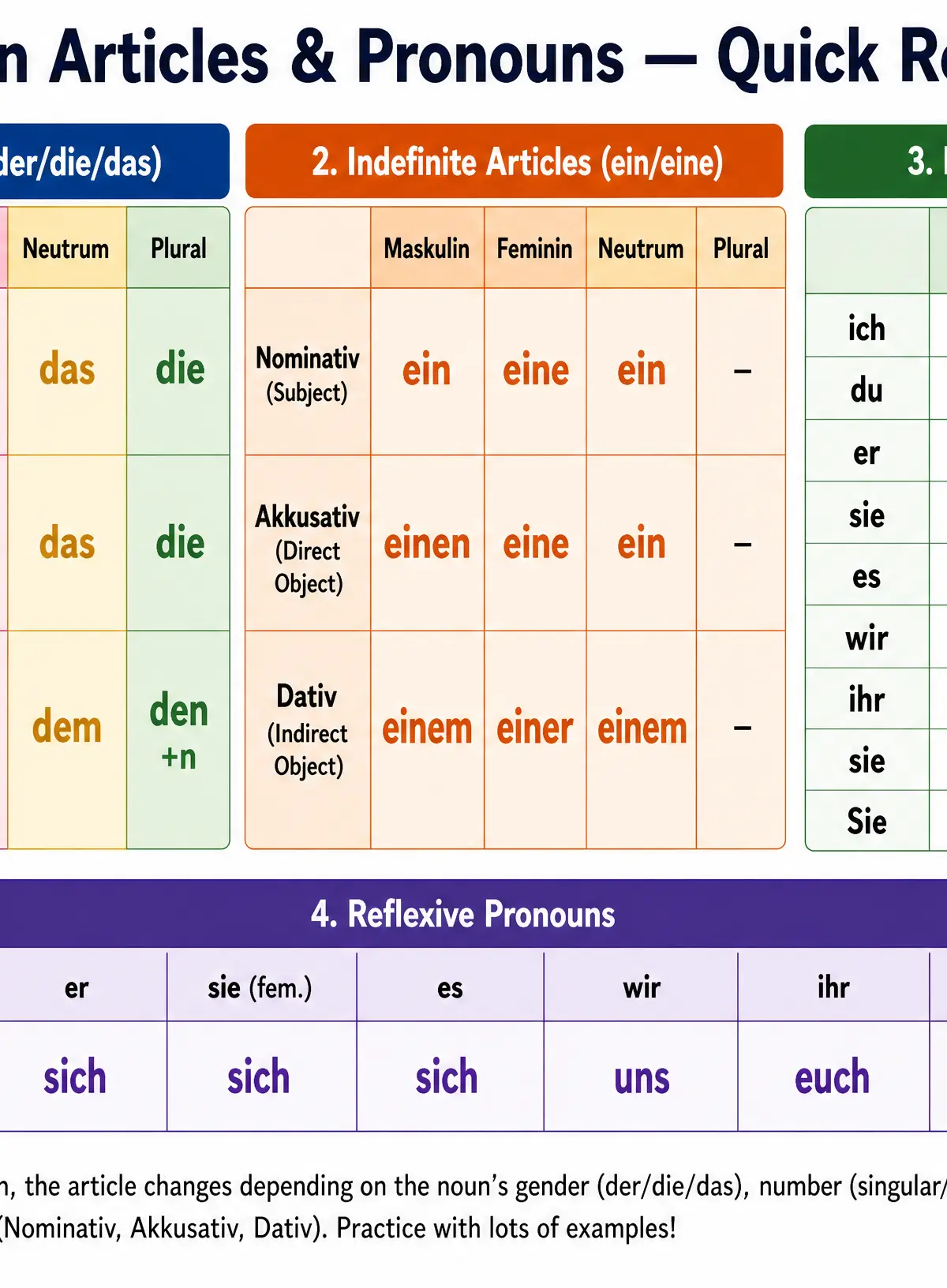
Key Structure 1: The Definite Article and Cases
When to use it: Use the definite article (the) when referring to a specific noun. The form changes depending on the noun's gender and its grammatical role (case) in the sentence.
Conjugation Table
| Case | Masculine (der) | Feminine (die) | Neuter (das) | Plural (die) |
|---|---|---|---|---|
| Nominativ (Subject) | der | die | das | die |
| Akkusativ (Direct Object) | den | die | das | die |
| Dativ (Indirect Object) | dem | der | dem | den (+n) |
Irregulars to learn: Remember that in the Dative plural, you must add an '-n' to the noun itself if it doesn't already end in -n or -s (e.g., den Kindern).
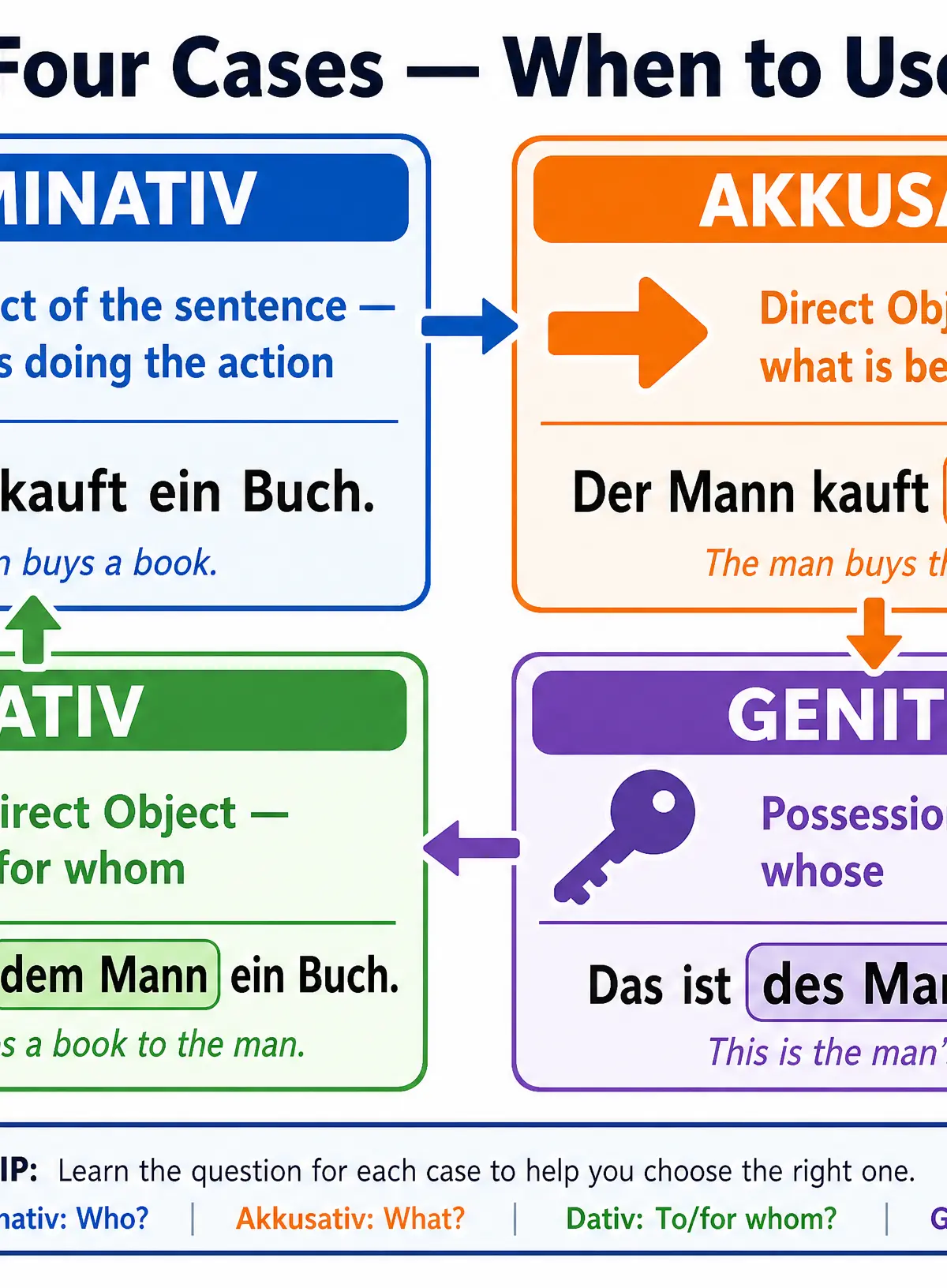
Key Structure 2: Personal Pronouns
When to use it: Use personal pronouns to replace nouns (I, you, he, she, it, we, they) to avoid repetition. They must match the case of the noun they replace.
Conjugation Table
| English | Nominativ | Akkusativ | Dativ |
|---|---|---|---|
| I | ich | mich | mir |
| you (informal sg.) | du | dich | dir |
| he | er | ihn | ihm |
| she | sie | sie | ihr |
| it | es | es | ihm |
| we | wir | uns | uns |
| you (informal pl.) | ihr | euch | euch |
| they | sie | sie | ihnen |
| you (formal) | Sie | Sie | Ihnen |
Key Structure 3: Possessive Adjectives
When to use it: Use possessive adjectives (my, your, his, her, etc.) to show ownership. They take the same endings as the indefinite article ('ein').
Conjugation Table (Base Forms)
| English | German Base Form |
|---|---|
| my | mein |
| your (informal sg.) | dein |
| his / its | sein |
| her / their | ihr |
| our | unser |
| your (informal pl.) | euer |
| your (formal) | Ihr |
Note: Add endings to these base forms based on the gender and case of the noun that follows (e.g., mein Hund, meine Katze, meinen Bruder).
🎧 Listening Skills
What to Expect
In the listening exam, you will hear native speakers talking at a natural pace. Articles and pronouns are often unstressed and spoken quickly, making them hard to catch. However, they are crucial clues for working out who is doing what to whom.
Listening Strategies
- Listen for the '-m' and '-r' sounds: If you hear 'ihm' or 'dem', you know a male/neuter person is receiving something (Dative). If you hear 'ihr' or 'der', it's a female.
- Watch out for 'sie': The word 'sie' can mean she, they, or you (formal). Listen to the verb ending to work out which one it is (sie spielt = she plays; sie spielen = they play).
- Identify the subject first: Figure out who is doing the action (Nominative), then work out who is receiving it (Accusative/Dative).
Common Listening Traps
- Confusing 'ihn' and 'ihm': 'Ihn' (him - accusative) and 'ihm' (to him - dative) sound similar but change the meaning of the sentence.
- Missing the '-n' on 'einen': 'Ich habe ein Bruder' vs 'Ich habe einen Bruder'. The '-en' tells you the brother is the object.
🗣️ Speaking Skills
Role Play Scenarios
Scenario 1: Buying a ticket
- You: Ich möchte eine Fahrkarte nach Berlin, bitte. (I would like a ticket to Berlin, please. - Akkusativ)
- Official: Einfach oder hin und zurück?
- You: Einfach, für mich und meinen Bruder. (Single, for me and my brother. - Akkusativ after 'für')
Scenario 2: At a restaurant
- Waiter: Was möchten Sie trinken? (What would you like to drink? - Formal Sie)
- You: Ich nehme einen Apfelsaft und sie nimmt ein Wasser. (I'll take an apple juice and she'll take a water. - Akkusativ)
Photo Card Practice
Model Photo Card Response:
- Qu 1 (Description): Auf dem Foto sehe ich einen Mann und eine Frau. Sie sitzen in einem Café. (In the photo I see a man and a woman. They are sitting in a cafe.)
- Qu 2 (Opinion): Ich denke, dass das Café sehr gemütlich ist, weil es viele Pflanzen gibt. (I think that the cafe is very cosy because there are lots of plants.)
- Qu 3 (Related topic): Letztes Wochenende bin ich mit meinen Freunden in ein Restaurant gegangen. (Last weekend I went to a restaurant with my friends.)
- Qu 4 (Past/Future): Nächstes Jahr werde ich meinen Geburtstag in einem großen Restaurant feiern. (Next year I will celebrate my birthday in a big restaurant.)
- Qu 5 (Unpredictable): Mein Lieblingsessen ist Pizza, weil sie lecker schmeckt. (My favourite food is pizza because it tastes delicious.)
General Conversation Questions
| Question (German) | Model Answer | English Translation |
|---|---|---|
| Was machst du in deiner Freizeit? | In meiner Freizeit spiele ich Fußball mit meinen Freunden, weil es Spaß macht. | In my free time I play football with my friends because it is fun. |
| Wie verstehst du dich mit deiner Familie? | Ich verstehe mich gut mit meinem Bruder, aber meine Schwester ist manchmal nervig. | I get on well with my brother, but my sister is sometimes annoying. |
| Was hast du letztes Wochenende gemacht? | Letztes Wochenende habe ich einen neuen Film gesehen. Er war sehr spannend. | Last weekend I saw a new film. It was very exciting. |
| Was wirst du nächstes Jahr machen? | Nächstes Jahr werde ich mein Abitur machen und ein Auto kaufen. | Next year I will do my A-levels and buy a car. |
| Beschreibe deinen besten Freund. | Mein bester Freund heißt Tom. Ich kenne ihn seit fünf Jahren und ich vertraue ihm immer. | My best friend is called Tom. I have known him for five years and I always trust him. |
✍️ Writing Skills
Translation Practice
English → German:
| English | German | Key Grammar |
|---|---|---|
| I have a dog. | Ich habe einen Hund. | Accusative masculine indefinite article |
| He gives the book to the woman. | Er gibt der Frau das Buch. | Dative feminine (der) + Accusative neuter (das) |
| I am looking forward to my holiday. | Ich freue mich auf meinen Urlaub. | Reflexive pronoun (mich) + Accusative possessive (meinen) |
| We saw him yesterday. | Wir haben ihn gestern gesehen. | Accusative personal pronoun (ihn) |
| I get on well with my sister. | Ich verstehe mich gut mit meiner Schwester. | Reflexive (mich) + Dative possessive after 'mit' (meiner) |
Extended Writing
**Model 90-word response (Foundation):**Mein Name ist Anna und ich wohne in einem kleinen Haus in London. Ich habe einen Bruder und eine Schwester. Mein Bruder ist sehr sportlich und ich spiele oft Tennis mit ihm. Letztes Wochenende sind wir in den Park gegangen. Es war sehr schön. Nächstes Jahr werde ich mit meiner Familie nach Spanien fahren. Ich freue mich darauf, weil das Wetter dort immer sonnig ist.
**Model 150-word response (Higher):**Meiner Meinung nach ist Familie extrem wichtig. Ich habe ein sehr gutes Verhältnis zu meinen Eltern, obwohl sie manchmal streng sind. Mein jüngerer Bruder geht mir jedoch oft auf die Nerven, weil er meine Sachen nimmt, ohne mich zu fragen! Letztes Wochenende habe ich seinen Geburtstag gefeiert. Wir sind in ein tolles Restaurant gegangen und ich habe ihm ein neues Videospiel geschenkt. Er hat sich sehr darüber gefreut. In der Zukunft möchte ich vielleicht mit meinen Freunden in einer Wohnung leben, weil das unabhängiger wäre. Auf der anderen Seite ist es billiger, bei den Eltern zu wohnen. Letztendlich muss man sich entscheiden, was am besten für einen selbst ist.
Writing Checklist
- ✅ Have I checked the gender of every noun I used?
- ✅ Have I used the Accusative case for direct objects (e.g., after 'haben', 'es gibt')?
- ✅ Have I used the Dative case after dative prepositions (aus, bei, mit, nach, seit, von, zu)?
- ✅ Do my possessive adjectives (mein, dein) agree with the noun that follows them?
- ✅ Have I included reflexive pronouns correctly with reflexive verbs?
📚 Reading Skills
Key Strategies
- Look at the article to find the subject: In German, the subject isn't always at the start of the sentence. 'Den Mann beißt der Hund' means 'The dog bites the man' - we know this because 'der Hund' is Nominative (the subject) and 'den Mann' is Accusative (the object).
- Track pronouns back to their nouns: When you see 'er', 'sie', or 'es', quickly scan back to the previous sentence to find the noun it refers to. Remember, 'sie' could refer to a table (die Tabelle) just as easily as a woman (die Frau)!
False Friends & Tricky Words
| Word | Looks Like | Actually Means |
|---|---|---|
| sie | she | Can mean she, they, or you (formal Sie) |
| ihr | her | Can mean her (dative), their, your (plural), or to her |
| der See | the sea | the lake (the sea is 'die See' or 'das Meer') |
| das Gift | the gift | the poison (gift is 'das Geschenk') |
🌍 Cultural Knowledge
In German-speaking countries, the distinction between formal and informal pronouns is deeply embedded in the culture. Using 'du' (informal you) is reserved for family, friends, children, and peers. When speaking to adults you don't know, teachers, or in professional settings, you MUST use 'Sie' (formal you, always capitalized). Using 'du' inappropriately can be seen as disrespectful or overly familiar. At university or in modern startups, the 'du' culture is becoming more common, but the rule of thumb remains: stick to 'Sie' until offered the 'du' (das Du anbieten).
Additionally, understanding cases is crucial for navigating German cities. If you ask for directions, you'll hear instructions using the Dative case: "Gehen Sie an der Kirche vorbei" (Walk past the church).
Visual Resources
2 diagrams and illustrations
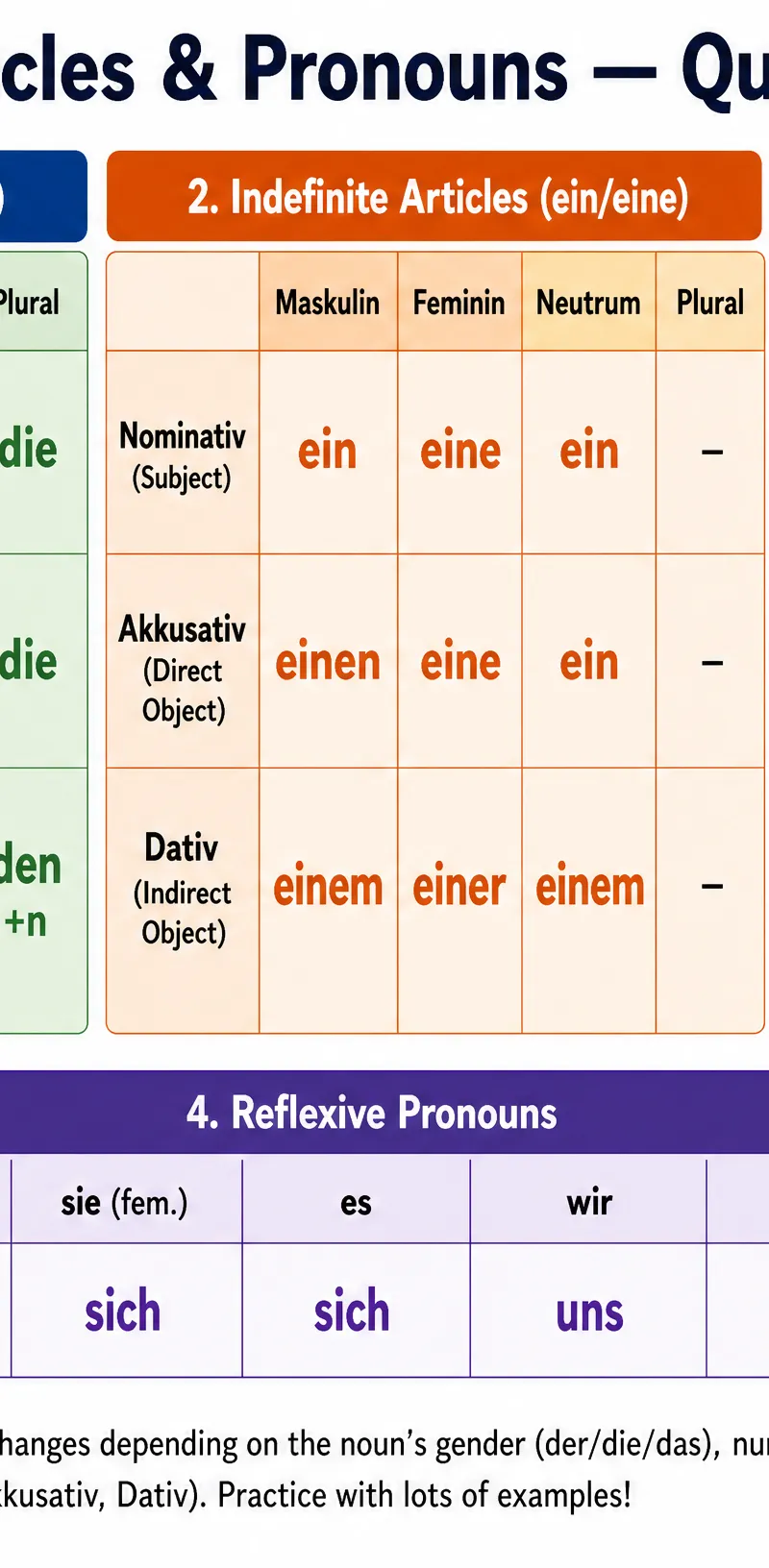

Interactive Diagrams
1 interactive diagram to visualise key concepts
Conceptual Flow Outline
How to choose the correct article in German
Worked Examples
4 worked examples — open one to explore the question and available guidance.
Practice Questions
Try the question, then reveal an answer plan or example response
Translate into German: 'I am buying a book for my brother.'
Hint: Identify the verb, the direct object (Akkusativ), and the preposition 'für' (which takes the Akkusativ).
Fill in the blanks with the correct relative pronoun: 'Das ist der Mann, ___ ich gestern gesehen habe.'
Hint: The man is the direct object of the second clause (I saw HIM).
Writing: Write 3 sentences describing what you and your friends do on the weekend. Use at least one reflexive verb.
Hint: Remember to use 'wir' and the correct reflexive pronoun 'uns'.
Reading: Read the text and answer in English. 'Mein Vater gibt meiner Schwester ein neues Handy zum Geburtstag.' Who receives the phone?
Hint: Look for the Dative article which indicates the receiver.
Speaking (Photo Card): Describe a photo of a family eating dinner. Use the phrase 'es gibt' correctly.
Hint: 'es gibt' is always followed by the Accusative case.
Translate into English: 'Wem gehört dieses Auto?'
Hint: Think about the case of the interrogative pronoun 'Wem'.
Exam technique
How to turn what you know into marks
How to approach the question
Writing: Always check the gender and case of every noun. Reading: Use articles to identify subjects and objects. Speaking: If unsure of a noun's gender, use a plural (which is always 'die' in nom/acc) or rephrase.
How to structure your answer
Writing: Introduction → Main points with opinions → Justified reasons → Different tenses → Conclusion. Speaking: Give opinion → Justify → Extend → Use different tense.
Timing
Listening: 25-35 mins. Speaking: 7-12 mins total. Reading: 45-60 mins. Writing: 60-75 mins.
Common pitfalls
- Changing feminine and neuter articles in the accusative (only masculine changes to 'den'/'einen')
- Using 'du' instead of 'Sie' in formal role plays
- Forgetting the '-n' on plural nouns in the dative case (e.g., mit den Kindern)
- Translating 'I like' as 'Ich mag' followed by the wrong case (it takes the accusative: Ich mag den Hund)
- Confusing 'sein' (his) and 'ihr' (her/their)
What the command words want
- Describe the photo
- Use 'Auf dem Foto gibt es + Akkusativ' (In the photo there is/are...)
- Translate into German
- Pay strict attention to gender, case, and adjectival agreements. Accuracy is key.
- Translate into English
- Look at the articles to determine who is doing what to whom. Don't just translate word-for-word.
- Write approximately 90 words
- Use a variety of vocabulary, but stick to grammar structures you are confident with. Ensure basic article agreement is solid.
- Write approximately 150 words
- Demonstrate knowledge of cases. Use prepositions that take the dative, and include complex sentences with reflexive verbs.
Watch or listen (optional)
Test your understanding of Vocabulary: Articles and pronouns
Active recall beats re-reading. Take an instant quiz now to test what you’ve learned and lock it into long-term memory.
7 days Premium · Then the free plan continues · No card, no charge