Pearson Edexcel · GCSE · German
Course version: Pearson-GCSE-German · Version from Mar 2026
Vocabulary: Basic vocabulary (greetings, numbers, days, months, seasons, times, colours)
This topic covers essential daily communication tools: greetings, numbers, days, months, seasons, times, and colours. It forms the foundation for all four skills (Listening, Speaking, Reading, Writing) and is frequently tested in role plays, dictation, and descriptive writing tasks.
- 11 min read
- 4 worked examples
- 6 practice questions
- 8 key terms
Check what you remember
Read the wording for your board, then hide it and explain Preposition in your own words. Rough notes are fine. This is a self-check, with no mark or grade.
Reference: Pearson Edexcel
A word that shows the relationship between a noun and other words in a sentence (e.g., am, im, um).
Study Notes
Overview
Welcome to the foundation of your GCSE German course! This topic covers the essential building blocks of the language: greetings, numbers, days, months, seasons, times, and colours. These words appear in every single paper — Listening, Speaking, Reading, and Writing. Mastering them is non-negotiable for achieving a strong grade, as they are crucial for understanding contexts, giving details, and navigating role play scenarios.
Listen to the full audio podcast for this topic below:
📖 Essential Vocabulary
Tier 1 — Foundation Core
| German | English | Gender | Example Sentence |
|---|---|---|---|
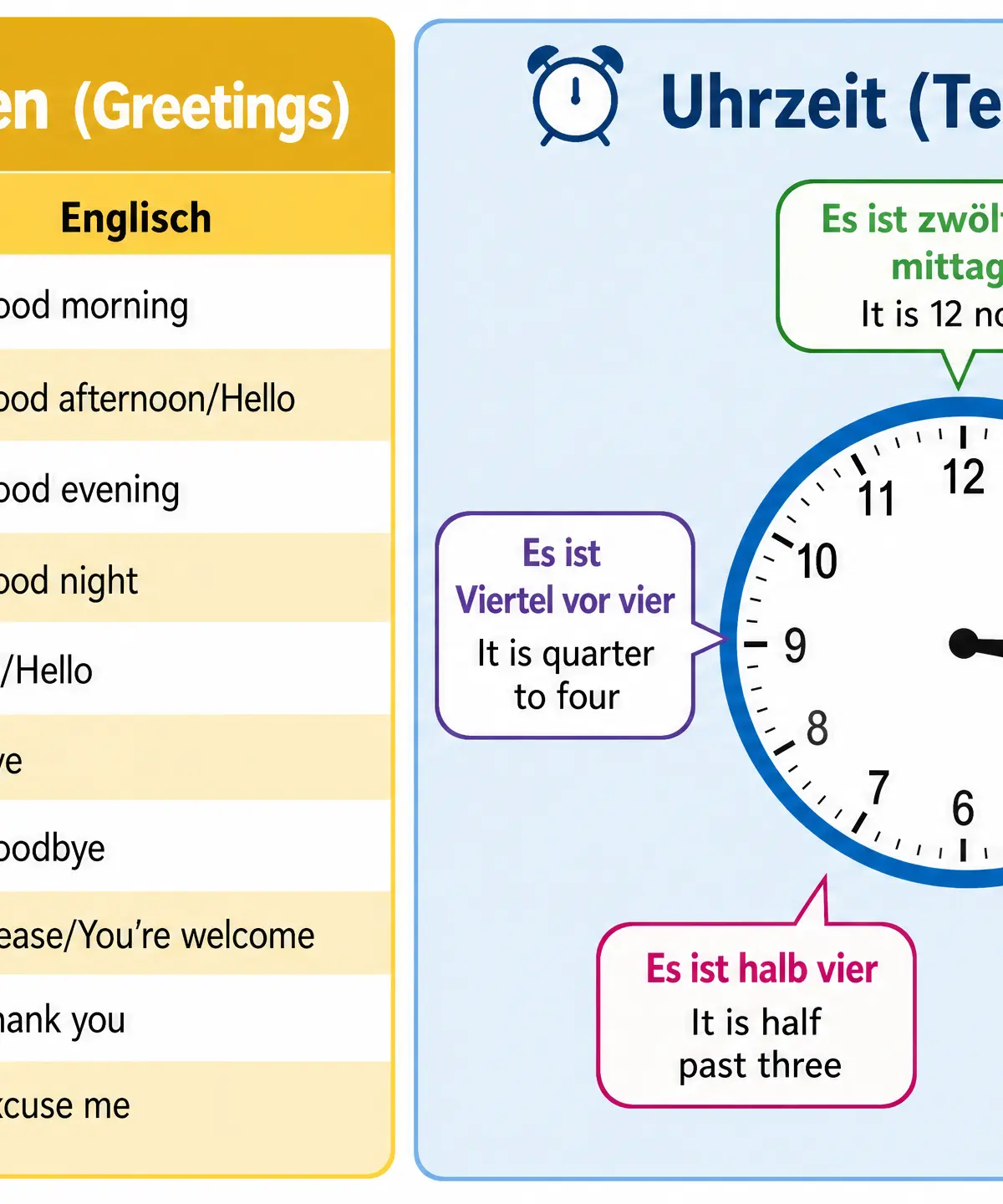
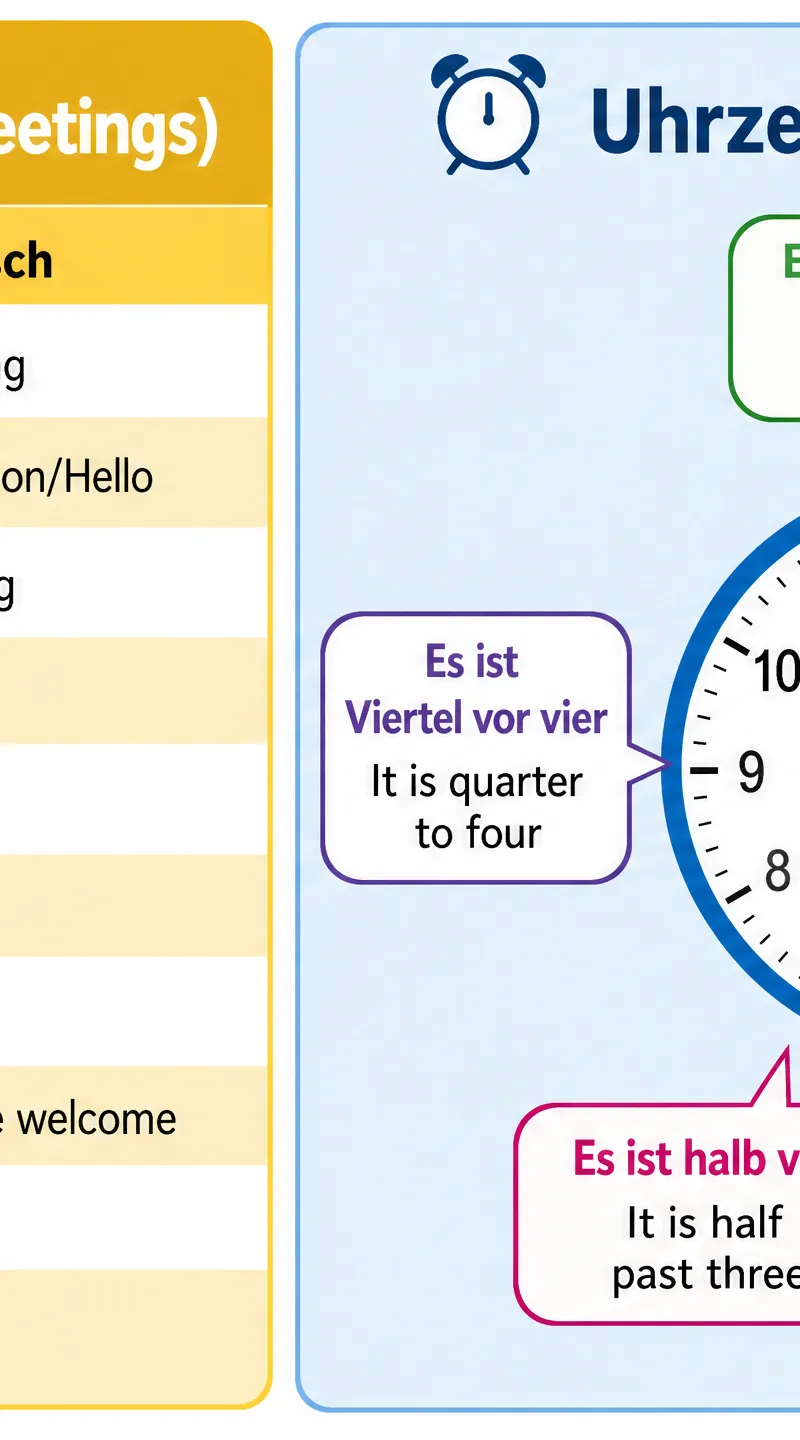
| Guten Morgen | Good morning | N/A | Guten Morgen, Herr Müller! |
| Guten Tag | Hello / Good afternoon | N/A | Guten Tag, wie geht's? |
| Auf Wiedersehen | Goodbye | N/A | Auf Wiedersehen bis morgen! |
| Hallo | Hello | N/A | Hallo, ich bin Anna. |
| Tschüss | Bye | N/A | Tschüss, bis später! |
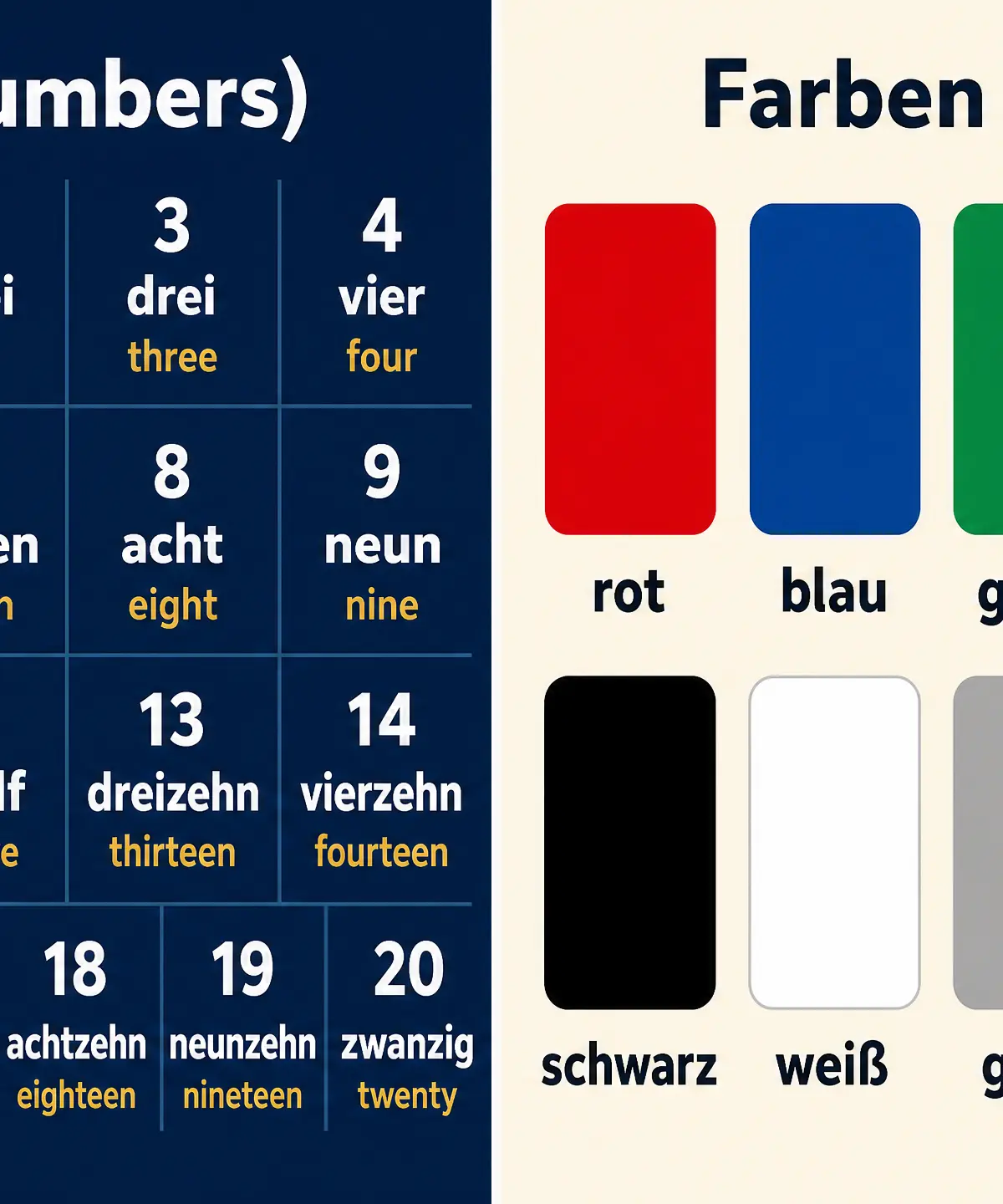
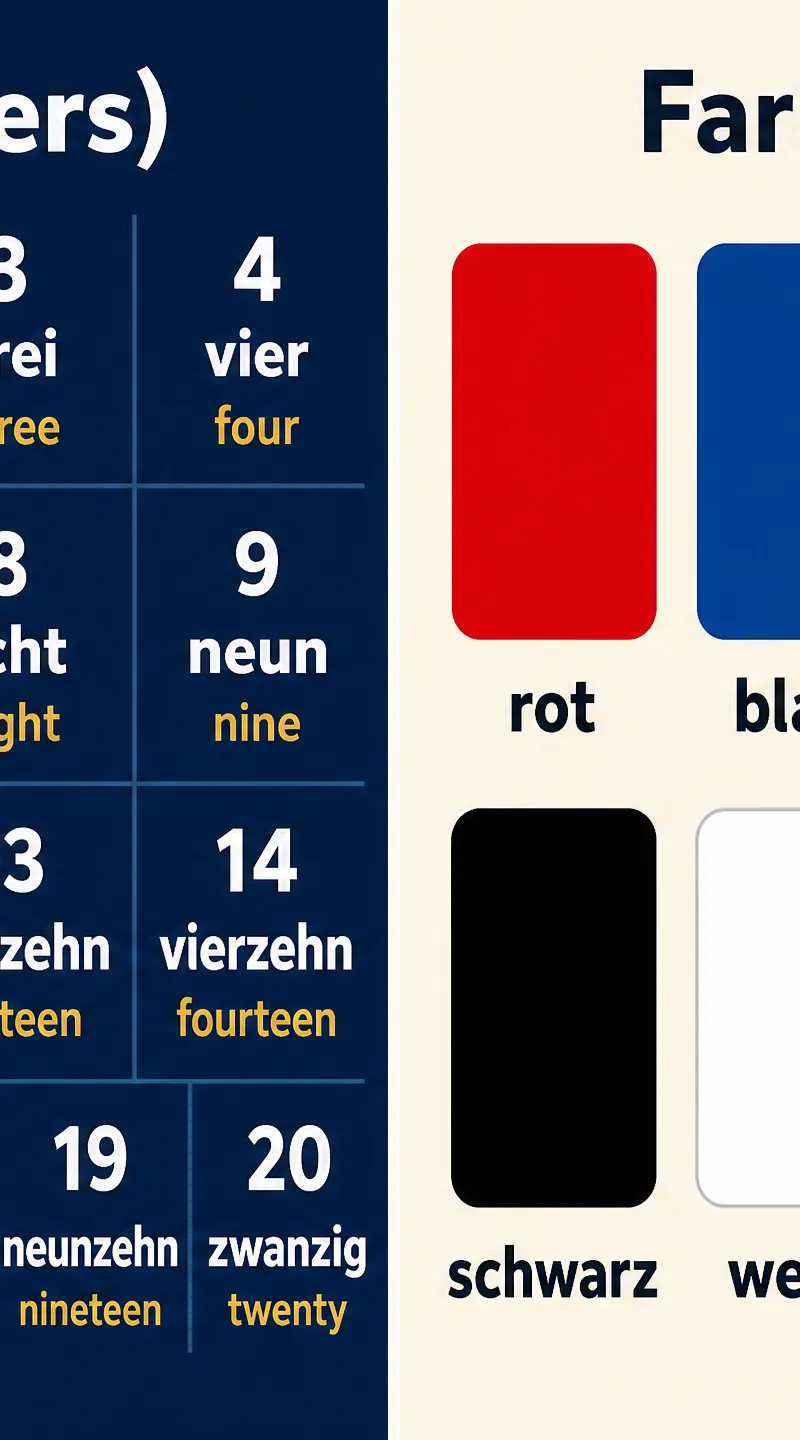
| null | zero | N/A | Meine Nummer ist null-sieben. |
| eins | one | N/A | Ich habe ein Buch. |
| zwei | two | N/A | Wir haben zwei Katzen. |
| drei | three | N/A | Es ist drei Uhr. |
| zehn | ten | N/A | Ich bin zehn Jahre alt. |
| zwanzig | twenty | N/A | Das kostet zwanzig Euro. |
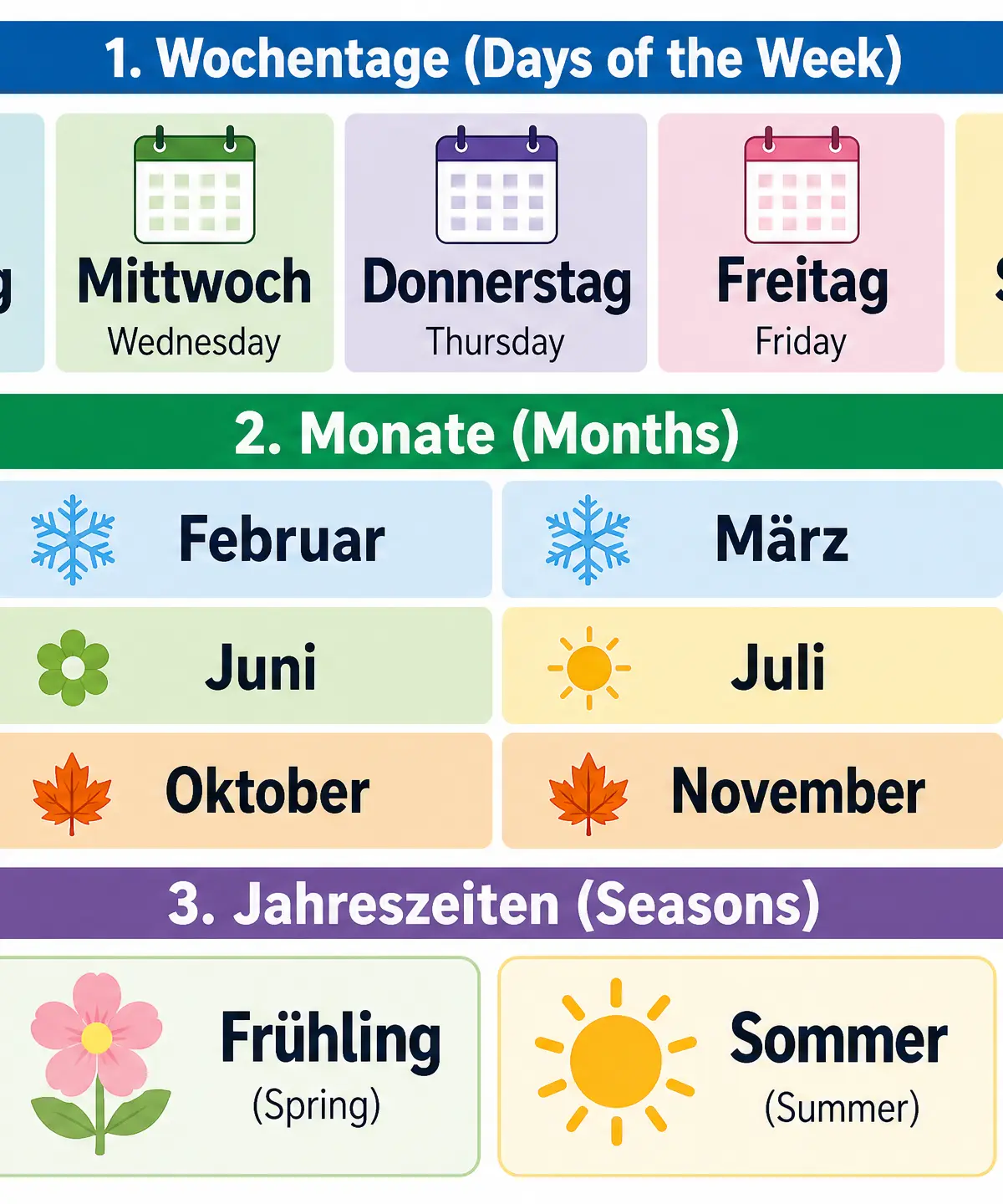
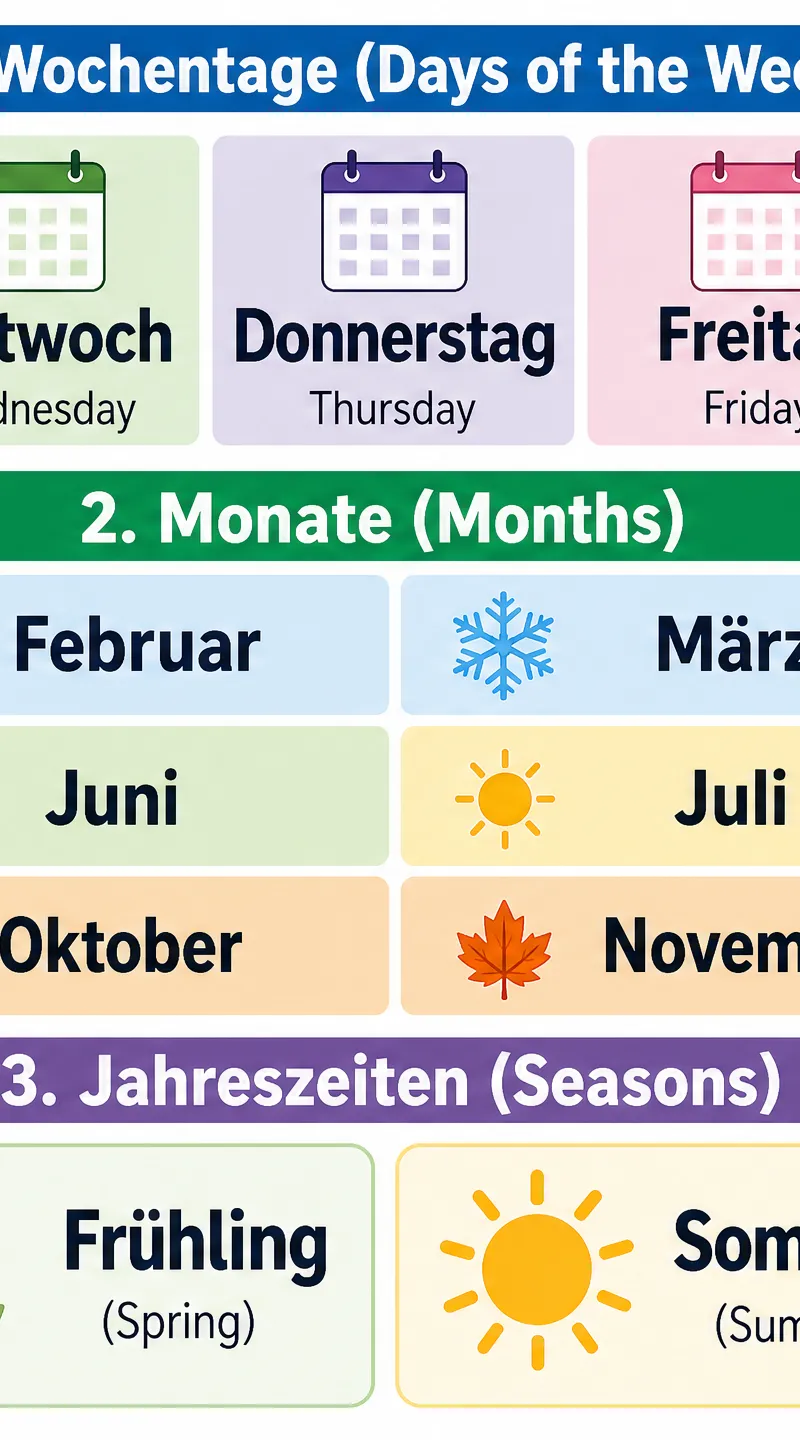
| Montag | Monday | der | Am Montag spiele ich Fußball. |
| Mittwoch | Wednesday | der | Mittwoch ist die Mitte der Woche. |
| Freitag | Friday | der | Freitag ist mein Lieblingstag. |
| Januar | January | der | Mein Geburtstag ist im Januar. |
| Sommer | summer | der | Im Sommer ist es heiß. |
| rot | red | N/A | Mein Auto ist rot. |
| blau | blue | N/A | Der Himmel ist blau. |
| grün | green | N/A | Das Gras ist grün. |
| schwarz | black | N/A | Mein Hund ist schwarz. |
Tier 2 — Higher Tier
| German | English | Gender | Example Sentence |
|---|---|---|---|
| der Vormittag | the morning (before noon) | der | Am Vormittag habe ich Schule. |
| der Nachmittag | the afternoon | der | Am Nachmittag mache ich Hausaufgaben. |
| Mitternacht | midnight | die | Um Mitternacht schlafe ich. |
| das Jahrhundert | the century | das | Wir leben im 21. Jahrhundert. |
| vorgestern | the day before yesterday | N/A | Vorgestern war das Wetter schlecht. |
| übermorgen | the day after tomorrow | N/A | Übermorgen fahre ich nach Berlin. |
| das Jahrzehnt | the decade | das | Ein Jahrzehnt hat zehn Jahre. |
| die Jahreszeit | the season | die | Meine Lieblingsjahreszeit ist der Frühling. |
| hellblau | light blue | N/A | Sie trägt ein hellblaues Kleid. |
| dunkelgrün | dark green | N/A | Der Wald ist dunkelgrün. |
High-Frequency Words & Phrases
| Phrase | English | Usage Context |
|---|---|---|
| Wie bitte? | Pardon? / I beg your pardon? | When you didn't hear or understand something. |
| Es tut mir leid | I'm sorry | Apologising for a mistake or giving bad news. |
| Entschuldigung | Excuse me | Getting someone's attention or apologising. |
| Danke schön | Thank you very much | Polite expression of gratitude. |
| Bitte schön | You're welcome | Polite response to 'Danke'. |
| Wie spät ist es? | What time is it? | Asking for the time. |
| Es ist Viertel nach... | It is quarter past... | Giving the time. |
| Es ist Viertel vor... | It is quarter to... | Giving the time. |
| Es ist halb... | It is half past (the previous hour) | Giving the time (e.g., halb drei = 2:30). |
| Am Wochenende | At the weekend | Discussing plans or past activities. |
📝 Grammar Focus
Key Structure 1: Prepositions of Time (am, im, um)
When to use it: In German, specific prepositions are used with different time expressions. Getting these right is essential for accuracy marks in Writing and Speaking.
Rules Table
| Preposition | Used with | Example | English |
|---|---|---|---|
| am (an + dem) | Days of the week, dates, parts of the day | am Montag, am Vormittag | on Monday, in the morning |
| im (in + dem) | Months, seasons, years | im Januar, im Sommer | in January, in summer |
| um | Specific clock times | um acht Uhr | at eight o'clock |
Exceptions to learn:
- in der Nacht (in the night) - uses 'in der' because Nacht is feminine.
- am Wochenende (at the weekend) - uses 'am' even though it's not a single day.
Key Structure 2: Adjective Endings with Colours
When to use it: When a colour word comes directly before a noun, it must agree with the gender and case of that noun. If it comes after the verb 'sein' (to be), it takes no ending.
Conjugation Table (Nominative Case)
| Subject | Verb Form | Colour Adjective | English |
|---|---|---|---|
| Der (masculine) | ist | rot | The red coat is here. (Der rote Mantel ist hier.) |
| Die (feminine) | ist | rot | The red bag is here. (Die rote Tasche ist hier.) |
| Das (neuter) | ist | rot | The red car is here. (Das rote Auto ist hier.) |
| Die (plural) | sind | rot | The red shoes are here. (Die roten Schuhe sind hier.) |
Note:
- Masculine adds -e (der rote Mantel)
- Feminine adds -e (die rote Tasche)
- Neuter adds -e (das rote Auto)
- Plural adds -en (die roten Schuhe)
- If using 'ein/eine/ein': ein roter Mantel, eine rote Tasche, ein rotes Auto.
🎧 Listening Skills
What to Expect
Listening exams frequently feature numbers (prices, phone numbers, ages, times) and dates. You will hear short announcements (e.g., train station times) and conversations arranging meetings.
Listening Strategies
- Write numbers as digits immediately: When you hear siebenundzwanzig, write '27' in the margin straight away. Don't try to hold it in your head.
- Listen for the 'und' in numbers: Remember German numbers from 21-99 are said 'backwards' (e.g., einundzwanzig = one-and-twenty).
- Watch out for 'halb': Halb neun means 8:30, NOT 9:30. This is the most common trap!
Common Listening Traps
- 16 vs 60: sechzehn (16) vs sechzig (60). Listen for the final consonant sound (-n vs -g).
- 13 vs 30: dreizehn (13) vs dreißig (30).
- Juni vs Juli: These sound very similar. Listen closely for the 'n' or 'l' sound.
🗣️ Speaking Skills
Role Play Scenarios
Scenario 1: Buying a train ticket
- Candidate: Guten Tag. Ich möchte eine Fahrkarte nach Berlin, bitte. (Hello. I would like a ticket to Berlin, please.)
- Examiner: Wann möchten Sie fahren? (When would you like to travel?)
- Candidate: Am Freitag um zehn Uhr. (On Friday at ten o'clock.)
Scenario 2: Arranging to meet a friend
- Examiner: Wann treffen wir uns? (When shall we meet?)
- Candidate: Treffen wir uns am Samstag um halb drei. (Let's meet on Saturday at half past two.)
Photo Card Practice
Model Photo Card Response:
- Qu 1 (Description): Auf dem Foto gibt es drei Personen. Sie tragen rote und blaue Pullover. (In the photo there are three people. They are wearing red and blue jumpers.)
- Qu 2 (Opinion): Ich finde das Wetter schön, weil es Sommer ist und die Sonne scheint. (I find the weather nice because it is summer and the sun is shining.)
- Qu 3 (Related topic): Meine Lieblingsjahreszeit ist der Winter, denn ich fahre gern Ski. (My favourite season is winter because I like skiing.)
- Qu 4 (Past/Future): Nächsten Sommer werde ich nach Spanien fahren. (Next summer I will travel to Spain.)
- Qu 5 (Unpredictable): Um wie viel Uhr stehst du normalerweise auf? (At what time do you normally get up?) - Ich stehe normalerweise um sieben Uhr auf. (I normally get up at seven o'clock.)
General Conversation Questions
| Question (German) | Model Answer | English Translation |
|---|---|---|
| Was ist dein Lieblingstag? | Mein Lieblingstag ist Samstag, weil ich keine Schule habe und ich lange schlafen kann. | My favourite day is Saturday because I have no school and I can sleep long. |
| Wann hast du Geburtstag? | Mein Geburtstag ist im Mai. Im Mai ist das Wetter oft sonnig und warm. | My birthday is in May. In May the weather is often sunny and warm. |
| Was machst du am Wochenende? | Am Wochenende spiele ich Fußball mit meinen Freunden. Letztes Wochenende haben wir gewonnen! | At the weekend I play football with my friends. Last weekend we won! |
| Welche Farbe magst du am liebsten? | Ich mag Blau am liebsten, weil es eine ruhige Farbe ist. Mein Zimmer ist auch blau. | I like blue the most because it is a calm colour. My room is also blue. |
| Um wie viel Uhr beginnt die Schule? | Die Schule beginnt um Viertel vor neun. Das ist sehr früh für mich! | School starts at quarter to nine. That is very early for me! |
✍️ Writing Skills
Translation Practice
English → German:
| English | German | Key Grammar |
|---|---|---|
| Good morning! | Guten Morgen! | Basic greeting |
| My birthday is in August. | Mein Geburtstag ist im August. | Preposition 'im' with months |
| The red car is fast. | Das rote Auto ist schnell. | Adjective ending (neuter) |
| We meet on Friday at 8:30. | Wir treffen uns am Freitag um halb neun. | Prepositions 'am' and 'um', 'halb' rule |
| I have sixteen books. | Ich habe sechzehn Bücher. | Number spelling |
Extended Writing
**Model 90-word response (Foundation):**Guten Tag! Ich heiße Tom und ich bin fünfzehn Jahre alt. Mein Geburtstag ist im Juli. Meine Lieblingsjahreszeit ist der Sommer, weil es heiß ist und ich im Meer schwimmen kann. Mein Lieblingstag ist der Samstag. Am Samstag stehe ich um zehn Uhr auf. Das ist toll! Dann spiele ich Fußball. Mein Fußballtrikot ist rot und weiß. Letztes Wochenende bin ich ins Kino gegangen. Nächstes Wochenende werde ich Musik hören. Tschüss!
**Model 150-word response (Higher):**Hallo! Ich heiße Sarah und ich bin sechzehn Jahre alt. Mein Geburtstag ist im Oktober, also im Herbst. Obwohl viele Leute den Sommer bevorzugen, ist meine Lieblingsjahreszeit der Winter, weil ich leidenschaftlich gern Ski fahre. Mein Lieblingstag in der Woche ist zweifellos der Freitag, da das Wochenende beginnt. Normalerweise stehe ich unter der Woche um Viertel vor sieben auf, was viel zu früh ist! Am Wochenende kann ich jedoch bis halb zehn schlafen. Letzten Samstag bin ich mit meinen Freunden in die Stadt gefahren, um ein rotes Kleid für eine Party zu kaufen. Es war ziemlich teuer, aber sehr schön. Nächsten Monat werde ich mit meiner Familie nach Deutschland fliegen. Wir werden am Dienstag um vierzehn Uhr abfliegen. Ich freue mich sehr darauf!
Writing Checklist
- ✅ Used 'am' for days, 'im' for months/seasons, 'um' for times
- ✅ Checked the spelling of numbers (especially -zehn vs -zig)
- ✅ Capitalised ALL nouns (Montag, Sommer, Uhr)
- ✅ Used the correct 'halb' time (halb drei = 2:30)
📚 Reading Skills
Key Strategies
- Skim for gist first: Look at the title and any pictures. Spot familiar words like days or colours to get the general context.
- Watch out for 'seit': Seit means 'since' or 'for' and is often used with time phrases. Seit drei Jahren = for three years.
- Pay attention to word order: In German, time phrases usually come early in the sentence (Time, Manner, Place). Ich spiele am Montag Fußball.
False Friends & Tricky Words
| Word | Looks Like | Actually Means |
|---|---|---|
| bald | bald (no hair) | soon |
| also | also (too) | so / therefore |
| aktuell | actual | current / up-to-date |
| das Gymnasium | gymnasium | secondary school (grammar school) |
🌍 Cultural Knowledge
Understanding German cultural norms regarding time and greetings is vital for authentic communication:
- Punctuality: Germans value punctuality highly (Pünktlichkeit). If you arrange to meet at 14:00, you should be there at 13:55. Being late is considered impolite.
- 24-hour clock: For official times (trains, TV schedules, school timetables), the 24-hour clock is always used. 3:00 PM is fünfzehn Uhr. The 12-hour clock is used in casual conversation.
- Formal vs Informal Greetings: Use Guten Tag and Sie (formal 'you') with adults you don't know, teachers, and in shops. Use Hallo and du (informal 'you') with friends, family, and children.
- Regional variations: In southern Germany and Austria, you will hear Grüß Gott (literally 'greet God') instead of Guten Tag, and Servus as a casual hello/goodbye.
Visual Resources
3 diagrams and illustrations
Interactive Diagrams
1 interactive diagram to visualise key concepts
Conceptual Flow Outline
Decision tree for choosing the correct German time preposition.
Worked Examples
4 worked examples — open one to explore the question and available guidance.
Practice Questions
Try the question, then reveal an answer plan or example response
Listening: Write down the price you hear: 'Das kostet siebenundneunzig Euro.'
Hint: Remember that German numbers are said 'backwards' (units then tens).
Reading: Translate the following phrase into English: 'Die Party beginnt um halb acht.'
Hint: Apply the 'halb looks ahead' rule.
Writing: Translate into German: 'My favourite season is spring because the trees are green.'
Hint: Check your noun capitalisation and verb position after 'weil' (because).
Speaking: Answer the question in German: 'Welche Farbe hat dein Schlafzimmer?' (What colour is your bedroom?)
Hint: Answer in a full sentence.
Writing: Write a short paragraph (approx 40 words) describing what you do on a typical Saturday. Include times.
Hint: Use 'am Samstag' and 'um [time] Uhr'.
Reading: True or False? 'Im Sommer fahre ich nach Italien, aber im Winter bleibe ich in England.' The person travels to Italy in winter.
Hint: Look closely at the seasons mentioned.
Exam technique
How to turn what you know into marks
How to approach the question
Skill-by-skill strategy: Listening — read questions first, write numbers as digits immediately. Speaking — prepare opinions in advance, have fillers ready. Reading — skim first, then detail, watch for false friends. Writing — plan before writing, check noun capitalisation and adjective endings.
How to structure your answer
Writing: Introduction → Main points with time phrases → Justified reasons → Different tenses → Conclusion. Speaking: Give detail (e.g. colours, times) → Justify → Extend.
Timing
Listening: 25 mins (heard twice). Speaking: 7-12 mins total (role play + photo card + conversation). Reading: 45-60 mins. Writing: 60-75 mins (translation + structured + extended).
Common pitfalls
- Confusing 'halb acht' (7:30) with 8:30.
- Forgetting to capitalise days of the week and months.
- Using the wrong preposition (e.g., saying 'in Montag' instead of 'am Montag').
- Writing 'sechzig' when they hear 'sechzehn'.
- Forgetting adjective endings when colours are placed before nouns (e.g., writing 'ein rot Auto' instead of 'ein rotes Auto').
- Translating 'also' as 'also' instead of 'so/therefore'.
What the command words want
- Describe the photo
- Use colours extensively to describe clothing and objects to show range of vocabulary.
- Translate into German
- Write full sentences with correct grammar — ensure all nouns are capitalised.
- Translate into English
- Meaning over word-for-word — capture the sense, especially with time phrases like 'halb'.
- Write approximately 90 words
- Foundation task — cover all 4 bullet points, use basic time phrases (am, im, um) accurately.
- Write approximately 150 words
- Higher task — use complex time phrases (vorgestern, in der Zukunft), 3 tenses, and ambitious vocabulary.
Watch or listen (optional)
Test your understanding of Vocabulary: Basic vocabulary (greetings, numbers, days, months, seasons, times, colours)
Active recall beats re-reading. Take an instant quiz now to test what you’ve learned and lock it into long-term memory.
7 days Premium · Then the free plan continues · No card, no charge