Pearson Edexcel · GCSE · German
Course version: Pearson-GCSE-German · Version from Mar 2026
Vocabulary: Conjunctions
Master German conjunctions to unlock higher grades. This topic covers coordinating (no word order change) and subordinating (verb to the end) conjunctions, essential for justifying opinions in Speaking and constructing complex sentences in Writing tasks across all exam boards.
- 13 min read
- 4 worked examples
- 6 practice questions
- 8 key terms
Check what you remember
Read the wording for your board, then hide it and explain Conjunction in your own words. Rough notes are fine. This is a self-check, with no mark or grade.
Reference: Pearson Edexcel
A linking word used to connect clauses or sentences (e.g., and, but, because).
Study Notes
Overview
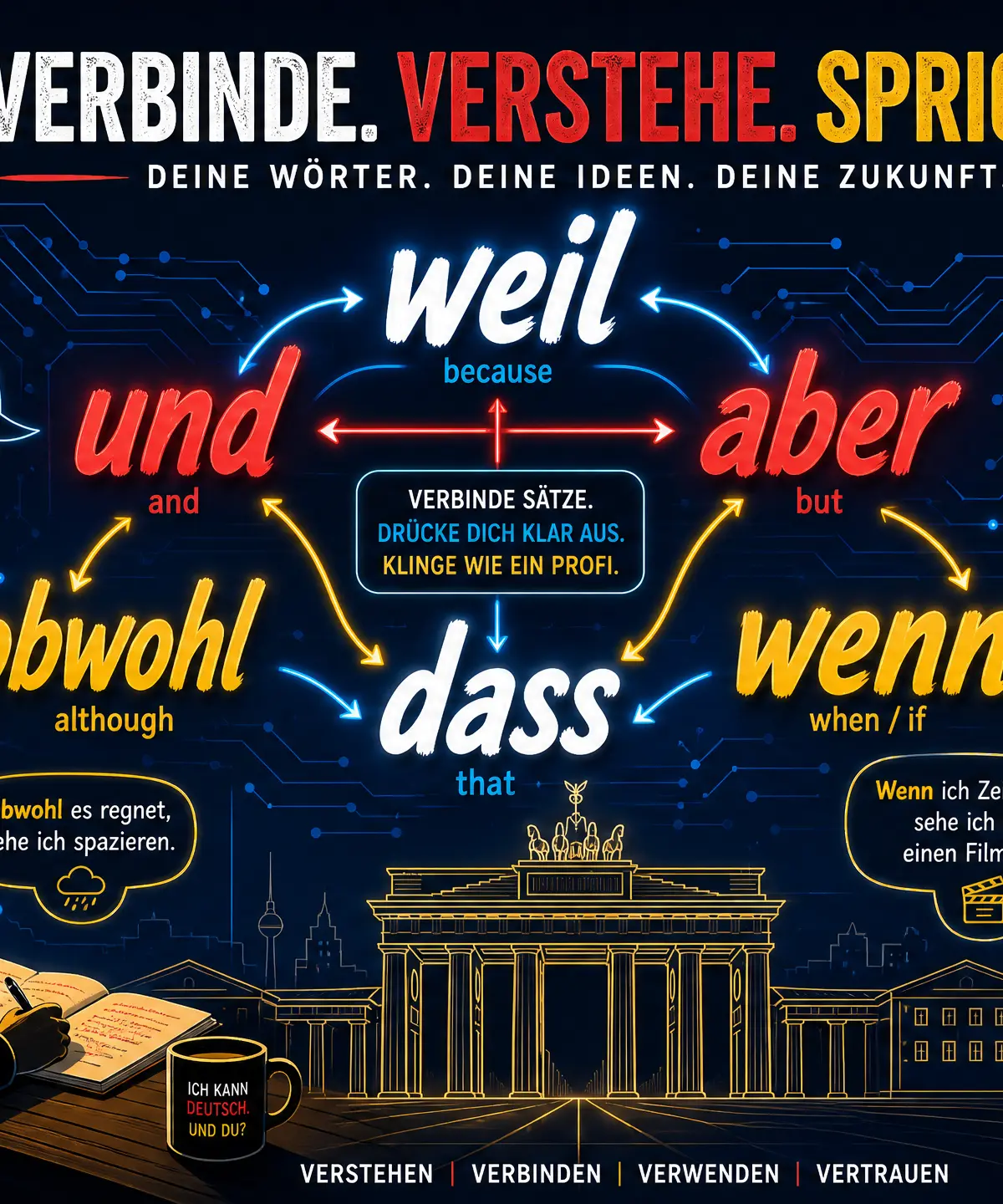
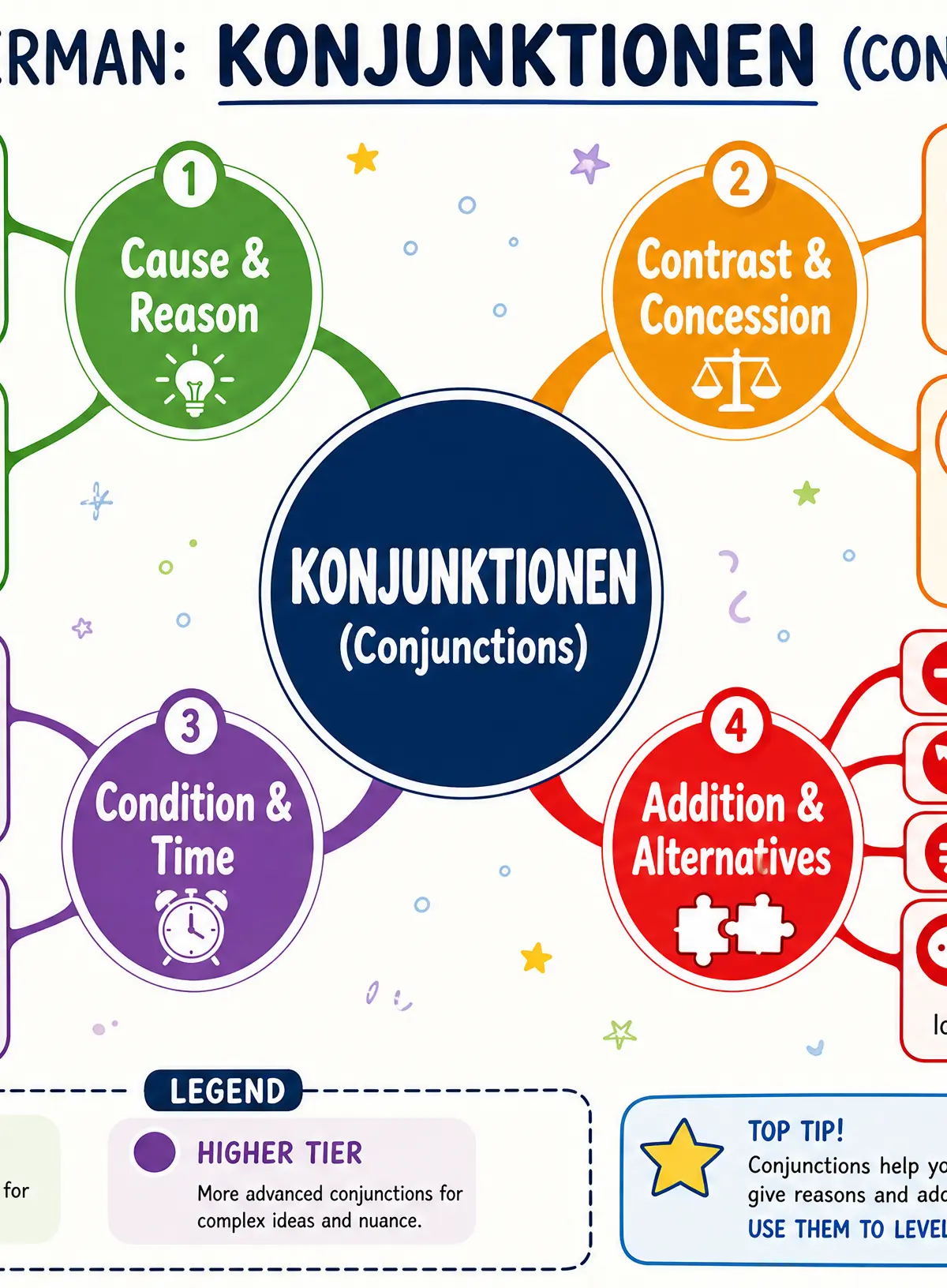
Conjunctions are the "glue" of the German language. They allow you to link simple sentences into complex, sophisticated ideas. In your GCSE exams, examiners are actively looking for your ability to use conjunctions—especially to give reasons (e.g., weil, denn) and to contrast ideas (e.g., aber, obwohl).
Mastering conjunctions is vital for all four skills: in Listening and Reading, they act as signposts telling you a reason or contrast is coming; in Speaking and Writing, they are the key to unlocking the higher mark bands (Grades 7-9) by allowing you to build complex sentences and justify your opinions.
📖 Essential Vocabulary
Tier 1 — Foundation Core
| German | English | Gender | Example Sentence |
|---|---|---|---|
| und | and | N/A | Ich lerne Deutsch und ich höre Musik. |
| aber | but | N/A | Ich mag Sport, aber ich bin müde. |
| oder | or | N/A | Gehen wir ins Kino oder bleiben wir zu Hause? |
| denn | because | N/A | Ich lerne Deutsch, denn es ist wichtig. |
| weil | because | N/A | Ich lerne Deutsch, weil es wichtig ist. |
| dass | that | N/A | Ich denke, dass Deutsch toll ist. |
| wenn | when / if | N/A | Wenn ich Zeit habe, lese ich ein Buch. |
| auch | also / too | N/A | Ich spiele Fußball und auch Tennis. |
| dann | then | N/A | Ich esse Frühstück, dann gehe ich zur Schule. |
| danach | after that | N/A | Wir spielen am Computer, danach essen wir. |
| deshalb | therefore | N/A | Es regnet, deshalb bleibe ich zu Hause. |
| so | so | N/A | Es war spät, so bin ich ins Bett gegangen. |
| wie | like / as | N/A | Er ist so groß wie sein Bruder. |
| als | than (comparison) | N/A | Sie ist älter als ich. |
| als | when (past) | N/A | Als ich jünger war, spielte ich Klavier. |
Tier 2 — Higher Tier
| German | English | Gender | Example Sentence |
|---|---|---|---|
| obwohl | although | N/A | Obwohl es regnet, gehe ich spazieren. |
| da | since / as | N/A | Da ich krank bin, bleibe ich im Bett. |
| ob | whether / if | N/A | Ich weiß nicht, ob er heute kommt. |
| sondern | but rather | N/A | Ich trinke keinen Tee, sondern ich trinke Kaffee. |
| entweder ... oder | either ... or | N/A | Wir fahren entweder nach Spanien oder nach Italien. |
| weder ... noch | neither ... nor | N/A | Ich mag weder Mathe noch Physik. |
| nicht nur ... sondern auch | not only ... but also | N/A | Sie ist nicht nur intelligent, sondern auch sehr freundlich. |
| bevor | before | N/A | Bevor ich schlafe, lese ich ein Buch. |
| nachdem | after | N/A | Nachdem ich gegessen hatte, machte ich meine Hausaufgaben. |
| damit | so that | N/A | Ich lerne viel, damit ich gute Noten bekomme. |
High-Frequency Words & Phrases
| Phrase | English | Usage Context |
|---|---|---|
| Ich bin der Meinung, dass... | I am of the opinion that... | Introducing a justified opinion in Speaking/Writing |
| Einerseits ... andererseits | On the one hand ... on the other hand | Weighing up arguments in extended writing |
| Aus diesem Grund | For this reason | Giving a consequence or conclusion |
| Das liegt daran, dass... | That is because... | Explaining a complex reason |
| Im Gegensatz zu | In contrast to | Comparing two things |
| Trotzdem | Nevertheless / Anyway | Showing a contrasting result despite a fact |
| Jedoch | However | Introducing a contrasting idea |
| Zum Beispiel | For example | Giving evidence for a point |
| Zusammenfassend kann man sagen, dass... | In summary one can say that... | Concluding a 150-word Higher writing task |
| Ich muss zugeben, dass... | I must admit that... | Adding nuance to an opinion |
📝 Grammar Focus
Key Structure 1: Coordinating Conjunctions (No Word Order Change)
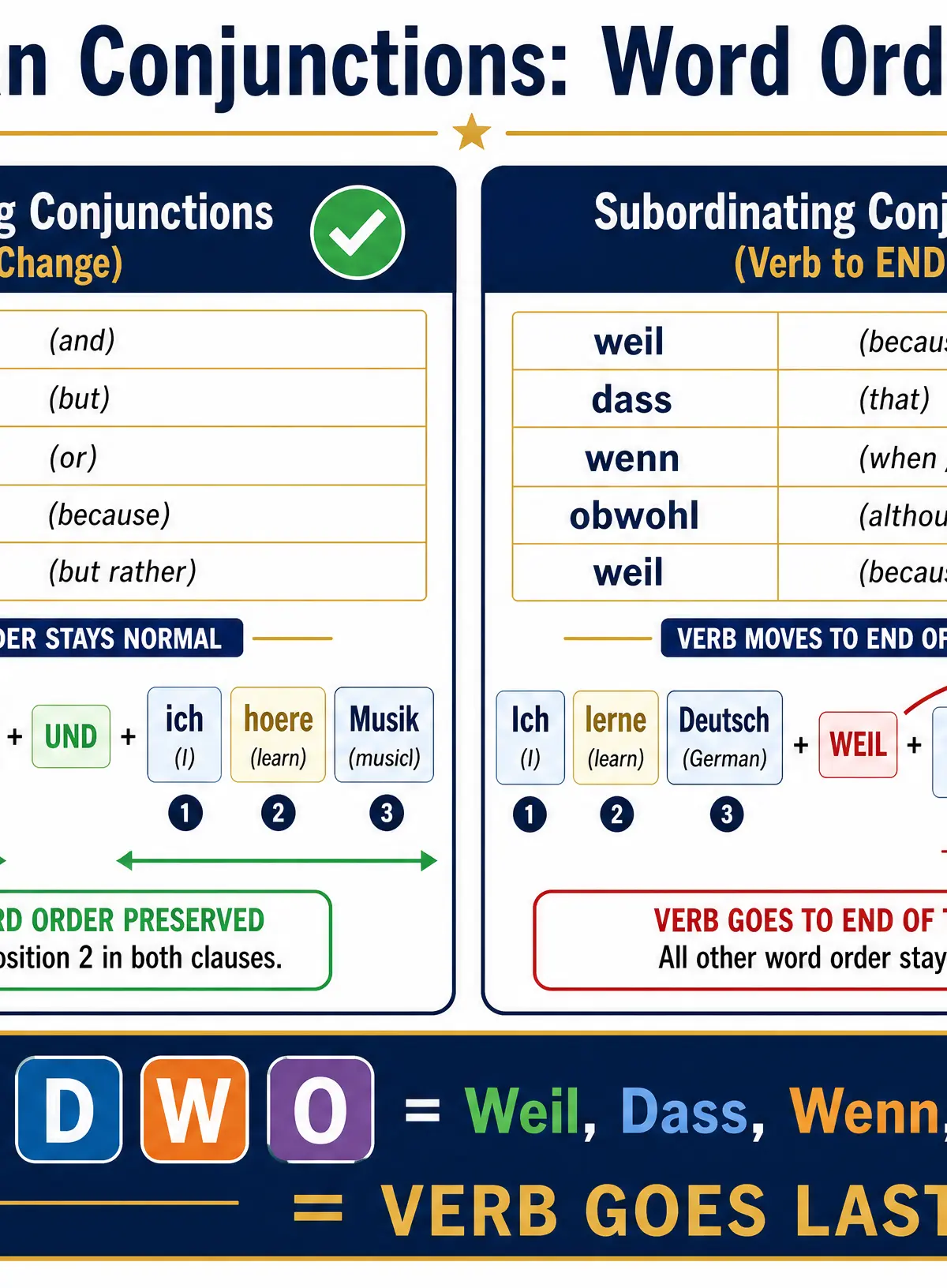
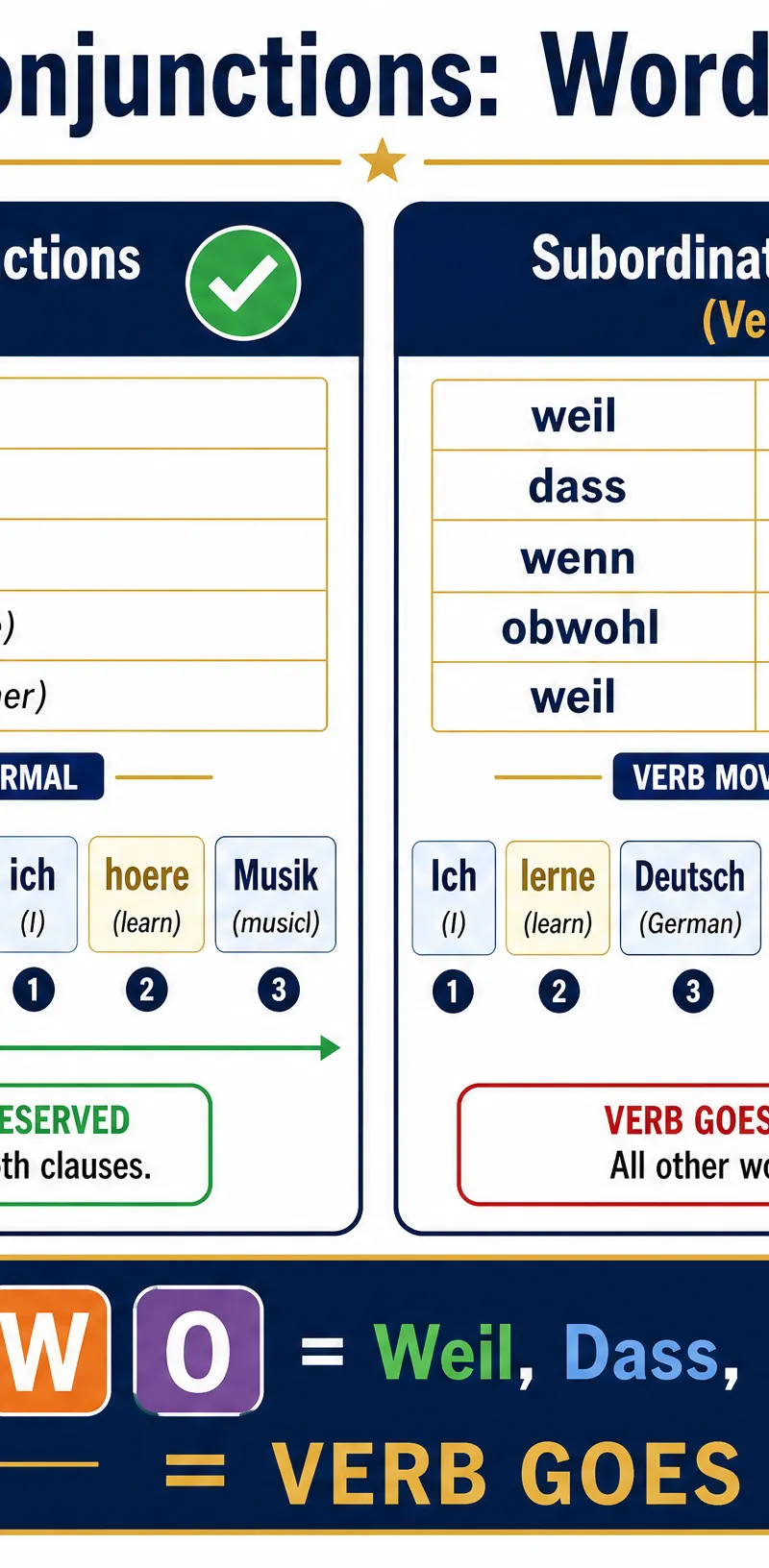
When to use it: Use these to join two main clauses together. The word order in the second clause stays exactly the same as normal (Subject - Verb - Object). The acronym ADUSO (Aber, Denn, Und, Sondern, Oder) helps remember these.
Conjugation Table: Using 'denn' (because)
| Subject | Verb Form (Main Clause) | Conjunction | Subject | Verb Form (Clause 2) | English |
|---|---|---|---|---|---|
| ich | lerne | denn | es | ist wichtig | I learn because it is important |
| du | lernst | denn | es | ist wichtig | You learn because it is important |
| er/sie/es | lernt | denn | es | ist wichtig | He/she/it learns because it is important |
| wir | lernen | denn | es | ist wichtig | We learn because it is important |
| ihr | lernt | denn | es | ist wichtig | You (pl) learn because it is important |
| sie/Sie | lernen | denn | es | ist wichtig | They/You (formal) learn because it is important |
Irregulars to learn: None specific to the conjunction, but remember standard irregular verbs like sein (to be) and haben (to have).
Key Structure 2: Subordinating Conjunctions (Verb to the END)
When to use it: Use these to introduce a subordinate clause. The golden rule is that the conjugated verb gets kicked to the very end of the clause. Remember the WDWO rule (Weil, Dass, Wenn, Obwohl).
Conjugation Table: Using 'weil' (because)
| Subject | Verb Form (Main Clause) | Conjunction | Subject | Rest of Clause | Verb Form (End) | English |
|---|---|---|---|---|---|---|
| ich | lerne | weil | es | wichtig | ist | I learn because it is important |
| du | lernst | weil | es | wichtig | ist | You learn because it is important |
| er/sie/es | lernt | weil | es | wichtig | ist | He/she/it learns because it is important |
| wir | lernen | weil | es | wichtig | ist | We learn because it is important |
| ihr | lernt | weil | es | wichtig | ist | You (pl) learn because it is important |
| sie/Sie | lernen | weil | es | wichtig | ist | They/You (formal) learn because it is important |
Irregulars to learn: Modal verbs (können, müssen, etc.) also go to the end. E.g., weil ich Hausaufgaben machen muss.
Key Structure 3: Inversion (Subordinate Clause First)
When to use it: To impress the examiner, start your sentence with the subordinate clause. When you do this, the main clause must start with the verb (Verb-Comma-Verb rule).
Conjugation Table: Inversion with 'Obwohl' (Although)
| Conjunction | Subject | Rest of Clause | Verb Form (End) | , | Verb Form (Main) | Subject | English |
|---|---|---|---|---|---|---|---|
| Obwohl | es | regnet | ist | , | gehe | ich | Although it is raining, I go |
| Obwohl | es | regnet | ist | , | gehst | du | Although it is raining, you go |
| Obwohl | es | regnet | ist | , | geht | er | Although it is raining, he goes |
| Obwohl | es | regnet | ist | , | gehen | wir | Although it is raining, we go |
| Obwohl | es | regnet | ist | , | geht | ihr | Although it is raining, you (pl) go |
| Obwohl | es | regnet | ist | , | gehen | sie | Although it is raining, they go |
🎧 Listening Skills
What to Expect
In the Listening exam, conjunctions act as crucial signposts. When a speaker gives an opinion, they will almost always follow it with weil or denn to give a reason. If they use aber or obwohl, a contrast or negative point is coming. Examiners use these to test if you understand the nuance of an opinion, not just the basic fact.
Listening Strategies
- Listen for the pivot: When you hear aber (but) or obwohl (although), the speaker is about to change their mind or introduce a negative. The true answer to the question often lies after these words.
- Wait for the verb: Because subordinating conjunctions push the verb to the end, you must listen to the very end of the sentence to understand the action. Don't stop listening halfway through!
- Note weil vs obwohl: A common trap is asking "Why does he like his town?" The speaker might say: "Obwohl es klein ist, liebe ich meine Stadt, weil es ruhig ist." The answer is "it is quiet", not "it is small".
Common Listening Traps
- Wenn vs Als: Both mean "when". Wenn is for present/future or repeated past events. Als is for a single past event. If you hear als, the speaker is talking about the past.
- Sondern: This means "but rather" after a negative. "Ich spiele nicht Tennis, sondern Fußball." The answer is football, not tennis.
🗣️ Speaking Skills
Role Play Scenarios
Scenario 1: At a tourist office (Foundation/Higher)
- Examiner: Wie kann ich Ihnen helfen?
- Candidate: Ich möchte eine Stadtrundfahrt machen, weil ich die Sehenswürdigkeiten sehen möchte.
- Examiner: Möchten Sie das heute oder morgen machen?
- Candidate: Ich möchte das heute machen, obwohl das Wetter schlecht ist.
Scenario 2: Discussing school (Higher)
- Examiner: Was ist dein Lieblingsfach?
- Candidate: Mein Lieblingsfach ist Geschichte, denn der Lehrer ist fantastisch, aber ich mag Mathe nicht, weil es zu schwierig ist.
Photo Card Practice
Model Photo Card Response (Topic: Environment):
- Qu 1 (Description): Auf dem Foto sehe ich viele Autos und viel Verkehr. Es gibt auch viel Smog, was sehr schlecht für die Umwelt ist.
- Qu 2 (Opinion): Ich finde, dass wir mehr mit dem Rad fahren sollten, weil Autos zu viele Abgase produzieren.
- Qu 3 (Related topic): In meiner Stadt gibt es viel Verschmutzung. Obwohl wir einen Park haben, gibt es überall Müll.
- Qu 4 (Past/Future): Als ich jünger war, bin ich immer mit dem Auto zur Schule gefahren, aber nächstes Jahr werde ich zu Fuß gehen.
- Qu 5 (Unpredictable): Was ist das größte Umweltproblem? Ich denke, dass der Klimawandel das größte Problem ist, da das Wetter immer extremer wird.
General Conversation Questions
| Question (German) | Model Answer | English Translation |
|---|---|---|
| Warum lernst du Deutsch? | Ich lerne Deutsch, weil ich die Kultur interessant finde und weil ich später in Berlin arbeiten möchte. | I learn German because I find the culture interesting and because I want to work in Berlin later. |
| Was machst du gern in deiner Freizeit? | Ich spiele gern Fußball, denn es hält mich fit, obwohl ich manchmal nach dem Training sehr müde bin. | I like playing football because it keeps me fit, although I am sometimes very tired after training. |
| Wie war dein letzter Urlaub? | Als ich letztes Jahr in Spanien war, war das Wetter toll, aber das Hotel war leider ziemlich schmutzig. | When I was in Spain last year, the weather was great, but unfortunately the hotel was quite dirty. |
| Was wirst du nächstes Wochenende machen? | Wenn das Wetter schön ist, werde ich mit Freunden in den Park gehen, oder wir werden ins Kino gehen. | If the weather is nice, I will go to the park with friends, or we will go to the cinema. |
| Ist es wichtig, gesund zu essen? | Ja, ich glaube, dass es sehr wichtig ist, damit man nicht krank wird. | Yes, I believe that it is very important so that you don't get sick. |
✍️ Writing Skills
Translation Practice
English → German:
| English | German | Key Grammar |
|---|---|---|
| I play tennis and I swim. | Ich spiele Tennis und ich schwimme. | Coordinating conjunction (und) - normal word order. |
| I like English because it is interesting. | Ich mag Englisch, weil es interessant ist. | Subordinating conjunction (weil) - verb to the end. |
| Although it is raining, I am playing football. | Obwohl es regnet, spiele ich Fußball. | Inversion - starting with subordinate clause, main clause starts with verb. |
| When I was young, I lived in London. | Als ich jung war, wohnte ich in London. | 'Als' for past 'when' + Inversion. |
| I think that the film was boring. | Ich denke, dass der Film langweilig war. | Subordinating conjunction (dass) + past tense verb to the end. |
Extended Writing
**Model 90-word response (Foundation):**Ich wohne in einer kleinen Stadt in England. Ich mag meine Stadt, weil es einen großen Park gibt. In meiner Freizeit spiele ich oft Fußball mit meinen Freunden, aber manchmal gehen wir ins Kino. Letztes Wochenende bin ich einkaufen gegangen, obwohl das Wetter sehr schlecht war. Nächstes Jahr werde ich nach Spanien fahren, denn ich liebe die Sonne. Ich denke, dass Urlaub sehr wichtig ist.
**Model 150-word response (Higher):**Meiner Meinung nach ist ein gesunder Lebensstil extrem wichtig. Ich versuche, jeden Tag gesund zu essen, obwohl ich manchmal Schokolade esse, weil sie so lecker ist! Wenn ich Zeit habe, treibe ich dreimal pro Woche Sport, denn das hält mich fit und reduziert Stress.
Als ich jünger war, war ich ziemlich faul und ich habe zu viel Fastfood gegessen. Das war eine schlechte Idee! Da ich jetzt älter bin, verstehe ich, dass Gesundheit Priorität hat.
In der Zukunft werde ich versuchen, mehr Wasser zu trinken, damit ich mich besser konzentrieren kann. Ich glaube, dass viele Jugendliche zu viel Zeit vor dem Bildschirm verbringen, anstatt draußen aktiv zu sein. Wir müssen das ändern!
Writing Checklist
- ✅ Used at least 3 different conjunctions (e.g., und, weil, obwohl).
- ✅ Checked word order: Verb at the END after weil, dass, wenn, obwohl.
- ✅ Used a comma before subordinating conjunctions.
- ✅ Attempted one inversion (starting a sentence with Obwohl or Wenn).
- ✅ Used conjunctions to justify opinions (e.g., Ich finde das toll, weil...).
📚 Reading Skills
Key Strategies
- Highlight the conjunctions: When reading a long text, physically highlight words like obwohl, weil, and jedoch. They break the sentence into manageable chunks and show the relationship between ideas.
- Look for the comma: In German, subordinate clauses are always separated by commas. Use commas to help you find where one idea ends and the next begins.
False Friends & Tricky Words
| Word | Looks Like | Actually Means |
|---|---|---|
| also | also / too | therefore / so (Auch = also/too) |
| denn | then | because (Dann = then) |
| wenn | when | when / if (Wann = when in a question) |
| dass | das (the) | that (as a conjunction joining clauses) |
🌍 Cultural Knowledge
When speaking or writing in German, using conjunctions to link your ideas to cultural knowledge shows great sophistication. For example, discussing the environment: "Ich finde Recycling wichtig, weil Umweltschutz in Deutschland eine große Rolle spielt." (I find recycling important because environmental protection plays a big role in Germany). Or discussing festivals: "Obwohl das Oktoberfest in München berühmt ist, gibt es auch tolle Weihnachtsmärkte in Nürnberg." (Although the Oktoberfest in Munich is famous, there are also great Christmas markets in Nuremberg.) This demonstrates both linguistic skill and cultural awareness.
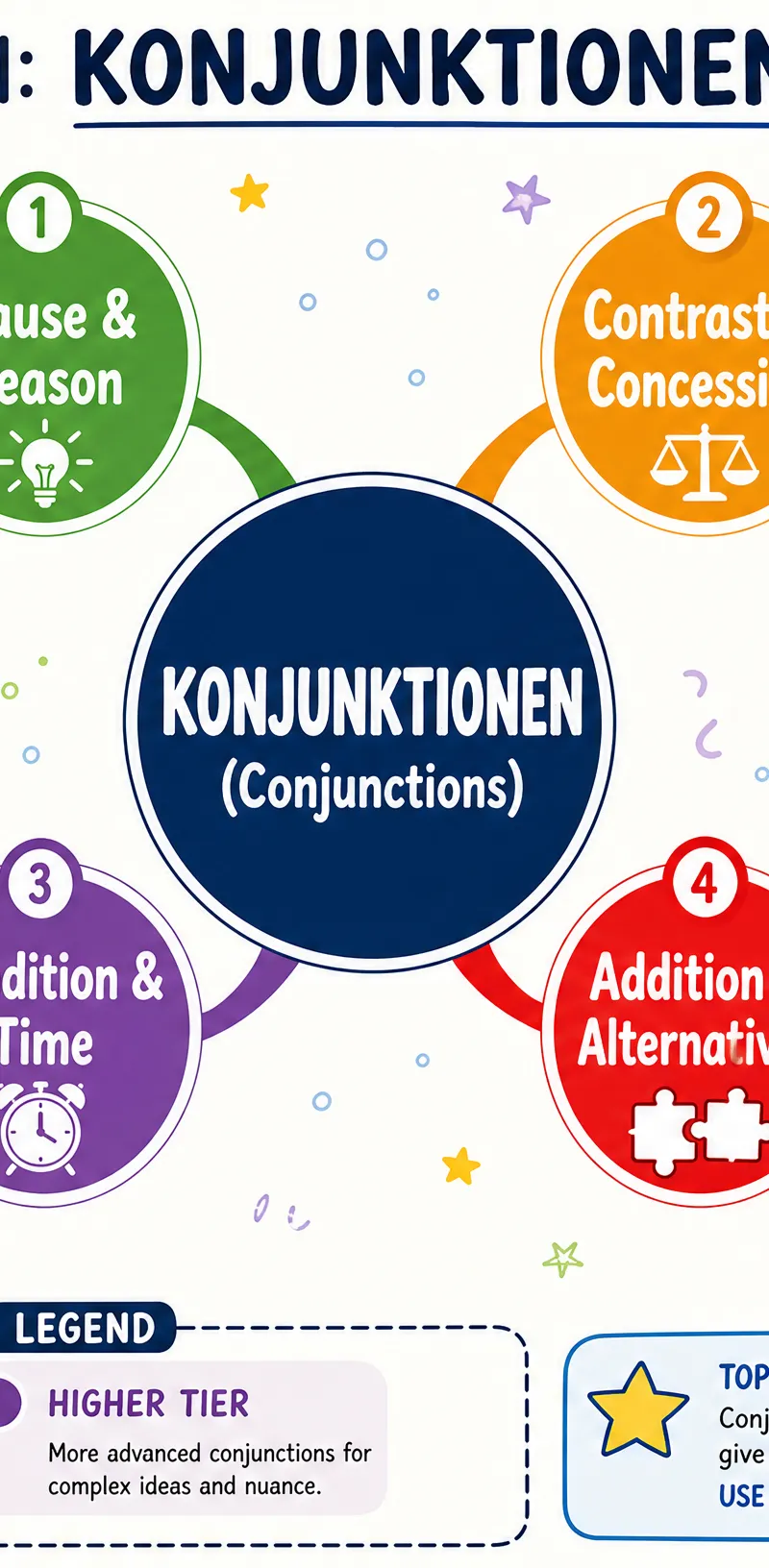
Interactive Diagrams
1 interactive diagram to visualise key concepts
Conceptual Flow Outline
Choosing the right conjunction and word order
Worked Examples
4 worked examples — open one to explore the question and available guidance.
Practice Questions
Try the question, then reveal an answer plan or example response
Translate into German: I play football because it is fun.
Hint: Remember what happens to the verb 'is' after 'because'.
Translate into German: Although I am tired, I am doing my homework.
Hint: Start with 'Obwohl' and remember the Verb-Comma-Verb rule.
Speaking: Answer the question 'Wie findest du deine Schule?' Give an opinion and two reasons.
Hint: Use 'weil' for one reason and 'denn' for the other to show variety.
Writing: Write 90 words about your free time. Include what you do, what you don't do, and why.
Hint: Use 'und', 'aber', and 'weil'.
Reading: Read the sentence. Does the person like their job? 'Obwohl die Arbeit anstrengend ist und ich früh aufstehen muss, liebe ich meinen Job, weil meine Kollegen fantastisch sind.'
Hint: Look past the 'Obwohl' clause to find the main opinion.
Fill in the blank with the correct conjunction (weil / denn / obwohl): Ich lerne Deutsch, _______ ich in Berlin wohnen möchte.
Hint: Look at the position of the verb 'möchte'.
Exam technique
How to turn what you know into marks
How to approach the question
In Writing, plan your conjunctions before you start writing. Write 'weil', 'obwohl', 'dass' at the top of your paper and tick them off as you use them.
How to structure your answer
Speaking: Always use the 'Opinion + Conjunction + Reason' structure. E.g., 'Ich mag X, weil Y...'
Timing
Writing: Allow 5 minutes at the end specifically to check your conjunctions and verb positions.
Common pitfalls
- Forgetting to move the verb to the end after 'weil' (e.g., writing 'weil ich bin krank' instead of 'weil ich krank bin').
- Using 'denn' but moving the verb to the end (denn takes normal word order).
- Confusing 'wenn' and 'als' when talking about the past.
- Starting a sentence with 'Obwohl' but forgetting the Verb-Comma-Verb rule.
- Translating the English 'that' as 'das' instead of the conjunction 'dass' (with double s).
What the command words want
- Justify your opinions
- This is a direct instruction to use 'weil', 'denn', or 'da'. You will not get full marks without them.
- Translate into German
- Look out for 'because' and 'although'. Decide immediately if you will use a coordinating or subordinating conjunction.
- Write approximately 150 words
- Examiners have a checklist. They are looking for complex sentences. Using 'obwohl' or starting with a subordinate clause ticks the 'complex structures' box.
Watch or listen (optional)
Test your understanding of Vocabulary: Conjunctions
Active recall beats re-reading. Take an instant quiz now to test what you’ve learned and lock it into long-term memory.
7 days Premium · Then the free plan continues · No card, no charge