Pearson Edexcel · GCSE · German
Course version: Pearson-GCSE-German · Version from Mar 2026
Vocabulary: Cultural and geographical words
Master the essential vocabulary for countries, regions, cities, and cultural events across the German-speaking world. This topic is heavily tested in Reading and Listening distractors, and provides excellent high-mark opportunities in Speaking and Writing tasks when combined with prepositions and adjective endings.
- 12 min read
- 4 worked examples
- 6 practice questions
- 8 key terms
Check what you remember
Read the wording for your board, then hide it and explain Dative Case in your own words. Rough notes are fine. This is a self-check, with no mark or grade.
Reference: Pearson Edexcel
The grammatical case used to show location (static position) when answering the question 'wo?' (where?).
Study Notes
Overview
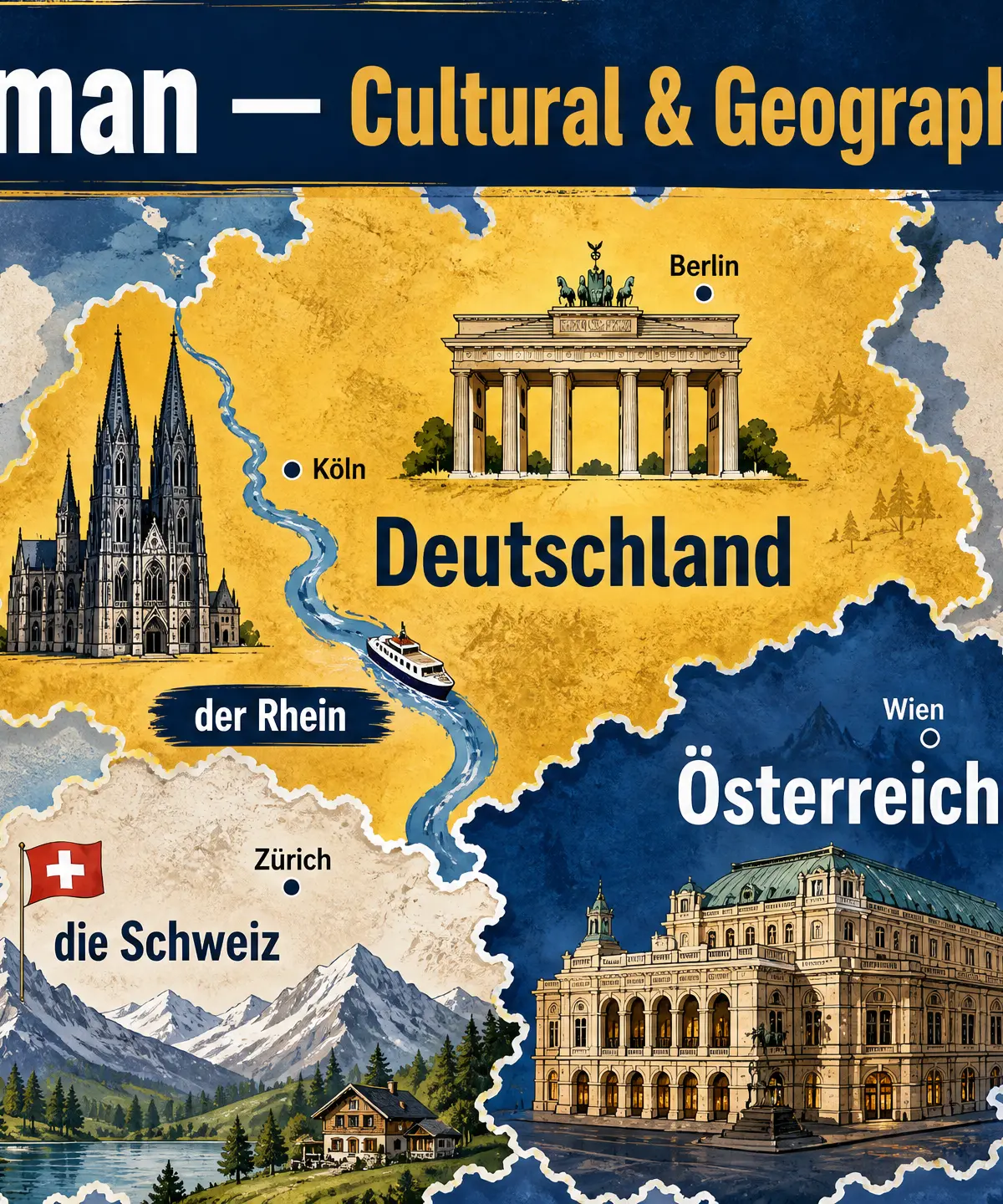
This topic covers the cultural and geographical vocabulary required for the GCSE German specification, focusing on the DACH region (Deutschland, Österreich, Schweiz). It is absolutely vital because it forms the foundation for discussing holidays, cultural life, and global contexts. Examiners specifically look for accurate use of prepositions with places, correct genders for countries, and specific cultural knowledge. You will need this vocabulary across all four papers: to understand contexts in Reading and Listening, to describe photos and role-plays in Speaking, and to add detail and interest to your Writing tasks.
🎧 Audio Revision: The Study Guide Podcast
Listen to our comprehensive 10-minute podcast covering all the key concepts, vocabulary, and exam tips for this topic.
📖 Essential Vocabulary
Tier 1 — Foundation Core
| German | English | Gender | Example Sentence |
|---|---|---|---|
| Deutschland | Germany | n | Ich wohne in Deutschland. |
| Österreich | Austria | n | Wien ist die Hauptstadt von Österreich. |
| die Schweiz | Switzerland | f | Wir fahren im Winter in die Schweiz. |
| das Land | the country | n | Das ist ein schönes Land. |
| die Stadt | the city/town | f | Meine Stadt ist sehr groß. |
| das Dorf | the village | n | Er wohnt in einem kleinen Dorf. |
| die Hauptstadt | the capital city | f | Berlin ist die Hauptstadt Deutschlands. |
| der Fluss | the river | m | Der Rhein ist ein langer Fluss. |
| der See | the lake | m | Wir schwimmen im See. |
| das Meer | the sea | n | Im Sommer fahren wir ans Meer. |
| der Berg | the mountain | m | Ich wandere gern in den Bergen. |
| der Wald | the forest | m | Der Schwarzwald ist sehr bekannt. |
| der Norden | the north | m | Hamburg liegt im Norden. |
| der Süden | the south | m | München liegt im Süden. |
| die Insel | the island | f | Wir machen Urlaub auf einer Insel. |
Tier 2 — Higher Tier
| German | English | Gender | Example Sentence |
|---|---|---|---|
| das Wahrzeichen | the landmark | n | Der Dom ist das Wahrzeichen von Köln. |
| die Umgebung | the surrounding area | f | Die Umgebung von Salzburg ist malerisch. |
| die Landschaft | the landscape | f | Die Landschaft in Österreich ist atemberaubend. |
| das Gebirge | the mountain range | n | Die Alpen sind ein riesiges Gebirge. |
| die Grenze | the border | f | Wir wohnen nah an der Grenze. |
| der Einwohner | the inhabitant (m) | m | Berlin hat über drei Millionen Einwohner. |
| das Fest | the festival | n | Das Oktoberfest ist ein weltbekanntes Fest. |
| der Brauch | the custom/tradition | m | Es gibt viele alte Bräuche in Bayern. |
| der Kanton | the canton (Swiss region) | m | Die Schweiz hat 26 Kantone. |
| die Veranstaltung | the event | f | Es gibt viele kulturelle Veranstaltungen. |
High-Frequency Words & Phrases
| Phrase | English | Usage Context |
|---|---|---|
| im Ausland | abroad | Useful for holiday and future plans. |
| auf dem Land | in the country(side) | Describing where you live or want to live. |
| in der Nähe von | near to | Locating places geographically. |
| weit weg von | far away from | Describing distances. |
| an der Küste | on the coast | Holiday destinations. |
| aus der ganzen Welt | from all over the world | Describing tourist attractions. |
| es befindet sich | it is located/situated | Formal alternative to 'es ist'. |
| es liegt | it lies / is situated | Standard way to describe geographical location. |
| berühmt für | famous for | Giving opinions on places. |
| meiner Meinung nach | in my opinion | Essential for higher writing/speaking marks. |
📝 Grammar Focus
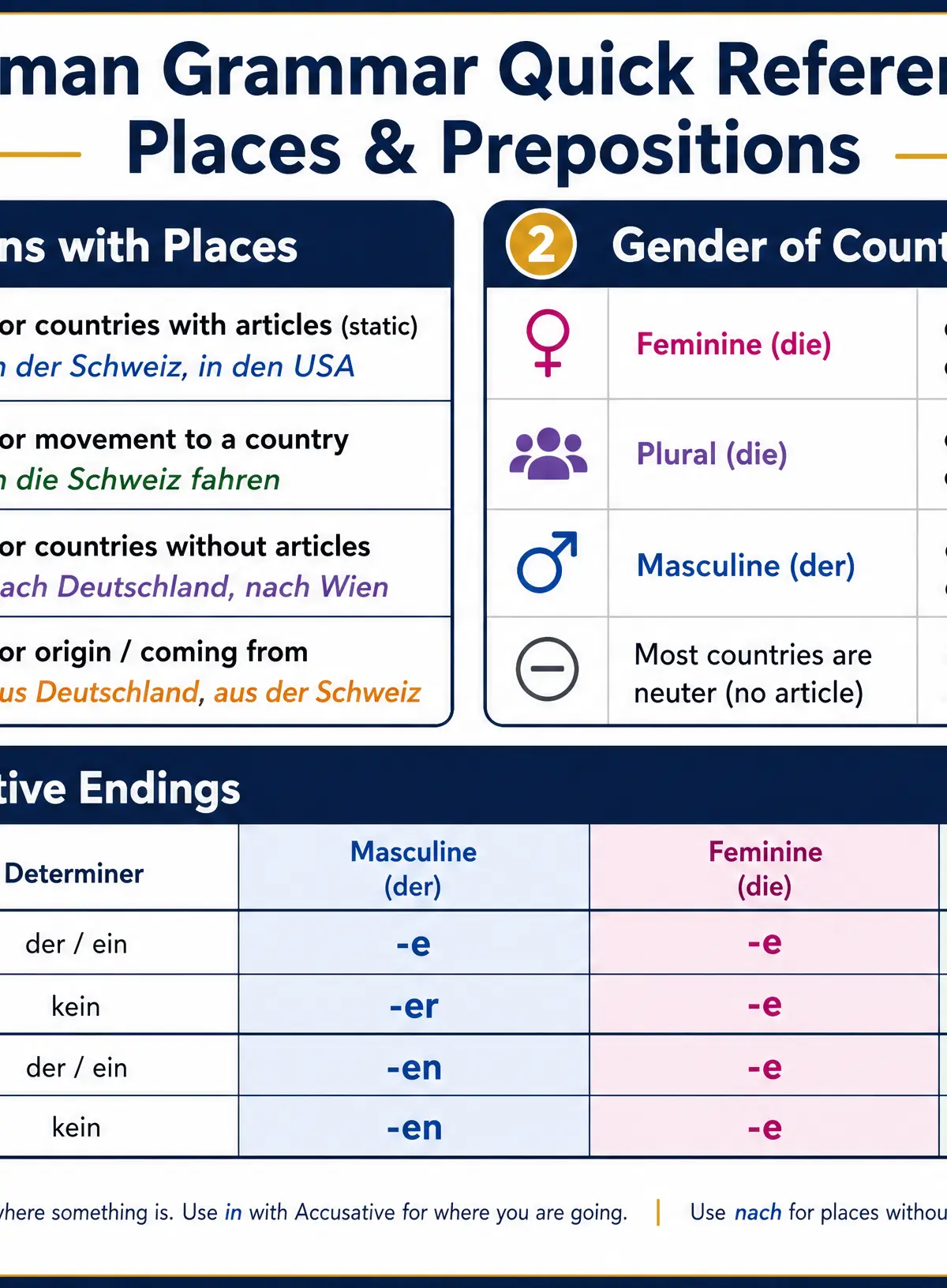
Key Structure 1: Prepositions with Geographical Places
When to use it: Whenever you describe where you are going (movement) or where you are (static).
Preposition Rules
| Preposition | Meaning | Case | Rule | Example |
|---|---|---|---|---|
| nach | to | Dative | For cities and neuter countries (no article) | Ich fahre nach Berlin / nach Deutschland. |
| in (movement) | to | Accusative | For countries with an article (die Schweiz) | Ich fahre in die Schweiz. |
| in (static) | in | Dative | For all places when you are already there | Ich bin in Berlin / in der Schweiz. |
| aus | from | Dative | For origin (where you come from) | Ich komme aus England / aus der Schweiz. |
Irregulars to learn: Countries with articles must be learned by heart. Feminine: die Schweiz, die Türkei, die Slowakei. Plural: die USA, die Niederlande. Masculine: der Iran, der Irak.
Key Structure 2: Compass Directions and Adjectives
When to use it: To precisely locate places on a map, which examiners reward highly.
| Noun (The North) | Adjective (northern) | Example Usage |
|---|---|---|
| der Norden | nördlich | Hamburg liegt im Norden. / Die nördliche Küste. |
| der Süden | südlich | München liegt im Süden. / Der südliche Teil. |
| der Osten | östlich | Leipzig liegt im Osten. / Die östliche Grenze. |
| der Westen | westlich | Köln liegt im Westen. / Die westliche Region. |
Key Structure 3: Describing Location with 'liegen' and 'sich befinden'
When to use it: Instead of just using 'ist' (is), use these verbs to sound more authentic and access higher marks.
Conjugation Table: sich befinden (to be located - reflexive)
| Subject | Verb Form | English |
|---|---|---|
| ich | befinde mich | I am located |
| du | befindest dich | you are located |
| er/sie/es | befindet sich | he/she/it is located |
| wir | befinden uns | we are located |
| ihr | befindet euch | you (pl) are located |
| sie/Sie | befinden sich | they/You are located |
🎧 Listening Skills
What to Expect
Listening tasks often feature announcements (e.g., at a train station or festival), weather reports, or people describing their holidays or hometowns. You will hear a lot of place names and cultural events.
Listening Strategies
- Listen for prepositions: 'nach' means they are going there, 'aus' means they are coming from there. This completely changes the answer.
- Note times and dates: Festivals (Karneval, Oktoberfest) are often linked to specific months or seasons.
- Watch for negatives: Words like nie (never), nicht (not), or kein (no/none) will flip the meaning of a sentence.
Common Listening Traps
Examiners love to use distractors. You might hear: "Letztes Jahr bin ich in die Schweiz gefahren, aber dieses Jahr fahre ich nach Österreich." (Last year I went to Switzerland, but this year I am going to Austria). If the question asks where they are going this year, you must wait for the second part of the sentence.
🗣️ Speaking Skills
Role Play Scenarios
Scenario: You are at a tourist information office in Vienna.
- You: Guten Tag. Ich suche ein Wahrzeichen in der Stadt.
- Officer: Der Stephansdom ist sehr berühmt.
- You: Wie komme ich dorthin?
- Officer: Nehmen Sie die U-Bahn Linie 1.
- You: Danke. Gibt es auch ein gutes Restaurant in der Nähe?
Photo Card Practice
Model Photo Card Response (A photo of people at Oktoberfest):
- Qu 1 (Description): Auf dem Foto sehe ich viele Leute auf einem Fest. Ich glaube, es ist das Oktoberfest in München. Sie trinken Bier und tragen traditionelle Kleidung.
- Qu 2 (Opinion): Ich finde das Fest sehr interessant, weil die Atmosphäre toll aussieht und die Leute glücklich sind.
- Qu 3 (Related topic): In England haben wir auch Festivals, aber sie sind anders. Wir haben oft Musikfestivals im Sommer, wo man zeltet.
- Qu 4 (Past/Future): Nächstes Jahr werde ich mit meinen Freunden nach Deutschland fahren, um das Oktoberfest zu erleben.
- Qu 5 (Unpredictable): Ja, Kultur ist sehr wichtig, weil man viel über die Geschichte eines Landes lernen kann.
General Conversation Questions
| Question (German) | Model Answer | English Translation |
|---|---|---|
| Wo wohnst du? | Ich wohne in einer kleinen Stadt im Norden von England. Es liegt in der Nähe von Manchester. | I live in a small town in the north of England. It is situated near Manchester. |
| Was ist das Wahrzeichen deiner Region? | Das Wahrzeichen meiner Region ist eine alte Burg. Meiner Meinung nach ist sie sehr historisch und schön. | The landmark of my region is an old castle. In my opinion it is very historical and beautiful. |
| Warst du schon mal in Deutschland? | Ja, letztes Jahr bin ich nach Berlin gefahren. Die Hauptstadt war unglaublich und sehr lebendig. | Yes, last year I travelled to Berlin. The capital city was incredible and very lively. |
| Welches deutsche Fest möchtest du besuchen? | Ich würde gern den Karneval in Köln besuchen, weil ich mich gern verkleide und die Paraden fantastisch aussehen. | I would like to visit the Carnival in Cologne because I like dressing up and the parades look fantastic. |
| Warum ist es wichtig, andere Kulturen zu kennen? | Es ist wichtig, weil es uns toleranter macht und man neue Traditionen und leckeres Essen entdecken kann. | It is important because it makes us more tolerant and you can discover new traditions and delicious food. |
✍️ Writing Skills
Translation Practice
English → German:
| English | German | Key Grammar |
|---|---|---|
| I live in a village in the south. | Ich wohne in einem Dorf im Süden. | in + dative (einem), compass directions |
| Next year we are travelling to Switzerland. | Nächstes Jahr fahren wir in die Schweiz. | in + accusative for feminine country |
| The landscape is very beautiful. | Die Landschaft ist sehr schön. | specific vocabulary |
| In my opinion, the capital city is too loud. | Meiner Meinung nach ist die Hauptstadt zu laut. | Verb second rule after a time/opinion phrase |
| I would like to visit the festival because it is famous. | Ich möchte das Fest besuchen, weil es berühmt ist. | weil sends the verb to the end |
Extended Writing
**Model 90-word response (Foundation):**Ich wohne in einer mittelgroßen Stadt in England. Meine Stadt liegt im Norden und hat viele Einwohner. Das Wahrzeichen ist eine alte Kirche. Letztes Jahr bin ich mit meiner Familie nach Deutschland gefahren. Wir haben Berlin besucht. Berlin ist die Hauptstadt und ist sehr groß und interessant. Das Wetter war toll. Nächstes Jahr möchte ich in die Schweiz fahren, weil ich die Berge liebe und gern Ski fahre. Ich finde andere Kulturen sehr spannend.
**Model 150-word response (Higher):**Ich wohne in einer malerischen Stadt im Nordwesten von England, die sich in der Nähe der Küste befindet. Obwohl es oft regnet, finde ich die Landschaft wunderschön. Das bekannteste Wahrzeichen ist das historische Schloss, das viele Touristen anzieht.
Letzten Sommer hatte ich die Gelegenheit, nach Österreich zu reisen. Wir haben zwei Wochen in Wien verbracht. Die Kultur dort hat mich völlig fasziniert. Wir haben die berühmte Sachertorte probiert und die Architektur bewundert. Es war ein unvergessliches Erlebnis, weil die Leute so freundlich waren.
In der Zukunft würde ich wahnsinnig gern die Schweiz besuchen. Da ich mich sehr für Wintersport interessiere, wäre es mein Traum, in den Alpen Ski zu fahren. Außerdem möchte ich meine Deutschkenntnisse verbessern. Meiner Meinung nach ist es äußerst wichtig, andere Länder zu besuchen, um den eigenen Horizont zu erweitern und neue Bräuche kennenzulernen.
Writing Checklist
- ✅ Three tenses used accurately (Present, Perfect/Imperfect, Future/Conditional)
- ✅ Opinions given and justified with 'weil' or 'da'
- ✅ Correct prepositions used for countries (nach vs in die)
- ✅ Sophisticated vocabulary (Wahrzeichen, Landschaft, sich befinden)
- ✅ Accurate adjective endings and verb positions
📚 Reading Skills
Key Strategies
- Skim for gist: Read the text quickly first to understand the overall context. Is it a brochure? A blog post about a holiday? A news article about a festival?
- Look for glossed words: If a place name or cultural term isn't on the spec, it will have a small asterisk (*) and be translated at the bottom. Use these clues!
- Highlight time phrases: These help you understand if the text is talking about the past, present, or future.
False Friends & Tricky Words
| Word | Looks Like | Actually Means |
|---|---|---|
| das Gift | a gift/present | poison (present = das Geschenk) |
| aktuell | actual | current/up-to-date (actual = eigentlich) |
| das Gymnasium | a gym | a grammar school (gym = das Fitnessstudio) |
| der See | the sea | the lake (the sea = das Meer) |
| die See | the sea | the sea (but 'der See' is the lake!) |
🌍 Cultural Knowledge

Understanding the cultural context of the DACH region (Deutschland, Österreich, Schweiz) is vital.
Germany is highly regional. The north (e.g., Hamburg) is flat and coastal, while the south (Bavaria/Bayern) is mountainous and famous for traditional customs like the Oktoberfest and Lederhosen. Karneval (or Fasching) is a massive event in February, particularly in Cologne (Köln) and the Rhineland, involving parades and costumes.
Austria (Österreich) is famous for its imperial history, classical music (Mozart was born in Salzburg), and coffee house culture in the capital, Vienna (Wien). The landscape is dominated by the Alps.
Switzerland (die Schweiz) has four official languages (German, French, Italian, Romansh) and is divided into 26 cantons (Kantone). It is famous for its stunning Alpine scenery, lakes, and high standard of living.
Silvester (New Year's Eve) is celebrated across all three countries with huge fireworks displays (Feuerwerk) at midnight.
Visual Resources
2 diagrams and illustrations
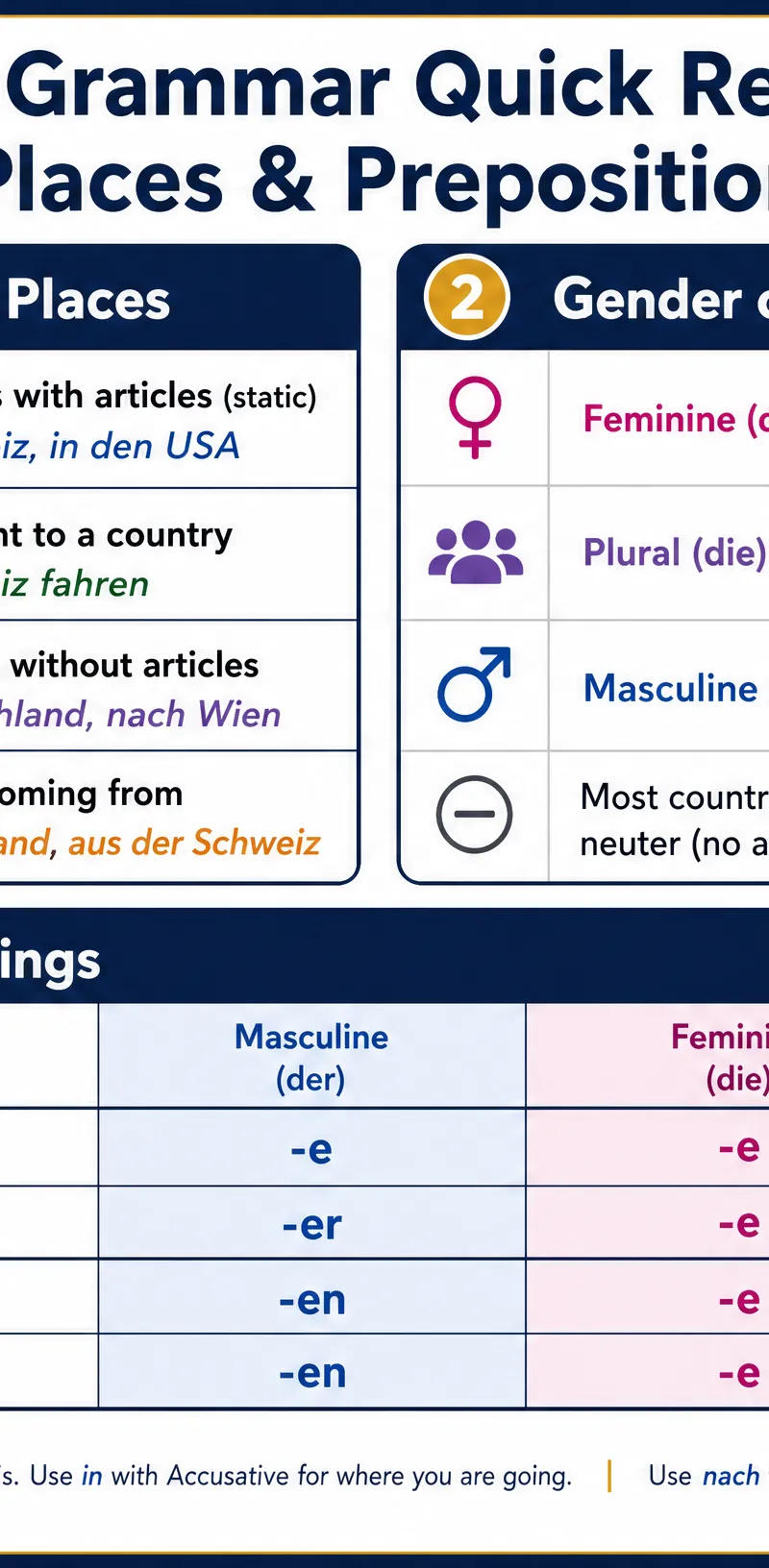
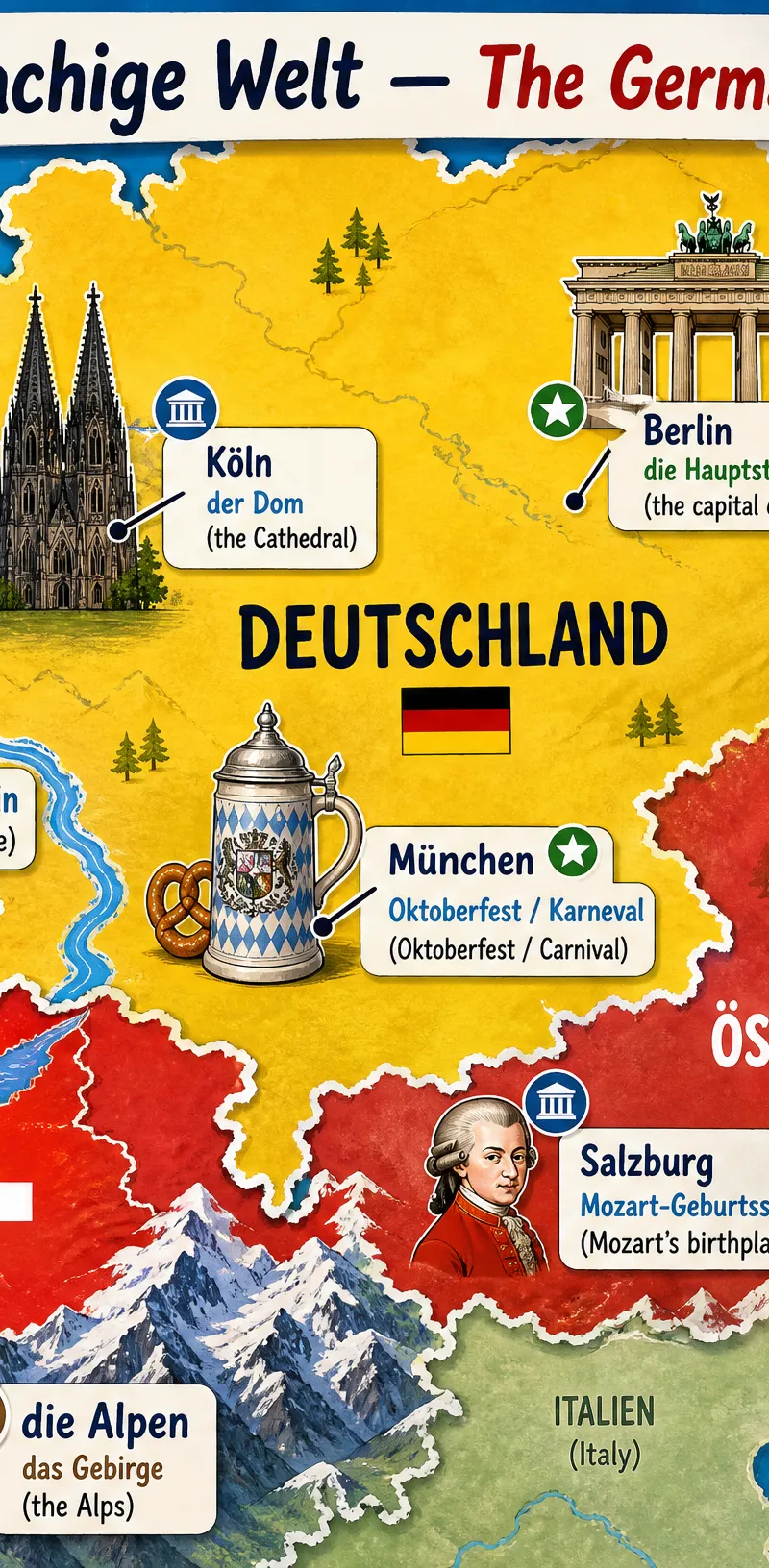
Interactive Diagrams
1 interactive diagram to visualise key concepts
Conceptual Flow Outline
Decision tree for geographical prepositions
Worked Examples
4 worked examples — open one to explore the question and available guidance.
Practice Questions
Try the question, then reveal an answer plan or example response
Translate into German: 'I live in the south of Germany. Next year I am travelling to Switzerland because the mountains are beautiful.'
Hint: Check your prepositions for countries and remember the verb position after 'weil'.
Speaking (Photo Card): Describe a photo of people celebrating New Year's Eve in Berlin. (Give 3 details)
Hint: Use 'Auf dem Foto gibt es...' and specific vocabulary for the event.
Writing (Foundation): Write 40-50 words about your town. Include: where it is, what the landscape is like, and one opinion.
Hint: Keep sentences simple but accurate. Use 'es gibt' and 'meiner Meinung nach'.
Reading (Higher): 'Obwohl ich normalerweise die Berge bevorzuge, verbringe ich diesen Sommer an der Küste im Norden Deutschlands, um die Landschaft zu genießen.' Why is the person going to northern Germany?
Hint: Look for the 'um... zu' clause at the end of the sentence.
Listening (Standard): [Audio: "Die Hauptstadt von Österreich ist berühmt für ihre klassische Musik und die vielen historischen Gebäude."] What two things is the capital of Austria famous for?
Hint: Listen for the cognates.
Translation (Higher): 'The cathedral is the landmark of the city. It is located in the west.'
Hint: Use the sophisticated reflexive verb for 'is located'.
Exam technique
How to turn what you know into marks
How to approach the question
Skill-by-skill strategy: Listening — read questions first, underline question words (who, what, where). Speaking — prepare 3 'golden phrases' (e.g., meiner Meinung nach) to use regardless of the topic. Reading — use the glossaries and watch for false friends. Writing — plan your tenses before writing a single word.
How to structure your answer
Writing: Introduction (Present) → Past experience (Perfect) → Justified opinion (Present + weil) → Future plans (Future/Conditional).
Timing
Listening: 25-35 mins (heard twice). Speaking: 7-12 mins total (role play + photo card + conversation). Reading: 45-60 mins. Writing: 60-75 mins (translation + structured + extended).
Common pitfalls
- Saying 'in Deutschland' when you mean 'to Germany' (it must be nach Deutschland)
- Forgetting that 'die Schweiz' needs an article and changes case (in die Schweiz = to, in der Schweiz = in)
- Translating 'actual' as 'aktuell' (aktuell means current)
- Using 'ist' instead of 'es gibt' (there is/are) when describing a region
- Failing to justify opinions with a subordinate clause (weil/da + verb at end)
What the command words want
- Describe the photo
- Use 'Auf dem Foto gibt es...' (In the photo there is...) and 'Ich glaube, dass...' (I believe that...).
- Translate into German
- Accuracy is key. Check genders, adjective endings, and verb positions carefully.
- Translate into English
- Focus on the overall meaning, not word-for-word literal translation. Ensure it makes sense in English.
- Write approximately 90 words
- Foundation task — You must address all four bullet points. Use the present tense and at least one other tense (past or future).
- Write approximately 150 words
- Higher task — Address all bullet points using three tenses. Include justified opinions and complex structures (subordinate clauses, infinitives with zu).
Watch or listen (optional)
Test your understanding of Vocabulary: Cultural and geographical words
Active recall beats re-reading. Take an instant quiz now to test what you’ve learned and lock it into long-term memory.
7 days Premium · Then the free plan continues · No card, no charge