Pearson Edexcel · GCSE · German
Course version: Pearson-GCSE-German · Version from Mar 2026
Vocabulary: Irregular inflected verb forms (Foundation and Higher)
Mastering irregular inflected verb forms is the key to unlocking top marks in GCSE German. This guide covers essential stem-changing verbs, perfect tense auxiliary rules (haben vs. sein), and modal verbs across all four exam skills.
- 14 min read
- 4 worked examples
- 6 practice questions
- 8 key terms
Check what you remember
Read the wording for your board, then hide it and explain Strong Verb (Irregular Verb) in your own words. Rough notes are fine. This is a self-check, with no mark or grade.
Reference: Pearson Edexcel
A verb that does not follow the standard, predictable conjugation patterns. They often have stem vowel changes in the present tense and irregular past participles.
Study Notes
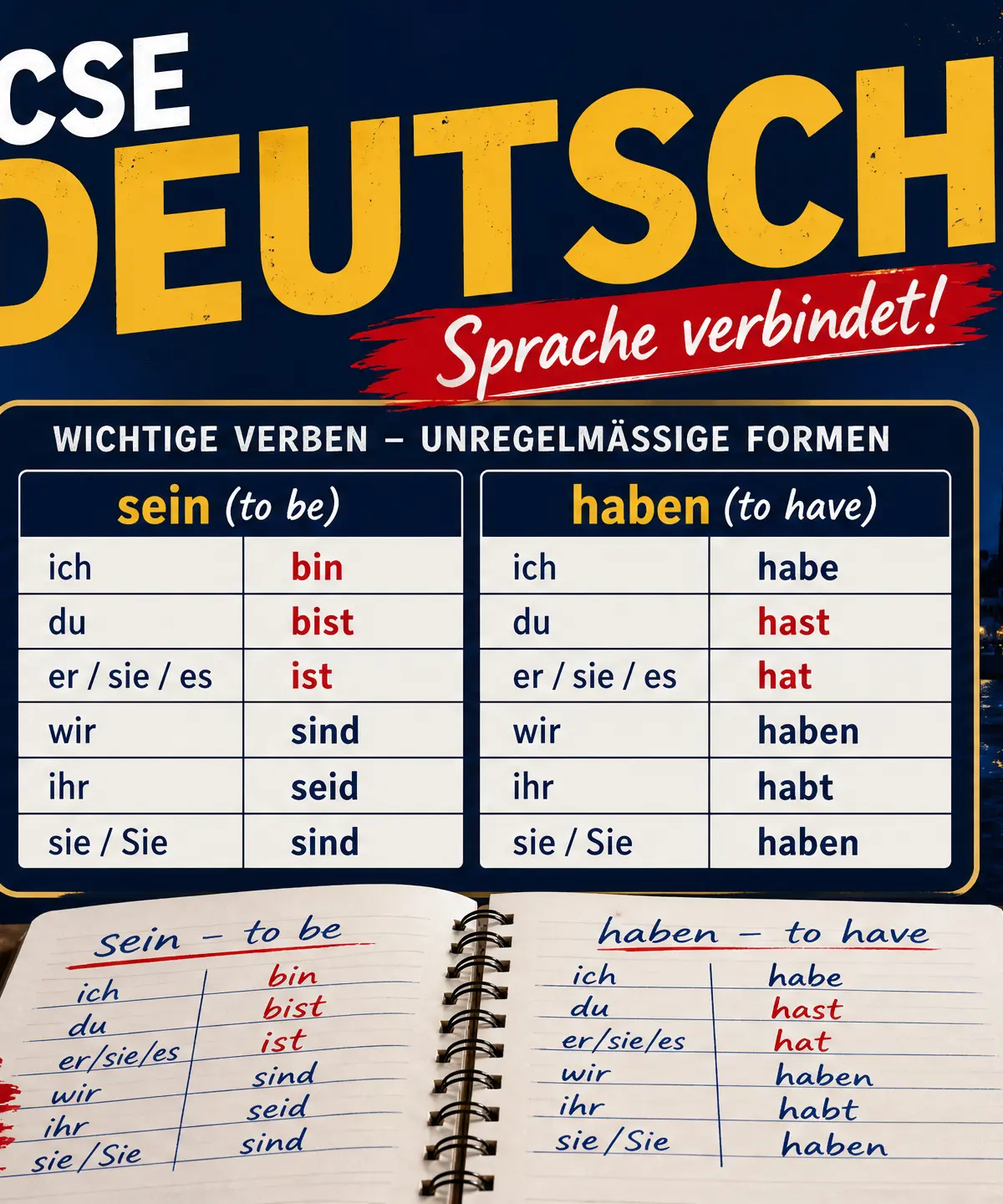
Overview
Welcome to your definitive guide on German irregular inflected verb forms. While regular verbs follow predictable patterns, the most frequently used verbs in German are irregular (strong). The Pearson Edexcel GCSE specification explicitly requires candidates to master these verbs for both Foundation and Higher tiers. They appear constantly in Listening and Reading texts, and using them accurately in Speaking and Writing is the clearest way to demonstrate language range to an examiner. This guide covers stem-changing verbs in the present tense, the perfect tense with haben and sein, and modal verbs.
🎧 Listen to the Podcast
Before diving into the grammar, listen to our 10-minute audio guide. It covers the core concepts, common exam traps, and includes a quick-fire recall quiz.
📖 Essential Vocabulary
Tier 1 — Foundation Core
| German | English | Gender | Example Sentence |
|---|---|---|---|
| anfangen | to start | N/A | Der Film fängt um acht Uhr an. |
| essen | to eat | N/A | Mein Bruder isst gern Pizza. |
| fahren | to travel/drive | N/A | Wir fahren jedes Jahr nach Spanien. |
| finden | to find | N/A | Ich finde das Buch sehr interessant. |
| geben | to give | N/A | Mein Vater gibt mir Taschengeld. |
| gehen | to go | N/A | Ich gehe am Wochenende ins Kino. |
| haben | to have | N/A | Hast du einen Hund? |
| lesen | to read | N/A | Sie liest jeden Abend ein Buch. |
| nehmen | to take | N/A | Ich nehme den Bus zur Schule. |
| schlafen | to sleep | N/A | Das Baby schläft den ganzen Tag. |
| sehen | to see | N/A | Siehst du das große Haus dort? |
| sein | to be | N/A | Ich bin fünfzehn Jahre alt. |
| sprechen | to speak | N/A | Er spricht sehr gut Deutsch. |
| tragen | to wear/carry | N/A | Sie trägt ein rotes Kleid. |
| trinken | to drink | N/A | Ich trinke lieber Wasser als Cola. |
Tier 2 — Higher Tier
| German | English | Gender | Example Sentence |
|---|---|---|---|
| abfahren | to depart | N/A | Der Zug fährt in zehn Minuten ab. |
| aussehen | to look (appearance) | N/A | Das neue Restaurant sieht toll aus. |
| empfehlen | to recommend | N/A | Ich empfehle dieses Hotel. |
| einladen | to invite | N/A | Ich lade meine Freunde zur Party ein. |
| gefallen | to please/like | N/A | Das blaue Hemd gefällt mir gut. |
| helfen | to help | N/A | Er hilft seiner Mutter in der Küche. |
| lassen | to let/leave | N/A | Lass mich in Ruhe! |
| vergessen | to forget | N/A | Vergiss nicht, deine Hausaufgaben zu machen! |
| verlassen | to leave (a place) | N/A | Wir verlassen das Haus um acht Uhr. |
| werden | to become | N/A | Sie wird nächstes Jahr Ärztin. |
High-Frequency Words & Phrases
| Phrase | English | Usage Context |
|---|---|---|
| Es gibt... | There is / there are | Describing photos or towns |
| Ich bin gefahren | I travelled | Talking about past holidays |
| Ich habe gesehen | I saw | Discussing films, TV, or past events |
| Ich möchte... | I would like... | Role play: ordering food or buying tickets |
| Man kann... | You can / one can | Describing facilities in a town |
| Das hat mir gefallen | I liked it | Giving an opinion in the past tense |
| Ich werde... gehen | I will go... | Talking about future plans |
| Ich muss... machen | I have to do... | Talking about chores or school rules |
| Er/Sie sieht... aus | He/She looks... | Describing people or things |
| Wir sind geblieben | We stayed | Describing past holidays |
📝 Grammar Focus
Key Structure 1: Stem Changes in the Present Tense
When to use it: When using specific strong verbs in the present tense.
The Golden Rule: Stem changes ONLY happen in the du and er/sie/es forms. The ich, wir, ihr, and sie/Sie forms use the regular stem.
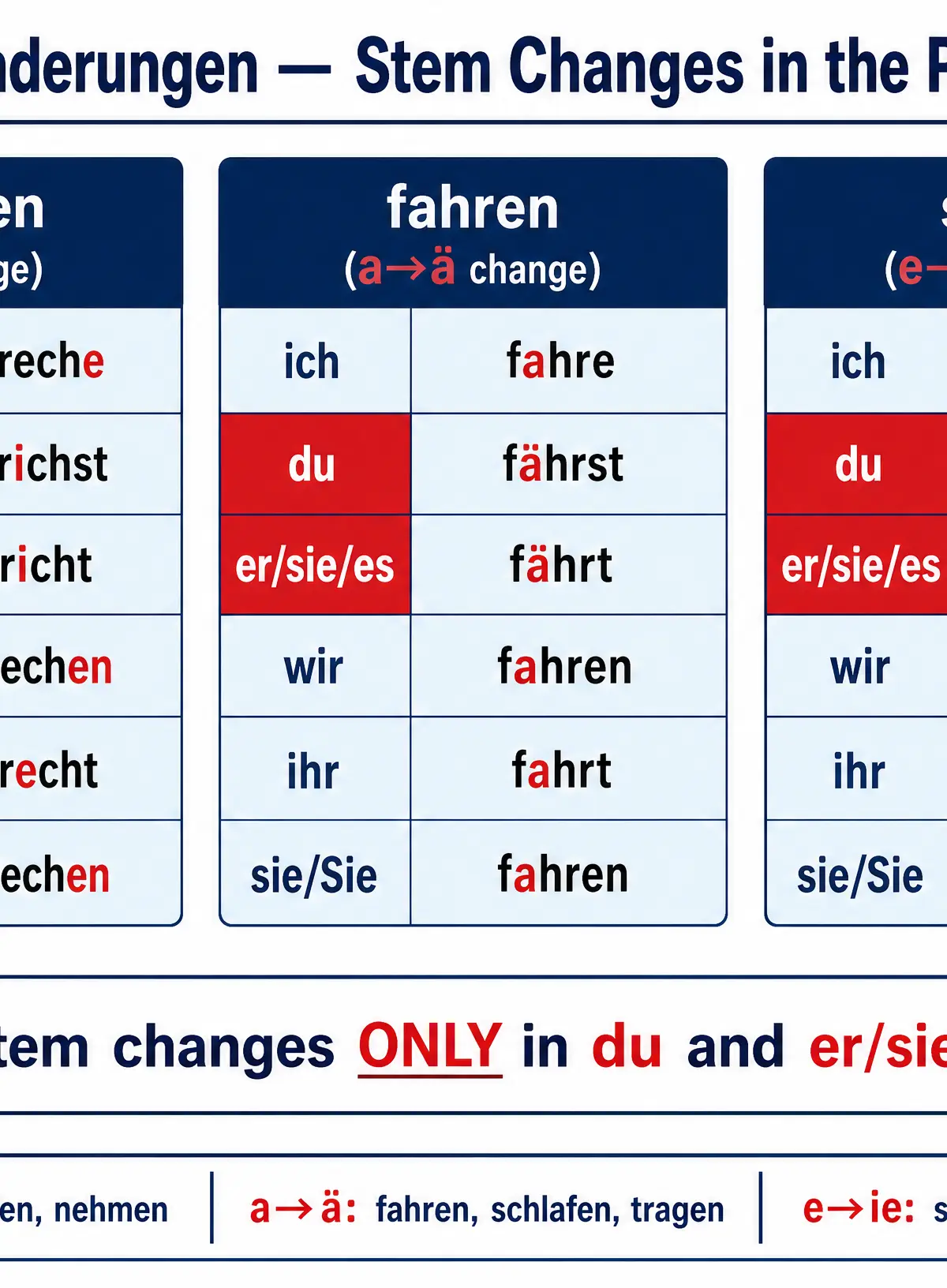
Conjugation Table: e → i change (e.g., sprechen - to speak)
| Subject | Verb Form | English |
|---|---|---|
| ich | spreche | I speak |
| du | sprichst | you speak (informal) |
| er/sie/es | spricht | he/she/it speaks |
| wir | sprechen | we speak |
| ihr | sprecht | you speak (plural) |
| sie/Sie | sprechen | they/You speak |
Irregulars to learn: helfen (hilft), nehmen (nimmt - note the double m!), geben (gibt), essen (isst).
Conjugation Table: e → ie change (e.g., sehen - to see)
| Subject | Verb Form | English |
|---|---|---|
| ich | sehe | I see |
| du | siehst | you see (informal) |
| er/sie/es | sieht | he/she/it sees |
| wir | sehen | we see |
| ihr | seht | you see (plural) |
| sie/Sie | sehen | they/You see |
Irregulars to learn: lesen (liest), empfehlen (empfiehlt).
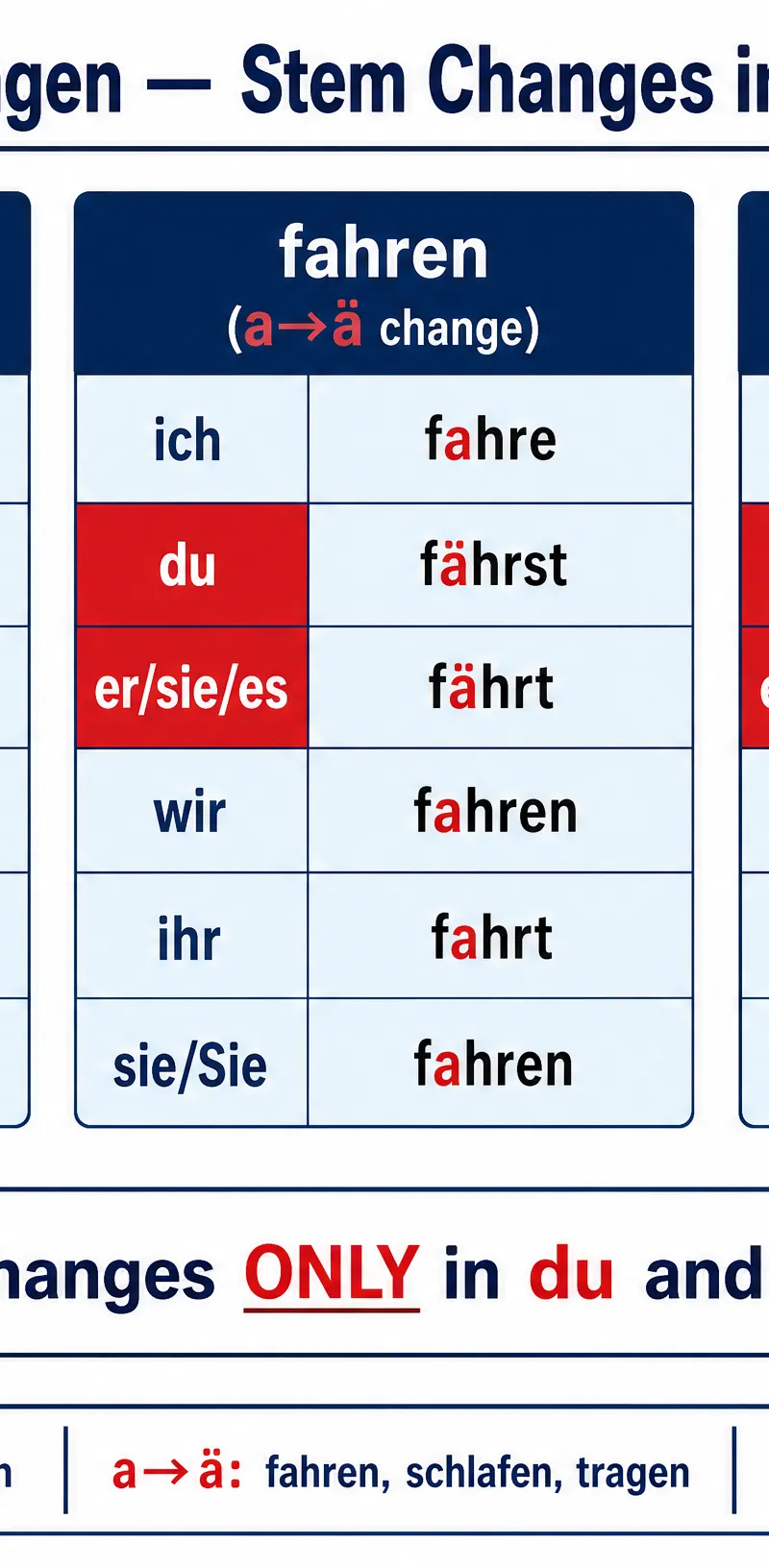
Conjugation Table: a → ä change (e.g., fahren - to travel/drive)
| Subject | Verb Form | English |
|---|---|---|
| ich | fahre | I travel |
| du | fährst | you travel (informal) |
| er/sie/es | fährt | he/she/it travels |
| wir | fahren | we travel |
| ihr | fahrt | you travel (plural) |
| sie/Sie | fahren | they/You travel |
Irregulars to learn: schlafen (schläft), tragen (trägt), anfangen (fängt... an), waschen (wäscht).
Key Structure 2: Perfect Tense with haben vs. sein
When to use it: To talk about events that happened in the past. This is the most common past tense in spoken German and informal writing.

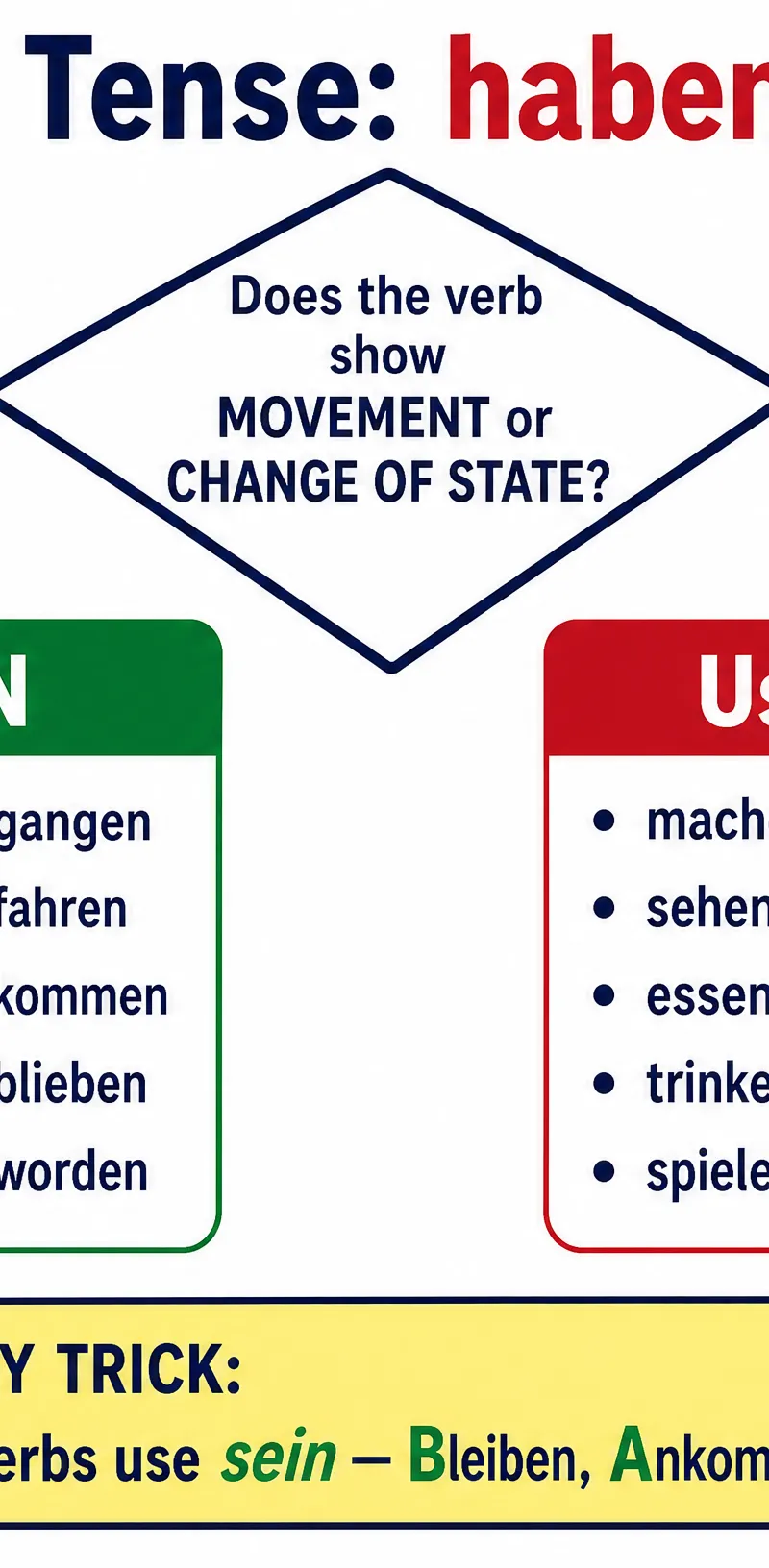
The Rule: Most verbs take haben as the auxiliary verb. However, verbs indicating movement from A to B (e.g., gehen, fahren) or a change of state (e.g., sterben, werden) take sein. The verb bleiben (to stay) is an exception and also takes sein.
Conjugation Table: Perfect Tense with 'sein' (e.g., gehen - to go)
| Subject | Auxiliary (sein) | Past Participle | English |
|---|---|---|---|
| ich | bin | gegangen | I went |
| du | bist | gegangen | you went |
| er/sie/es | ist | gegangen | he/she/it went |
| wir | sind | gegangen | we went |
| ihr | seid | gegangen | you went (plural) |
| sie/Sie | sind | gegangen | they/You went |
Key Structure 3: Modal Verbs
When to use it: To express ability (können), permission (dürfen), necessity (müssen), obligation (sollen), desire (wollen), or liking (mögen).
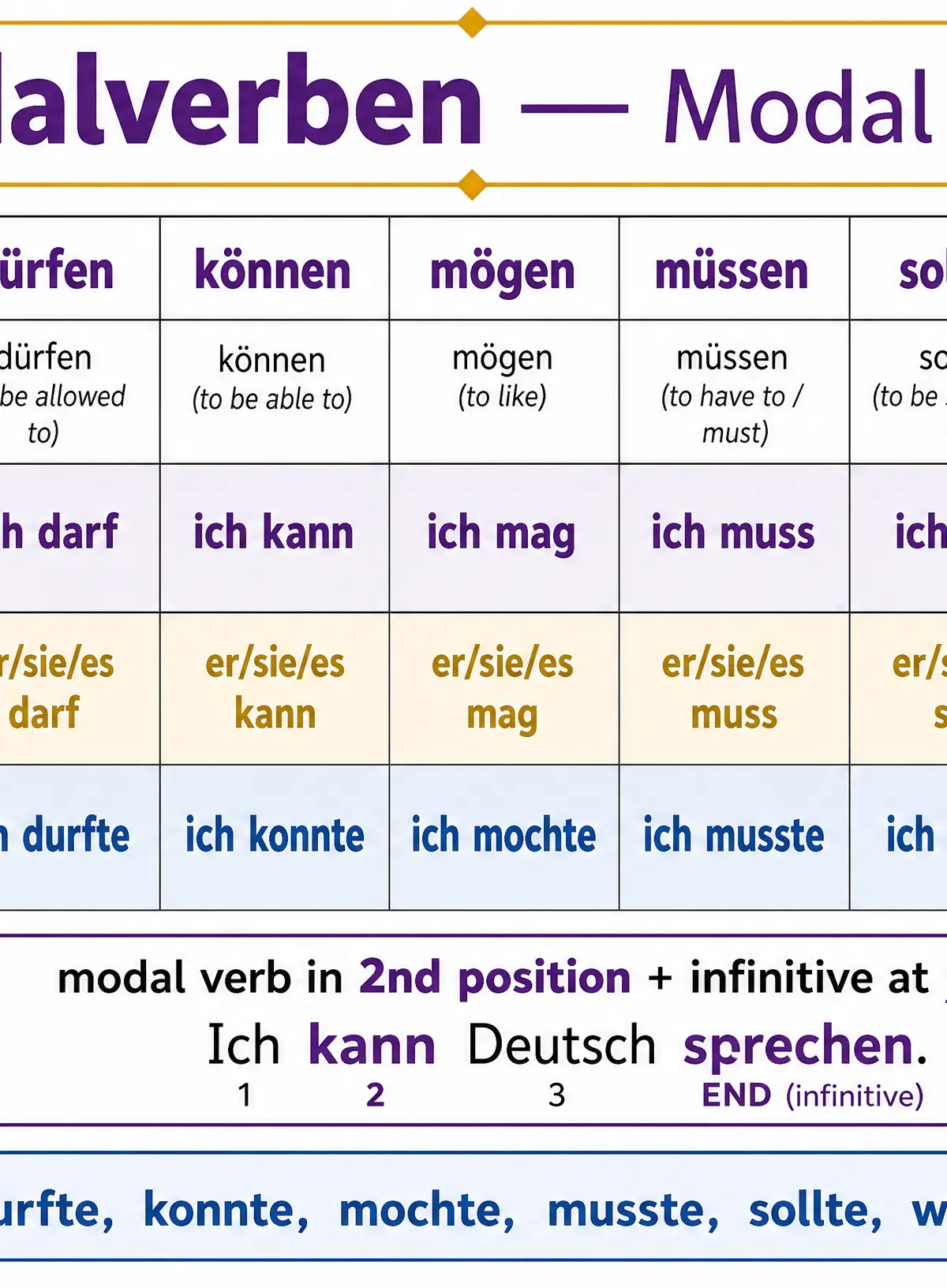
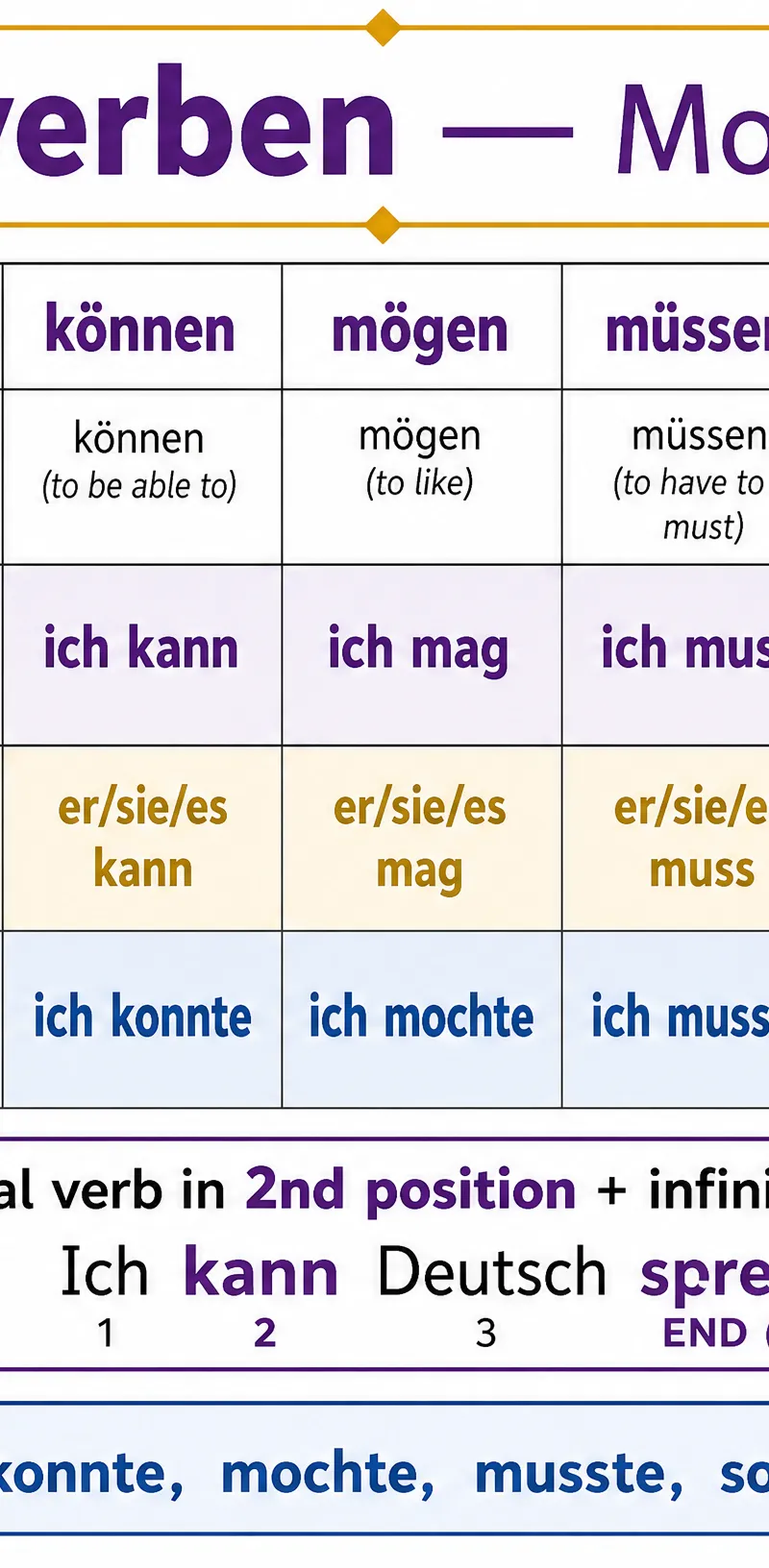
The Rule: In the present tense, modal verbs lose their umlaut (except mögen which changes to mag), and the ich and er/sie/es forms are identical. The modal verb sits in second position, sending the infinitive to the very end of the sentence.
Conjugation Table: können (to be able to / can)
| Subject | Present | Imperfect | English (Present) |
|---|---|---|---|
| ich | kann | konnte | I can |
| du | kannst | konntest | you can |
| er/sie/es | kann | konnte | he/she/it can |
| wir | können | konnten | we can |
| ihr | könnt | konntet | you can (plural) |
| sie/Sie | können | konnten | they/You can |
🎧 Listening Skills
What to Expect
In the listening exam, irregular verbs are frequently used to test your understanding of timeframes. You will hear native speakers describing past holidays (using perfect tense with sein), daily routines (using stem-changing verbs), and future plans (using modal verbs).
Listening Strategies
- Listen for the auxiliary: Hearing 'ist' instead of 'hat' immediately signals a verb of movement or change of state.
- Listen to the end of the sentence: Because German sends the past participle and infinitive to the end of the clause, you must wait until the speaker finishes the sentence to know what action actually happened.
- Watch for 'ist' vs 'isst': They sound identical. Context is key: 'Er ist einen Apfel' makes no sense (He is an apple), so it must be 'Er isst einen Apfel' (He eats an apple).
Common Listening Traps
- Confusing present and past: 'Er fährt' (he travels) vs 'Er ist gefahren' (he travelled). Listen carefully for the auxiliary verb.
- Missing the modal: 'Ich fahre nach Berlin' (I travel to Berlin) vs 'Ich will nach Berlin fahren' (I want to travel to Berlin). The modal completely changes the intent.
🗣️ Speaking Skills
Role Play Scenarios
Scenario 1: At the train station
- Teacher: Wohin möchten Sie fahren? (Where would you like to travel?)
- Student: Ich möchte nach München fahren. (I would like to travel to Munich.)
- Teacher: Wann fährt der Zug ab? (When does the train depart?)
- Student: Der Zug fährt um 10 Uhr ab. (The train departs at 10 o'clock.)
Scenario 2: In a restaurant
- Teacher: Was nimmst du als Hauptspeise? (What are you taking for the main course?)
- Student: Ich nehme das Schnitzel mit Pommes. (I'll take the schnitzel with chips.)
- Teacher: Und was möchtest du trinken? (And what would you like to drink?)
- Student: Ich möchte ein Mineralwasser trinken. (I would like to drink a mineral water.)
Photo Card Practice
Model Photo Card Response (Topic: Holidays):
- Qu 1 (Description): Auf dem Foto sehe ich eine Familie. Sie fahren mit dem Auto in den Urlaub. Das Wetter ist schön. (In the photo I see a family. They are travelling by car on holiday. The weather is nice.)
- Qu 2 (Opinion): Ich finde Autoreisen toll, weil man viel sehen kann. (I find car journeys great because you can see a lot.)
- Qu 3 (Past tense): Letztes Jahr sind wir nach Italien gefahren. Wir sind zwei Wochen geblieben. (Last year we travelled to Italy. We stayed for two weeks.)
- Qu 4 (Future tense): Nächstes Jahr will ich nach Spanien fliegen. (Next year I want to fly to Spain.)
- Qu 5 (Unpredictable): Im Urlaub muss man sich entspannen. (On holiday one must relax.)
General Conversation Questions
| Question (German) | Model Answer | English Translation |
|---|---|---|
| Was isst du gern zum Frühstück? | Ich esse normalerweise Toast mit Marmelade, weil das lecker ist. | What do you like to eat for breakfast? / I normally eat toast with jam because it is tasty. |
| Wohin bist du letztes Jahr gefahren? | Letztes Jahr bin ich mit meiner Familie nach Frankreich gefahren. Das hat mir sehr gut gefallen. | Where did you travel last year? / Last year I travelled to France with my family. I liked it very much. |
| Was musst du zu Hause machen? | Ich muss mein Zimmer aufräumen und ich helfe meiner Mutter in der Küche. | What do you have to do at home? / I have to tidy my room and I help my mother in the kitchen. |
| Was wirst du nächstes Wochenende machen? | Ich will ins Kino gehen und einen neuen Film sehen. | What will you do next weekend? / I want to go to the cinema and see a new film. |
| Was trägst du normalerweise am Wochenende? | Ich trage meistens Jeans und ein T-Shirt, weil das bequem ist. | What do you normally wear at the weekend? / I mostly wear jeans and a t-shirt because it is comfortable. |
✍️ Writing Skills
Translation Practice
English → German:
| English | German | Key Grammar |
|---|---|---|
| He speaks German well. | Er spricht gut Deutsch. | Stem change (e→i) in 3rd person |
| I travelled to Berlin. | Ich bin nach Berlin gefahren. | Perfect tense with 'sein' |
| We have to do our homework. | Wir müssen unsere Hausaufgaben machen. | Modal verb + infinitive at end |
| She is reading an interesting book. | Sie liest ein interessantes Buch. | Stem change (e→ie) in 3rd person |
| I ate pizza and drank water. | Ich habe Pizza gegessen und Wasser getrunken. | Irregular past participles with 'haben' |
Extended Writing
**Model 90-word response (Foundation) - Topic: Free time:**In meiner Freizeit lese ich gern Bücher, weil das entspannend ist. Mein Bruder liest nicht gern; er sieht lieber fern. Am Wochenende fahre ich oft mit dem Rad in den Park. Letztes Wochenende bin ich mit meinen Freunden ins Kino gegangen. Wir haben einen Actionfilm gesehen und wir haben Popcorn gegessen. Der Film hat mir sehr gut gefallen. Nächstes Wochenende will ich schwimmen gehen, aber ich muss zuerst meine Hausaufgaben machen.
(Translation: In my free time I like reading books because it is relaxing. My brother doesn't like reading; he prefers watching TV. At the weekend I often cycle to the park. Last weekend I went to the cinema with my friends. We saw an action film and we ate popcorn. I liked the film very much. Next weekend I want to go swimming, but I have to do my homework first.)
**Model 150-word response (Higher) - Topic: Holidays:**Normalerweise fahre ich jeden Sommer mit meiner Familie nach Spanien, weil das Wetter dort immer sonnig und heiß ist. Ich finde Strandurlaube wunderbar, da man sich richtig entspannen kann. Wenn wir dort sind, schwimme ich im Meer und mein Vater liest ein Buch am Strand.
Letztes Jahr war jedoch anders. Wir sind nach Österreich gefahren, um in den Alpen zu wandern. Die Reise war sehr lang; wir sind zwölf Stunden mit dem Auto gefahren! Obwohl die Landschaft atemberaubend aussah, hat es mir nicht so gut gefallen, weil ich jeden Tag sehr früh aufstehen musste. Wir haben viele Berge gesehen und traditionelles Essen gegessen.
Nächstes Jahr wollen wir nach Griechenland fliegen. Ich möchte unbedingt die historischen Sehenswürdigkeiten besichtigen. Meine Mutter sagt, dass wir ein schönes Hotel buchen werden. Ich freue mich schon darauf!
Writing Checklist
- ✅ Have I used the correct auxiliary verb (haben or sein) for my perfect tense verbs?
- ✅ Have I remembered the stem changes for du and er/sie/es in the present tense?
- ✅ Are my past participles correct? (e.g., gegessen, not geesst)
- ✅ If I used a modal verb, is the infinitive at the very end of the sentence?
- ✅ Have I included at least three different tenses? (Higher tier)
📚 Reading Skills
Key Strategies
- Identify the tense: Look for the auxiliary verbs hat/habe or ist/bin. If you see them, scan to the end of the sentence to find the past participle. This tells you what action actually occurred in the past.
- Recognise stem changes: Don't let stem changes confuse your vocabulary recognition. Er nimmt comes from nehmen. Sie läuft comes from laufen.
- Modal verb sandwiches: Remember that a modal verb in second position 'sandwiches' the rest of the clause, with the main action verb sitting right at the full stop.
False Friends & Tricky Words
| Word | Looks Like | Actually Means |
|---|---|---|
| er will | he will (future) | he wants to (modal verb) |
| bekommen | to become | to receive/get (werden = to become) |
| er ist | he is | he is (but sounds like 'er isst' = he eats) |
| fast | fast | almost (schnell = fast) |
🌍 Cultural Knowledge
When writing or speaking about holidays, knowing regional differences adds authenticity to your German. If you write "Wir sind in die Alpen gefahren" (We travelled to the Alps), examiners know you understand the geography of southern Germany, Austria, and Switzerland. If you mention "Ich habe Currywurst gegessen" (I ate Currywurst), it shows cultural awareness of typical fast food in Berlin. Using irregular verbs to describe these authentic cultural experiences (fahren, essen, sehen) elevates your work from a basic translation exercise to genuine communication.
Visual Resources
3 diagrams and illustrations
Interactive Diagrams
1 interactive diagram to visualise key concepts
Conceptual Flow Outline
Decision tree for choosing between haben and sein in the perfect tense
Worked Examples
4 worked examples — open one to explore the question and available guidance.
Practice Questions
Try the question, then reveal an answer plan or example response
Reading: Read the text. 'Gestern bin ich mit dem Zug nach München gefahren. Ich habe meine Tante besucht und wir haben Kuchen gegessen.' What did the person do yesterday? Give two details.
Hint: Look for the past participles at the end of the clauses.
Writing: Translate into German: 'She reads a book.'
Hint: Remember the stem change for 'lesen' in the 'sie' form.
Writing: Translate into German: 'We stayed at home.'
Hint: Which auxiliary verb does 'bleiben' take?
Speaking: Answer the general conversation question: 'Was hast du letztes Wochenende gemacht?'
Hint: Use the perfect tense with both 'haben' and 'sein' to show range.
Writing: Translate into German: 'I wanted to go to the cinema, but I had to do my homework.'
Hint: Use the imperfect tense of the modal verbs 'wollen' and 'müssen'.
Writing: Write approximately 90 words about your free time. Include: what you like doing, what you did last weekend, what you have to do at home.
Hint: Cover all bullet points. Use present tense, perfect tense, and a modal verb.
Exam technique
How to turn what you know into marks
How to approach the question
Writing: Always plan your verbs before you start writing. Jot down the perfect tense forms (with haben/sein) and the stem changes you plan to use in the margin.
How to structure your answer
Writing/Speaking: Aim for the 'Rule of 3 Tenses'. Include one sentence about the past (perfect tense), one about the present, and one about the future (using 'werden' or a modal verb).
Timing
Listening: 25 mins (Foundation) / 35 mins (Higher). Speaking: 7-12 mins total. Reading: 45-60 mins. Writing: 60-75 mins.
Common pitfalls
- Forgetting the stem change in the 'du' and 'er/sie/es' forms (e.g., writing 'er seht' instead of 'er sieht')
- Using 'haben' instead of 'sein' for verbs of movement (e.g., 'ich habe gegangen' instead of 'ich bin gegangen')
- Forgetting to put the infinitive at the end of the sentence when using a modal verb
- Confusing 'will' (wants to) with the English future tense 'will' (which is 'werden' in German)
- Using weak past participle endings on strong verbs (e.g., 'geesst' instead of 'gegessen')
What the command words want
- Describe the photo
- Use 'Auf dem Foto gibt es...' (In the photo there is...) and present tense verbs to describe actions (e.g., 'Der Mann isst einen Apfel').
- Translate into German
- Accuracy is key. Check every verb ending, stem change, and auxiliary verb. Partial marks are awarded for correct elements.
- Write approximately 90 words
- Foundation task. Ensure you address all 4 bullet points. Use the present tense accurately and include at least one past or future timeframe.
- Write approximately 150 words
- Higher task. You must use at least three tenses (past, present, future/conditional). Use complex structures like subordinate clauses, but ensure the verb goes to the end.
Watch or listen (optional)
Test your understanding of Vocabulary: Irregular inflected verb forms (Foundation and Higher)
Active recall beats re-reading. Take an instant quiz now to test what you’ve learned and lock it into long-term memory.
7 days Premium · Then the free plan continues · No card, no charge