Pearson Edexcel · GCSE · German
Course version: Pearson-GCSE-German · Version from Mar 2026
Vocabulary: Irregular inflected verb forms (Higher only)
This Higher tier topic focuses on mastering the unpredictable forms of high-frequency strong verbs in German. It covers vowel changes in the present tense, irregular past participles, the simple past, and modal verbs, which are essential for accessing the top marks across all four exam skills.
- 12 min read
- 4 worked examples
- 6 practice questions
- 8 key terms
Check what you remember
Read the wording for your board, then hide it and explain Strong Verb (Starkes Verb) in your own words. Rough notes are fine. This is a self-check, with no mark or grade.
Reference: Pearson Edexcel
A verb that changes its stem vowel in the past tense and has a past participle ending in -en.
Study Notes

Overview
This study guide covers irregular inflected verb forms, a crucial topic for Higher tier GCSE German candidates. Unlike weak (regular) verbs, strong (irregular) verbs change their vowels and do not follow predictable patterns in all tenses. Mastering these forms is essential because they are the most high-frequency verbs in the language (like sein, haben, gehen). Examiners actively look for accurate use of these verbs across at least three tenses to award top marks in Writing and Speaking, and they form the core of complex Listening and Reading texts.
📖 Essential Vocabulary
Tier 1 — Foundation Core
| German | English | Gender | Example Sentence |
|---|---|---|---|
| sein | to be | n/a | Ich bin heute sehr müde. |
| haben | to have | n/a | Wir haben ein großes Haus. |
| gehen | to go | n/a | Er geht jeden Tag in die Schule. |
| kommen | to come | n/a | Sie kommt aus Berlin. |
| fahren | to travel/drive | n/a | Wir fahren im Sommer nach Spanien. |
| sehen | to see | n/a | Ich sehe meine Freunde am Wochenende. |
| essen | to eat | n/a | Was isst du gern zum Frühstück? |
| lesen | to read | n/a | Er liest abends ein Buch. |
| geben | to give | n/a | Kannst du mir das Buch geben? |
| nehmen | to take | n/a | Ich nehme den Bus in die Stadt. |
| sprechen | to speak | n/a | Sie spricht sehr gut Deutsch. |
| helfen | to help | n/a | Er hilft seiner Mutter in der Küche. |
| treffen | to meet | n/a | Wir treffen uns um acht Uhr. |
| schlafen | to sleep | n/a | Ich schlafe normalerweise acht Stunden. |
| tragen | to wear/carry | n/a | Sie trägt ein rotes Kleid. |
Tier 2 — Higher Tier
| German | English | Gender | Example Sentence |
|---|---|---|---|
| werden | to become | n/a | Ich möchte Arzt werden. |
| wissen | to know (a fact) | n/a | Weißt du, wo der Bahnhof ist? |
| vergessen | to forget | n/a | Ich habe meine Hausaufgaben vergessen. |
| verlieren | to lose | n/a | Er hat sein Handy verloren. |
| empfehlen | to recommend | n/a | Welches Restaurant empfiehlst du? |
| verbringen | to spend (time) | n/a | Wir haben zwei Wochen in Italien verbracht. |
| stattfinden | to take place | n/a | Das Konzert findet am Samstag statt. |
| gefallen | to please | n/a | Das neue Kino gefällt mir sehr gut. |
| einladen | to invite | n/a | Ich habe zehn Freunde zu meiner Party eingeladen. |
| anfangen | to begin/start | n/a | Der Film fängt um 20 Uhr an. |
High-Frequency Words & Phrases
| Phrase | English | Usage Context |
|---|---|---|
| es gibt (+ accusative) | there is / there are | Describing a town or school. |
| ich bin ... gefahren | I travelled ... | Describing past holidays. |
| das hat mir gut gefallen | I liked that / that pleased me | Giving opinions on past events. |
| wenn ich älter bin | when I am older | Expressing future plans. |
| ich habe vor, ... zu [verb] | I intend to ... | Expressing future intentions. |
| um ... zu [verb] | in order to ... | Adding complex structures for Higher tier. |
| meiner Meinung nach ist ... | in my opinion ... is ... | Introducing justified opinions. |
| ich hatte keine Zeit | I had no time | Using the simple past naturally. |
| es war fantastisch | it was fantastic | Giving opinions in the past tense. |
| ich würde sagen, dass ... | I would say that ... | Using the conditional for top marks. |
📝 Grammar Focus
Key Structure 1: Present Tense Vowel Changes
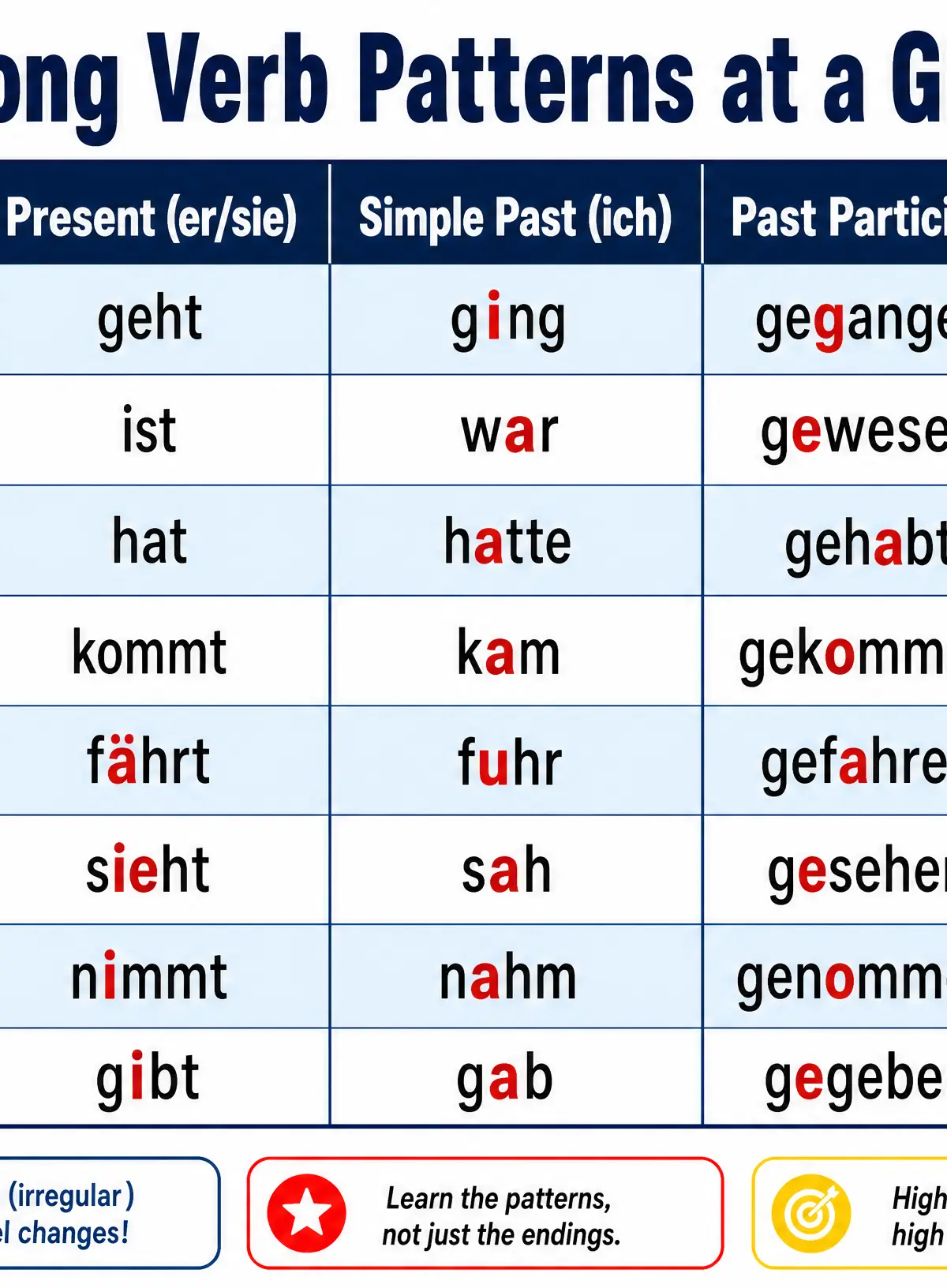
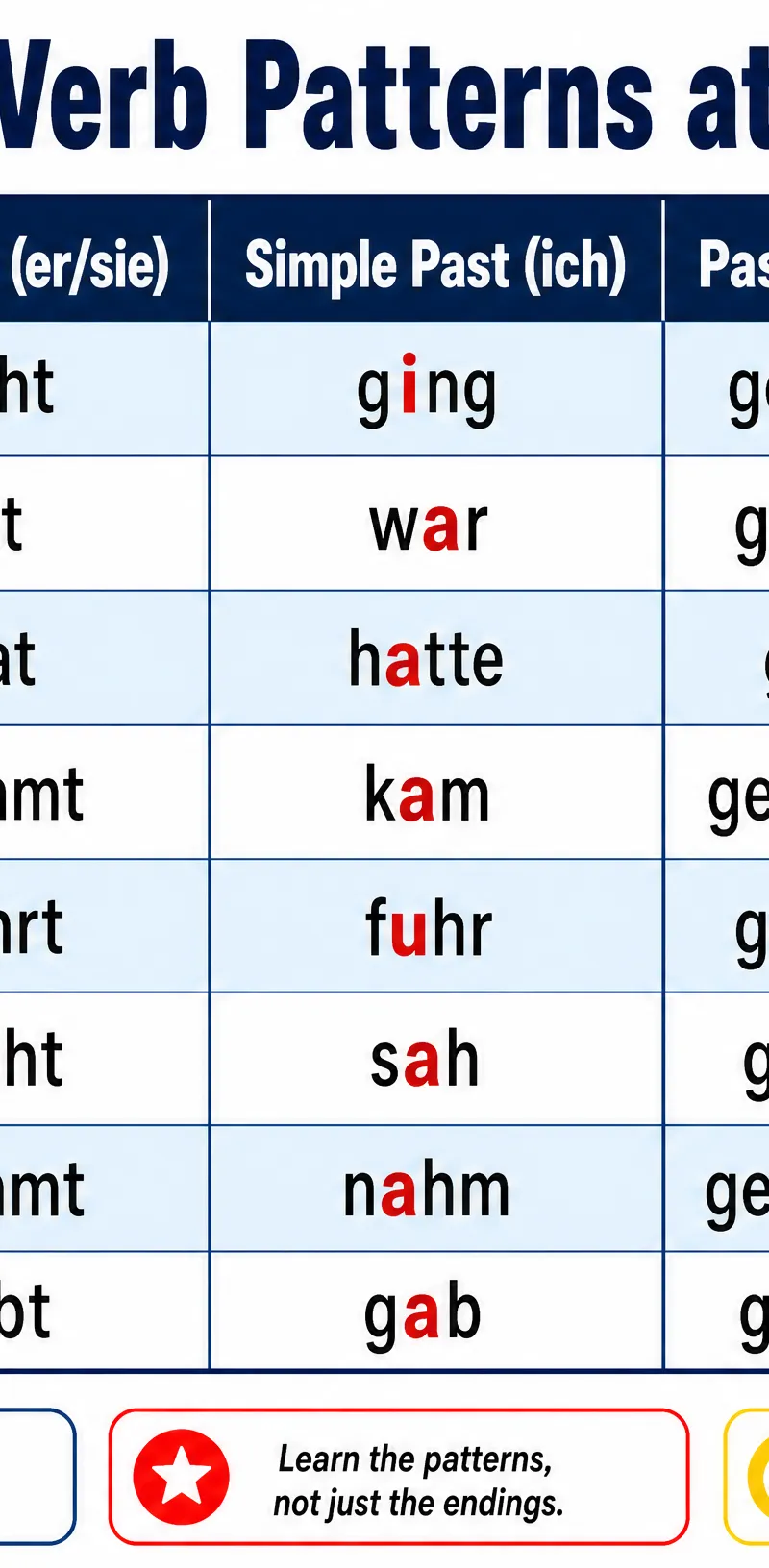
When to use it: When describing current actions or habits. Strong verbs often change their stem vowel in the 2nd (du) and 3rd (er/sie/es) person singular.
Conjugation Table: fahren (a → ä)
| Subject | Verb Form | English |
|---|---|---|
| ich | fahre | I drive/travel |
| du | fährst | you drive/travel |
| er/sie/es | fährt | he/she/it drives/travels |
| wir | fahren | we drive/travel |
| ihr | fahrt | you (pl) drive/travel |
| sie/Sie | fahren | they/you (formal) drive/travel |
Irregulars to learn:
- a → ä: fahren, schlafen, tragen, waschen
- e → i: essen, geben, helfen, sprechen, treffen
- e → ie: lesen, sehen, empfehlen
Key Structure 2: The Perfect Tense (Das Perfekt)
When to use it: To talk about completed actions in the past. This is the main past tense for speaking and informal writing.
Conjugation Table: gehen (sein) vs sehen (haben)
| Subject | Verb Form (sein) | English | Verb Form (haben) | English |
|---|---|---|---|---|
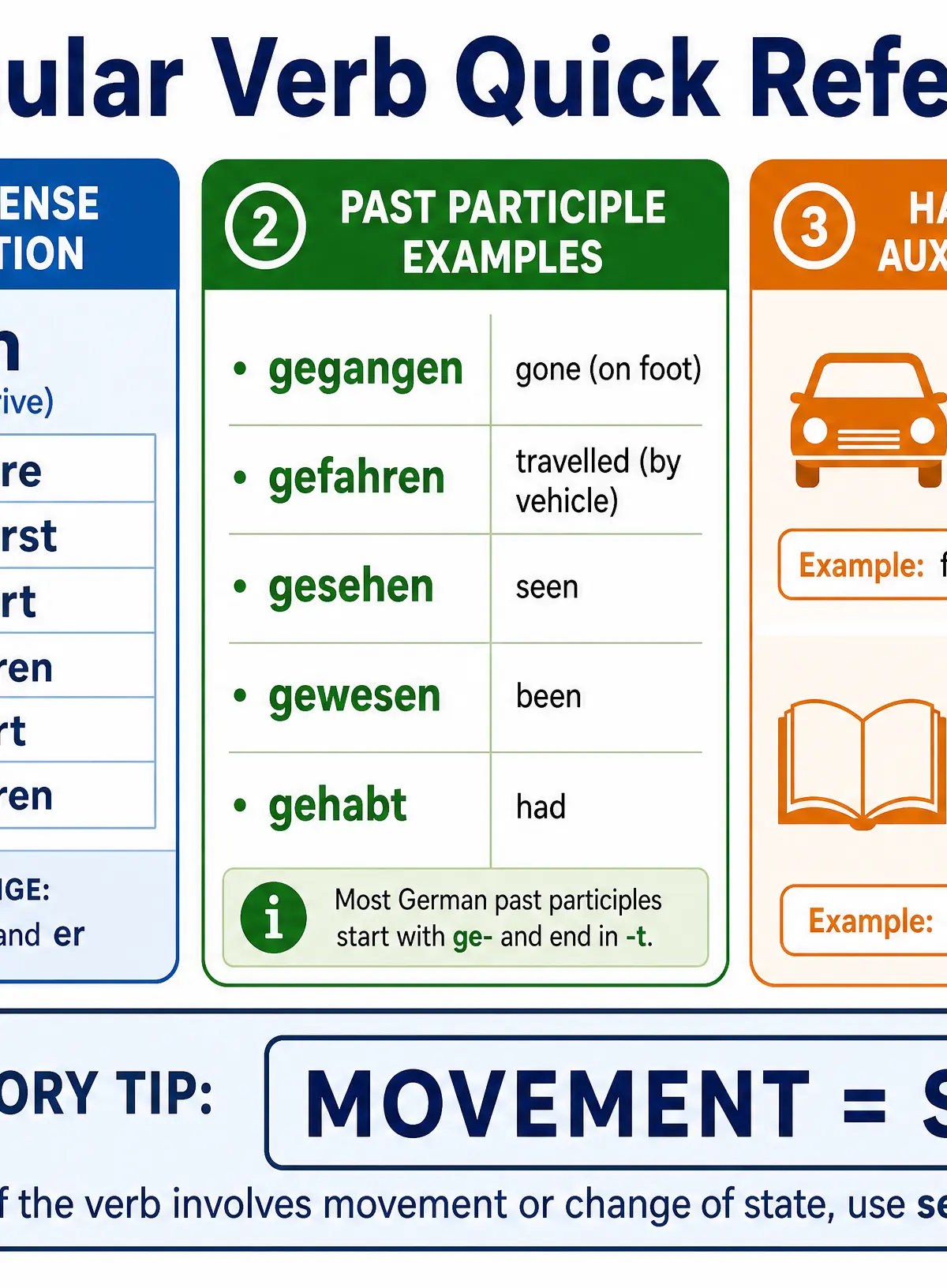
| ich | bin gegangen | I went | habe gesehen | I saw |
| du | bist gegangen | you went | hast gesehen | you saw |
| er/sie/es | ist gegangen | he/she/it went | hat gesehen | he/she/it saw |
| wir | sind gegangen | we went | haben gesehen | we saw |
| ihr | seid gegangen | you (pl) went | habt gesehen | you (pl) saw |
| sie/Sie | sind gegangen | they went | haben gesehen | they saw |
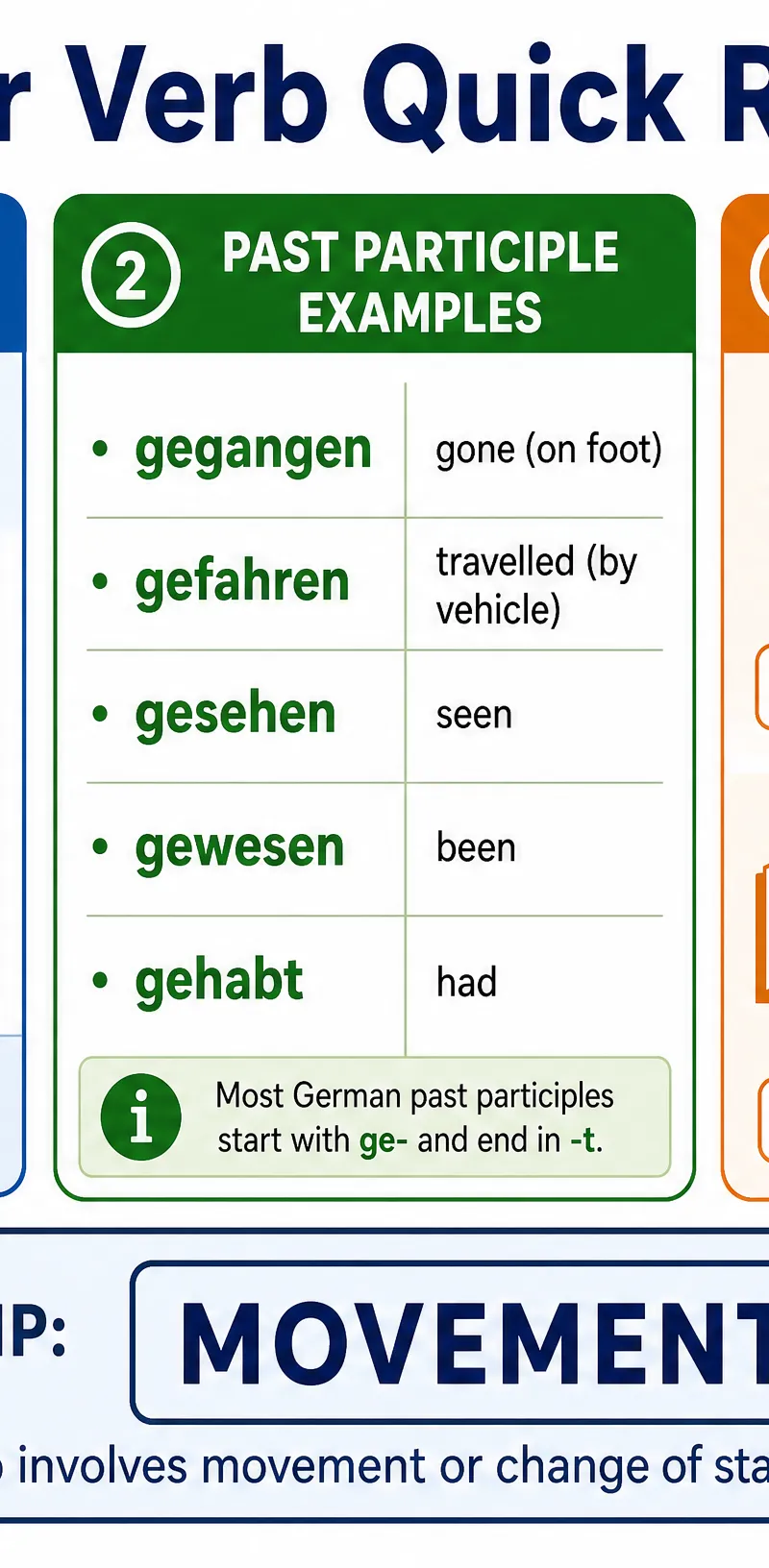
Irregulars to learn: Strong verbs have irregular past participles, usually ending in -en instead of -t. You must learn which take sein (movement/change of state) and which take haben.
- sein: gefahren, gekommen, geblieben, gewesen, geworden
- haben: gegessen, gelesen, geschrieben, getrunken, gefunden
Key Structure 3: The Simple Past (Das Imperfekt) of sein and haben
When to use it: While the perfect tense is used for most past actions, sein (to be) and haben (to have) are almost always used in the simple past, even in spoken German.
Conjugation Table: war vs hatte
| Subject | Verb Form (sein) | English | Verb Form (haben) | English |
|---|---|---|---|---|
| ich | war | I was | hatte | I had |
| du | warst | you were | hattest | you had |
| er/sie/es | war | he/she/it was | hatte | he/she/it had |
| wir | waren | we were | hatten | we had |
| ihr | wart | you (pl) were | hattet | you (pl) had |
| sie/Sie | waren | they were | hatten | they had |
🎧 Listening Skills
What to Expect
In the Higher tier listening exam, candidates will hear authentic-speed German featuring complex tenses. Irregular verbs will frequently be used to test your understanding of timeframes (e.g., distinguishing between er fährt and er fuhr).
Listening Strategies
- Listen for the auxiliary: The difference between present and past often hinges on catching a quick hat or ist before the main verb at the end of the sentence.
- Watch out for simple past: Higher tier texts often use simple past forms of strong verbs (e.g., gab, kam, ging) rather than the perfect tense.
- Note the vowel: Hearing er liest vs er las changes the entire timeframe of the sentence.
Common Listening Traps
- Confusing wurde (became - past) with würde (would - conditional).
- Missing the ge- prefix on past participles when spoken quickly, mistaking a past action for a present one.
- Not recognising separable irregular verbs (e.g., Er nahm an dem Projekt teil).
🗣️ Speaking Skills
Role Play Scenarios
Scenario 1: At the tourist office
- Question: Wie sind Sie hierher gekommen? (How did you get here?)
- Response: Ich bin mit dem Zug gefahren, weil es schneller ist. (I travelled by train because it is faster.)
Scenario 2: At a restaurant
- Question: Was haben Sie gestern Abend gegessen?
- Response: Ich habe Schnitzel mit Pommes gegessen. Es war sehr lecker.
Photo Card Practice
Model Photo Card Response (Theme: Holidays):
- Qu 1 (Description): Auf dem Foto sehe ich eine Familie. Sie essen in einem Restaurant.
- Qu 2 (Opinion): Meiner Meinung nach sieht das Essen lecker aus, weil sie glücklich sind.
- Qu 3 (Related topic): Normalerweise fahre ich mit meiner Familie nach Spanien, und wir essen oft Tapas.
- Qu 4 (Past): Letztes Jahr sind wir nach Italien gefahren und ich habe viel Pizza gegessen.
- Qu 5 (Future): Nächstes Jahr werden wir in Deutschland bleiben, um die Kultur zu erleben.
General Conversation Questions
| Question (German) | Model Answer | English Translation |
|---|---|---|
| Was hast du letztes Wochenende gemacht? | Letztes Wochenende bin ich mit meinen Freunden ins Kino gegangen. Danach haben wir Pizza gegessen. Es war toll. | What did you do last weekend? / Last weekend I went to the cinema with my friends. Afterwards we ate pizza. It was great. |
| Wie fährst du normalerweise zur Schule? | Normalerweise fahre ich mit dem Bus, aber gestern bin ich mit dem Rad gefahren, weil das Wetter schön war. | How do you normally travel to school? / Normally I travel by bus, but yesterday I cycled because the weather was nice. |
| Was wirst du nächstes Jahr machen? | Nächstes Jahr werde ich auf die Oberstufe gehen, um Abitur zu machen. | What will you do next year? / Next year I will go to sixth form to do my A-levels. |
| Hast du einen Teilzeitjob? | Ja, ich arbeite in einem Café. Ich muss Kunden helfen und Tische abräumen. | Do you have a part-time job? / Yes, I work in a café. I have to help customers and clear tables. |
| Was ist dein Lieblingsfach? | Mein Lieblingsfach ist Geschichte, weil der Lehrer sehr gut ist. Letzte Woche haben wir einen interessanten Film gesehen. | What is your favourite subject? / My favourite subject is History because the teacher is very good. Last week we watched an interesting film. |
✍️ Writing Skills
Translation Practice
English → German:
| English | German | Key Grammar |
|---|---|---|
| He reads a book every day. | Er liest jeden Tag ein Buch. | Vowel change in present tense (e → ie). |
| We went to Germany last year. | Wir sind letztes Jahr nach Deutschland gefahren. | Perfect tense with sein for movement. |
| I had no time yesterday. | Ich hatte gestern keine Zeit. | Simple past of haben. |
| She saw her friends in the park. | Sie hat ihre Freunde im Park gesehen. | Irregular past participle with haben. |
| You must help your brother. | Du musst deinem Bruder helfen. | Modal verb conjugation + dative case. |
Extended Writing
**Model 90-word response (Foundation/Overlap):**Letztes Jahr bin ich mit meiner Familie nach Spanien gefahren. Wir sind geflogen und die Reise war sehr lang. In Spanien haben wir in einem schönen Hotel geschlafen. Jeden Tag habe ich im Meer geschwommen und abends haben wir im Restaurant gegessen. Das Essen war fantastisch, weil ich Paella liebe. Nächstes Jahr möchte ich nach Italien fahren, weil das Wetter dort auch sehr heiß ist. Ich fahre gern in den Urlaub, um mich zu entspannen.
**Model 150-word response (Higher):**Meiner Meinung nach sind Ferien extrem wichtig, um sich vom Schulstress zu erholen. Letzten Sommer bin ich mit meiner Familie nach Österreich gefahren. Obwohl die Reise ziemlich lang war, hat sie mir gut gefallen, weil ich im Zug ein interessantes Buch gelesen habe. Als wir in Wien ankamen, war das Wetter wunderbar. Wir haben viele Sehenswürdigkeiten gesehen und ich habe jeden Tag Sachertorte gegessen, was köstlich war!
Normalerweise fahren wir ans Meer, aber dieses Jahr wollten wir etwas Neues ausprobieren. Die Berge waren wunderschön und wir sind oft wandern gegangen. Einmal haben wir uns leider verlaufen, aber zum Glück hat uns ein freundlicher Mann geholfen.
In der Zukunft habe ich vor, mit meinen Freunden nach Berlin zu fahren. Wir werden in einer Jugendherberge bleiben, da das billiger ist. Ich freue mich schon darauf, weil ich die deutsche Kultur faszinierend finde.
Writing Checklist
- ✅ Tenses: Have I used present, perfect, and future tenses clearly?
- ✅ Auxiliary verbs: Have I used sein for movement/change of state and haben for others?
- ✅ Vowel changes: Did I check the du and er/sie/es forms of strong verbs?
- ✅ Past participles: Are my irregular participles spelled correctly (e.g., gelesen, not geleset)?
- ✅ Word order: Is the past participle at the end of the sentence?
📚 Reading Skills
Key Strategies
- Identify the timeframe: Look for time markers (gestern, früher, morgen) to help contextualise irregular verb forms you might not immediately recognise.
- Spot the infinitive: When you see an irregular simple past form like nahm or zog, try to work backwards to the infinitive (nehmen, ziehen) to understand the meaning.
- Watch for separable prefixes: In reading texts, irregular verbs often have prefixes that change their meaning (e.g., kommen = to come, bekommen = to receive, ankommen = to arrive).
False Friends & Tricky Words
| Word | Looks Like | Actually Means |
|---|---|---|
| bekommen | to become | to receive / get |
| werden | to word | to become / will |
| raten | to rate | to advise / guess |
| verbringen | to bring | to spend (time) |
🌍 Cultural Knowledge
Understanding cultural context enriches your speaking and writing. When discussing holidays (a common topic for testing irregular verbs like fahren, fliegen, bleiben), knowing that many Germans holiday at the Ostsee (Baltic Sea) or in the Alps adds authenticity. When using verbs like essen and trinken, referencing specific regional foods (e.g., Currywurst in Berlin, Weißwurst in the Ruhr area, or Sachertorte in Vienna) demonstrates cultural awareness that examiners reward.
Visual Resources
2 diagrams and illustrations
Interactive Diagrams
1 interactive diagram to visualise key concepts
Conceptual Flow Outline
Decision tree for choosing haben vs sein in the perfect tense
Worked Examples
4 worked examples — open one to explore the question and available guidance.
Practice Questions
Try the question, then reveal an answer plan or example response
Translate into German: 'Yesterday I went to the cinema and I saw a good film.'
Hint: Think carefully about which auxiliary verb to use for 'went' compared to 'saw'.
Write the correct present tense form of the verb in brackets: Er (lesen) jeden Abend die Zeitung.
Hint: Remember the vowel change for 'lesen' in the 'er' form.
Rewrite this sentence in the perfect tense: Wir fahren mit dem Zug nach Berlin.
Hint: Fahren involves movement. Which auxiliary do you need?
Read the text: 'Früher aß ich gern Schokolade, aber heute esse ich lieber Obst.' What did the person like eating in the past?
Hint: Look at the simple past form 'aß'.
Translate into English: 'Letztes Jahr bin ich nach Deutschland geflogen.'
Hint: Don't translate 'bin' as 'am' in this context.
Write 90 words about your free time. Include: what you do normally, what you did last weekend, and what you will do next weekend.
Hint: Ensure you use three distinct tenses and include justified opinions.
Exam technique
How to turn what you know into marks
How to approach the question
Writing: Always plan your verbs first. Write down the infinitive, decide the tense, check if it's irregular, and place it at the end if it's a past participle.
How to structure your answer
Speaking: Always aim for the 'Rule of 3' in extended answers: Opinion + Reason + Past/Future tense example.
Timing
Writing: Allow about 1 minute per mark. For a 32-mark essay, spend 5 mins planning, 20 mins writing, 7 mins checking.
Common pitfalls
- Using 'haben' instead of 'sein' for verbs of movement (e.g., writing 'ich habe gegangen').
- Forgetting the vowel change in the present tense (e.g., writing 'er fahrt' instead of 'er fährt').
- Applying weak verb rules to strong verbs (e.g., writing 'geseht' instead of 'gesehen').
- Putting the past participle in the middle of the sentence instead of at the very end.
- Using the present tense when the question asks about a past event.
What the command words want
- Beschreiben Sie
- Use present tense, focus on accurate 3rd person verb forms (er/sie/es).
- Übersetzen Sie
- Focus on grammatical accuracy over literal word-for-word translation.
- Was sind Ihre Pläne?
- Use future tense (werden + infinitive) or present tense with a future time phrase.
- Was haben Sie gemacht?
- Mandatory perfect tense. Check your haben/sein auxiliaries.
Watch or listen (optional)
Test your understanding of Vocabulary: Irregular inflected verb forms (Higher only)
Active recall beats re-reading. Take an instant quiz now to test what you’ve learned and lock it into long-term memory.
7 days Premium · Then the free plan continues · No card, no charge