Pearson Edexcel · GCSE · German
Course version: Pearson-GCSE-German · Version from Mar 2026
Vocabulary: Nouns
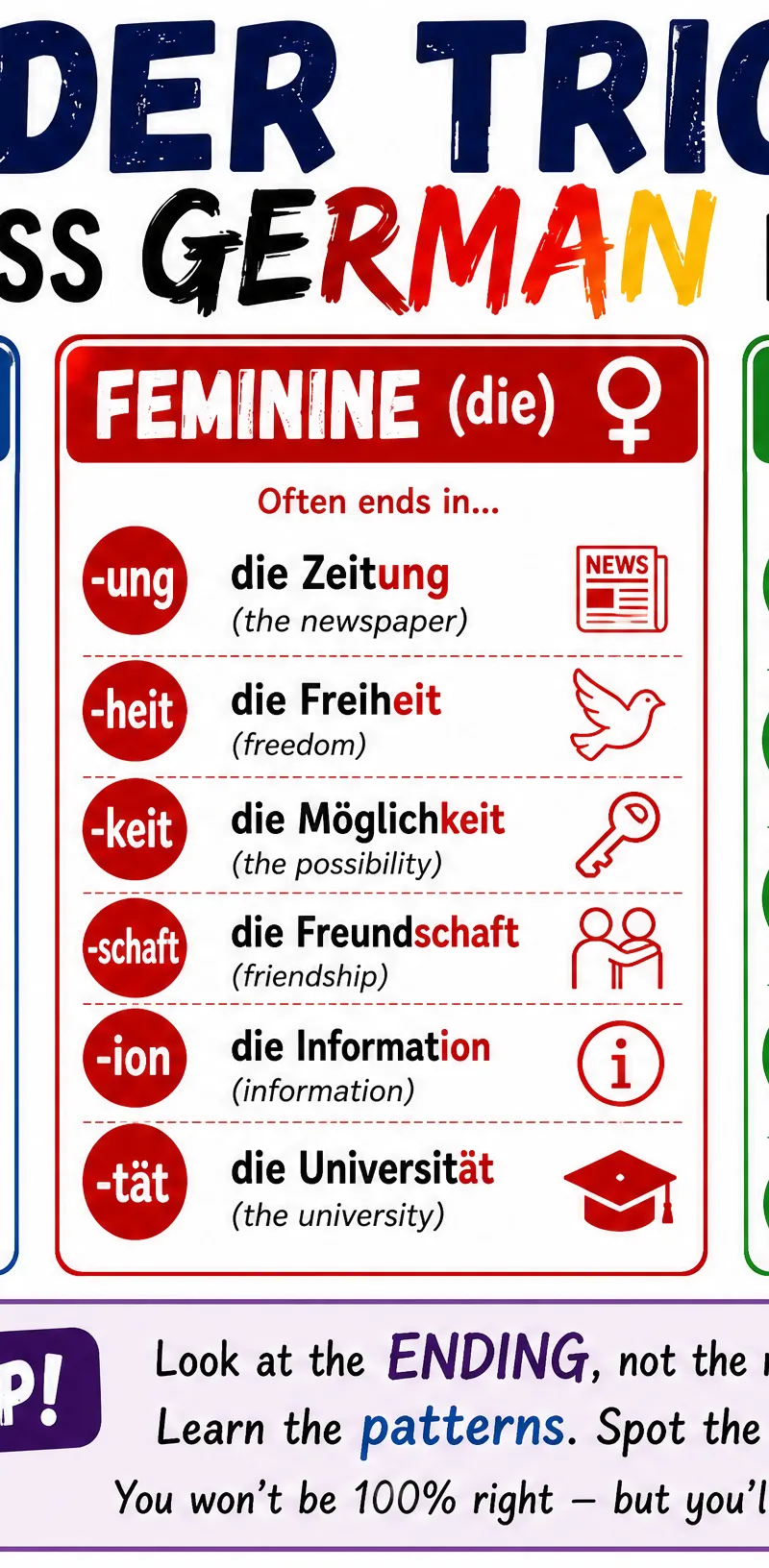
Mastering German nouns is essential for GCSE success. This guide covers noun gender (der, die, das), plural formation, compound nouns, and the critical case changes (Nominative, Accusative, Dative) required across Listening, Speaking, Reading, and Writing.
- 14 min read
- 4 worked examples
- 6 practice questions
- 8 key terms
Check what you remember
Read the wording for your board, then hide it and explain Noun (Nomen) in your own words. Rough notes are fine. This is a self-check, with no mark or grade.
Reference: Pearson Edexcel
A naming word for a person, place, thing, or abstract idea. In German, they are always capitalised.
Study Notes
Overview
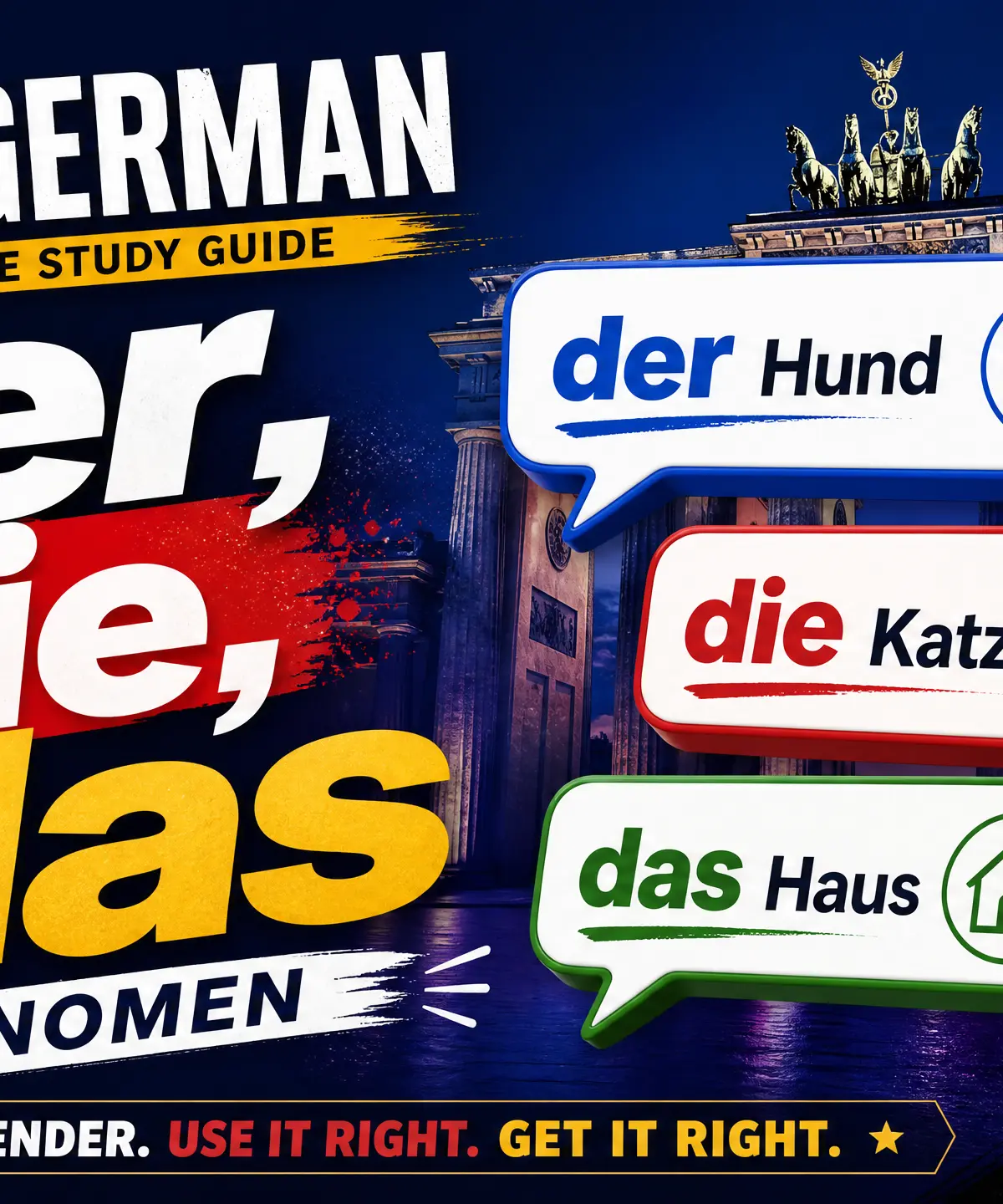
Nouns (Nomen) are the building blocks of the German language. Unlike English, where nouns are relatively straightforward, German nouns are dynamic: they have a grammatical gender (masculine, feminine, or neuter), they change form in the plural, and their accompanying articles change depending on their grammatical role in a sentence (the case). Mastering nouns is not just about vocabulary; it is fundamentally about grammar. Accuracy with nouns is heavily rewarded in the Writing and Speaking exams, while understanding compound nouns and case changes is crucial for higher-tier Listening and Reading comprehension.
📖 Essential Vocabulary
Tier 1 — Foundation Core
| German | English | Gender | Example Sentence |
|---|---|---|---|
| der Hund | the dog | m | Der Hund ist sehr freundlich. (The dog is very friendly.) |
| die Katze | the cat | f | Ich habe eine schwarze Katze. (I have a black cat.) |
| das Haus | the house | n | Wir wohnen in einem großen Haus. (We live in a big house.) |
| der Bruder | the brother | m | Mein Bruder heißt Thomas. (My brother is called Thomas.) |
| die Schwester | the sister | f | Seine Schwester ist zwölf Jahre alt. (His sister is twelve years old.) |
| das Auto | the car | n | Das Auto ist kaputt. (The car is broken.) |
| der Vater | the father | m | Mein Vater arbeitet in Berlin. (My father works in Berlin.) |
| die Mutter | the mother | f | Meine Mutter ist Lehrerin. (My mother is a teacher.) |
| das Kind | the child | n | Das Kind spielt im Garten. (The child is playing in the garden.) |
| der Apfel | the apple | m | Ich esse einen Apfel. (I am eating an apple.) |
| die Schule | the school | f | Die Schule beginnt um acht Uhr. (School starts at eight o'clock.) |
| das Buch | the book | n | Er liest ein interessantes Buch. (He is reading an interesting book.) |
| der Tisch | the table | m | Das Buch liegt auf dem Tisch. (The book is lying on the table.) |
| die Tür | the door | f | Bitte mach die Tür zu. (Please close the door.) |
| das Fenster | the window | n | Das Fenster ist offen. (The window is open.) |
Tier 2 — Higher Tier
| German | English | Gender | Example Sentence |
|---|---|---|---|
| der Umweltschutz | environmental protection | m | Der Umweltschutz ist heutzutage sehr wichtig. (Environmental protection is very important nowadays.) |
| die Gesellschaft | society | f | Wir leben in einer modernen Gesellschaft. (We live in a modern society.) |
| das Vorurteil | prejudice | n | Es gibt leider viele Vorurteile. (Unfortunately, there are many prejudices.) |
| der Wettbewerb | competition | m | Er hat den Wettbewerb gewonnen. (He won the competition.) |
| die Herausforderung | challenge | f | Das war eine große Herausforderung für mich. (That was a big challenge for me.) |
| das Erlebnis | experience | n | Der Urlaub war ein unvergessliches Erlebnis. (The holiday was an unforgettable experience.) |
| der Einfluss | influence | m | Die Medien haben einen großen Einfluss auf Jugendliche. (The media have a big influence on young people.) |
| die Ausbildung | education / training | f | Eine gute Ausbildung ist wichtig für die Zukunft. (A good education is important for the future.) |
| das Verhalten | behaviour | n | Sein Verhalten war inakzeptabel. (His behaviour was unacceptable.) |
| der Fortschritt | progress | m | Der technologische Fortschritt ist rasant. (Technological progress is rapid.) |
High-Frequency Words & Phrases
| Phrase | English | Usage Context |
|---|---|---|
| zum Beispiel (z.B.) | for example | Used to introduce an example in writing or speaking. |
| meiner Meinung nach | in my opinion | Essential for giving opinions in Speaking and Writing. |
| auf der einen Seite... auf der anderen Seite | on the one hand... on the other hand | Excellent for balanced arguments at Higher tier. |
| im Vergleich zu | in comparison to | Useful for comparing things, especially in the Photo Card. |
| in der Zukunft | in the future | Crucial for accessing future tense marks. |
| in der Vergangenheit | in the past | Crucial for accessing past tense marks. |
| es gibt (+ Accusative) | there is / there are | A fundamental structure; always takes the accusative case. |
| um ... zu (+ Infinitive) | in order to | A complex structure highly rewarded by examiners. |
| ich interessiere mich für | I am interested in | Good for expressing interests and hobbies. |
| ich freue mich auf | I am looking forward to | Excellent for concluding an informal letter or email. |
📝 Grammar Focus
Key Structure 1: The Nominative Case
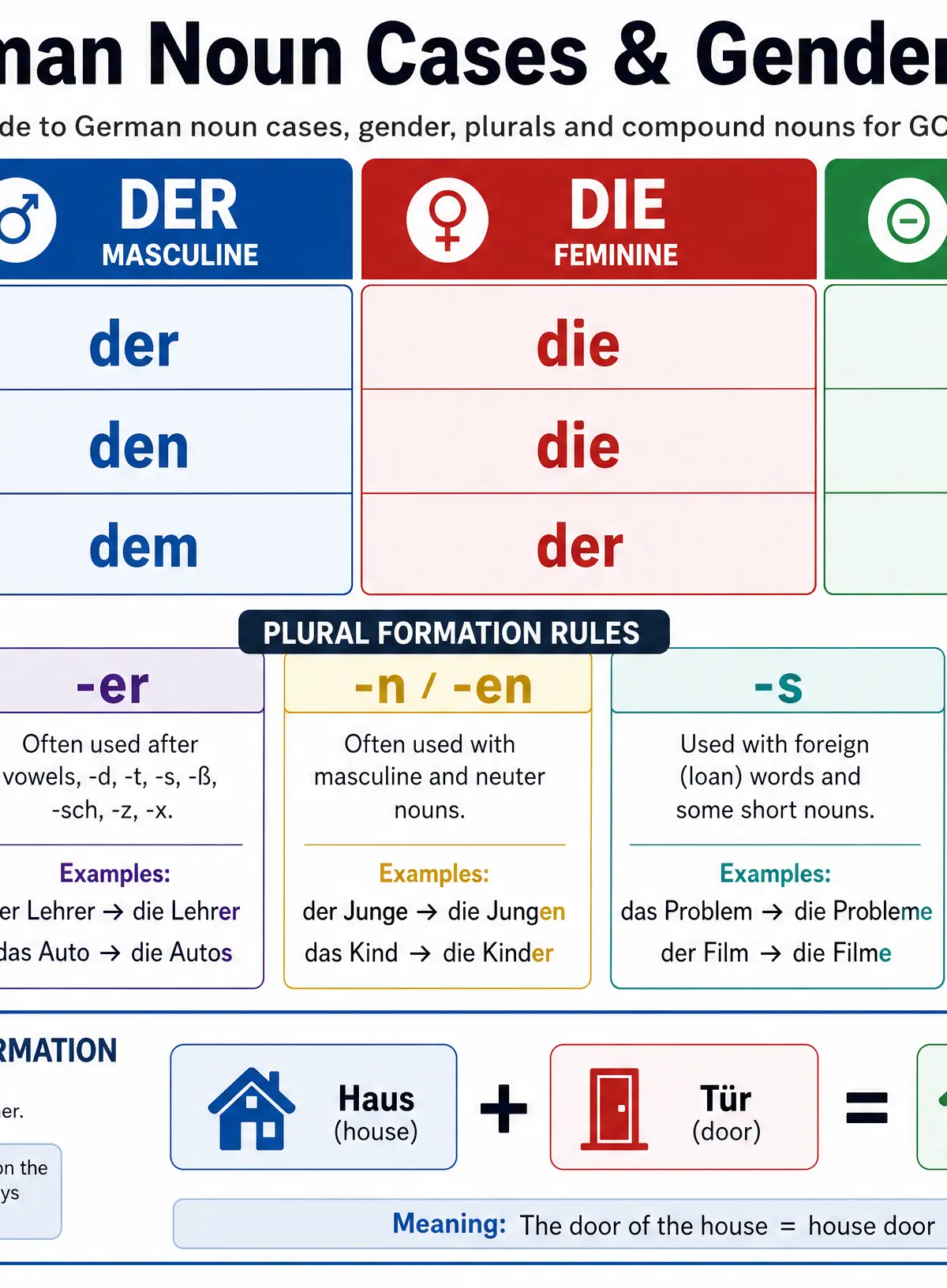
When to use it: The nominative case is used for the subject of the sentence. This is the person or thing doing the action of the verb. It is also used after the verb sein (to be) and werden (to become).
Definite Articles (The) - Nominative
| Gender | Article | Example | English |
|---|---|---|---|
| Masculine | der | Der Hund bellt. | The dog barks. |
| Feminine | die | Die Katze schläft. | The cat sleeps. |
| Neuter | das | Das Kind spielt. | The child plays. |
| Plural | die | Die Kinder spielen. | The children play. |
Key Structure 2: The Accusative Case
When to use it: The accusative case is used for the direct object of the sentence. This is the person or thing receiving the action of the verb (e.g., I buy the dog). It is also used after specific prepositions (durch, für, gegen, ohne, um) and after the phrase es gibt (there is/are).
Definite Articles (The) - Accusative
| Gender | Article | Example | English |
|---|---|---|---|
| Masculine | den | Ich sehe den Hund. | I see the dog. |
| Feminine | die | Ich sehe die Katze. | I see the cat. |
| Neuter | das | Ich sehe das Kind. | I see the child. |
| Plural | die | Ich sehe die Kinder. | I see the children. |
Crucial Rule: Only masculine nouns change their article in the accusative case (der becomes den, ein becomes einen).
Key Structure 3: The Dative Case
When to use it: The dative case is used for the indirect object of the sentence (e.g., I give the book to the man). It is frequently used after dative prepositions (aus, bei, mit, nach, seit, von, zu) and with certain verbs like helfen (to help) and gefallen (to please).
Definite Articles (The) - Dative
| Gender | Article | Example | English |
|---|---|---|---|
| Masculine | dem | Ich helfe dem Mann. | I help the man. |
| Feminine | der | Ich helfe der Frau. | I help the woman. |
| Neuter | dem | Ich helfe dem Kind. | I help the child. |
| Plural | den (+n) | Ich helfe den Kindern. | I help the children. |
Crucial Rule: In the dative plural, you must add an '-n' to the end of the noun if it doesn't already end in '-n' or '-s'.
🎧 Listening Skills
What to Expect
The Listening exam will test your ability to distinguish between singular and plural nouns, and your understanding of compound nouns. You will hear native speakers discussing various topics, and you must extract specific information. Noun cases often provide clues about who is doing what to whom.
Listening Strategies
- Listen for the Article: The article (der, die, das, den, dem) is a massive clue. It tells you the gender and the case, which helps you parse the sentence structure even if you miss the verb.
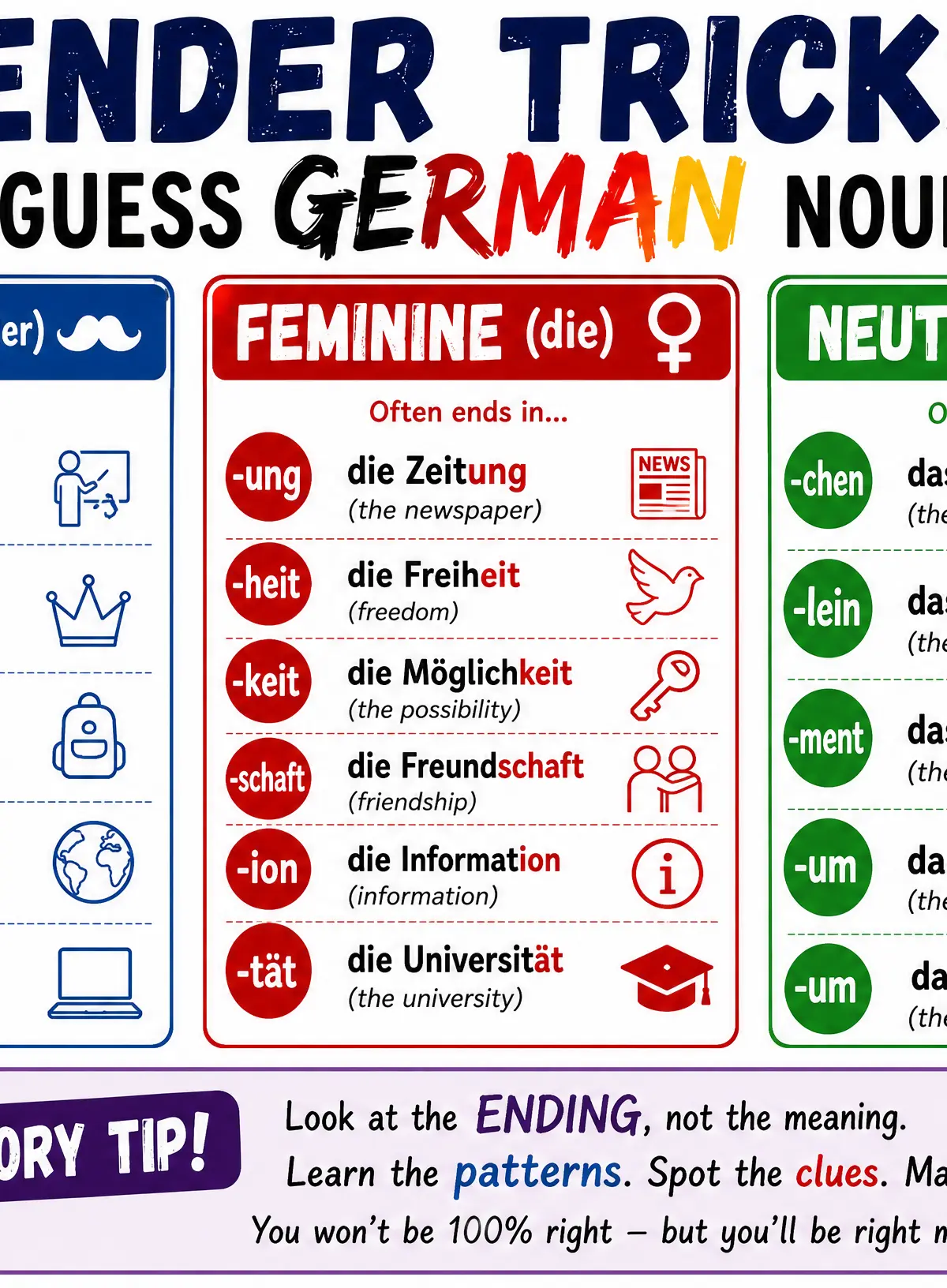
- Break Down Compound Nouns: If you hear a long, unfamiliar word, try to split it into its component nouns. Umweltschutz = Umwelt (environment) + Schutz (protection).
- Watch for Plural Endings: Listen carefully for the subtle '-e', '-er', or '-n' endings, or the addition of an umlaut (e.g., Bruder vs Brüder), which changes the meaning from singular to plural.
Common Listening Traps
- False Friends: Words that sound like English words but mean something else. E.g., das Gymnasium means grammar school, not gymnasium/sports hall (which is die Turnhalle). Der Chef means boss, not a cook (which is der Koch).
- Dative Feminine: Hearing der before a noun that you know is feminine (e.g., mit der Frau). This is not a masculine noun; it is a feminine noun in the dative case.
🗣️ Speaking Skills
Role Play Scenarios
Scenario 1: At the Tourist Office
- Candidate: Ich suche ein gutes Hotel im Stadtzentrum. (I am looking for a good hotel in the city centre.)
- Examiner: Wie lange möchten Sie bleiben?
- Candidate: Ich möchte für drei Nächte bleiben. (I would like to stay for three nights.)
Scenario 2: Buying a Train Ticket
- Candidate: Ich möchte eine Fahrkarte nach Berlin, bitte. (I would like a ticket to Berlin, please.)
- Examiner: Einfach oder hin und zurück?
- Candidate: Hin und zurück, bitte. Was kostet das? (Return, please. How much does that cost?)
Photo Card Practice
Model Photo Card Response (Topic: Environment):
- Qu 1 (Description): Auf dem Foto gibt es viele junge Leute. Sie sammeln Müll im Park. Das Wetter ist sonnig. (In the photo there are many young people. They are collecting rubbish in the park. The weather is sunny.)
- Qu 2 (Opinion): Meiner Meinung nach ist das eine tolle Initiative, weil der Umweltschutz extrem wichtig ist. (In my opinion, this is a great initiative because environmental protection is extremely important.)
- Qu 3 (Related topic): Zu Hause trennen wir immer den Müll und wir recyceln Papier und Glas. (At home we always separate the rubbish and we recycle paper and glass.)
- Qu 4 (Past/Future): Nächstes Wochenende werde ich mit dem Rad zur Schule fahren, um die Umwelt zu schützen. (Next weekend I will cycle to school to protect the environment.)
- Qu 5 (Unpredictable): Ja, Umweltverschmutzung ist ein großes Problem in meiner Stadt, besonders die Luftverschmutzung durch Autos. (Yes, environmental pollution is a big problem in my town, especially air pollution from cars.)
General Conversation Questions
| Question (German) | Model Answer | English Translation |
|---|---|---|
| Was ist dein Lieblingsfach? | Mein Lieblingsfach ist Geschichte, weil der Lehrer sehr lustig ist und ich die Themen interessant finde. | My favourite subject is History because the teacher is very funny and I find the topics interesting. |
| Was hast du letztes Wochenende gemacht? | Letztes Wochenende bin ich mit meinen Freunden ins Kino gegangen. Der Film war fantastisch! | Last weekend I went to the cinema with my friends. The film was fantastic! |
| Wie ist das Wetter heute? | Heute ist das Wetter furchtbar. Es regnet stark und es ist ziemlich kalt. | Today the weather is awful. It is raining heavily and it is quite cold. |
| Was wirst du in der Zukunft als Beruf machen? | In der Zukunft möchte ich als Arzt arbeiten, um kranken Menschen zu helfen. | In the future I would like to work as a doctor in order to help sick people. |
| Wie findest du deine Stadt? | Ich finde meine Stadt sehr lebendig, obwohl es manchmal zu viel Verkehr gibt. | I find my town very lively, although there is sometimes too much traffic. |
✍️ Writing Skills
Translation Practice
English → German:
| English | German | Key Grammar |
|---|---|---|
| The man buys a dog. | Der Mann kauft einen Hund. | Accusative case (masculine 'einen'). |
| I am travelling with my sister. | Ich fahre mit meiner Schwester. | Dative case after 'mit' (feminine 'meiner'). |
| There is a big problem. | Es gibt ein großes Problem. | Accusative case after 'es gibt' (neuter 'ein'). |
| We live in the houses. | Wir wohnen in den Häusern. | Dative plural (add '-n' to 'Häuser'). |
| I give the book to the teacher. | Ich gebe dem Lehrer das Buch. | Dative indirect object ('dem Lehrer'), Accusative direct object ('das Buch'). |
Extended Writing
**Model 90-word response (Foundation) - Topic: Free Time:**In meiner Freizeit spiele ich gern Fußball, weil es gesund ist. Letztes Wochenende bin ich mit meinem Bruder ins Sportzentrum gegangen. Wir haben zwei Stunden lang Tennis gespielt. Das war sehr anstrengend, aber es hat Spaß gemacht. Nächstes Wochenende werde ich Musik hören und ein Buch lesen, weil ich mich entspannen möchte. Mein Lieblingshobby ist jedoch das Lesen. Ich lese jeden Abend in meinem Schlafzimmer.
(Examiner note: Covers all time frames, includes opinions and reasons, uses correct noun genders and basic cases).
**Model 150-word response (Higher) - Topic: Holidays:**Normalerweise verbringe ich meine Sommerferien in Spanien, weil das Wetter dort immer wunderschön ist. Wir übernachten meistens in einem großen Hotel an der Küste. Letztes Jahr sind wir jedoch nach Deutschland gefahren. Die Reise war ziemlich langweilig, da wir mit dem Auto gefahren sind, aber die Landschaft war atemberaubend. Eines Tages haben wir ein altes Schloss besichtigt, was ein unvergessliches Erlebnis war. Meiner Meinung nach sind Ferien im Ausland extrem wichtig, um neue Kulturen kennenzulernen und Fremdsprachen zu üben. In der Zukunft möchte ich eine Weltreise machen, wenn ich genug Geld habe. Ich hoffe, dass ich nächstes Jahr nach Italien fliegen werde, um die historischen Sehenswürdigkeiten zu sehen.
(Examiner note: Excellent range of vocabulary, complex structures like 'um... zu', three time frames, justified opinions, accurate noun cases and compound nouns).
Writing Checklist
- ✅ Have I used at least three tenses (Past, Present, Future/Conditional)?
- ✅ Have I included opinions and justified them with reasons (weil, da)?
- ✅ Have I checked the gender of my nouns (der/die/das)?
- ✅ Have I applied the accusative case after 'es gibt' and for direct objects?
- ✅ Have I applied the dative case after dative prepositions (mit, nach, aus, etc.)?
📚 Reading Skills
Key Strategies
- Context is King: Don't panic if you don't know a noun. Look at the words around it (verbs, adjectives) to deduce its meaning.
- Deconstruct Compounds: German creates new words by joining nouns. Read them backwards. Tischtennis = table tennis. Krankenhaus = sick house (hospital).
- Identify the Subject: Find the noun in the nominative case to understand who is performing the action, especially in complex sentences where word order is inverted.
False Friends & Tricky Words
| Word | Looks Like | Actually Means |
|---|---|---|
| das Gymnasium | gymnasium | grammar school |
| der Chef | chef | boss / manager |
| aktuell | actual | current / up-to-date |
| das Gift | gift | poison |
| bekommen | to become | to get / receive |
🌍 Cultural Knowledge
Understanding German compound nouns gives you insight into the German mindset, which values precision and logic. Words like Schadenfreude (pleasure derived from another's misfortune) or Fernweh (a longing for distant places) capture complex emotions in a single noun. Furthermore, the use of formal vs. informal address (Sie vs. du) often dictates the choice of nouns and titles used in professional and social settings in Germany, Austria, and Switzerland. This cultural awareness enriches your speaking and writing responses, demonstrating a deeper engagement with the language.
Visual Resources
2 diagrams and illustrations
Interactive Diagrams
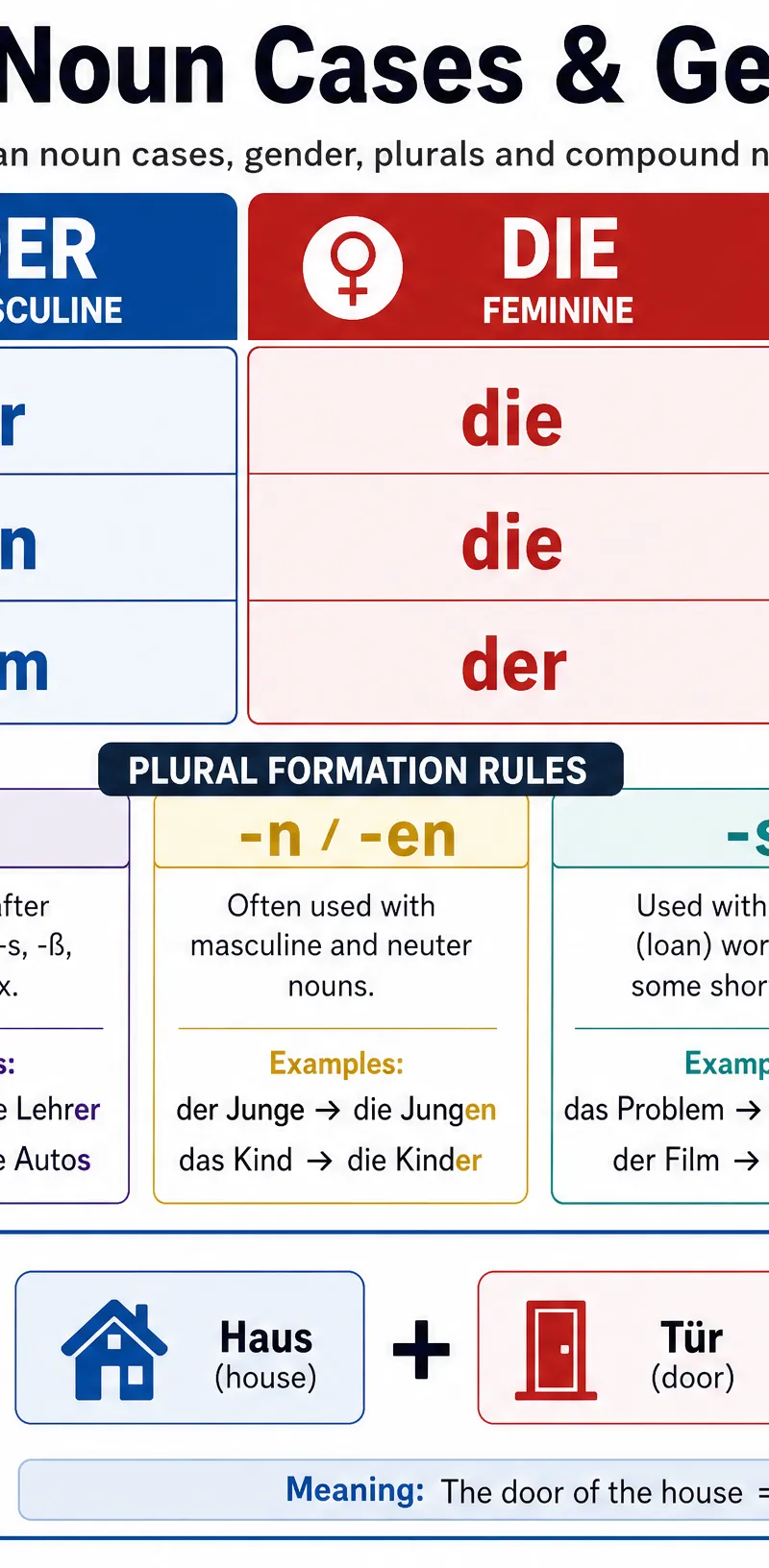
1 interactive diagram to visualise key concepts
Conceptual Flow Outline
How to choose the correct noun case
Worked Examples
4 worked examples — open one to explore the question and available guidance.
Practice Questions
Try the question, then reveal an answer plan or example response
Writing (Foundation): Translate the following sentence into German: 'The boy has a dog.'
Hint: Think about the case of 'a dog'. Is it the subject or the object?
Writing (Higher): Translate the following sentence into German: 'I am going to the cinema with my friends.'
Hint: The preposition 'mit' always takes the dative case. Don't forget the dative plural rule!
Reading (Standard): Read the compound noun and provide its English translation: 'die Hauptschule'.
Hint: Break it down: Haupt = main/head, Schule = school.
Speaking (Photo Card): Look at a photo of a family eating dinner. Answer the question: 'Was essen die Leute auf dem Foto?'
Hint: Start your sentence with 'Auf dem Foto...' and use the accusative case for the food they are eating.
Listening (Higher): You hear: 'Mein Bruder arbeitet in einem großen Krankenhaus.' Where does the brother work?
Hint: Translate the compound noun 'Krankenhaus'.
Writing (Standard): Write the plural form of 'das Buch'.
Hint: Remember the rule about adding an ending and often an umlaut for short neuter nouns.
Exam technique
How to turn what you know into marks
How to approach the question
Skill-by-skill strategy: Listening — read questions first, annotate with likely vocabulary. Speaking — prepare 'safety phrases' for opinions. Reading — highlight the verb to find the subject/object. Writing — draft a quick plan of the tenses and key nouns you will use.
How to structure your answer
Writing: Introduction → Point 1 (Opinion + Reason) → Point 2 (Past Event) → Point 3 (Future Plan) → Conclusion. Ensure every paragraph contains a justified opinion.
Timing
Listening: 25 mins (Foundation) / 35 mins (Higher). Speaking: 7-12 mins total. Reading: 45 mins (Foundation) / 60 mins (Higher). Writing: 60 mins (Foundation) / 75 mins (Higher).
Common pitfalls
- Using 'die' for everything when unsure of gender.
- Forgetting to change 'der' to 'den' in the accusative case.
- Missing umlauts on plural nouns (e.g., writing 'Bruder' instead of 'Brüder' for brothers).
- Using English word order instead of sending the second verb to the end.
- Confusing 'mit die' instead of the correct dative 'mit der' for feminine nouns.
What the command words want
- Describe the photo
- Use 'Auf dem Foto gibt es...' (In the photo there is/are). Describe people, actions, and weather.
- Translate into German
- Accuracy is key. Check verb endings, noun genders, and case agreements.
- Translate into English
- Focus on the meaning, not a literal word-for-word translation. Pay attention to tenses.
- Write approximately 90 words
- Cover all four bullet points evenly. Use the present tense and at least one other time frame.
- Write approximately 150 words
- Address both bullet points in detail. Must include three time frames, complex structures, and justified opinions.
Watch or listen (optional)
Test your understanding of Vocabulary: Nouns
Active recall beats re-reading. Take an instant quiz now to test what you’ve learned and lock it into long-term memory.
7 days Premium · Then the free plan continues · No card, no charge