Pearson Edexcel · GCSE · German
Course version: Pearson-GCSE-German · Version from Mar 2026
Vocabulary: Prepositions
Master German prepositions and the cases they trigger (accusative, dative, and dual-case). This comprehensive guide covers essential vocabulary, grammar rules, infinitive constructions, and exam techniques across Listening, Speaking, Reading, and Writing.
- 11 min read
- 4 worked examples
- 6 practice questions
- 8 key terms
Check what you remember
Read the wording for your board, then hide it and explain Preposition in your own words. Rough notes are fine. This is a self-check, with no mark or grade.
Reference: Pearson Edexcel
A word that links nouns, pronouns, or phrases to other words within a sentence (e.g., in, on, with).
Study Notes
Overview
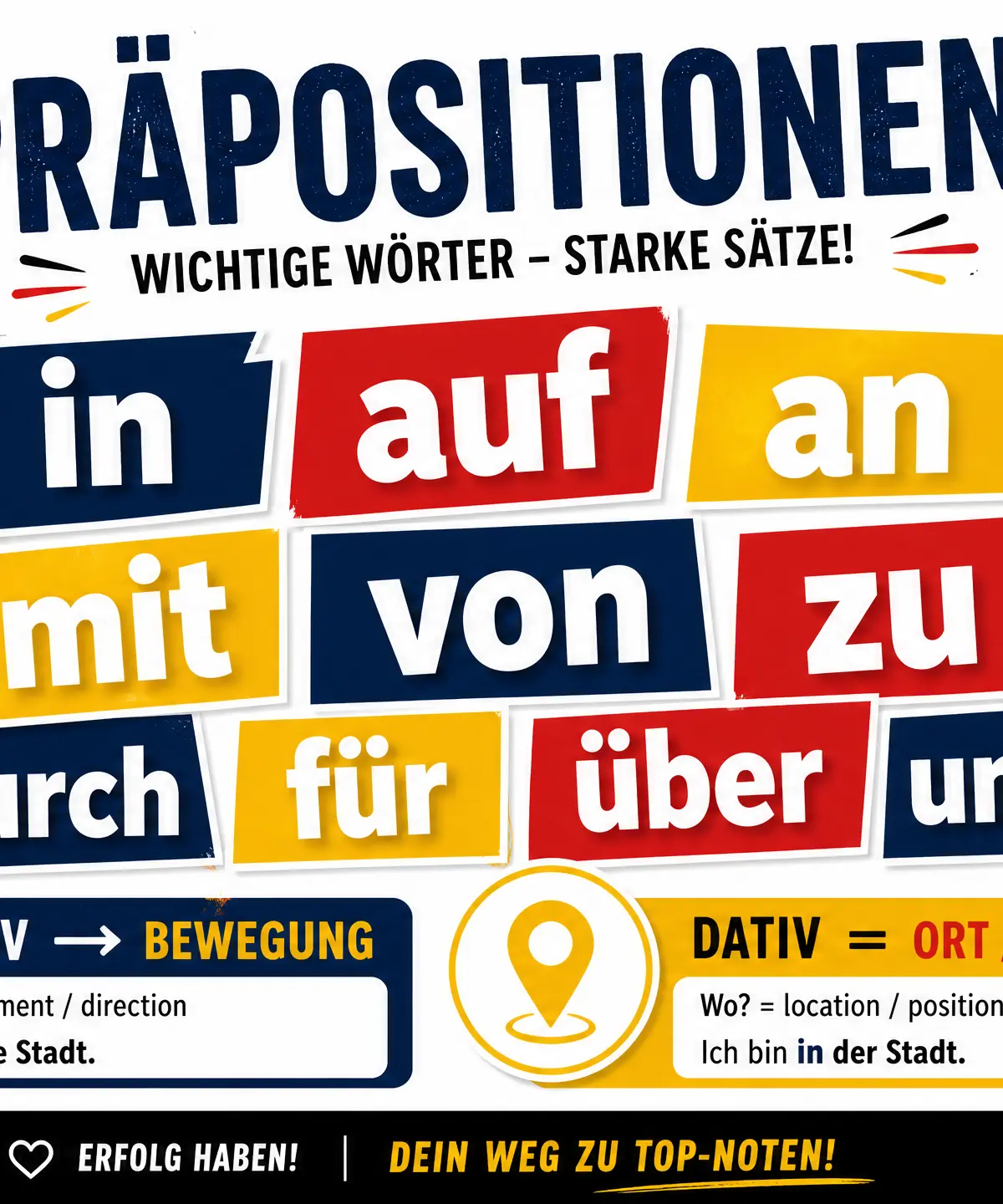
Prepositions are the glue that holds German sentences together. They are small words (like in, auf, mit) that show the relationship between nouns or pronouns. In the GCSE German exam, mastering prepositions is crucial because they determine the grammatical case (Accusative or Dative) of the words that follow them. Using the wrong case after a preposition is a common error that examiners look out for. Getting this right will significantly boost your marks in Writing and Speaking, and help you decode tricky texts in Reading and Listening.
🎧 The Prepositions Podcast
Listen to our 10-minute audio guide covering all the key rules, memory hooks, and a quick-fire recall quiz!
📖 Essential Vocabulary
Tier 1 — Foundation Core
| German | English | Gender/Case | Example Sentence |
|---|---|---|---|
| durch | through | Accusative | Wir gehen durch den Park. |
| für | for | Accusative | Das Geschenk ist für meinen Bruder. |
| gegen | against | Accusative | Er spielt gegen die Wand. |
| ohne | without | Accusative | Ich trinke Kaffee ohne Zucker. |
| um | around / at (time) | Accusative | Der Unterricht beginnt um acht Uhr. |
| aus | out of / from | Dative | Sie kommt aus der Schweiz. |
| bei | at / near / with | Dative | Ich wohne bei meiner Tante. |
| mit | with | Dative | Ich fahre mit dem Bus zur Schule. |
| nach | after / to (cities/countries) | Dative | Nach der Schule spiele ich Fußball. |
| seit | since / for (time) | Dative | Ich lerne seit einem Jahr Deutsch. |
| von | from / of / by | Dative | Das Buch ist von meinem Lehrer. |
| zu | to (places/people) | Dative | Wir gehen zu dem (zum) Supermarkt. |
| in | in / into | Dual-case | Er ist in der Küche. (Location) |
| auf | on (horizontal) | Dual-case | Das Buch liegt auf dem Tisch. |
| an | at / on (vertical) | Dual-case | Das Bild hängt an der Wand. |
Tier 2 — Higher Tier
| German | English | Gender/Case | Example Sentence |
|---|---|---|---|
| gegenüber | opposite | Dative | Die Post ist gegenüber dem Bahnhof. |
| entlang | along | Accusative | Wir spazieren den Fluss entlang. |
| außer | except for | Dative | Alle außer mir haben die Hausaufgaben gemacht. |
| zwischen | between | Dual-case | Der Stuhl steht zwischen dem Bett und dem Schrank. |
| hinter | behind | Dual-case | Der Hund schläft hinter dem Sofa. |
| neben | next to | Dual-case | Die Bank ist neben der Bäckerei. |
| über | over / above / about | Dual-case | Wir fliegen über die Alpen. |
| unter | under / below | Dual-case | Die Katze sitzt unter dem Tisch. |
| vor | in front of / before / ago | Dual-case | Wir treffen uns vor dem Kino. |
| um...zu | in order to | Infinitive | Ich lerne Deutsch, um in Berlin zu arbeiten. |
High-Frequency Words & Phrases
| Phrase | English | Usage Context |
|---|---|---|
| zum Beispiel (z.B.) | for example | Giving examples in writing/speaking |
| am Wochenende | at the weekend | Discussing free time |
| am Abend | in the evening | Discussing daily routine |
| in der Nähe von | near to | Describing where you live |
| meiner Meinung nach | in my opinion | Justifying views (note: Dative follows) |
| von Zeit zu Zeit | from time to time | Expressing frequency |
| auf dem Land | in the countryside | Describing location |
| in der Stadt | in the town/city | Describing location |
| mit meinen Freunden | with my friends | Discussing social activities |
| zu Hause | at home | Describing location |
📝 Grammar Focus
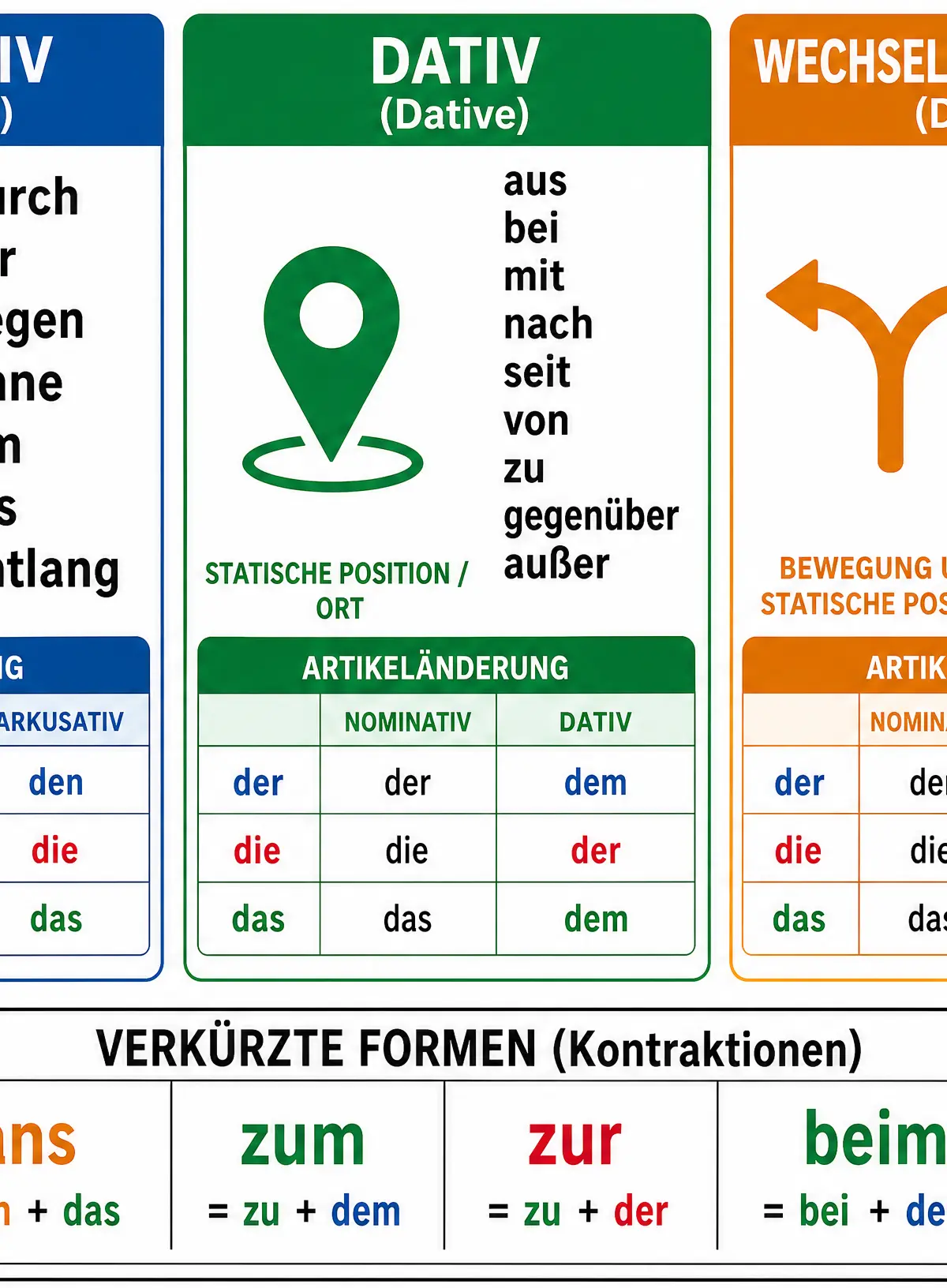
Key Structure 1: Accusative and Dative Prepositions
When to use it: Some prepositions always take the Accusative case, and others always take the Dative case, regardless of context. You must memorize these groups.
Accusative Prepositions (DOGFU-B): durch, ohne, gegen, für, um, bis.
Dative Prepositions (ABMNSZVG): aus, bei, mit, nach, seit, von, zu, gegenüber.
Article Changes Table
| Case | Masculine (der) | Feminine (die) | Neuter (das) | Plural (die) |
|---|---|---|---|---|
| Nominative (Subject) | der / ein | die / eine | das / ein | die / meine |
| Accusative (Object/Acc Prep) | den / einen | die / eine | das / ein | die / meine |
| Dative (Indirect/Dat Prep) | dem / einem | der / einer | dem / einem | den (+n) / meinen (+n) |
Key Structure 2: Dual-Case Prepositions (Wechselpräpositionen)
When to use it: These 9 prepositions (an, auf, hinter, in, neben, über, unter, vor, zwischen) can take either the Accusative OR the Dative case.
The Golden Rule:
- WOHIN? (Where to?) = Movement/Direction = AKKUSATIV
- WO? (Where?) = Location/Position = DATIV
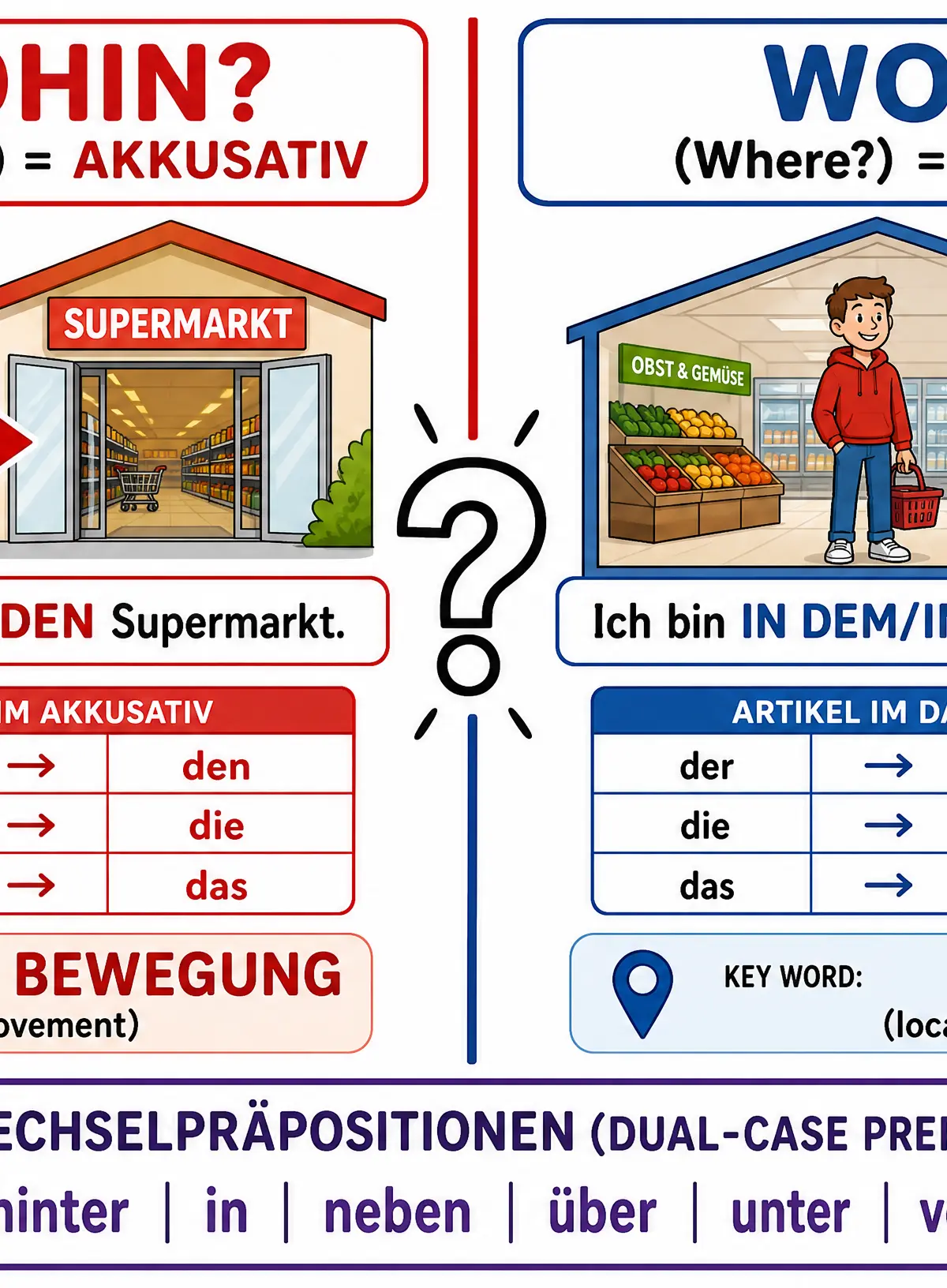
Examples:
- Movement: Ich gehe in den Park. (I am going into the park. - Accusative)
- Location: Ich bin in dem Park. (I am in the park. - Dative)
Key Structure 3: Contracted Forms
When to use it: In natural German, prepositions often merge with the definite article. Examiners expect you to use these contractions, especially in writing and speaking.
Common Contractions Table
| Preposition + Article | Contraction | Example |
|---|---|---|
| in + das (Acc) | ins | Ich gehe ins Kino. |
| an + das (Acc) | ans | Wir fahren ans Meer. |
| zu + dem (Dat) | zum | Ich gehe zum Bahnhof. |
| zu + der (Dat) | zur | Ich gehe zur Post. |
| bei + dem (Dat) | beim | Ich bin beim Arzt. |
| von + dem (Dat) | vom | Ich komme vom Training. |
🎧 Listening Skills
What to Expect
Listening tasks often test your ability to distinguish between movement and location, or to identify who is doing what based on the preposition used. You will hear contracted forms spoken quickly at natural speed.
Listening Strategies
- Listen for contractions: Words like zum, zur, beim are often said quickly. Train your ear to catch them, as they give vital clues about location.
- Note the case: If you hear mit dem or für den, use the case to figure out the gender of the noun if you don't know it.
- Watch for 'nach' vs 'zu': Nach is used for geographical places (nach Berlin, nach Deutschland) and zu for local places/people (zum Supermarkt, zu meinem Freund).
Common Listening Traps
- Seit: Seit means 'since' or 'for' a period of time, and it always takes the dative. Seit einem Jahr means 'for a year' (up to the present), not 'since a year'.
- Vor: Vor can mean 'in front of' (location) or 'ago' (time). Vor zwei Jahren means 'two years ago'.
🗣️ Speaking Skills
Role Play Scenarios
Scenario 1: Asking for directions
- You: Entschuldigung, wie komme ich zum Bahnhof?
- Examiner: Gehen Sie geradeaus und dann links.
- You: Ist es weit von hier?
Scenario 2: Making plans
- You: Hast du Lust, heute Abend ins Kino zu gehen?
- Examiner: Ja, gern! Wann treffen wir uns?
- You: Wir treffen uns um acht Uhr vor dem Kino.
Photo Card Practice
Model Photo Card Response (Topic: Town/Free Time):
- Qu 1 (Description): Auf dem Foto sehe ich drei Personen. Sie sitzen in einem Café neben der Bäckerei.
- Qu 2 (Opinion): Ich finde das Bild schön, weil ich gern mit meinen Freunden Kaffee trinke.
- Qu 3 (Related topic): Letztes Wochenende bin ich mit dem Zug in die Stadt gefahren.
- Qu 4 (Past/Future): Nächstes Jahr möchte ich nach Spanien reisen, um Spanisch zu lernen.
- Qu 5 (Unpredictable): Mein Lieblingsort ist der Park, weil ich dort ohne Stress entspannen kann.
General Conversation Questions
| Question (German) | Model Answer | English Translation |
|---|---|---|
| Wie kommst du zur Schule? | Ich fahre normalerweise mit dem Bus zur Schule, aber manchmal gehe ich zu Fuß. | How do you get to school? / I usually travel by bus to school, but sometimes I walk. |
| Was machst du am Wochenende? | Am Wochenende gehe ich oft mit meinen Freunden ins Kino. | What do you do at the weekend? / At the weekend I often go to the cinema with my friends. |
| Wo wohnst du? | Ich wohne in einem kleinen Dorf in der Nähe von London. | Where do you live? / I live in a small village near London. |
| Wohin fährst du gern in den Urlaub? | Ich fahre sehr gern ans Meer, weil ich gern schwimme. | Where do you like to go on holiday? / I really like going to the sea because I like swimming. |
| Was hast du gestern nach der Schule gemacht? | Nach der Schule bin ich zu meinem Freund gegangen und wir haben Videospiele gespielt. | What did you do yesterday after school? / After school I went to my friend's house and we played video games. |
✍️ Writing Skills
Translation Practice
English → German:
| English | German | Key Grammar |
|---|---|---|
| I am going to the park. | Ich gehe in den Park. | in + Accusative (movement) |
| We live near the school. | Wir wohnen in der Nähe von der Schule. | von + Dative (die -> der) |
| I am travelling by train. | Ich fahre mit dem Zug. | mit + Dative (der -> dem) |
| The book is lying on the table. | Das Buch liegt auf dem Tisch. | auf + Dative (location) |
| I am learning German in order to work in Berlin. | Ich lerne Deutsch, um in Berlin zu arbeiten. | um...zu + infinitive clause |
Extended Writing
**Model 90-word response (Foundation):**Ich wohne in einer kleinen Stadt in der Nähe von Manchester. Meine Stadt ist ziemlich ruhig, aber es gibt einen großen Park. Letztes Wochenende bin ich mit meinen Freunden in den Park gegangen. Wir haben Fußball gespielt und es hat viel Spaß gemacht. Nächstes Wochenende fahre ich mit meiner Familie ans Meer. Ich freue mich darauf, weil ich gern schwimme. Meiner Meinung nach ist das Leben auf dem Land besser als in der Stadt, weil es nicht so laut ist.
**Model 150-word response (Higher):**Ich wohne seit fünf Jahren in einem Vorort von London. Obwohl die öffentlichen Verkehrsmittel gut sind, fahre ich meistens mit dem Fahrrad zur Schule, um fit zu bleiben. Letzten Samstag bin ich mit meinen Freunden ins Stadtzentrum gefahren. Wir haben uns vor dem neuen Kino getroffen und einen Actionfilm gesehen. Danach sind wir in ein italienisches Restaurant gegangen, was total lecker war! Nächstes Jahr habe ich vor, mit meiner Familie nach Deutschland zu fliegen. Ich lerne fleißig Deutsch, um dort mit den Leuten sprechen zu können. Meiner Meinung nach ist es unglaublich wichtig, Fremdsprachen zu lernen, weil man dadurch andere Kulturen besser versteht. In der Zukunft möchte ich ein Jahr im Ausland verbringen, statt sofort auf die Universität zu gehen.
Writing Checklist
- ✅ Did I use the correct case after Accusative (DOGFU-B) and Dative (ABMNSZVG) prepositions?
- ✅ Did I apply the Wohin/Wo rule for dual-case prepositions?
- ✅ Did I use contracted forms (zum, zur, ins, ans) correctly?
- ✅ Did I include at least one infinitive construction (um...zu, ohne...zu, statt...zu)?
📚 Reading Skills
Key Strategies
- Look for prepositions to identify the object: If you see für den Mann, you know 'the man' is the object receiving the action. If you see mit dem Mann, the action is being done 'with' him.
- Use prepositions to guess vocabulary: If you see Ich schwimme im... you know the next word must be a body of water (See, Meer, Schwimmbad) and it must be Dative.
- Spot the time phrases: Prepositions like vor (ago), seit (since/for), and in (in/future) are crucial for working out the tense of the passage.
False Friends & Tricky Words
| Word | Looks Like | Actually Means |
|---|---|---|
| nach | near | after / to (a country/city) |
| vor | for | in front of / before / ago |
| bei | by | at / near / with (a person/company) |
| seit | sight | since / for (a period of time) |
🌍 Cultural Knowledge
When writing or speaking about towns and transport in Germany, it's great to mention real cultural elements. For example, Germans often travel mit der U-Bahn (by underground train) or mit der S-Bahn (suburban train). When giving directions, you might mention walking zum Marktplatz (to the market square) or zum Rathaus (to the town hall), which are central features of almost every German town. Knowing these terms makes your German sound authentic and shows cultural awareness.
Visual Resources
2 diagrams and illustrations

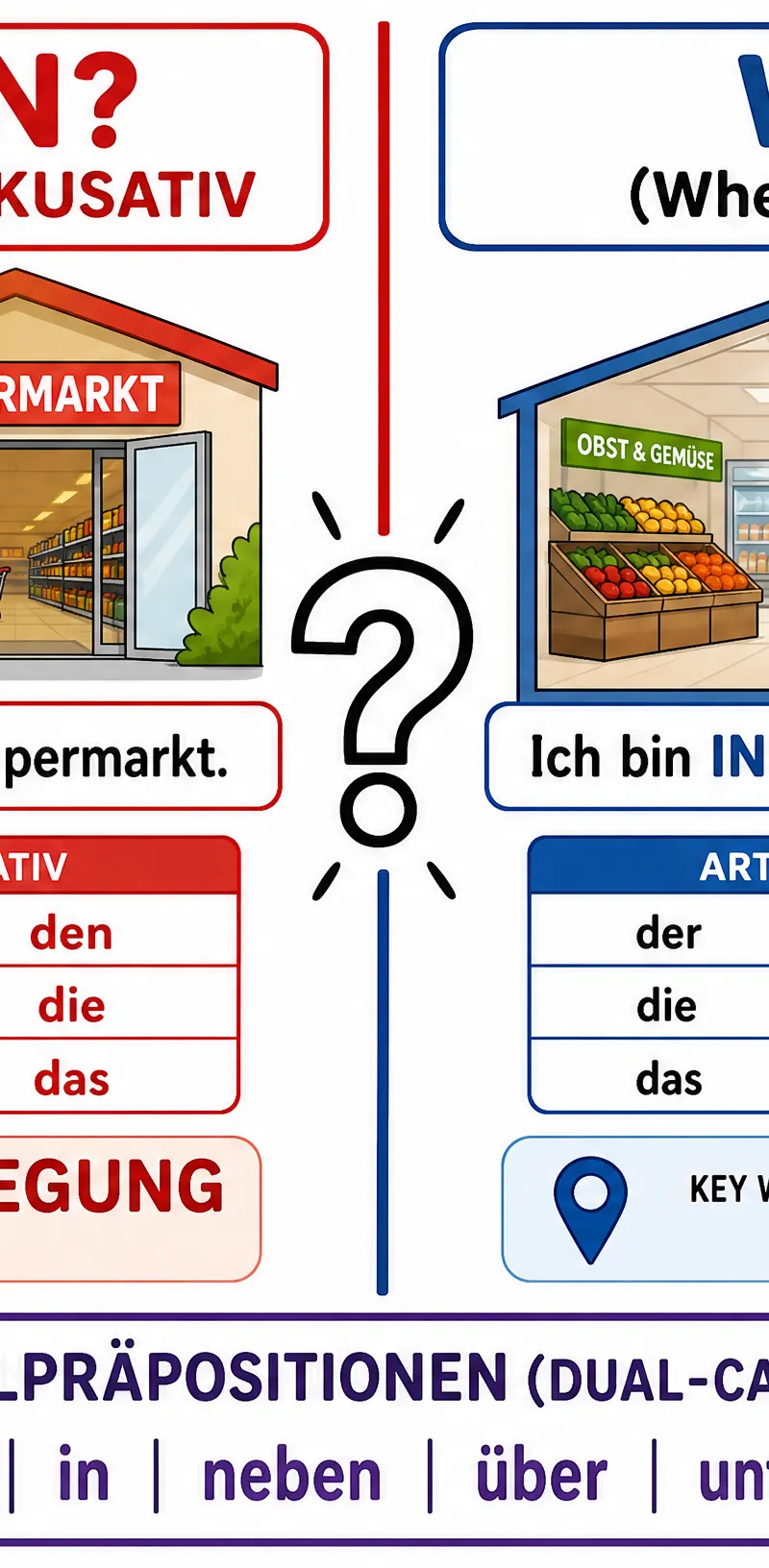
Interactive Diagrams
1 interactive diagram to visualise key concepts
Conceptual Flow Outline
How to choose the correct case after a preposition
Worked Examples
4 worked examples — open one to explore the question and available guidance.
Practice Questions
Try the question, then reveal an answer plan or example response
Translate into German: 'I am travelling to Germany with my family.'
Hint: Think about which preposition to use for a country, and what case follows 'mit'.
Fill in the blanks with the correct contracted preposition: 'Am Wochenende gehe ich _____ (in das) Kino und dann _____ (zu dem) Park.'
Hint: Combine the preposition and the article into one short word.
Write a 90-word email to your German exchange partner about your town. Include: where it is, what is near it, how you travel around, and an opinion.
Hint: Use 'in der Nähe von', 'mit dem...', and give a justified opinion.
Rewrite this sentence using an 'um...zu' construction: 'Ich lerne Deutsch. Ich möchte in Berlin arbeiten.'
Hint: Drop the 'Ich möchte' and put the infinitive verb at the very end after 'zu'.
Choose the correct article: 'Das Bild hängt an _____ Wand.' (die Wand - location)
Hint: Location (Wo?) requires the Dative case.
Describe a photo showing people at a train station.
Hint: Use positional prepositions (vor, neben, auf) and say how they are travelling.
Exam technique
How to turn what you know into marks
How to approach the question
Skill-by-skill strategy: Listening — read questions first, note keywords. Speaking — prepare opinions in advance, have fillers ready. Reading — skim first, then detail. Writing — plan before writing, check accuracy after.
How to structure your answer
Writing: Introduction → Main points with opinions → Justified reasons → Different tenses → Conclusion. Speaking: Give opinion → Justify → Extend → Use different tense.
Timing
Listening: 25 mins (heard twice). Speaking: 7-12 mins total (role play + photo card + conversation). Reading: 45-60 mins. Writing: 60-75 mins (translation + structured + extended).
Common pitfalls
- Using 'nach' for local places instead of 'zu' (e.g., writing 'nach dem Supermarkt' instead of 'zum Supermarkt').
- Forgetting to change the article after 'mit' (e.g., writing 'mit mein Freund' instead of 'mit meinem Freund').
- Confusing 'vor' (ago) with 'für' (for) when talking about time.
- Not using contracted forms like 'zum' or 'ins', which makes the German sound unnatural.
- Missing the 'zu' in infinitive constructions (e.g., writing 'um spielen' instead of 'um zu spielen').
What the command words want
- Describe the photo
- Say what you can see, give an opinion, relate to your experience. Use positional prepositions (neben, vor, hinter).
- Translate into German
- Write full sentences with correct grammar — partial marks for partially correct. Double-check preposition cases.
- Translate into English
- Meaning over word-for-word — capture the sense, don't guess cognates. Pay attention to 'seit' meaning 'for'.
- Write approximately 90 words
- Foundation task — cover all 4 bullet points, use present + one other tense. Include simple prepositional phrases.
- Write approximately 150 words
- Higher task — 3 tenses, opinions, complex structures. Use um...zu clauses and da-compounds.
Watch or listen (optional)
Test your understanding of Vocabulary: Prepositions
Active recall beats re-reading. Take an instant quiz now to test what you’ve learned and lock it into long-term memory.
7 days Premium · Then the free plan continues · No card, no charge