Pearson Edexcel · GCSE · German
Course version: Pearson-GCSE-German · Version from Mar 2026
Vocabulary: Short phrases
This topic covers essential short phrases that act as the building blocks of fluent German. You'll master opinion phrases, justification connectives, and complex infinitive structures (um...zu), which are heavily rewarded by examiners across Listening, Speaking, Reading, and Writing.
- 12 min read
- 4 worked examples
- 6 practice questions
- 8 key terms
Check what you remember
Read the wording for your board, then hide it and explain Subordinating Conjunction in your own words. Rough notes are fine. This is a self-check, with no mark or grade.
Reference: Pearson Edexcel
A linking word (like weil, dass, da, obwohl) that sends the conjugated verb to the end of its clause.
Study Notes
Overview
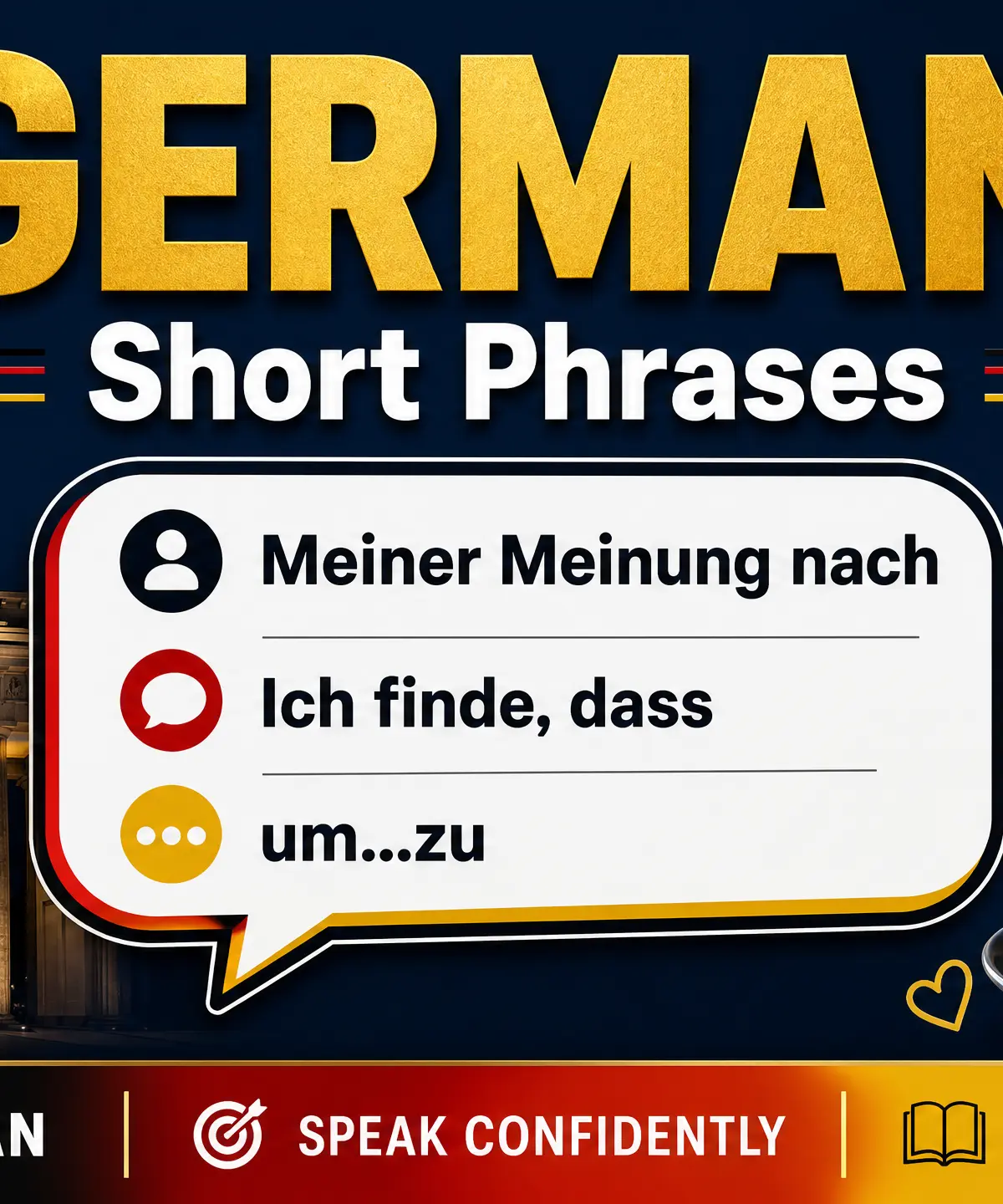
Mastering short phrases is the secret weapon for GCSE German success. Whether you are aiming for a grade 4 or a grade 9, examiners are actively looking for candidates who can link ideas naturally, express justified opinions, and move seamlessly between different timeframes. This topic is not just a vocabulary list; it is a structural toolkit that you will use in every single exam paper, particularly in the Speaking (Role Play, Photo Card, General Conversation) and Writing (90-word and 150-word tasks) exams.
📖 Essential Vocabulary
Tier 1 — Foundation Core
| German | English | Gender | Example Sentence |
|---|---|---|---|
| meiner Meinung nach | in my opinion | n/a | Meiner Meinung nach ist das toll. |
| ich finde, dass | I find that | n/a | Ich finde, dass es wichtig ist. |
| ich denke, dass | I think that | n/a | Ich denke, dass es gut ist. |
| ich glaube, dass | I believe that | n/a | Ich glaube, dass es Spaß macht. |
| es macht Spaß | it is fun | n/a | Fußball spielen macht Spaß. |
| es ist langweilig | it is boring | n/a | Die Hausaufgaben sind langweilig. |
| ich bin dafür | I am for it / I agree | n/a | Schuluniformen? Ich bin dafür. |
| ich bin dagegen | I am against it / I disagree | n/a | Hausaufgaben? Ich bin dagegen. |
| zum Beispiel | for example | n/a | Ich mag Sport, zum Beispiel Tennis. |
| auf der einen Seite | on the one hand | n/a | Auf der einen Seite ist es gut. |
| auf der anderen Seite | on the other hand | n/a | Auf der anderen Seite ist es teuer. |
| es kommt darauf an | it depends | n/a | Es kommt darauf an, wie das Wetter ist. |
| ich hätte gern | I would like | n/a | Ich hätte gern ein Eis, bitte. |
| es tut mir leid | I am sorry | n/a | Es tut mir leid, ich habe keine Zeit. |
| wie viel kostet das? | how much does that cost? | n/a | Entschuldigung, wie viel kostet das? |
Tier 2 — Higher Tier
| German | English | Gender | Example Sentence |
|---|---|---|---|
| ich bin fest davon überzeugt, dass | I am firmly convinced that | n/a | Ich bin fest davon überzeugt, dass Umweltschutz wichtig ist. |
| ich stehe auf dem Standpunkt, dass | I take the view that | n/a | Ich stehe auf dem Standpunkt, dass Hausaufgaben unnötig sind. |
| es lässt sich nicht leugnen, dass | it cannot be denied that | n/a | Es lässt sich nicht leugnen, dass Technologie nützlich ist. |
| im Großen und Ganzen | by and large / on the whole | n/a | Im Großen und Ganzen mag ich meine Schule. |
| meiner Ansicht nach | in my view | n/a | Meiner Ansicht nach ist das eine schlechte Idee. |
| im Gegensatz zu | in contrast to | n/a | Im Gegensatz zu gestern ist das Wetter heute schön. |
| einerseits... andererseits | on the one hand... on the other hand | n/a | Einerseits ist es teuer, andererseits ist es praktisch. |
| um ehrlich zu sein | to be honest | n/a | Um ehrlich zu sein, habe ich keine Lust. |
| es ist wichtig, zu betonen, dass | it is important to emphasise that | n/a | Es ist wichtig zu betonen, dass wir helfen müssen. |
| ich muss zugeben, dass | I must admit that | n/a | Ich muss zugeben, dass ich faul war. |
High-Frequency Words & Phrases
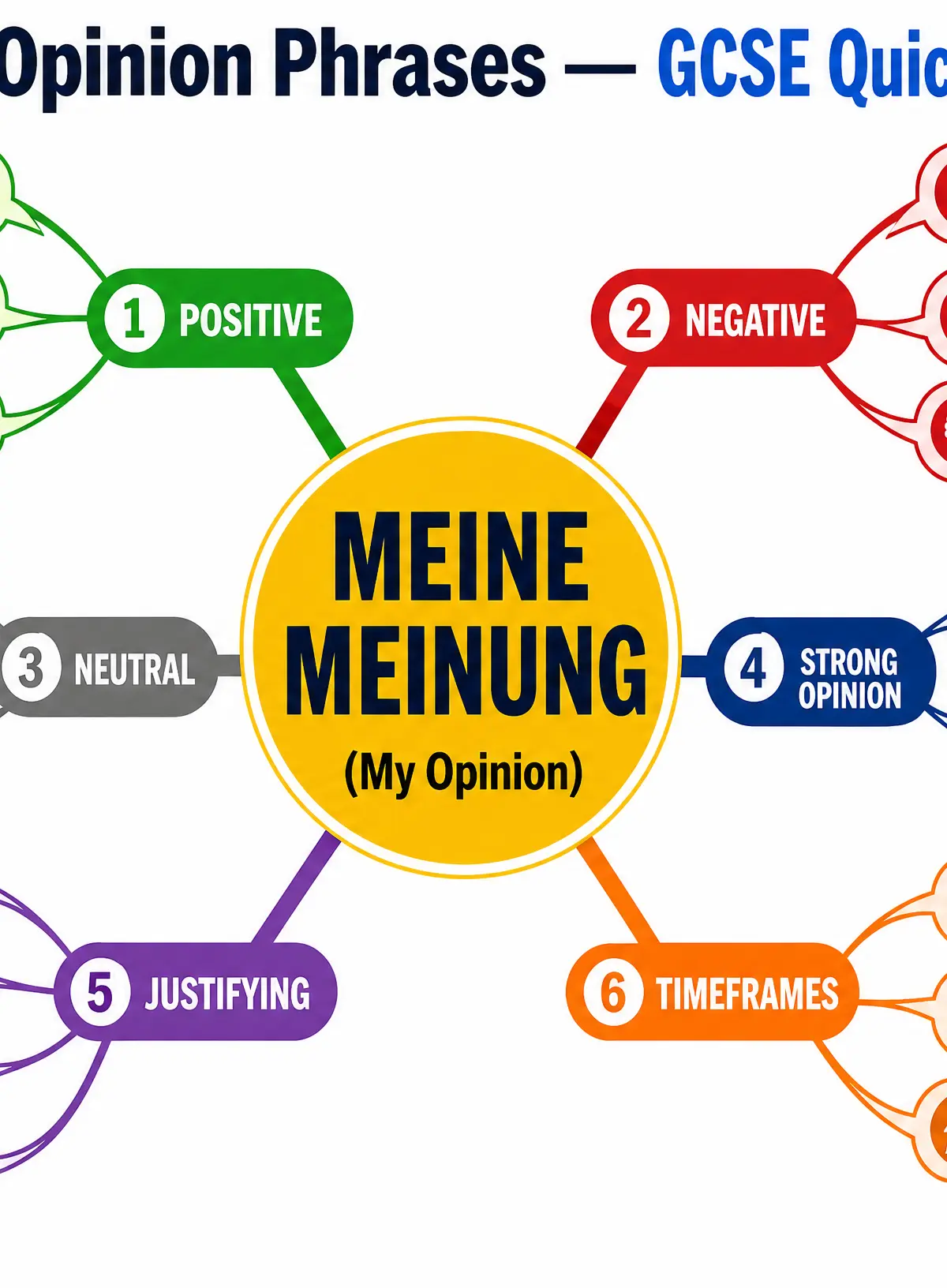
| Phrase | English | Usage Context |
|---|---|---|
| weil | because (verb to end) | Justifying an opinion (subordinating) |
| da | because/since (verb to end) | Justifying an opinion (subordinating) |
| denn | because (normal word order) | Justifying an opinion (coordinating) |
| deshalb | therefore (verb 2nd) | Linking a reason to a consequence |
| früher | previously / in the past | Introducing past tense (verb 2nd) |
| heutzutage | nowadays | Introducing present tense (verb 2nd) |
| in der Zukunft | in the future | Introducing future tense (verb 2nd) |
| hoffentlich | hopefully | Expressing future hopes (verb 2nd) |
| glücklicherweise | fortunately | Expressing relief (verb 2nd) |
| leider | unfortunately | Expressing regret (verb 2nd) |
📝 Grammar Focus
Key Structure 1: Infinitive Clauses (um...zu, statt...zu, ohne...zu)
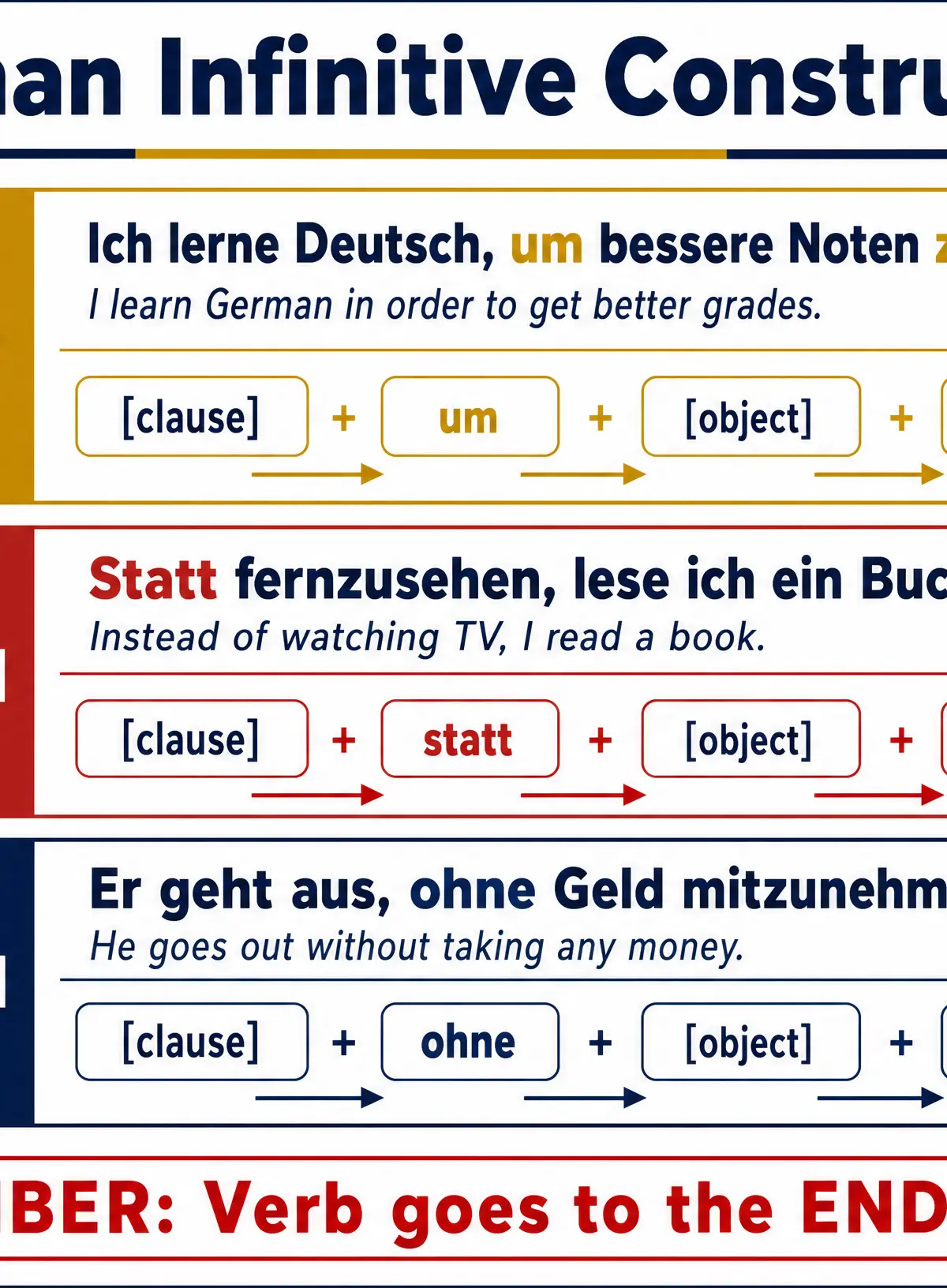
When to use it: To explain why you are doing something (um...zu), what you are doing instead of something else (statt...zu), or doing something without doing another thing (ohne...zu). These are highly rewarded by examiners.
Structure Pattern
| Clause 1 | Conjunction | Object/Details | zu + Infinitive |
|---|---|---|---|
| Ich lerne Deutsch, | um | bessere Noten | zu bekommen. |
| Ich lese ein Buch, | statt | am Computer | zu spielen. |
| Er geht zur Schule, | ohne | seine Hausaufgaben | zu machen. |
Irregulars to learn: Separable verbs merge with 'zu'. For example, fernsehen becomes fernzusehen. Mitnehmen becomes mitzunehmen.
Key Structure 2: Subordinating Conjunctions (weil, dass, da, obwohl)
When to use it: To link sentences and provide reasons. These conjunctions send the conjugated verb to the very end of the clause.
Structure Pattern
| Main Clause | Conjunction | Subject | Details | Conjugated Verb (End) |
|---|---|---|---|---|
| Ich mag Deutsch, | weil | es | interessant | ist. |
| Ich finde, | dass | Hausaufgaben | langweilig | sind. |
| Wir bleiben zu Hause, | da | es | heute | regnet. |
| Ich spiele Fußball, | obwohl | ich | müde | bin. |
Key Structure 3: Adverbs Causing Verb Inversion
When to use it: When you start a sentence with a time phrase or opinion phrase, the verb MUST come in the second position, pushing the subject to the third position.
Structure Pattern
| Adverb / Phrase (Pos 1) | Verb (Pos 2) | Subject (Pos 3) | Rest of sentence |
|---|---|---|---|
| Früher | wohnte | ich | in Berlin. |
| Meiner Meinung nach | ist | Mathe | sehr schwer. |
| Deshalb | muss | man | recyceln. |
| Hoffentlich | wird | das Wetter | morgen besser. |
🎧 Listening Skills
What to Expect
You will hear native speakers giving opinions on various topics (school, holidays, environment). They will frequently use short phrases to justify their views or contrast the past with the present.
Listening Strategies
- Listen for the contrast: Speakers often use einerseits... andererseits (on the one hand... on the other hand) to give a balanced view. Wait for the second half of the sentence before deciding if their overall opinion is positive or negative.
- Watch for timeframes: Pay close attention to früher (past) vs heutzutage (present) vs in der Zukunft (future). The question might ask "What did he think of the town in the past?"
- Identify the justification: When you hear weil or da, the speaker is about to give the reason for their opinion. This is often the answer to a "Why?" question.
Common Listening Traps
- Denn vs Dann: Denn means 'because', but dann means 'then'. Don't confuse them.
- Opinion shifts: A speaker might start negatively (Früher fand ich es furchtbar...) but end positively (...aber heutzutage liebe ich es). Always listen to the whole utterance.
🗣️ Speaking Skills
Role Play Scenarios
Scenario 1: At a tourist office
- You: Guten Tag. Ich hätte gern Informationen über die Stadt, bitte. (Good day. I would like information about the town, please.)
- Assistant: Natürlich. Was möchten Sie machen?
- You: Könnten Sie mir helfen? Ich möchte wissen, wie viel eine Stadtrundfahrt kostet. (Could you help me? I would like to know how much a city tour costs.)
Scenario 2: Discussing school with a German exchange partner
- Partner: Wie findest du deine Schule?
- You: Meiner Meinung nach ist die Schule gut, obwohl wir zu viele Hausaufgaben haben. Ich bin der Meinung, dass das stressig ist. (In my opinion the school is good, although we have too much homework. I am of the opinion that it is stressful.)
Photo Card Practice
Model Photo Card Response (Topic: Environment):
- Qu 1 (Description): Auf dem Foto sehe ich viele Autos und viel Stau. Meiner Meinung nach ist das furchtbar für die Umwelt.
- Qu 2 (Opinion): Ich finde, dass wir mehr mit dem Rad fahren sollten, um die Umwelt zu schützen.
- Qu 3 (Related topic): Zu Hause recyceln wir immer Papier und Glas, weil es wichtig ist.
- Qu 4 (Past/Future): Früher bin ich immer mit dem Auto zur Schule gefahren, aber in der Zukunft werde ich zu Fuß gehen.
- Qu 5 (Unpredictable): Ja, ich bin fest davon überzeugt, dass der Klimawandel das größte Problem ist.
General Conversation Questions
| Question (German) | Model Answer | English Translation |
|---|---|---|
| Wie findest du dein Handy? | Ich finde, dass mein Handy extrem nützlich ist, weil ich mit Freunden chatten kann. | I find that my mobile is extremely useful because I can chat with friends. |
| Was hast du letztes Wochenende gemacht? | Letztes Wochenende bin ich ins Kino gegangen, um den neuen James Bond Film zu sehen. | Last weekend I went to the cinema in order to see the new James Bond film. |
| Wie war deine Grundschule? | Früher war meine Schule sehr klein, aber meiner Meinung nach war sie besser, da wir keine Prüfungen hatten. | Previously my school was very small, but in my opinion it was better since we had no exams. |
| Was wirst du nächstes Jahr machen? | In der Zukunft möchte ich auf die Uni gehen, statt eine Lehre zu machen. | In the future I would like to go to uni instead of doing an apprenticeship. |
| Ist es wichtig, fit zu bleiben? | Ja, es lässt sich nicht leugnen, dass Gesundheit wichtig ist. Deshalb spiele ich oft Tennis. | Yes, it cannot be denied that health is important. Therefore I often play tennis. |
✍️ Writing Skills
Translation Practice
English → German:
| English | German | Key Grammar |
|---|---|---|
| I would like a ticket. | Ich hätte gern eine Fahrkarte. | Transactional phrase |
| In my opinion, the food is delicious. | Meiner Meinung nach ist das Essen lecker. | Verb inversion after phrase |
| I learn German because it is fun. | Ich lerne Deutsch, weil es Spaß macht. | Subordinating conjunction (verb to end) |
| In the past, I played football. | Früher habe ich Fußball gespielt. | Time phrase causing inversion |
| I work to earn money. | Ich arbeite, um Geld zu verdienen. | um...zu infinitive clause |
Extended Writing
**Model 90-word response (Foundation):**Meiner Meinung nach ist meine Stadt sehr schön. Es gibt ein großes Kino und viele Geschäfte. Ich finde, dass das toll ist, weil ich gern einkaufen gehe. Letztes Wochenende bin ich mit meinen Freunden in die Stadt gegangen, um Pizza zu essen. Es hat viel Spaß gemacht. Früher gab es ein Schwimmbad, aber jetzt ist es geschlossen. Das ist schade. In der Zukunft möchte ich in Berlin wohnen, denn es ist eine fantastische Stadt.
**Model 150-word response (Higher):**Es lässt sich nicht leugnen, dass meine Region sowohl Vor- als auch Nachteile hat. Einerseits gibt es viele Freizeitmöglichkeiten für Jugendliche, wie zum Beispiel ein modernes Sportzentrum. Ich finde, dass das extrem wichtig ist, um fit zu bleiben. Andererseits gibt es zu viel Verkehr und die Luftverschmutzung ist ein großes Problem.
Früher war die Stadt viel ruhiger und sauberer, aber heutzutage gibt es überall Stau. Letzte Woche bin ich mit dem Bus gefahren, statt mit dem Auto zu fahren, um die Umwelt zu schützen. Es hat ewig gedauert, weil der Bus Verspätung hatte!
Ich bin fest davon überzeugt, dass die Regierung mehr tun muss. In der Zukunft hoffe ich, dass wir bessere öffentliche Verkehrsmittel haben werden, da das Leben in der Stadt dann angenehmer wäre.
Writing Checklist
- ✅ Have I used 'Meiner Meinung nach' with the verb immediately following?
- ✅ Have I used 'weil' or 'dass' and sent the verb to the end of the clause?
- ✅ Have I included at least one infinitive clause (um...zu / statt...zu)?
- ✅ Have I used timeframe phrases (früher / in der Zukunft) to show different tenses?
📚 Reading Skills
Key Strategies
When reading longer texts, highlight the short phrases and connectives. They act as signposts. If you see obwohl (although), you know a contrast is coming. If you see deshalb (therefore), you are about to read the consequence.
False Friends & Tricky Words
| Word | Looks Like | Actually Means |
|---|---|---|
| also | also | therefore / so |
| aktuell | actually | current / up-to-date |
| eventuell | eventually | currently / possibly |
| fast | fast | almost |
| Meinung | meaning | opinion |
🌍 Cultural Knowledge
In German-speaking countries, expressing your opinion clearly and directly is culturally valued. Germans are often perceived as very direct (direkt) compared to British people. Using phrases like Ich bin fest davon überzeugt (I am firmly convinced) or Ich stehe auf dem Standpunkt (I take the view) is not seen as aggressive, but rather as participating properly in a debate. In your exams, adopting this confident, direct style when justifying your opinions will make your German sound much more authentic.
Visual Resources
2 diagrams and illustrations
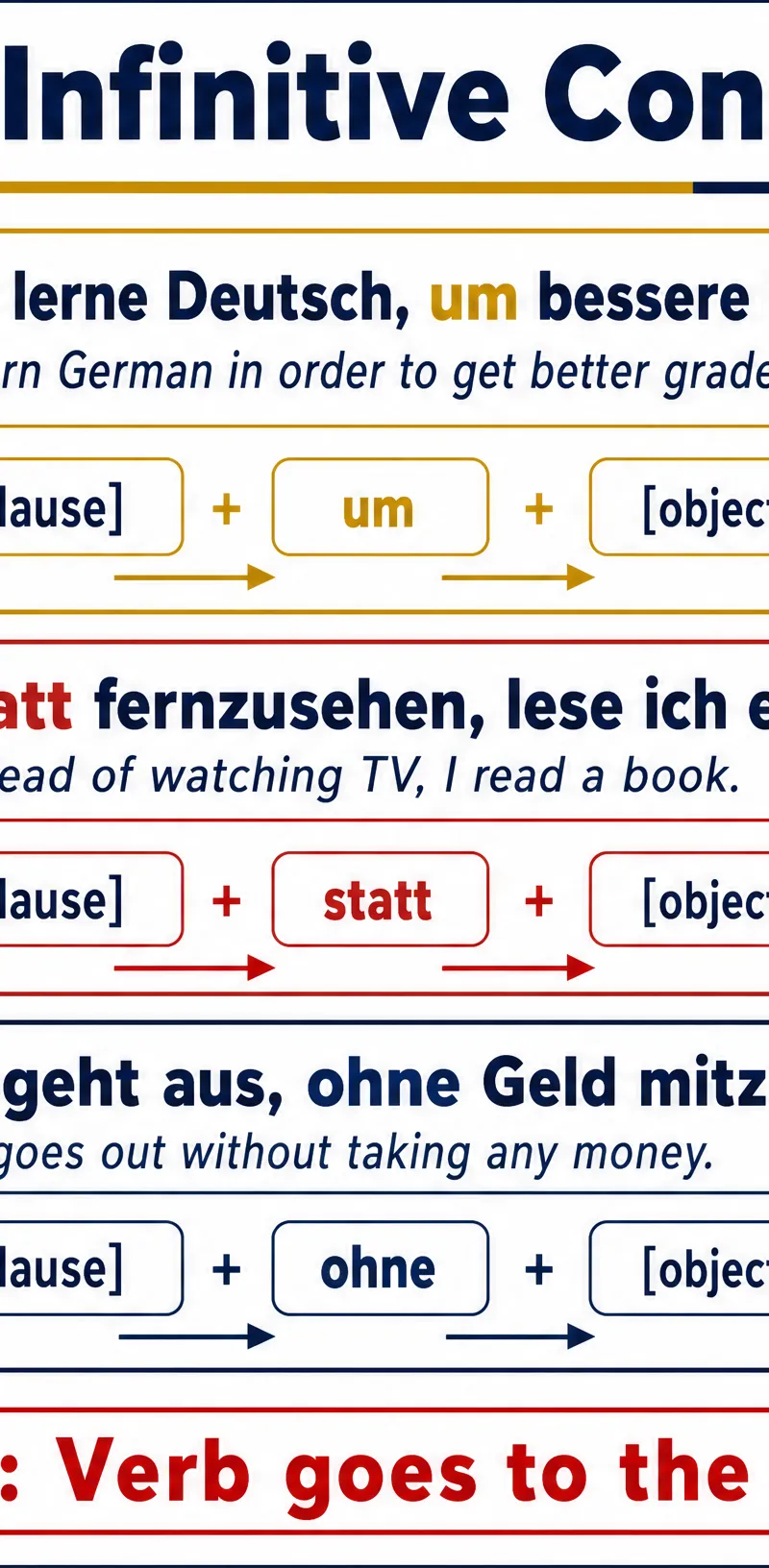
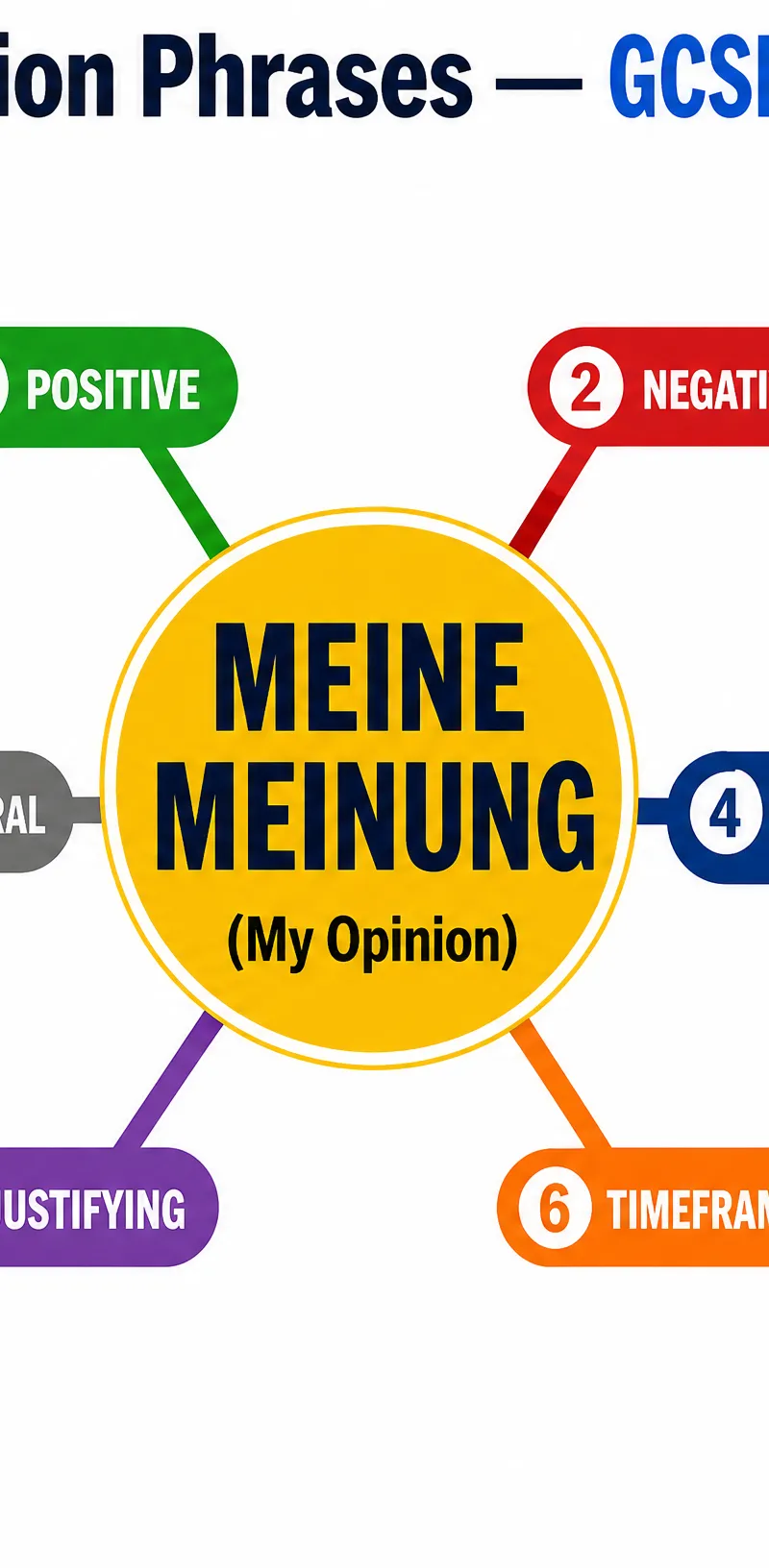
Interactive Diagrams
1 interactive diagram to visualise key concepts
Conceptual Flow Outline
Word order rules for opinion phrases
Worked Examples
4 worked examples — open one to explore the question and available guidance.
Practice Questions
Try the question, then reveal an answer plan or example response
Translate into German: 'In my opinion, the environment is important.'
Hint: Remember what happens to the verb after 'Meiner Meinung nach'.
Complete the sentence using 'weil': Ich fahre mit dem Rad. Es ist umweltfreundlich.
Hint: Join the sentences. What does 'weil' do to the verb in the second sentence?
Translate into German: 'I go to town in order to meet my friends.'
Hint: Use the 'um...zu' construction. Where does the infinitive verb go?
Speaking General Conversation: Was denkst du über Schuluniformen?
Hint: Give an opinion, justify it, and use a complex phrase.
Rewrite this sentence to start with the time phrase: 'Ich spiele am Wochenende Fußball.'
Hint: Move 'Am Wochenende' to the front. What happens to the verb?
Translate into German: 'Instead of doing homework, I watched TV.'
Hint: Use 'statt...zu'. Remember 'fernsehen' is a separable verb.
Exam technique
How to turn what you know into marks
How to approach the question
Writing: Always plan your complex phrases before you start writing. Write 'um...zu', 'weil', and 'Meiner Meinung nach' at the top of your paper and tick them off as you use them.
How to structure your answer
Speaking: Always follow the OJE structure: Opinion (Ich finde, dass...) + Justification (...weil es toll ist) + Extension (Früher war es...).
Timing
Listening: 25-35 mins. Speaking: 7-12 mins total. Reading: 45-60 mins. Writing: 60-75 mins.
Common pitfalls
- Writing 'weil es ist gut' instead of 'weil es gut ist'.
- Writing 'Früher ich spielte' instead of 'Früher spielte ich'.
- Translating 'I would like' as 'Ich möchte' (which means I want) instead of the more polite 'Ich hätte gern'.
- Forgetting the comma before 'weil', 'dass', and 'um'.
What the command words want
- Describe the photo
- Use 'Auf dem Foto gibt es...' and then immediately give an opinion using 'Ich finde, dass...'
- Write approximately 150 words
- You MUST include justified opinions and three timeframes. Use the short phrases to structure this.
Watch or listen (optional)
Test your understanding of Vocabulary: Short phrases
Active recall beats re-reading. Take an instant quiz now to test what you’ve learned and lock it into long-term memory.
7 days Premium · Then the free plan continues · No card, no charge