Pearson Edexcel · GCSE · German
Course version: Pearson-GCSE-German · Version from Mar 2026
Vocabulary: Verbs
This comprehensive GCSE German topic covers the essential verbs and structures you need for exam success. Master regular and irregular conjugations, modal verbs, the perfect tense, and separable verbs to boost your marks across Listening, Speaking, Reading, and Writing.
- 11 min read
- 4 worked examples
- 6 practice questions
- 8 key terms
Check what you remember
Read the wording for your board, then hide it and explain Infinitive in your own words. Rough notes are fine. This is a self-check, with no mark or grade.
Reference: Pearson Edexcel
The 'dictionary form' of a verb, usually ending in -en (e.g., spielen, machen).
Study Notes
Overview
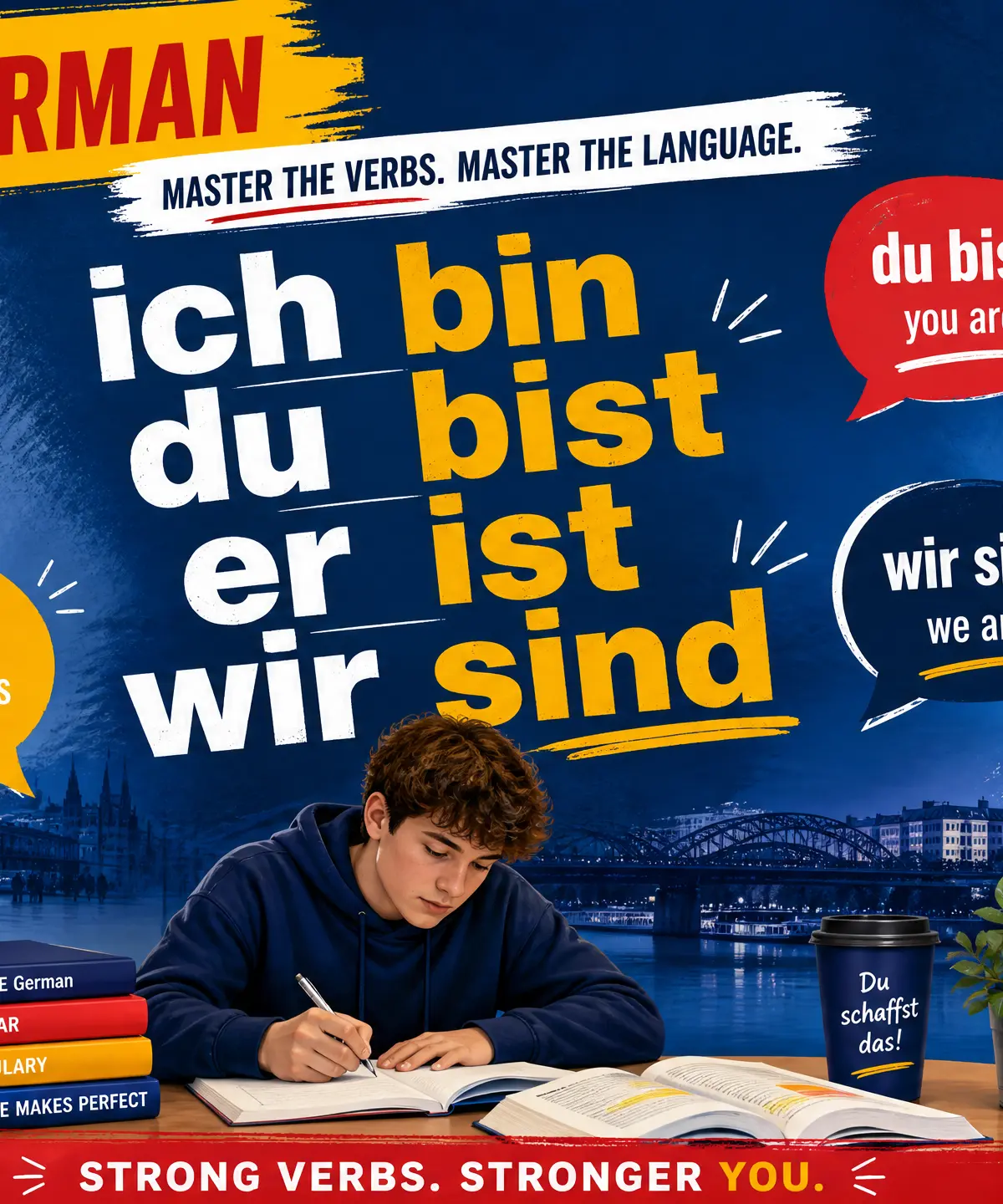
This study guide covers the most critical grammatical building blocks in German: Verbs. Verbs are the engine of every sentence. Whether you're describing a past holiday in the Speaking exam or decoding a complex text in the Reading paper, your ability to recognise and use verbs accurately is what examiners look for to award higher grades. This topic spans all four skills and is essential for both Foundation and Higher tiers.
📖 Essential Vocabulary
Tier 1 — Foundation Core
| German | English | Gender | Example Sentence |
|---|---|---|---|
| spielen | to play | N/A | Ich spiele am Wochenende Fußball. |
| machen | to do/make | N/A | Wir machen unsere Hausaufgaben. |
| gehen | to go | N/A | Er geht in die Stadt. |
| haben | to have | N/A | Ich habe einen Bruder. |
| sein | to be | N/A | Sie ist sehr freundlich. |
| lernen | to learn | N/A | Wir lernen jeden Tag Deutsch. |
| wohnen | to live | N/A | Ich wohne in einem kleinen Haus. |
| hören | to hear/listen | N/A | Ich höre gern Popmusik. |
| sehen | to see | N/A | Ich sehe einen Film. |
| essen | to eat | N/A | Wir essen Pizza zum Abendessen. |
| trinken | to drink | N/A | Er trinkt Wasser. |
| kaufen | to buy | N/A | Ich kaufe ein neues T-Shirt. |
| finden | to find | N/A | Ich finde Mathe langweilig. |
| arbeiten | to work | N/A | Mein Vater arbeitet in einem Büro. |
| schreiben | to write | N/A | Ich schreibe eine E-Mail. |
Tier 2 — Higher Tier
| German | English | Gender | Example Sentence |
|---|---|---|---|
| verbringen | to spend (time) | N/A | Ich habe zwei Wochen in Spanien verbracht. |
| sich interessieren für | to be interested in | N/A | Ich interessiere mich für Geschichte. |
| stattfinden | to take place | N/A | Das Festival findet im Sommer statt. |
| teilnehmen an | to take part in | N/A | Ich nehme an einem Austausch teil. |
| sich freuen auf | to look forward to | N/A | Ich freue mich auf die Sommerferien. |
| verbessern | to improve | N/A | Ich möchte mein Deutsch verbessern. |
| umweltfreundlich sein | to be eco-friendly | N/A | Wir müssen umweltfreundlich sein. |
| unterstützen | to support | N/A | Meine Eltern unterstützen mich. |
| entwickeln | to develop | N/A | Die Technologie entwickelt sich schnell. |
| verbieten | to forbid/ban | N/A | Handys sind in der Schule verboten. |
High-Frequency Words & Phrases
| Phrase | English | Usage Context |
|---|---|---|
| Ich denke, dass... | I think that... | Giving opinions (sends verb to end) |
| Meiner Meinung nach... | In my opinion... | Expressing views (inverts verb and subject) |
| Einerseits... andererseits... | On the one hand... on the other hand... | Balancing an argument |
| Es gibt... | There is/are... | Describing places or situations |
| Ich habe vor, ... zu... | I intend to... | Future plans (Higher tier structure) |
| Um ... zu ... | In order to... | Explaining purpose (Higher tier structure) |
| Ich würde sagen, dass... | I would say that... | Sophisticated opinion phrase |
| Leider | Unfortunately | Adding nuance to a negative point |
| Zum Glück | Fortunately | Adding nuance to a positive point |
| Normalerweise | Normally | Describing habits |
📝 Grammar Focus
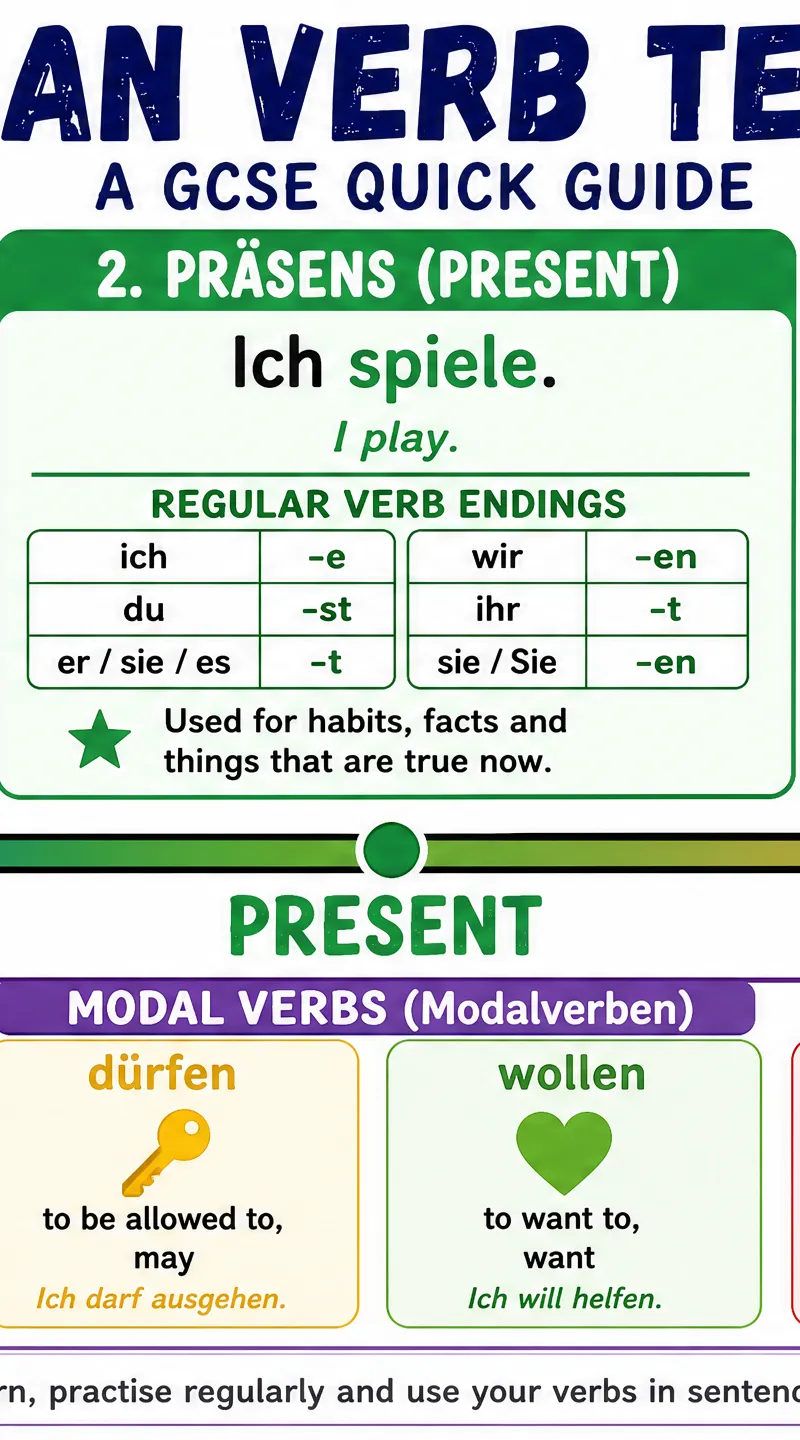
Key Structure 1: The Present Tense (Präsens)
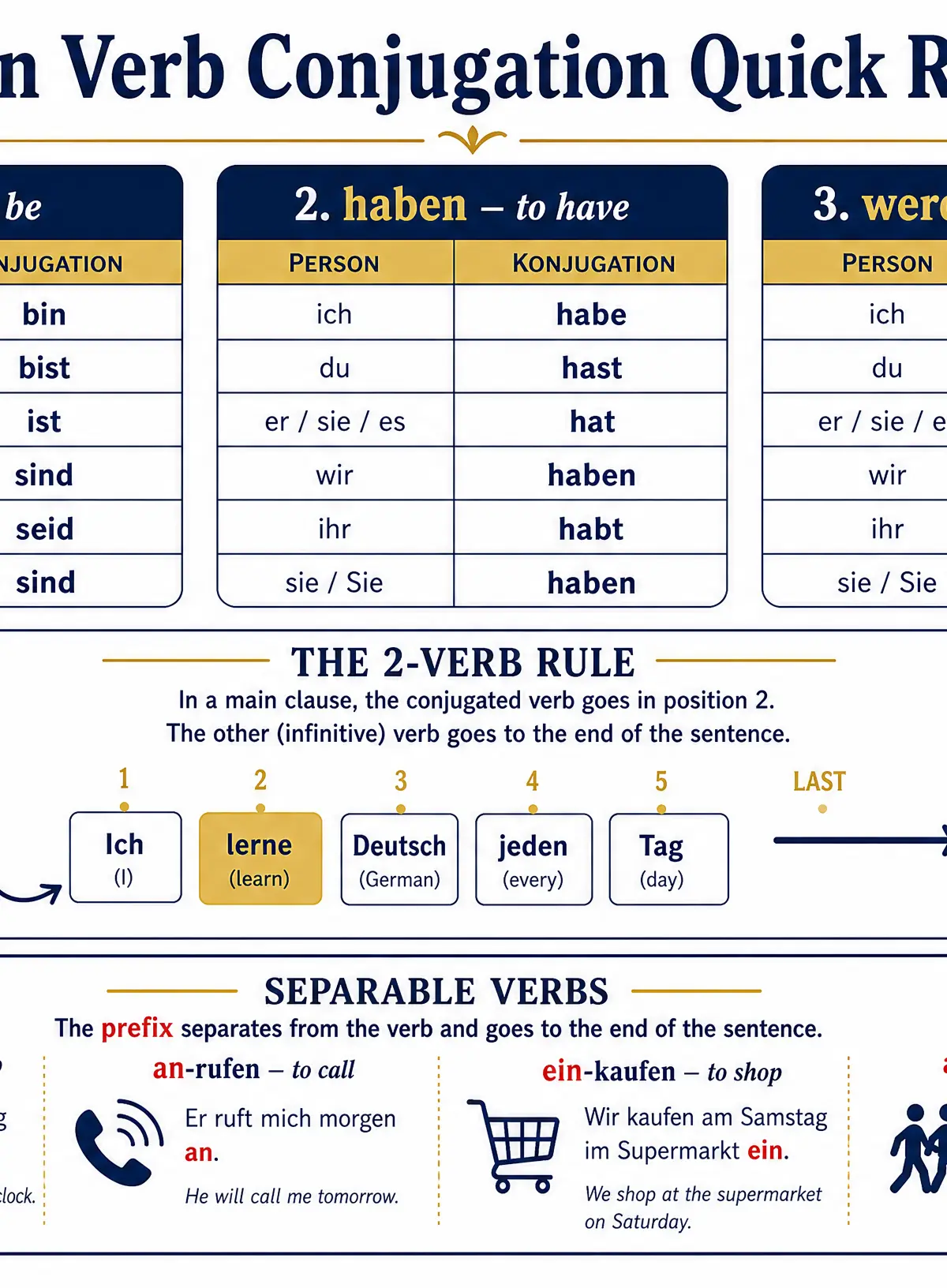
When to use it: To describe habits, facts, and things happening right now. In German, it can also express the future if used with a time phrase (e.g., "Ich spiele morgen" = I am playing tomorrow).
Conjugation Table: Regular Verbs (e.g., spielen)
| Subject | Verb Form | English |
|---|---|---|
| ich | spiele | I play |
| du | spielst | you play (informal) |
| er/sie/es | spielt | he/she/it plays |
| wir | spielen | we play |
| ihr | spielt | you (plural) play |
| sie/Sie | spielen | they/You (formal) play |
Irregulars to learn: sein (to be), haben (to have), werden (to become).
Key Structure 2: The Perfect Tense (Perfekt)
When to use it: The main past tense used in spoken German and informal writing (like emails to friends). It requires an auxiliary verb (haben or sein) and a past participle.
Conjugation Table: Perfect Tense with 'haben' (e.g., spielen)
| Subject | Verb Form | English |
|---|---|---|
| ich | habe gespielt | I played / have played |
| du | hast gespielt | you played |
| er/sie/es | hat gespielt | he/she/it played |
| wir | haben gespielt | we played |
| ihr | habt gespielt | you (plural) played |
| sie/Sie | haben gespielt | they/You played |
Irregulars to learn: Verbs of motion/change of state use sein (e.g., Ich bin gegangen - I went; Ich bin gefahren - I travelled).
Key Structure 3: Modal Verbs (Modalverben)
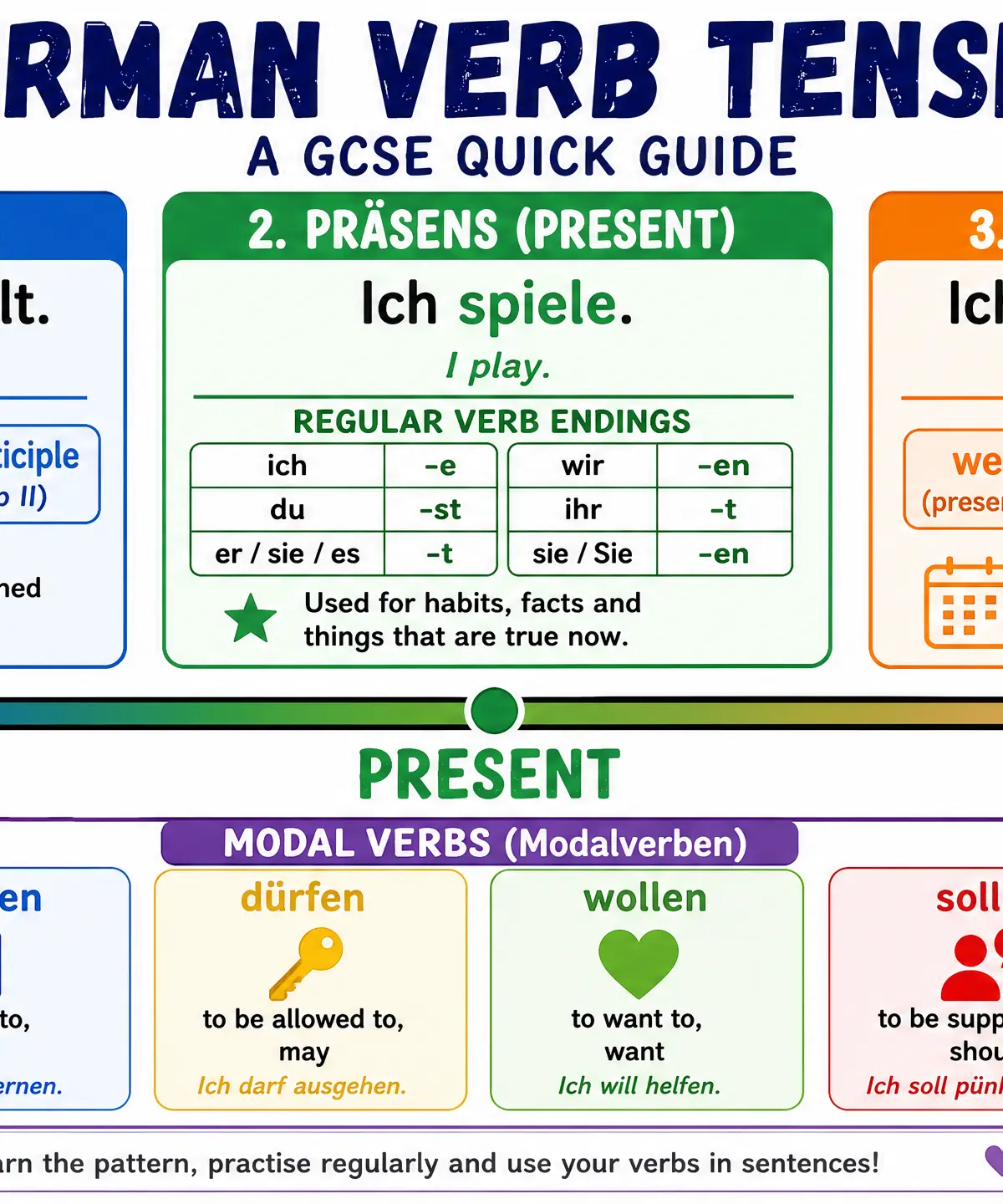
When to use it: To express ability (können), obligation (müssen), permission (dürfen), desire (wollen), advice (sollen), or liking (mögen). They follow the 2-verb rule: the modal verb is conjugated in position 2, and the main verb goes to the end in the infinitive.
Conjugation Table: können (to be able to / can)
| Subject | Verb Form | English |
|---|---|---|
| ich | kann | I can |
| du | kannst | you can |
| er/sie/es | kann | he/she/it can |
| wir | können | we can |
| ihr | könnt | you (plural) can |
| sie/Sie | können | they/You can |
🎧 Listening Skills
What to Expect
You will hear native speakers in various scenarios (announcements, conversations, interviews). Questions will test your ability to identify tenses (Did it happen, is it happening, or will it happen?) and grasp opinions.
Listening Strategies
- Listen for time markers: Words like gestern (yesterday), heute (today), or morgen (tomorrow) often give away the tense before you even process the verb.
- Watch for negatives: Nicht and kein completely change the meaning. Listen carefully to where they are placed.
- Note the auxiliary: Hearing habe or bin immediately tells you the action is in the past.
Common Listening Traps
- False Friends: E.g., bekommen means 'to receive', NOT 'to become' (which is werden).
- Separable Verbs: The prefix might be at the end of a long sentence. If you hear "Ich kaufe im Supermarkt in der Stadtmitte ein", the verb is einkaufen (to shop), not just kaufen (to buy).
🗣️ Speaking Skills
Role Play Scenarios
Scenario: At a tourist office.
- You: Ich möchte ein Fahrrad mieten. (I want to hire a bike. - Modal verb)
- Officer: Wie lange möchten Sie das Fahrrad haben? (How long do you want to have the bike?)
- You: Ich brauche es für drei Tage. (I need it for three days. - Present tense)
Photo Card Practice
Model Photo Card Response:
- Qu 1 (Description): Auf dem Foto gibt es drei Personen. Sie essen in einem Restaurant. (In the photo there are three people. They are eating in a restaurant.)
- Qu 2 (Opinion): Ich finde das Essen lecker, weil ich Pizza liebe. (I find the food tasty because I love pizza.)
- Qu 3 (Past): Letztes Wochenende habe ich auch Pizza gegessen. (Last weekend I also ate pizza.)
- Qu 4 (Future): Nächstes Wochenende werde ich ins Kino gehen. (Next weekend I will go to the cinema.)
- Qu 5 (Unpredictable): Mein Lieblingsessen ist Pasta, obwohl es nicht sehr gesund ist. (My favourite food is pasta, although it is not very healthy.)
General Conversation Questions
| Question (German) | Model Answer | English Translation |
|---|---|---|
| Was machst du in deiner Freizeit? | In meiner Freizeit spiele ich Fußball und ich lese gern. | In my free time I play football and I like reading. |
| Was hast du letztes Wochenende gemacht? | Letztes Wochenende bin ich mit meinen Freunden ins Kino gegangen. | Last weekend I went to the cinema with my friends. |
| Was wirst du nächstes Wochenende machen? | Nächstes Wochenende werde ich meine Hausaufgaben machen und faulenzen. | Next weekend I will do my homework and laze around. |
| Was ist dein Lieblingsfach und warum? | Mein Lieblingsfach ist Deutsch, weil es interessant ist und der Lehrer nett ist. | My favourite subject is German because it is interesting and the teacher is nice. |
| Wie findest du deine Stadt? | Ich finde meine Stadt toll, obwohl es nicht viel für Jugendliche gibt. | I find my city great, although there isn't much for young people. |
✍️ Writing Skills
Translation Practice
English → German:
| English | German | Key Grammar |
|---|---|---|
| I play tennis. | Ich spiele Tennis. | Present tense regular verb |
| I must do my homework. | Ich muss meine Hausaufgaben machen. | Modal verb + infinitive at end |
| Yesterday I went to the cinema. | Gestern bin ich ins Kino gegangen. | Perfect tense with 'sein' (motion) |
| I am tired because I get up early. | Ich bin müde, weil ich früh aufstehe. | Separable verb in a subordinate clause |
| Next year I will travel to Germany. | Nächstes Jahr werde ich nach Deutschland fahren. | Future tense (werden + infinitive) |
Extended Writing
**Model 90-word response (Foundation):**Ich wohne in London. Es ist eine große Stadt. In meiner Freizeit spiele ich oft Fußball im Park mit meinen Freunden. Das macht Spaß. Letztes Wochenende bin ich ins Kino gegangen und ich habe einen Actionfilm gesehen. Der Film war fantastisch, weil er sehr spannend war. Nächstes Wochenende werde ich Musik hören und ich werde meine Hausaufgaben machen. Ich lerne gern Deutsch, aber Mathe ist ziemlich langweilig.
(Demonstrates present, perfect, and future tenses, plus justified opinions).
**Model 150-word response (Higher):**Meiner Meinung nach ist London eine fantastische Stadt, obwohl es manchmal zu laut ist. Normalerweise verbringe ich meine Freizeit mit meinen Freunden. Wir gehen oft einkaufen oder wir spielen Fußball im Park. Letztes Wochenende war super! Zuerst bin ich mit meiner Familie in ein italienisches Restaurant gegangen, wo ich Pizza gegessen habe. Das Essen war köstlich. Danach haben wir einen Film im Kino gesehen.
In der Zukunft möchte ich an der Universität studieren, um Arzt zu werden. Ich interessiere mich sehr für Biologie, weil ich Menschen helfen will. Nächstes Jahr werde ich nach Deutschland fahren, um mein Deutsch zu verbessern. Ich freue mich darauf!
(Demonstrates multiple tenses, complex structures like 'um...zu', reflexive verbs, and sophisticated vocabulary).
Writing Checklist
- ✅ Three tenses used (Present, Past, Future)
- ✅ Opinions with reasons (weil, da)
- ✅ Connectives (und, aber, oder, deshalb)
- ✅ Verb position (Infinitive/participle at the end? Verb 2nd in main clause?)
- ✅ Adjective agreements correct
📚 Reading Skills
Key Strategies
- Skim for gist: Read the text quickly first to get the overall topic before looking at the questions.
- Identify the tense: Look at the verbs. Is the text describing a past event or a future plan? This is a common distractor in multiple-choice questions.
- Look for cognates: Words that look similar in English and German (e.g., interessant, Musik, Sport).
False Friends & Tricky Words
| Word | Looks Like | Actually Means |
|---|---|---|
| bekommen | become | to receive / get |
| das Gymnasium | gymnasium (gym) | grammar school |
| aktuell | actual | current / up-to-date |
| also | also | therefore / so |
| brav | brave | well-behaved |
🌍 Cultural Knowledge
Understanding cultural context can elevate your writing and speaking responses. When discussing holidays, mentioning a trip to the Schwarzwald (Black Forest) or the Ostsee (Baltic Sea) shows authentic knowledge. When discussing food, moving beyond 'Bratwurst' to mention Kaffee und Kuchen (the afternoon tradition of coffee and cake) or regional dishes like Spätzle (Swabian noodles) demonstrates wider cultural awareness. In schools, mentioning the Abitur (A-Level equivalent) rather than just 'Examen' adds a layer of authenticity that examiners appreciate.
🎧 Podcast Revision
Listen to our 3-minute revision podcast covering the core concepts of German verbs, common exam mistakes, and a quick-fire recall quiz.
Visual Resources
2 diagrams and illustrations
Interactive Diagrams
1 interactive diagram to visualise key concepts
Conceptual Flow Outline
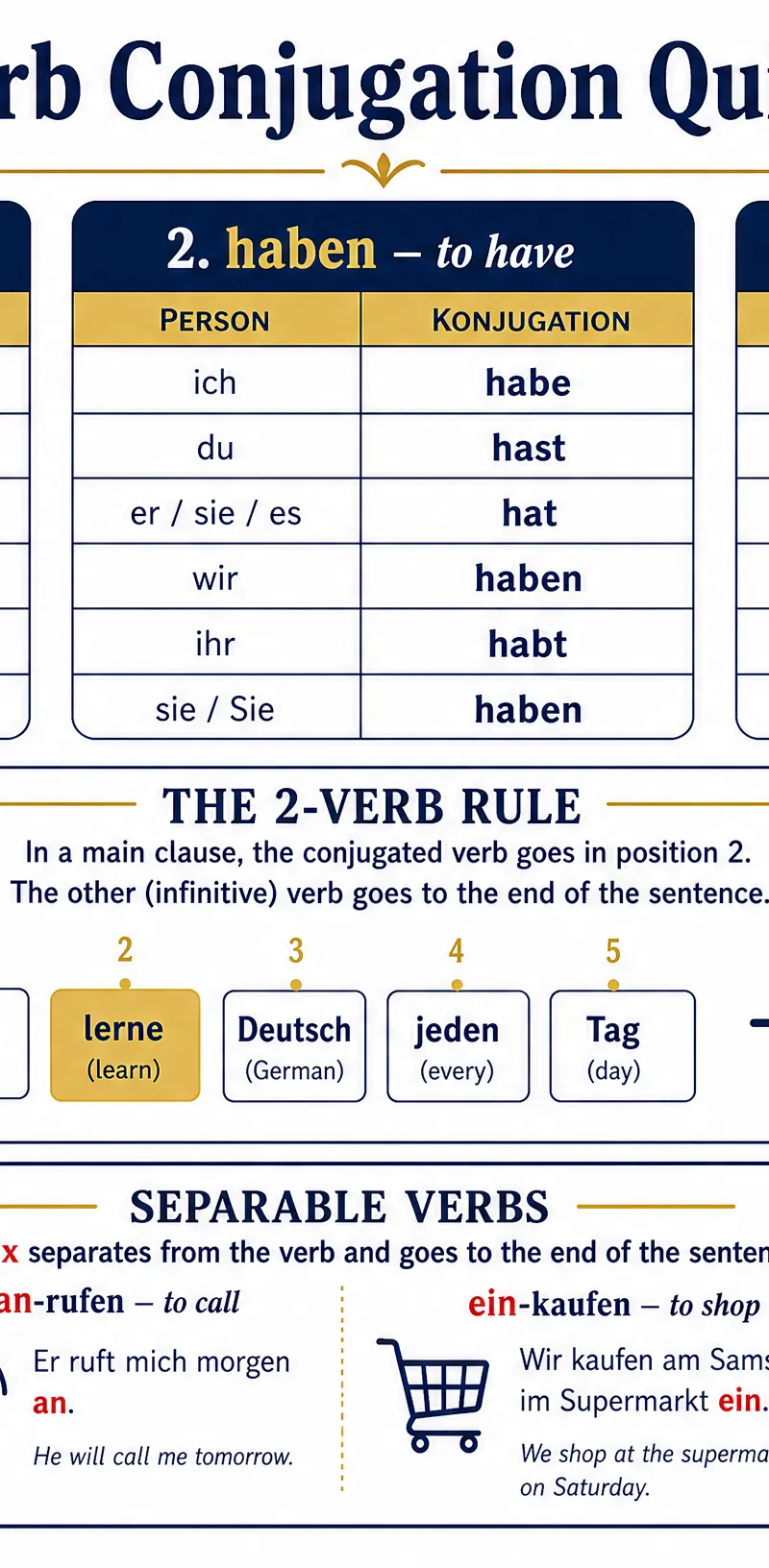
The German 2-Verb Rule
Worked Examples
4 worked examples — open one to explore the question and available guidance.
Practice Questions
Try the question, then reveal an answer plan or example response
(Writing) Translate into German: 'I must do my homework because I want to learn German.'
Hint: Think about the modal verb 'must', the 2-verb rule, and what 'because' (weil) does to the verb order.
(Speaking) Answer the conversation question: 'Was hast du letztes Wochenende gemacht?'
Hint: Use the perfect tense. Remember to use 'sein' if you talk about going somewhere.
(Writing - Higher) Write approximately 150 words about school. Include: your opinion on subjects, what you did at school yesterday, and your plans for next year.
Hint: Ensure you use present, perfect, and future tenses. Try to include a 'weil' clause and an 'um...zu' clause.
(Reading) Read: 'Ich fahre gern Rad, aber gestern hat es geregnet, also bin ich zu Hause geblieben und habe ferngesehen.' Why didn't the person cycle yesterday?
Hint: Look for the word 'gestern' and the reason given.
(Listening) You hear: 'Morgen werde ich mit meinem Bruder einkaufen gehen.' When is this happening?
Hint: Listen for the time marker at the start.
(Writing) Translate into German: 'I am interested in music.'
Hint: Use the reflexive verb 'sich interessieren für'.
Exam technique
How to turn what you know into marks
How to approach the question
Skill-by-skill strategy: Listening — read questions first, note keywords. Speaking — prepare opinions in advance, have fillers ready. Reading — skim first, then detail. Writing — plan tenses before writing, check verb placement after.
How to structure your answer
Writing: Introduction → Main points with opinions → Justified reasons → Different tenses → Conclusion. Speaking: Give opinion → Justify → Extend → Use different tense.
Timing
Writing: 60-75 mins total. For a 16-mark 90-word question, spend about 15 minutes. For a 32-mark 150-word question, spend about 30 minutes.
Common pitfalls
- Forgetting to put the infinitive or past participle at the end of the sentence.
- Using 'haben' instead of 'sein' for movement verbs in the perfect tense.
- Translating 'I am playing' literally as 'Ich bin spielen' (It should just be 'Ich spiele').
- Forgetting the reflexive pronoun (mich, dich, sich).
- Using only the present tense — examiners want at least 3 tenses at Higher.
- Not justifying opinions with 'weil' or 'da'.
What the command words want
- Describe the photo
- Say what you can see (Es gibt...), give an opinion (Ich finde das...), relate to your experience (Letztes Wochenende habe ich...).
- Translate into German
- Write full sentences with correct grammar — partial marks are given for correct verb conjugations even if a noun is wrong.
- Translate into English
- Meaning over word-for-word — capture the sense, don't guess false friends like 'bekommen'.
- Write approximately 90 words
- Foundation task — cover all 4 bullet points, use present + one other tense (usually perfect).
- Write approximately 150 words
- Higher task — 3 tenses, opinions, complex structures (um...zu, reflexive verbs), ambitious vocabulary.
Watch or listen (optional)
Test your understanding of Vocabulary: Verbs
Active recall beats re-reading. Take an instant quiz now to test what you’ve learned and lock it into long-term memory.
7 days Premium · Then the free plan continues · No card, no charge