Pearson Edexcel · GCSE · Greek
Course version: Pearson-GCSE-Greek · Version from Mar 2026
Local area, holiday and travel
This study guide covers the essential Theme 2 topic of Local Area, Holidays, and Travel for GCSE Greek. It provides crucial vocabulary, grammatical structures, and exam strategies to help candidates secure top marks across listening, reading, speaking, and writing papers.
- 4 min read
- 3 worked examples
- 5 practice questions
- 6 key terms
Check what you remember
Read the wording for your board, then hide it and explain Nominative Case (Ονομαστική) in your own words. Rough notes are fine. This is a self-check, with no mark or grade.
Reference: Pearson Edexcel
The grammatical case used for the subject of the sentence (the person/thing doing the action).
Study Notes

Overview
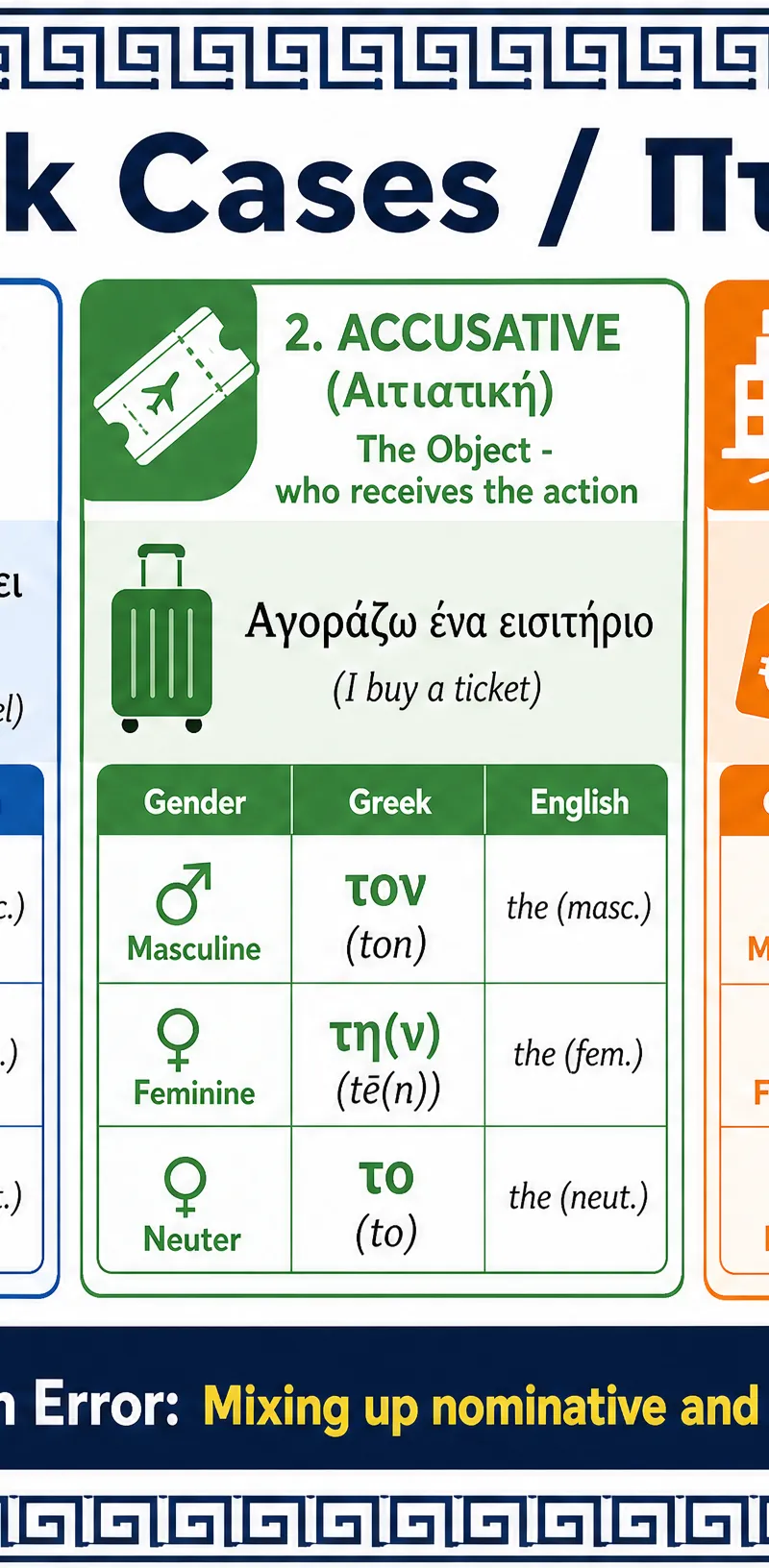
Theme 2 (Local Area, Holiday and Travel) is a foundational pillar of the GCSE Greek specification. Examiners consistently use this theme to test candidates' ability to convey information, narrate events coherently, and demonstrate a range of vocabulary and grammatical structures. The topic spans practical transactions (booking accommodation, ordering food, asking for directions) to descriptive narratives (discussing weather, evaluating places to visit, and expressing preferences for holidays). To achieve top mark bands, candidates must move beyond rehearsed language and show spontaneous interaction, particularly in the speaking assessment. Crucially, examiners reward the accurate application of past, present, and future tenses alongside correct case conventions (Nominative vs Accusative).
Key Vocabulary Categories
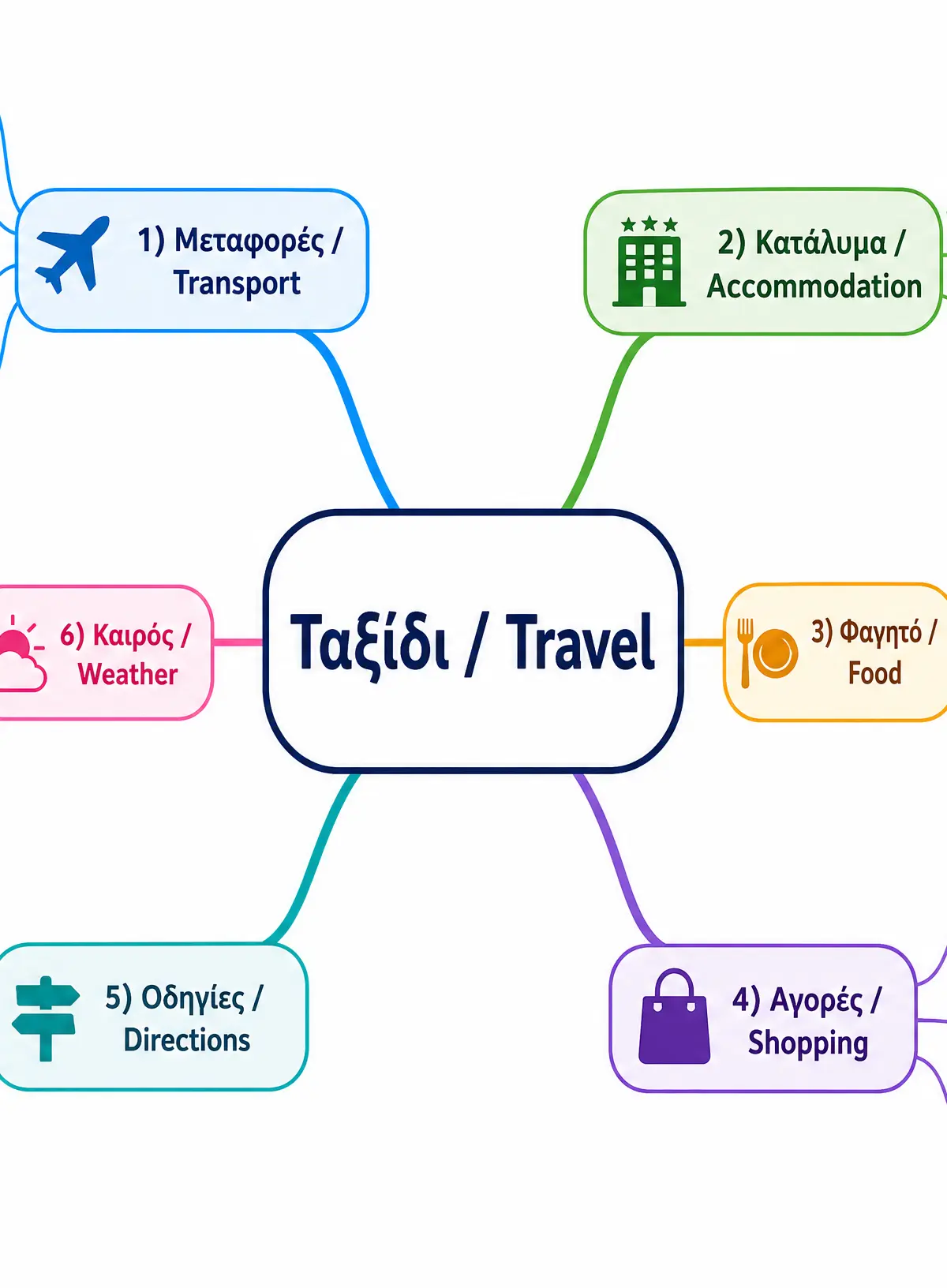
1. Transport (Μεταφορές)
Key Terms: αεροπλάνο (aeroplane), τρένο (train), λεωφορείο (bus), πλοίο (boat), εισιτήριο (ticket).
Exam Context: Frequently tested in listening and reading comprehension regarding travel arrangements and delays.
2. Accommodation (Κατάλυμα)
Key Terms: ξενοδοχείο (hotel), κάμπινγκ (camping), δωμάτιο (room), μονόκλινο (single room), δίκλινο (double room).
Exam Context: Essential for transactional speaking role-plays and formal writing tasks (e.g., emailing a hotel).
3. Food and Eating Out (Φαγητό και Εστιατόριο)
Key Terms: εστιατόριο (restaurant), μενού (menu), λογαριασμός (bill), γκαρσόν (waiter), πρωινό (breakfast).
Exam Context: Common in speaking role-plays where candidates must order food or complain about a service issue.
4. Directions (Οδηγίες)
Key Terms: αριστερά (left), δεξιά (right), ευθεία (straight on), κοντά (near), μακριά (far).
Exam Context: High-frequency vocabulary in listening map-reading tasks and speaking role-plays.
5. Weather (Καιρός)
Key Terms: ήλιος (sun), βροχή (rain), ζέστη (hot), κρύο (cold), χιόνι (snow).
Exam Context: Used to add descriptive detail in extended writing tasks to elevate the quality of language.
Core Grammatical Structures
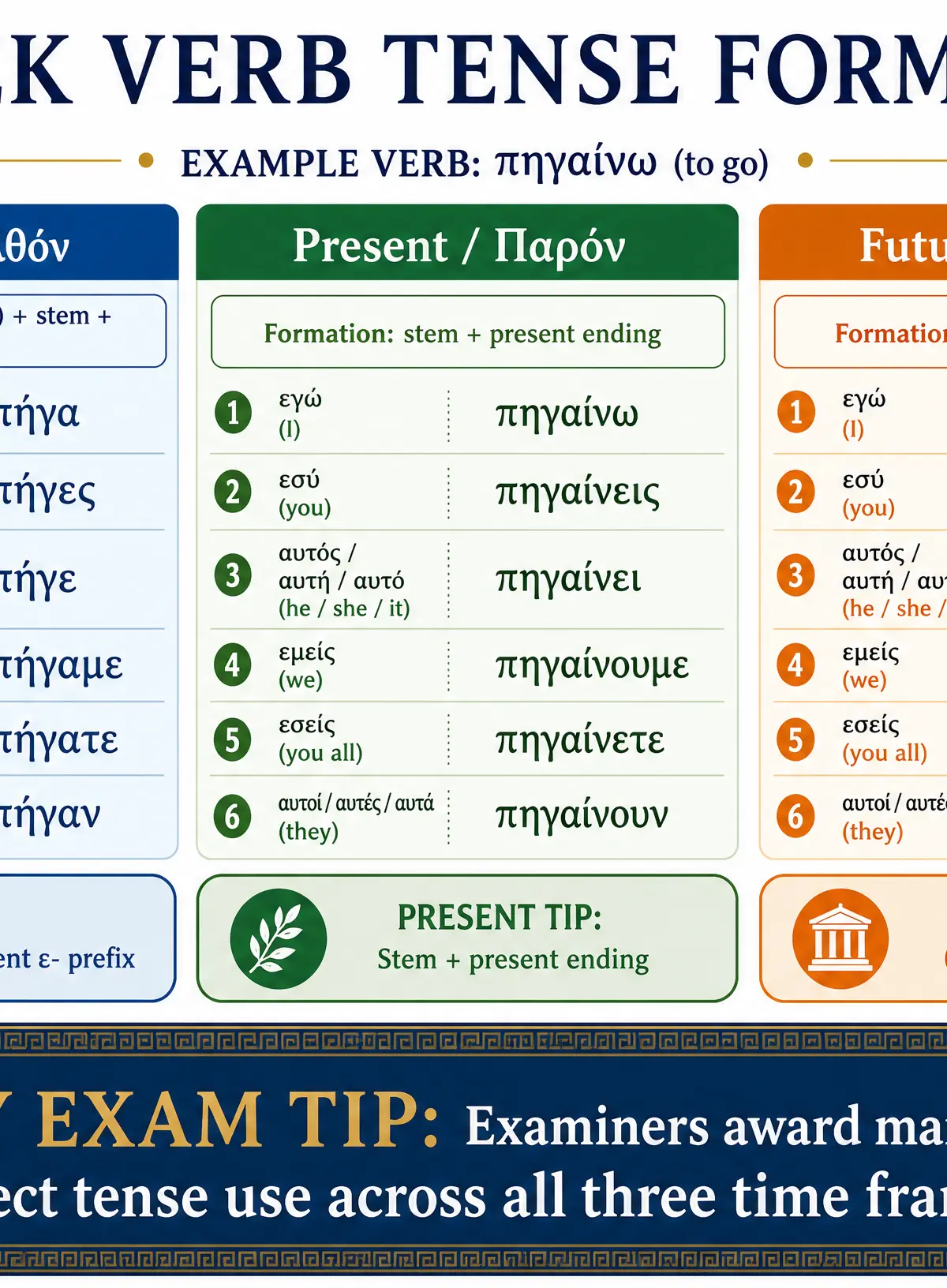
Tense Mastery
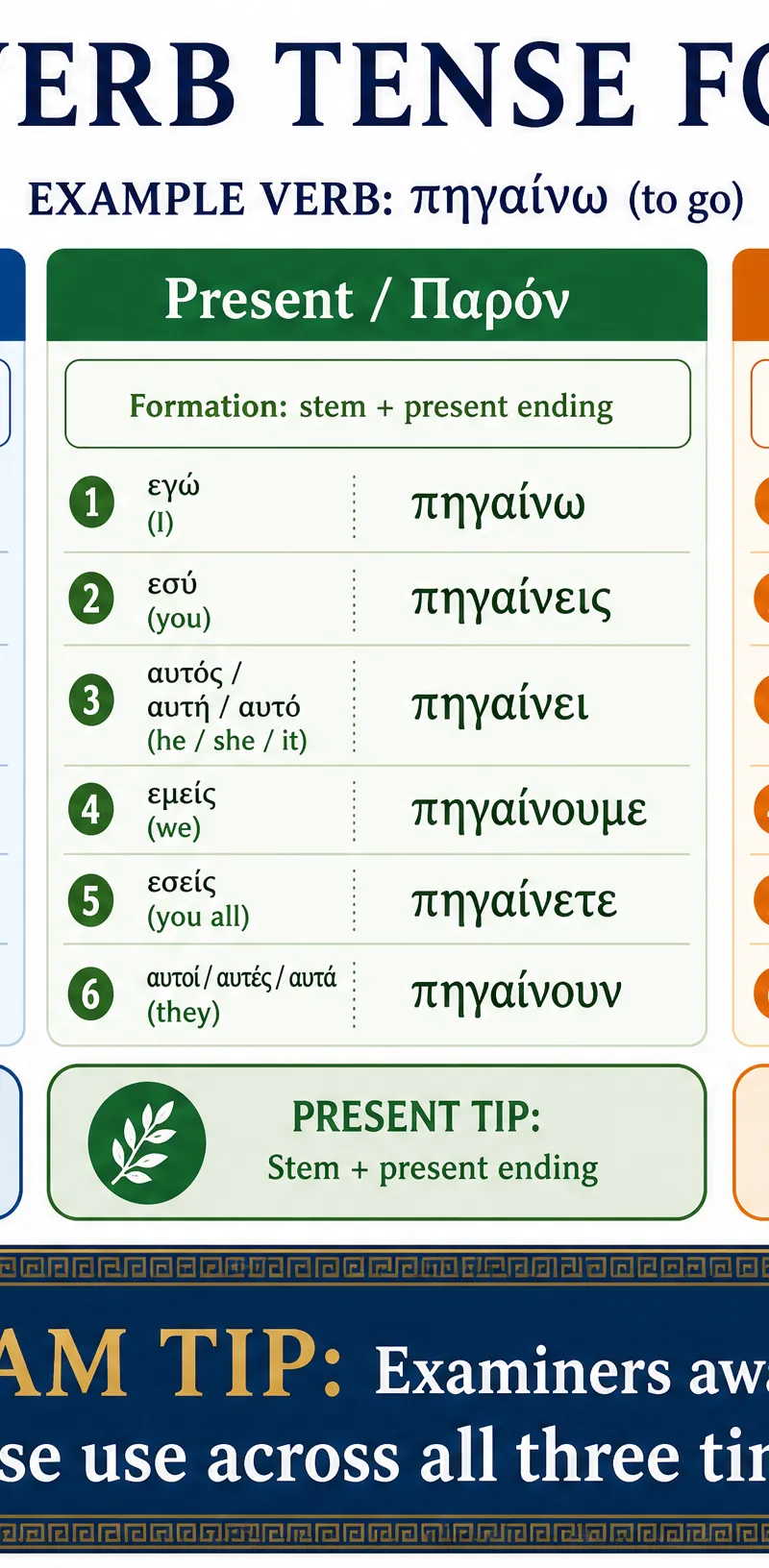
Examiners explicitly look for the accurate use of three time frames (past, present, future) to award marks in the highest bands for writing and speaking.
- Past: Look for the augment (ε-) prefix. Example: Πέρσι πήγα στην Ελλάδα (Last year I went to Greece).
- Present: Stem + present ending. Example: Μου αρέσει η θάλασσα (I like the sea).
- Future: θα + dependent form. Example: Του χρόνου θα πάω στην Κρήτη (Next year I will go to Crete).
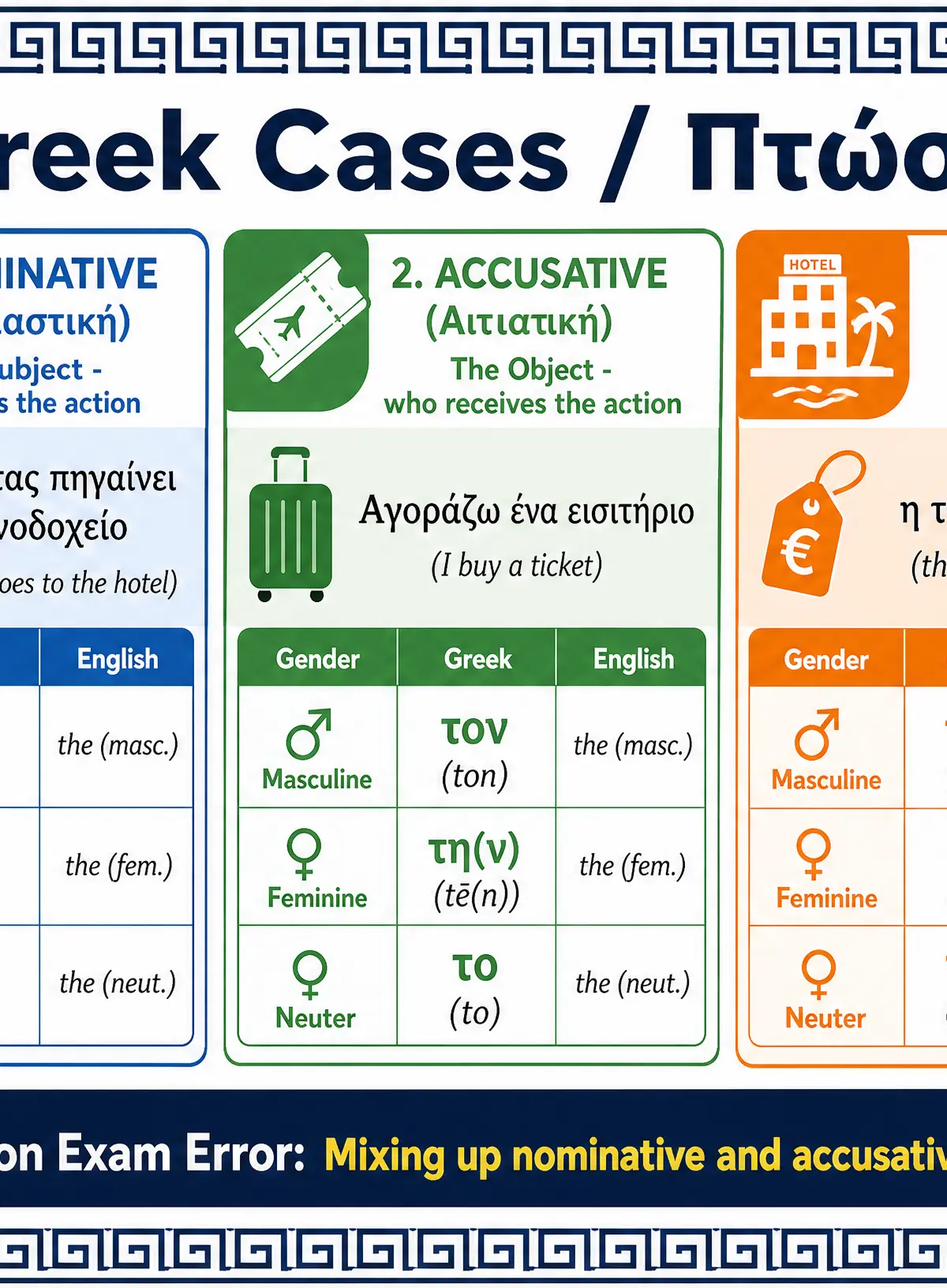
Case Conventions
A common area where candidates drop marks is the incorrect application of cases, particularly confusing the Nominative (subject) and Accusative (object). Remember that prepositions like στο / στην (to the) require the Accusative case.
Register
Understanding when to use formal vs informal language is critical. Using εσύ (informal 'you') when addressing a hotel manager in a formal writing task will limit the marks available for communication and content.
Visual Resources
3 diagrams and illustrations
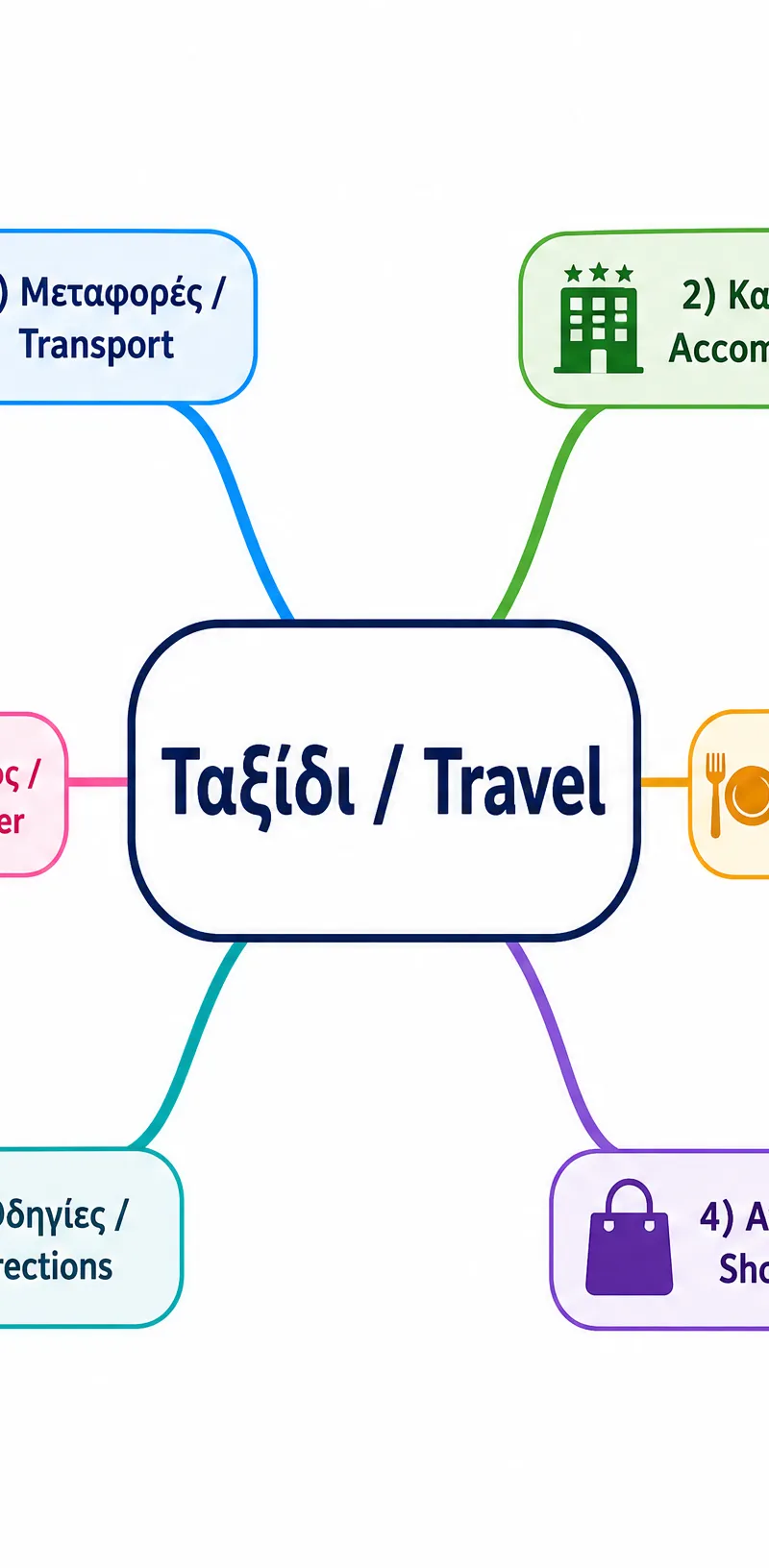
Interactive Diagrams
1 interactive diagram to visualise key concepts
Conceptual Flow Outline
Decision tree for maximizing marks in extended writing tasks.
Worked Examples
3 worked examples — open one to explore the question and available guidance.
Practice Questions
Try the question, then reveal an answer plan or example response
Reading Comprehension: Read the short text and answer in English. 'Το ξενοδοχείο ήταν πολύ ωραίο, αλλά η θάλασσα ήταν βρώμικη.' What did the person think of the hotel and the sea? (2 marks)
Hint: Look for the contrasting conjunction 'αλλά'.
Speaking Picture-Based Task: Describe the picture of a busy Greek market. What is happening? (4 marks)
Hint: Use present continuous concepts (what they are doing right now) and positional vocabulary.
Writing Translation: Translate into Greek: 'Next year I will travel to Athens by plane.' (3 marks)
Hint: Remember the future tense marker and the preposition rule for transport.
Listening Comprehension: You hear an announcement at a train station. 'Το τρένο για τη Θεσσαλονίκη θα καθυστερήσει είκοσι λεπτά.' Why is there a problem? (1 mark)
Hint: Listen for the word related to time or delay.
Extended Writing: Write a blog post about your town for tourists. Include: what there is to see, what you can do, and your opinion of the town. (12 marks)
Hint: Use a variety of adjectives and justify your opinions.
Exam technique
How to turn what you know into marks
How to approach the question
Always number the bullet points in writing tasks and tick them off to ensure full coverage.
How to structure your answer
- Essay questions
- Introduction, Paragraph 1 (Past), Paragraph 2 (Present/Opinions), Paragraph 3 (Future), Conclusion.
- Source questions
- Read the question first, then scan the Greek text for keywords or synonyms.
- Explain questions
- State the fact, provide a reason using 'γιατί' or 'επειδή' (because), and add an opinion.
Timing
Approximately 1 minute per mark in the writing paper. Use speaking preparation time (12 mins) to plan tenses.
Common pitfalls
- Failing to cover all bullet points in writing tasks.
- Using rehearsed language that does not answer the specific question.
- Mixing up the Nominative and Accusative cases.
- Mother-tongue interference (e.g., putting adjectives before nouns incorrectly).
What the command words want
- Describe
- Provide detailed adjectives and expand on basic nouns.
- How useful
- Not typically applicable for MFL, but evaluate options using comparatives (πιο... από).
- Explain why
- Use conjunctions like 'γιατί' (because) to link ideas.
- How far do you agree
- Give a balanced opinion using 'από τη μία πλευρά... από την άλλη πλευρά' (on one hand... on the other hand).
Watch or listen (optional)
Test your understanding of Local area, holiday and travel
Active recall beats re-reading. Take an instant quiz now to test what you’ve learned and lock it into long-term memory.
7 days Premium · Then the free plan continues · No card, no charge