Pearson Edexcel · GCSE · Greek
Course version: Pearson-GCSE-Greek · Version from Mar 2026
School
This study guide provides a comprehensive overview of the GCSE Greek 'School' topic, covering essential vocabulary, grammatical structures, and cultural contexts. Mastering this theme is crucial for success, as it frequently appears across listening, reading, speaking, and writing assessments, allowing candidates to demonstrate their linguistic range and cultural awareness.
- 3 min read
- 3 worked examples
- 5 practice questions
- 6 key terms
Check what you remember
Read the wording for your board, then hide it and explain Το Δημοτικό Σχολείο in your own words. Rough notes are fine. This is a self-check, with no mark or grade.
Reference: Pearson Edexcel
Primary school in the Greek education system.
Study Notes
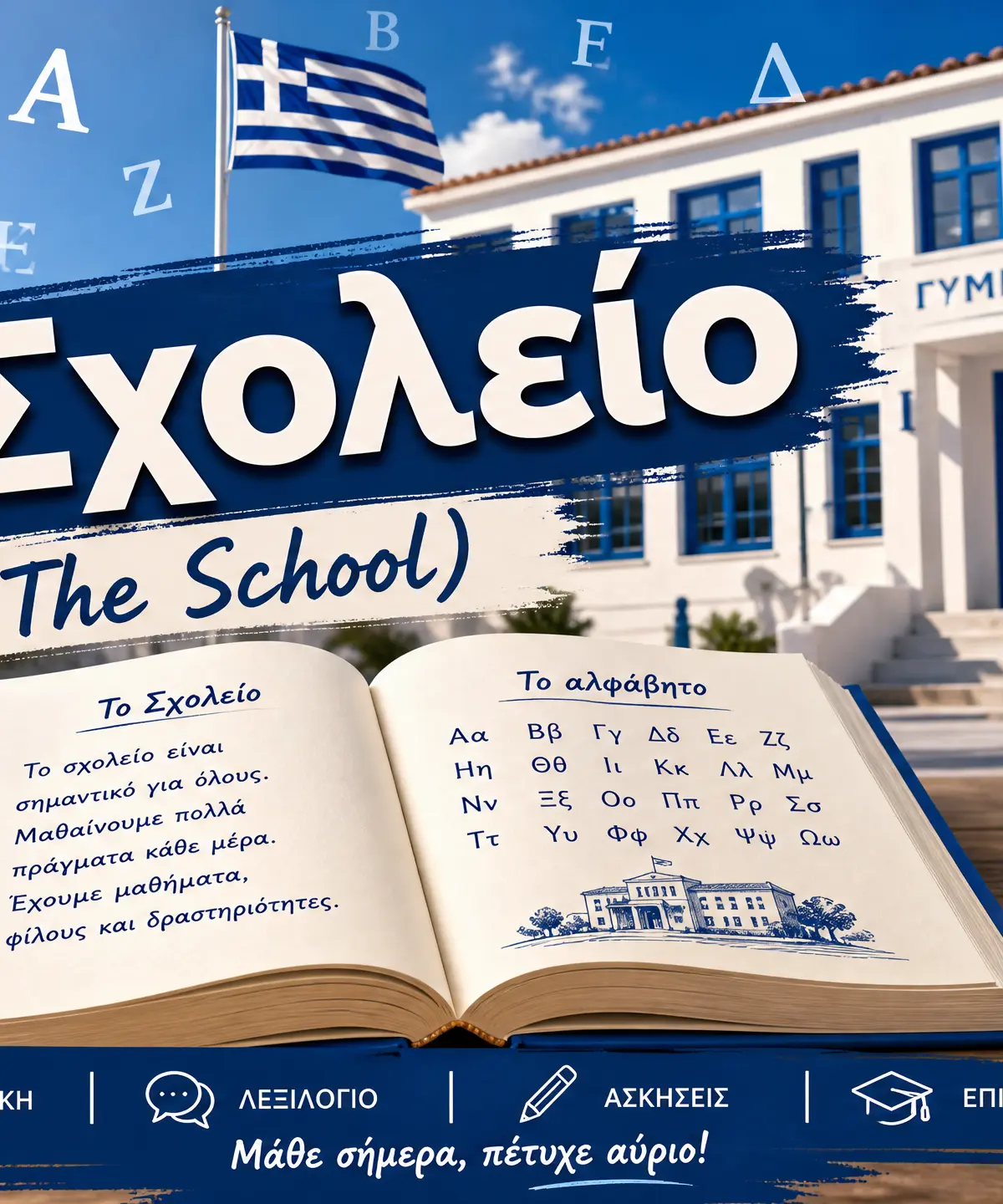
Overview
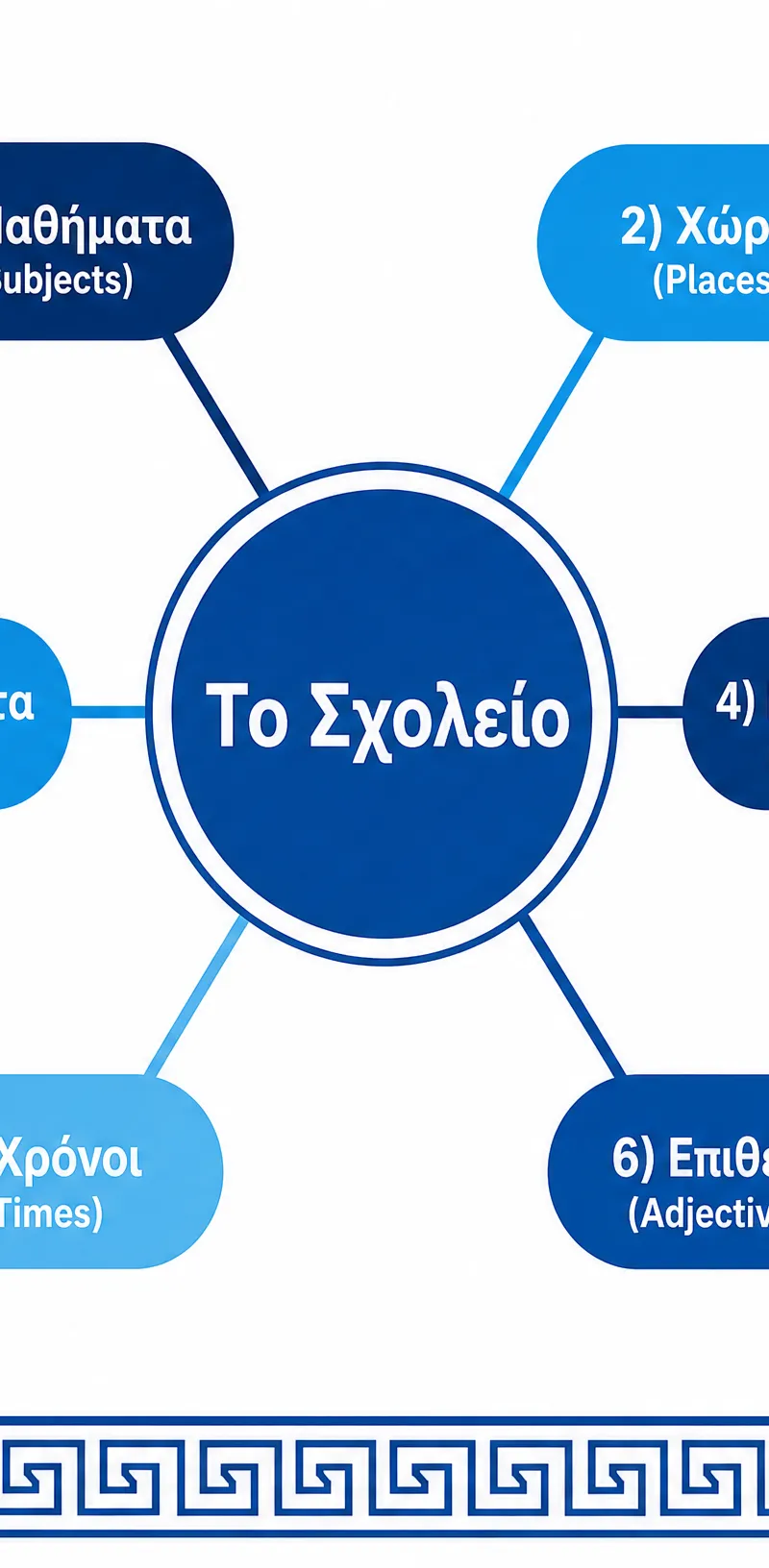
Theme 3: The School (Το Σχολείο) is a foundational topic in the GCSE Greek specification. It requires candidates to understand and communicate about the school environment, daily routines, subjects, rules, and extracurricular activities. Examiners expect candidates to go beyond simple vocabulary recall; they are looking for the ability to narrate events coherently, express and justify opinions, and adapt language for different purposes. Crucially, this topic provides an excellent platform to demonstrate grammatical range, particularly the accurate use of past, present, and future tenses, and the appropriate application of formal versus informal registers.
Core Vocabulary & Contexts
Types of Schools (Τύποι Σχολείων)
In Greece and Cyprus, the education system is structured differently from the UK. Understanding these terms is vital for cultural context and accurate communication:
- Το Δημοτικό Σχολείο: Primary school (ages 6-12).
- Το Γυμνάσιο: Lower secondary school (ages 12-15).
- Το Λύκειο: Upper secondary school (ages 15-18).
School Subjects (Μαθήματα)
Candidates must confidently name and express opinions on various subjects. Key vocabulary includes:
- Μαθηματικά: Mathematics
- Ιστορία: History
- Ελληνικά: Greek
- Αγγλικά: English
- Φυσική: Physics
- Χημεία: Chemistry
- Γεωγραφία: Geography
- Φυσική Αγωγή (Γυμναστική): Physical Education
- Τέχνη: Art
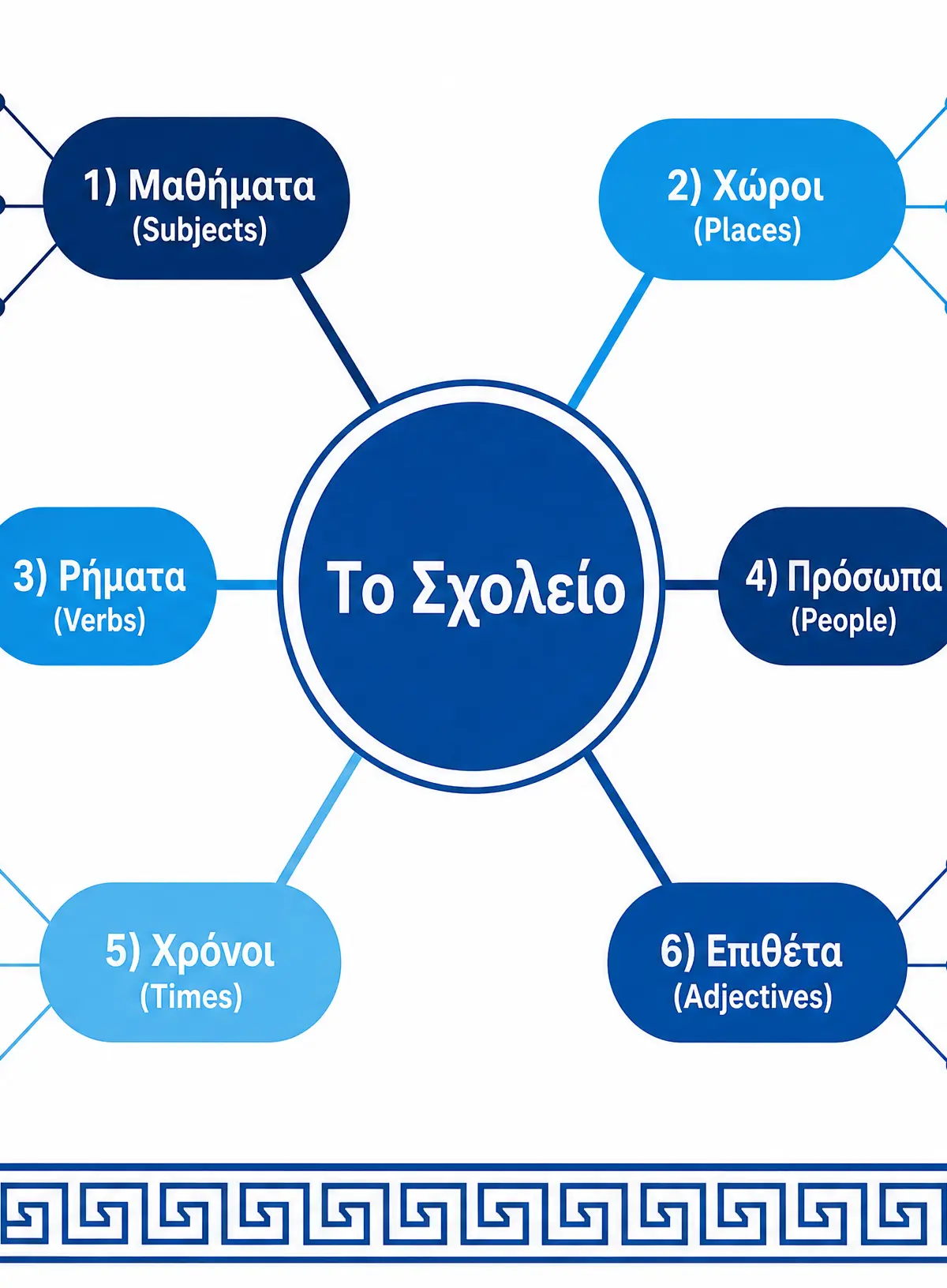
Key Grammatical Structures
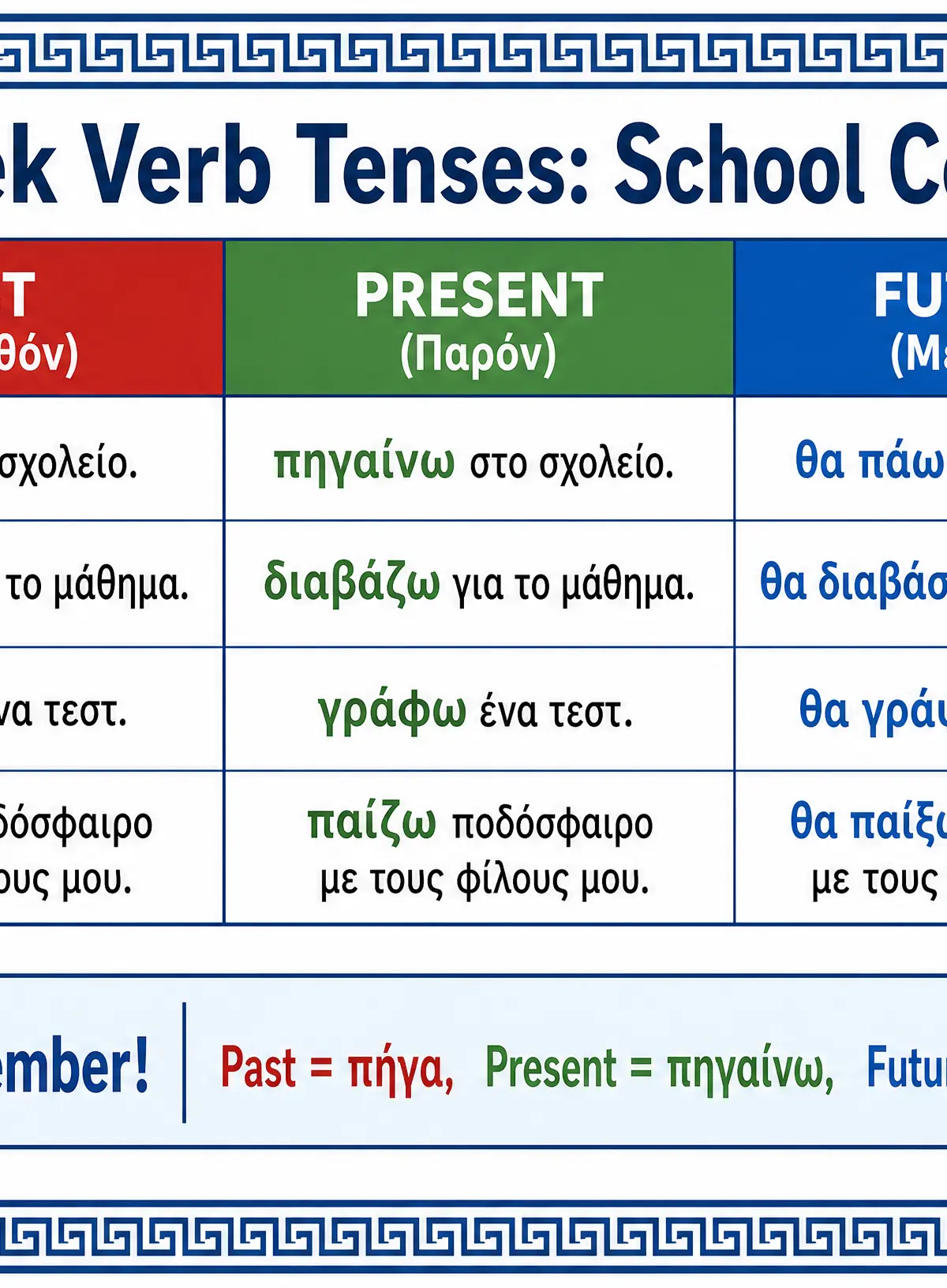
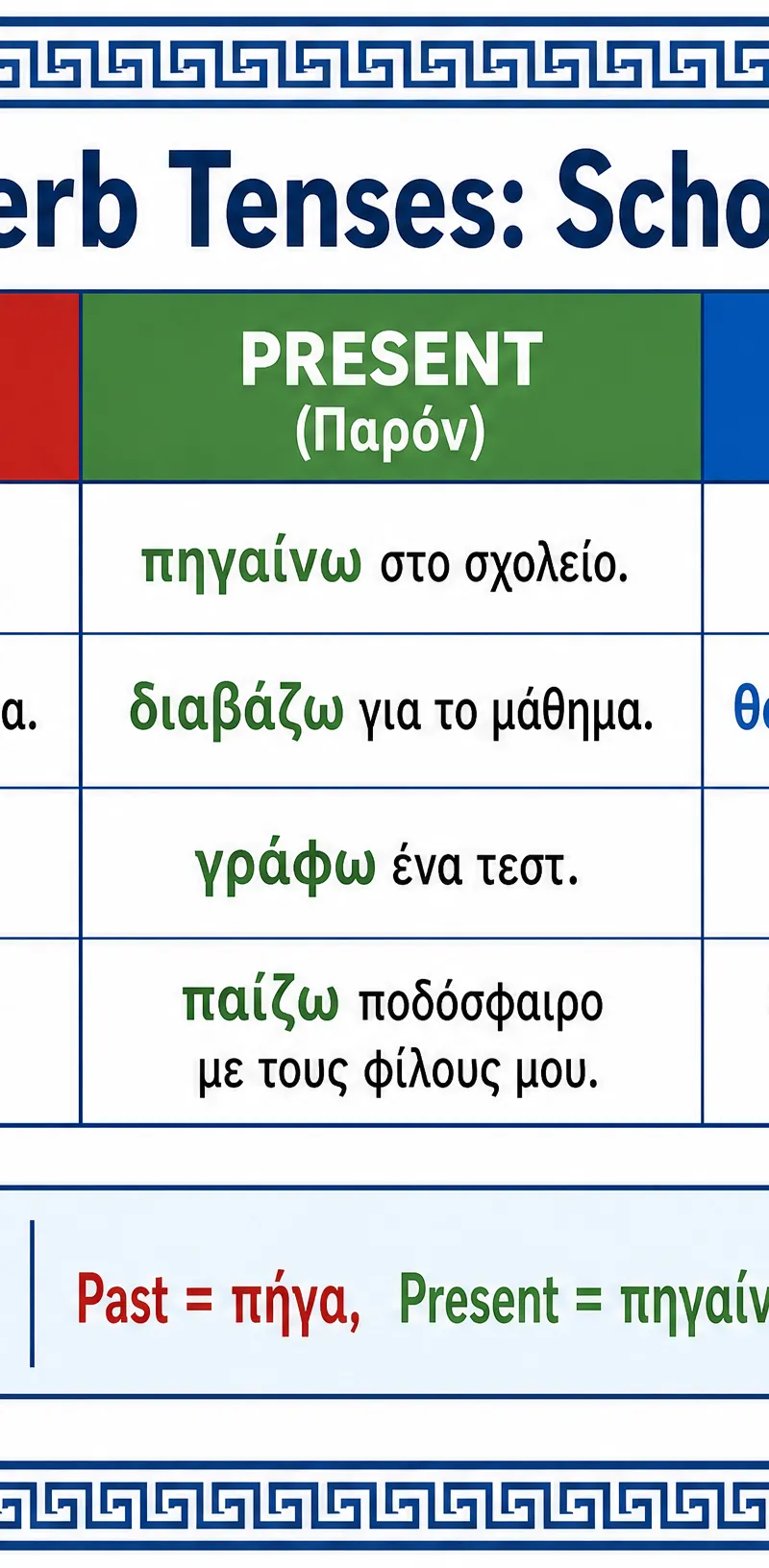
Tense Formation
Examiners heavily reward the accurate use of multiple tenses. Candidates must demonstrate they can narrate school events in the past, describe current routines, and discuss future educational plans.
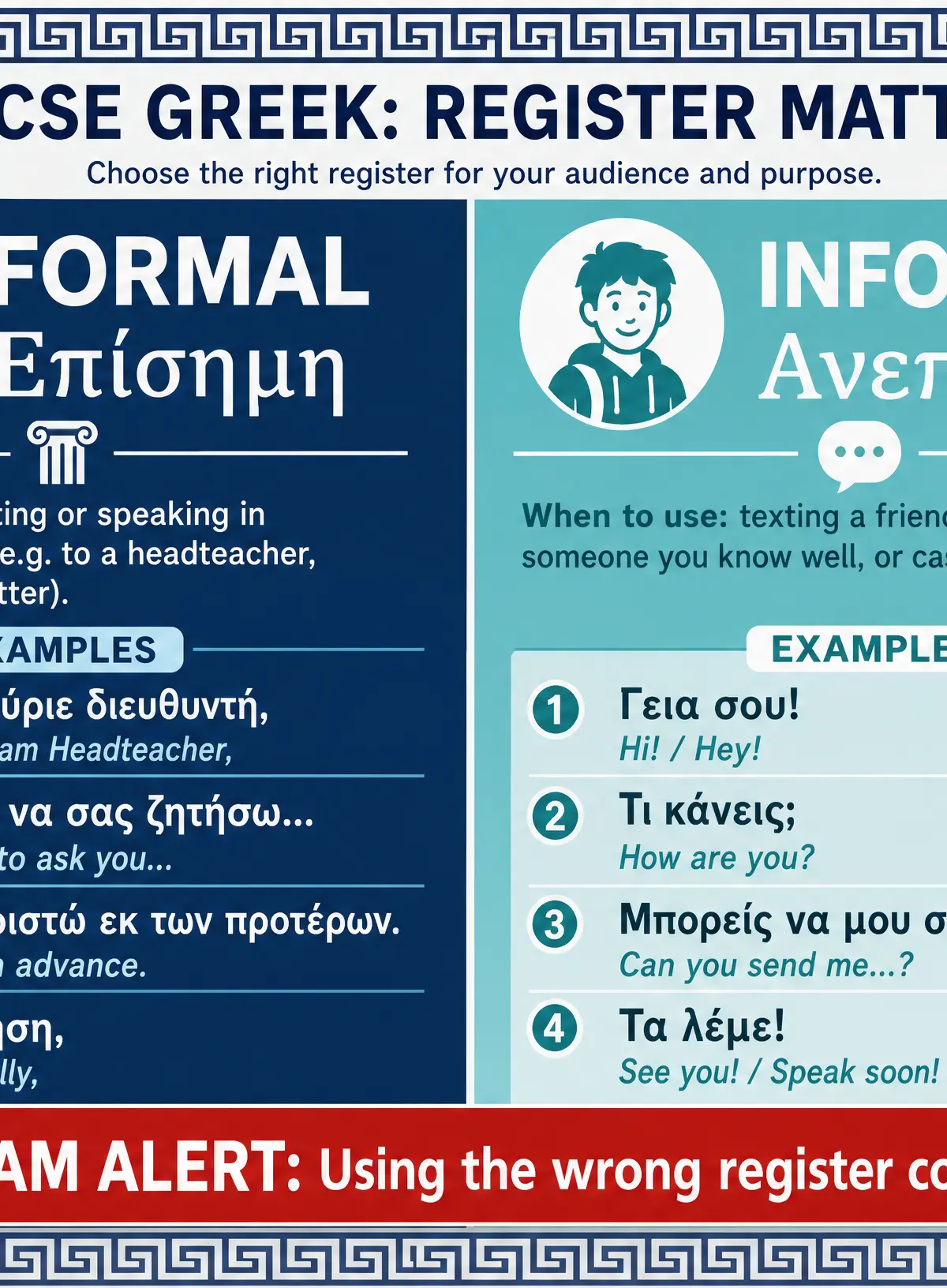
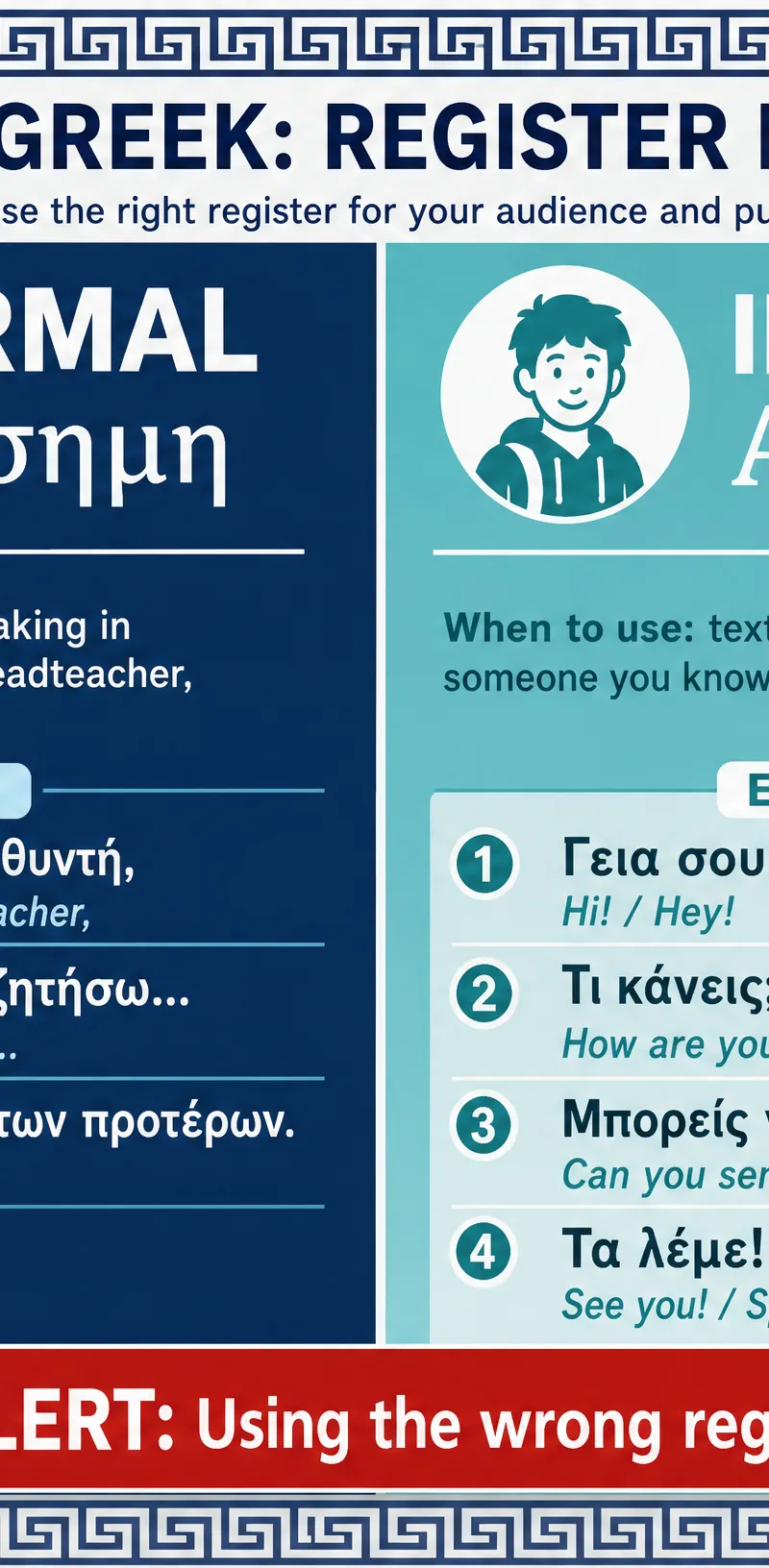
Register: Formal vs. Informal
A common pitfall is the inappropriate use of register. When writing to a headteacher or a formal entity, candidates must use the plural/formal 'you' (εσείς) and formal greetings/sign-offs. When writing to a friend about school life, the informal 'you' (εσύ) is required.
Expressing and Justifying Opinions
To access the higher mark bands (Levels 3 and 4 in writing and speaking), candidates must not only state an opinion but justify it with developed reasoning.
- Basic: Μου αρέσει η ιστορία. (I like history.)
- Developed: Μου αρέσει πάρα πολύ η ιστορία γιατί ο καθηγητής είναι εξαιρετικός και τα μαθήματα είναι πάντα ενδιαφέροντα. (I really like history because the teacher is excellent and the lessons are always interesting.)
Audio Resource: The School Topic Podcast
Listen to this 10-minute podcast episode to consolidate your learning, hear correct pronunciation, and pick up top examiner tips for the speaking and writing assessments.
Visual Resources
3 diagrams and illustrations
Interactive Diagrams
1 interactive diagram to visualise key concepts
Conceptual Flow Outline
The Greek Education System Structure
Worked Examples
3 worked examples — open one to explore the question and available guidance.
Practice Questions
Try the question, then reveal an answer plan or example response
Write a blog post for your school website about a recent school event. Mention what the event was, what you did, and your opinion of it. (16 marks)
Hint: Ensure you use the past tense accurately to describe the event, and provide a justified opinion.
Read the text about Nikos's school. Answer the question in English: Why does Nikos prefer his new school? (2 marks)
Text: Ο Νίκος πηγαίνει τώρα στο λύκειο. Του αρέσει το νέο του σχολείο περισσότερο από το γυμνάσιο επειδή οι καθηγητές είναι πιο φιλικοί και έχει περισσότερες επιλογές στα μαθήματα.
Hint: Look for the word 'επειδή' (because) to find the reasons.
Translate the following paragraph into English. (9 marks)
Το σχολείο μου είναι αρκετά μεγάλο. Έχουμε μια σύγχρονη βιβλιοθήκη όπου διαβάζω συχνά. Του χρόνου, ελπίζω να πάω σε ένα σχολείο στην Αθήνα.
Hint: Pay attention to adjectives like 'αρκετά' and 'σύγχρονη', and ensure the final sentence reflects the future intention.
Speaking General Conversation: Ποιο είναι το αγαπημένο σου μάθημα και γιατί; (What is your favourite subject and why?) (5 marks)
Hint: Name the subject clearly and provide at least two reasons to justify your choice.
Write a formal letter to your Greek headteacher suggesting a new after-school club. Mention what the club is, why it would be beneficial, and when it should take place. (16 marks)
Hint: You MUST use the formal register (εσείς/σας) throughout the letter. Do not use informal greetings.
Exam technique
How to turn what you know into marks
How to approach the question
Always highlight the bullet points in the prompt. Tick them off as you write to ensure full coverage. Identify the target audience immediately to determine the correct register (formal or informal).
How to structure your answer
- Essay questions
- Introduction (Greeting/Context) -> Paragraph 1 (Bullet point 1) -> Paragraph 2 (Bullet point 2) -> Paragraph 3 (Bullet point 3) -> Conclusion (Sign-off). Ensure a mix of tenses across the paragraphs.
- Source questions
- Read the text twice. First for general meaning, second to locate specific answers. Look out for synonyms; the text will rarely use the exact same words as the question.
- Explain questions
- State opinion -> Use 'γιατί' -> Provide a developed reason -> Add an extra detail (e.g., 'Επίσης...').
Timing
Allocate approximately 1 minute per mark for writing tasks, allowing 5 minutes at the end for proofreading tenses and agreements.
Common pitfalls
- Failing to address all bullet points in a writing or speaking task, which caps the maximum achievable mark.
- Mixing up verb endings, particularly confusing the first person 'I' (-ω) with the second person 'you' (-εις).
- Using informal language (e.g., 'Γεια σου') when the task specifies writing a formal letter or speaking to a person of authority.
- Reading entirely from prepared notes during the speaking assessment, destroying the required spontaneity.
What the command words want
- Describe
- Provide detailed information using adjectives and specific vocabulary (e.g., colours, sizes, emotions).
- Translate
- Focus on the meaning rather than word-for-word literal translation. Pay special attention to verb tenses and noun-adjective agreement.
- Explain why
- Give an opinion and use connective words like 'γιατί' (because) or 'επειδή' (since) to provide a clear reason.
- Write an email/letter
- Ensure you use the correct opening and closing conventions appropriate for the specified register (formal or informal).
Watch or listen (optional)
Test your understanding of School
Active recall beats re-reading. Take an instant quiz now to test what you’ve learned and lock it into long-term memory.
7 days Premium · Then the free plan continues · No card, no charge