AQA · A-Level · History
Course version: 7042 · Version from Sept 2017
How important was the role of key individuals and groups and how were they…
Full specification wording
1A The Age of the Crusades, c1071–1204 – consequence in this period through the following key questions:: How important was the role of key individuals and groups and how were they affected by developments?
Key individuals, such as Pope Urban II, Saladin, and Richard the Lionheart, were pivotal in driving the ideological and military momentum of the Crusades.
Checked against the AQA 7042 specification (opens in a new tab) on .
- Point 6 of 6
- 4 key terms
Study notes
From the checked teaching notes for this specification point.
The idea
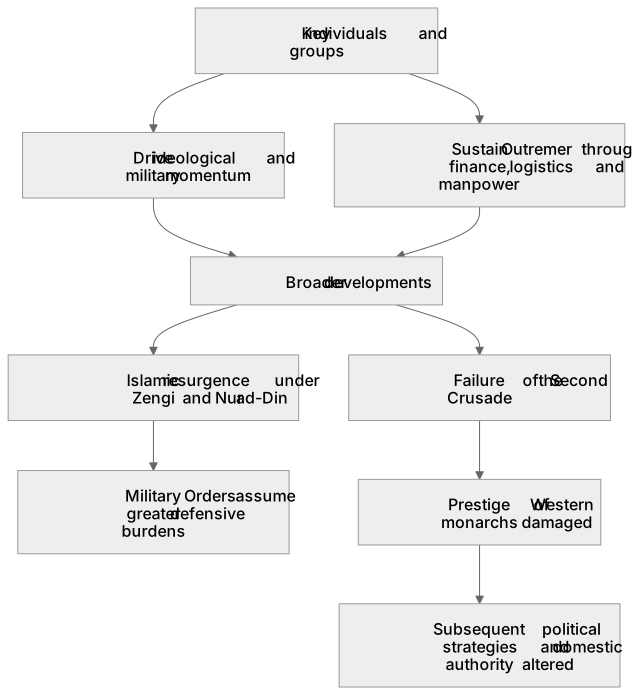
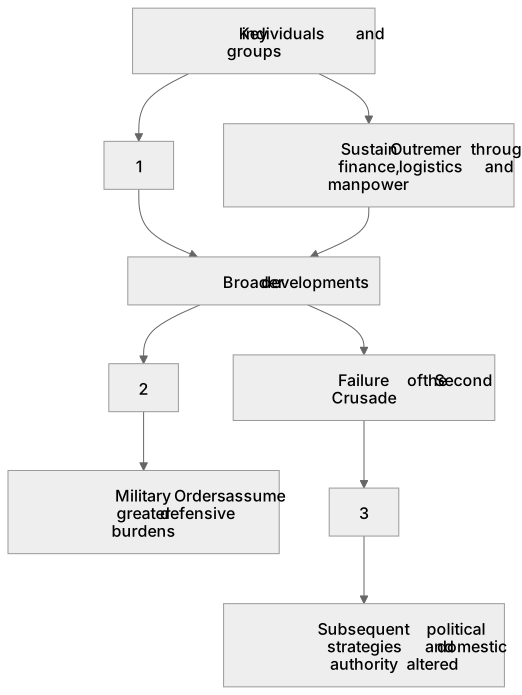
Key individuals, such as Pope Urban II, Saladin, and Richard the Lionheart, were pivotal in driving the ideological and military momentum of the Crusades. Similarly, groups like the Military Orders (Templars and Hospitallers) and the Italian maritime republics played crucial roles in sustaining Outremer through finance, logistics, and manpower. However, these figures and factions were profoundly affected by broader developments. For instance, the Islamic resurgence under Zengi and Nur ad-Din forced the Military Orders to assume greater defensive burdens, while the failure of the Second Crusade severely damaged the prestige of Western monarchs like Louis VII, altering their subsequent political strategies and domestic authority.
What earns the marks
- Evaluate the impact of specific leaders, such as popes, monarchs, and Islamic commanders, on the trajectory of the Crusades.
- Assess the contribution of key groups, including the Military Orders and Italian merchants, to the survival and economy of the Crusader States.
- Analyse how shifting geopolitical developments, such as the unification of Islamic Syria and Egypt, altered the strategies and power of key individuals.
- Explain how the outcomes of specific crusades affected the reputation, authority, and resources of participating groups and leaders.
Common mistakes and how to put them right
Focusing solely on the actions of individuals without addressing how they were affected by broader events.
Put it right: Ensure a two-way analysis showing both their impact on history and history's impact on them.
Overlooking the role of collective groups in favour of famous kings.
Put it right: Integrate the vital contributions and changing fortunes of the Military Orders and Italian city-states.
Presenting Islamic leaders as a monolithic force.
Put it right: Differentiate between the specific roles, challenges, and developments affecting leaders like Zengi, Nur ad-Din, and Saladin.
Exam tips
- Structure your essay to explicitly weigh the importance of individuals against the importance of groups to provide a balanced evaluation.
- Use the changing fortunes of the Templars and Hospitallers as a prime example of how groups were affected by the increasing military pressure on Outremer.
- When discussing individuals, link their personal motivations and subsequent political fallout directly to the broader consequences of the period.
Try the lesson
The start of the 1A The Age of the Crusades, c1071–1204 – consequence in this period through the following key questions:: How important was the role of key individuals and groups and how were they affected by developments? lesson, made from checked teaching notes for this specification point.
Have a go first
What was the primary role of Pope Urban II in the developments that initiated the First Crusade in 1095?
Listen
Key individuals, such as Pope Urban II, Saladin, and Richard the Lionheart, were pivotal in driving the ideological and military momentum of the Crusades. Similarly, groups like the Military Orders (Templars and Hospitallers) and the Italian maritime republics played crucial roles in sustaining Outremer through finance, logistics, and manpower. However, these figures and factions were profoundly affected by broader developments. For instance, the Islamic resurgence under Zengi and Nur ad-Din forced the Military Orders to assume greater defensive burdens, while the failure of the Second Crusade severely damaged the prestige of Western monarchs like Louis VII, altering their subsequent political strategies and domestic authority. A strong answer earns marks for these points. Evaluate the impact of specific leaders, such as popes, monarchs, and Islamic commanders, on the trajectory of the Crusades. Assess the contribution of key groups, including the Military Orders and Italian merchants, to the survival and economy of the Crusader States. Analyse how shifting geopolitical developments, such as the unification of Islamic Syria and Egypt, altered the strategies and power of key individuals. Explain how the outcomes of specific crusades affected the reputation, authority, and resources of participating groups and leaders. A common slip: Focusing solely on the actions of individuals without addressing how they were affected by broader events. Instead, ensure a two-way analysis showing both their impact on history and history's impact on them. Exam tip: Structure your essay to explicitly weigh the importance of individuals against the importance of groups to provide a balanced evaluation.
See it
Key words
Say what each word means before you turn the card.
Leadership and personal agency
Try answering aloud or in your head before turning the card.
Institutional power and collective action
Try answering aloud or in your head before turning the card.
Impact of military success and failure
Try answering aloud or in your head before turning the card.
Adaptation to geopolitical shifts
Try answering aloud or in your head before turning the card.
See every definition
- Leadership and personal agency
- Key individuals, such as Pope Urban II, Saladin, and Richard the Lionheart, were pivotal in driving the ideological and military momentum of the Crusades.
- Institutional power and collective action
- Groups like the Military Orders and the Italian maritime republics played crucial roles in sustaining Outremer through finance, logistics, and manpower.
- Impact of military success and failure
- The failure of the Second Crusade severely damaged the prestige of Western monarchs like Louis VII, altering their subsequent political strategies and domestic authority.
- Adaptation to geopolitical shifts
- The Islamic resurgence under Zengi and Nur ad-Din forced the Military Orders to assume greater defensive burdens.
Label the diagram
Some boxes have lost their names. Pick the right name for each number.
1Box 1
2Box 2
3Box 3
There is more to this lesson
The full lesson goes on to check your understanding and help you earn the marks. Create a free account to carry on, with your progress saved.
A week of Premium from your first lesson · Then the free plan continues · No card, no charge
Test your understanding of 1A The Age of the Crusades, c1071–1204 – consequence in this period through the following key questions:: How important was the role of key individuals and groups and how were they affected by developments?
Active recall beats re-reading. Take an instant quiz now to test what you’ve learned and lock it into long-term memory.
A week of Premium from your first lesson · Then the free plan continues · No card, no charge