AQA · A-Level · History
Course version: 7042 · Version from Sept 2017
Relations of the Crusader states with the Byzantine Empire, the Latin…
Full specification wording
1A The Age of the Crusades, c1071–1204 – The foundation of new states and the Second Crusade, c1099–1149: Relations of the Crusader states with the Byzantine Empire, the Latin West, the Muslim Near East and indigenous peoples
The Crusader states relied on complex diplomatic and military relations to survive.
Checked against the AQA 7042 specification (opens in a new tab) on .
- Point 3 of 6
Study notes
From the checked teaching notes for this specification point.
The idea
The Crusader states relied on complex diplomatic and military relations to survive. Relations with the Byzantine Empire fluctuated between alliance and hostility, exemplified by John II Comnenus asserting suzerainty over Antioch in 1137. Ties with the Latin West were vital for manpower and financial aid, often secured through papal appeals and the establishment of military orders. Interactions with the Muslim Near East were pragmatic; despite ideological enmity, truces and alliances of convenience were common, such as the 1108 alliance between Tancred of Antioch and Ridwan of Aleppo against fellow Christians and Muslims. Internally, the Franks ruled as a minority, adopting a pragmatic approach towards indigenous peoples, allowing religious freedom for taxation.
What earns the marks
- Evaluate the shifting alliances between the Crusader states and the Byzantine Empire, particularly regarding the contested control of Antioch.
- Analyse the dependency of Outremer on the Latin West for military reinforcements, financial support, and the recruitment of crusaders.
- Assess the pragmatic nature of Frankish-Muslim relations, highlighting instances of trade, truces, and cross-faith military alliances.
- Explain the administrative policies used to govern indigenous populations, focusing on taxation and religious tolerance.
Common mistakes and how to put them right
Assuming relations with the Muslim Near East were purely hostile.
Put it right: Acknowledge the frequent pragmatic truces and alliances of convenience between Franks and Muslim rulers.
Overstating the level of support from the Latin West.
Put it right: Recognise that Western aid was often sporadic and insufficient to meet the constant defensive needs of Outremer.
Believing indigenous populations were forcibly converted to Latin Christianity.
Put it right: Understand that Franks allowed indigenous Muslims and Eastern Christians to maintain their own religious practices to ensure economic stability.
Exam tips
- Use specific examples of cross-faith alliances, such as the Battle of Tell Bashir, to demonstrate the pragmatic nature of Crusader diplomacy.
- Contrast the theoretical ideology of the Crusades with the practical realities of governing a minority settler state in the Levant.
- When evaluating Byzantine relations, explicitly mention the Treaty of Devol or the campaigns of John II Comnenus to provide concrete evidence.
Try the lesson
The start of the 1A The Age of the Crusades, c1071–1204 – The foundation of new states and the Second Crusade, c1099–1149: Relations of the Crusader states with the Byzantine Empire, the Latin West, the Muslim Near East and indigenous peoples lesson, made from checked teaching notes for this specification point.
Have a go first
How did the Crusader states generally manage their relations with the indigenous Muslim and Eastern Christian populations in the early 12th century?
Listen
The Crusader states relied on complex diplomatic and military relations to survive. Relations with the Byzantine Empire fluctuated between alliance and hostility, exemplified by John II Comnenus asserting suzerainty over Antioch in 1137. Ties with the Latin West were vital for manpower and financial aid, often secured through papal appeals and the establishment of military orders. Interactions with the Muslim Near East were pragmatic; despite ideological enmity, truces and alliances of convenience were common, such as the 1108 alliance between Tancred of Antioch and Ridwan of Aleppo against fellow Christians and Muslims. Internally, the Franks ruled as a minority, adopting a pragmatic approach towards indigenous peoples, allowing religious freedom for taxation. A strong answer earns marks for these points. Evaluate the shifting alliances between the Crusader states and the Byzantine Empire, particularly regarding the contested control of Antioch. Analyse the dependency of Outremer on the Latin West for military reinforcements, financial support, and the recruitment of crusaders. Assess the pragmatic nature of Frankish-Muslim relations, highlighting instances of trade, truces, and cross-faith military alliances. Explain the administrative policies used to govern indigenous populations, focusing on taxation and religious tolerance. A common slip: Assuming relations with the Muslim Near East were purely hostile. Instead, acknowledge the frequent pragmatic truces and alliances of convenience between Franks and Muslim rulers. Exam tip: Use specific examples of cross-faith alliances, such as the Battle of Tell Bashir, to demonstrate the pragmatic nature of Crusader diplomacy.
See it
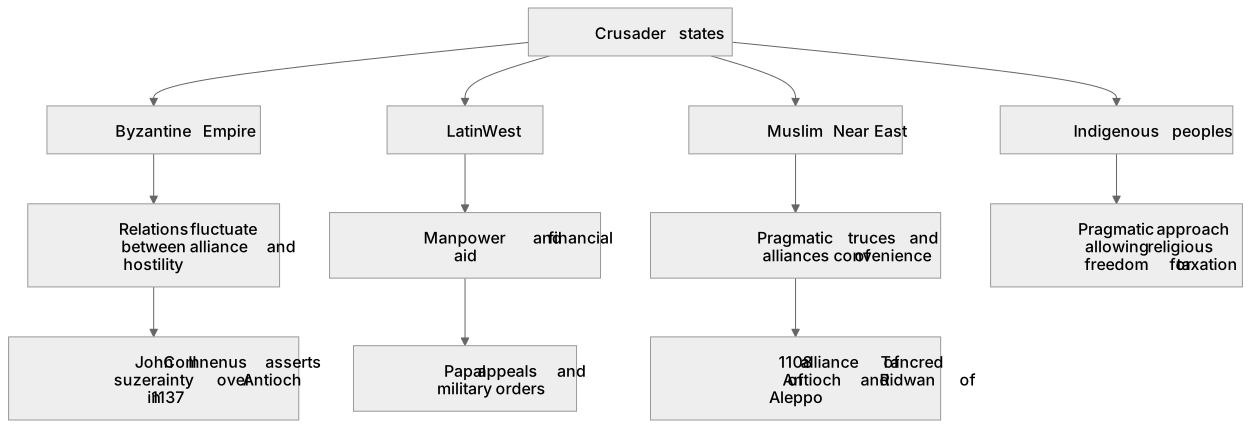
Label the diagram
Some boxes have lost their names. Pick the right name for each number.
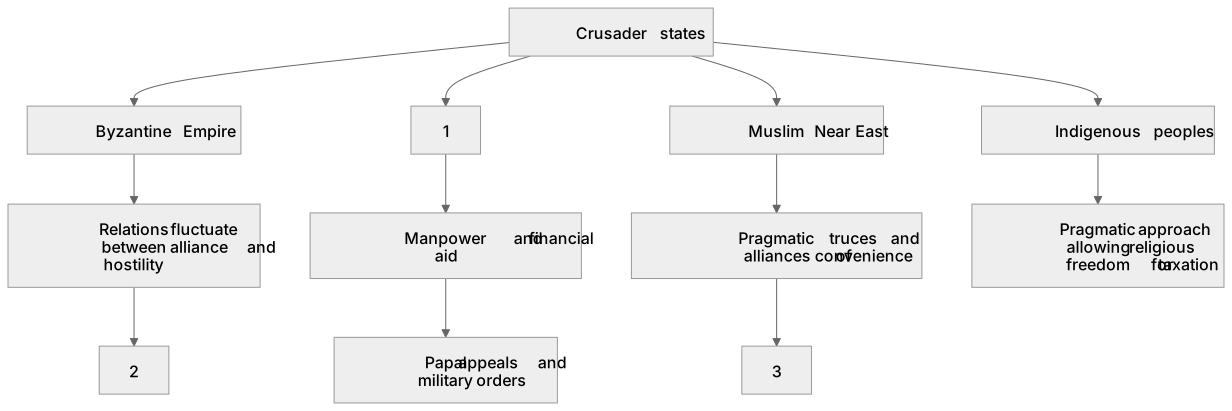
1Box 1
2Box 2
3Box 3
There is more to this lesson
The full lesson goes on to check your understanding and help you earn the marks. Create a free account to carry on, with your progress saved.
A week of Premium from your first lesson · Then the free plan continues · No card, no charge
Test your understanding of 1A The Age of the Crusades, c1071–1204 – The foundation of new states and the Second Crusade, c1099–1149: Relations of the Crusader states with the Byzantine Empire, the Latin West, the Muslim Near East and indigenous peoples
Active recall beats re-reading. Take an instant quiz now to test what you’ve learned and lock it into long-term memory.
A week of Premium from your first lesson · Then the free plan continues · No card, no charge