AQA · A-Level · History
Course version: 7042 · Version from Sept 2017
The context of Islamic power in the Near East from 1149; the rise of…
Full specification wording
1A The Age of the Crusades, c1071–1204 – The Muslim Counter-Crusade and Crusader states, 1149–1187 (A-level only): The context of Islamic power in the Near East from 1149; the rise of Nureddin in Syria and Egypt and the growth of jihad
Following the Second Crusade's failure in 1149, the Islamic Near East experienced a profound shift towards unification under Nureddin.
Checked against the AQA 7042 specification (opens in a new tab) on .
- Point 1 of 6
- 4 key terms
Study notes
From the checked teaching notes for this specification point.
The idea
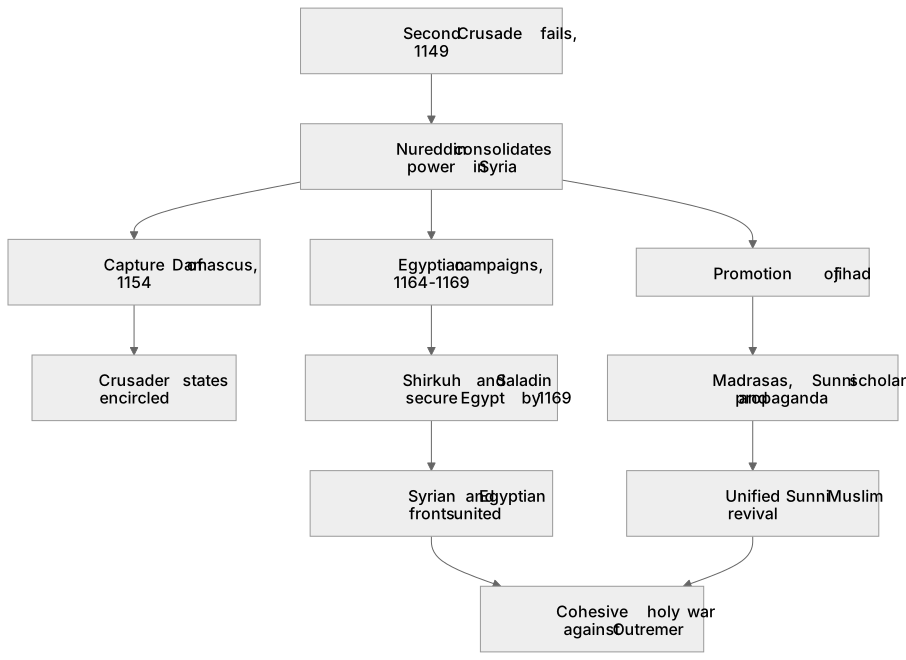
Following the Second Crusade's failure in 1149, the Islamic Near East experienced a profound shift towards unification under Nureddin. Initially consolidating power in Syria by capturing Damascus in 1154, Nureddin effectively encircled the Crusader states. He subsequently expanded his influence into Fatimid Egypt, dispatching Shirkuh and Saladin to secure the region by 1169, thereby uniting the Syrian and Egyptian fronts. Central to his strategy was the ideological weapon of jihad. Nureddin actively sponsored religious institutions, scholars, and propaganda to cultivate a unified Sunni Muslim revival. This growth of jihad transformed the conflict from fragmented territorial disputes into a cohesive holy war, fundamentally altering the balance of power against Outremer.
What earns the marks
- Explain the significance of Nureddin's capture of Damascus in 1154 for the political and military unification of Syria.
- Analyse the strategic importance of the Egyptian campaigns (1164-1169) in encircling the Crusader states and securing vast financial resources.
- Evaluate the methods used by Nureddin to promote jihad, such as building madrasas, patronising Sunni scholars, and commissioning the Minbar of the Aqsa Mosque.
- Assess the transition of Islamic power from fragmented, competing emirates to a unified front capable of systematically challenging Outremer.
Common mistakes and how to put them right
Assuming Saladin initiated the unification of Syria and Egypt.
Put it right by emphasising that Nureddin laid the crucial groundwork and initiated the Egyptian campaigns.
Treating jihad solely as a military concept.
Put it right by explaining its spiritual and political dimensions, including Nureddin's patronage of Sunni religious institutions and propaganda.
Confusing the timeline of Egyptian conquest.
Put it right by noting that Shirkuh and Saladin secured Egypt on Nureddin's behalf before Saladin eventually asserted his own independence.
Exam tips
- Use the capture of Damascus (1154) as a key turning point when evaluating the threat posed by a unified Syria to the Crusader states.
- Link the ideological growth of jihad directly to military successes, showing how religious fervour aided recruitment, morale, and political cohesion.
- When discussing Islamic power, explicitly contrast the unified front under Nureddin with the fragmented Muslim response encountered during the First Crusade.
Try the lesson
The start of the 1A The Age of the Crusades, c1071–1204 – The Muslim Counter-Crusade and Crusader states, 1149–1187 (A-level only): The context of Islamic power in the Near East from 1149; the rise of Nureddin in Syria and Egypt and the growth of jihad lesson, made from checked teaching notes for this specification point.
Have a go first
Which city's capture in 1154 was a crucial milestone in Nureddin's efforts to unify Muslim Syria under his control?
Listen
Following the Second Crusade's failure in 1149, the Islamic Near East experienced a profound shift towards unification under Nureddin. Initially consolidating power in Syria by capturing Damascus in 1154, Nureddin effectively encircled the Crusader states. He subsequently expanded his influence into Fatimid Egypt, dispatching Shirkuh and Saladin to secure the region by 1169, thereby uniting the Syrian and Egyptian fronts. Central to his strategy was the ideological weapon of jihad. Nureddin actively sponsored religious institutions, scholars, and propaganda to cultivate a unified Sunni Muslim revival. This growth of jihad transformed the conflict from fragmented territorial disputes into a cohesive holy war, fundamentally altering the balance of power against Outremer. A strong answer earns marks for these points. Explain the significance of Nureddin's capture of Damascus in 1154 for the political and military unification of Syria. Analyse the strategic importance of the Egyptian campaigns (1164-1169) in encircling the Crusader states and securing vast financial resources. Evaluate the methods used by Nureddin to promote jihad, such as building madrasas, patronising Sunni scholars, and commissioning the Minbar of the Aqsa Mosque. Assess the transition of Islamic power from fragmented, competing emirates to a unified front capable of systematically challenging Outremer. A common slip: Assuming Saladin initiated the unification of Syria and Egypt. Instead, emphasising that Nureddin laid the crucial groundwork and initiated the Egyptian campaigns. Exam tip: Use the capture of Damascus (1154) as a key turning point when evaluating the threat posed by a unified Syria to the Crusader states.
See it
Put the events in order
Put these events in the order they happened, earliest first.
- 1. Shirkuh and Saladin secure Egypt for Nureddin
- 2. The Second Crusade fails in the Near East
- 3. Nureddin's Egyptian campaigns begin
- 4. Nureddin captures Damascus
Key words
Say what each word means before you turn the card.
Religious ideology and jihad
Try answering aloud or in your head before turning the card.
Political unification and leadership
Try answering aloud or in your head before turning the card.
Strategic encirclement
Try answering aloud or in your head before turning the card.
Sunni revivalism
Try answering aloud or in your head before turning the card.
See every definition
- Religious ideology and jihad
- The ideological weapon central to Nureddin's strategy, promoted through religious institutions, scholars and propaganda to cultivate a unified Sunni Muslim revival.
- Political unification and leadership
- The profound shift towards unification under Nureddin, consolidating power in Syria and expanding influence into Fatimid Egypt to unite the Syrian and Egyptian fronts.
- Strategic encirclement
- Nureddin's effective encircling of the Crusader states after consolidating power in Syria by capturing Damascus in 1154.
- Sunni revivalism
- A unified Sunni Muslim revival cultivated through Nureddin's sponsorship of religious institutions, scholars and propaganda.
Label the diagram
Some boxes have lost their names. Pick the right name for each number.
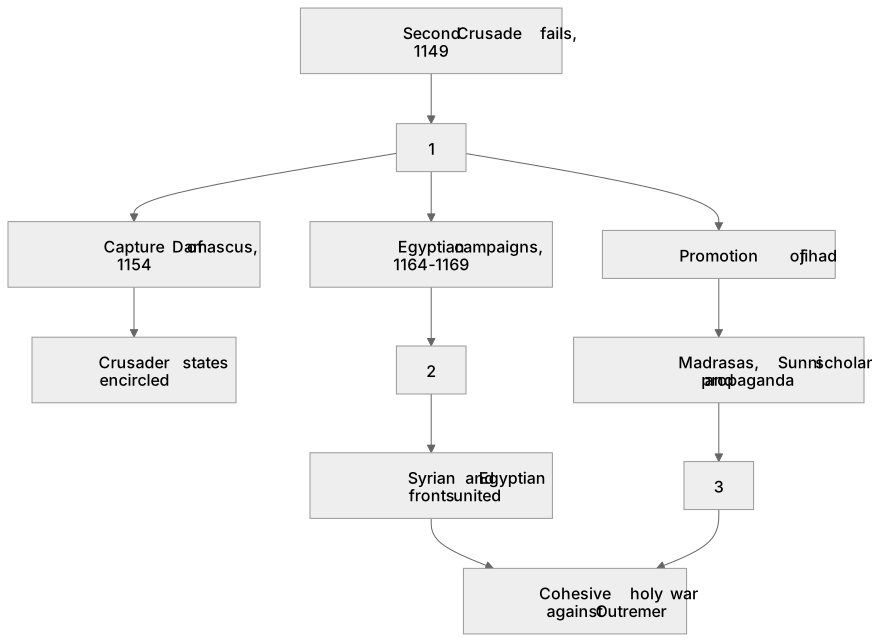
1Box 1
2Box 2
3Box 3
There is more to this lesson
The full lesson goes on to check your understanding and help you earn the marks. Create a free account to carry on, with your progress saved.
A week of Premium from your first lesson · Then the free plan continues · No card, no charge
Test your understanding of 1A The Age of the Crusades, c1071–1204 – The Muslim Counter-Crusade and Crusader states, 1149–1187 (A-level only): The context of Islamic power in the Near East from 1149; the rise of Nureddin in Syria and Egypt and the growth of jihad
Active recall beats re-reading. Take an instant quiz now to test what you’ve learned and lock it into long-term memory.
A week of Premium from your first lesson · Then the free plan continues · No card, no charge