AQA · A-Level · History
Course version: 7042 · Version from Sept 2017
Christianity in western Europe c1071; the role of the Church in the late…
Full specification wording
1A The Age of the Crusades, c1071–1204 – The origins of conflict and the First Crusade, c1071–c1099: Christianity in western Europe c1071; the role of the Church in the late 11th century; the rising influence of the Papacy
In c1071, Christianity dominated western Europe, shaping both daily life and political structures.
Checked against the AQA 7042 specification (opens in a new tab) on .
- Point 1 of 6
- 4 key terms
Study notes
From the checked teaching notes for this specification point.
The idea
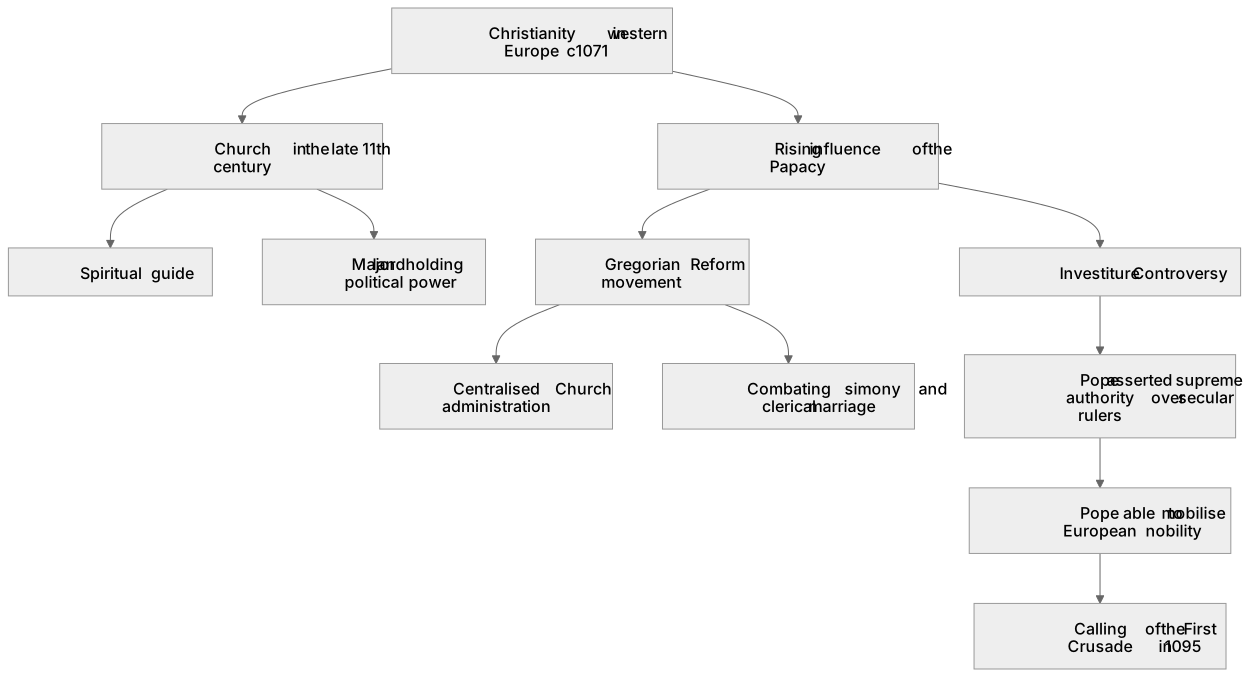
In c1071, Christianity dominated western Europe, shaping both daily life and political structures. The Church in the late 11th century played a central role, acting as the primary source of education, law, and spiritual salvation, while bishops often held significant feudal power. Concurrently, the Papacy experienced rising influence, driven by the Gregorian Reform movement. Popes like Gregory VII asserted supreme authority over secular rulers, famously clashing with Holy Roman Emperor Henry IV during the Investiture Controversy. This growing papal power centralised Church administration and established the ideological foundation for the Pope to mobilise European nobility, ultimately paving the way for the calling of the First Crusade in 1095.
What earns the marks
- Explain the pervasive nature of Christianity in c1071, highlighting its influence on the worldview and daily lives of the laity.
- Analyse the dual role of the Church in the late 11th century, functioning as both a spiritual guide and a major landholding political power.
- Evaluate the impact of the Gregorian Reforms in centralising papal authority and combating clerical abuses like simony and clerical marriage.
- Assess the significance of the Investiture Controversy in demonstrating the rising influence of the Papacy over secular monarchs.
Common mistakes and how to put them right
Assuming the Papacy had absolute control over all European monarchs in c1071.
Put it right: Recognise that papal authority was still being actively contested and consolidated during this period.
Treating the Church solely as a religious institution.
Put it right: Acknowledge the Church's extensive political, economic, and feudal roles in late 11th-century society.
Confusing the Eastern Orthodox Church with Western Christianity.
Put it right: Specify that the Papacy's rising influence primarily affected western Europe, distinct from the Byzantine religious sphere.
Exam tips
- Use the Investiture Controversy as a concrete example to demonstrate the rising political influence of the Papacy.
- Link the centralisation of papal power in the late 11th century directly to the Pope's ability to later call the First Crusade.
- When discussing the role of the Church, ensure you address both its spiritual hold over the peasantry and its political leverage over the nobility.
Try the lesson
The start of the 1A The Age of the Crusades, c1071–1204 – The origins of conflict and the First Crusade, c1071–c1099: Christianity in western Europe c1071; the role of the Church in the late 11th century; the rising influence of the Papacy lesson, made from checked teaching notes for this specification point.
Have a go first
In the western Church of the late 11th century, which office held supreme jurisdictional authority over the whole Latin Church?
Listen
In c1071, Christianity dominated western Europe, shaping both daily life and political structures. The Church in the late 11th century played a central role, acting as the primary source of education, law, and spiritual salvation, while bishops often held significant feudal power. Concurrently, the Papacy experienced rising influence, driven by the Gregorian Reform movement. Popes like Gregory VII asserted supreme authority over secular rulers, famously clashing with Holy Roman Emperor Henry IV during the Investiture Controversy. This growing papal power centralised Church administration and established the ideological foundation for the Pope to mobilise European nobility, ultimately paving the way for the calling of the First Crusade in 1095. A strong answer earns marks for these points. Explain the pervasive nature of Christianity in c1071, highlighting its influence on the worldview and daily lives of the laity. Analyse the dual role of the Church in the late 11th century, functioning as both a spiritual guide and a major landholding political power. Evaluate the impact of the Gregorian Reforms in centralising papal authority and combating clerical abuses like simony and clerical marriage. Assess the significance of the Investiture Controversy in demonstrating the rising influence of the Papacy over secular monarchs. A common slip: Assuming the Papacy had absolute control over all European monarchs in c1071. Instead, recognise that papal authority was still being actively contested and consolidated during this period. Exam tip: Use the Investiture Controversy as a concrete example to demonstrate the rising political influence of the Papacy.
See it
Key words
Say what each word means before you turn the card.
Religious authority versus secular power
Try answering aloud or in your head before turning the card.
Reform and centralisation
Try answering aloud or in your head before turning the card.
Social control and belief systems
Try answering aloud or in your head before turning the card.
The origins of holy war
Try answering aloud or in your head before turning the card.
See every definition
- Religious authority versus secular power
- Popes asserted supreme authority over secular rulers, clashing with the Holy Roman Emperor during the Investiture Controversy.
- Reform and centralisation
- The Gregorian Reform movement drove the rising influence of the Papacy, centralising Church administration and combating clerical abuses.
- Social control and belief systems
- Christianity dominated western Europe, shaping daily life and political structures, with the Church as the primary source of education, law and spiritual salvation.
- The origins of holy war
- Growing papal power established the ideological foundation for the Pope to mobilise European nobility, paving the way for the First Crusade.
Label the diagram
Some boxes have lost their names. Pick the right name for each number.
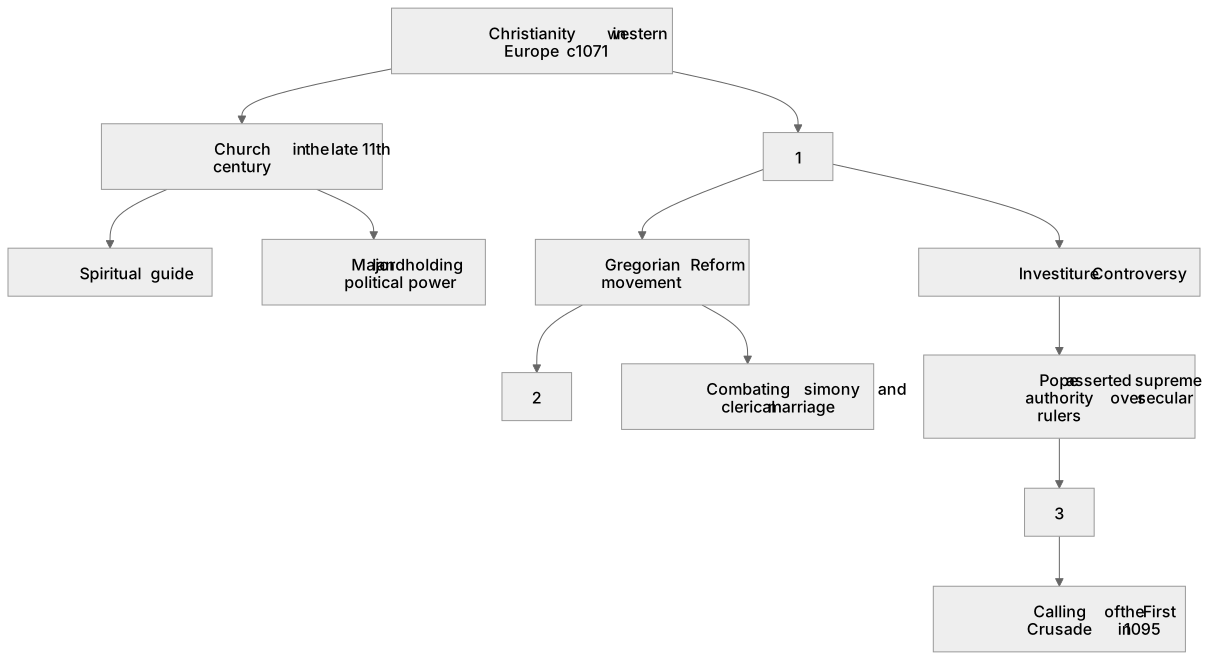
1Box 1
2Box 2
3Box 3
There is more to this lesson
The full lesson goes on to check your understanding and help you earn the marks. Create a free account to carry on, with your progress saved.
A week of Premium from your first lesson · Then the free plan continues · No card, no charge
Test your understanding of 1A The Age of the Crusades, c1071–1204 – The origins of conflict and the First Crusade, c1071–c1099: Christianity in western Europe c1071; the role of the Church in the late 11th century; the rising influence of the Papacy
Active recall beats re-reading. Take an instant quiz now to test what you’ve learned and lock it into long-term memory.
A week of Premium from your first lesson · Then the free plan continues · No card, no charge