AQA · A-Level · History
Course version: 7042 · Version from Sept 2017
Urban II: the reasons for the calling of the First Crusade; responding to…
Full specification wording
1A The Age of the Crusades, c1071–1204 – The origins of conflict and the First Crusade, c1071–c1099: Urban II: the reasons for the calling of the First Crusade; responding to the call for help from the Byzantine Empire; the political and religious motives of the Papacy
Pope Urban II called the First Crusade at the Council of Clermont in 1095, driven by a complex blend of motives.
Checked against the AQA 7042 specification (opens in a new tab) on .
- Point 4 of 6
- 4 key terms
Study notes
From the checked teaching notes for this specification point.
The idea
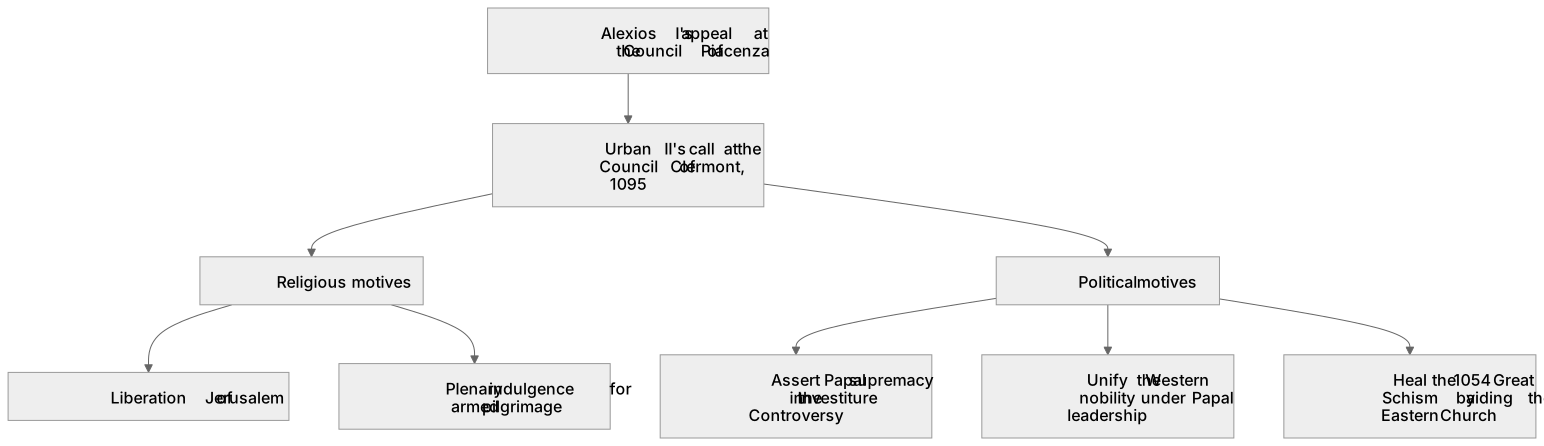
Pope Urban II called the First Crusade at the Council of Clermont in 1095, driven by a complex blend of motives. The immediate catalyst was responding to Emperor Alexios I's appeal at Piacenza for mercenaries to combat the Seljuk Turks. However, Urban transformed this into a grander religious and political project. Religiously, he sought to liberate Jerusalem, offering the revolutionary concept of a plenary indulgence to knights, thereby channelling their martial violence into a holy cause. Politically, Urban aimed to assert Papal supremacy during the Investiture Controversy, unify the fractured Western nobility under Papal leadership, and potentially heal the 1054 Great Schism by aiding the Eastern Church.
What earns the marks
- Explain the significance of Alexios I's appeal at the Council of Piacenza as the immediate trigger for Urban II's call to arms.
- Analyse Urban II's religious motives, particularly the liberation of the Holy Sepulchre and the introduction of the plenary indulgence for armed pilgrimage.
- Evaluate the political context of the Investiture Controversy, showing how the Crusade helped Urban II assert papal authority over secular monarchs.
- Assess the motive of healing the 1054 Great Schism by demonstrating Western military support for the Eastern Orthodox Church.
- Discuss the social motive of redirecting the violent energies of Western knights away from internal conflicts towards an external enemy.
Common mistakes and how to put them right
Stating that Alexios I asked Urban II to launch a crusade to capture Jerusalem.
Put it right: Clarify that Alexios only requested a small force of Western mercenaries to help reclaim Anatolia; Urban II expanded this into a crusade for Jerusalem.
Ignoring the political context of the Investiture Controversy.
Put it right: Link Urban's call to his need to demonstrate papal power and outmanoeuvre the Holy Roman Emperor.
Treating religious and political motives as mutually exclusive.
Put it right: Explain how religious zeal and political ambition were deeply intertwined in papal thinking during the eleventh century.
Exam tips
- Weigh the relative importance of the Byzantine appeal against Urban's own papal ambitions when discussing the origins of the Crusade.
- Use the concept of the 'Peace of God' movement to explain why Urban wanted to redirect knightly violence out of Europe.
- Avoid simplistic explanations; acknowledge that Urban's motives were a synthesis of genuine piety, strategic opportunism, and ecclesiastical politics.
Try the lesson
The start of the 1A The Age of the Crusades, c1071–1204 – The origins of conflict and the First Crusade, c1071–c1099: Urban II: the reasons for the calling of the First Crusade; responding to the call for help from the Byzantine Empire; the political and religious motives of the Papacy lesson, made from checked teaching notes for this specification point.
Have a go first
What was the immediate catalyst that prompted Pope Urban II to call for the First Crusade at the Council of Clermont in 1095?
Listen
Pope Urban II called the First Crusade at the Council of Clermont in 1095, driven by a complex blend of motives. The immediate catalyst was responding to Emperor Alexios I's appeal at Piacenza for mercenaries to combat the Seljuk Turks. However, Urban transformed this into a grander religious and political project. Religiously, he sought to liberate Jerusalem, offering the revolutionary concept of a plenary indulgence to knights, thereby channelling their martial violence into a holy cause. Politically, Urban aimed to assert Papal supremacy during the Investiture Controversy, unify the fractured Western nobility under Papal leadership, and potentially heal the 1054 Great Schism by aiding the Eastern Church. A strong answer earns marks for these points. Explain the significance of Alexios I's appeal at the Council of Piacenza as the immediate trigger for Urban II's call to arms. Analyse Urban II's religious motives, particularly the liberation of the Holy Sepulchre and the introduction of the plenary indulgence for armed pilgrimage. Evaluate the political context of the Investiture Controversy, showing how the Crusade helped Urban II assert papal authority over secular monarchs. Assess the motive of healing the 1054 Great Schism by demonstrating Western military support for the Eastern Orthodox Church. A common slip: Stating that Alexios I asked Urban II to launch a crusade to capture Jerusalem. Instead, Clarify that Alexios only requested a small force of Western mercenaries to help reclaim Anatolia; Urban II expanded this into a crusade for Jerusalem. Exam tip: Weigh the relative importance of the Byzantine appeal against Urban's own papal ambitions when discussing the origins of the Crusade.
See it
Key words
Say what each word means before you turn the card.
Papal authority and the Investiture Controversy
Try answering aloud or in your head before turning the card.
Religious zeal and the concept of holy war
Try answering aloud or in your head before turning the card.
East-West relations and the Great Schism
Try answering aloud or in your head before turning the card.
Knightly piety and the Peace of God
Try answering aloud or in your head before turning the card.
See every definition
- Papal authority and the Investiture Controversy
- Urban aimed to assert Papal supremacy during this controversy, demonstrating papal power and outmanoeuvring the Holy Roman Emperor.
- Religious zeal and the concept of holy war
- Urban sought to liberate Jerusalem, offering a plenary indulgence to knights and channelling their martial violence into a holy cause.
- East-West relations and the Great Schism
- Urban potentially sought to heal the 1054 Great Schism by aiding the Eastern Church through Western military support.
- Knightly piety and the Peace of God
- Urban wanted to redirect the violent energies of Western knights away from internal conflicts towards an external enemy.
Label the diagram
Some boxes have lost their names. Pick the right name for each number.
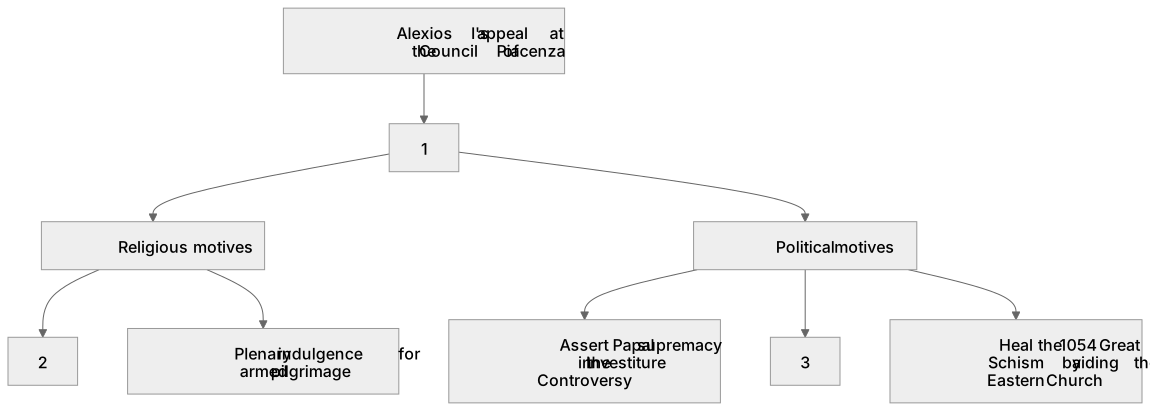
1Box 1
2Box 2
3Box 3
There is more to this lesson
The full lesson goes on to check your understanding and help you earn the marks. Create a free account to carry on, with your progress saved.
A week of Premium from your first lesson · Then the free plan continues · No card, no charge
Test your understanding of 1A The Age of the Crusades, c1071–1204 – The origins of conflict and the First Crusade, c1071–c1099: Urban II: the reasons for the calling of the First Crusade; responding to the call for help from the Byzantine Empire; the political and religious motives of the Papacy
Active recall beats re-reading. Take an instant quiz now to test what you’ve learned and lock it into long-term memory.
A week of Premium from your first lesson · Then the free plan continues · No card, no charge