AQA · A-Level · History
Course version: 7042 · Version from Sept 2017
The course of the Fourth Crusade: military preparations; the diversion to…
Full specification wording
1A The Age of the Crusades, c1071–1204 – The Third and Fourth Crusades, 1187–1204 (A-level only): The course of the Fourth Crusade: military preparations; the diversion to Zara; the failure to make any impact on Muslim power
The Fourth Crusade's military preparations were fatally flawed by the Treaty of Venice (1201).
Checked against the AQA 7042 specification (opens in a new tab) on .
- Point 5 of 6
Study notes
From the checked teaching notes for this specification point.
The idea
The Fourth Crusade's military preparations were fatally flawed by the Treaty of Venice (1201). Envoys contracted a fleet for 33,500 men, but only around 12,000 arrived, leaving the crusaders unable to pay the 85,000 silver marks owed to the Venetians. To settle this debt, Doge Enrico Dandolo proposed a diversion to Zara, a Christian city in Dalmatia, which the crusaders besieged in 1202 despite papal prohibition. This diversion set a precedent for prioritising political and financial needs over religious goals. Consequently, the crusade failed to make any impact on Muslim power; the army never reached its intended target of Egypt or the Holy Land, instead diverting again to sack Constantinople in 1204, entirely abandoning the fight against Islam.
What earns the marks
- Explain the terms and consequences of the Treaty of Venice, specifically the financial shortfall caused by low crusader turnout.
- Analyse the role of Doge Enrico Dandolo and Venetian commercial interests in redirecting the crusade.
- Evaluate the significance of the siege of Zara (1202) as the first major diversion and its resulting papal excommunication.
- Assess the ultimate failure of the crusade to engage Muslim forces, noting the abandonment of the planned Egyptian campaign.
Common mistakes and how to put them right
Claiming the original target of the Fourth Crusade was Constantinople.
Put it right: The original secret target was Egypt, to attack the Ayyubid power base before moving to Jerusalem.
Stating the Pope supported the attack on Zara.
Put it right: Pope Innocent III explicitly forbade the attack on the Christian city of Zara and excommunicated the crusaders when they proceeded.
Assuming the crusaders fought Muslim armies during this campaign.
Put it right: The Fourth Crusade never engaged Muslim forces, fighting only fellow Christians at Zara and Constantinople.
Exam tips
- Link the failure of military preparations directly to the subsequent diversions, showing how financial debt drove strategic decisions.
- Use the Treaty of Venice as a concrete example of how logistical planning undermined the religious objectives of the crusade.
- When evaluating the crusade's failure against Muslim power, contrast the outcome with Pope Innocent III's original intentions.
Try the lesson
The start of the 1A The Age of the Crusades, c1071–1204 – The Third and Fourth Crusades, 1187–1204 (A-level only): The course of the Fourth Crusade: military preparations; the diversion to Zara; the failure to make any impact on Muslim power lesson, made from checked teaching notes for this specification point.
Have a go first
Which agreement formed the basis of the military preparations for the Fourth Crusade by securing transport for the crusader army?
Listen
The Fourth Crusade's military preparations were fatally flawed by the Treaty of Venice (1201). Envoys contracted a fleet for 33,500 men, but only around 12,000 arrived, leaving the crusaders unable to pay the 85,000 silver marks owed to the Venetians. To settle this debt, Doge Enrico Dandolo proposed a diversion to Zara, a Christian city in Dalmatia, which the crusaders besieged in 1202 despite papal prohibition. This diversion set a precedent for prioritising political and financial needs over religious goals. Consequently, the crusade failed to make any impact on Muslim power; the army never reached its intended target of Egypt or the Holy Land, instead diverting again to sack Constantinople in 1204, entirely abandoning the fight against Islam. A strong answer earns marks for these points. Explain the terms and consequences of the Treaty of Venice, specifically the financial shortfall caused by low crusader turnout. Analyse the role of Doge Enrico Dandolo and Venetian commercial interests in redirecting the crusade. Evaluate the significance of the siege of Zara (1202) as the first major diversion and its resulting papal excommunication. Assess the ultimate failure of the crusade to engage Muslim forces, noting the abandonment of the planned Egyptian campaign. A common slip: Claiming the original target of the Fourth Crusade was Constantinople. Instead, The original secret target was Egypt, to attack the Ayyubid power base before moving to Jerusalem. Exam tip: Link the failure of military preparations directly to the subsequent diversions, showing how financial debt drove strategic decisions.
See it
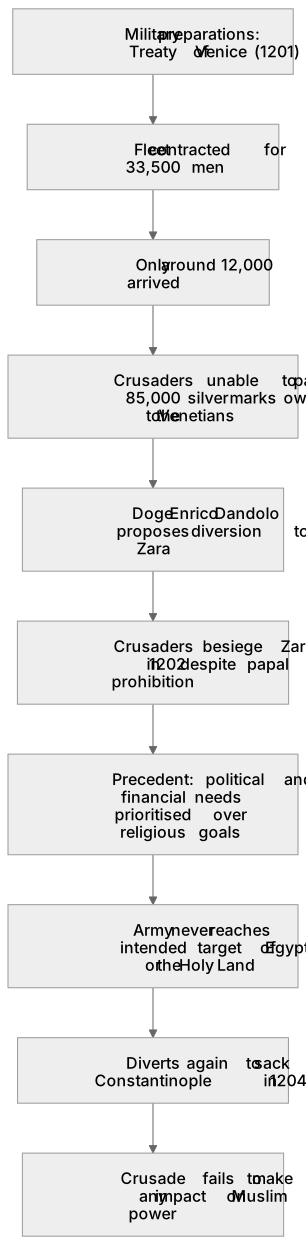
Put the events in order
Put these events in the order they happened, earliest first.
- 1. Treaty of Venice contracted a fleet for the crusade
- 2. Crusaders sacked Constantinople, abandoning the fight against Islam
- 3. Crusaders besieged Zara despite papal prohibition
Label the diagram
Some boxes have lost their names. Pick the right name for each number.
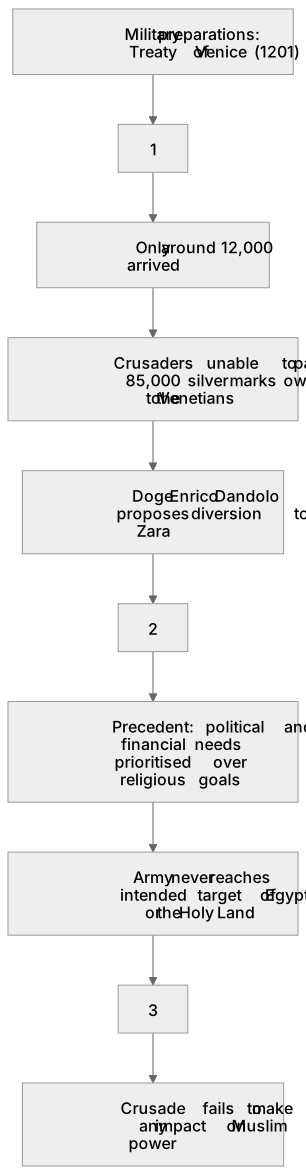
1Box 1
2Box 2
3Box 3
There is more to this lesson
The full lesson goes on to check your understanding and help you earn the marks. Create a free account to carry on, with your progress saved.
A week of Premium from your first lesson · Then the free plan continues · No card, no charge
Test your understanding of 1A The Age of the Crusades, c1071–1204 – The Third and Fourth Crusades, 1187–1204 (A-level only): The course of the Fourth Crusade: military preparations; the diversion to Zara; the failure to make any impact on Muslim power
Active recall beats re-reading. Take an instant quiz now to test what you’ve learned and lock it into long-term memory.
A week of Premium from your first lesson · Then the free plan continues · No card, no charge