Pearson Edexcel · A-Level · History
Course version: 9HI0 · Version from Sept 2015
Urbanisation and affluence: the changing nature of cities; expansion of…
Full specification wording
Affluence and conformity, 1955–63: Urbanisation and affluence: the changing nature of cities; expansion of the suburbs; highway development; growing ownership and use of cars; white collar jobs and service industries; consumerism and domestic technology.
Post-war affluence reshaped American space and work.
Checked against the Pearson Edexcel 9HI0 specification (opens in a new tab) on .
- Point 1 of 4
- 4 key terms
Study notes
From the checked teaching notes for this specification point.
The idea
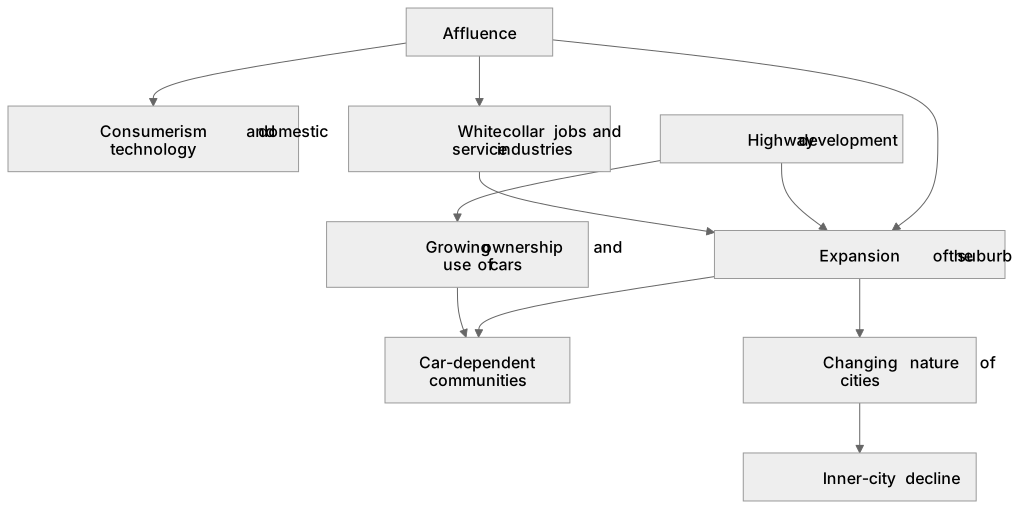
Post-war affluence reshaped American space and work. Cities changed as downtowns declined and populations decentralised; suburbs expanded rapidly, exemplified by Levittown, creating car-dependent communities. Highway development, notably the 1956 Interstate Highway Act, accelerated this by linking suburbs to cities and enabling long-distance travel. Car ownership soared, with 60 million vehicles by 1960, transforming daily life and leisure. Employment shifted from manufacturing to white-collar and service industries, while consumerism and domestic technology—televisions, refrigerators, washing machines—became markers of status. These changes were uneven: not all shared in prosperity, and urban decay persisted.
What earns the marks
- Explains how urbanisation and affluence changed the nature of cities, including suburbanisation, inner-city decline, and the growth of car-dependent metropolitan areas.
- Analyses the expansion of the suburbs, using examples such as Levittown, and links it to federal policies, economic prosperity, and social conformity.
- Assesses the role of highway development, especially the 1956 Interstate Highway Act, in reshaping travel, commerce, and residential patterns.
- Evaluates the growing ownership and use of cars, including the rise of the two-car family, and its effects on leisure, shopping, and urban planning.
- Examines the shift to white-collar jobs and service industries, and how this altered the occupational structure and gender roles.
- Discusses consumerism and domestic technology, such as television and household appliances, as expressions of affluence and conformity.
Common mistakes and how to put them right
Treating suburbanisation as solely a natural outcome of individual choice.
Put it right: Recognise the role of federal policies, such as mortgage guarantees and highway funding, in enabling and shaping suburban growth.
Assuming that affluence was universal.
Put it right: Acknowledge persistent poverty, racial segregation, and regional disparities that limited access to the new prosperity.
Overlooking the environmental and social costs of highway development.
Put it right: Consider the displacement of communities, increased pollution, and the decline of public transport.
Exam tips
- Use specific data, such as the 1956 Interstate Highway Act or the number of cars by 1960, to support arguments about scale and impact.
- Connect economic changes to social outcomes, for example linking white-collar jobs to suburban commuting patterns.
- When discussing consumerism, distinguish between different groups and regions to show nuanced understanding.
Try the lesson
The start of the Affluence and conformity, 1955–63: Urbanisation and affluence: the changing nature of cities; expansion of the suburbs; highway development; growing ownership and use of cars; white collar jobs and service industries; consumerism and domestic technology. lesson, made from checked teaching notes for this specification point.
Have a go first
Which development in the United States during the 1950s most directly facilitated the rapid expansion of the suburbs?
Listen
Post-war affluence reshaped American space and work. Cities changed as downtowns declined and populations decentralised; suburbs expanded rapidly, exemplified by Levittown, creating car-dependent communities. Highway development, notably the 1956 Interstate Highway Act, accelerated this by linking suburbs to cities and enabling long-distance travel. Car ownership soared, with 60 million vehicles by 1960, transforming daily life and leisure. Employment shifted from manufacturing to white-collar and service industries, while consumerism and domestic technology—televisions, refrigerators, washing machines—became markers of status. These changes were uneven: not all shared in prosperity, and urban decay persisted. A strong answer earns marks for these points. Explains how urbanisation and affluence changed the nature of cities, including suburbanisation, inner-city decline, and the growth of car-dependent metropolitan areas. Analyses the expansion of the suburbs, using examples such as Levittown, and links it to federal policies, economic prosperity, and social conformity. Assesses the role of highway development, especially the 1956 Interstate Highway Act, in reshaping travel, commerce, and residential patterns. Evaluates the growing ownership and use of cars, including the rise of the two-car family, and its effects on leisure, shopping, and urban planning. A common slip: Treating suburbanisation as solely a natural outcome of individual choice. Instead, Recognise the role of federal policies, such as mortgage guarantees and highway funding, in enabling and shaping suburban growth. Exam tip: Use specific data, such as the 1956 Interstate Highway Act or the number of cars by 1960, to support arguments about scale and impact.
See it
Key words
Say what each word means before you turn the card.
Suburbs
Try answering aloud or in your head before turning the card.
Highway development
Try answering aloud or in your head before turning the card.
White-collar jobs
Try answering aloud or in your head before turning the card.
Consumerism
Try answering aloud or in your head before turning the card.
See every definition
- Suburbs
- Residential areas outside cities that expanded rapidly, exemplified by Levittown, creating car-dependent communities.
- Highway development
- Road building, notably the 1956 Interstate Highway Act, that linked suburbs to cities and enabled long-distance travel.
- White-collar jobs
- Employment that shifted away from manufacturing alongside service industries as part of the changing occupational structure.
- Consumerism
- The culture in which domestic technology such as televisions, refrigerators and washing machines became markers of status.
Label the diagram
Some boxes have lost their names. Pick the right name for each number.
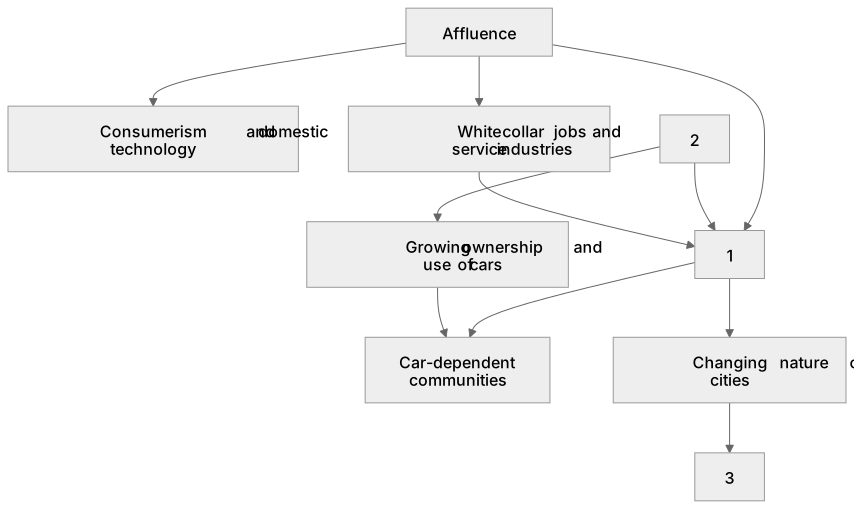
1Box 1
2Box 2
3Box 3
There is more to this lesson
The full lesson goes on to check your understanding and help you earn the marks. Create a free account to carry on, with your progress saved.
A week of Premium from your first lesson · Then the free plan continues · No card, no charge
Test your understanding of Affluence and conformity, 1955–63: Urbanisation and affluence: the changing nature of cities; expansion of the suburbs; highway development; growing ownership and use of cars; white collar jobs and service industries; consumerism and domestic technology.
Active recall beats re-reading. Take an instant quiz now to test what you’ve learned and lock it into long-term memory.
A week of Premium from your first lesson · Then the free plan continues · No card, no charge