Pearson Edexcel · A-Level · History
Course version: 9HI0 · Version from Sept 2015
The Second Five-Year Plan (the Great Leap Forward), 1958– 62: Mao’s…
Full specification wording
Agriculture and industry, 1949–65: The Second Five-Year Plan (the Great Leap Forward), 1958– 62: Mao’s reasons for launching it; state-owned enterprises; the successes and failures of the second Plan. The Lushan Conference 1959. Liu, Deng and economic reform, 1962–65.
The Second Five-Year Plan, known as the Great Leap Forward (1958–62), aimed to accelerate industrial and agricultural output through mass mobilisation and communes.
Checked against the Pearson Edexcel 9HI0 specification (opens in a new tab) on .
- Point 4 of 4
- 3 key terms
Study notes
From the checked teaching notes for this specification point.
The idea
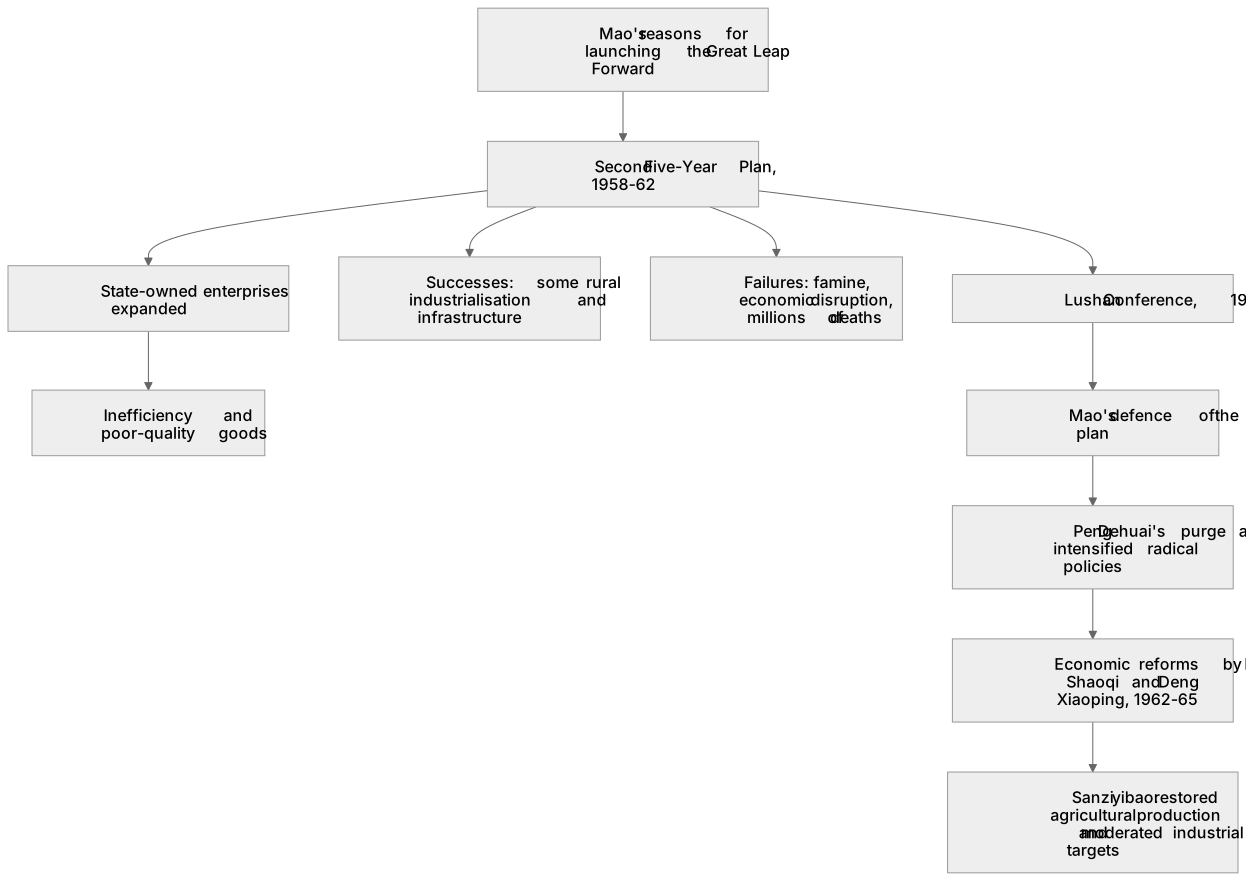
The Second Five-Year Plan, known as the Great Leap Forward (1958–62), aimed to accelerate industrial and agricultural output through mass mobilisation and communes. Mao launched it to surpass Britain and the USA economically, to prove the superiority of Chinese socialism over the Soviet model, and to decentralise industry. State-owned enterprises expanded, but many were inefficient and produced poor-quality goods. Successes included some rural industrialisation and infrastructure, but failures were severe: famine, economic disruption and millions of deaths. The Lushan Conference (1959) initially reviewed the plan; Mao’s defence of it led to Peng Dehuai’s purge and intensified radical policies. After 1962, Liu Shaoqi and Deng Xiaoping introduced economic reforms, including sanzi yibao (three freedoms, one guarantee), which restored agricultural production and moderated industrial targets.
What earns the marks
- Explains Mao’s reasons for launching the Great Leap Forward: economic catch-up, ideological competition with the USSR, and mass mobilisation for rapid growth.
- Describes the role of state-owned enterprises in the Second Five-Year Plan, including their expansion and the problems of inefficiency and poor quality.
- Evaluates the successes and failures of the plan, such as some rural industrial growth versus famine, economic disruption and human cost.
- Analyses the significance of the Lushan Conference 1959, including Mao’s defence of the plan and the political consequences for critics like Peng Dehuai.
- Explains the economic reforms led by Liu Shaoqi and Deng Xiaoping from 1962 to 1965, including sanzi yibao and their impact on recovery.
Common mistakes and how to put them right
Treating the Great Leap Forward as only an industrial campaign.
Put it right by recognising its combined agricultural and industrial aims and the commune system.
Assuming the Lushan Conference resolved the plan’s problems.
Put it right by noting it reinforced Mao’s line and led to purges of critics.
Confusing the post-1962 reforms with a complete abandonment of socialism.
Put it right by explaining they were pragmatic adjustments within the planned economy.
Exam tips
- Use specific evidence of targets, outcomes and policies to support your arguments about the Great Leap Forward.
- Link the Lushan Conference to the political and economic developments of 1959–62.
- Compare the approaches of Mao and the reformist leaders Liu and Deng to show change and continuity.
Try the lesson
The start of the Agriculture and industry, 1949–65: The Second Five-Year Plan (the Great Leap Forward), 1958– 62: Mao’s reasons for launching it; state-owned enterprises; the successes and failures of the second Plan. The Lushan Conference 1959. Liu, Deng and economic reform, 1962–65. lesson, made from checked teaching notes for this specification point.
Have a go first
Which of the following was a primary reason why Mao Zedong launched the Second Five-Year Plan (the Great Leap Forward) in 1958?
Listen
The Second Five-Year Plan, known as the Great Leap Forward (1958–62), aimed to accelerate industrial and agricultural output through mass mobilisation and communes. Mao launched it to surpass Britain and the USA economically, to prove the superiority of Chinese socialism over the Soviet model, and to decentralise industry. State-owned enterprises expanded, but many were inefficient and produced poor-quality goods. Successes included some rural industrialisation and infrastructure, but failures were severe: famine, economic disruption and millions of deaths. The Lushan Conference (1959) initially reviewed the plan; Mao’s defence of it led to Peng Dehuai’s purge and intensified radical policies. After 1962, Liu Shaoqi and Deng Xiaoping introduced economic reforms, including sanzi yibao (three freedoms, one guarantee), which restored agricultural production and moderated industrial targets. A strong answer earns marks for these points. Explains Mao’s reasons for launching the Great Leap Forward: economic catch-up, ideological competition with the USSR, and mass mobilisation for rapid growth. Describes the role of state-owned enterprises in the Second Five-Year Plan, including their expansion and the problems of inefficiency and poor quality. Evaluates the successes and failures of the plan, such as some rural industrial growth versus famine, economic disruption and human cost. Analyses the significance of the Lushan Conference 1959, including Mao’s defence of the plan and the political consequences for critics like Peng Dehuai. A common slip: Treating the Great Leap Forward as only an industrial campaign. Instead, recognising its combined agricultural and industrial aims and the commune system. Exam tip: Use specific evidence of targets, outcomes and policies to support your arguments about the Great Leap Forward.
See it
Put the events in order
Put these events in the order they happened, earliest first.
- 1. Mao launches the Great Leap Forward
- 2. Liu Shaoqi and Deng Xiaoping introduce economic reforms
- 3. The Lushan Conference takes place
Key words
Say what each word means before you turn the card.
Ideological rivalry and the Soviet model
Try answering aloud or in your head before turning the card.
Famine and economic crisis
Try answering aloud or in your head before turning the card.
Political purges and pragmatic reform
Try answering aloud or in your head before turning the card.
See every definition
- Ideological rivalry and the Soviet model
- Mao launched the plan to prove the superiority of Chinese socialism over the Soviet model.
- Famine and economic crisis
- The failures of the plan were severe and included famine, economic disruption and millions of deaths.
- Political purges and pragmatic reform
- At the Lushan Conference Mao's defence of the plan led to Peng Dehuai's purge, and after 1962 Liu Shaoqi and Deng Xiaoping introduced economic reforms.
Label the diagram
Some boxes have lost their names. Pick the right name for each number.
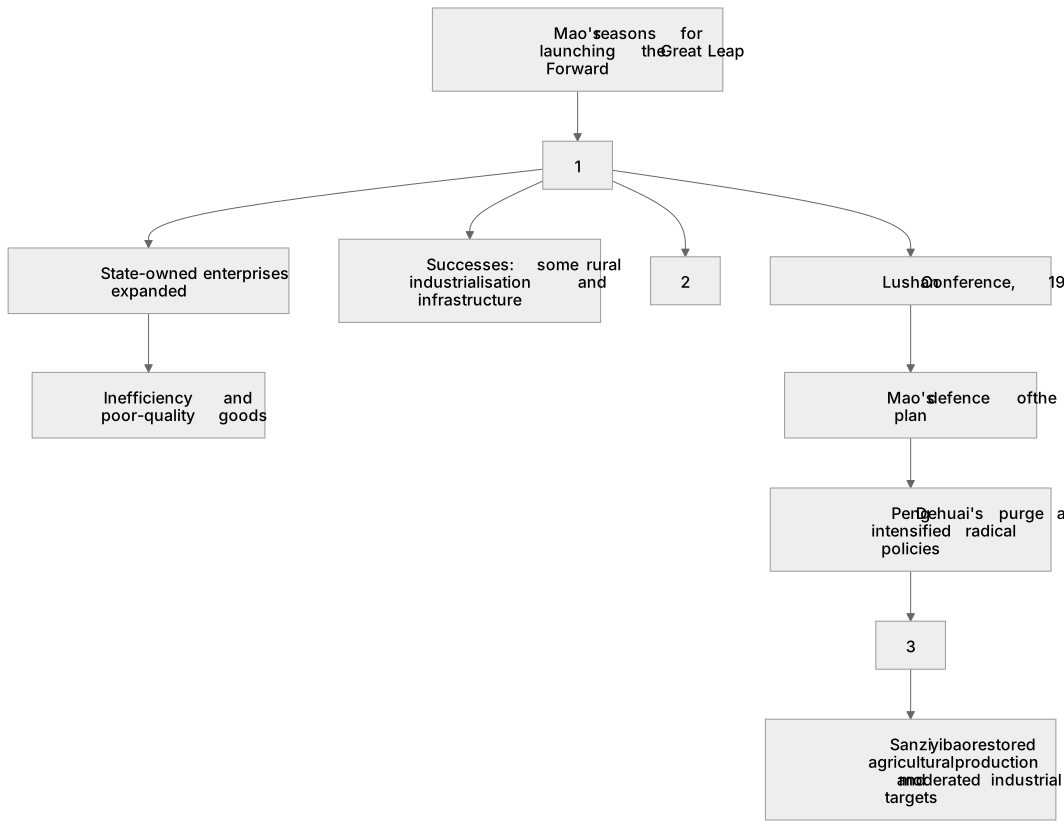
1Box 1
2Box 2
3Box 3
There is more to this lesson
The full lesson goes on to check your understanding and help you earn the marks. Create a free account to carry on, with your progress saved.
A week of Premium from your first lesson · Then the free plan continues · No card, no charge
Test your understanding of Agriculture and industry, 1949–65: The Second Five-Year Plan (the Great Leap Forward), 1958– 62: Mao’s reasons for launching it; state-owned enterprises; the successes and failures of the second Plan. The Lushan Conference 1959. Liu, Deng and economic reform, 1962–65.
Active recall beats re-reading. Take an instant quiz now to test what you’ve learned and lock it into long-term memory.
A week of Premium from your first lesson · Then the free plan continues · No card, no charge